




IntelliPaper
Abstract
As the world energy market was still getting used to OPEC+'s production restrictions and the fallout from Russia's invasion of Ukraine, geopolitical tensions in the Middle East continued to escalate, causing unease since October 7,2023. Palestinian political and military organisation Hamas attacked Israel on 7 October, reigniting years of conflict between Palestine and Israel. Israel has been violently responding to Hamas by bombing the Palestinian Gaza region for over a month now, and the growing casualty toll has kept the commodities market in a state of unease. As a result, on dramatically changing geopolitical situation in the region also illustrated that how last decade Arabian countries playing important role with relationship gigantic states. Qatar one of states that immediately reacted to this humanitarian crises. Official Doha are threatening to create a global gas shortage as part of their support for Palestine. “If the bombing of Gaza does not stop, we will cut off the gas supply to the world,” said Emir Tamim bin Hamad Al Thani.
Explore Digital Article Text
Conversely, important Arab nations have recently made investments in creating regional security arrangements. These states, if they can agree on a strategy, have a greater desire and capacity to lead regional diplomacy due to long-term trends.
First, two vital neighbors of Israel and Palestine, Egypt and Jordan, are potentially powerful investors in such an approach. Geostrategically and politically, for the Egyptian and Jordanian governments, the Gaza war poses massive national security threats linked to the dangers of a Palestinian mass displacement, in addition to the troubling specter of long-term violence in Gaza, the West Bank, and East Jerusalem. Second, Saudi Arabia is a potential participant. Saudi Arabia is not a direct neighbor of the Palestinians and does not have diplomatic ties with Israel, in contrast to Egypt and Jordan. However, Saudi diplomacy, in an effort to get the kingdom out of a proxy war in Yemen and regional escalation at large, has reoriented its course to conflict resolution and stabilization steps in the Middle East. Saudi leaders endorsed a Chinese mediation initiative to restore diplomatic relations with Iran and, prior to the Gaza war, engaged officials of U.S. President Joe Biden's administration in talks tailored toward normalizing relations between Saudi Arabia and Israel. Long term violence and ongoing confrontations between Israel and the Palestinians, along with their wider ramifications in the Middle East, pose fundamental threats to Saudi Arabia's interest in regional security and stability.
A final set of participants include not only the Arab countries that signed the Abraham Accords with Israel and normalized relations—the United Arab Emirates, Bahrain, and Morocco—but also Qatar, which has maintained collaborative relations with Israel as well as with all Palestinian actors, including the Palestinian Authority and Hamas . The web of diplomatic relations and collaboration schemes these countries have developed with Israel and Palestine in recent years can be instrumental in facilitating regional peace efforts.
Main Arab actors today are not waiting to be courted: they are deeply interested in a secure regional order, more capable of acting (not merely reacting) diplomatically and engaging with both Israelis and Palestinians.
In the past, Arab states have been parties to the conflict. They have been deeply divided and each had their own interests, making diplomacy difficult and often centered around merely getting parties to the table. When they arrived, all attention was on courting them to make concessions and grant recognition; each grudging step in that direction was hard-won. Key Arab players nowadays are not waiting to be courted; rather, they are better capable of acting diplomatically and interacting with both Israelis and Palestinians than simply waiting for the phone to ring. They are also sincerely interested in a stable regional order. Once the talk of American policy talks, key Arab states now prioritize regional stability. Undoubtedly, none of those states could act by themselves, and they're not accustomed to working together.
Based on several regional and international causes, the Palestinian issue was gradually deprioritized. Leading up to the current war in Gaza, the political environment left little room for a political solution.
But it was not only Israel's disinvestment from two-state diplomacy that drove the Palestinian issue downward in importance. On the
Palestinian side, ongoing disputes between the PA in Ramallah and militant movements led by Hamas's government in Gaza meant there would be no unified voice if a negotiation table was ever set. Arab-mediated reconciliation efforts between the PA and Hamas—both Egyptian- and Qatari-led—bore no fruit. Israeli policy became based on cementing the division and decay, not overcoming it. Hamas's radical rhetoric and willingness to engage in frequent rounds of hostilities with Israel increased the PA's impotence and irrelevance, both for successive Israeli governments that were preoccupied with security and for the Palestinian public that moved between radicalization and disenchantment.
Indeed, the destructive decline of Palestinian national institutions was greatly aided by regional circumstances. Regionally, although Egypt and Jordan kept up their diplomatic efforts to revive peace talks between Israel and the PA based on the two-state solution, some Arab states (like Algeria) confined their roles to fiery rhetoric and minor reconciliation talks between Palestinian factions. Others, such as Syria and Libya, paid little attention to the Israeli Palestinian conflict altogether due to internal turmoil. And some countries engaged in normalization efforts with Israel that offered no political end to the conflict, such as Bahrain, Morocco, and the United Arab Emirates.
Key European countries traditionally engaged in the Middle East, such as France, Germany, Great Britain, and Italy, confined their policies on Palestine to economic aid packages for the West Bank and humanitarian aid for Gaza. Preoccupied with domestic tensions due to the rise of right-wing populism and intra-European fiscal and political conflicts, European governments reduced their engagement in the Middle East to key strategic interests, trade, migration, and security. The West's disinterest in resolving the Israeli-Palestinian problem has grown as a result of the worldwide crises brought on by the coronavirus pandemic and Russia's invasion of Ukraine.
Given the circumstances in the region and around the world, as well as the internal politics of all the major players, the gradual decline of diplomacy may make sense. However, inertia has once again shown to have an extremely high cost. There have been unexpected outbursts of global diplomacy in response to previous explosions; these experiences offer both good and bad lessons for any current endeavor. In fact, it might be obvious on BBVA research on Geopolitics of the Middle East and pontetial spillovers on picture No1.
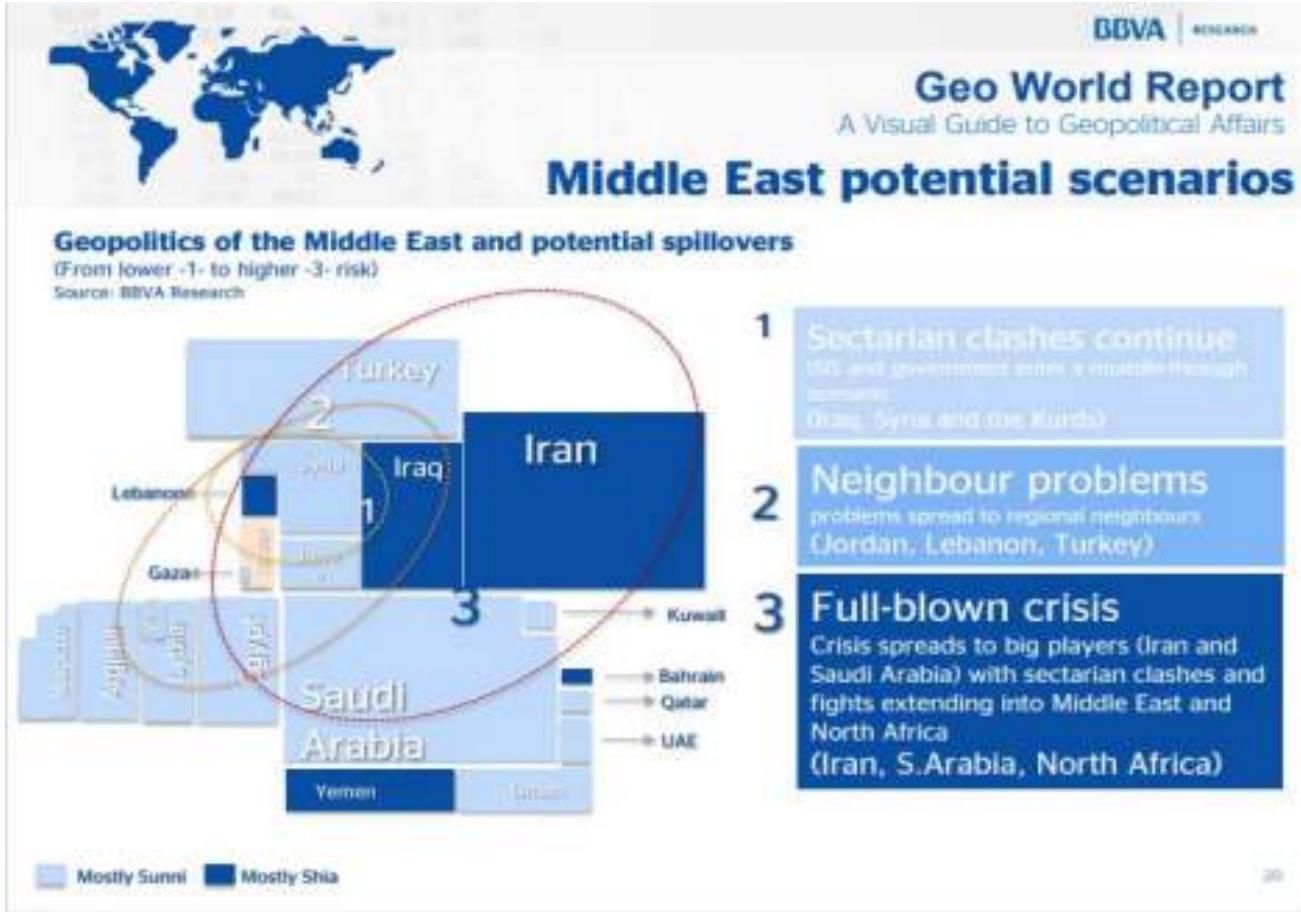
The BBVA Research Geo World Report A Visual Guide to Geopolitical Affairs - Middle East potential scenarios.P-20 On November 11, 2023 leaders of the Islamic, Arab and oil-producing worlds gathered in the capital of Saudi Arabia. This meeting became historic from any point of view.
First, the events were initially planned to be divided into two days: on November 11, 2023 a meeting of the heads of the League of Arab States (LAS) was to take place, and the next day, the cool conference halls of Riyadh were to receive numerous delegates from the Organization of Islamic Cooperation (OIC). The main issue on the agenda, of course, was the situation in the Gaza
Strip, and since this very situation for the Palestinians is extremely desperate and difficult, it was decided to combine both events.
Here you need to understand that the League includes 22 Arabic-speaking countries, chaired by a representative of Egypt, and the
Organization of Islamic Cooperation under its wing unites as many as 57 participating countries (the structure is headed by a functionary from the Muslim-African Chad).
Secondly, representatives of Israel, although they were absent from Riyadh, can rightfully count a resounding victory to their credit. For the simple reason that all the fiery and emotional speeches demanding that all earthly and heavenly punishments be brought down on the heads of the Jews ended in an enchanting fuss, although some players tried to persuade brothers in faith to take decisive action.
For example, Iranian President Ibrahim Raisi proposed a theoretically feasible mechanism, implying the severance of any political and economic ties with Israel and the introduction of broad sanctions. Algeria's initiatives were more radical and obviously unfeasible. In addition to traditional calls to stop any relations with Tel Aviv, representatives of the African continent intended to demand that the United States not establish new military bases in the Middle East and not provide any practical assistance to Israel. The requirement for Washington is obviously impossible to fulfill, and therefore, as a motivating stick, key representatives of the Arab oil-producing world had to introduce an embargo on the sale of hydrocarbons to Israel in particular and the West in general.
And at this point the main scandal and embarrassment occurred.
Eleven representatives of the League voted for the proposed scenario, but Saudi Arabia, the UAE, Bahrain and Morocco were categorically against it, and flatly refused to curtail trade in oil, which is directly or indirectly supplied in the interests of Israel.
In fact, all the emotional steam from the summit was blown away. Neither religious appeals nor appeals for the unity of peoples of Arab origin helped.
Influence of Sea corridor to the region
Crude oil prices declined on 25 December, 2023 during thin Christmas trade amid questions about unity among OPEC+ producers and concerns on Red Sea trading routes due to attacks from the Yemeni Houthi rebel group.
Any ship flying the Israeli flag would be targeted, according to the Houthi organization, which responded to Israel's attacks on the blockaded Gaza Strip.
Since the Suez Canal is used by about 12% of all trade, the Red Sea is one of the most significant trading routes in the world. Following a security breach, a number of multinational corporations, including the Mediterranean Shipping Company (MSC), owned by Italy and Switzerland, Maersk, based in Denmark, Hapag-Lloyd, a German shipper, and CMA CGM, based in France, halted all of their operations in the Red Sea. Following the declaration by the British energy company bp that it would cease all tanker activity in the Red Sea, there were worries expressed that seaborn deliveries, which have primarily hampered the transfer of commodities up to this point, would soon extend to the shipping of energy . Experts say the prolonged inability of the Suez to operate may pose economic threats for regional countries such as Egypt, whose economy is already fragile.
What happened to oil prices during previous conflicts involving Israel and Palestinians?
The 1973 oil crisis, which followed the October War and saw Egypt and Syria launch a surprise attack on Israel to retake territory, has come to mind in light of the recent surge in oil prices.
In response to US support for Israel during the 1973 conflict, Arab oil producing countries cut oil production and placed embargoes on the US and some of its allies, causing oil prices to quadruple over the following months. The situation today, however, is very different from back then.
Many in OPEC came to the conclusion that the 1973 embargo was a grave error as a result of the decades-long animosity cultivated by the major oil-consuming countries.
6. https://www.aa.com.tr/en/economy/oil-prices-start-week-with-thin-trade-due-to-christmasholiday-break/3091709
-
The Abraham Accords Declaration - https://www.state.gov/the-abraham-accords/ https://www.aljazeera.com/news/2023/11/7/i slamophobia-anti-semitism-rises-in-europe-a mid israel-hamas-war-official
-
The BBVA Research Geo World Report A Visual Guide to Geopolitical Affairs - Middle East potential scenarios.P-20
9. https://www.aljazeera.com/news/2023/11/7/i
slamophobia-anti-semitism-rises-in-europe-a
mid israel-hamas-war-official
10. https://www.reuters.com/world/middle-east/palestinian-rocket-fire-israeli-air-strikes-gaza-2021-05-11/
11. Doha Agreement 2012 English
12. https://carnegieendowment.org/specialprojects/breakingtheisraelpalestinestatusquo 16. https://www.yenisafak.com/gundem/bu-savasi-abd-yonetiyor-4573406
Palestine-Israel Conflict: the Influence of Arab Countries on the Oil Policy and Geopolitics of the Middle East
Author α: Student of Journalism and Mass Communication University of Uzbekistan.
σ: Doctor of Philosophy, Political Science, Journalism and Mass Communications University of Uzbekistan
Natural resources have had an essential role in international relations and its importance has changed throughout the centuries.
Conflict of Interest
The authors declare no conflict of interest.
Ethical Approval
Not applicable
Data Availability
The datasets used in this study are openly available at [repository link] and the source code is available on GitHub at [GitHub link].
Funding
This work did not receive any external funding.
References
Cite this article
Related Research



Special Issue
Launch a focused special issue to highlight research, emerging trends, and expert insights in your academic field.
