


IntelliPaper
Abstract
This work presents a thought experiment where the number of cellular duplications or generations (G) is used as a biological clock to investigate the effects of relativistic environments on biological time. We demonstrate that, although physical clocks in different reference systems measure varying times due to relativistic time dilation, biological time remains invariant and corresponds to the ‘proper’ time. This invariance holds not only across inertial reference frames but also extends to non-inertial, accelerated, and gravitational reference systems. The invariance arises because G is defined as the ratio of the growth time to the duplication time, ensuring that any relativistic effects influencing these time intervals cancel out.
These findings challenge the classic interpretation of Einstein's twin paradox, which suggests differential ageing due to relativistic velocities. In reality, while physical clocks indicate differing times, biological time, and thus the biological age of living organisms, remains unaffected, aligning consistently with the proper time. Although bacterial cultures were used as a model in this study, the results are generalisable to all cellular systems, provided identical growth conditions are maintained. This study provides new insights into the interplay between biological processes and relativistic effects, establishing G as a reliable and invariant measure of biological time across all reference frames
Explore Digital Article Text
I. INTRODUCTION
In special relativity, 'proper' time refers to the time interval measured by a clock moving alongside an object, effectively at rest relative to the events being timed. This measurement remains invariant across all inertial reference frames. According to relativity, time appears to slow down for objects moving at relativistic speeds, a phenomenon experimentally confirmed for subatomic particles such as muons. When muons are produced in the upper atmosphere by cosmic ray interactions, they travel toward the Earth's surface at speeds approaching that of light. Due to their short half-life, one would expect that very few of them would reach the Earth's surface. However, observations indicate a significant number of muons reaching sea level, a result explained by relativistic time dilation affecting muons travelling at relativistic velocities.
The proper time of the muons, measured in their rest frame, remains constant. However, in the Earth's rest frame, the time is dilated due to their high speed. In atmospheric muons, this effect allows them to travel greater distances before they decay, as shown by Rossi and Hall (1941). Similarly, in a controlled synchrotron environment, time dilation significantly extends the apparent lifetime of muons, as demonstrated by Bailey et al. (1977). More recently, Botermann et al. (2014) have confirmed relativistic time dilation in lithium-ion beams, providing further evidence for this fundamental prediction of Einstein's theory.
Whereas relativity has had a significant impact on many areas of physics and technology, there remains a notable gap in the scientific literature regarding both experimental and theoretical studies on biological clocks about relativistic effects. Recent studies, such as Maestrini et al. (2018) and Ajdžanović, V.Z. et al. (2023), have examined ageing through concepts loosely inspired by relativity, such as notions of time dilation and contraction. However, these models do not involve systems at relativistic speeds or accelerations in the physical sense . Instead, they focus on biological ageing rates affected by pathological conditions like cancer and chronic inflammation. In this context, 'acceleration' is used metaphorically, referring to biological factors speeding cellular deterioration. Such processes compress what can be seen as 'biological time', leading to faster ageing but without any connection to actual relativistic velocities or physical accelerations.
In this study, we use bacterial growth as a 'biological clock' to demonstrate that biological time, represented by the number of bacterial generations , is invariant across all inertial frames. Thus, G is a biological timekeeper independent of relativistic time dilation.
To further explain why G better represents biological aging, consider a simple example: two cultures of the same bacterial species, grown under different experimental conditions such that one has an average doubling time of 1 hour, while the other has an average doubling time of 0.5 hours. After 2 hours of growth, both have experienced the same elapsed physical time. However, in biological terms, the first culture has , while the second has . This means that the second culture, in the same 2-hour growth period, has biologically aged more than the first. Although simplistic, this example clearly indicates why G is a better measure of biological aging: it reflects the generational progression, which directly correlates with the biological processes underlying aging.
This study proposes a thought experiment with two identical bacterial cultures: one situated on Earth (System T) and the other onboard a spacecraft moving at relativistic speed v relative to Earth (System A). All culture conditions, such as temperature, nutrient medium composition, and oxygenation, are kept the same in both systems. This setup allows us to isolate the effects of proper time on biological growth, helping to validate the invariance of G as a measure of biological time across inertial systems.
The twin paradox describes a scenario where one twin remains on Earth while the other travels at relativistic speed and later returns. According to special relativity, each twin observes the other's clock running slower due to time dilation. This symmetry creates a paradox: each twin observes the other aging more slowly relative to themselves.
The resolution of the paradox is that the travelling twin undergoes phases of acceleration and deceleration during their journey, which disrupt the symmetry of the situation. These phases involve transitions between inertial reference frames, distinguishing the travelling twin from the one who remains on Earth. As a result, the travelling twin experiences less elapsed time throughout of the journey, consistent with the predictions of relativity.
In this study, we intentionally exclude the acceleration and deceleration phases of the travelling twin's journey to focus exclusively on inertial systems. This approach allows us to analyse the effects of relativistic time dilation on biological processes in a simplified context, isolating its impact within purely inertial frames.
The anticipated result of this thought experiment is that biological time, as measured by the number of bacterial generations , remains invariant in both reference frames despite the relativistic effects observed in physical clocks. Moreover, this invariance is not limited to inertial reference frames; it also applies to non-inertial systems, including those that are uniformly accelerated or within gravitational fields. This invariance occurs because biological time is represented by G, which is defined as the ratio of the growth time to the duplication time. Any relativistic effects, mathematically represented by the relativistic gamma factor, influence these two time intervals equally and cancel each other out. This ensures that G remains invariant across all reference frames (see Chapter 3.2).
Therefore, in the famous twin paradox (Einstein, 1905), while the times measured by physical clock on Earth and on the spacecraft differ, the biological ages of the two twins remain the same.
II. RESULTS
In biological formulas, used to describe population growth or similar processes, such as the logistic equation, it is typically unnecessary to distinguish between proper time and relative time, as these formulas generally refer to a stationary reference frame (commonly the "laboratory" frame or, more broadly, the "Earth" frame). However, in this study, we address relativistic effects. Therefore, throughout the manuscript, we will explicitly specify whether we are referring to "proper time" or "relative time" whenever such distinctions are relevant.
2.1 Invariance of Bacterial Duplication Number Across Inertial Reference Frames
The number of bacterial duplications or generations G is invariant across all inertial reference frames, as it is measured relative to the proper time of the respective system. Thus, the number of duplications G is a consistent measure of biological time progression independent of the reference frame. In other words, if we determine the number of duplications under specific and same culture conditions on Earth or on spacecraft travelling at a relativistic velocity v, we will use a clock synchronized with the system in which the study is conducted (either on Earth or aboard the spacecraft), which will measure the proper time. Consequently, the number of duplications will be identical in both systems, provided that growth conditions are the same. This means that the bacterial duplication number is 'invariant' with respect to any inertial reference frame. Such invariance highlights the consistency of biological processes across different contexts. From this follows that biological time, represented by the number of generations G, does not depend on the relativistic effects experienced by physical measuring instruments, as we will demonstrate later.
The following section details the experimental setup and calculations designed to test the invariance of G across inertial frames.
2.2 Description of the Thought Experiment and Calculations
In special relativity, proper time (measured within the reference system) and relative time t (measured by an observer external to the moving system) are related by the formula:
Where t represents the relative time measured by an observer moving at velocity v relative to the object, is the proper time experienced by the object, c is the speed of light in vacuum and is described in the section named "Abbreviations and Glossary".
The thought experiment is designed as follows:
System T (on Earth): A bacterial culture grows with a doubling or generation time equal to hours of proper time.
System A (on a spacecraft moving at speed v relative to Earth): An identical Earth bacterial culture grows at the same doubling rate , measured with respect to the spacecraft's proper time. To ensure identical conditions in both experiments, the spacecraft laboratory simulates an acceleration equivalent to Earth's gravity (1g), eliminating potential variations in bacterial growth due to differing gravitational forces. This setup controls for both the relativistic and the biochemical effects of gravity on bacterial growth.
Furthermore, to avoid growth differences due to acceleration as the spacecraft reaches velocity v:
The experiment starts once the spacecraft reaches a constant velocity .
It is conducted entirely at this constant relativistic speed (v).
The experiment duration, denoted as the growth period , is identical in both systems and measured as proper time within each system. At the end of this growth period , the cultures are frozen to preserve the bacterial count and prevent further division. This allows for a direct comparison based solely on each system's proper time.
2.2.1 System on Earth as Observed from the Spacecraft's Reference Frame (System A)
For an observer on the spacecraft, the proper time on Earth becomes:
Where is the relative growth time measured with respect to the spacecraft reference frame, and represents the proper time duration of the experiment, which is the same for both systems.
From the spacecraft perspective, the relativistic doubling time of the bacterial culture on Earth is as follows:
Where is the relative duplication time measured with respect to the spacecraft reference frame, and denotes the proper time in which the bacteria double in number, which is also equal for both systems.
Over a period observed on Earth, the number of bacterial generations is given by:
Consequently, an observer on the spacecraft will see that the bacteria on Earth double exactly times.
2.2.2 System on the spacecraft as seen from Earth (System T)
For the observer on Earth, the proper time in the spacecraft corresponds to the following:
From the terrestrial perspective, the relative doubling time of the bacterial culture in the spacecraft becomes:
During this relative time, the number of bacterial generations is given by:
Thus, the observer on Earth finds that the bacterial generation number is , identical to that of the culture on the spacecraft (see Eq. 4).
In fact:
This result is highly significant, demonstrating that the bacterial generation number G, under identical culture conditions, remains invariant across all inertial reference frames. Consequently, G is a reliable measure of biological time, consistently corresponding to the proper time of the reference system, regardless of the time dilation observed between different systems.
2.2.3 Freezing and Final Result Using an Exponential or Logistic Growth Model
At the end of the growth period in each system, the cultures are frozen to prevent further bacterial divisions and preserve the final count. Assuming an exponential growth model, the final number of bacteria is given by:
Where is the initial number of bacteria.
The final count remains identical in both systems, as the observed number of doublings are invariant with respect to the proper time. Freezing preserves this count, enabling an accurate comparison between the two systems without the influence of the spacecraft's deceleration. The identical count confirms that the biological time elapsed for the two cultures is the same, as indicated by G, which serves as the true measure of biological time.
Even when employing a different growth model, such as a more realistic logistic model, the final count remains identical in both systems, as well as the general equation for G remaining unchanged (see Appendix A).
We derive below the logistic growth equation in a relativistic context, showing that the final bacterial count remains invariant across inertial reference frames. Starting with the general logistic equation, we introduce relativistic modifications to the growth rate r and the elapsed time t, highlighting their relationship to the relativistic factor .
The logistic growth equation describing population dynamics in environments with limited resources was proposed by Verhulst. It is the following:
Where is the initial population size, is the population size at time t, K represents the carrying capacity of the environment (maximum sustainable population), r indicates the growth rate measured in units of and t, the elapsed time, corresponds to .
This equation captures the balance between exponential growth during the early phase and the eventual stabilisation of the population as it approaches the carrying capacity K. In a relativistic framework, both the elapsed time t and the growth rate r are affected by time dilation, which varies depending on the relative velocity between the observer and the growing system. The proper growth , measured in the inertial frame of the bacteria, appears dilated to an external observer, and can be expressed as below (see also Eq.5):
Since r is defined as the inverse of time (see legend of Eq.10) it must also be treated in relativistic terms, therefore we have:
Where is the growth rate r measured in the inertial frame at rest relative to the growing population, and indicates .
Substituting these relativistic forms of t (Eq.11) and r (Eq.12) into the logistic growth equation above, we obtain:
Simplifying further, the relativistic factors cancel out, leaving:
Equation 13 clearly demonstrates that, under identical environmental and cultivation conditions, the final bacterial count depends only on the proper growth parameters and , which are measured in the inertial frame of the population. Therefore, the final bacterial count is invariant across frames. This result highlights that, even in relativistic contexts, the population size at the end of the growth period remains the same for all observers, reinforcing the conclusion that, even in more realistic growth models such as the logistic model, biological time remains unaffected by time dilation, and therefore, the two cultures age by the same amount.
Clearly, any bacterial or cellular culture undergoing logistic growth can be considered a biological clock only during its exponential phase. This is because, in the terminal growth phase, bacteria essentially cease to replicate. Consequently, G, the number of generations in this phase, tends to zero as the proper doubling time ( ) approaches infinity. Specifically:
2.3 Numerical Examples Using Exponential Growth Model
Consider an example with 1,000 initial bacteria for both cultures, a proper growth time of 2 hours, a mean doubling time of equal to 0.5 hours, and a spacecraft travelling at a velocity of 0.9c. Using the formula for relativistic time dilation, both the growth time and duplication time are found to be dilated relative to the other reference frame.
2.3.1 Numerical Example Exponential Model: System on the Spacecraft as Seen from Earth (System T)
For an observer on Earth, the proper growth time hours on the spacecraft appears dilated by an amount calculable using Eq.5:
Using Eq.6, we can determine the doubling time of the culture on the spacecraft as observed from Earth:
During this growth period (4.588 hours, Eq.14), and based on the generation number calculated using Eq.15 (1.147 hours), we can determine how many times the bacteria on the spacecraft double:
Thus, the observer on Earth observes that the bacteria on the spacecraft double four times during the course of the experiment.
2.3.2. Numerical Example: System on Earth as Seen from the Spacecraft (System A)
Below, we repeat the same calculations as before, but from the perspective of the spacecraft.
For an observer on the spacecraft, the proper growth time hours on Earth can be calculated using Equation 2:
Using Eq.3, we can determine the doubling time of the culture on Earth as observed from the spacecraft:
Thus, the observer in the spacecraft sees that the bacteria on Earth double exactly in:
Thus, the bacteria on the spacecraft double precisely 4 times, identical to the doubling observed in the Earth culture.
The final bacterial count in each system is then calculated using Eq.9, based on the identical result from Eq.16 and Eq.19, confirming four doublings.
Consequently, both the total bacterial count and the bacterial generation number G remain the same in the two inertial reference frames considered. This indicates that, unlike relative time, the elapsed biological time measured by G remains unchanged across both systems. In other words, the two cultures have 'aged' by the same amount.
Based on the numerical example, here is a table showing the data for proper and relative times in the two systems (Earth and spacecraft) for bacterial growth rates.
| System | Proper Growth Time (τgrowth) | Relative Growth Time (tgrowth) | Proper Doubling Time (τ) | Relative Doubling Time (t) | Generations Number (G) | Final Number of Bacteria |
| Spacecraft (v = 0.9c) | 2 hours | 4.588 hours | 0.5 hours | 1.147 hours | 4 | 16,000 |
| Earth | 2 hours | 4.588 hours | 0.5 hours | 1.147 hours | 4 | 16,000 |
2.4 Numerical Example Using Logistic Growth Model
As demonstrated earlier, the equation describing the logistic growth model results invariant across all inertial reference frames. This invariance ensures that the final bacterial count is the same for any observer, regardless of their frame of reference.
In this section, we provide a numerical example to calculate the number of bacteria resulting after 2 hours of proper growth time. The calculation is performed using the previously derived logistic equation (Eq.13). For this example, we will use the following parameters:
Carrying capacity:
Initial population:
Proper growth rate: hours
Proper growth time: hours From which we have:
Based on these values, we calculate that in every reference frame considered, the final number of bacteria is approximately 16,199. In fact:
This value is practically the same as that obtained with the exponential model, indicating that in both cases, using the parameters above, the bacteria are in the exponential growth phase.
III. DISCUSSION
This thought experiment shows that, although physical clocks in different inertial systems measure different times due to relativistic time dilation, biological time, indicated by the bacterial generation number G, remains invariant and corresponds to the 'proper' time. The bacterial generation number G is identical in the two inertial frames considered here and remains constant across any other inertial frame.
In this study, we used bacteria. However, the same results would be obtained using any other microorganism or eukaryotic cells in culture, as long as the growth conditions are the same in both inertial systems.
The bacterial culture, through the number of generations G, represents a true "biological clock" that is invariant and capable of measuring biological aging. As previously illustrated, we have already presented an example demonstrating this principle. Here, we propose a similar example, but with different numerical values, to reinforce the fundamental idea that G serves as a universal biological measure of aging. Let us consider, for example, two bacterial cultures, A and B, of the same species but grown under different conditions. In culture A, the bacteria have a mean duplication time of 0.5 hours, while in culture B, the mean duplication time is 1 hour. Both cultures are allowed to grow for a total of 10 hours, measured by a physical clock.
Calculating the number of generations G for each culture, we obtain:
For culture A: generations.
For culture B: generations.
Although 10 hours of physical clock time have passed for both cultures, culture A is biologically twice as "old" as culture B since it has undergone twice the number of generations.
This example clearly highlights that biological time, as measured by the biological clock G, is not directly correlated to the time measured by physical clocks and is, in fact, what quantifies biological aging. For these reasons, the same principle can be applied to more complex organisms, such as humans. In conclusion, while physical clocks are subject to relativistic time dilation, biological aging, as measured by the biological clock G, remains invariant for all living organisms, including the most complex ones, such as humans, confirming its universal nature and independence from the chosen reference frame.
Another fundamental measure of biological aging in eukaryotic cells, including higher organisms, is telomere shortening, which occurs with each cell division and is widely recognized as a marker of physiological aging, the natural aging process independent of pathological conditions (Oeseburg et al., 2010; Vaiserman, A., & Krasnienkov, D., 2021).
Since telomere length is directly linked to the number of cell divisions, it follows that telomere shortening is inherently proportional to the number of generations G. This further confirms that it is not just an abstract measure but a fundamental biological clock that tracks the passage of biological time.
If G remains invariant across reference frames, then telomere shortening, being directly dependent on G, must also be invariant. This strengthens the argument that biological time, as measured by G, progresses independently of relativistic time dilation. Given that telomere shortening is a well-established marker of aging in eukaryotic cells, this relationship reinforces the validity of using G as a universal measure of biological time.
This result revisits the classic interpretation of Einstein's twin paradox, which posits that the twin travelling at relativistic speeds ages more slowly compared to the twin who remains on Earth, as indicated by physical clocks. In reality, both twins would have the same biological ageing at the end of their journeys despite the differing times displayed by the physical clocks in the two systems. Thus, biological time aligns with the proper time of each system and remains unaffected by the relativistic time dilation impacting physical measuring devices.
3.1 Deriving the Time Dilation Equation in a Centrifuge with Radius "r" and Acceleration "a"
In this chapter, we derive the equation for the time dilation experienced by an object in a rotating system, specifically within an ultracentrifuge. The premise for this derivation is that, according to the equivalence principle of general relativity, an acceleration causes time dilation that is the same as that produced by an equivalent gravitational field (Misner, Thorne, & Wheeler, 1973, Chapter 16). Therefore, a time dilation effect should manifest due to the strong centripetal accelerations generated during the operation of these ultracentrifuges. For the following derivation, we will use Newtonian gravitational formulas, as they are more than sufficient for our analysis.
We start with the equation for time dilation in a gravitational field:
Where t is the time measured by an observer far from the mass, is the proper time measured in proximity to the mass, K is the universal gravitational constant, M is the mass of the body generating the gravitational field, r is the distance from the centre of the mass, and c is the speed of light in a vacuum.
According to the equivalence principle, a gravitational field is equivalent to a uniformly accelerated system. In other words, a uniformly accelerating system replicates the effects of a gravitational field. Therefore, we can transform the term into terms of acceleration.
Newton's law of universal gravitation states that the gravitational force between two objects of masses M and m, separated by a distance r, is given by the following equation:
According to Newton's second law, the force can also be expressed as:
where a is acceleration.
Equating the two previous expressions (Eq.22 and 23) for force F, we obtain:
By eliminating m from both sides, we find the acceleration a:
Substituting of eq.25 into equation 21 allows us to rewrite the gravitational time dilation t in terms of acceleration, obtaining:
From Eq.26, we determine the time dilation factor due to centripetal acceleration over a distance r.
If , there is no time dilation, and time flows the same way in both systems.
If , it means that for an external observer, time appears 'dilated' or flows more slowly in the accelerated system.
While the thought experiment previously described demonstrates, at least theoretically, the invariance of biological time in inertial systems, it is also essential to explore how biological processes might behave in relativistic accelerated or gravitational systems.
Studies indicate that microorganisms exposed to accelerations of thousands of g experience significant biological alterations in growth compared to cultures maintained under non-accelerated conditions. Notably, a study has examined the resilience of prokaryotic life under extreme gravitational forces, revealing surprising findings regarding their ability to grow and survive even under conditions vastly exceeding Earth's gravity. Deguchi et al. (2011) investigated the growth patterns of various microorganisms, such as Escherichia coli, Paracoccus denitrificans, and Shewanella amazonensis, under hyper accelerative conditions in centrifuges, reaching accelerations as high as .
At , E. coli shows highly suppressed growth after 60 hours of incubation, while Paracoccus denitrificans exhibits significantly slowed growth, although cell proliferation continues under these extreme conditions.
To reach , the authors reported using a Beckman XL-80 ultracentrifuge (Deguchi et al., 2011). One of the rotors capable of achieving these accelerations is the Type 90 Ti, which has a maximum radius of 7.6 cm.
Using Eq.27, we calculate the extent of the time dilation observed relative to the bacteria under these accelerations.
This result suggests that the effects of time dilation at these high accelerations are negligible for biological processes; therefore, the significant differences in growth observed by Deguchi et al. (2011) cannot be attributed to relativistic effects. However, due to the profound biological effects caused by the strong accelerations required to observe relativistic effects, the type of experiment proposed in this study may not be feasible for investigating potential relativistic effects on biological time in non-inertial systems.
3.2 Invariance of Bacterial Duplication Number in Non-Inertial Reference Frames
As previously noted, studying the potential relativistic effects on biological time in non-inertial systems is experimentally challenging. However, in this chapter, we demonstrate mathematically that biological time, measured through G, remains invariant even in non-inertial reference frames, such as gravitational and uniformly accelerated systems.
G is defined as the ratio of the proper growth time to the proper duplication time. In relativistic reference frames, both inertial and non-inertial, these two times can undergo an identical dilation equal to the gamma factor. Consequently, the relativistic gamma factor mathematically cancels out, rendering G, the biological time, invariant.
This concept is demonstrated through the simple mathematical steps shown below:
Where , in this case, represents the gravitational relativistic factor.
In summary, in an accelerated reference frame, G is given by:
and, in a gravitational reference frame:
Thus, in a generic non-inertial reference frame, G remains identical to its value in an inertial reference frame (see Eq.8).
In conclusion, this study highlights the invariance of biological time, as represented by the cellular generation number G, across both inertial and non-inertial reference frames. While relativistic time dilation influences physical clocks, G remains unaffected due to its mathematical definition as the ratio between the growth time and the duplication time, which ensures the cancellation of any relativistic effects on these intervals.
This invariance underscores the fundamental connection between biological processes and proper time, offering a universal metric for measuring biological time regardless of relativistic conditions. By establishing G as a reliable and invariant measure, this work provides a theoretical framework that could be extended to diverse biological systems, including more complex multicellular structures or tissues.
Abbreviations and Glossary c: The speed of light in a vacuum is approximately 300,000 km/s.
Equivalence principle: A principle enunciated by Einstein stating that all effects of a uniform gravitational field are identical to those generated by a uniform acceleration of the coordinate system. This principle generalises a result of Newtonian gravitational theory, where a uniform acceleration of the coordinate system gives rise to a gravitational field.
g: Acceleration due to gravity at the surface of the Earth, approximately .
G: Number of bacterial generations or duplications.
K: (Gravitational constant): The constant of proportionality in Newton's law of universal gravitation, with a value of
Proper time ( ): Time measured by a clock in the same reference frame, whether inertial (a reference frame that is stationary or moving at a constant relative velocity) or non-inertial (a reference frame that is uniformly accelerated or in a gravitational field). In both cases, it corresponds to the time measured by a clock that is stationary with respect to the reference frame.
Relative time (t): Time measured by an observer in a different frame of reference from the event being observed. It is affected by factors such as relative motion (special relativity) or gravitational fields (general relativity). (Oxford Reference: A Dictionary of Physics).
Time dilation: Time dilation is a phenomenon predicted by Einstein's theories of relativity, where time passes at different rates depending on relative motion and gravitational fields. In special relativity, an observer moving at high speeds relative to another will perceive time as passing more slowly. In general relativity, time runs slower in stronger gravitational fields; for example, a clock closer to a massive object like Earth or a black hole will tick more slowly compared to one further away. This means that time is not absolute but varies with speed and gravity. The relativistic gamma factor ( ) quantifies this effect and is calculated differently depending on whether the system is inertial or influenced by gravity.
Gamma factor ( ): In inertial systems, the gamma factor is expressed by the following equation:
In gravitational systems, it is given by:
APPENDIX A
DERIVATION OF THE GENERAL EQUATION TO CALCULATE THE NUMBER OF GENERATIONS G
In general, population growth is governed by the following differential equation:
In the relativistic framework, we must replace t with , the proper time:
From this, we isolate :
Integrating the left-hand side from o to (the total growth time) and the right-hand side from to , we have:
Using equation A.1 again, but this time integrating the left-hand side from 0 to (the time it takes for the population to double) and the right-hand side from to , we derive the general equation for calculating the doubling time of a population:
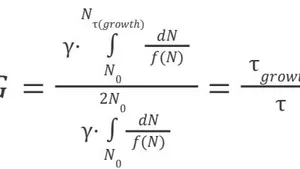
From these equations, we derive the general formula to calculate G, regardless of the growth model:
In relativistic term and , as seen by an observer moving at relativistic speeds, are dilated by the same amount, equal to the relativistic factor . Therefore, even when using the general equation to calculate G, it remains invariant with respect to any reference frame because cancels out mathematically.
Indeed:
Funding
This research did not receive any specific grant from funding agencies in the public, commercial, or not-for-profit sectors.
Declaration of competing interest
The author declares that there are no competing interests.
Data availability
No data were collected for this study.
Conflict of Interest
The authors declare no conflict of interest.
Ethical Approval
Not applicable
Data Availability
The datasets used in this study are openly available at [repository link] and the source code is available on GitHub at [GitHub link].
Funding
This work did not receive any external funding.
References
Cite this article
Related Research

Special Issue
Launch a focused special issue to highlight research, emerging trends, and expert insights in your academic field.