

IntelliPaper
Abstract
This article is about the Great Umayyad Mosque in Damascus through the journeys of the Andalusian traveler Ibn Jubayr (d. 1217 AD) called: "Rihlat Ibn Jubayr- Travels of Ibn Jubayr" or what is called: "Taḏkira bi-akhbār can ittifāqāt al-asfār- A Reminder of News about Travel Agreements", and the Moroccan traveler Ibn Battuta (d. 1377 AD) called: "Tuhfaf An-Nuzzar fi Ghara'ib al-Amsar wa-'Aja'ib Al-Asfar- A masterpiece for the observer of the wonders of countries and the wonders of travel " - as a model, as these two journeys, despite the time distance between them, are the truest mirror of the era in which their author lived, as what they wrote of literary texts, stories and news is an important source of information about the city of Damascus in the Middle Ages, and what it contains of monuments and religious architecture, the most important of which is the Great Umayyad Mosque.
Explore Digital Article Text
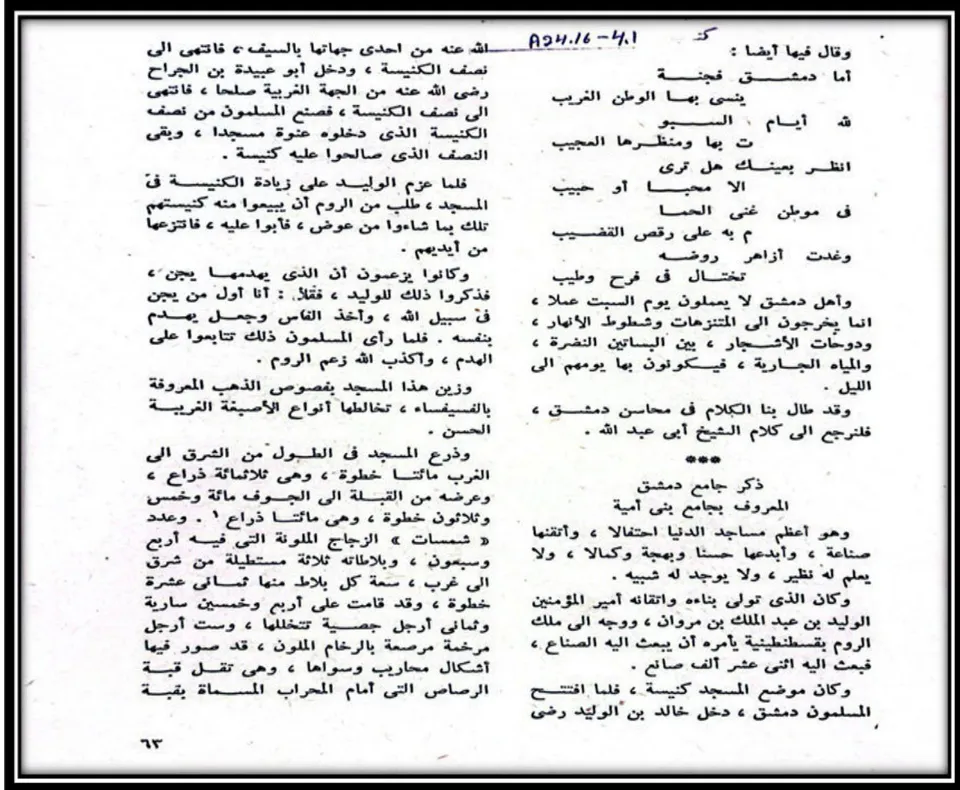
"The striking similarity between the accounts of Ibn Jubayr and Ibn Battuta in their descriptions of the Umayyad Mosque lies in their detailed, vivid, and comprehensive portrayals. Their narratives reflect an objective and reportorial mode of description."
"The high literary and historical value of travel writing, which represents one of the most effective means of recording travelers' observations of Islamic cities and their architectural heritage. The works of Ibn Jubayr and Ibn Battuta demonstrate remarkable precision of observation and expressive clarity, characterized by vivid imagery and fluid language. Moreover, travel literature constitutes a vital historical and archaeological source, providing essential geographical and cultural information about the Levant and the broader Eastern regions. In this respect, it is comparable in importance to material sources such as inscriptions, tablets, scrolls, and manuscripts."3."
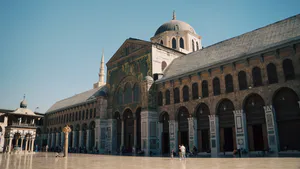
The grandeur of the Umayyad Mosque inspired numerous narrators and travelers who visited it, including the Andalusian traveler Ibn Jubayr and the Moroccan traveler Ibn Battuta. Both portrayed it as the "pearl" of Damascus, the "paradise of the East," and a rare architectural masterpiece—one of the most famous, grandest, and most beautifully constructed mosques of the Umayyad era. The renowned geographer Yaqut al-Hamawi (1995) wrote in Mu jam al-Buldan ("Dictionary of Countries"): "If a person lived for a thousand years and visited the Umayyad Mosque every day, he would see today what he did not see yesterday."
Among the most important findings of this study is the strong convergence between the accounts of Ibn Jubayr and Ibn Battuta in their descriptions of the Great Umayyad Mosque in Damascus. Both texts employ rich aesthetic language and detailed references to artistic decoration, highlighting the magnificence, grandeur, and originality of medieval Islamic architecture as embodied in the mosque. The structure emerges not only as a masterpiece of Umayyad civilization but also as a central religious landmark within the Arab-Islamic world.
Historical reports further emphasize this significance. It is said that the Umayyad Caliph Al-Walid I declared in 705 CE: "I wish to build a mosque the like of which has never been built before me, nor will anyone after me build its equal." Likewise, the Abbasid Caliph Al-Ma'mun is reported to have acknowledged its uniqueness, stating: "It was built unlike any mosque before it" (al-Bahnasi, 1988, p. 25).
I. INTRODUCTION
The Great Umayyad Mosque in Damascus occupies a prominent place in the travel accounts of Ibn Jubayr and Ibn Battuta, both of whom described Damascus as the "paradise of the East." Historians and writers have frequently cited their descriptions, portraying the mosque as a masterpiece of Islamic architecture and a defining monument of Islamic civilization.
A review of comparative studies on the two travelogues indicates that, despite the importance of the mosque in their narratives, it has not received sufficient focused analysis. This study therefore examines the Great Umayyad Mosque through the accounts of Ibn Jubayr and Ibn
Battuta in order to identify similarities and differences in their descriptions of its aesthetic and artistic features. It seeks to answer the central question:
Why is the Umayyad Mosque considered one of the masterpieces of Islamic architecture in Arab–Islamic civilization?
Travel literature represents one of the most important intellectual products of the medieval Islamic West. Scholars have highlighted its value due to the reliability of its observations, stylistic richness, and narrative depth. The travelogues of Ibn Jubayr and Ibn Battuta in particular constitute foundational works in this tradition.
This study begins with brief biographical introductions to both travelers and their journeys, followed by a comparative analysis of their descriptions of the mosque.
II. IBN JUBAYR
Abu al-Husayn Muhammad ibn Jubayr al-Kinani (539 AH/1144 CE-614 AH/1217 CE) was an Andalusian traveler and writer born in Valencia. He undertook several journeys to the East and authored a celebrated travelogue commonly known as Rihlat Ibn Jubayr. He died in Alexandria at the age of approximately seventy-five.
Ibn Jubayr arrived in Damascus during one of his eastern journeys and recorded an extensive and stylistically elaborate description of the city and its Great Mosque. His prose is characterized by ornate language and rhetorical devices typical of medieval Arabic literary style, including rhymed prose. While critics have sometimes noted the artificiality of such stylistic features, the work remains an invaluable historical and literary source.
In his description of Damascus, Ibn Jubayr presents the city as a place of exceptional natural and spiritual beauty, emphasizing its gardens, flowing water, and religious significance. He famously describes it as the "paradise of the East," reflecting both aesthetic admiration and spiritual symbolism.
III. IBN BATTUTA
Like Ibn Jubayr, Ibn Battuta provides a detailed account of Damascus in his travelogue Tuhfat al-Nuzzar fi Ghara'ib al-Amsar wa-'Aja'ib al-Asfar. He arrived in the city in 726 AH/1326 CE and resided there for a period at the Malikite madrasa known as al-Sharabshiyya.
Ibn Battuta's description is more concise but equally emphatic in its praise. He describes Damascus as unparalleled in beauty and explicitly acknowledges Ibn Jubayr's earlier account. His narrative blends observation with literary embellishment, including poetic references that reinforce the city's reputation as a terrestrial paradise.
Both travelers record traditions concerning the construction of the mosque, including accounts of its immense cost and the ambitious building program attributed to the Umayyad Caliph al-Walid I. These narratives highlight the mosque's monumental scale and the resources invested in its construction.
IV. PREVIOUS STUDIES
Several comparative studies have examined the journeys of Ibn Jubayr and Ibn Battuta; however, most focus on urban descriptions across different regions rather than a dedicated analysis of the Great Umayyad Mosque. Existing scholarship tends to address broader themes such as religious sentiment, urban development, or regional geography.
Although a number of works analyze aspects of their travel literature, few provide a systematic comparative study centered specifically on the mosque's architectural and artistic features. This gap underscores the need for a focused analytical approach examining the mosque through both narratives.
V. RESEARCH PROBLEM AND QUESTIONS
The research problem stems from the limited scholarly attention devoted to the Umayyad Mosque within comparative travel literature studies, despite its architectural and civilizational importance.
This study addresses the following questions:
How did Ibn Jubayr and Ibn Battuta describe Damascus and the Great Umayyad Mosque?
What similarities and differences appear in their accounts regarding architectural features and artistic decoration?
How do their stylistic approaches shape the reader's perception of the mosque?
VI. RESEARCH OBJECTIVES
This study aims to:
Analyze the descriptive focus of both travelers on the Umayyad Mosque.
Compare historical and aesthetic elements in their narratives.
Examine the architectural and artistic features emphasized in each account.
Evaluate the broader cultural significance of the mosque within medieval Islamic travel literature.
VII. IMPORTANCE OF THE STUDY
The importance of this study lies in its focus on a monument that has received limited dedicated comparative analysis in travel literature scholarship. By examining the mosque through the perspectives of two major travelers, the study highlights its role as a central symbol of Umayyad architectural achievement and Islamic cultural identity.
VIII. METHODOLOGY
The study adopts an analytical and comparative methodology. It combines descriptive textual analysis with inductive and critical approaches in order to identify patterns, similarities, and differences in the two narratives. Comparative textual analysis enables a more nuanced understanding of how each traveler constructed the image of the mosque (Maxwell 2013; Creswell 2013; Creswell and Clark 2017).
IX. RESULTS AND DISCUSSION
A close reading of both texts reveals strong overlap in the narrative traditions surrounding the construction of the mosque. Both accounts present similar stories regarding the transformation of a former church into a mosque and emphasize the determination of the Umayyad leadership in completing the project.
However, differences emerge in descriptive emphasis. Ibn Jubayr offers a more elaborate and rhetorically rich narrative, characterized by extended aesthetic descriptions and religious symbolism. In contrast, Ibn Battuta provides a more concise but structured account, focusing on key architectural features and social functions.
Both travelers demonstrate a notable concern with numerical and spatial details, including measurements, structural components, and institutional roles. This quantitative tendency reflects broader intellectual traditions in medieval Islamic scholarship and suggests that travel literature may serve as a valuable historical source for architectural and urban studies.
Artistic and Architectural Features
Both narratives highlight the richness of the mosque's artistic decoration. The descriptions emphasize:
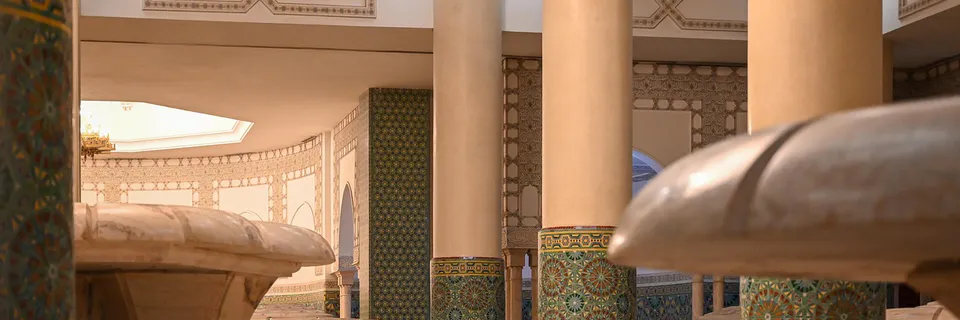
Vegetal motifs and mosaics, associated with Umayyad artistic identity. Geometric ornamentation, including octagonal forms and patterned marble.
Calligraphic elements, especially inscriptions linked to sacred figures.
Domes and minarets, which symbolize architectural innovation and religious significance.
These features collectively reinforce the mosque's status as a landmark of Islamic architectural development.
Shared Religious Framework
Both travelers wrote from similar religious and intellectual backgrounds, which shaped their narrative tone. Their writings frequently incorporate Qur'anic references, devotional language, and expressions of admiration. This shared framework contributes to the idealized portrayal of Damascus and its mosque as a space of spiritual and aesthetic excellence.
Conflict of Interest
The authors declare no conflict of interest.
Ethical Approval
Not applicable
Data Availability
The datasets used in this study are openly available at [repository link] and the source code is available on GitHub at [GitHub link].
Funding
This work did not receive any external funding.
References
Cite this article
Related Research


Special Issue
Launch a focused special issue to highlight research, emerging trends, and expert insights in your academic field.