




IntelliPaper
Abstract
Supernumerary nostril is a very uncommon congenital anomaly where an additional nostril is present besides the normal pair. Since the initial description by Lindsay in 1906, only sporadic cases have been documented. The anomaly may occur on one or both sides and can coexist with other craniofacial abnormalities. We describe an 8-day-old female neonate with an accessory nostril positioned superolateral to the left nostril, accompanied by medial coloboma of the left eyelid and absence of the alar cartilage. Management was planned using core reconstructive principles, emphasizing relocation of aberrantly positioned tissues and coverage of secondary defects with adjacent local flaps. Alar cartilage repositioning combined with a glabellar flap was performed. The postoperative course was uneventful with acceptable functional and aesthetic outcomes. Early correction is advocated to limit distortion of the developing nasal framework, secondary facial deformity, and later psychosocial impact.¹–⁵
Explore Digital Article Text
Introduction
Supernumerary nostril represents an exceptionally rare congenital malformation of external nose, originally described by Lindsay in 1906. The defining feature is the presence of an accessory nostril in addition to the normally developed pair. Reported cases demonstrate variable laterality and positioning, with the accessory opening occurring superior, lateral, or medial to native nostril, reflecting disturbances in embryologic development of the lateral nasal process. A notable proportion of reported patients originates from Asia. Associated anomalies have included esophageal atresia, naso-ocular clefts, cleft lip and palate, patent ductus arteriosus. Owing to the heterogeneity of presentations and the scarcity of cases, no uniform operative strategy exists; therefore, surgical planning must be individualized based on anatomy and tissue availability. We document a rare presentation of supernumerary nostril with concomitant medial eyelid coloboma and outline our reconstructive approach and outcome.
Case Report
An 8-day-old female neonate was presented to our department with the chief complaint of an ill-formed nose since birth. The child was the first issue of the parents. There was no relevant family history, no associated congenital deformities apart from the nasal and eyelid anomalies, and no history of maternal illness or complications during pregnancy.
Clinical Findings
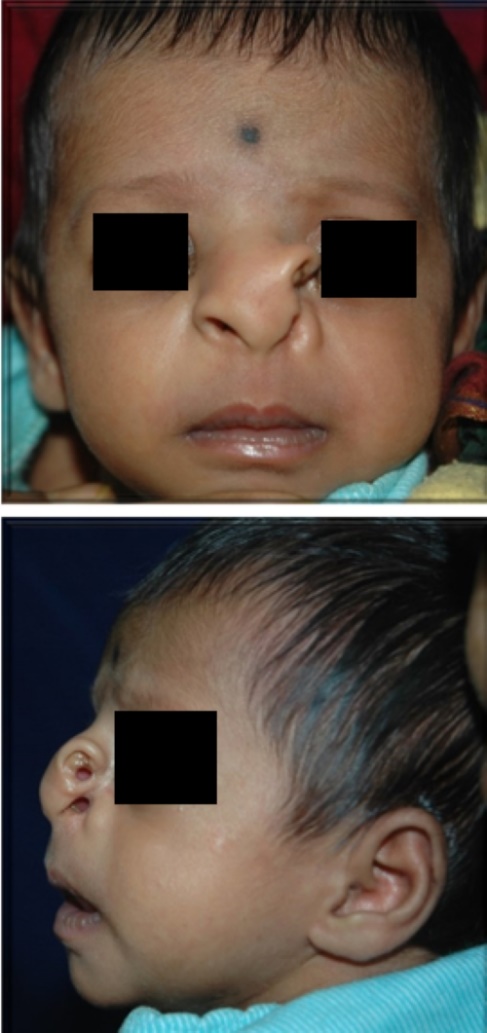
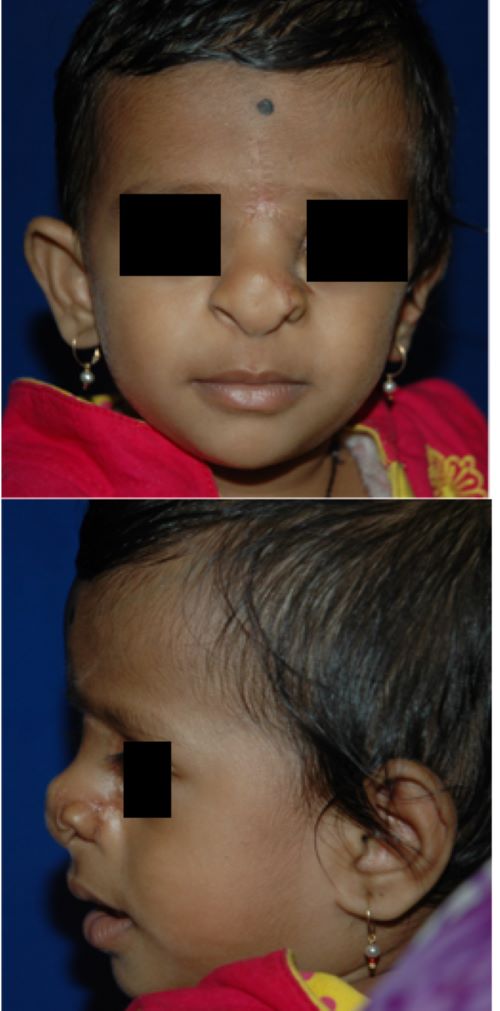
On clinical examination, an accessory nostril was observed positioned superior and lateral to the left nostril. The left alar cartilage was severely hypoplastic and displaced. A medial coloboma of the left eyelid was also noted. No other craniofacial or systemic anomalies were detected on clinical examination.
Etiology
Nakamura proposed that aberrant morphogenesis of the lateral nasal process during mesenchymal proliferation can result in the formation of a cleft or groove, effectively partitioning the process into two components. This developmental error may culminate in duplication of nostril and alar elements on the affected side, accounting for the spectrum of accessory nostril presentations described in the literature.
Diagnosis
Accessory nostril with medial coloboma of the left eyelid.
Treatment Plan
The treatment plan included:
-
Repositioning of the nasal alar cartilage
-
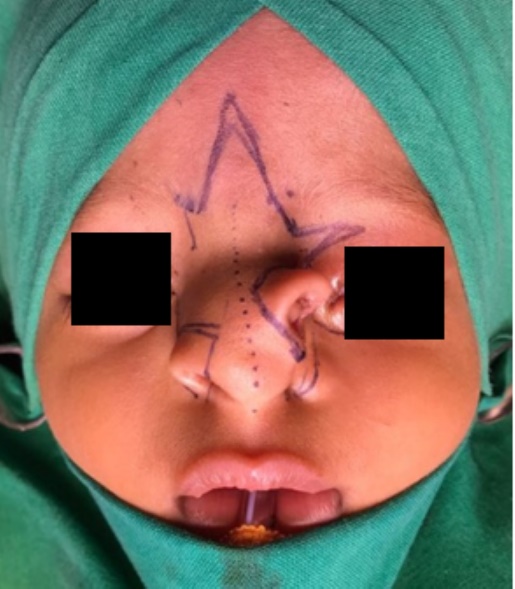
Reconstruction using a glabellar flap
Principles of Surgical Planning
-
Identification and assessment of normal tissue available
-
Repositioning of abnormally placed tissue to its normal anatomical location as dictated by the contralateral normal side
-
Reconstruction of the secondary defect using adjacent normal tissue to maintain the repositioned structures
Surgical Technique
The accessory nostril tract was excised during the surgical procedure, repositioning of the abnormally placed alar cartilage to recreate normal nostril anatomy, and reconstruction of the defect using a glabellar flap. A glabellar flap was selected because it provided adjacent, well-vascularized tissue with adequate mobility and color match for coverage of the superior nasal defect while minimizing tension on the constructed alar region. Care was taken to preserve the surrounding soft tissues and achieve symmetrical nostril contour. Tension-free closure was performed.
Outcome
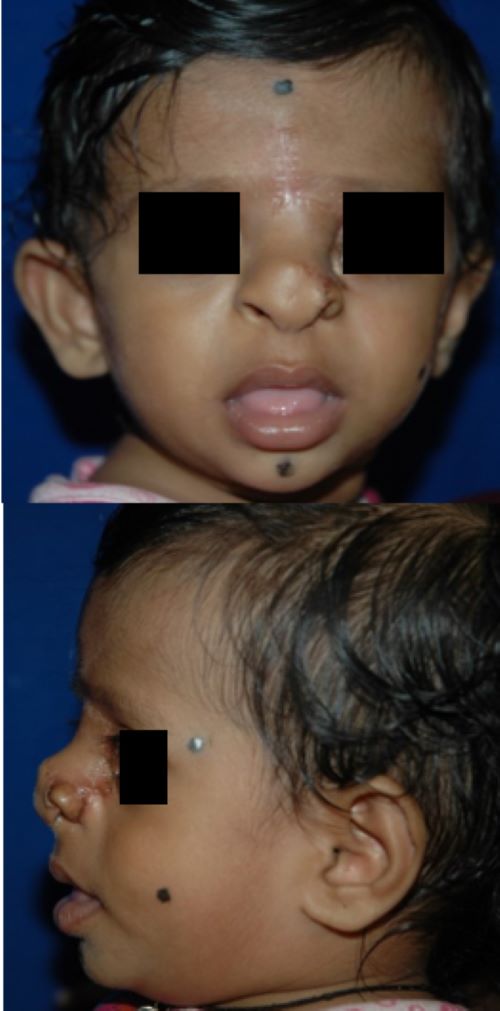
Postoperative evaluation demonstrated satisfactory restoration of nasal contour and symmetry. The immediate postoperative period was uneventful. On late follow-up, stable healing with acceptable aesthetic outcome was observed. Secondary-stage correction of residual medial eyelid coloboma was planned.
Discussion
Supernumerary nostril is among the rarest congenital nasal anomalies reported. Prior series have documented associations with other congenital conditions, including naso-ocular clefts, esophageal atresia, cleft lip and palate, and patent ductus arteriosus. The location of the accessory opening varies according to the site of aberration within the lateral nasal process throughout development, explaining medial, lateral, or superior positions relative to the native nostril. The coexistence of supernumerary nostril and medial eyelid coloboma may reflect a developmental disturbance involving the frontonasal process and adjacent facial fusion planes. Such anomalies may share embryological overlap with Tessier craniofacial cleft spectrum deformities, particularly those affecting the naso-ocular region. Early operative correction is favored to minimize progressive distortion of the immature nasal cartilaginous framework, prevent secondary deformity of adjacent structures, address functional concerns, and reduce potential psychosocial sequelae. In the present case, the medial eyelid coloboma was small and did not compromise corneal protection or eyelid closure at presentation. Therefore, priority was given to early nasal reconstruction to prevent progressive distortion of the developing nasal framework. Secondary correction of the eyelid deformity was planned subsequently. Given the diversity of anatomic patterns, no single technique is universally applicable; reconstruction should be tailored to each patient using established plastic surgical principles.
Conclusion
A rare congenital nasal deformity with variable presentation is called supernumerary nostril. There is no universal standard method of correction. Surgical management should be tailored to each case, adhering to basic principles of plastic and reconstructive surgery. Secondary-stage correction may be required for associated anomalies such as medial eyelid coloboma to achieve optimal functional and aesthetic outcomes.
This case report is reported consistent with the CARE (Case Report) guidelines.
The parents or legal guardians of the patient offered written informed consent for current case report and the related clinical images to be published.
Conflict of Interest
The authors declare no conflict of interest.
Ethical Approval
Not applicable
Data Availability
The datasets used in this study are openly available at [repository link] and the source code is available on GitHub at [GitHub link].
Funding
This work did not receive any external funding.
Cite this article
Related Research

Special Issue
Launch a focused special issue to highlight research, emerging trends, and expert insights in your academic field.
