

IntelliPaper
Abstract
Background:
In recent years, understanding the macroeconomic contributions and social value of sports has advanced globally. While traditional sports management literature heavily focuses on subjective well-being and social capital, few empirical studies have quantified the mechanisms translating these intangible psychological benefits into macro-level economic indicators, such as Gross Domestic Product (GDP).
Purpose:
This study focused on rugby to quantify the socioeconomic value of sports-induced well-being. Specifically, it elucidated the causal pathways through which rugby match watching enhances labor productivity and simulated its ultimate contribution to national GDP and Social Return on Investment (SROI).
Methods:
A web-based survey was conducted from June 11 to 23, 2026, targeting a sample of 14,835 rugby fans in Japan. The survey captured demographics, viewing behaviors, and self-reported improvements in psychological, interpersonal, and physical dimensions. Data analysis employed descriptive statistics, co-occurrence network structure analysis of open-ended happiness descriptions, and path analysis to test the direct and indirect effects of well-being factors on work productivity.
Results:
Descriptive statistics revealed high engagement among respondents, with rugby watching yielding substantial perceived benefits for stress relief, social bonds, and social well-being. The co-occurrence network analysis visualized that the peak moments of happiness are deeply tied to a sequential "rugby story"-ranging from a team’s victory and dynamic plays to the unique post-match "no-side" spirit. Path analysis demonstrated a dual-structured transmission mechanism: individual physical health (beta= 0.335) and stress relief (beta = 0.325) exert powerful direct effects on work productivity. Simultaneously, corporate sponsorship favorability (beta = 0.328) functions as a major trigger that fosters overall social happiness, which indirectly boosts productivity (indirect effect = 0.049).
Discussion/Conclusion:
The self-reported work productivity increase (28.36%) was converted into a conservative macroeconomic model (10% realization rate) to prevent overestimation bias. Assuming an affected labor population of 200,000 workers, regular rugby watching is estimated to create an annual economic value of 30.5 billion JPY (165 million EUR) through improved real productivity. Operationally utilizing the Japan Rugby Football Union's 2025 budget (8.3 billion JPY) as the investment baseline, the estimated SROI ratio was 3.67. This study underscores that public and corporate investments in sports environments are highly efficient economic policies that mitigate workplace presenteeism, improve worker well-being, and tangibly support national macroeconomic growth.
Explore Digital Article Text
Introduction
In recent years (2024–2026), statistical verification using macroeconomic data and empirical case studies have rapidly advanced worldwide regarding how much sports contribute to national assets. Kostadinović et al (2025) collaborated with EUROSTAT to comprehensively track sports-related goods and services across Europe. The sports sector (game watching, performance, and related industries) contributes about 3.37% of the EU GDP (over 100 trillion JPY: approximately 627.5 billion EUR). This study formulates a mechanism by which regular sports experiences improve workers’ mental health (reducing loneliness and depression) and that eliminating “workplace unemployment“ (a state where productivity drops while attending work: presenteeism) directly contributes to maintaining and raising macro-GDP across all industries.
In a study on urban economic resilience through attracting large-scale sporting events, Li (2026) views sports events not as “transient tourism consumption” but as “investments that enhance the long-term economic resilience of cities and businesses.” This study examines panel data from major cities. Cities that regularly host professional sports and large-scale sporting events have demonstrated significantly higher “economic resilience” in the event of external economic shocks (such as recessions) compared to cities that do not host the event. Furthermore, by regularly engaging with sports, it has demonstrated that the subjective well-being of citizens (workers) increases, optimizing industrial collaboration within local communities and labor utilization rates—an “intangible legacy effect” that strongly supports GDP.
The World Economic Forum (Davos Conference) report on “Sports Economics” (2026) analyzes growth forecasts for the global sports economy and how sports are driving productivity in other industries. As of 2026, the global sports industry will generate 372 trillion JPY annually, equivalent to 2.02 trillion EUR; It is said that its true value lies in the ‘Green Spillover Effects’ it provides to other sectors such as healthcare, tourism, and technology. In particular, the combination of the “digital economy × sports watching” has established consumption scenarios that boost fan motivation and well-being, even outside stadiums (at home or at work). It is pointed out that this stimulates engagement among businesspeople and indirectly streamlines the efficiency of corporate production activities.
WHO(2022) clarified the disease burden and economic losses caused by insufficient physical activity and economic growth in each country, and proposed policies to promote physical activity by 2030. As a representative study directly estimating the economic effects of healthcare, Ding et al. (2016) presented the economic losses due to global physical inactivity, as well as losses in medical expenses and productivity. The WEF’s Future of Jobs Report (2023:2025) is an official report that explores discussions on “healthy workers,” “well-being,” and “human capital investment.” References to ESG, social value, and corporate value as Stakeholder Capitalism are considered highly compatible with social value and SROI research in sports (WEF. 2020). A particularly effective study in sports research is the OECD’s international comparison of happiness, which is a representative literature discussing subjective well-being, productivity improvement, and economic growth (2019; 2020). Policy discussions that deepen the human capital value of well-being created through sports and health promotion are needed (Sasaki et al. 2025).
Purpose/Method
In this study, we focused on rugby to quantify the socioeconomic value of wellbeing, conducting a web survey via email to rugby fans. Reply information was anonymous, and no personal information was collected. It takes about five minutes to respond to the web, so the psychological stress is extremely low. This research was approved by the NSPC (Nippon Sport Policy Commission) Research Ethics Committee (May 2026: Approval No. 26-1). The survey period was June 10~21, 2026.
The questions included age, gender, method of watching, frequency of watching, and the benefits of rugby watching for wellbeing. Participants choose from options ranging from 0%, 5%, 10%, 20%, 30%, or 50% or higher for ‘stress relief,’ ‘increased work productivity,’ ‘building bonds with family and friends,’ ‘physical health,’‘social well-being,’ and ‘favorability toward supported companies.’ Finally, it was an openended question about the moment when watching the game feels the happiest. The analysis included descriptive statistics, a co-occurrence network structure of the value that makes watchers feel most happy (free-form description) (Sasaki et al., 2025), and the well-being factors were the contribution value to work productivity (path analysis) and GDP contribution value (we used R program). The uniqueness of this study lies in proposing a structured approach to well-being GDP contribution by quantifying sports value.
Results and discussion
The web survey was sent and collected from June 11th to 23rd 2026 : total Sample Size: 14,835 respondents.
Descriptive statistics related to well-being
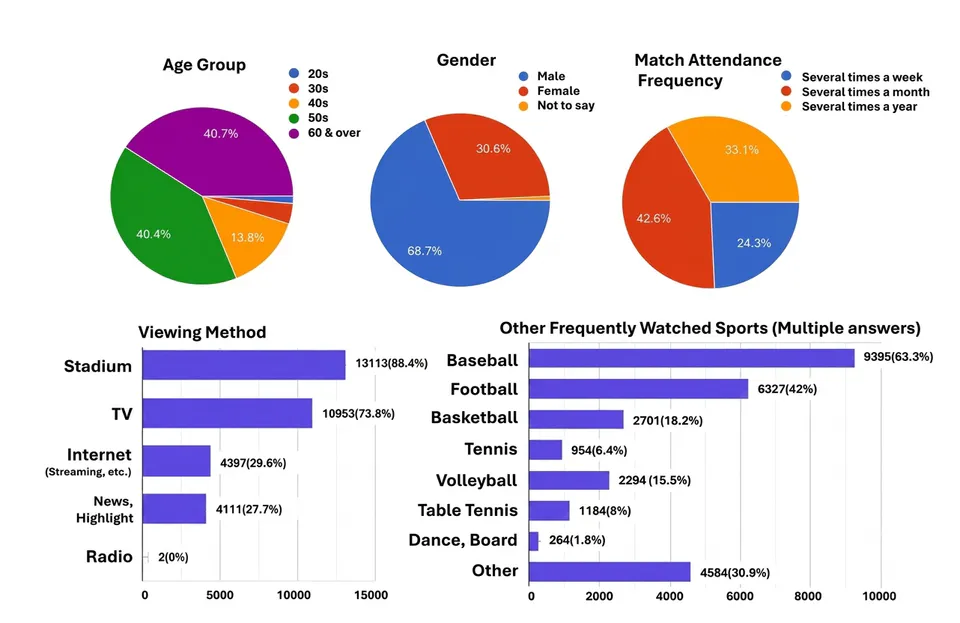
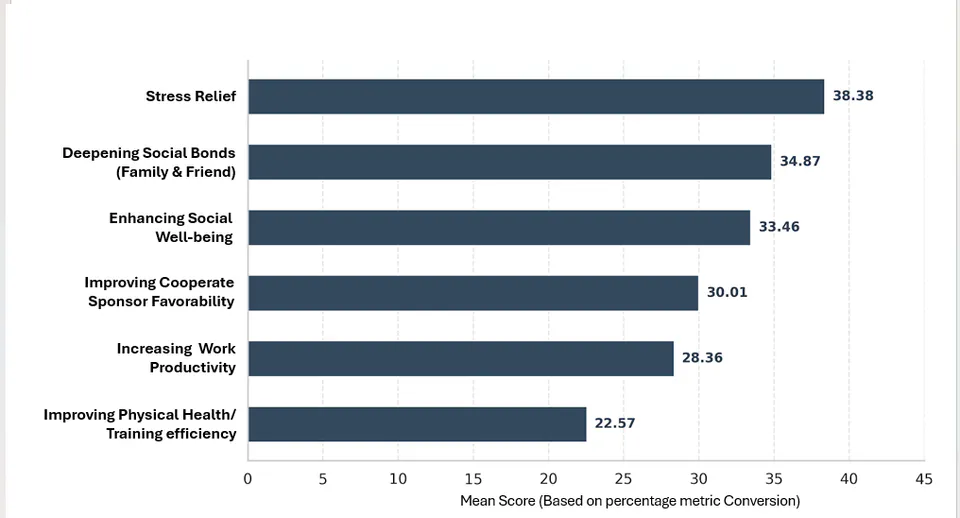
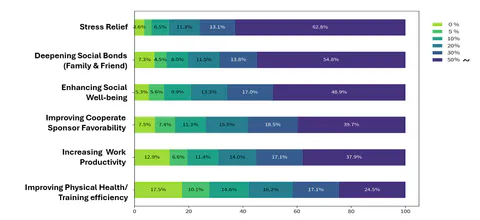
Data mainly targeted “men aged 50 and over” and “enthusiastic rugby fans who regularly watch matches (several times a month~). Overall, engagement with rugby was extremely high, with particularly positive evaluations for stress relief, strengthening bonds, and social well-being.
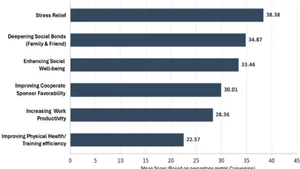
Rugby watchers tended to feel more psychological and interpersonal benefits than physical ones. The highest proportion of respondents answered “over 50%” across all categories (with a frequency of 50.0 for all categories), and overall, very positive responses about rugby watching were gathered.
Most of the types of watching were live at stadiums (88.4%) and TV (73.8%). Aside from rugby, most of the games are ‘baseball’ (63.3%) and football (42%), showing the popular sports in Japan.
The effects of watching games are, in the order of “stress relief,” “building bonds with family and colleagues,” “increased social well-being,” “favorability of supporting companies,” “labor productivity,” and then “physical health.” The social and interpersonal value of watching is also relatively high.
Co-occurrence Network Structure of rugby Watching Value
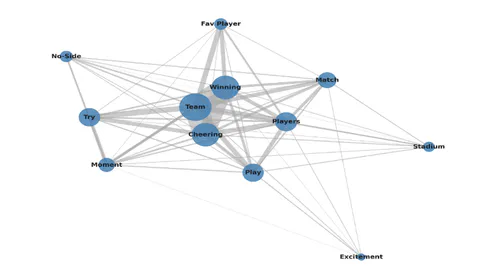
A co-occurrence network graph was drawn from the response results on ‘The happiest moment you feel most from watching games.’ The size of the circle in the graph indicated the frequency of occurrence, and the thickness of the line indicated the strength (or abundance) of the co-occurrence.
- Central Cluster: Team / Winning / Cheering
At the very center of the network, connected by the strongest line. It was visually proven that the “moment when the team you support wins” is a universal and greatest source of happiness for spectators.
- Rugby-specific competition and aesthetic cluster (left to center): Try / Players / Play
Moment Features: This was a group of happiness strongly linked to dynamic competitive characteristics, such as “offense and defense just before a try” or “the moment witnessing a player’s excellent play.
No-Side Features: The games were widely connected like a web, connecting ‘matches,’ ‘players,’ and ‘try.’ This showed that many people felt the deep emotion and happiness unique to rugby in moments of hugs and handshakes (the no-side spirit) when they celebrate their efforts without friend or foe after fierce battles.
- Personal attachment and stadium experience cluster (top, right side)
Fav Player (favorite) Features: Connected by thick lines with “teams” and “players,” the very act of “having your favorite players or teams perform” is an independent and strong element of happiness.
Stadium / Excitement Features: Located around the network (bottom right), connected to “matches” and “play.” Not only TV and streaming, but also moments of “emotion” surrounded by the live atmosphere and unity of the local stadium are highlighted as unique experiential values.
From the results of free writing, it is not just about “I’m happy to win,” but also about “cheering for players who play with dedication (Cheering → Players), witnessing their wonderful plays and try moments (Play → Try → Moment), and praising each other with no side after the match (Match → No-Side).” This cooccurrence network clearly reveals that rugby watchers could find the greatest happiness (wellbeing) in the entire series of rugby stories.
Rugby Watching and Work Productivity
While most previous sports management research has focused on the impact on ‘social well-being,’ this study aims to examine the mechanisms of contribution to the macroeconomy beyond that. Therefore, we set ‘work efficiency’ as the target variable approach through path analysis. Using Path Analysis, we elucidated the specific causal mechanism of whether watching sports increases labor productivity. In path analysis, placing “mediating variables” between factors allows verification of direct and indirect effects (causal steps).
Firstly, as a theoretical path model, it is proposed that personal value (primary effect), ‘stress relief,’ ‘physical health,’ ‘bonds with family and friends,’ and ‘favorability toward supporting companies’ from watching rugby directly enhance labor productivity. Next, transition path to social and macro values (mediating variables), personal fulfillment fosters a broader perception of "social happiness" (macro positive emotions). Achieving the final target variable brings together personal fulfillment (direct effect) and empathy for social well-being (indirect effect), resulting in ‘improved productivity in work and study.’ The path analysis results (standardized pass coefficient: β) represent the strength of each causal pathway calculated based on statistical analysis (all pathways are extremely significant at p < 0.001).
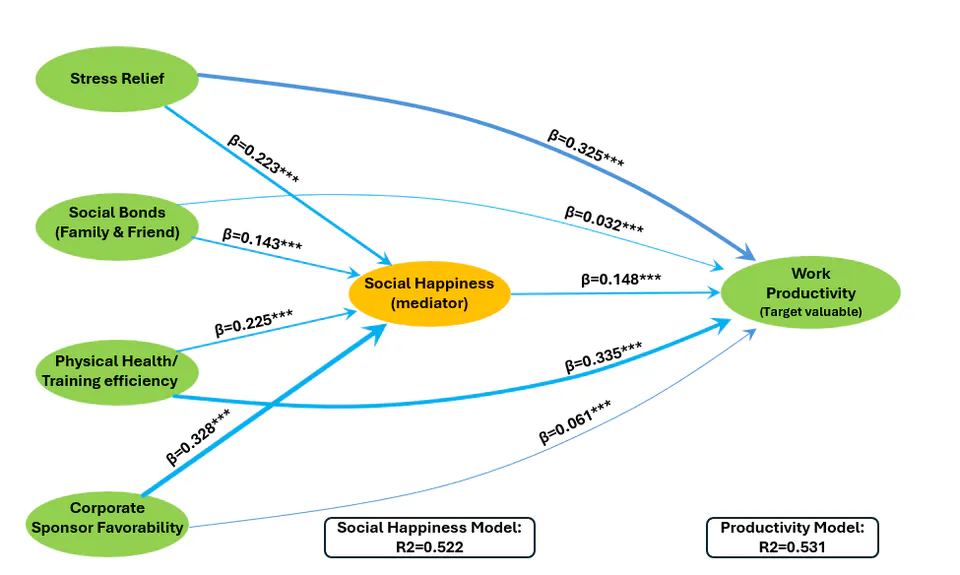
First Step is the path from personal value to social well-being: a chain of factors that trigger the macro psychology of “enhancing the overall well-being of society.” By fostering a positive impression of companies supporting sports and fulfilling one’s own physical and mental health, we can understand a process where psychology shifts toward a macro perspective that “this sports culture would be making society as a whole happy.”
Next step serves as a path from each variable to work productivity, including the direct effects (the power to directly improve work productivity) and the indirect effects (the power to mediate ‘social wellbeing' to improve work productivity: for example, the favorability of a supporting company improve social happiness and affect work productivity: i.e., 0.328*0.148=0.049, etc..
From pass analysis, we can understand the dual structure: ‘direct performance improvements’ and ‘benefits from macro environments.’ While proving that individual “physical health (0.335)” and “stress relief (0.325)” exist as powerful direct channels (direct effects) to improve work productivity, at the same time, a mental backup route (indirect effect) that mediates a macro environmental perception (0.148) that “overall social well-being is rising” also functions simultaneously. It could logically demonstrate the comprehensive value transmission mechanism of rugby watching.
Descriptive statistics showed that ‘favorability of supporting companies’ had little impact on work productivity. However, by analyzing the path, ‘goodwill toward corporate support (0.328)’ became the biggest trigger for fostering ’overall social well-being.’This mediates social well-being (0.148) and indirectly contributes significantly to work productivity (indirect effect: 0.049). The significance of social values like as CSR (Corporate Social Responsibility) and ESG (Environmental Social Governance) of sponsorship, which states that “corporate support for sports ultimately contributes to improving work productivity across society,” could be confirmed.
Work Productivity, GDP, and SROI (Social Return of Investment)
In this study, watching rugby increased work productivity (28.36%), but considering self-reported productivity as equivalent to macroeconomic GDP growth rates would lead to overestimation bias (Barrero et al., 2021). To ensure the robustness of policy implications and align with standard macroeconomic evaluation frameworks (Kahn et al., 2021), the realization scenarios for productivity improvement psychology can be considered as follows: conservative type (10% realization rate, GDP-equivalent effect 2.83%), standard type (25% realization rate, 7.09%), and optimistic type (50% realization rate, 14.18%). Based on previous research (Kostadinović, 2025: Kekkonen, 2025: Gibbs, 2023), subjective improvements in work productivity could be converted to about a 2.0% to 3.5% increase in real labor productivity (recovery of workplace unemployment), and setting a figure of 2.84% as a contribution to GDP base improvement would be considered reasonable.
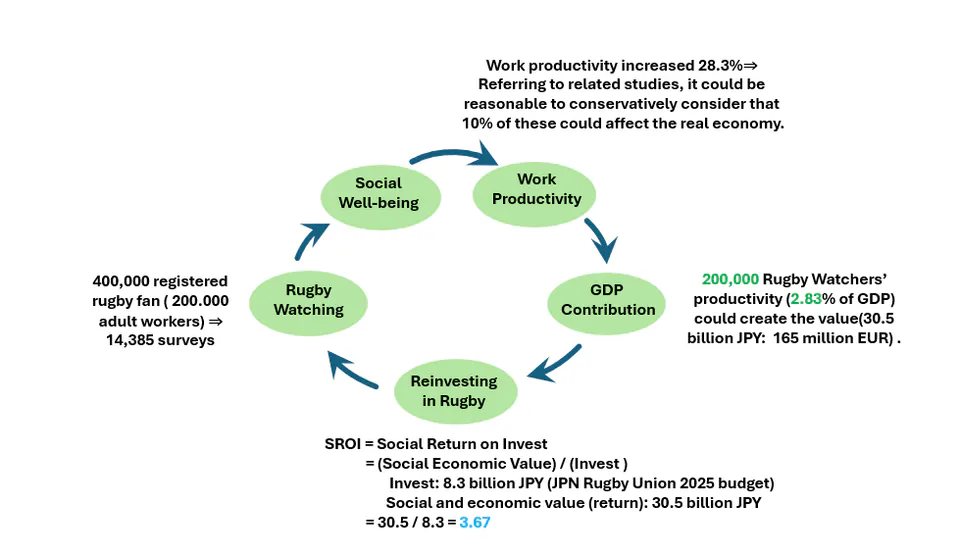
The following is the estimation process. Japan’s GDP reached 669 trillion JPY (approximately 3,63 trillion EUR: Calculated at the exchange rate of 1 EUR = 184 JPY as of June 2026) . The GDP per capita is 5.45 million JPY (30,000 EUR). The population of improving productivity is set at 200,000 workers (half of the 400,000 fan registrations). This value would be highly consistent with the 200,000 adults who watch multiple games (5~6 times) for JPN Rugby League One 2024-2025 season, 1,187,470 = 1.2 million total attendances. The work productivity rate reported above was 28.3%, but the actual economic value of productivity gains is set more conservatively at the10% of 28 (=2.83%). If per capita GDP of 5.45 million JPY increases by 2.8%, the estimated value creation is 150,000 JPY (813EUR). The total economic value created (converted to GDP) is 30.5 billion JPY (165 million EUR), equivalent to the productivity improvement effect of 200,000 rugby watchers. This estimate was set conservatively (as low as possible) based on past research. However, improving the watching environment for sports such as rugby might be a “highly efficient economic policy” directly linked to improving worker productivity, corporate performance, and even the national budget.
In recent years, the Social Return of Investment Index (SROI) expresses how many times the social and economic value would be returned to the invested costs, expressed as a ratio (multiple). Here, the investment amount is operationally set as the Japan Rugby Football Union 2025 budget (8.3 billion JPY: 48.8 million EUR), and its SROI is estimated.
SROI = (30.5 billion JPY; 165 million EUR) / (8.3 billion JPY; 48.8 million EUR) = 3.67
The SROI analysis yielded a ratio of 3.67:1. This indicates that for every 1 JPY invested by the national governing body (JRFU), approximately 3.67 JPY of social and economic value could be returned to Japanese society through enhanced work productivity. The calculated SROI ratio (3.67) might demonstrate the substantial socioeconomic justification for public and corporate investments in rugby. While sports budgets are often scrutinized for their direct financial returns, this finding highlights that the true value of rugby watchers extends to macro-level economic benefits, specifically by mitigating workplace stress and boosting national productivity (GDP). It should be noted again that this SROI ratio is a conservative estimate, as it solely accounts for worker productivity and excludes other potential social returns, such as reductions in healthcare costs or community revitalization.
Future tasks and limitations of this study
As a result, sports sponsorship value would be expected to continue questioning the validity of estimation methods as the development focuses on community attachment and trust-building. There are clarifying the multilayered sports values such as national economic value (rugby watching → well-being→ labor productivity→ GDP contribution), regional social values (rugby watching → social bonds → social capital→ regional revitalization), or corporate value (rugby watching → favorability of supporting companies → enhancement of corporate value) without overestimating.
Although the data size of this study could suggest some kind of validity in these estimates, future research approaches would require even more careful consideration of the actual socioeconomic engagement structures. For example, we must be vigilant that value could be lost due to dark events such as matchfixing, doping, and violence, which are serious social issues behind sports. In any case, the economic approach must not deviate from what is meant to contribute to the true well-being of people and society.
Conflict of Interest
The authors declare no conflict of interest.
Ethical Approval
Not applicable
Data Availability
The datasets used in this study are openly available at [repository link] and the source code is available on GitHub at [GitHub link].
Funding
This work did not receive any external funding.
References
Cite this article
Related Research

Special Issue
Launch a focused special issue to highlight research, emerging trends, and expert insights in your academic field.