



IntelliPaper
Abstract
The work was oriented to analyze the behavior through simulation processes of urban environmental pollution in rest areas caused by non-ionizing electromagnetic waves produced by wireless technologies. The mixed methodology and the hypothetical-deductive approach allowed structuring the research process in four phases of documentation, practice, processing and simulation model. The sampling and data collection in the sites defined in terms of electric and magnetic field strength, power density and exposure time made it possible to determine that the polluting effects analyzed are closely linked to the type and number of emission sources, distance to the sources, spatial location and construction materials, as aspects that, alt[hough not under the direct control of human beings, can be reduced by means of the adequate use of wireless technology devices and the correct definition of construction materials.
Explore Digital Article Text
I. INTRODUCTION
Since its beginnings, mankind has had the enormous need to communicate, interrelate and transmit knowledge, that is, to provide information and reproduce it from one to another; starting from primitive phonemes, cave paintings or writings on stone, thanks to creativity and its systematic application in innovation processes, significant progress has been made in scientific development (Espitia et al., 2021), so that technological innovation has become an essential component of human nature that can provide welfare conditions (Castellanos et al., 2019).
Urban environments increasingly welcome technological developments that help the planning process and improve the quality of life of human beings, and advances in global positioning systems for development (Puentes et al., 2019), the use of artificial intelligence and automatic learning to improve security and defense parameters (Gutiérrez-Portela et al., 2021), support for military forces (Espitia et al., 2021) and even their application to general (Paredes-Chacín et al., 2020) and specific educational processes (Cuevas and Díaz, 2020), are proof of this.
Nowadays, all information is available to anyone in just a few hundredths of a second with the click of a button or the touch of a touch screen, all thanks to what is called "connectivity". However, despite the rapid technological development, connectivity was difficult to achieve, as urban communities and cities were immersed in a sea of antennas and equipment that, due to their novelty and indiscriminate location, visibly affected the urban landscape.
Over the years, and gradually, the equipment that allows connectivity became part of the urban landscape, in addition to having the advantage of not requiring extensive cabling or fixed points of support in each street, and considering that the attention has been mostly focused on how the concentration of industrial processes negatively affects human health (Zafra-Mejía et al., 2020) and (Eslava-Pedraza et al., 2021), without addressing in detail the impact of connectivity on environmental pollution caused by connectivity.
Wireless technologies, specifically cellular telephony as a product, once its functionality was proven, was made available to the general population, being the pioneers in the Nordic countries despite its high costs at the beginning. The phenomenon of having a communication device without any type of wired connection, portable, similar in use to conventional telephone sets, soon became a success; but it did not stop there, parallel and almost as members of a single gestation, cellular telephony eventually expanded its services and included in its platform the use of another prodigious technological advance such as the Internet. A successful merger was born from that moment and turned the cellular equipment into a multi-equipment that serves as musical equipment, recorder, camera, television, tablet, alarm clock, telephone and remote control, because today through applications and internet connection any user can control the TV, air conditioner or refrigerator among others at long distance.
International organizations and governments were not oblivious to the charm of the services offered by cellular telephony and the Internet, and soon began massification programs reaching the point that today and according to statistics there are more cellular devices in use than people on the planet (UIT, 2016) hey would also be inserted into the economy and would create their own space, hence today we hear in the jargon of finance terms such as "digital economy", "e-commerce", "online store" or "virtual shopping" among others (CEPAL, 2013).
In everyday life, more and more people are dependent on connectivity and therefore on technology that generates non-ionizing electromagnetic waves. Some devices that generate electromagnetic waves are acquired voluntarily and others are assigned and provided by service companies for a better operation of their networks and products. Therefore, the proliferation of electromagnetic wave generating devices is evident and the increase of environmental pollution by these are increasing in the environment.
Studies of environmental contamination by electromagnetic waves have usually focused on studying, analyzing, measuring and issuing recommendations regarding exposure limits to high voltage lines, radio communication stations and recently cell phone base stations (Recommendations to limit exposure to electric, magnetic and electromagnetic fields (up to 300 GHz) (ICNIRP, 1998), but very little interest has been shown in establishing specific recommendations for exposure limits to non-ionizing electromagnetic waves produced by wireless technologies such as those emitted by cellular telephony or Internet or WIFI equipment. Epidemiological scientific studies that normally study the possible effects of the waves produced by cell phone equipment use as a dosimetric magnitude the Specific Absorption Rate (SAR) which is defined as the ratio of energy absorbed over time per unit mass of exposed body tissue (Quintana and Sepúlveda, 2013) or in simpler terms studies the thermal effect of the waves produced by cell phone equipment in the head and more specifically in the human brain, However, over time scientists have asked whether the aforementioned waves not only produce a thermal effect, but whether they can affect the human body without the need for an immediate physical response, which has led to study the possible relationship between the physics of non-ionizing waves and their biological effect on the human being.
Unfortunately, the systems work with only one measurement parameter such as Electric Field Strength (V/m), leaving aside the other three parameters such as Magnetic Field Strength (A/m), Magnetic Flux Density ( T) and Power Density (W/M2).
The massive presence of electromagnetic radiation emission sources has generated a type of almost imperceptible and immaterial pollution called "electromagnetic pollution" or "electropollution" (Gallego Serna, 2011). Electromagnetic pollution (term recognized by the WHO in 1981) is caused by the emission of electromagnetic radiation originated by electrical and electronic devices (Méndez, 2008) and has the characteristic of propagating in a vacuum, presenting three phenomena when it collides with an object: being transmitted through the object, being reflected or being absorbed.
Scientific communities, research groups and ordinary people are increasingly raising questions about the possible risks resulting from continuous and massive exposure to non-ionizing electromagnetic waves, to such an extent that the World Health Organization (WHO) through the International Agency for Research on Cancer (IARC) has categorized radiofrequency electromagnetic fields as group 2B, defined as "possibly carcinogenic to humans" (IARC, 2013). Unfortunately, the results of the different studies have been varied and contradictory, which has led political communities such as the European Union to take regulatory measures, while many nations are only governed by international regulations or, as in the case of Colombia, only have regulations to regulate the ICT sector and the use of the radioelectric spectrum (Congreso de la República de Colombia, 2019) and (ANE, 2020), but from an approach that is subject to international determinations, which are considered permissive due to the low restriction values they handle.
Electromagnetic waves have three propagation mechanisms: reflection, diffraction and scattering. Reflection occurs when an electromagnetic wave hits a surface of much larger dimensions than the wavelength of the signal and whose properties are different from the previous medium.
Diffraction occurs when the path of the wave is obstructed by objects that have sharp corners and edges; when the wave hits the object, secondary waves are produced that are assumed as new wave fronts propagating even in the space behind the object. The naturalization of diffraction at high frequencies depends on the geometry of the obstacle, amplitude, phase and polarization of the wave.
The scattering mechanism occurs when the wave is obstructed by objects whose dimensions are much smaller than the wavelength, or when there is a high number of objects per unit volume in the propagation medium. It can also occur due to rough surfaces or irregularities in the communication channel. Objects such as lamps, poles, trees, furniture cause dispersion producing either increase or decrease of the signal (Castellanos y Talero, 2005).
Indoor propagation is that which occurs in an enclosed environment. In general, it is affected by the same mechanisms of outdoor propagation, although much more marked. In indoor environments, the distances are short, predominantly multipath propagation and there is a greater susceptibility to variations caused by doors, windows, furniture, people, among others (Castellanos y Talero, 2005).
Multipath propagation in wireless communications often means that there is no line of sight between the transmitter and the receiver, so the transmitted signal must follow indirect paths.
When multiple signals arrive at the receiver through different paths in an indoor environment, two types of interference can occur: constructive interference and destructive interference. Constructive interference occurs when the vector sum of the signals produces an increase in the amplitude of the received signal. Destructive interference occurs when the vector sum of the signals produces a decrease in the received signal at the receiver.
Another phenomenon that occurs when handling multipath propagation is fading, which occurs when the receiving antenna does not pick up a single clean signal, receiving multiple replicas that upon reaching the antenna give a resulting signal that may have a different value in amplitude and phase, depending on the intensity and relative propagation time of the waves and the bandwidth of the transmitted signal.
Indoor propagation in the framework of this study corresponds to wifi routers and mobile cellular telephony equipment.
II. METHODOLOGY
The mixed methodological approach (Hernández Sampieri, 2014) is represented in the harmonious combination of quantitative and qualitative aspects; in addition, the hypothetical deductive approach that permeates most of the research process is complemented with an inductive approach represented in the possibility of applying the results obtained in multiple and varied contexts. The methodology employed allowed the research to be structured in four phases: documentation, practice, processing and, finally, simulation model.
III. RESULTS
3.1 Documentation
This phase consisted of a search for similar studies and research projects in international, national and regional organizations and institutions.
The first studies on the health effects of Non-Ionizing Electromagnetic Radiation (NIR) began in the 1960s (Méndez et al., 2008), by means of which it was verified that some physiological responses resulting from radiation could be beneficial, as in physiotherapy, or, in other cases, harmful to health; But it was not until 1992 in Montreal (Canada), during the Eighth International Congress of the International Radiation Protection Association (IRPA), that a new independent scientific organization was established, the International Commission for Non-Ionizing Radiation Protection (ICNIRP), whose functions are to investigate the hazards that may be associated with different forms of NIR, to develop international recommendations on exposure limits for NIR, and to address all aspects of NIR protection against known adverse health effects (Hernández et al., 2008).
The international scientific community debates year after year in different scenarios, what would be the levels and conditions of radiation that can be considered as innocuous, but so far there is no definitive final conclusion. For this reason, the WHO recommends the adoption of preventive measures on this issue, which is why several countries have adopted laws and guidelines on NIR and preventive health. Thus, countries such as Austria and Switzerland have NIR laws that contemplate much lower irradiation levels than those recommended by the ICNIRP, since this commission does not take into account preventive measures for long-term radiation (Méndez et al., 2008).
The concern about the dizzying growth of cellular and wifi equipment is not for less, since there are currently more cellular equipment subscribers than people on the planet, to the point that in countries or administrative regions such as Hong Kong 234 subscriptions/100 inhabitants, Bahrain 217 subscriptions/100 inhabitants, United Arab Emirates 204 subscriptions/100 inhabitants or in more representative countries in terms of demographics China 97 subscriptions/100 inhabitants, India 87 subscriptions/100 inhabitants and United States 127 subscriptions/100 inhabitants among others (Banco Mundial, 2016).
The degree of inclusion of wireless technologies (Wi-Fi and mobile telephony) has reached such an extent that international organizations such as the Organization for Economic Cooperation and Development (OECD), the Economic Commission for Latin America and the Caribbean (ECLAC), the World Bank and the ITU, among others, have included ICT or Internet connectivity indicators in their economic studies (Isoglio, 2021), (Banco Mundial, 2010), (UIT, 2015) and (UIT, 2018), correlating them directly with the degree of development of nations and clearly visualizing the gap between developed and developing countries.
3.2 Practice
The procedural development of the research project is of a mixed nature, which allows the combination of quantitative aspects with qualitative tools for the collection and analysis of information, represented in measurements and surveys, respectively. In accordance with the project's frame of reference, previous results on the impact of wireless technologies in free spaces (Barrera Monsalve and J. Mosquera, Téllez, 2018) were taken into account to take measurements in living spaces (rooms) at night. Since the characteristics were so accurate, it was logical that the type of sampling was "non-random" since all the homeowners were not willing to allow the operator of the measuring equipment to enter.
The first stage established in the qualitative method corresponded to a survey, which was carried out in the Los Pinos neighborhood of the city of Cúcuta, in order to find out where people placed the cell phone equipment while resting or sleeping at night. The survey was conducted with a population of 73 people, establishing as a result that 73.97% of people place the cell phone on the night table next to the bed, 8.22% under the pillow, 6.85% under the bed and only 10.96% leave the equipment more than 1.5 meters away from the bed or outside the room; that is, 89.04% of those surveyed leave the cell phone equipment less than 30 centimeters from their head. Additionally, it was established that none of the respondents have the wifi equipment in the room.
{"image_source":{"path":"images/22bda7c2945fbb6ec44b435ad915e1a8f3508c8e6576f87ec4aeaf0e9bbe2a64.jpg"},"content":"","chart_caption":[{"type":"text","content":"Figure 1: Location of cellular equipment during sleeping or resting hours."}],"chart_footnote":[]}
The measurements taken in other similar outdoor projects show that the results are usually much lower than the values recommended by international organizations and national legislation, so the project was not a comparison of "recommended values" versus "indoor values", but rather "outdoor values versus "indoor values" of a single study area. The selected sector was the Los Pinos neighborhood in the city of Cúcuta, because it is a densely populated area, it is a residential neighborhood, its topography is flat, the housing has a typical design and most of them have not suffered alterations in their distribution and materials, the date of construction is similar and it has a cell phone base station of a service operator within the study area, This allows us to provide more information about electromagnetic wave pollution from wireless technologies identified in the home, such as cellular telephony, wifi broadband equipment and waves coming from other services with similar characteristics but outdoors. Additionally, points were taken in areas of urban extension of the city. It should be noted that the measurement was of immission due to the contribution of all radiofrequency sources whose fields are present in the place at a height of 1.50 meters.
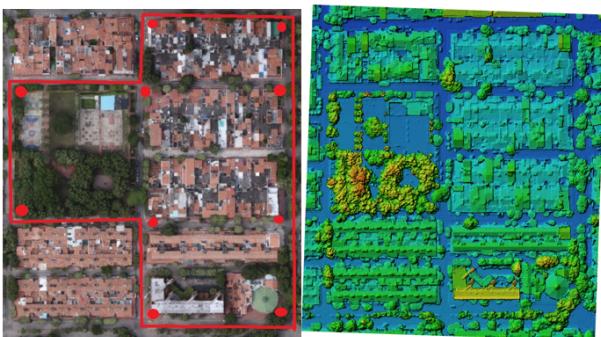 Source: (Barrera, 2018) Figure 2: Aerial delimitation photograph (a) and altimetry photograph of Los Pinos neighborhood, Cúcuta (b).
The next stage of the project consisted of taking measurements corresponding to Electric Field Strength (V/m), Magnetic Field Strength (A/m) and Power Density (W/m2) during a period of 6 minutes, using the RF intensity meter CEM
EXTECH INSTRUMENTS Model 480846 frequency scale from 10 MHz to 8GHz. During the data collection process, all measurement points were georeferenced.
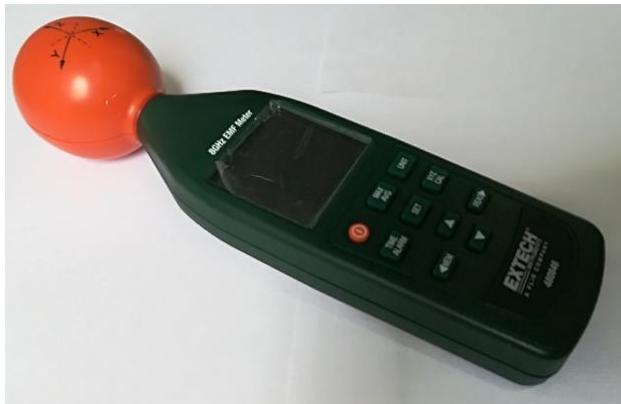 Source: (Barrera, 2018). Figure 3: EMF RF intensity measuring equipment
3.3 Processing
The third phase corresponded to the processing of the information collected and in its development box and whisker diagrams were used to compare the three measured variables such as electric field strength (V/m), magnetic field strength (A/m) and power density (W/m2).
{"image_source":{"path":"images/00807078fc1ac558b2fe6fb0656766df929c5e643bfe2b016d252c6c40f08da1.jpg"},"content":"","chart_caption":[{"type":"text","content":"Source: (Barrera, 2018)."},{"type":"text","content":"Figure 4: Electromagnetic Contamination Variation in Living Space in the Los Pinos Neighborhood Indoor Measurement"}],"chart_footnote":[]} As can be seen in Figure 4, the measurements obtained at the sampling points in the Los Pinos neighborhood showed a decrease in electromagnetic wave contamination when cellular equipment was not included.
Figure 5 shows the results of the measurements taken in neighborhoods on the outskirts of the city of Cúcuta, which allowed us to identify the increase in electromagnetic wave contamination when cellular equipment was included.
{"image_source":{"path":"images/dceea9783b9e4ee907aa505a3974d1ad95d3bd5ee8f41bc7af6823830df59aca.jpg"},"content":"","chart_caption":[{"type":"text","content":"Source: (Barrera, 2018)"},{"type":"text","content":"Figure 5: Electromagnetic Contamination Variation in Habitable Space Neighborhoods periphery Indoor Measurement."}],"chart_footnote":[]} As can be seen, the graphs presented above show opposite behaviors, since the variables studied increase or decrease depending on the inclusion or not of cellular telephone equipment.
3.4 Simulation model
The fourth phase of the project corresponds to the design of a simulation model, which consisted of using boxes with a base of 0.30 x 0.60 centimeters and a height of 0.30 centimeters in 5 different materials. The dimensions of the boxes were established based on the information obtained in the survey, which showed that most people rest with the cell phone equipment at 30 centimeters or less from the head, a measure that was established as the width of the base; the longest measure of the base was established at 60 centimeters to allow locating inside the boxes both the EMF RF intensity measuring equipment and the emission sources, either the wifi equipment or the cell phone equipment.
The time determined for taking measurements is 6 minutes, which corresponds to the time worked during the previous stages of measurement and as established by the IUT-T K.61 recommendation and the Colombian legislation.
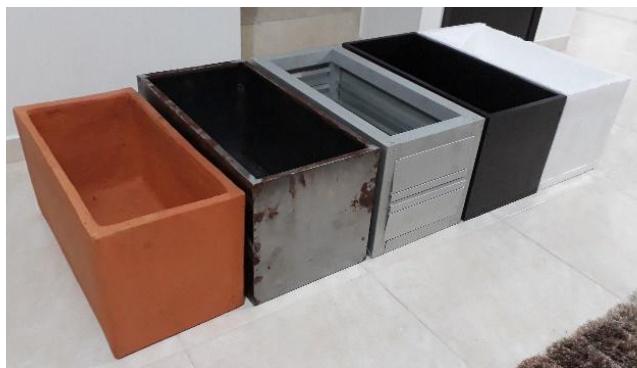 Source. (Barrera, 2018). Figure 6: Photograph of simulation model boxes made of clay, metal, aluminum, melanin and icopor.
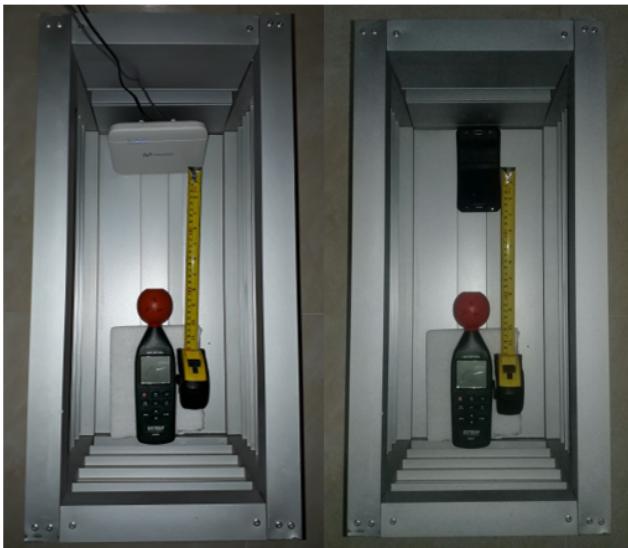
Measurements were taken without restriction and in each of the materials using two pieces of equipment. In the case of the cellular telephony equipment, the SAMSUNG J5 PRIME was used, which has average SAR values both in the manufacturing company and in the market (0.713 W/kg for the USA); the broadband or wifi equipment used was an Askey model
RTV9015VW. As with the field measurements, these were performed indoors at one of the points that presented the least interference at night.
 Source. Barrera, 2018).
Figure 7: Photograph of aluminum box with measuring equipment and a. Broadband or wifi equipment, b. Cellular telephone equipment. Broadband or wifi equipment, b. cellular telephony equipment.
3.5 Final results
The analysis of the study shows that environmental contamination by non-ionizing electromagnetic waves from wireless technologies is largely influenced by the construction materials used in the space and the distance to the source.
{"image_source":{"path":"images/1970e84477822e343a0e70578078bbc218606fd1b90c469717e56627e7983ef3.jpg"},"content":"","chart_caption":[{"type":"text","content":"Source: (Barrera, 2018)."},{"type":"text","content":"Figure 8: Electromagnetic Contamination Variation in Building Material Living Space. Indoor measurement."}],"chart_footnote":[]} As shown in graph 8, when the space was confined, the values of electric field (V/m), magnetic field (mA/m) and power density (mW/m2) increased, the latter being the highest with the proposed simulation model. All the materials worked differently, the normal one being the one that reflects the behavior of the environmental contamination corresponding to "no material". The metal box (representing metal carpentry in the living space) works as a Faraday Cage protecting from the emitting source; the clay box (representing masonry in the living space) is shown as the second highest blocking to electromagnetic pollution and; finally, the icopor boxes (representing light construction in the living space) and the melanin (representing furniture and architectural finishes in melanin in the living space) show a higher percentage of affectation by electromagnetic pollution. Finally, the aluminum box (represents aluminum carpentry in the living space) worked as an antenna or an amplifier equipment of the waves and therefore of the electromagnetic pollution.
The results obtained for Electromagnetic Contamination, Variation in Living Space in the Los Pinos Indoor Measurement Neighborhood, shown in Figure 4, show the interference phenomenon that affects the results due to radiation resulting from the contribution of all the radiofrequency sources whose fields are present in the area. It is important to keep in mind that it is feasible to reduce EMF in homes through a series of precautionary measures as established by (Álvarez-Ovallos et al., 2014) and (Tomitsch and Dechant, 2015), but in the case of Los Pinos Indoor Measurement it is an interference phenomenon and not a space free of electromagnetic contamination by non-ionizing electromagnetic waves resulting from wireless technologies. The results obtained for Electromagnetic Contamination Variation in Habitable Space in Peripheral Neighborhoods Indoor Measurement can be considered normal because when the cell phone is less than 30 centimeters away from the RF EMF intensity measuring equipment, the contamination increases.
IV. DISCUSSION
The proposed simulation model presents the results corresponding to the six restriction media proposed, establishing that there are materials that amplify the value of the electromagnetic waves under study in a constant way for Electric Field (V/m), Magnetic Field (mA/m), and in some cases presenting exponential increases such as the case of Power Density (W/m2) in the scenario corresponding to Aluminum.
The scenario corresponding to the Aluminum box shows that there are materials that can amplify values of non-ionizing electromagnetic waves, thus presenting an increase in one of the Electromagnetic Contamination indicators.
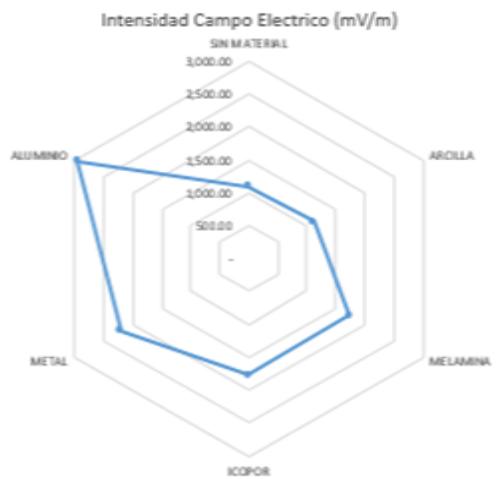
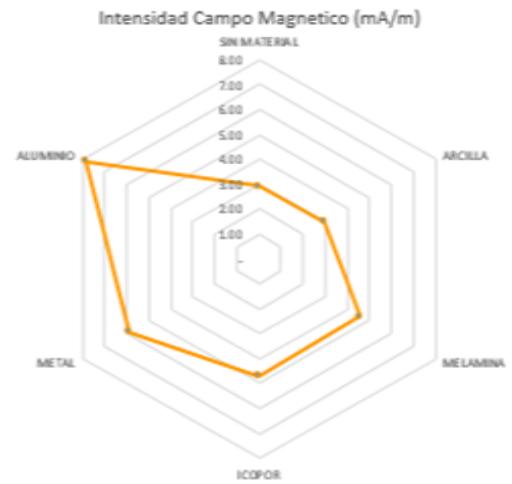
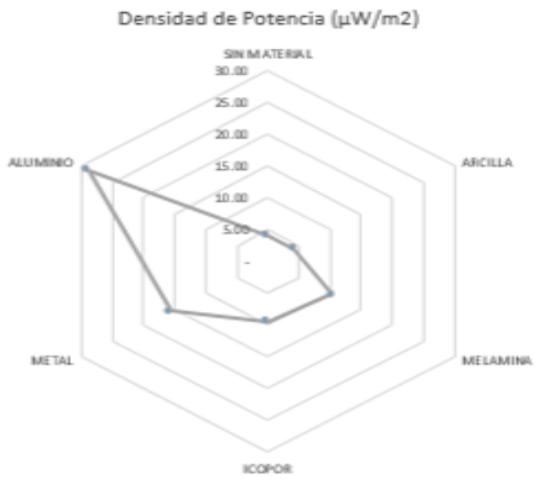 Figure 9: Radial graph of maximum average values of the simulation model Electric field (mV/m), Magnetic field (mA/m), and Power density ( W/m ).
V. CONCLUSIONS
The estimation of environmental pollution by non-ionizing electromagnetic waves produced by wireless technologies in living spaces is closely linked to the type of emission sources, number of sources, distance to the sources, location of the space under study and construction materials that confine the site.
The discrimination of non-ionizing electromagnetic wave producing devices produced by wireless technologies in residential rest areas should be based on the source and type of non-ionizing electromagnetic wave generated. Indoor emission devices correspond to cellular telephony equipment (mobile broadband) and wifi equipment (fixed broadband).
The establishment of the magnitudes of the parameters of non-ionizing electromagnetic waves in living spaces of rest is linked to a series of variables that in most cases the inhabitant cannot establish or control, but through the implementation of the culture of the correct use of wireless technology devices and the correct architectural design and use of suitable materials of the living space either outdoor or indoor source through visual inspections, electromagnetic pollution can be reduced.
Environmental contamination by electromagnetic waves in indoor spaces varies significantly depending on the spatial configuration, architectural arrangement, construction materials used, type of source and distance of the subject to the source, with aluminum being the material with the highest amplification values and clay-based materials those with the lowest values and therefore the least contamination with indoor sources.
Conflict of Interest
The authors declare no conflict of interest.
Ethical Approval
Not applicable
Data Availability
The datasets used in this study are openly available at [repository link] and the source code is available on GitHub at [GitHub link].
Funding
This work did not receive any external funding.
References
Cite this article
Related Research



Special Issue
Launch a focused special issue to highlight research, emerging trends, and expert insights in your academic field.
