I. INTRODUCTION
Let and ; be naturals, where . We consider the sufficient smooth function , where the point has coordinates
\[x_{k} = \left(x_{k,1}; \dots ; x_{k,n_{k}}\right) \in R^{n_{k}} (k\in e_{s} = \{1,\dots ,s\}).\]
More precisely,
\[R ^ {n} = R ^ {n _ {1}} \times R ^ {n _ {2}} \times \dots \times R ^ {n _ {s}}.\]
Thus we consider the fixed, non-negative, integral vector such that, , that is, , for all . Here we consider by Q the set of vectors where for every . The number of set Q is equal to:
\[|Q| = \prod_{k=1}^{s}(1 + n_k).\]
Therefore, to the vector , we shall correspond the vector of the set of non-negative, integral vectors , where
\[l ^ {0} = (0, 0, \dots , 0), l _ {k} ^ {1} = (l _ {k, 1}, 0, \dots , 0), \dots , l _ {k} ^ {i _ {k}} = (0, 0, \dots , l _ {k, n _ {k}})\]
for all . Then to the vector , we let correspond the vector , where . Here the largest number is less than for all , when then we assume that for all .
Theremore, we consider
\[D^{\vec{l}} f = D_{1}^{\vec{l}_{1}^i} \dots D_{s}^{\vec{l}_{s}^i} f,D_{k}^{\vec{l}_{k}^i} f = D_{k,1}^{\vec{l}_{k}^i} \dots D_{k,n_k}^{\vec{l}_{k}^i} f,G_{t^{\varkappa}} = G \cap I_{t^{\varkappa}}(x),\]
\[I _ {t ^ {\varkappa}} (x) = I _ {t _ {1} ^ {\varkappa_ {1}}} (x _ {1}) \times I _ {t _ {2} ^ {\varkappa_ {2}}} (x _ {2}) \times \dots \times I _ {t _ {s} ^ {\varkappa_ {s}}} (x _ {s}),\]
\[I_{t_k^{\nu_k}}(x_k) = \left\{ y_k : |y_k - x_k| < \frac{1}{2} t_k^{|\nu_k|}, k \in e_s \right\}\]
and
\[|\beta_k| = \sum_{j=1}^{n_k}\beta_{k,j}^{i_k}; |\beta_k^{i_k}| = \sum_{j=1}^{n_k}\beta_{k,j}^{i_k}\frac{dt_k}{t_k} = \prod_{j\in e_k^i}\frac{dt_{k,j}}{t_{k,j}},\]
we take , when , but when , then ; , , , and we take
\[\omega_{k,j} = 1, \mathrm{when} k\in e^i,\]
or we give
\[\omega_{k,j}=0,\mathrm{when}k\in e_{s}/e^{i},\]
\[e ^ {i} = s u p p \overline {{l}} ^ {i} = s u p p l ^ {i} = s u p p \omega , 1 \leq \theta \leq \infty ; 1 \leq p < \infty .\]
Here -is fixed vector and a∈ [0,1], , , . Here
\[\Delta^ {\omega} (t) f = \Delta_ {1} ^ {\omega_ {1}} (t _ {1}) \dots \Delta_ {s} ^ {\omega_ {s}} (t _ {k}) f,\]
when , and
\[\Delta_ {k} ^ {\omega_ {k}} (t _ {k}) f = \Delta_ {k, 1} ^ {\omega_ {k, 1}} (t _ {k, 1}) \dots \Delta_ {k, n _ {k}} ^ {\omega_ {k, n _ {k}}} (t _ {k, n _ {k}}) f, (k \in e _ {s}),\]
following are finite difference function, which has direction with variables and with order , by step for and for all and , following
\[\Delta_{k,j_{k}}^{1}(t_{k,j_{k}})f(\dots,x_{k,j_{k}},\dots)\]
\[False\]
and
\[\Delta_ {k, j _ {k}} ^ {\omega_ {k, j _ {k}}} \big (t _ {k, j _ {k}} \big) f \big (\dots , x _ {k, j _ {k}}, \dots \big) =\]
\[\Delta_ {k, j _ {k}} ^ {1} \big (t _ {k, j _ {k}} \big) \Big \{\Delta_ {k, j _ {k}} ^ {\omega_ {k, j _ {k}} - 1} \big (t _ {k, j _ {k}} \big) f \big (\dots , x _ {k, j _ {k}}, \dots \big) \Big \}\]
but when , then
\[\Delta_ {k, j _ {k}} ^ {0} (t _ {k, j _ {k}}) f (\dots , x _ {k, j _ {k}}, \dots) = f (\dots , x _ {k, j _ {k}}, \dots).\]
[10, 24, 25, 27]
Let us assume that we have a basis functions . Given function can be rewritten with this basis: . Hence we obtain
\[\langle \varphi_ {k}, f \rangle = \langle \varphi_ {k}, \sum_ {n = 1} c _ {n} \varphi_ {n} (x) \rangle = \sum_ {n = 1} c _ {n} \langle \varphi_ {k}, \varphi_ {n} \rangle = \langle \varphi_ {k}, \sum_ {k = 1} ^ {\infty} c _ {k} \varphi_ {k} (x) \rangle .\]
\[\sum_ {n = 1} ^ {\infty} c _ {n} \langle \varphi_ {k}, \varphi_ {n} \rangle = \langle \varphi_ {k}, \sum_ {k = 1} ^ {\infty} c _ {k} \varphi_ {k} (x) \rangle .\]
If introducing basis is an orthogonal basis, then we get , where is the Kronecker delta:
\[\delta_{kn} = \left\{ \begin{array}{l l} 1, & k = n \\ 0, & k \neq n \end{array} \right.\]
\[\langle \varphi_ {k}, f \rangle = \sum_ {n = 1} ^ {\infty} c _ {n} \langle \varphi_ {k}, \varphi_ {n} \rangle = \sum_ {n = 1} ^ {\infty} c _ {n} n _ {k} \delta_ {k n}.\]
That is,
\[c _ {k} = \frac{\langle \varphi_ {k} , f \rangle}{n _ {k}} = \frac{\langle \varphi_ {k} , f \rangle}{\langle \varphi_ {k} , \varphi_ {k} \rangle}, k = 1, 2, \ldots\]
Let be a linearly independent sequence of continuous functions defined for . The an orthogonal basis of functions can be found following
\[\varphi_{0} = f_{0}, \varphi_{k} = f_{k} - \sum_{n=0}^{n-1} \frac{\langle f_{k}, \varphi_{n}\rangle}{\|\varphi_{n}\|^{\tau}}, n = 1, 2, \ldots\]
[5, 7, 21, 26]
Definition. We denote by
\[\mathcal{L}_{p,a,\varkappa,\tau}(G)\]
normed Lorentz–Morrey space of locally summability, measurable functions f, on G, with finite norm
\[\| f \| _ {p, a, \kappa , \tau : G} = \| f \| _ {\mathcal{L} _ {p a \kappa \tau (G)}} =\]
\[\left\{
\begin{array}{c}
\left\{\int_{0}^{\infty} \left[ \prod_{k \in e_s} [ t_k ]_1^{- \frac{|\varkappa_k| a}{p} - 1} \times \| f^* \|_{p, G_{t^\varkappa}(x)} \right]^\tau \prod_{k \in e_s} \frac{d t_k}{t_k} \right\}^{1 / \tau}, \\
\sup_{0 < t < \infty} \left(\prod_{k \in e_s} [ t_k ]_1^{- \frac{|\varkappa_k| a}{p}} \times \| f^* \|_{p, G_{t^\varkappa}(x)}\right)
\end{array}
\right.
\tag{2}\]
where and is the decreasing rearrangement of f [9].
The properties of this space are main objects of Analysis. Let us give some characterization of :
-
is a qiasi-norm.
-
We must note that, for every
\[\mathcal{L}_{p,a,\kappa,p}(G) = \mathcal{L}_{p,a,\kappa}(G)\]
3) The space is complete.
4) For c>0 we have
\[\| f \| _ {p, a, c \kappa , \tau : G} = \frac{1}{C ^ {\frac{S}{\tau}}} \| f \| _ {p, a, \kappa , \tau : G}\] 5. For any we get:
a)
b)
- If then
\[\mathcal{L}_{q,b,\kappa,\tau_1}(G) \subset_{>} \mathcal{L}_{p,a,\kappa,\tau_2}(G)\]
and
\[\| f \| _ {p, a, \varkappa , \tau_ {2} \colon G} \leq \| f \| _ {q, b, \varkappa , \tau_ {1} \colon G}.\tag{3}\]
[2, 4, 8, 15, 16, 18, 23]
Some relations between this norm and some corresponding sums of Fourier coefficients are introduced for the case with a general orthonormal bounded system.
Let us take following well-known inequalities for
\[c _ {1} \big \| \bar{f} \big \| _ {\mathcal{L} _ {p, a, \varkappa , \tau (G)}} ^ {p} \leq \sum_ {i \in Q} \prod_ {k \in e _ {S}} [ t _ {k} ] _ {1} ^ {- \frac{| \varkappa_ {k} | a}{p}} \times\]
\[| r _ {k} | _ {p} \leq \frac {c _ {2}}{\prod_ {k \in e _ {S}} [ t _ {k} ] _ {1} ^ {- \frac {| \varkappa_ {k} | a}{p}}} \left\| D ^ {\bar {l} ^ {i}} f \right\| _ {\mathcal {L} _ {p, a, \varkappa , \tau} (G)} ^ {p}\tag{4).}\]
In addition, here
\[\overline{f(t)} = \frac{1}{\prod_{k\in e_s} [t_k]_1^{-\frac{|\varkappa_k|a}{p}}} \times \int_0^\infty f(s) \prod_{k\in s_k} \frac{ds_k}{s_k}\]
and is the derivative of the function . That is, are the Fourier coefficients of the function f. Here, is the nonincreasing rearrangement of the sequence .
Let us give generalized Lorentz-Morrey space such that
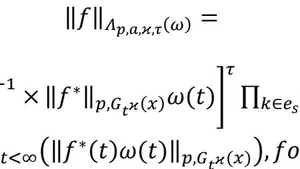
\[\begin{array}{r l} & {\| f \| _ {\varLambda_ {p, a, \varkappa , \tau} (\omega)} =} \\& {\left\{\left\{\int_ {0} ^ {\infty} \left[ \prod_ {k \in e _ {s}} [ t _ {k} ] _ {1} ^ {- \frac {| \varkappa_ {k} | a}{p} - 1} \times \| f ^ {*} \| _ {p, G _ {t ^ {\varkappa}} (x)} \omega (t) \right] ^ {\tau} \prod_ {k \in e _ {s}} \frac {d t _ {k}}{t _ {k}} \right\} ^ {1 / \tau}, \text{for } 0 < \tau < \infty \right.} \\& {\qquad \left. \sup_{0 < t < \infty} \big (\| f ^ {*} (t) \omega (t) \| _ {p, G _ {t ^ {\varkappa}} (x)} \big), \text{for } \tau = \infty \right\}} \end{array}\]
and where positive, having some additional growth property and .
Therefore, in this problem, if converges, then
\[\int_0^\infty \left(f(x) - \sum_{n=1}^{N} c_n \varphi_n\right)^{\tau} \to 0, N \to \infty.\]
Definition: Let be integrability function with s variables defining on the . The Fourier series expansion of the function f is following
\[f (\sigma) = f (\sigma_ {1}, \ldots , \sigma_ {s}) = \int \int \dots \int e ^ {- i (x _ {1} \sigma_ {1} + \dots + x _ {s} \sigma_ {s})} \prod_ {k \in e _ {s}} x _ {k}.\]
Then we hold
\[f (x) = \frac {1}{2 \pi} \int_ {0} ^ {\infty} (\dots \frac {1}{2 \pi} \left\{\int_ {0} ^ {\infty} f (x _ {1}, \ldots , x _ {s}) e ^ {i x _ {s} \cdot \sigma_ {s}} d \sigma_ {s} \right\} \times\]
\[e ^ {i x _ {s - 1} \cdot \sigma_ {s - 1}} d \sigma_ {s - 1} \dots \Big) e ^ {i x _ {1} \cdot \sigma_ {1}} \frac {d \sigma_ {1}}{\sigma_ {1}}.\tag{5}\]
We can imagine writing the Fourier series as following
\[\sum_ {i \in Q} c _ {\sigma_ {1}, \dots , \sigma_ {s}} \prod_ {k \in e _ {s}} e ^ {2 \pi \sigma_ {k} \cdot x _ {k}}.\]
The Fourier series expansion in n dimensional is approximated following
\[f(x) = \sum_{i\in\mathbb{Z}^n} c_i \prod_{k\in e_s} e^{2\pi\sigma_k\cdot x_k}.\]
The Fourier coefficients can be defined by the integral
\[\hat{f} = \int_{0}^{\infty} \int_{0}^{\infty} e^{-2\pi i \sigma_1 x_1} e^{-2\pi i \sigma_2 x_2} \dots e^{-2\pi i \sigma_s x_s} f(x_1, \dots x_s) \prod_{k \in e_s} x_k\]
\[r_k = r_k(f) = \int_0^\infty f(x)\phi_k(x)dx, k \in \mathbb{N}.\]
[11, 12, 22]
\[\text { II. } \quad \text { SOME MAIN RESULTS }\]
Theorem (Generalized Parseval): Let . Then
\[\| f \| _ {\mathcal {L} _ {p, a, \varkappa , \tau (G)}} ^ {\tau} = \sum_ {k = 1} ^ {\infty} | r _ {k} | ^ {\tau}\]
where
\[r_{k}=r_{k}(f)=\int_{0}^{\infty}\left|\prod_{k\in e_{s}}[t_{k}]_{1}^{-\frac{|\varkappa_{k}|a}{p}-1}\times f(x)\right|\times\]
\[\prod_{k\in e_{s}}e^{2\pi\sigma_{k}\cdot x_{k}}\prod_{k\in e_{s}}dx_{k}\]
are the Fourier coefficients of the functions f with respect to the trigonometric system.
Proof: Inverse of Fourier transformation is
\[f(x) = \sum_{k=1}^{\infty} r_k(\sigma) \prod_{k\in e_s} e^{2\pi\sigma_k\cdot x_k}\]
Use these two properties to rewrite the left-hand side of this theorem:
\[\begin{array}{c} \int_ {0} ^ {\infty} | f (x) | ^ {\tau} \prod_ {k \in e _ {s}} d x _ {k} = \int_ {0} ^ {\infty} | f (x) | \cdot | f (x) | \dots | f (x) | \prod_ {k \in e _ {s}} x _ {k} = \\\sum_ {k = 1} ^ {\infty} | r _ {k} | \Bigl \{\dots \sum_ {k = 1} ^ {\infty} | r _ {k} (\sigma) | \prod_ {k \in e _ {s}} e ^ {2 \pi \sigma_ {k} \cdot x _ {k}} \Bigr \}. \end{array}\]
\[\begin{array}{r l r} & & {\int_ {0} ^ {\infty} | f (x) | ^ {\tau} \prod_ {k \in e _ {s}} d x _ {k} = \sum_ {k = 1} ^ {\infty} | r _ {k} | \left\{\dots \sum_ {k = 1} ^ {\infty} | r _ {k} (\sigma) | \prod_ {k \in e _ {s}} e ^ {2 \pi \sigma_ {k} \cdot x _ {k}} \right\} =} \\& & {= \sum_ {k = 1} ^ {\infty} | r _ {k} | \dots \sum_ {k = 1} ^ {\infty} | r _ {k} ^ {*} |.} \end{array}\]
Taking generalized Cauchy-Schwarz and Holder inequalities we have
\[\int_ {0} ^ {\infty} | f (x) | ^ {\tau} \prod_ {k \in e _ {s}} d x _ {k} = \sum_ {k = 1} ^ {\infty} | r _ {k} | \dots \sum_ {k = 1} ^ {\infty} | r _ {k} ^ {*} | = \sum_ {k = 1} ^ {\infty} | r _ {k} | ^ {\tau}.\]
We must note that, Bessel inequality holds for any general orthonormal system. Let the function be periodic with period 1 and integrable on and be an orthogonal system. The numbers
\[r_{n}=r_{n}(f)=\int_{0}^{\infty}|f(x)\varphi_{k}(x)|\prod_{k\in e_{s}}dx_{k},\,n\in\mathbb{N}\]
are called the Fourier coefficients of the function with respect to the system .
Theorem (Bessel F.): Let are orthonormal system in , and are the Fourier coefficients of the function f. Then
\[\sum_{k=1}^\infty |r_k|^{\tau} \leq \int_0^\infty \left| \prod_{k\in e_s}[t_k]_1^{-\frac{|\varkappa_k|a}{p}-1} \times f(x) \right|^{\tau} \prod_{k\in e_s}\frac{dx_k}{x_k} = \|f\|_{\mathcal{L}_{p,a,\varkappa,\tau}(G)}^{\tau}\]
Proof of theorem: Let us rewrite following
\[\sum_ {k = 1} ^ {\infty} | r _ {k} | ^ {\tau} = \sum_ {k = 1} ^ {\infty} \bigl [ \int_ {0} ^ {\infty} f (x) \varphi_ {k} (x) \prod_ {k \in e _ {s}} d x _ {k} \bigr ] ^ {\tau}.\]
If we introduce infinite sum
\[f = \sum_{k=1}^{\infty} \int_0^\infty \bigl( f(x) \varphi_k(x) \bigr) \varphi_k(x) \prod_{k\in e_s} dx_k .\]
We know that, this series converges. With aid to Parseval's identity we have following
\[\begin{array}{r l} & 0 \leq \left\| f - \sum_ {k = 1} ^ {\infty} \int_ {0} ^ {\infty} (f (x) \varphi_ {k} (x)) \varphi_ {k} (x) \prod_ {k \in e _ {s}} d x _ {k} \right\| ^ {\tau} = \\& \| f \| ^ {\tau} - C _ {\tau} ^ {1} \sum_ {k = 1} ^ {\infty} \int_ {0} ^ {\infty} f (x) \cdot ((f (x) \varphi_ {k} (x)) \varphi_ {k} (x)) \prod_ {k \in e _ {s}} d x _ {k} + \\& \dots + (- 1) ^ {\tau + 1} C _ {\tau} ^ {\tau} \sum_ {k = 1} ^ {\infty} \int_ {0} ^ {\infty} | f (x) \varphi_ {k} (x) | ^ {\tau} \prod_ {k \in e _ {s}} d x _ {k} = \\& \| f \| ^ {\tau} - C _ {\tau} ^ {1} \sum_ {k = 1} ^ {\infty} \int_ {0} ^ {\infty} f (x) | f (x) \varphi_ {k} (x) | ^ {\tau} \prod_ {k \in e _ {s}} d x _ {k} + \dots \\& (- 1) ^ {\tau + 1} C _ {\tau} ^ {\tau} \sum_ {k = 1} ^ {\infty} \int_ {0} ^ {\infty} | f (x) \varphi_ {k} (x) | ^ {\tau} \prod_ {k \in e _ {s}} d x _ {k} = \\& \| f \| ^ {\tau} + \sum_ {k = 1} ^ {\infty} \int_ {0} ^ {\infty} | f (x) \varphi_ {k} (x) | ^ {\tau} \prod_ {k \in e _ {s}} d x _ {k} \end{array}\]
or . (if is even)
Let us introduce Rietz F. and Ficher E. theorem for Lorentz-Morrey type spaces with many groups of variables, which is the result that given space is complete and that is, every Cauchy sequence of function in convergence to a function in .
Theorem (Rietz F. and Ficher E.): Let are orthonormal system in and be an arbitrary sequence of Then there exists a function for which the numbers are its Fourier coefficients in this system and following inequality exits
\[\|f\|_{\mathcal{L}_{p,a,\kappa,\tau}(G)}^{\tau} \leq \sum_{k=1}^\infty |r_k|^\tau.\]
Proof of the theorem: In order to proof this theorem I have to proof that, given space is complete. It has been proved in [19].
From this theorem we hold following theorem.
Teorem: (F. Hausdorf and W. Yong)
- If and
\[r_{k} = r_{k}(f) = \int_{0}^{\infty} \left| \prod_{k\in e_{s}} [t_{k}]_{1}^{-\frac{|\varkappa_{k}|a}{p}-1} \times f(x) \right| \prod_{k\in e_{s}} e^{2\pi\sigma_{k}\cdot x_{k}} \prod_{k\in e_{s}} dx_{k}\]
then we get
\[\left(\sum_{k \in Z^{n}} | r_{k} |^{ρ}\right)^{1 / ρ} \leq \| f \|_{\mathcal{L}_{p, a, \kappa, \rho}(G)}\] 2. If and then the trigonometric series converges in the metric to some function and it holds that
\[\|f\|_{\mathcal{L}_{p,a,\kappa,\rho}(G)} \leq \left(\sum_{k\in\mathbb{Z}^n}|r_k|^\rho\right)^{1/\rho}\]
Where .
Teorem (Paley R.): Let be the orthonormal system on such that for all and and , . Then we have
\[1) (\sum_ {i = 1} ^ {\infty} | r _ {i} | ^ {\tau} k ^ {\tau - 2}) ^ {1 / \tau} \leq c _ {3} M ^ {\frac {2 - \tau}{\tau}} \| f \| _ {\mathcal {L} _ {p, a, \varkappa , \tau} (G)},\]
where and .
\[2) \| f \| _ {\mathcal {L} _ {p, a, \varkappa , \tau} (G)} \leq c _ {4} M ^ {\frac {\tau - 2}{\tau}} (\sum_ {i = 1} ^ {\infty} | r _ {k} | ^ {\tau} \times k ^ {\tau - 2}) ^ {1 / \tau} < \infty\]
where and the sequence satisfies the following condition
\[\left(\sum_ {i = 1} ^ {\infty} r _ {i} \times k ^ {\tau - 2}\right) ^ {1 / \tau} < \infty\]
and the function is given by the formula .
Proof: Taking inequality (2.7.3) in [17] we hold
\[\begin{array}{r l} & {\left(\sum_ {k = 1} ^ {\infty} | r _ {k} | ^ {\tau} k ^ {\tau - 2}\right) ^ {1 / \tau} \leq \sum_ {k = 1} ^ {\infty} \{| r _ {k} | ^ {\tau} \} ^ {1 / \tau} \sum_ {k = 1} ^ {\infty} \{k ^ {\tau - 2} \} ^ {1 / \tau} =} \\& {\qquad = \sum_ {k = 1} ^ {\infty} | r _ {k} | \sum_ {k = 1} ^ {\infty} \{k ^ {\tau - 2} \} ^ {1 / \tau}.} \end{array}\]
Then taking Bessel theorem we get
\[\sum_ {k = 1} ^ {\infty} | r _ {k} | = \| f \| _ {p}\]
and using Hardy-Littlewood inequality follows
\[\sum_ {k = 1} ^ {\infty} \{k ^ {\tau - 2} \} ^ {1 / \tau} = \sum_ {k = 1} ^ {\infty} k ^ {\frac {\tau - 2}{\tau}} =\]
\[\sum_ {k = 1} ^ {\infty} \left(k ^ {\frac {2 - \tau}{\tau}}\right) ^ {- 1 / \tau} \leq c _ {3} M ^ {\frac {2 - \tau}{\tau}}.\]
Then we get given first assumption.
2) Taking the Hardy-Littlewood inequality and Minkowski's inequality we hold
\[c _ {4} M ^ {\frac {\tau - 2}{\tau}} \biggl (\sum_ {i = 1} ^ {\infty} | r _ {k} | ^ {\tau} \times k ^ {\tau - 2} \biggr) ^ {1 / \tau} \geq c _ {4} M ^ {\frac {\tau - 2}{\tau}} \biggl (\sum_ {i = 1} ^ {\infty} | r _ {k} | ^ {\tau} \times (| k | + 1) ^ {\tau - 2} \biggr) ^ {1 / \tau} \geq\]
\[\left(\sum_ {i = 1} ^ {\infty} | r _ {k} ^ {*} | ^ {\tau} \times (| k | + 1) ^ {\tau - 2}\right) ^ {1 / \tau} \geq \int_ {0} ^ {\infty} | f (x) | ^ {\tau} \prod_ {k \in e _ {s}} d x _ {k}.\]
Theorem A: Let us suppose that the function f satisfying following conditions
\[| f (x _ {1} + t _ {1}, x _ {2}, \dots x _ {s}) - f (x _ {1}, x _ {2}, \dots x _ {s}) | \leq C | t _ {1} | ^ {\alpha}\]
\[| f (x _ {1}, x _ {2} + t _ {2}, \dots x _ {s}) - f (x _ {1}, x _ {2}, \dots x _ {s}) | \leq C (x _ {1}) | t _ {2} | ^ {\alpha}\]
\[| f (x _ {1}, x _ {2}, \dots x _ {s} + t _ {s}) - f (x _ {1}, x _ {2}, \dots x _ {s}) | \leq C (x _ {1}, \dots x _ {s - 1}) | t _ {s} | ^ {\alpha}\]
\[\int_ {0} ^ {\infty} C (x _ {1}) \prod_ {k = 1, \dots n _ {k}} d x _ {1, k}, k \epsilon e _ {s} < \infty\]
\[\int_ {0} ^ {\infty} C (x _ {1}, \dots , x _ {s - 1}) \prod_ {k \in e _ {s}} \prod_ {k = 1, \dots n _ {k}} d x _ {1, k} < \infty , 0 < \alpha \leq 1.\]
Then (5) holds, if we take limit for :
\[f (x) = \frac {1}{2 \pi} \lim _ {N _ {1} \to \infty} \int_ {- N _ {1}} ^ {N _ {1}} (\dots \frac {1}{2 \pi} \lim _ {N _ {s - 1} \to \infty} \left\{\int_ {- N _ {s - 1}} ^ {N _ {s - 1}} \lim _ {N _ {s} \to \infty} \int_ {- N _ {1}} ^ {N _ {1}} f (x _ {1}, \ldots , x _ {s}) e ^ {i x _ {s} \cdot \sigma_ {s}} d \sigma_ {s} \right\} \times\]
\[e ^ {i x _ {s - 1} \cdot \sigma_ {s - 1}} d \sigma_ {s - 1} \dots \Big) e ^ {i x _ {1} \cdot \sigma_ {1}} d \sigma_ {1}.\tag{6}\]
Proof: Taking
\[f _ {1} (\sigma_ {1}, x _ {1}, \dots , x _ {s}) = \int_ {0} ^ {\infty} f (x _ {1}, \dots , x _ {s}) e ^ {i x _ {1} \cdot \sigma_ {1}} \prod_ {k = 1, \dots n _ {k}} d x _ {1, k}\]
and with aid of Fubini's theorem the function is summarized for all . Following taking first condition we get
\[f (x _ {1}, \dots , x _ {s}) = \lim _ {N _ {1} \to \infty} \frac {1}{2 \pi} \int_ {0} ^ {N _ {1}} f _ {1} (\sigma_ {1}, x _ {1}, \dots , x _ {s}) e ^ {i \sigma_ {1} x _ {1}} \prod_ {k = 1, \dots n _ {k}} d x _ {1, k}.\]
Indeed, the function is summarized for all . In addition, with aid of given condition we have
\[| f (\sigma_ {1}, x _ {2} + t _ {2}, \dots x _ {s}) - f (x _ {1}, x _ {2}, \dots x _ {s}) | \leq\]
\[\int_ {0} ^ {\infty} | f (\sigma_ {1}, x _ {2} + t _ {2}, \dots x _ {s}) - f (x _ {1}, x _ {2}, \dots x _ {s}) | \leq\]
\[| t _ {\alpha} | ^ {\alpha} \int_ {0} ^ {\infty} C (x _ {1}) \prod_ {k = 1, \dots n _ {k}} d x _ {1, k}.\]
Then we hold following
\[f _ {2} (\sigma_ {1}, \sigma_ {2}, x _ {1}, \dots , x _ {s}) = \int_ {0} ^ {\infty} f _ {1} (x _ {1}, \dots , x _ {s}) e ^ {i x _ {2} \cdot \sigma_ {2}} \prod_ {k = 1, \dots n _ {k}} d x _ {2, k}.\]
Then next expression is real
\[f _ {1} (\sigma_ {1}, x _ {1}, \dots , x _ {s}) = \lim _ {N _ {2} \to \infty} \frac {1}{2 \pi} \int_ {N _ {2}} ^ {N _ {2}} f _ {2} (\sigma_ {1}, \sigma_ {2}, x _ {1}, \dots , x _ {s}) e ^ {i x _ {2} \cdot \sigma_ {2}} \prod_ {k = 1, \dots n _ {k}} d x _ {2, k}.\]
Where
\[f (x _ {1}, \dots , x _ {s})\]
\[= \lim _ {N _ {1} \to \infty} \frac {1}{2 \pi} \int_ {0} ^ {N _ {1}} \left\{\lim _ {N _ {2} \to \infty} \frac {1}{2 \pi} \int_ {0} ^ {N _ {2}} f _ {2} (\sigma_ {1}, \sigma_ {2}, x _ {3}, \dots , x _ {s}) e ^ {i \sigma_ {2} x _ {2}} \prod_ {k = 1} ^ {n _ {k}} d \sigma_ {2, k} \prod_ {k = 1} ^ {n _ {k}} d \sigma_ {1, k}\right\}.\]
Then continuing such way we get our assumption. [3, 6, 13, 14, 20, 28]
ACKNOWLEDGEMENT
The author wishes to thank her teachers Professors Mahammad Quliyev, Sadig Abdullaev, Sabir Mirzoev, Alik Nadjafov and Adish Mammadov for several conversations and some books. The author is grateful to the referees for numerous comments that improved the quality of the paper.