





IntelliPaper
Explore Digital Article Text
I. INTRODUCTION
In this paper I will present a theory of composition based on the work and commentary of Ernest Hemingway. Although there has been some talk of a Hemingway theory of composition, and some of its aspects are well known, it has never been compiled into a whole before (though I'll give Joe Bunting credit, he has crafted a reasonable summary of a number of the points I will bring up [see the website in Sources Cited]; and I should mention Ernest Hemingway on Writing by Larry W. Phillips [1999]). Hemingway's writing technique has a number of well-known qualities that will make their way into this theory, and thus some of this material and data is already well known. His work has been called "uncompromising," and the language is seen as short, direct, and to the point. No doubt true enough, but I hope to go a bit deeper in my examination. We might view Hemingway's talent, in the manner in which he once viewed the skills of his sometime-friend F. Scott Fitzgerald:
His talent was as natural as the pattern that was made by the dust of a butterfly's wings. At one time he understood it no more than the butterfly did and he did not know when it was brushed or marred. Later he became conscious of his damaged wings and of their construction and he learned to think and could not fly anymore because the love of flight was gone and he could only remember when it had been effortless (A Moveable Feast 129).
We will find that Hemingway thought much the same of his own writing, below.
A. E. Hotchner wrote in Papa Hemingway that as he was preparing to interview Papa in 1948, he was "struck with an affliction common to my generation: 'Hemingway Awe'" (3), which is a feeling that I know many people would agree with in terms of Hemingway's writing. When Hotchner was given a first draft of The Old Man and the Sea in Havana in the early 1950s, he experienced "one of the most overwhelming reading experiences of my life" (72), which many other readers have also had while consuming Hemingway's brilliant prose.
At one point, Phillips writes that "At some times [Hemingway] showed an almost superstitious reluctance to talk about writing, seeming fearful that saying too much might have an inhibiting effect on his muse" (Foreword). I have not found this to be true, and in fact Hem often wrote up his views on the theory and practice of writing and composition in substantial detail, and I will refer often to these words in this paper. (Admittedly, Phillips later says "Hemingway wrote often about writing" [Preface]).
Although this paper is not an overt analysis of Hemingway's "style," proper, I will endeavor to include some passages from his work to illustrate my points, and to highlight the methods that Hemingway believed led to best writing.
II. COMPOSITION THEORY
To give some initial shape to this discussion, following is a brief look at some of the terminology that has been used in terms of theories of composition in the past. Much of this is rather rigid and static, with focuses on areas that are not in fact related to writing much at all (the reader will have to use his imagination in terms of how these ideas might actually accord with writing and composition, not least Hemingway's). These theories employ declarations about "joining statements," "possibilistic information-flow" (Maclean) "spatial composition" (and similarly, "the theory of composition [tracing] how the impact of the image is achieved, of form and space in design, on human perception" [from Zheleva-Martins]), "theory of signs," "formation" (often in terms of industrial design, which in some respects has been connected with writing and composition), and somewhat high-flown conceptions of logic, principles, techniques, rules, and styles.
Much early theory of composition simply focused on mechanics, grammar, structure, and the like. Theory of late in actual terms of writing revolves around process (and post-process)—that is, writing as a process rather than a product—as well as generalized looks at writing classes in college and what they teach in terms of subject creation and invention, prewriting, drafting, thesis construction, essay structure, revision, parallelism, audience, general language usage, pedagogy, genre, voice, and assessment (what might be called "cognitive writing theory," or simply "academic writing," and these are also elements of Process Writing Theory, "viewed not just as a linear series of stages but rather as a hierarchical set of sub-processes" [Yao 188]).
"Cultural studies" theories of composition (social or socio-cultural theory) have come into vogue, examining writing as an artifact of culture and what happens in writing when cultures come into contact with each other (from Wikipedia, "Cultural studies theory of composition"). Such social views have branched into a variety of possibilities—"social-cognitive" (accounting for the cognitive operations and representations that underlie the social process of communicating in a specific social context.), "social constructionism" (treating writing as the conversant activity of members of particular discourse communities), "social interactive theory" (a mutual frame of reference, a shared social reality between writer and reader), "social-historic theory" (words as dynamic, negotiable spaces within which particular personal and social significations converge, clash, and co-exist.). and "social-humanistic theory" (writing based on personal experience and interactivity) (all above from Yao). In all of the above, we see how writing Is "simultaneously...a cognitive and social activity, and that these approaches may differ to a certain extent, but they are mutually reinforcing rather than incompatible" (Yao 197).
Edgar Allen Poe wrote his "The Philosophy of Composition," a relatively simplistic approach that focused on: 1. The length of works (he believed they should be short); 2. Method (he argued that writing is methodical and analytical, as opposed to spontaneous.), and 3. "Unity of effect" (emotional response to a work).
Vandenberg et. al. come up with a reasonable overall theory comprised of Relations, Locations, Positions, in which the authors look at: 1. Conversations and negotiations with others (relations); 2. Writing in terms of material places and intellectual spaces (locations); and 3. The contingency of our beliefs, values and identity (positions). This is a good look, and will have some usefulness in terms of our look at Hemingway, which I will now turn to.
III. HEMINGWAY'S JOURNALISM METHODOLOGY
To begin in earnest (pardon the linguistic aside), in some senses we might turn to journalism methods as core to the Hemingway Theory of
Composition. Needless to say, Hemingway was an enthusiastic journalist who worked for numerous newspapers and magazines during his life, even when he was principally a writer of literature, into the 1940s. This might be called the "who, what, when, where, why, how" approach to writing—and we see associations with what we have looked at so far: Who (social, cultural, relations) What (positions, method, corporeality), When (process, in the offing), Where (locations, discernment), Why and How (that which is cognitive, apperceptive).
Hemingway once wrote, seeming to reach into these depths, "I was trying to write then and I found the greatest difficulty, aside from knowing truly what you really felt, rather than what you were supposed to feel, and had been taught to feel, was to put down what really happened in action [italics added]; what the actual things were which produced the emotion that you experienced. In writing for a newspaper you told what happened and, with one trick and another, you communicated the emotion aided by the element of timeliness which gives a certain emotion to any account of something that has happened on that day; but the real thing, the sequence of motion and fact which made the emotion and which would be as valid in a year or in ten years or, with luck and if you stated it purely enough, always, was beyond me and I was working very hard to get it" (in Phillips, Death in the Afternoon, 2; and more on permanence and "always" below).
To be sure Hemingway considered these methods important to his own style, which generally meant that which is "economical and understated" (Wikipedia, "Ernest Hemingway"), refraining from excessive use of adjectives and adverbs, avoiding literary wandering and fanciful asides. Ezra Pound was "...the man who had taught me to distrust adjectives as I would later learn to distrust certain people in certain situations..." Papa wrote (A Moveable Feast, 134) Hemingway did not... "adorn his prose with extra words and poetic-sounding language" (Baldwin). Instead he used unpretentious, declarative sentences, short, simple words, a definite lack of superfluity, and a positive, vigorous approach. Hemingway wrote in For Whom the Bell Tolls, "The world is a fine place and worth fighting for and I hate very much to leave it," a sentence with 16 of 19 words one syllable in length, and the remaining two with two syllables. And there is the classic opening to A Moveable Feast: "Then there was the bad weather" (3). "Show the readers everything, tell them nothing," he once said, indicating his refusal to "explain" to readers (Goodreads), and another time he said, in no uncertain terms, "My aim is to put down on paper what I see and what I feel in the best and simplest way" (UP Journey). He also said in a journalism way, "If I started to write elaborately, or like someone introducing or presenting something, I found that I could cut that scrollwork or ornament out and throw it away and start with the first true simple declarative sentence I had written" (Bunting). "Do not worry," Hem went on in A Moveable Feast. "You have always written before and you will write now. All you have to do is write one true sentence. Write the truest sentence that you know" (12).
Newspaper writing was often the path to this simplified approach, and "On the [Kansas City] Star you were forced to learn to write a simple declarative sentence. This is useful to anyone. Newspaper work will not harm a young writer and could help him if he gets out of it in time" (in Phillips, "An Interview with Ernest Hemingway" The Paris Review 18, Spring 1958). He went on, indicating his preference for the short, direct and simple (and much more on this below), "There were many words that you could not stand to hear and finally only the names of places had dignity. Certain numbers were the same way and certain dates and these with the names of the places were all you could say and have them mean anything. Abstract words such as glory, honor, courage, or hallow were obscene beside the concrete names of villages, the numbers of roads, the names of rivers, the numbers of regiments and the dates" (Goodreads). In some ways we see here again the importance of "positions," and "locations," a la Vandenberg et. al.
Hemingway once told his friend F. Scott Fitzgerald, "Write the best story that you can and write it as straight as you can" (A Moveable Feast 160). Of his understated journalism style, he once wrote in a letter, "I am trying to make, before I get through, a picture of the whole world—or as much of it as I have seen. Boiling it down always, rather than spreading it out thin" (to Mrs. Paul Pfeiffer, 1933, Baker, 397).
Simply put, Hemingway considered much of his literature to be based on journalism style and methods, and some of this work was even actual journalism (The Green Hills of Africa, The Dangerous Summer). Along these lines, and as noted, Papa avoided excessive "explanation", interpretation and even overt description. Again, this is in essence journalism-style writing, and Hemingway once said, "Since I had started to break down all my writing and get rid of all facility and try to make instead of describe, writing had been wonderful to do" (A Moveable Feast 136). Any good journalist would understand what it means to "make" story, as opposed to neutral "description." Hemingway went on in a letter to his father in 1925, "You see I am trying in all my stories to get the feeling of the actual life across - not to just depict life—or criticize it—but to actually make it alive. So that when you have read something by me you actually experience the thing" (Baker 153). Also, in A Moveable Feast, Hemingway wrote "...I'm trying to do it so it will make it without you knowing it, and so the more you read it, the more there will be" (138).
Another time he said, in a journalistic vein, and capturing his preference to always be observing and taking note of what he saw around him, "My aim is to put down on paper what I see and what I feel in the best and simplest way" (UP Journey). In terms of all the journalism methods and styles that Hemingway employed, we might say this was all an effort to "enter the story," which he strongly endorsed. "Then I went back to writing," he wrote in A Moveable Feast, "and I entered far into the story and was lost in it. I was writing it now and it was not writing itself and I did not look up nor know anything about the time nor think where I was" (5). There was a reverse to this as well, and once he found that "the story was writing itself and I was having a hard time keeping up with it" (A Moveable Feast 5). Similarly, in his unadorned and positive imagery brought to life on the page, "I was writing about up in Michigan, and since it was a wild, cold, blowing day it was that sort of day in the story" (A Moveable Feast 4).
IV. THE ICEBERG THEORY OF LITERATURE
A second of Hemingway's key theoretical approaches has been commented on extensively: his "Iceberg Theory" of writing. In this approach, Hemingway said that only the tip of true meaning showed in fiction—readers see only the tops of the icebergs above the water—but the knowledge that you wish to convey about character and significance (much of which never even makes it into the story) is in fact the bulk of the iceberg beneath the surface. This is what gives your story weight and gravitas. Hotchner wrote how Hemingway "long ago explained to me that your stories gain strength in direct ratio to what you can leave out of them.... It's only the important things you know about and omit that strengthen the story," capturing the essence here (163). Hemingway once said of his story "The Killers," "That story probably had more left out of it than anything I ever wrote. I left out all Chicago" (Tyler, 80). He went on about his story "Out of Season" that "I had omitted the real end of it which was that the old man hanged himself. This was omitted on my new theory that you could omit anything if you knew that you omitted and the omitted part would strengthen the story and make people feel something more than they understood" (A Moveable Feast, 75). Of one of his greatest stories he said, "I guess the story that tops them all for leave-out was 'A Clean Well-Lighted Place.' I left everything out of that one" (Hotchner 164).
Hemingway went on that, "If a writer of prose knows enough of what he is writing about he may omit things that he knows and the reader, if the writer is writing truly enough, will have a feeling of those things as strongly as though the writer had stated them. The dignity of movement of an ice-berg is due to only one-eighth of it being above water. A writer who omits things because he does not know them only makes hollow places in his writing" (Death in the Afternoon, 154). In one comment, Hemingway seems to be commenting on what can and cannot be discerned in each piece of writing, when he says, "Things may not be immediately discernible in what a man writes, and in this sometimes he is fortunate; but eventually they are quite clear, and by these and the degree of alchemy that he possesses, he will endure or be forgotten" (UP Journey). And finally, Hemingway in A Moveable Feast wrote "The story was about coming back from the war but there was no mention of the war in it" (76).
Readers are left to decide how iceberg-like Hemingway's works actually are—what they believe may have been left out, and what they themselves believe is the bulk of meaning and significance that lies "beneath the surface" of the fictional waters.
4.1 Le Mot Juste and Writing is Rewriting
Another key theoretical point to consider—and Hemingway very much considered this stylistic approach just that, theoretical to the extreme—is his less-well-known skill at choosing what he called, le mot juste, the one and only best word to be used in any sentence. Hemingway said of Ezra Pound in A Moveable Feast, he was "the man I liked and trusted the most as a critic then, the man who believed in the mot juste—the one and only correct word to use..." (118). To be sure Hemingway believed exactly this, and his propensity to rewrite his work to the nth degree is associated with this—"I rewrote the ending to A Farewell to Arms, the last page of it, thirty-nine times before I was satisfied" (UP Journey) he said, and "I always rewrite each day up to the point where I stopped. When it is all finished, naturally you go over it. You get another chance to correct and rewrite when someone else types it, and you see it clean in type. The last chance is in the proofs. You're grateful for these different chances" (BrainyQuote). "The only kind of writing is rewriting," he said in A Moveable Feast, coining the classic phrase (from Goodreads), and Hemingway may have had this in mind when he once said "I am like a blind pig when I work" (A Moveable Feast 87). "Today I reread and rewrote four chapters," he told a group of high school students in 1958 (Hotchner 201). "You put down the words in hot blood, like an argument, and correct them when your temper has cooled" (201). Hemingway's propensity was to read every word he had written the day before the following day, and carefully edit every word yet again (as with A Farewell to Arms). The absolute best writing method, he said, was "to read it all every day from the start, correcting as you go along, then go on from where you stopped the day before. When it gets so long that you can't do this every day read back two or three chapters each day; then each week read it all from the start. That's how you make it all of one piece" (Farnam Street). As noted here, rereading every word, every day, was critical. "After writing a story," Hem advised, "I was always empty and both sad and happy, as though I had made love, and I was sure this was a very good story although I would not know truly how good until I read it over the next day" (A Moveable Feast 5-6). Associated with this idea is the necessity of stopping writing when you know "what will happen next." The best method, Hemingway wrote in an October 1935 article in Esquire, was "always to stop when you are going good and when you know what will happen next. If you do that every day when you are writing a novel you will never be stuck. That is the most valuable thing I can tell you so try to remember it" (CWA).
He went on that, "It was in that room too that I learned not to think about anything that I was writing from the time I stopped writing until I started again the next day. That way my subconscious would be working on it and at the same time I would be listening to other people and noticing everything" (A Moveable Feast, 12, and here we see hints of Vandenberg's Relations). "What did I know best that I had not written about and lost?" Hemingway continued. "What did I know about truly and care for the most? There was no choice at all" (Bunting). More on these approaches below.
4.2 The Well of Writing, and, Observe
To continue, "Never empty yourself of what you have" was one of Hemingway's key approaches. "I had learned already never to empty the well of my writing, but always to stop when there was still something there in the deep part of the well, and let it refill at night from the springs that fed it" he wrote in A Moveable Feast (23). Hemingway wrote of his love of writing in coffee shops in the morning (he never missed a sunrise, and rose at 5:00 am every day he once said, in order to quickly breakfast and be off to the shops) and how in these locations he sometimes filled his well—his principle method of always observing. "A girl came into the café and sat by herself at a table near the window," he wrote in A Moveable Feast (5). "She was very pretty with a face fresh as a newly minted coin if they minted coins in smooth flesh. I've seen you, beauty, and you belong to me now, whoever you are waiting for and if I never see you again, I thought. You belong to me and all Paris belongs to me and I belong to this notebook and this pencil" (5). "If a writer stops observing he is finished," Hemingway wrote. "Experience is communicated by small details intimately observed." Papa went on that "When people talk listen completely. Don't be thinking what you're going to say. Most people never listen. Nor do they observe. You should be able to go into a room and when you come out know everything that you saw there and not only that. If that room gave you any feeling you should know exactly what it was that gave you that feeling. Try that for practice" (above from Goodreads). Here we see Vandenberg's Relations at work.
4.3 Truth
Associated with these ideas is Hemingway's focus on the truth (which can be associated with his effort to find the "one true and only word" in every sentence he wrote). Make your writing truer than real—write what you know and love, was Hemingway's central aim.
"All good books are alike in that they are truer than if they had really happened," he wrote, "and after you are finished reading one you will feel that all that happened to you, and afterwards it will all belong to you—the good and the bad, the ecstasy, the remorse, and sorrow, the people and the places and how the weather was. If you can get so that you can give that to people, then you are a writer" (LibQuotes). Imparting truth at every turn, was for Hemingway, taken "From things that have happened and from things as they exist and from all things that you know and all those you cannot know, you make something through your invention that is not a representation but a whole new thing truer than anything true and alive, and you make it alive, and if you make it well enough, you give it immortality" (UP Journey). "True fiction must come from everything you've ever known, ever seen, ever felt, ever learned" he said to Hotchner in Papa Hemingway (103). He went on that the real challenge in writing is to "make the person who is reading [the prose] believe that the things happened to him too" (Gatzemeyer). Further in A Moveable Feast, Papa wrote "I decided that I would write one story about each thing that I knew about. I was trying to do this all the time I was writing, and it was good and severe discipline" (12). In his reading of Dostoyesky, referring to his own attachment to all things military, Hemingway wrote that "there were things believable and not to be believed, but some so true they changed you as you read them; frailty and madness, wickedness and saintliness, and the insanity gambling were there to know as you knew the landscape and toads in Turgenev, and the movement of troops, the terrain and the officers and the men and the fighting in Tolstoi" (A Moveable Feast 117). To sum up, Hemingway wrote that "I am trying in all my stories to get the feeling of the actual life across—not to just depict life—or criticize it—but to actually make it alive. So that when you have read something by me, you actually experience the thing. You can't do this without putting in the bad and the ugly as well as what is beautiful" (UP Journey). Along these lines, he wrote, "You see I'm trying in all my stories to get the feeling of the actual life across—not to just depict life—or criticize it—but to actually make it alive. So that when you have read something by me you actually experience the thing. You can't do this without putting in the bad and the ugly as well as what is beautiful. Because if it is all beautiful you can't believe in it. Things aren't that way. It is only by showing both sides—3 dimensions and if possible 4 that you can write the way I want to" (letter to Dr. C. E. Hemingway, 1925, Baker, 153).
Hemingway finally said, "I was trying to write then and I found the greatest difficulty, aside from knowing truly what you really felt, rather than what you were supposed to feel, and had been taught to feel, was to put down what really happened; what the actual things were which produced the emotion that you experienced...the real thing, the sequence of motion and fact which made the emotion and which would be as valid in a year or in ten years or, with luck and if you stated it purely enough, always, was beyond me and I was working very hard to get it" (Goodreads).
Hemingway once commented that imagination "is the one thing beside honesty that a good writer must have." He went on to link imagination and truth, in that "The more [one] learns from experience the more truly [one] can imagine. If [one] gets so [one] can imagine truly enough people will think that the things he relates all really happened..." (By-Line, no page number).
4.4 Art and Writing
In another theoretical turn, Hem wrote of the importance of bringing in visual and musical art into "one's" writing. EH once said that his writing at the beginning of A Farewell to Arms, was a "conscious imitation of the way Mr. Johann Sebastian Bach used a note in music when he was emitting counterpoint" (Wells). He was referring to his use of the word "and," which appears about 50 times in the first paragraph of the novel. In A Moveable Feast Hemingway wrote "I went [to the Musée du Luxembourg] nearly every day for the Cézannes and to see the Manets and the Monets and the other Impressionists...I was learning something from the painting of Cézanne that made writing simple true sentences far from enough to make the stories have the dimensions I was trying to put in them. I was learning very much from him but I was not articulate enough to explain it to anyone. Besides it was a secret" (12-13). He studied how painters helped him to see, to hear, and how to feel or not feel. They were part of his ability to present an image hard, clear, concentrated and as true as a painter's color. "Ernest always tried to locate the heart of a painting, what he called 'the pure emotion,' the real thing the artist set out to achieve" wrote Hotchner (187). "...and he identified with the difficulty of the artist's task, for he felt that as a writer he had the same struggle to achieve the same pure emotion..." (187). "Eschew the monumental. Shun the Epic," Hemmingway wrote. "All the guys who can paint great big pictures can paint great small ones" (letter to Maxwell Perkins, 1932, Baker, 352).
4.5 Read
In what might seem an obvious approach that is vital to good writing, Hemingway recommended that writers read. Hemingway was a prodigious reader, and "When I was writing," he said in A Moveable Feast, "it was necessary for me to read after I had written....afterwards, when you were empty, it was necessary to read in order not to think or worry about your work until you could do it again...To keep my mind off writing sometimes after I had worked I would read writers who were writing then, such as Aldous Huxley, D.H. Lawrence..." (23-24). In a word, "There is no friend as loyal as a book" (Goodreads), and Hemingway wrote appreciatively of the great Russian novelist masters in A Moveable Feast—including, as noted, Dostoyevksy, and "I had read all of Turgenev, what had been published in English of Gogol...Tolstoi and...Chekov" (117).
In another amusing turn, Papa wrote "If the book is good, is about something that you know, and is truly written, and reading it over you see that this is so, you can let the boys yip and the noise will have that pleasant sound coyotes make on a very cold night when they are out in the snow and you are in your own cabin that you have built or paid for with your work" (AZ Quotes). Lucy Fuggle writes of how in 1934 a "young American with aspirations to become a writer hitched 2,000 miles across America. The reason? To find Ernest Hemingway and get some advice." The advice asked for was which great books to read, and Hemingway provided a list of 16 including Crane, Twain, Hawthorne, Flaubert, Joyce and a number of the great Russians (see Fuggle, and Hemingway often spoke of writers he recommended in several of his books).
V. THE COMFORT ZONE, DON'T WORRY, DON'T SELL YOURSELF
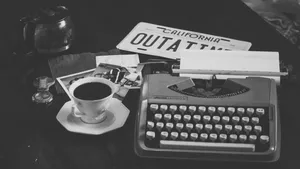
Write at the same time every day in a comfortable location—advice any writer would probably enjoy taking. "It was a pleasant café, warm and clean and friendly," he wrote of favorite café on the Place St-Michel (A Moveable Feast 4). "I hung up my old waterproof on the coat rack to dry and put my worn and weathered felt hat on the rack above the bench and ordered a café au lait. The waiter brought it and I took out a notebook from the pocket of the coat and a pencil and started to write" (A Moveable Feast 4). It was most important "to write in tranquility" Hemingway once said, "trying to write as well as I can, with no eye on any market, nor any thought of what the stuff will bring, or even if it can ever be published" (letter to Grace Hall Hemingway, 1927, Baker 244).
A couple of final points in Hemingway's theory include his advising readers to not worry too much— "For Christ sake write and don't worry about what the boys will say nor whether it will be a masterpiece nor what. I write one page of masterpiece to ninety one pages of shit. I try to put the shit in the wastebasket" (letter to F. Scott Fitzgerald, 1934, Baker, 408). and finally, "Don't sell yourself." "Write the best story that you can and write as straight as you can" he told F. Scott Fitzgerald (A Moveable Feast 160), and most of all, he told his friend, "don't write slop" (A Moveable Feast 160).. The important thing was not to sell oneself out writing stories for magazines, much less anything like film scripts. "F. Scott Fitzgerald had told me how he wrote what he thought were good stories," said Hemingway, "and which really were good stories" (A Moveable Feast 136). Fitzgerald, however, "changed them for submission, knowing exactly how he must make them into salable magazine stories. I had been shocked at this and I said I thought it was whoring.... I said that I did not believe anyone could write any way except the very best he could write without destroying his talent" (A Moveable Feast 136). Do not "trick" your writing "to conform to any formula" he told Fitzgerald (A Moveable Feast 160). About Fitzgerald, Hemingway went on, "Work would help him; noncommercial, honest work—a paragraph at a time. But he judged a paragraph by how much money it made him and ditched his juice into that channel because he got instant satisfaction" (letter to Maxwell Perkins, 1936, Baker 438). About any given posterity in writing, Hemingway once wrote, "I only think about writing truly. Posterity can take care of herself..." (letter to Arthur Mizener, Baker, 698).
In Hemingway's eyes, for a "true writer"—and few if any writers could have much more reached such status than Hemingway—to succeed, "each book should be a new beginning where he tries again for something that is beyond attainment. He should always try for something that has never been done or that others have tried and failed. Then sometimes, with great luck, he will succeed" (UP Journey)—that which is beyond attainment, that which has never been done, and finally, success—the veritable hallmarks of all that Hemingway achieved as a writer.
VI. CONCLUSION
Hemingway delved even deeper into his theory of writing when he wrote in the Preface to A Moveable Feast, exploring his own journalism suppositions and Iceberg theory, "For reasons sufficient to the writer, many places, people, observations and impressions have been left out of this book. Some were secrets and some were known by everyone and everyone has written about them and will doubtless write more." He probed deeper, becoming yet more theoretical within a fiction/nonfiction postulate, "If the reader prefers, this book may be regarded as fiction. But there is always the chance that such a book of fiction may throw some light on what has been written as fact."
This will conclude my look at Hemingway's masterful technique, and how he did in fact have a "theory of composition"—although he probably would have laughed at the notion. I will let this all stand as I have proposed it, and go forward on my own, always with the Hemingway Theory of Composition guiding me. None other than Papa himself once wrote, "if [one's] writing is good enough, it will last as long as there are human beings" (Cowley). That says it all about Hemingway and writing.
Conflict of Interest
The authors declare no conflict of interest.
Ethical Approval
Not applicable
Data Availability
The datasets used in this study are openly available at [repository link] and the source code is available on GitHub at [GitHub link].
Funding
This work did not receive any external funding.
References
Cite this article
Related Research



Special Issue
Launch a focused special issue to highlight research, emerging trends, and expert insights in your academic field.
