

IntelliPaper
Abstract
One of the most prominent industries in the world is oil and gas which plays a major role in influencing the global economic scenario. The primary source of fuel all around the world is delivered by these industries. In general, financial statement analysis focuses on evaluating the performance of organizations that contribute to developing the economy or thriving in a highly competitive environment. The objective of the research is to examine the various approaches adopted by the researchers of recent times towards predicting the Financial Performance and Financial Distress of Oil and Gas Companies. An attempt is made by the researcher to identify the techniques through which financial distress and performance of the Oil and Gas Companies belonging to India and Oman are predicted. The research also has identified and proposed a few strategies that are to be adopted by the Oil and Gas Sector to improve their financial performance and stay sustainable in the market in the long run.
Explore Digital Article Text
Introduction
Prediction of financial distress has gained importance among the researchers because of its significance to the organizations, stakeholders, lenders, and investors. If the level of financial distress is high then it may lead to the closure of a business. Financial distress is a situation where an individual or firm cannot produce enough income or revenue. It is a situation in which an organization or an individual is not able to pay or meet its financial duty. This occurs because of nonperforming assets, revenue sensitivity, higher fixed costs that result in economic downturns. Signs of financial distress are cash flows, poor profits, falling margins, extended payment days, poor growth of sales or decline in revenues, bank relationships, problems in raising capital, and an increase in internet payments. Firms with a low concentration of ownership and low independence degree face financial distress. Factors that influence financial distress are the size of the firm, liquidity, solvency, risk and growth, and profitability . Financial performance is an assessment of how well a company could adopt its resources and produce revenues. In general, the assessment of the overall financial performance of a company over a given period . This paper has reviewed the various approaches adopted by the recent researchers for the prediction of financial distress and their performance focusing on Oil and Gas companies in India and Oman.
An overview of the Oil and Gas Sector in India
One of the essential sources of energy in an economy is the oil and gas (O&G) sector. In India, 40 percent of the source of energy is obtained from the O & G sector. India is the ninth biggest importer of crude oil and the fifth-biggest consumer of petrol. The petroleum sector in India plays a vital part in developing the rapid growth of the economy by contributing nearly 15 percent of the gross domestic product. As a result, the Oil and gas sector in India plays a vital role in impacting the economic decisions of the nation . India is the 4th country that imports oil and petroleum after China, Japan, and the US. India has planned to spend $58 billion towards the upstream growth of oil and natural gas by 2023 . Further India is also taking various measures to combat its energy requirement by evolving to different sources of renewable energy . The economic and political scenario of any nation is influenced by the growth of its Oil and Gas sector.
An Overview of the Oil and gas sector in Oman
The largest Oil and Gas producer among the Middle Eastern countries is Oman. The Sultanate of Oman contains five billion oil reserves with a daily average production of around 970,000 barrels of crude oil as of 2015 and at present, it has reached 110,00 barrels. In Oman, a major part of natural gas production is utilized for the extraction of oil. The economy of Oman highly relies upon the Oil and Gas sector as it contributes around 79 percent towards government revenues. Since the inception of the Oil and Gas sector, it acts as a pushing force for sustainable elements for the growth of the Omani economy. O&G sector has also contributed generously towards national development by supporting the enhancement of infrastructure, education, healthcare services, and other areas of economic progress . Oman for the past 50 years had witnessed remarkable growth in the economy. Especially, from the year 1999, the economy has seen tremendous growth due to the rise of oil prices. The maximum amount of income in Oman is obtained through its Oil and Gas companies. They contribute around 80% of the total income of the nation . In Oman, local as well as international oil and gas companies extract and produce allied products of O&G where proper safety procedures are followed during the production activities. In recent times Oman is focussing on improving production to meet the growing demands in the future and also to invest in alternative business activities to increase other sources of income. At present Oman has invested around 4 billion dollars in projects related to gas development. A project named Liquefied Natural Gas, an alternative source of energy has been planned to be established in the year 2026 .
Definition of Financial Performance and Financial Distress
Financial Performance is the ability of assets belonging to the organization to in generating profits & returns with minimum debt and tax burden . Financial Performance is measured as Return on Asset (ROA) which represents the financial performance in the short turn. The financial performance of an organization is essential for shareholders, investors, customers other stakeholders . Financial distress is referred to as a circumstance when an organization is not able to meet its financial obligations. In case the organization is not able to meet its liabilities will negatively influence its stakeholders, which in turn will create a negative impact on a nation’s economy. Financial distress leads an organization to bankruptcy when not managed properly. The identification of financial distress is significant for the survival of any business in the longrun .
Methodology
Data Collection
Data plays an important role in conducting research. The data can be collected from primary and secondary sources . In this study, an extensive search of the literature is carried out to collect secondary data from numerous research articles that are peer-reviewed and that are published in high-quality indexed journals with good impact factors.
Quality Assessment
The collected research articles were assessed by two researchers who checked and verified the articles whether they could be utilized for literature review or not. A discussion was made to sort out the journals. Quality appraisal was carried out by the researchers to analyse the design of research, conceptual model, the variables used, methods used for measuring the variables, type of analysis carried out, and overall relevance to the study. The articles were categorized based on types like “yes, no, maybe, or can’t decide”. Then these articles were listed into ratings such as highly relevant, moderately relevant, and not relevant. The articles that are were found to be highly relevant and moderately relevant were selected for the study and others were not used in this study.
Search Strategy
Databases used for this search were high indexed journals like Springer, Elsevier, Sage, Inderscience, and Wiley. Keywords used in this research were financial distress, bankruptcy, financial performance, financial analysis, prediction of financial performance, prediction of financial analysis, Oil and Gas companies, India, Oman. The articles that have been published in the recent ten years alone were shortlisted in this research. Records searched through the database were in total 250. Duplicates removed were 128. Records screened were 122. Records excluded, based on abstract and titles were 34. Full-text articles excluded, with reasons were 36. Full-text articles included in this research are 26.
Criteria for Inclusions
The inclusion criteria used to select the research articles are as follows:
Studies in which Financial Performance and Financial Distress were used as a variable.
Research articles with empirical studies were chosen.
The studies which were carried out either in Oman or India was selected for the study
Exclusion Criteria
Research articles in which Financial Performance and Financial Distress of sectors other than Oil and Gas companies had been done were not chosen for this study.
The research was about the companies belonging to countries other than that India and Oman.
Results
Approaches for the Prediction of Financial Performance of Oil and Gas Companies in India
Ravindra and Rao analyzed the financial performance of ONGC (Oil and Natural Gas Corporation) Videsh Ltd. (OVL), is a subsidiary of ONGC Ltd. In this study trend analysis and ratio analysis were utilized. A trend analysis was made keeping both short and long-term trends. In ratio analysis, structural ratios namely Debt-Equity ratio, total debt to assets ratio, and proprietary ratios were calculated.
Deepika and Dhivya evaluated the financial performance using ratio analysis. The various ratios used in this study were profitability and solvency ratio. The author concluded that from the year 2012 to 2016 performance of oil and natural gas companies was satisfactory and their growth was found to be fluctuating.
Sharma and Agarwal measured and compared the public sector and private sector in terms of their financial performance. The authors had adopted ratio analysis for the measurement of financial performance. It is found that the expense ratio and profitability ratio were given more importance in their research. Both the public sector and private sector were found to be performing in an equal manner without any significant difference in their performance.
Annavarpu and Arava have explored the financial performance of Bharat Petroleum Corporation Limited using financial ratios. The authors had analysed the financial performance using Profitability ratios in terms of gross and net profit margins, capital turnover, and solvency capacity by collecting the annual reports of Bharat Petroleum Corporation Limited.
A study was carried out by Agrawal and Upadhyay to analyze the financial performance during post and pre deregulation of Indian Oil Corporation (IOC). This research analyzed factors impacting deregulation on liquidity, solvency, and profitability of the firm and it is verified by using ratio analysis. Before deregulation, IOC was tolerating losses often since prices were legalized by the Indian government. It provided financial support for Oil and Gas with high prices. After deregulation firms prevail over such circumstances gradually and short-term solvency and profitability of the firms are enhanced.
Ramya et al. predicted the companies’ financial position, solvency, and liquidity using ratio analysis. Different ratios like liquidity ratio, current ratio, turnover ratios, and absolute liquid ratio were used for measuring and evaluating financial performance. From the findings of their study, it was obvious that the firm had been performed well. At the same time, the firm has to concentrate on fulfilling its current liabilities. Therefore, firms have to concentrate on acquiring profits in the future by considering external and internal factors. When considering resources, the firm is suggested to adopt its assets appropriately.
Financial performance is ranked on Oil and Gas firms in India using the TOPSIS (Technique for order of preference of similarity to ideal solution) method. The computed ratio was changed to indicate the ranking performance of Oil and Gas firms by using TOPSIS and entropy method. In 2011, the highest-ranking firm is Hindustan Ltd, BPCL (2012), Gail (2013), and Petronet (2014, 2015). The lowest ranking was not the same every year .
Bansal et al. compared the financial performance of global and Indian oil companies. Different ratios such as Earnings Ratio, Debt Equity ratios, Current and Acid Test Ratio, market value ratios, and activity ratios were used for measuring the financial performance of Global and Indian oil companies. When comparing liquidity ratios of selected firms, it was noticed that Cairn India and IOCL had perfect current ratios. It was observed that Cairn India had a maximum ratio in the acid test than other firms during 2010 to 2014 and it indicates the best liquidity positions of the firm.
Ahmad in his study analysed the financial performance of HP (Hindustan Petroleum). This research collected secondary information. From the findings of the study, it was suggested that company management have to concentrate on profitability and liquidity position. Quick and current ratios do not have standard norms in the ratio of liquidity. The firm either minimizes current liabilities or maximizes its current assets. The research was conducted by Sheik and Scott to study financial performance and analysis and Oil and Natural Gas Corporation (ONGC) from 2007 to 2012. One powerful and important tool for analyzing finance is trend analysis. Secondary data was used in this study. Financial analysis assists the firm to identify its financial soundness and profitability.
Das and Dey analyzed the capital structure of Indian petroleum companies using a fund of shareholders to capital employed ratio, debt-equity ratio, and financial leverage. It was noticed that Indian petroleum industries are performing with minimal debt funds, particularly in ONGC, Oil India Limited, Numaligarh Refinery Limited. Thus, these companies have to raise costs it acquires the profits of capital at a low cost.
Lanjewar and Bansal compared the financial performance of selected Oil and Gas companies in India. Ratios like profitability ratio, leverage ratio, liquidity ratio, and turnover ratio were adopted for measuring financial performance among selected Oil and Gas companies. When comparing financial ratios, SWPE (South West Pinnacle Exploration) indicates the average return on assets and average turnover and the high current ratio enhances the firm’s financial strength. Hindustan oil exploration indicates the maximum inventory turnover ratio. Jindal exploration Industries Ltd explored the maximum ratio at profit earning.
In an interesting study conducted by Yogesh and Mahadevappa to analyze the value-added ratios (VAR) of IOC. VAR is estimated by using value-added statements and ratio analysis. VAR is helpful to firms for measuring efficiency and productivity. Yasodha et al. analyzed the financial position of IOC. Ratio analysis is used in this research. Different ratios like quick ratio, current ratio, profit ratios, basic earnings per share, debt ratio, absolute liquid ratio, return on equity, debt-equity ratio, and proprietary ratio. It was suggested that the firm has to minimize its expenses for achieving higher heights.
Sugumar and Prema identified the financial position and liquidity of the IOC. It was carried out using statistical tools and ratio analysis. Long-term solvency and profitability were satisfactory. At the same time, the position of liquidity was weak and it is important to focus on solving its short-term solvency. Likewise, Bharathi and Ramya studied profitability, liquidity for evaluating the position of IOC. The current ratio is enhanced, steps are to be carried out for enhancing the liquidity level. A firm’s financial performance has to be monitored by taking appropriate decisions.
Table 1 illustrates approaches for the prediction of the financial performance of Oil and Gas companies in India.
| S.No | Author and Year | Approaches | Outcomes of the research | ||
|---|---|---|---|---|---|
| Deepika and Dhivya, 2017 | Ratio Analysis, Solvency Ratio, and Profitability Ratio | The performance of oil and natural gas companies was satisfactory and their growth was found to be fluctuating | |||
| Sharma and Agarwal, 2019 | Ratio Analysis, Expenses Ratio, and Profitability Ratio | The public sector and private sector were found to be performing in an equal manner without any significant difference in their performance. | |||
| Agrawal and Upadhyay, 2017 | Ratio analysis | Before deregulation IOC was tolerating losses often since prices were legalized by the central government. After deregulation firms overcame that situation gradually and the short-term solvency and profitability of the firms enhanced. | |||
| Ramya et al., 2018 | Ratio analysis, liquid ratio, current ratio, turnover ratios, and absolute liquid ratio | Firms had to concentrate on acquiring profits in the future by considering external and internal factors | |||
| Yadav et al., 2016 | TOPSIS method | The ranking was given to selected companies based on performance. The highest-ranking was given to Hindustan Ltd in 2011, BPCL in 2012, Gail in 2013, and Petronet in 2014 and 2015. | |||
| Bansal et al., 2016 | Gross & Net Profit ratios, leverage ratios, liquidity ratios, market value ratios, and activity ratios | When comparing liquidity ratios of selected firms, it was noticed that Cairn India and IOCL had perfect current ratios | |||
| Das and Dey, 2013 | Fund of shareholders to capital employed ratio, debt-equity ratio, and financial leverage. | Selected companies had to raise costs they acquired the profits of capital at low cost. | |||
| Lanjewar and Bansal, 2021 | Profitability ratio, leverage ratio, liquidity ratio, and turnover ratio | Hindustan oil exploration indicated the maximum inventory turnover ratio. Jindal exploration Industries Ltd obtained the maximum ratio at profit earning. | |||
| Sugumar and Prema, 2019 | Statistical tools and ratio analysis | Long-term solvency and profitability were satisfactory. | |||
| Bharathi and Ramya, 2020 | Ratio analysis | A firm’s financial performance has to be monitored by taking appropriate decisions. |
Approaches for the Prediction of Financial Performance of Oil and Gas Companies in India
Approaches for the Prediction of Financial Distress of Oil and Gas Companies in India
Sanesh evaluated the financial position of NIFTY 50 companies that included Oil and Gas companies such as Bharat Petroleum, GAIL, ONGS, and reliance industries. The model used to predict was the Altman Z score. It is found that the Oil and Gas sector was not thriving at the time of this study when compared with other sectors.
Nandi et al. analysed the financial distress to identify the probability of bankruptcy for 12 oil industries for 5 years. This study was based on the Altman Z score model that was used to determine the prediction of bankruptcy. In this model certain activity ratio that includes working capital, total asset turnover, retained earnings to total asset, EBT, to total assets were considered for calculation. The outcome of the model is verified by discriminant analysis. It is found that almost 75 percent of the industries are performing well and do not fall under the category of bankruptcy.
Ramshesh and Sreenivas examined and compared the financial distress of Bharat Petroleum Corporation, Indian Oil Corporation, and Hindustan petroleum. In this study Z score was analysed with important turnover ratios that included working capital, asset turnover rations, Earnings per share ratios, etc. The results showed that Bharat Petroleum Corporation had scored better than the other two companies chosen for this study.
Tamilselvi evaluated the financial health of Hindustan Petroleum Corporation Limited from 2015 to 2019 using the Z score model developed by Altman. It is found that the score was greater than 5 thus signifying that there is a low probability of bankruptcy for Hindustan Petroleum Corporation Limited.
Rahul et al. investigated the financial distress of Oil and Gas companies listed in the S&P BSE Oil and Gas Index. In this study, the Altman Z score and Springate S score are calculated and the precision is compared. The companies were classified based upon the score into two types, non-distress, and distress. But the results varied between the models. The authors recommend employing both methods to get accurate results.
Kumar et al. examined the outer performance of main firms listed in SandP BSE Oil and Gas index using Springate S score and Altman Z score. Binary logistic regression was developed for the Altman Z score and Springate S score model. It was found that Springate S score model and Altman Z score had a high accuracy rate for predicting financial stress. In addition to that, the Altman Z score has the most influential characteristics to determine bankruptcy, especially in the Oil and Gas sector . Further, it was noticed that logistic regression could be adopted by a financial manager, investment companies, researchers, and investors for policy implications and investment. Similar to that Singh and Mishra adopted a logistic and discriminate model for predicting bankruptcy and financial distress for Indian firms. Vikas and Bansal stated that the 4th industrial revolution leads to disruption because of uncertainty factors. Risk theory was adopted by integrating DEA (Date envelopment analysis) was estimated based on risk with possibility percentage or risk value. Table 2 describes approaches for the prediction of financial distress of Oil and Gas companies in India.
| S.no | Author and Year | Approaches | Outcomes of the research | |
| Sanesh, 2016, Nandi et al., 2019 Ramshesh and Sreenivas, 2019 Tamilselvi, 2019 | Altman Z Score | Altman Z score had a high accuracy rate | ||
| Rahul et al., 2020 | Altman Z score and Springate S score | It was found that employing both approaches resulted in the best accuracy rate | ||
| Kumar et al., 2021 | Altman Z score and Springate S score, Binary logistic regression | Altman Z score has the most influential characteristics to determine the bankruptcy | ||
| Vikas and Bansal (2019) | DEA | It was measured based on risk with possibility percentage or risk value. |
Approaches for the Prediction of Financial Distress of Oil and Gas Companies in India
Approaches for the Prediction of Financial Performance of Oil and Gas Companies in Oman
In Oman, only a few studies have been performed related to financial performance and financial distress concerning the Oil and Gas Companies. The recent studies have been reviewed here. Singh et al. had evaluated the financial performance of Oman oil marketing company, and Oil and Gas industry in Oman using financial analysis and compared it with the competitors. The authors calculated the performance using Liquidity Analysis: Short term solvency, Leverage Analysis: Long term solvency, Profitability analysis: Profit Margin, Return on Assets and Return on equity and Marketability ratios: Earnings Per Share and Dividend per share. Oman's government attempting to reduce oil dependence by expanding the economy
Nooney et al. measured and compared the performance of Shell Oman Marketing and Oman Oil Marketing using liquidity, solvency, and profitability position by the data collected from 2013 to 2017. The data was analysed using current ratio, acid test ratio, profit ratios including gross and net margin, return on equity ratio, return on capital ratio, return on asset ratio, debt ratio, and dept to equity ratio. Fluctuations of oil prices have a high effect on the movements of the stock index. Ahmed et al. had analyzed the performance of Oil and Gas companies using return on asset and return on equity. The findings showed that Oman Oil Marketing, Muscat gases, and Shell Oman Marketing were performing well when compared with that of the other Oil and Gas companies.
On the other hand, Echchabi and Azouzi studied fluctuations in oil prices and movements in the stock market. It was found that fluctuations in oil price affect movements of the stock index. On the other hand, movements of stock price do not affect the prices of oil in Oman. Al-Mawali et al. analyzed a macroeconomic model that is designed for studying the impact of Oil and Gas companies in Oman. It forecasted the effect of oil on other sectors in the economy of Oman.
| S.no | Author and Year | Approaches | Outcomes of the research |
| Singh et al., 2018 | Liquidity Analysis, Leverage Analysis, Profitability analysis Marketability ratios | Oman's government was attempting to reduce oil dependence by expanding the economy | |
| Nooney et al., 2019 | Liquidity, Solvency and profitability | Fluctuations of oil price had a high effect on movements of the stock index | |
| Ahmed et al., 2021 | Return on Asset and Return on Equity | Oman Oil Marketing, Muscat Gases, and Shell Oman Marketing were performing well when compared with that of the other Oil and Gas companies. |
Approaches for the Prediction of Financial Performance and Financial Distress of Oil and Gas Companies in Oman
Findings and Suggestions
Major Findings
The important findings of the study are:
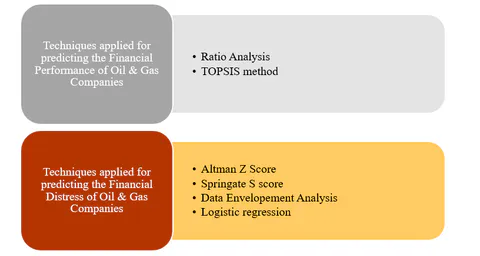
In India financial performance of the Oil and Gas industry has been analyzed through ratio analysis. Primary data has not been collected in these researches. All the previous research had adopted secondary data. Data was found to have been gathered from various sources such as research papers, books, articles, company publications, and journals. Methods followed for analyzing financial performance in the Oil and Gas Companies were gross profit ratio, absolute liquid ratio, net profit ratio, profitability, solvency ratios, turnover ratios, trend analysis, liquid ratio, TOPSIS method, activity ratios, return on investment ratio, expenses ratio, capital turnover, current ratio, and market value ratios. It was clear from the collected data that ratio analysis has been adopted for analyzing financial performance in Indian Oil and gas companies. Financial distress has been predicted using techniques like Altman Z score, Springate S score, DEA, binary logistic regression, logistic model. It was noticed from the above findings that the Altman Z score is mostly adopted for predicting financial distress in Oil and gas companies. When compared to India only a few studies are performed in Oman. In Oman financial performance was computed by ratio analysis similar to India. However, there has not been even single research on financial distress concerning the Oil and Gas Companies in Oman. The major findings have been graphically presented in Figure 1:
Findings of the review
Strategies to be adapted by Oil and Gas companies to enhance their financial performance
Business leaders in Oil and Gas companies and corporations need strong strategies to stay competitive. Strategies entail new drives which could minimize uncertainties in policy and improve earnings between the regimes of volatility. Understanding exogenous and endogenous factors are the main things to characterize trends of the market with certainty
When considering trends of minimal prices of oil, key measures are followed to reduce the effect on the organization. Along with managing prices, it is important to monitor the non-operated assets and at the same time proposed proactive and effective substitute resolution to operational issues together with partners are considered for managing the asset .
Fluctuations of price in the global market have an impact on oil marketing organizations or oil corporations. There is a requirement for firms to follow strong measures which entail an exact mechanism of restructuring. The restructuring includes many actions and it is the best way for reducing pressure on expenses of the firm. By reducing the pressure, most of the problems are dismissed .
Flows of cash in oil firms without diversification of portfolio are associated with oil prices volatility. The difference in the entity of business is away from its main portfolio minimizes the risk of the portfolio on investment of capital market .
Strategies to be adapted by Oil and Gas Companies to enhance overcome financial distress
It is important to focus on a range of external and internal data when assessing and monitoring the stability of finance across a portfolio of customers, vendors, and firms. Approaches to be included are publicly available assessment of data, proprietary tools to assess firms, continuous outcomes, risk-rating methodologies, ranking the strategic customer and suppliers .
Companies that struggle with liquidity problems would focus on necessary actions to be taken for avoiding bankruptcy or distress. Such decisions could pose a greater reputational or financial risk to partners of the business. The main thing to reducing risk is identifying where does risk lies. Distress risk is identified by collecting public insight like executive speeches, public sentiment in real-time, presentations, and changes in analyst rating .
Oil and Gas companies could deploy new working ways with their contractors for reducing financial distress and at the same time by constructing resilience of supply chain and long-term procurement thus bad impacts of the crisis are avoided. Suppliers and operators have to focus on strategic partnership and novel technologies for reducing costs as well as enduring in the oil market .
Measures for reducing financial pressures on dealers encompass enhanced access to finance, expanding preferential rates, direct lending to dealers, bank guarantees, and measures for protecting against default like the choice to sell-off, recover, or buy input materials. Cross-operator levers entail packages from the support of the government for equipment suppliers in the Oil and gas Company that entails exemptions in tax, structural guarantees for main fields, coordinated bail-out efforts by the cross operator, and high transparency on-demand pipeline .
Conclusion
The Oil and Gas sector is one of the most important sectors in creating an influence in the economic and political environment of any nation. The financial performance of companies is significant to shareholders, creditors, potential investors, and bankers. As an emerging nation, the Oil and Gas sector in India is one of the main industries which contributes towards the growth of the economy and plays a main role in decision making. When deeply focusing on corporate competition, firms have to enhance the efficiency and effectiveness of management and have to perform well by analyzing the strategy and policy of the firm. Financial performance and health of firm maintains competition, maximizes profits, economic growth, the efficiency of cost, and develops the economic value of the firm. Firm management can carry out a few actions and decisions are made for improving the financial condition of the firm. If the distressed state of the firm is identified earlier, it would help in minimizing or overcoming the happening of distress. Thus, management has to supervise the financial condition of the firm by analyzing the firm’s financial statements often. The profitability position of any Oil and Gas company will be high when its operating efficiency is good. It is recommended that the Oil and Gas companies must try to raise the availability of liquid cash which in turn will enhance their profitability. Alternatively, they must also consider spending a certain amount on different types of debt instruments in such a way that the funds are distributed equally.
Future Scope
This research has reviewed various techniques adopted for the prediction of the financial performance and financial distress in Oil and Gas companies in India and Oman. The current paper is limited to reviewing literature through a collection of secondary data. In the future, this work can be extended by analyzing the actual data, to compare the financial performance and financial distress of Oil and Gas companies of Oman and India. Further advanced techniques like machine learning can be employed in the future to predict financial distress and financial performance.
Conflict of Interest
The authors declare no conflict of interest.
Ethical Approval
Not applicable
Data Availability
The datasets used in this study are openly available at [repository link] and the source code is available on GitHub at [GitHub link].
Funding
This work did not receive any external funding.
References
Cite this article
Related Research

Special Issue
Launch a focused special issue to highlight research, emerging trends, and expert insights in your academic field.