


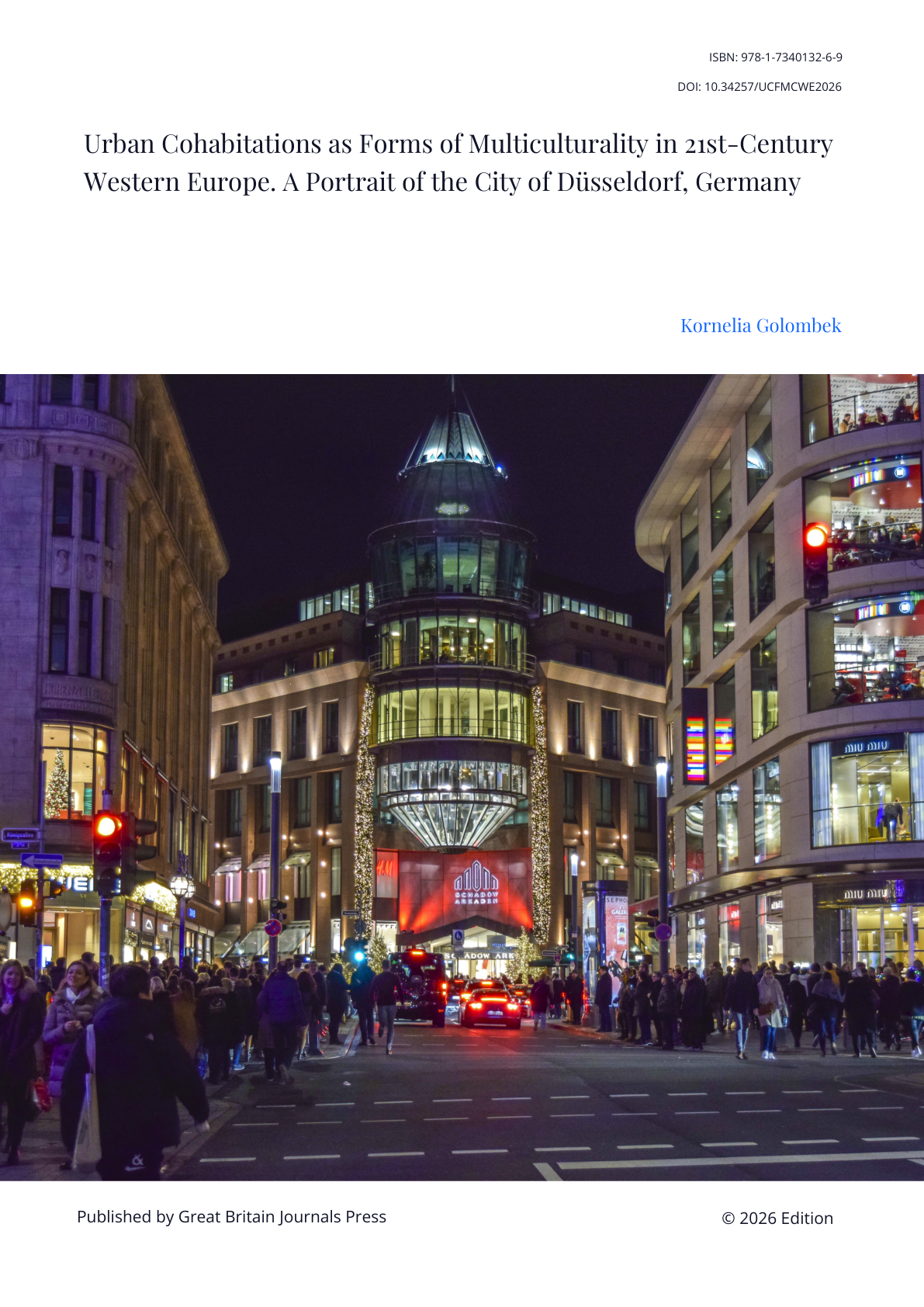
Urban Cohabitations as Forms of Multiculturality in 21st-Century Western Europe.
Submitted
03 Mar 2026
Accepted
01 May 2026
Current Edition
2026
19 May 2026
IntelliPaper
Abstract
What it means to live after the trauma of the First World War in 1920s London is a question posed by one of England’s most significant writers, Virginia Woolf, in her work “Mrs. Dalloway“ This question evokes a specific state of consciousness that reveals how the inhabitants of urban metropolises early in the twentieth century coped with burdens, negative thoughts, and profound social upheavals.
Likewise, a major city is at the centre of this work whose analysis captures the phenomenon of urban cohabitation as an expression of multiculturality in 21st century Western Europe. The metropolis under investigation is located in Western Germany and is the capital of North Rhine-Westphalia: Düsseldorf.
Düsseldorf serves as an empirical case through which urban dynamics can be interpreted. The moods and atmospheres that shape everyday life in this city range from a diverse social world marked by languages, cultures, and lifestyles to a visible form of diversity continuously negotiated among its residents. At the same time, an atmosphere of anonymity and individuality emerges – characterised by limited social control - highlights not so much a lived sense of community as a societal coexistence structured by parallel modes of living.
From a scholarly perspective, these everyday cultural phenomena are illuminated through the works of key figures in classical sociology, including Émile Durkheim, Georg Simmel, Max Horkheimer, Theodor W. Adorno, and Jürgen Habermas. Theoretical perspectives gain vividness through an empirical approach: in this context, pedestrians on the streets of Düsseldorf, as well as representatives from politics, culture, religion, and actors from the fashion, music, and theatre scenes, are given a voice. In doing so, the discourse acquires a “touch of life” that connects theoretical reflections with concrete urban experiences.
Urban Sociology
Metropolitan Dynamics
Diversity
Lifestyles
Cultural Negotiation
About the Authors
Book Overview
Interactive Book
Academic Disclosures
AI Use Disclosure
No generative AI was used for analysis or results,
No statement was found indicating that AI was used to write the book manuscript.
Funding Organization
No external funding was declared for this work.
References
- Stefan Hradil, 2015. Armut in einer modernen Gesellschaft.(In): Armut in einer modernen Gesellschaft..
- Stefan Hradil, Annette Spellerberg, 2011. Lebensstile und soziale Ungleichheit. GWPGesellschaft. Wirtschaft. Politik 60.1 (2011).
- Frank Janning, 1991. , Pierre Bourdieus Theorie der Praxis., Westdeutscher Verlag.
- Karl Jasper, 1949. Vom Ursprung und Ziel der Geschichte München: Piper 1949..
- Hubert Knoblauch, 2003. Habitus und Habitualisierung: zur Komplementarität von Bourdieu mit dem Sozialkonstruktivismus..
- Kant. Immanuel, 1905. Gesammelte Schriften , Herausgegeben von der Königlich PreuBischen Akademie der Wissenschaften..
- Immanuel Kant, 1785/1990. Grundlegung zur Metaphysik der Sitten. In: Kant, Immanuel: Werke in zwölf Bänden, Bd. 7. Herausgegeben von Wilhelm Weischedel. Kant, Immanuel: Werke in zwölf Bänden, Bd. 7. Herausgegeben von Wilhelm Weischedel. Frankfurt am Main: Suhrkamp Verlag, Suhrkamp Verlag.
- Vanessa Kayling, 2008. Die Rezeption und Modifikation des platonischen Eros-Begriffs in der französischen Literatur vom Mittelalter bis zum 17. Jahrhundert unter Berücksichtigung der antiken, arabischen und italienischen Tradition., Romanistischen Verlag.
- Alfred [1933] Korzybski, 1994. Science and Sanity: An Introduction to Non-Aristotelian Systems and General Semantics..
- Emmanuel Lévinas, 2008. Vom Sein zum Seienden..
Download Citation
Cite this book
Kornelia Golombek. (2026). Urban Cohabitations as Forms of Multiculturality in 21st-Century Western Europe.. London Journals Press. https://doi.org/10.34258/UCFMCWE2026
Copy CitationDownload Citation
