


IntelliPaper
Abstract
In this research, extracts were extracted at an ethanol ratio to find out the active ingredients with the effect of removing 2-nonenal, which is the cause of senile body odor, of the hot water extract of Chamaecyparis Obtusa Leaf. Also, the component analysis, antioxidant capacity, polyphenol and flavonoid quantitative analysis, antimicrobial activity and 2-nonenal removal efficiency were investigated. In the measurement of chromaticity, the higher the ethanol ratio in the Chamaecyparis Obtusa Leaf extract, the more the yellowness decreased and the redness increased. GC-MS component analysis showed the active ingredient of sesquiterpene group. LC-MS quantitative analysis showed a high polyphenol content in 40% ethanol extract. In the antioxidant experiment of Chamaecyparis Obtusa Leaf extract, more than 50 % of the ethanol extract showed higher antioxidant activity than the ascoribic acid control. It showed more than 80 % antimicrobial activity against Staphylococcus aureus strain, a food poisoning-causing bacterium, under all extraction conditions. Among them, 100 % ethanol extract showed high antimicrobial activity of 99.9 %. In addition, the highest 2-Nonenal removal efficacy was investigated in the ethanol 40 % extraction.
Explore Digital Article Text
I. INTRODUCTION
In the era of the aging population rapidly increased, as interest in health increases, researches on functional bioactive materials for suppressing aging and maintaining health is being extensively studied in each field [1]. The most notable cause of aging in the body is free radicals, which damage skin cells and tissues and break down the antioxidant defense system so that it causes disease and accelerates aging [2]. Therefore, as it is recently recognized that the cause of adult disease and aging is due to free radicals, researches on antioxidants known as substances that can control or remove the free radicals have been reported [3]. In addition, the changes in the monounsaturated fatty acid composition of the skin surface that appear as aging progress cause an increase in lipid peroxides related to aging and then produce 2-nonenal [4]. It is reported that 2-nonenal, which has been pointed out as the main cause of senile body odor, has a correlation with the increase in age. Still, the sensitivity of smell decreases in the older adults, and more than three-quarters of the 80's elderly cannot smell at all, regardless of living conditions or cultural levels [5]. For this reason, the elderly may not be aware of it, but it may affect those around them and cause conflicts. According to recent research trends related to natural substances, it is reported that ingredients with excellent physio-logical activity among extracts such as wood and leaves of trees can be used as functional materials [6].
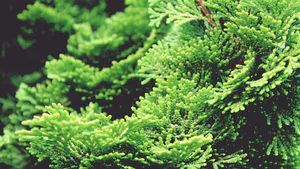
Chamaecyparis obtusa is an evergreen coniferous tree of the Cupressaceae family in the Chamaecyparis genus, which is native to Japan, and it is mainly grown in Jeju Island and southern regions of Korea. The main component of phytoncide, which is reported to be contained in a large amount in Chamaecyparis obtusa leaves, is a terpene, which gives a forest bathing effect with a characteristic scent from the stern and has various functional effects such as antimicrobial, insect repellent, and deodorizing properties . Essential oil of Chamaecyparis obtusa consists of about
66% monoterpenes and 25% sesquiterpenes, and the main components are sabinene, limonene, bornyl acetate, borneol+α-terpineol, and elemol [9].
According to the previous researches on Chamaecyparis obtusa, there are studies on the component analysis and immune efficacy of Chamaecyparis obtusa leaf extract , studies on antioxidant and whitening effects , studies suggesting the possibilities of using it as a natural preservative , studies suggesting the practical potential as a skin improvement agent for atopic infants , and studies suggesting that terpinen-4-ol( ), a monoterpene type of Chamaecyparis essential oil, is an effective antifungal agent and has an insect repellent function .
A general method for extracting such a natural product includes a steam distillation method using a solvent, a methanol extraction method, an ethanol extraction method, an ether extraction method, a propylene glycol extraction method, a supercritical fluid extraction method using carbon dioxide, and the like. The filtration methods for separating natural products include the vacuum-filtration (VF) method and micro-filtration (MF) method .
Among them, most studies related to Chamaecyparis obtusa extract have been conducted by extracting Chamaecyparis essential oil. These are mainly reported as studies related to component analysis, activity studies, and antimicrobial action of the essential oils . Accordingly, in this research, the hot water extraction method was used to confirm the differences in the components appearing according to the extraction method. The composition of the extraction components was compared according to the ratio of the extraction solvent. In addition, by applying the Chamaecyparis obtusa leaf extract, the removal efficacy of 2-nonenal was investigated along with component analysis, antioxidant action, and antimicrobial action.
II. EXPERIMENT
2.1 Sample
The Chamaecyparis obtusa leaf used in the experiment was domesticated (collected from the Chamaecyparis obtusa forest in Jangseong-gun, Jeollanam-do) and was purchased in February 2021. Samples were prepared by taking only the leaves after washing and removing stems and refrigerated until use for the experiment.
2.2 Chamaecyparis obtusa leaf extract
For extraction of Chamaecyparis Obtusa leaves, 0 ~ 100% ethanol was used as the solvent. The solvent was set to 300 ml, and the sample was set to 30 g. Using a high-pressure hot water extractor (KSP-240L, KYUNGSEO E&P, Incheon, South Korea), the extraction process was performed for the sample at a temperature of 80 °C, a pressure of 0.06 MPa, and an extraction time of 3 hours. The extracted solution was filtered under reduced pressure using a 5~8 μm filter. The filtrate was concentrated with a vacuum concentrator and refrigerated at four °C for storing.
2.3 Colorimetric Analysis for Chamaecyparis Obtusa Leaf Extract
The Chamaecyparis obtusa leaf extracts according to the ethanol concentration was measured using a colorimeter (CR-400, Konica Minolta, Tokyo, Japan), and the average value was calculated by measuring three times in the same manner. The measured values were expressed as the values of L*(brightness), a*(redness), b*(yellowness)
2.4 Component analysis for Chamaecyparis obtusa leaf extract
A GC-MS analysis method was used to analyze the composition of the Chamaecyparis obtusa leaf extract. For GC (Agilent 19091S-433) analysis, HP-5ms (30 m x 250 μm x 0.25 μm) was used as the column. Helium (He) was used for the carrier gas. After maintaining the initial temperature at 60 °C for 2 minutes, the oven temperature was increased by ten °C/min to the final temperature of 270 °C. Then the analysis was carried out while maintaining the temperature for 10 minutes.
2.5 Content analysis for polyphenol and flavonoid in Chamaecyparis obtusa leaf extract
Polyphenol content analysis was confirmed using the LC-MS analysis method. Pretreatment was conducted by diluting the polyphenol standard sample (Gallic acid, Daejung Chemicals & Metals Co. Ltd, Siheung, Korea) and the sample preparation. The ULTIMATE3000 RSLC was used for LC equipment, and The Q-EXACTIVE ORBITRAP PLUS MS was used for MS equipment. The injection volume was set to 5 , and MS condition was performed in negative mode. The quantitative analysis set the auxiliary gas flow rate to 13, the capillary temperature to 263 °C, and the auxiliary gas heater temperature to 25 °C.
The analysis method for the standard sample (Quercetin, SIGMA, Missouri, USA) used for flavonoid content analysis was set with the same equipment and experimental conditions as the polyphenol content analysis equipment. The quantitative analysis was performed by setting the auxiliary heater temperature to 425 °C.
2.6 Antioxidant efficacy analysis for Chamaecy paris obtusa leaf extract
The DPPH method is a representative experimental method to confirm the scavenging ability for free radicals. The DPPH standard sample used in this experiment was 2,2-Diphenyl -1-picrylhydrazyl(free radical), Powder from Alfa Aesar. As for the experimental method, adding each of 1 of extracts of various concentrations to a 1.5 mM DPPH solution dissolved in methanol, mixing them, and then leaving the mixture at room temperature for 10 minutes, the absorbance was measured at using UV/Vis spectrophotometer(KLAB, Deajeon, Korea). The DPPH scavenging activity inhibition rate (IR) was calculated using the following equation with the absorbance values of the control group to which the sample was not added and the experimental group to which the sample was added [16].
2.7 Antimicrobial activity analysis for Chama-ecyparis obtusa leaf extract
The strain used for the measurement of antimicrobial activity was test-sterilized Staphylococcus aureus (ATCC 6538) (from the Korea National Institutes of Health) in an Autoclave (121 ± 2°C) for 15 minutes. Phosphate buffer (pH 7.2, SIGMA, Taufkirchen, Germany) was set to 50 ml, and the weight of the sample was set to 1.0 ml for analysis.
2.8 2-Nonenal removal efficacy analysis for Chamaecyparis obtusa leaf extract
The trans-2-Nonenal used for the analysis of 2-nonenal removal efficacy was purchased from TOKYO CHEMICAL INDUSTRY. 50 l of Chamaecyparis obtusa leaf extract was injected into 1 ml trans-2-Nonenal reference material diluted to 0.0075% and dispersed at 500 RPM for 30 minutes. Solutions A and B were each injected in 150 l and left in an oven at 60 C for 15 minutes. After that, only the supernatant was taken, and the absorbance was measured at 300 nm.
III. RESULTS AND DISCUSSION
3.1 Chamaecyparis obtusa leaf extract
The yield of the Chamaecyparis obtusa leaf extract, according to the extraction conditions, showed a tendency to decrease as the ethanol content increased. It was estimated that this was due to the effect of evaporation in the extraction process (80 °C) since the boiling point of ethanol is 78 °C. As a result, it was confirmed that a very low yield of 1.7% was obtained in 100% ethanol. The result is shown in Table I.
Table I: The yield for Chamaecyparis obtusa leaf
| No | Water: Ethanol | After decompression(g) | After concentration(g) | Yield(%) |
| A | 100: 0 | 354.0 | 339.0 | 95.7 |
| B | 80: 20 | 279.0 | 173.0 | 62.0 |
| C | 60: 40 | 230.0 | 154.0 | 66.9 |
| D | 50: 50 | 245.0 | 177.0 | 72.2 |
| E | 40: 60 | 326.0 | 137.0 | 42.0 |
| F | 20: 80 | 285.0 | 82.0 | 28.7 |
| G | 0: 100 | 289.0 | 5.0 | 1.7 |
3.2 Colorimetric for Chamaecyparis obtusa leaf extract
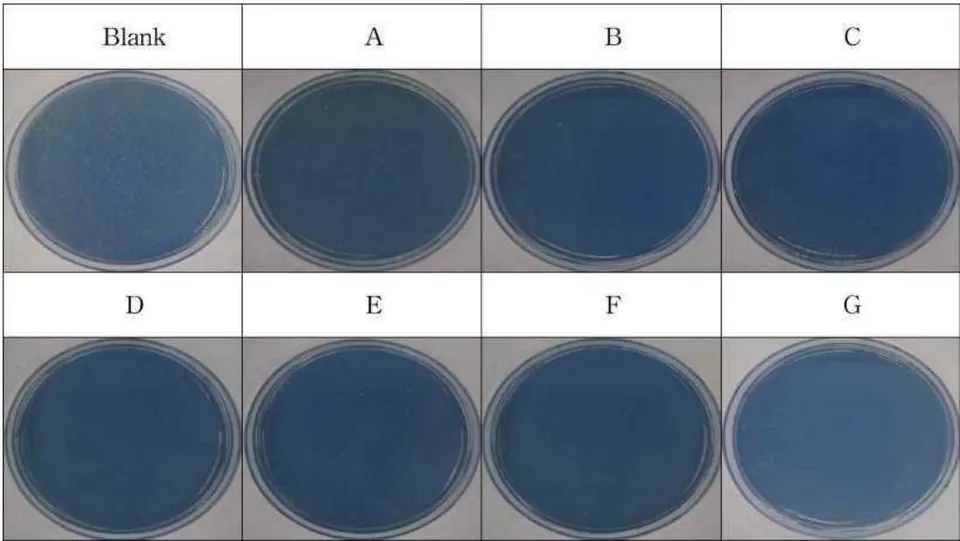
From the colorimetric measurement results for Chamaecyparis obtusa leaf extract as shown in
Table II and Figure 1. the L value and the yellowness b* show a tendency to sharply decrease as the ethanol content increases. Still, the redness a* shows a tendency to gradually increase.
Table II: Colorimetric results of Chamaecyparis obtusa leaf
| A | B | C | D | E | F | G | |
| L* | 39.57 | 39.40 | 38.80 | 31.60 | 28.62 | 21.13 | 8.41 |
| a* | 0.87 | 1.22 | 1.24 | 1.28 | 1.31 | 1.36 | 2.90 |
| b* | 17.62 | 16.27 | 10.94 | 10.39 | 7.27 | 3.24 | 1.77 |
{"image_source":{"path":"images/f2e459f4eb477f1db94a978982c6f481dd7d262396fa0efe3f18b5351ca7400e.jpg"},"content":"","chart_caption":[{"type":"text","content":"Figure 1: Chamaecyparis obtusa leaf extract"}],"chart_footnote":[]}
3.3 GC-MS analysis for active ingredients of Chamaecyparis obtusa leaf extract
As the result of GC-MS analysis, various aromatic components were identified in the Chamaecyparis obtusa leaf extract. When compared by the concentration of the extract, the most active ingredient was detected at 100% ethanol. The results are shown in Figure 2. to Figure 8.
{"image_source":{"path":"images/036bdcef40372da8886814e7101096964466d8bdec7aa581ecff87e49f489aa6.jpg"},"content":"","chart_caption":[{"type":"text","content":"Figure 2: GC-MS chromatogram of 0% ethanol extracts A of Chamaecyparis obtusa leaf"}],"chart_footnote":[]} {"image_source":{"path":"images/621ef7dbe7ddbb0772d6f42f6828205959231a99a17bfa9c8a057164b69b6491.jpg"},"content":"","chart_caption":[{"type":"text","content":"Figure 3: GC-MS chromatogram of 20% ethanol extracts B of Chamaecyparis obtusa leaf"}],"chart_footnote":[]}
{"image_source":{"path":"images/2e312b207aa4a852f09646ae5b150603425f4efee9b3f93a0951f3faa3731bcf.jpg"},"content":"","chart_caption":[{"type":"text","content":"Figure 4: GC-MS chromatogram of 40% ethanol extracts C of Chamaecyparis obtusa leaf"}],"chart_footnote":[]} {"image_source":{"path":"images/4f98ba4a6bbbae9e2101dd7b8f476a54700e963d4bbab2fe1bd7ae945cf99599.jpg"},"content":"","chart_caption":[{"type":"text","content":"Figure 5: GC-MS chromatogram of 50% ethanol extracts D of Chamaecyparis obtusa leaf"}],"chart_footnote":[]}
{"image_source":{"path":"images/055054abc76d8b56e25c7c705f9bbb38b9f2f428922bec9c6231d9365ecc669e.jpg"},"content":"","chart_caption":[{"type":"text","content":"Figure 6: GC-MS chromatogram of 60% ethanol extracts E of Chamaecyparis obtusa leaf"}],"chart_footnote":[]} {"image_source":{"path":"images/d2f1810e0fe1b8b757f8681a457aff29cc300f2b15acee1aff13d613dc52708a.jpg"},"content":"","chart_caption":[{"type":"text","content":"Figure 7: GC-MS chromatogram of 80% ethanol extracts F of Chamaecyparis obtusa leaf"}],"chart_footnote":[]}
{"image_source":{"path":"images/7e6d25234703496c9a2df693a661fa6832babf239feca298d87f8f08307bf976.jpg"},"content":"","chart_caption":[{"type":"text","content":"Figure 8: GC-MS chromatogram of 100% ethanol extracts G of Chamaecyparis obtusa leaf"}],"chart_footnote":[]} When compared by extract concentration, the higher the ethanol content, the higher the active ingredient was detected. As shown in Figure 8. The most active ingredients and concentrations were confirmed at ethanol 100%. The extract components analyzed by GC-MS are shown in Table III to Table IX.
Table III: GC-MS chromatogram profile of 0% ethanol extracts A of Chamaecyparis obtusa leaf
| Retention time (RT) | Name of the compound | Quality | Area peak (%) |
| 14.466 | vinylphenol | 96 | 2.69 |
| 18.948 | MOME INOSITOL | 58 | 18.54 |
| 19.506 | 43 | 12.69 | |
| 20.624 | Eudesmol | 87 | 4.05 |
| 24.803 | Heptamethoxyflavone | 50 | 35.23 |
| 25.568 | 91 | 14.64 |
Table IV: GC-MS chromatogram profile of 20% ethanol extracts B of Chamaecyparis obtusa leaf
| Retention time (RT) | Name of the compound | Quality | Area peak (%) |
| 19.202 | MOME INOSITOL | 62 | 41.45 |
| 19.837 | Terpinen-4-ol | 53 | 24.04 |
| 20.633 | Eudesmol | 91 | 13.88 |
Table V: GC-MS chromatogram profile of 40% ethanol extracts C of Chamaecyparis obtusa leaf
| Retention time (RT) | Name of the compound | Quality | Area peak (%) |
| 14.912 | CARENE | 94 | 1.33 |
| 17.561 | Elemol | 91 | 9.06 |
| 19.300 | MOME INOSITOL | 93 | 33.63 |
| 19.963 | Terpinen-4-ol | 58 | 19.04 |
| 20.635 | Eudesmol | 83 | 10.67 |
Table VI: GC-MS chromatogram profile of 50% ethanol extracts D of Chamaecyparis obtusa leaf
| Retention time (RT) | Name of the compound | Quality | Area peak (%) |
| 14.915 | CARENE | 94 | 2.91 |
| 17.570 | Elemol | 91 | 16.14 |
| 19.941 | MOME INOSITOL | 55 | 12.24 |
| 20.636 | Eudesmol | 87 | 7.44 |
Table VII: GC-MS chromatogram profile of 60% ethanol extracts E of Chamaecyparis obtusa leaf
| Retention time (RT) | Name of the compound | Quality | Area peak (%) |
| 12.528 | Terpinen-4-ol | 98 | 0.92 |
| 17.558 | Elemol | 89 | 2.95 |
| 19.314 | MOME INOSITOL | 96 | 35.73 |
| 20.021 | cyclopentane | 64 | 20.26 |
| 20.631 | Eudesmol | 91 | 6.01 |
Table VIII: GC-MS chromatogram profile of 80% ethanol extracts F of Chamaecyparis obtusa leaf
| Retention time (RT) | Name of the compound | Quality | Area peak (%) |
| 12.531 | Terpinen-4-ol | 97 | 1.09 |
| 14.096 | Bornyl acetate | 99 | 1.87 |
| 14.916 | CARENE | 93 | 2.95 |
| 17.571 | Elemol | 91 | 10.53 |
| 19.539 | MOME INOSITOL | 96 | 18.69 |
| 20.329 | 43 | 18.75 | |
| 22.725 | Furanone | 58 | 0.07 |
Table IX: GC-MS chromatogram profile of 100% ethanol extracts G of Chamaecyparis obtusa leaf
| Retention time (RT) | Name of the compound | Quality | Area peak (%) |
| 14.139 | Acetic acid | 98 | 3.72 |
| 14.980 | CARENE | 93 | 4.62 |
| 16.286 | Thujopsene | 99 | 3.34 |
| 16.623 | Bicyclosesquiphellandrene | 95 | 2.65 |
| 17.662 | Elemol | 91 | 9.41 |
| 18.448 | Cedrol | 96 | 2.03 |
| 18.928 | Eudesmol | 98 | 3.29 |
| 20.486 | MOME INOSITOL | 25 | 2.98 |
| 20.675 | Thiophene | 38 | 2.83 |
| 21.435 | Phenol | 18 | 15.60 |
| 22.006 | Beyerene | 99 | 3.38 |
| 25.236 | Phenanthrenol | 95 | 1.47 |
| 25.570 | 99 | 2.14 |
3.4 Antioxidant effect analysis for active ingredients of Chamaecyparis obtusa leaf extract
As a result of measuring the DPPH radical scavenging ability of the Chamaecyparis obtusa leaf extract, the value of ascorbic acid used as a control group was 1.70; A was 3.04, B was 2.44, D was 1.70, E was 1.66, F was 1.58 and G was 1.63, so it was found that the extracts E ~ G with more than 50% of ethanol showed higher antioxidant effect than ascorbic acid.
{"image_source":{"path":"images/b5529eaffa41c23424052a223870cf4cb3c45460dd67d9f3b73892193f322f12.jpg"},"content":"","chart_caption":[{"type":"text","content":"Figure 9: Comparison of the inhibitory rate of the extract by ethanol ratio."}],"chart_footnote":[]}
3.5 Analysis of polyphenol and flavonoid contents
The total polyphenol content of the Chamaecyparis obtusa leaf extract was measured using gallic acid as reference material. The total polyphenol content of Chamaecyparis obtusa leaf extract converted to gallic acid is shown in Table X, and the graph comparing the polyphenol content of each extract is shown in Figure 10. As a result of the experiment, the highest polyphenol content was confirmed at the ethanol 40% extract C.
The total flavonoid content of the Chamaecyparis obtusa leaf extract was measured using Quercetin as reference material. The total flavonoid content of Chamaecyparis obtusa leaf extract converted to Quercetin is shown in Table X I, and the graph comparing the flavonoid content of each extract is shown in Figure 11. As a result of the experiment, the highest flavonoid content was confirmed at the ethanol 100% extract G.
Table X: Polyphenol content level
| Final conc. (ug/ml) | Area peak | |
| A | 1.760 | 6,293,210 |
| B | 0.890 | 2,982,439 |
| C | 6.359 | 23,794,093 |
| D | 1.372 | 4,819,903 |
| E | 1.136 | 3,919,670 |
| F | 1.512 | 5,349,640 |
| G | 1.732 | 6,188,643 |
{"image_source":{"path":"images/0517eead9f1e6d9c0799bb91c05e2ffaaaff0677498f606be134f4922fff3c95.jpg"},"content":"","chart_caption":[{"type":"text","content":"Figure 10: Polyphenol levels comparison"}],"chart_footnote":[]}
Table XI: Flavonoid content level
| Final conc. (ug/ml) | Area peak | |
| A | 104.767 | 36,208,117 |
| B | 131.684 | 55,389,930 |
| C | 103.646 | 35,409,359 |
| D | 106.466 | 37,418,502 |
| E | 106.274 | 37,282,180 |
| F | 95.901 | 29,889,743 |
| G | 200.985 | 104,775,356 |
{"image_source":{"path":"images/632d169245b758fb8a681cd6646272528186094a78324c5308ad148480befa18.jpg"},"content":"","chart_caption":[{"type":"text","content":"Figure 11: Flavonoid levels comparison"}],"chart_footnote":[]}
3.6 Antimicrobial analysis for active ingredient of Chamaecyparis obtusa leaf extract
the ethanol content increased. In particular, the 100% ethanol extract G showed a high bacterial reduction rate of 99.9% after 24 hours. Therefore, as a result of the antimicrobial analysis, it was confirmed that the hot water extract component of the Chamaecyparis obtusa leaf had a high antimicrobial effect on Staphylococcus aureus bacteria.
The results of the antimicrobial analysis of Chamaecyparis obtusa leaf extract are shown in Table X II, and the comparative graph of the bacterial reduction rate of each extract is shown in Figure 12. As a result of the experiment, it was found that the antimicrobial activity increased as
Table XII: Results of an antimicrobial analysis of Chamaecyparis obtusa leaf for Staphylococcus aureus
| Blank | A | B | C | |
| Initial number of bacteria | ||||
| after 24 hours | ||||
| Bacterial reduction rate | - | 86.7 | 87.3 | 94.5 |
| D | E | H | G | |
| Initial number of bacteria | ||||
| after 24 hours | < 30 | |||
| Bacterial reduction rate | 96.9 | 96.7 | 98.3 | 99.9 |
{"image_source":{"path":"images/4d51104c9ab9aac6a410b75e52b107079d1b6696c9729e5170f0c77590fda077.jpg"},"content":"","chart_caption":[],"chart_footnote":[]}
Analysis for 2-nonenal removal effect for active ingredient of Chamaecyparis obtusa leaf extract. The result of the 2-nonenal removal effect is shown in Table X III. A high removal rate of 97.09% was confirmed at the ethanol 40% extract C.
Table XIII: Absorbance measurement results to determine 2-nonenal removal effect
| Absorbance (300 nm) | Removal rate (%) | |
| Control | 1.304 | |
| A | 0.85 | 34.82 |
| B | 0.367 | 71.86 |
| C | 0.038 | 97.09 |
| D | 0.834 | 36.04 |
| E | 0.963 | 26.15 |
| F | 0.858 | 34.20 |
| G | 1.351 | - |
IV. CONCLUSIONS
As a result of the efficacy analysis of the hot water extract of Chamaecyparis obtusa leaf, the following conclusions were confirmed.
As a result of colorimetric analysis, the L value and the yellownessshow a tendency to sharply decrease as the ethanol content increases. Still, the rednessshows a tendency to gradually increase.
As a result of GC-MS analysis for Chamaecyparis obtusa leaf extract, a large amount of sesquiterpene was found in hot water extracts, unlike most monoterpene, which were detected in essential oil extracts of Chamaecyparis obtusa leaf.
As a result of the 2-nonenal removal effect, the highest nonenal removal effect was confirmed at 40% ethanol extract, of which reason was estimated to be due to the extractable active ingredient of polyphenol and Terpinen-4-ol that was detected at the highest level at 40% ethanol extract.
Accordingly, the results of this research are expected that the high-pressure hot water extract of Chamaecyparis obtusa leaves not only removes free radicals, which are the causative agents of aging and disease caused by active radicals but also has useful value as a functional natural materials in various bio-industry fields such as antimicrobial and senile body odor removal.
ACKNOWLEDGEMENT
This work is supported by the National Research Foundation of Korea (NRF-2020R1F1A1074571) and the 2021 HANNAM University Innovation Research Program.
Conflict of Interest
The authors declare no conflict of interest.
Ethical Approval
Not applicable
Data Availability
The datasets used in this study are openly available at [repository link] and the source code is available on GitHub at [GitHub link].
Funding
This work did not receive any external funding.
References
Cite this article
Related Research

Special Issue
Launch a focused special issue to highlight research, emerging trends, and expert insights in your academic field.