


IntelliPaper
Abstract
The conventional linear supply chain is fast giving way to circular supply chain as nations and businesses begin to recognize the need for recycling scarce resources while demand keeps multiplying. Besides regulatory obligations for the innocuous disposal and reuse of discarded manufactured goods, there's an unmistakable hint that customers prefer businesses that recycle materials, and several leading businesses are finding added value through circular supply chains.
Purpose – The purpose of this paper is to apply circular supply chain model for the assessment of environmental, economic, or social impacts of electric vehicles (EV) batteries over their entire life cycle.
Methodology – The study uses systematic literature review. We identify 101 papers and filtered them using the key words to arrive at the requisite number of articles necessary to draw the conclusion.
Findings – EVs are vital to attaining global targets of carbon emissions reduction. However, it is evident from new research that the world is unprepared to handle the Lithium-Ion Battery (LIB) waste generated once EVs complete their useful life span. Recycling and battery capacity improvements could be the best solution.
Conclusion – EV sector presents the possibility of recycling and drawing benefits from a circular economy. LIB waste recycling will help cut down toxic waste generation besides abating social menaces of child labor. The best benefit of EVs is the demonstration of how recycling can be used by an industry to grow and meet growing demand. This is the key to directing nations to adopt policies supporting application of CE approach to production.
Explore Digital Article Text
I. INTRODUCTION
There is no denying the fact that resources, required to meet the uncountable and ever increasing needs of human beings, are scarce and have several alternative uses (Robbins, 2007). That is the whole essence of Economics and the crux of Lionel Robbin's definition of economics. It is also the key to understanding the need for recycling products to reduce wastefulness and ensure the optimum utilization of resources to meet human needs. Consumptions, across the world, are growing at an alarming rate. The global final consumption expenditure (at constant 2010 USD) has expanded by about in the last 5 decades (World Bank, 2019). Consequently, several natural resources will be seriously depleted in the near future creating a huge shortfall unless there occurs a significant change in the manner in which we acquire, manufacture, deliver, consume, reclaim and regenerate products (Hazen et al., 2017).
The research focuses on explaining the 'circular economy' (CE) methodology that will help to sustain such high levels of consumption and the necessary production. This methodology is expected to transmute or alter the purpose that these resources serve in the economy. Waste from industrial units would turn into a valuable input for process and the products could be overhauled, refurbished, reused or improved instead of being disposed off (Preston, 2012). One of the key industries that can utilize this technology is the automotive industry especially the massively expanding EV segment where the vehicle batteries need to be replaced every 8 to 10 years (Union of Concerned Scientists, 2018) creating pile of toxic wastes with adverse environmental implications (Harper et al., 2019a; Stojanović et al., 2018). There are other issues – economic and social, associated with the manufacturing of EV batteries. The article discusses the concepts of circular economy and circular supply chain from various perspectives with special emphasis on EV battery recycling and its socio-economic and environmental impacts.
Circular supply chain in EV batteries being still a nascent concept, there is a dearth of research in this segment. The research pertaining to the application of circular economy in manufacturing falls short of its widespread practical applications (Adams, Osmani, Thorpe, & Thornback, 2017). In the field of research most articles on the electric vehicle batteries focus on the technical aspects of improving efficiencies, optimizing re-use or improvement in the performance metrics (Chen et al., 2020; Gucciardi et al., 2021; Kamath et al., 2020; Patten et al., 2011). Several articles discuss the secondary use of batteries or the effect of the re-cycling on the government subsidy policy to electric vehicle manufacturers (Gu et al., 2018, 2021; Mirzaei Omrani & Jannesari, 2019). A study by Ahuja also highlights in its finding the need for regulatory intervention if the recycling or the circular economy in EVs is to be profitable and in his study Ajay highlights the importance of Battery swapping as well as the challenge of adoption of EVs in India (Ahuja et al., 2020; Serohi, 2021). There are some studies that aim at creating models to forecast the number of critical materials that can be recovered from Lithium Batteries through recycling end of life EV and analyzing the potential of a closed-loop supply or the challenges in the process (Ellingsen et al., 2014; Olivetti et al., 2017; Olsson et al., 2018; Pagliaro & Meneguzzo, 2019; Sato & Nakata, 2019). In some studies measures to decrease environmental impacts related to resource usage and strengthen the availability of raw materials to become more competitive in the global economy, is discussed as a key strategy (Díaz-Ramírez et al., 2020; Glöser-Chahoud & Schultmann, 2019; Omahne et al., 2021). Moreover, several studies have looked at issues related to battery recycling for electric vehicles (Beaudet et al., 2020; Harper et al., 2019b). One study analyzes all life cycle phases of an electric vehicle battery from the material extraction, processing, manufacturing, and operation phases to the end-of-life phases of vehicles and batteries, with the result highlighting that the manufacturing phase is the most influential phase in terms of socio-economic impacts compared to other life cycle phases, whereas operation phase is the most dominant phase in the terms of environmental impacts (Onat et al., 2014).
Circular EV battery supply chains are still a nascent concept and the coverage of CEs in this domain is fragmented. The Figure 1 shows the number of references in peer-reviewed literature mentioning circular economy from 1999 through 2019. The figure indicates an increase in this category of publication in peer-reviewed literature since 2015(Bjørnbet et al., 2021). The objective of this review is to examine the impact of the implementation of the CE principles in manufacturing companies with particular focus on the recycling of electric vehicle batteries over their lifetime. A search of relevant databases reveals that few studies discuss the application of circular economy in manufacturing and fall short of discussing the widespread practical applications in the Environmental, Economic, and Social sectors (Adams, Osmani, Thorpe, & Thornback, 2017). This paper besides trying to partially fulfil this gap also brings to light an important emerging aspect of the circular economy - a retaliation from traditional fuel economy. While vehicle manufacturers can shift from ICE models to BEV models, it is difficult for suppliers of traditional fuel to change over to an alternative. They will suffer a massive drop in revenue putting their existence at stake. This article introduces the topic and therefore, lays the foundation for future research.
{"image_source":{"path":"images/f1e2183db1beed76277d0d1cea4f669a8daa8daaeaba9e2c655bbf9bb885208a.jpg"},"content":"","chart_caption":[{"type":"text","content":"Figure 1: Number of hits in Scopus on the search string 'circular economy', 1999–2019"}],"chart_footnote":[]}
The article is divided into 6 sections with several subsections. Section 1 of the thesis introduces the topic, provides background, research rationale and the aims and objectives of the study. Section 2 presents the literature review that explains the topic, talks about the emergence of the concept, its progression and evolution. Section 3 explains the research methodology. Section 4 analyzes the data gathered from various sources while Section 5 presents a discussion collating the previous 2 sections. Section 6, the conclusion, is the presentation of the researcher's opinion on the basis of the foregoing research.
II. LITERATURE REVIEW
2.1 Understanding a circular economy and its benefits
Circular Economy (CE) (figure 2) is a concept that has attracted many scholars and hence research studies. Such an economy is believed to turn commodities, that are at or near the end of their useful life, into resources for other products, and in the process completes loops in industrial ecosystems, reduces wastage to the minimum and adheres to sustainable methods (Geisendorf & Pietrulla,2018; Khan & Haleem, 2020; Nascim- ento et al., 2019; Ünal et al., 2019). According to the definition provided by the Ellen MacArthur Foundation (2015, p. 2) a CE refers to an economy that is "restorative or regenerative by intention and design" and the objective of such an economy is "to keep products, components, and materials at their highest utility and value at all times, distinguishing between technical and biological cycles"(The Ellen MacArthur Foundation, 2015).
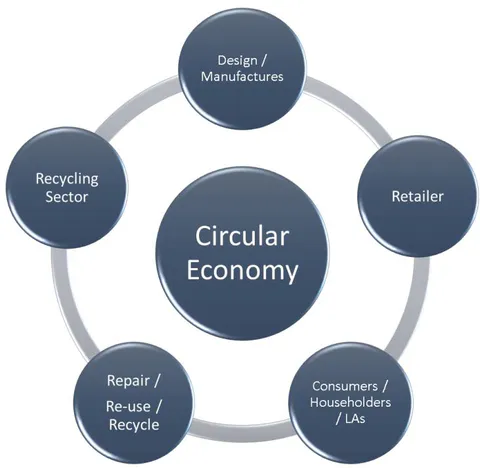
A CE strives to reconstitute capital, which could be either human or natural or manufactured, or social or financial. The rebuilding makes sure that movements of goods and services improve and increase over time. A circular economy, therefore, is associated with green development or sustainable development (Nascimento et al., 2019; Sanguino et al., 2020; Schroeder et al., 2019). It refers to that procedure of resources utilization which encompasses 3 Rs – "reduction, reuse and recycling" of resources (Geng et al., 2019; González-Sánchez et al., 2020). Minimization of material waste along with the application of biodegradable products help to recycle the discarded products back to the environment (Valavanidis, 2018). The topic is fast gaining popularity amongst practitioners and scholars (Kirchherr et al., 2017). The ultimate focus of this new economic model is on dissociating global economic development from consumption of limited resources. Depending upon the dissemination of approaches concerning green management, manufacturers have paid a lot of attention to the impact, on environment, of production procedures in addition to avoidance of waste, "recycling, reuse and reduction" to the minimum of final discarding of end-of-life products (Isernia et al., 2019).
Migration to a more circular economy is believed to make such benefits available as releasing a significant part of the stress on the environment, ensuring that the raw materials supply is more stable and secure, developing and maintaining the competitive edge, encouraging innovation, providing a thrust to the general economic growth, generating employment (580,000 jobs creation in the European Union alone) (European Parliament, 2015). Further, a switch to a CE improves the synergy between the community and the industry because the participants as well as the stakeholders in a closed looped supply chain extend collaboration to make it a success. strengthens the connection between the society and industry (Kumar et al., 2019).
2.2 Need for Circular Supply Chain Management
The circular economy delineates a domain in which reuse by way of reparation, reconditioning and overhaul is the established social and economic model (Charter, 2018). Therefore, the aim of a circular economy is to extort maximum benefit from the materials, energy and wastes pertaining to an industry. For enhancing the efficiency of resources, a circular economy links the supply and demand of supply chain Industries (Manavalan & Jayakrishna, 2019). The need to safeguard and provide support to an incessantly expanding global demand, in a sustainable manner, calls for an efficient and sufficient management of operations pertaining to the supply chain (Theophilus et al., 2019). Here, the concept of circular supply chain assumes importance. A circular supply chain is different from the traditional supply chain which is characterized by a desegregated course that consists of procurement of raw materials and components, fabrication and assembly of products, along with delivery of the final products to consumers by means of distribution or retail or both (Manavalan & Jayakrishna, 2019). The circular supply chain provides a model capable of encouraging the producers and Product sellers to procure cast-off materials and turn them into a product for resale (De Angelis et al., 2018; Jain et al., 2018; Kuebix, 2019; Nandi et al., 2020; Yang et al., 2018) thereby reducing pollution on the one hand and enhancing profitability on the other. For instance, there has been an explosion in the demand for electricity-driven cars which run on batteries that have a short lifespan. Therefore, there would be millions of waste batteries with negative abandonment values. Therefore, recycling these batteries (employing emerging technologies) would make the supply chains more sustainable and reduce the cost of the cars in the longer run.
Over the years, the United Nations (UN) in consort with more than a few of the biggest production economies in the world have put into operation certain policy directives concerning sustainability of resource, reduction of emission, and effective management of waste material (Koh et al., 2017). The conventional linear economy is made up of uncomplicated linear value chain which moves along the following simple path (Hannon et al., 2016). Encouraging and impelling the shift from the present linear "extraction - use - disposal" method of resource utilization, to a more circular methodology having alternative conduits for by products, emissions, as also waste products were the objectives driving the development of these policies (Huysman et al., 2015). Therefore, for several producers and supply chain participants, the persuasion for moving towards a circular supply chain was the product of federal government efforts and policies (Robinson, 2020). The government imposes certain restrictions regarding the type of products that can be discarded as waste, and the products that should be reclaimed, the quantum of raw materials that can be consumed by certain entity, and also define the procedures that must be followed by the supply chain entities who have renounced the conventional methodology of production and sale. Nevertheless, consumers appear to be the obvious and the most important impetus behind the circular supply chain(Robinson, 2020).
Circular supply chain refers to an integrated supply chain model that encompasses forward as well as reverse aspects of the supply chain (Baporikar, 2020). It involves the complete process of reverse logistics, that helps to continue a growth trajectory in order to become sustainable in the near future when there will be no unlimited supply of resources (Robinson, 2020). Management of supply chain in the circular economy concentrates on elimination of waste for the improvement of operational efficiency and reduction of expenditures. Therefore, it becomes necessary for the businesses to examine and evaluate their processes, labor pools, and the supporting apparatuses in order to discover opportunities for the formation and reinforcement of a circular supply chain (Jain et al., 2018).
Management of supply chain for a circular economy is chiefly concerned with reduction of waste through reuse or recycling every conceivable material, spanning across packaging of product and shipping policies. Shipping materials that are reusable will be capable of putting off waste through the closure of loops and ostracizing waste materials from dumping grounds (Accorsi et al., 2019). There are a couple of views that have been taken into consideration for the purpose of delineating a circular supply chain. From the point of view of materials, the circular supply chain delineates a supply chain that uses, recycles and reuses materials repeatedly at the end of their practical life thereby ensuring generation of minimum material wastes all through the supply chain. Recycling refers to those materials that have been reclaimed for being utilized in diverse range of products and includes those materials that are recovered and converted into new batteries(Jungst, 2001). Several studies have demonstrated that the processes of optimized waste management may perhaps represent a germane approach towards attainment of socioeconomic and environmental paybacks expected from the embracing the CE approaches (Isernia et al., 2019). Integrating circular economy into supply chain management may make several advantages available from the perspective of sustainability (Farooque et al., 2019).
Several research papers corroborate the significance of good supply chain management for several economies across the world. Better results can be ensured through the development of policies and procedures that can achieve a more effective and maintainable supply chain. This can be achieved by way of fabricating cost-efficient programs, simplifying and expediting the flow, maintaining "just-in-time" deliveries inside the supply chains, implementing the 3Rs – reduce, reuse and recycle, and developing or enhancing the sustainability of the procedures (González-Sánchez et al., 2020). Through the integration of the theory of circular economy into supply chain management, Circular Supply Chain Management (CSCM) offers a new and convincing picture of the supply chain sustainability domain (Farooque et al., 2019). As a consequence, there is increasing research interest in the subject matter. Administration of total cost within the supply chain must take into account various aspects including cost of transportation, penalizations for deferrals and stoppages of regular operations, emission related expenditures, etc. Several of these costs will have an impact not only on the profit and loss account, but also on the feasibility and continuity of the supply process (Guo et al., 2017; Zhu et al., 2017).
2.3 Sectors that can benefit from CSCM
In the last few years, research undertaken by McKinsey has indicated that the circular economy, that involves using and reprocessing natural capital as usefully as possible and discovering value throughout the life cycles of finished products, has the potential to be, a significant part, if not the whole of the solution towards industries obtaining a reliable method to enhance their profitability and at the same time reduce their reliance on natural resources ("Mapping the Benefits of a Circular Economy," 2017). Every sphere of consumption is seeing continuous expansion and automobile sector is just one of them. Other sectors that might benefit from the circular economy philosophy. IT and telecommunication, automotive, packaging, furniture, apparel, are only a few names of industries that can profit from circular economy and circular supply chain management.
Supply chain is a key management consideration for every construction project and is a major progression that affects a circular economy. It is essential to break down costs and trace them back to actions, people, wherewithal, data, logistics, organization and most definitely to products and services that utilize raw materials to turn out finished products that satisfy customer needs, in order to get a grip on supply chain management (Tatlici & Sertyesilisik, 2019, p. 261). SCM is not restricted to simple cost reduction. It is a lot beyond that. It emphasizes on economic value added. The stress in on improving the final product or service in terms of quality, technology, delivery, and after sales service by managing the total content and the total process, the ultimate goal being meeting the consumers' requirements (Mulla Aneesa.I, Gupta, & Desai, 2015, p. 36). A cohesive administration and supervision of material and resources throughout the entire supply chain will translate into benefits in terms of expansion of the value-added by members of the supply chain, waste removal, cost cutting, and enhancement of customer satisfaction (Handfield & Nichols, 2002). Focusing on reusable materials allows firms extract the greatest advantage out of the procured resources or inputs (Blood-Rojas, 2017).
Studies reveal that investment in a circular supply chain have the possibility to bring in a superior return on investment (ROI) for the investing firm (Aalpega, 2021). A contemporary report on organic waste residue in Amsterdam, the Netherlands, discovered that exploiting bio-refineries, it was possible for waste separation and return logistics to generate €150 million in value addition, besides generating 900,000 tons of savings in materials and an annual CO emission reduction amounting to 600,000 tons (Ellen MacArthur Foundation, 2017).
IKEA revealed its strategy, in 2018, to turn into a circular business by 2030, through the elimination of waste alongside a promise to employ only those materials that are renewable or salvageable, across the complete range of its products. Annually Coca-Cola produces 3 million tons of plastic packaging. It has confirmed Sweden to be the first market where it will produce all its bottles from totally recyclable materials ("Better Bottling Thanks to Cognex Vision," 2007). The construction industry and a myriad of other everyday names including the industrial zone of Vallejo, located in Mexico, are planning moving to a circular economy by altering their production approaches and procedures in an attempt to transit towards an economy that has lower dependence on natural resources (Ghisetti & Montresor, 2020; Sfakianaki, 2015). Rapid urbanization and industrialization have led to massive expansion of demand for both passenger and commercial vehicles. The obvious fallout was the steady rise in pollution that has now attracted environmental activists, scientist, leaders and the general public. Data pertaining to emissions indicate that transport has emerged as the key element behind global-warming and pollution (Milman, 2018). The thrust on reducing environmental pollutants has led to the vehicle manufacturers seeking an alternate power source for their vehicles leading to the advent of hybrid and electric vehicles.
2.4 Emergence and progression of the EV sector in recent times
There has been a lot of apprehensions among auto-manufacturers across the world regarding the kind of reaction that EVs would receive from consumers. However, EVs are not new. They were plying the streets of USA since the late 1800s but by 1935, electric car lost popularity due to the increasing demand of internal-combustion engine (Thompson, 2017) and gradually came to be replaced by vehicles that run on fossil fuel. With the rapid growth in car demand fuel supplies started depleting at an alarming rate while pollution kept growing giving rise to serious environmental issues and attracting displeasure from environmental activists and scientists.
1970 saw the establishment of the Clean Air Act, that made it necessary for the states to take the responsibility of controlling their air quality along with meeting several standards by specified deadlines (Thompson, 2017). The Act exemplified a vital move in the responsibility of the federal government towards controlling the exposure of the citizens of United States to air pollution through the authorization of regulatory norms that would limit the emission of harmful gases and particles from stationary as also transportable sources (Ross et al., 2012). This was followed by the 1973 OPEC oil embargo that led to gasoline prices increasing sharply, and in turn triggered interest in vehicles that use alternatives fuels (Thompson, 2017). The drive to use the new breed of vehicles running on electricity instead of polluting cars that use petrol and diesel regained momentum in 2017 and the aggregated number of electric cars in the US is forecast to exceed 4.8 m in 2020, while in 2030 it is anticipated to be over 20.8 m. In the European Union the values are, respectively, app. 2 m in 2020 and 9 m in 2030. In the EU, countries with the biggest aggregated number of electric cars are Germany with 348 thousand in 2020 and 1.9 m in Great Britain with 342 thousand in 2020 and 1.6 m in 2030. Japan is characterized with the lowest expected values of app. 1.3 m in 2020 and 5.3 m in 2030. It ought to be stressed that even though the aggregated number of electric cars anticipated for the coming years is the lowest in Japan, the country clearly outpaces the European Union if the value is recalculated into the number of residents. Depending on the year, the value in Japan is, on average, three times higher than in the EU (Statharas et al., 2019; Tucki et al., 2020).
Despite a few launches the interest in EVs faded in US by 1979 due to certain drawbacks, only to reappear in early 1990s on the back of new federal and state regulations and in 1996 General Motors launched EV1, the EV that was designed and developed from the elementary principles. First mass production of hybrid vehicles was done by Toyota in 1997 and from there today EVs and hybrid vehicles have come to play an important role in the US automotive and transport sectors (Klass, 2019). Overcrowding and worsening of air quality present serious challenges to several cities in South East Asia which have induced governments to bend towards EV adoption (Agaton et al., 2020).
UK and France were the pioneers in supporting largescale EV development in Europe. Modern day EVs were launched in Europe over a decade ago and had received good response and acceptance from the consumers in the region. Compliance with more stringent emission norms require the European vehicle producers to turn to the production of plug-in hybrid electric vehicle (Ortar & Ryghaug, 2019). There is a clear rise in the demand for vehicles running on electricity not only in developed but also developing countries, despite the lack in development of infrastructure to run them in terms of availability of public charging points ("European Automobile Manufacturers' Association: Auto Makers and Electricity Sector Call for Rapid Action on Charging Points under EU Recovery Plan," 2020). There in a strong need to develop and deploy not only cost-effective but also energy-efficient resolutions for reutilizing end-of-life EV batteries and the need is becoming all the more urgent (Beaudet et al., 2020) due to the rise in the demand for EVs and the consequent spurt in demand for EV batteries leading to a stock.
Several technologies have emerged, as a result of research and development initiatives undertaken at both government and corporate levels in various countries, that promise to effectively recycle EV batteries. There are several instances of R&D initiatives that hold a lot of potential. These include the "Recycling Li-ion batteries for electric Vehicle" (ReLieVe) project be of special interest to Eramet, Suez, BASF, Chimie ParisTech and the Norwegian University of Science and Technology (Beaudet et al., 2020); the ReCell Center at Argonne National Laboratory and its proposals to develop a new straightforward recycling process (Energy Department Announces Opening of Battery Recycling Center at Argonne National Lab, 2019) and a number of projects undertaken in Canada that involve the Hydro-Quebec Center of Excellence in Transportation Electrification and Energy Storage, the University of Montreal, the National Research Council of Canada (NRC) and the National Center in Environmental Technology and Electrochemistry (CNETE) (Beaudet et al., 2020).
2.5 Environmental, Economic, and Social Impacts of Electric Vehicles
Societal benefits for EVs include national security benefits from reduced dependence on imports of fossil fuel, (Malmgren, 2016), domestic economic development will open up due to the possibility of using alternative energy routes to acquire mobility and the possibility of reducing the dependence of road transport on crude oil (Perujo, Thiel, & Nemry, 2011). Environmental benefits will be in the form of better air quality and health due to reduction in emission of CO2 and other pollutants (Malmgren, 2016). However, there is likely to be a general rise in Sulphur Dioxide (SO2) caused by the emanation of pollutants from the generation of necessary electricity (Saylav).
The global sales of EV is forecasted to reach 11m by 2025 (Simlett & Mortier, 2019). While replacement of ICE vehicles by EVs is inevitable, such change and spurt in demand is expected to leave 11 million tons of spent lithium-ion batteries (LIBs) that need to be recycled between now and 2030 (Gardiner, 2017; Kavanagh et al., 2018). The demise of EV batteries has intensified with several of them reaching their end-of-life, posed significant challenges in terms of ecological safekeeping and sustainable progress (Tang, Zhang, Li, & Li,
2019). From the point of view of both commerce and environment, the issue regarding the way an increasing stockpile of EV batteries is to be dealt with, is set to become a very crucial one (Simlett & Mortier, 2019). At the global level stockpile of these batteries is estimated to be in excess of 3.4 million by 2025, as against almost 55,000 in 2018 reflecting nearly 62-fold rise in just 7 years (IER, 2019). Efficient management of the battery life cycle is expected to be the prime factor driving the growth and development of EVs in the future (Simlett & Mortier, 2019). The manufacturers of EVs are now facing the challenge of bridging the gap between supply of and demand for EV components, for instance batteries, battery management systems, and powertrains, and so on ("Asia-Pacific
EV Powertrain Market to 2027 - Regional Analysis and Forecasts by Product Type; Application," 2020).
LIB technology is the most prevalent in today's EV sphere (Sigurðsson, 2010). Majority of batteries used in electric vehicle have lithium as their key component and depend on a mix of cobalt, manganese, nickel, and graphite and some additional primary components (Union of Concerned Scientists, 2018). In case of EVs, battery comprises lion's share of the cost and hence its disposal is twice as much costly, particularly if the waste is full of expensive materials (Jungst, 2001; Sigurðsson, 2010).
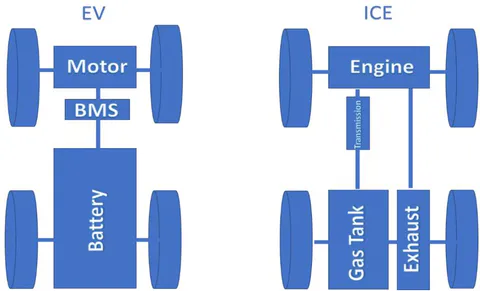
Batteries of EVs normally need to be replaced after a span of 7 to 10 years for smaller-sized vehicles and 3 to 4 years for such bigger vehicles as buses and vans (IER, 2019). Majority of these EV batteries have an 8-year warranty or a drive limit of 160,000km (100,000 mile) (University, 2017). The performance of a typical EV lithium-ion battery pack, post a few thousand charging cycles, starts to deteriorate rapidly. The battery is no longer capable of adequately and properly running the vehicle and needs to be replaced by a new one. However, this does not signify that the battery has reached its end. With appropriate systems and the right kinds of markets in position, these seemingly used and exhausted batteries have the potential to continue their journey and enjoy additional, two to three lives in uses that are less rigorous. Even in the present day, businesses, for instance utility companies and operators of telecom towers, are cashing in on recycled batteries to improve on their operational cost front (Simlett & Mortier, 2019).
2.6 Life cycle of EV batteries and its socio-economic and environmental impacts
Spent batteries can provide an opportunity to effectively cope with the serious challenges emerging for battery producers with respect to end-of-life waste-management. Producers need to gain access to strategic elements that are crucial for manufacturing EVs. Recycled lithium-ion batteries from EVs are believed to be able to provide a valuable secondary source for these indispensable materials (Harper et al., 2019a). The supply chain of EVs with the recycle of the batteries at EOL is shown in figure 4 below.
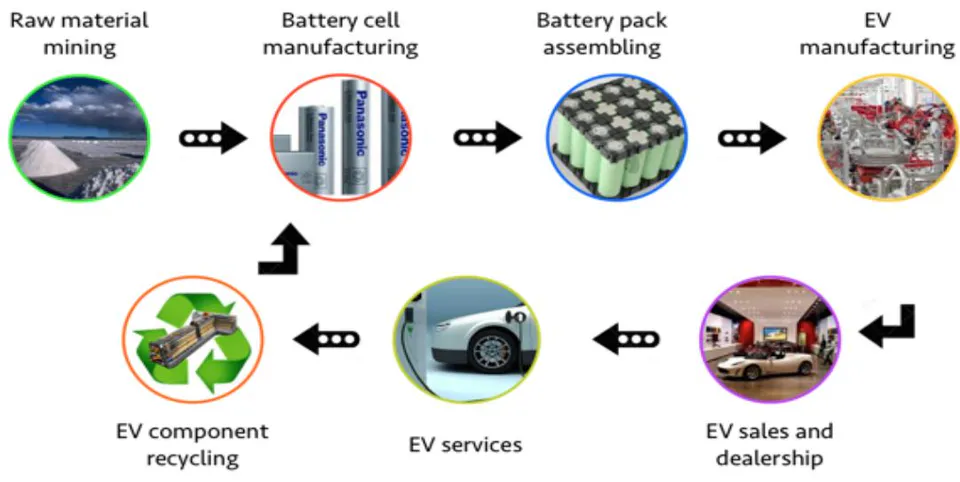
Less arduous, secondary usages for these batteries are likely to prolong their terms of operation, or in certain instances refurbishment might also be contemplated. At the end of the day, however, the battery needs to be processed in a manner that permits recycling all the valuable and/or hazardous components and materials (Jungst, 2001). Recycling presents the scope for reducing the life cycle costs by way of reclamation of expensive materials which in turn helps to forestall the expenses associated with disposal of hazardous waste materials. This is the key reason for the developers of power sources for EVs having recycling of maximum possible material at the end of their useful lives as one of their objectives (Jungst, 2001).
It goes without saying that exponential rise of EVs is the key factor responsible for the substantive and comparable development of the market for rechargeable batteries. However, the Special issue on strategic battery raw materials, a report released by the United Nations Conference on Trade and Development has underlined several environmental and socio-economic effects of mining the raw materials required for battery manufacturing (UNCTAD, 2020; Zhou et al., 2016). If not dealt with in a timely manner, these concerns are likely to diminish the importance that EVs receive as a form of transportation that has better conscientious (Gandhi, 2020).
Cobalt is an essential ingredient for manufacturing rechargeable batteries that are used to fuel smart phones and EVs (Clowes, 2019). Cobalt is necessary to keep the EV batteries from getting overheated and facilitates capacity maintenance throughout charging and recharging cycles (Lightfoot, 2019). However, lithium-ion batteries, that are expected to power approximately 30 million EVs globally by 2025, have not received the consideration that they deserve. Also, there are quite a few challenges that must be encountered when using cobalt in lithium-ion batteries, making it more difficult for electric vehicle manufactures to pull down EV costs (Lightfoot, 2019).
The metal itself is very rare. The Democratic Republic of Congo (DRC) contributes to almost 72% of global cobalt production (Clowes, 2019) out of which 20% Cobalt comes not from mines run by strongly regulated international mining firms but from small artisanal mines that are believed to have been associated with child labor and human rights exploitations by Amnesty International, among others (Campbell, 2020; Laudati & Mertens, 2019; Sanderson, 2019; UNCTAD, 2020). In June 2019, the DRC witnessed the death of 43 artisan miners due to landslide at a large copper and cobalt pit in one of the industrial mines that was being operated by Anglo-Swiss mining giant Glencore (Bordoni,
2019; Lightfoot, 2019). The supply chain of raw materials used in the EV battery production is shown in figure.
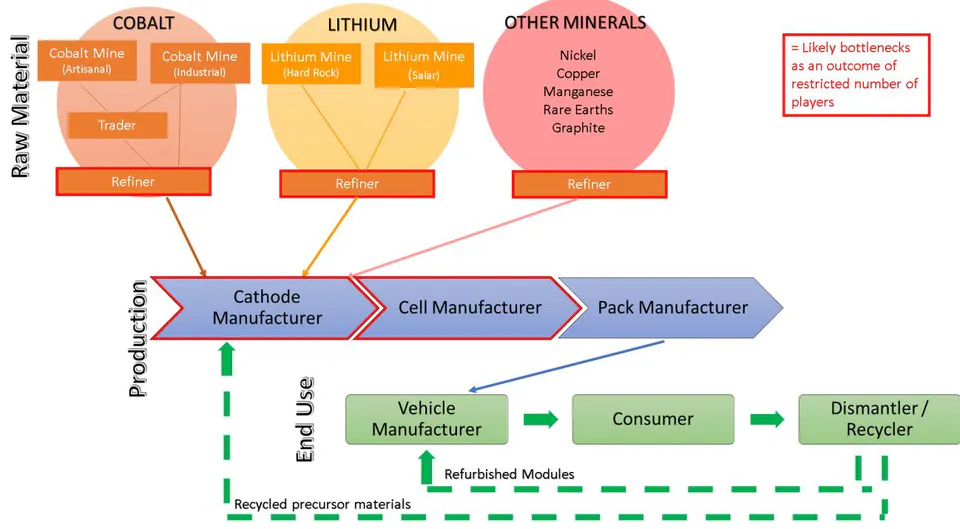
A historic lawsuit has been filed against some of the world's largest tech companies including Dell, Apple, Google, and Microsoft, by families of child laborer in Congo who became fatal casualties or were physically disabled while working in the mines that produce cobalt needed by the battery manufacturers as a raw material for the batteries that are used in smartphones, laptops and electric cars (Kelly, 2019). With the decline in the usage of fossil fuels providing traction for electric vehicles, the International Energy Agency has updated its 10-year forecast for the e-mobility segment, which notifies that economic and global political concerns will triumph over the environmental courtesies in terms of recycling industrial wastes (Hall, 2020; IEA, 2020).
2.7 Emerging Technologies
Society has come of age and environmental awareness amongst the masses has also resulted in the increased demand for EVs. This is also related to the age, education level, income of the individual, awareness amongst individuals about the implications of leading a green lifestyle (the envisages significant lifestyle changes and changes in shopping habits over the previous 5 years) and playing their part by changing consumption patterns. Research reveals that all these factors bear a positive correlation with the intent of purchasing an EV (Hanke et al., 2014).
Batteries being the most expensive component of EVs contributing to almost of an average mid-size vehicle (Anonymous, 2020). Besides increasing the risk of exhausting power, leaving the driver stranded, a weakening battery fast damages a vehicle's second-hand value. Tesla, the Californian EV maker, has a million-mile (1.6m km) batteries project going on (Anonymous, 2020). Tesla plans to launch an original low-cost, long-life battery in its Model 3 sedan in China, late 2020 or early 2021, that is expected to make the cost of EVs comparable to ICE models, besides allowing these batteries to have 2-3 lives in the electric power grid (Shirouzu & Lienert, 2020). Vehicles using LIBs (also used in cellphones) are likely to get replaced over the next few years by cars and trucks manufactured using lithium-iron phosphate and other chemistries. Besides reduc ing costs, it is expected to prolong vehicle ranges to at least 400 miles between charges and allow batteries to last for 1 million miles (Mullaney, 2020).
III. RESEARCH METHODOLOGY
seurs in the fields of circular economy and electric vehicles (Johnston, 2014).
3.2 Results
3.1 Systemic Review
As the research methodology I have adopted a systematic literature review. Systematic review refers to the examination of a distinctly formulated question which puts to use systematic and unambiguous methods for the purpose of identifying, selecting, and critically appraising pertinent research, and for collecting and analyzing data from various studies that are included in the review (Baumeister & Leary, 1997). Literature identifies, critically appraises and assimilates the findings of various high-quality individual studies that are of relevance to the subject of research and in so doing it addresses the research questions identified (Baumeister & Leary, 1997). This research has undertaken a thorough literature review of the field of study in order to examine both earlier and contemporary work of connois- From January 2000 to March 2021, we found 782 articles with the search term circular economy in general and recycling and supply chain in particular were selected initially for evaluation using most popular search engines for scholarly works, for instance, Google, Scholar, Springer., MDPI., Emerald., Sage., Science Direct., and Wiley. Online Libraries. After removing the duplicates, the articles remaining for analysis was 675. Out of these articles 135 articles were removed due to poor language context or being non English papers or book reviews. Finally, 540 randomly chosen articles were analyzed and of these 204 systematic reviews and/or meta-analysis met our inclusion criteria. Among these 84 articles were removed because these papers focussed more on the technical attributes of battery metrics rather than the management perspective (see Figure 6).
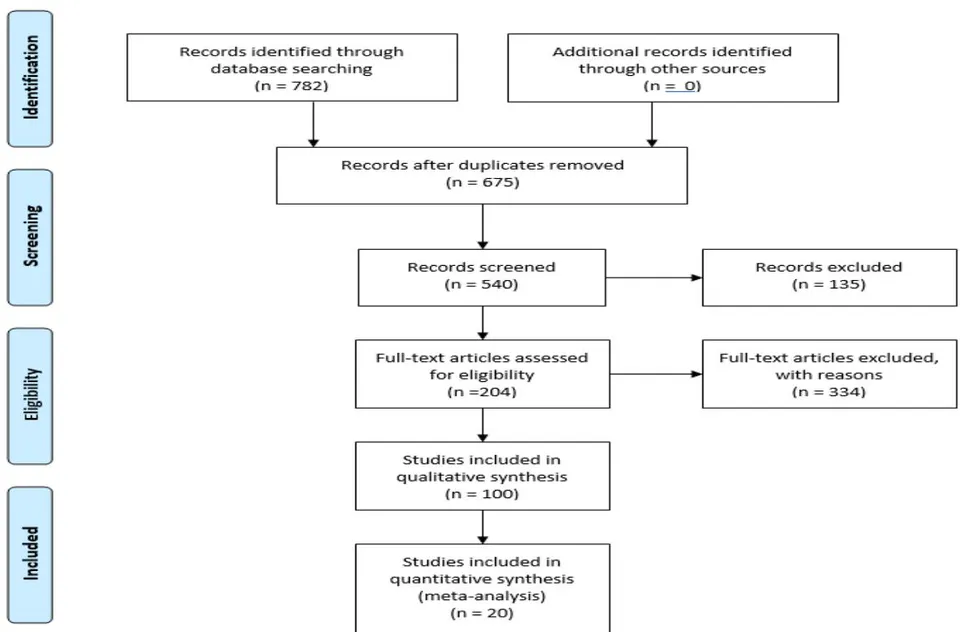
A comprehensive search of the literature was undertaken, followed by conjoining descriptions and tabular methods for the synthesis of literature (Bjørnbet, Skaar, Fet, & Schulte, 2021). Following this a filtering process was used to reduce the number of papers using a selection of keywords that specifically cover both the circular economy in general and recycling and supply chain in particular (Beaudet et al., 2020; Mo & Jeon, 2018; Nascimento et al., 2019). For the purpose of conducting this review dependably across conventional Supply Chain Management, sustainable Supply Chain Management and Circular Economy, phrases such as 'circular supply chains', 'circular economy', 'sustainable supply chains', recycling, waste management, 'reverse logistics,' 'closed loop' and several other combinations covering similar terminology, as our principal search terms were used.
3.3 Secondary Analysis
Secondary data presents excellent resources for research. Since the data has already been collected, cleansed, organized in a useful manner and published, it reduces the difficulties faced while handling primary and raw data. Time and resource constraints justify the use of secondary data. Secondary analysis involves empirical exercise applying the same fundamental research philosophies as research that utilize primary data (Johnston, 2014).
The research is based on secondary data that has been collected from various publications issued by various reliable agencies across the world. Charts and graphs offer an extremely efficient way to decode any patterns or trends present in the numerical data, on any variable, discernible though the quantitative data analysis. Appropriate visual representations help to present a clear unambiguous picture of any trend underlying the data. We have gathered data from authentic national and international sources (World Bank, UNCTAD, International Energy Agency and Statista) including government data bases across the world and globally renowned research houses (e.g. McKinsey, J.P. Morgan and Bloomberg).
Several charts such including simple bar charts, clustered bar charts, composite bar diagrams, pie chart and line diagrams have been used to draw out useful information. The data has been analyzed using charts and diagrams in order to bring out important trends and components.
IV. RESULTS
Countries across the world are fast implementing clean air policy and switching over to EVs is an important part of it. As of now, transport policies that target no-emission vehicles or phasing out of internal combustion engine (ICE) vehicles through 2050 have been publicized by 17 nations (IEA, 2020). This entails steady rise in EV sales and gradual but significant decline in conventional internal combustion engine (ICE) vehicles.
2019 saw global sales of electric cars crossing 2.1 million, exceeding levels reached 2018 (considered a record year) boosting the stock of electric cars to 7.2 million (IEA, 2020) of which battery fueled electric cars are estimated at around 1.7 million approximately in 2019 (Statista, 2020). The International Energy Agency estimates there will be 140m electric cars globally by 2030 depending on whether nations meet targets set in the Paris climate agreement (Gardiner, 2017).
In 2019 electric cars represented 2.6% of worldwide car sales and approximately 1% of global car stock, recording a 40% growth, year-on-year (IEA, 2020). In 2018 EV sales jumped 65% above 2017 figures. However, in 2019, there was only 9% year-on-year increase in the number of units sold to 2.3 million. The evolution of the EV stock and the growth of BEVs in comparison to EVs is shown in figure 7. Even the first quarter of 2020 saw sales decline by 25%. This indicates an easing of the rapid expansion. Overall, Europe witnessed the strongest growth in EVs (Gersdorf et al., 2020). Europe, however, went against the trend to record a 44% growth with its market share expanding to 26% (Gersdorf et al., 2020). HEV sales peaked in 2003 then gradually declined only to spike again in 2019.
{"image_source":{"path":"images/947a767e006ee710e431d96694022299c56f3a30628eae5e5ce36b5564adf6d0.jpg"},"content":"","chart_caption":[{"type":"text","content":"Figure 7: Global sales of electric vehicles vs battery-electric vehicle (Statista, 2020)"}],"chart_footnote":[]}
Notwithstanding the general contraction in sales, EV market penetration at the global level expanded by 30 basis points in 2019 to 2.8% from 2.5% in 2018, due to the additional growth witnessed in the first quarter of 2020 (Gersdorf et al., 2020).
{"image_source":{"path":"images/e2389498757b4e0ada2483f5878fc155af087334e9de9b8b4721e719e6a90a10.jpg"},"content":"","chart_caption":[{"type":"text","content":"Figure 8: Projected growth in BEV"}],"chart_footnote":[]} In the figure 8, the projection assumes the base case scenario to be cumulative of a billion all-electric vehicles on the roads globally by 2050 (Lambert, 2017) and projects the demand for EVs under 3 scenarios – base case, bull case and bear case. Research indicate that electric car sales are expected to take off beyond 2022. Bloomberg forecasts for annual EV sales is 10m by 2025, 28m by 2030, and 56m by 2040. According to Bloomberg NEF's "Electric Vehicle Outlook 2020" report, Passenger EV sales that soared to 2.1 million in 2019 from 450,000 in 2015, are expected to drop in 2020. Thereafter it is expected to head northwards regaining the momentum on the back of falling battery prices, improvement in energy density, better charging infrastructure, and new market entries (BloombergNEF, 2020).
According to auto industry analysts who are to forecast the timeline for EV sales to exceed ICE vehicle sales and as depicted in figure 9 new electric passenger car sales will overtake sales of ICE models by 2037 (Evarts, 2019).
{"image_source":{"path":"images/08ae7e04cea8a63577b361e28699d365ab9cca955d2bfcc00afea109e0f620f9.jpg"},"content":"","chart_caption":[{"type":"text","content":"Figure 9: Projected growth in EV vs ICE"}],"chart_footnote":[]}
Morgan Stanley's analysts predict that more EVs will be sold in 2040 than gas-powered cars (Lambert, 2017). On a conservative basis Bloomberg Energy predicts of global car sales to comprise of EV by 2040 (Lambert, 2017). In October of 2018, J.P. Morgan anticipated that EVs will comprise about of global vehicle sales in 2020 and by 2025, EVs and HEVs together will comprise an estimated of global vehicle sales (J.P.Morgan, 2018). According to a recent report by Cairn Energy Research Advisors, a research-based firm that focuses on EV and battery industries, there would be a spike in EV sales in 2021 as an increasing number of nations across the globe press on new campaigns with the objective of urging consumers to purchase vehicles powered by battery. The estimates publis- hed by Cairn indicate a surge in the global sales of EVs in 2021 and cross 3 million for the first time ever (Le Beau, 2020). But these were estimates were made before COVID-19 virus had struck us. The world economy is now very different from what it used to be. Depending on how things pan out during the rest of 2020, EV sales are expected to constitute nearly of total vehicle sales (Le Beau, 2020) even on a conservative basis and expand to over 25 million vehicles to constitute of global vehicle sales by 2025. Pure-ICE vehicles will be left with approximately of the market share in 2025, that is expected to fall to about by 2030, primarily in emerging markets (J.P.Morgan, 2018).
Growing production of EVs means increasing demand for batteries. The global EV battery market size estimated at 84 million by 2025, reflecting a compounded annual growth rate (CAGR) of 17.2% from 2018 to 2025. Fortune Business Insights Report (2018) predicts that global EV battery market will see a CAGR of 21.1% in volume to reach at 40.6 million units by 2026 from 8.6 million units in 2018. The global EV battery market is in position to grow at a CAGR of nearly 22% (by $ 44.24 bn approximately) during 2020-2024 (Kakkar, 2020; Research & Markets, 2020). The Fortune Business Insights Report emphasized that Asia-Pacific will lead the EV battery market because of the progressively stricter regulations introduced by respective governments to cut down carbon and greenhouse gas (GHG) emissions (ETAuto, 2019).
Over the last 20 years battery market growth has been fueled by the emergence of Lithium-ion technology. With the rapid growth in EV penetration, the automotive industry is looking forward to reducing its reliance on fossil fuels and lithium-ion battery manufacturers are poised to unlock access to opportunities that were unthinkable of a decade ago (Transparency Market Research, 2019). Lithium finds its largest end-use in rechargeable batteries as shown in pie chart in figure 10 taking almost 37% (Mo & Jeon, 2018).
{"image_source":{"path":"images/a130e0ba5aa7a71802171e93fc1cccdc726ba3a5088f71f0658e0e38e0c4235a.jpg"},"content":"","chart_caption":[{"type":"text","content":"Figure 10: Uses of Lithium- Demand in 2015"}],"chart_footnote":[]}
Lithium-ion battery market is projected to witness volume expansion at about 11% CAGR, from 2019 to 2027 reaching 15,764.89 Million Units by 2027 (Transparency Market Research, 2019). In terms of value, the growth is expected at about 9%
CAGR during 2019-2027 to reach US$ 41.5 Bn by 2027 (Transparency Market Research, 2019). In 2018 Asia Pacific garnered conspicuous share of the worldwide lithium-ion battery market. The charts showing Li battery demand growth in figure 11 predict a 2000 GWh capacity by 2030.
{"image_source":{"path":"images/6d3912e9b5ea957313cf0380b5db6c44f4bb25db3ebeccae4e4c3e5221a55d96.jpg"},"content":"","chart_caption":[{"type":"text","content":"Figure 11: Annual LI battery demand"}],"chart_footnote":[]}
According to the World Economic Forum, keeping global warming lower than 1.5 degrees would require adding 100 million electric vehicles altogether by 2030 (Eckart, 2017). By 2025 an estimated 90% of the lithium-ion battery market would comprise batteries powering EVs. However, Li-batteries are a key element behind the possibility of EVs generating higher carbon emissions over their lifecycle (consisting of raw materials procurement, manufacturing, use and recycling) compared to petrol or diesel cars (Eckart, 2017).
The huge scaling up of material demand for EV batteries necessitates increased attention to the challenges associated with raw material supply that relate mostly to ramping up production, social and environmental issues (IEA, 2020).
A key environmental issue is growing mineral crisis and consistent mining is also depleting water fast as the mining process used in South America (Lithium Triangle holds over 50% of global reserve) uses a lot of water – approximately 500,000 gallons per ton of lithium (Katwala,
2018). There is also risk of contamination of water due to leakage from the evaporation pools used during recovery (Katwala, 2018). Another big concern is waste disposal.
Considering the 2017 EV sales volume, UK researchers calculated that there will be 250,000MT, or 0.5 million cubic meters, of “unprocessed battery pack waste” when these EVs reach the end of complete their live-cycles in roughly 15-20 years, that can easily fill up 67 Olympic swimming pools (Hunt, 2019). This EV boom is expected to result in 11MT of expended lithium-ion batteries that would need recycling during 2017-2030 (Gardiner, 2017).
Cost of lithium-ion batteries plummeted 78.65% during 2010-2017 due to higher adoption of battery technology by the auto makers and the development of economical production methods by sellers (Kakkar, 2020). LIB pack price dropped 75% over 7 years from approximately 209/kWh in 2017, and is projected to fall below $100/kWh by 2025 (BloombergNEF, 2020). This reduced cost of LIB pack makes EV price comparable to traditional vehicle resulting in an earlier tipping point for active spread of EVs (Cobb, 2015; Mo & Jeon, 2018).
In 2015 manufacturing BEVs were much costlier than comparable ICEVs, chiefly owing to the cost of manufacturing batteries which imposed a significantly higher expenditure burden on vehicle owners(Brennan & Barder, 2016), increasing the cost of ownership compared to ICEVs. Up to 50% of the cost of a typical LIB comprises raw materials cost and replacing virgin materials by recycled materials, could reduce total pack cost by up to 30% (Beaudet et al., 2020).
Recycling a battery currently entails a cost of €1 per kg. However, just one third of that is the value of raw material reclaimed. Recycling lithium costs five times as much as extracting virgin material. Hence, only about 5% of lithium-ion batteries are recycled at present (Eckart, 2017; Gardiner, 2017) (Eckart, 2017; Gardiner, 2017; Reid & Julve, 2016). However, recycling would be logical considering the huge volume of consumption of lithium-ion batteries pushing lithium demand (expected to be 350,000 MT in 2020) and supply failing to keep up which might push material prices up in future. In 2015 aggregate LIB consumption requires metals and minerals worth $2 billion (Sanderson, 2017). While lithium demand is expected to rise 4 times between 2015 and 2050 to 480,000 tons (Eckart, 2017), demand for cobalt is expected only to double (Sanderson, 2017).
V. DISCUSSION
Undoubtedly living standards in the emerging markets have significantly improved due to economic growth yet concerns remain regarding the massive volume of consumer and industrial waste generated in these markets. Several municipalities spend nearly 50% of their budgets on solid-waste management (McKinsey & Co., 2017). Studies suggest that CE can be of help here. Employing CE principles, state-of-the-art businesses are discovering ways to transform trash into cash. By accumulating volumes that are big enough to validate business investment, these businesses can establish infrastructure necessary for systematic waste supply chains management (McKinsey & Co., 2017). CE approach to production is readily accepted in political and business spheres to surmount the deficiencies of conventional linear economy models of operation. Academic literature on CE is still at the embryonic stage. Adequate consideration is not given to implications of supply chain management, despite supply chain innovation's relevance in superior resource efficiency and CE (De Angelis, et al., 2017).
With the UN forecasting global population to reach nearly 10 billion by 2050, Earth's natural resources will only be more strained. This emphatically underscores the environmental benefits of the circular economy - a smaller amount waste going into landfill and lower water depletion, means lower GHG emissions (Stewart, 2020). CE addresses swelling resource issues faced by business and economies and has the potential for employment generation, growth initiation, and environmental impacts diminution, including carbon emanations (MacArthur, 2015). This works well for the corporates from shareholders' and consumers' perspectives since it takes care of CSR aspect of business operations. Current study by Nielsen suggest that 81% of worldwide customers strongly believe that companies should implement environment improvement strategies (Stewart, 2020).
EVs are vital to attaining global targets of carbon emissions reduction. However, it is evident from new research that the world is unprepared to handle the LIB waste generated once EVs complete their useful life span (Hunt, 2016). LIBs being a major cost component of EVs are more expensive than lead-acid batteries or NiMH batteries (Kakkar, 2020). But Tesla's new "million miles" battery developed with China's Contemporary Amperex Technology Ltd (CATL) deploying technology developed by Tesla in collaboration with a team of academic battery experts will bring the cost of electric vehicles closer to similar ICE vehicles. (Shirouzu & Lienert, 2020). If successful, this evolution we might even see the total cost of ownership (purchase price plus running costs) of EVs dipping below those of ICEVs (Reid & Julve, 2016). So, a huge amount of battery waste can and will be generated and battery recycling technology will come to the rescue besides abating social menaces of child labor and exploitation of labor by miners and cutting down adverse environmental impacts of mining.
EVs will positively impact automotive suppliers due to batteries. New services are expected to be created and recycling/reuse players are anticipated to grow (for example Umicore) while car maintenance and fuel sectors will decline (Sietzes wolfs, 2011). It is understood that there will be 11MT of EV batter waste by 2025 without simultaneous growth of systems to handle such huge waste volume (Eckart, 2017). A pragmatic method for recycling EV batteries as also other energy repositories from EVs is essential if this transportation technology is to be successfully implemented. Several battery manufacturing technologies involve the use of toxic materials. So, when these batteries are disposed these hazardous substances are released into the environment. This necessitates regulated disposal of EV batteries in certain cases but will most likely entail substantial expenditure and moves away from the objectives of benefiting the environment using zero-emission vehicles (Jungst, 2001). Researches indicate that recycling could be the element that would, in due course, drive the sustainability of lithium-ion cells through the minimization of waste and establishment of a circular economy (Gandhi, 2020).
As batteries from the first-batch of electric cars complete their useful life auto companies will have to decide whether to recycle or to put them to alternative use, One such use is reconditioning them and reusing them in less-exhausting stationary applications where batteries usually get charged and discharged at low rates and function with in a fortified working area under restrained environment(Reid & Julve, 2016). Due to complexity and low yield of recycling currently very few (approximately 5%) of lithium-ion batteries are recycled at present. Moreover, the recovery is dependent on the nature of cathodes used with a 70% recovery in lithium cobalt oxide (LCO) and a lower recovery for non-cobalt cathodes. (Brückner et al., 2020; Harper et al., 2019b). In addition to bearing the risk of discharging toxic gases if damaged these batteries suffer from another big disadvantage. The essential components (lithium and cobalt) extraction can cause water pollution and depletion besides other environmental concerns (Gardiner, 2017). The available literatures rightly emphasize on the virtues of recycling.
2014 European Commission report estimated €600 billion annual economic gains accruing to the EU manufacturing sector with EU countries undergoing transitions to a circular economy. Following several years of speedy economic growth even China adopted the CE concept in its last two 'Five Year Plans' recognizing the need to change course in raw materials and energy use and phase out industrial processes that generate excessive waste (Valavanidis, 2018). To gain perspective into the magnitude of EV battery waste, in 2019, China recycled 60MT plus LIBs and garnered more than 70% share of the battery recycling market (Mandal, 2020). Collective effort of smartphone producers, key automakers and the government helped the republic restraint the huge battery recycling problem caused by piling up of used batteries as an increasing number of people adopted
EVs(Mandal, 2020). European and Chinese markets would be the key factors driving EV demand soon and hence determining the fate of recycled battery and CE approach. China is already world's largest EV market manufacturing 1 million battery powered models in 2019 (Le Beau, 2020).
What no one is talking about the possible retaliation from oil companies. A key aspect of growth in battery driven cars is the displacement of oil as an important fuel for the transport sector. The articles that we reviewed did not shed much light on the impact that EVs and hence LIBs will have on the fossil fuel economy and the possible retaliation from countries that primarily thrive on Petro-money.
The adverse impact of passenger EVs and e-buses on global oil consumption continues to grow rapidly. Between 2011 and 2019, electric vehicles have dislodged almost 3% of the growth in global oil consumption (Murtaugh, 2019). As per Bloomberg NEF's May 2018 long-term EV outlook by 2040, EVs possibly will dislodge 6.4 million barrels/day of oil demand, while improvements in fuel efficiency will displace additional 7.5 million barrels/day, (Murtaugh, 2019). These have serious implications for both oil and electricity markets. Transport electrification, specifically by way of 2-wheelers, is already displacing approximately 1 million barrels of daily oil demand and by 2040 it will remove 17.6 million barrels daily. EVs altogether will add 5.2% to global electricity demand by 2040 (BloombergNEF, 2020). Distressed by low demand the oil producers can slash oil prices making driving ICEs further cheaper than EVs, thus making EVs unattractive to the vehicle buyers and throwing fresh challenges for the EV producers.
VI. CONCLUSION
In December 2019, France became the pioneer nation to pass a low towards this end, with a 20 years' timeline. We expect other countries to follow which will make it necessary to implement a circular economy framework to avoid battery waste accumulation and to eradicate the social evils associated with the mining of essential raw materials for battery. Recycling will also prove to be more economical for vehicle manufacturers. EVs can lead the way to solving, to a great extent, the problems created by the scarcity of resources even as world population continues to grow unabated. EV benefits include no tailpipe emissions, superior efficiency compared to ICE vehicles and huge potential for GHG emissions cuts, possibility of recycling and drawing benefits from a circular economy, along with growth of low-carbon electricity sector. But by far the best benefit derived from EVs is the demonstration of how recycling can be used by an industry to grow and meet growing demand. This is the key to directing nations to adopt policies supporting application of CE approach to production.
Conflict of Interest
The authors declare no conflict of interest.
Ethical Approval
Not applicable
Data Availability
The datasets used in this study are openly available at [repository link] and the source code is available on GitHub at [GitHub link].
Funding
This work did not receive any external funding.
References
Cite this article
Related Research

Special Issue
Launch a focused special issue to highlight research, emerging trends, and expert insights in your academic field.