



IntelliPaper
Abstract
In this paper using the metronidazole pharmaceutical drug compound as a green corrosion inhibitor that can be decreasing the rate of corrosion on metallic surface, as a result of the adsorption of metronidazole on the metal surface. In this regard, we simultaneously present an overview of metronidazole compound performance, as a corrosion inhibitor in 1M HCl, and with presence different concentrations of the drug. By using Electrochemical techniques (open-circuit potential, Potentio-dynamic polarization (PP), Electrochemical Impedance Spectroscopy (EIS), Electrochemical Frequency Modulation (EFM)) that illustrate the nature of adsorption. The surface examination by scanning electron microscopy (SEM), energy dispersive X-ray (EDX), atomic force microscopy (AFM), and Fourier transforms infrared (FT-IR) are confirmed the formation thin film that adsorbed on the metal surface according to the mechanism of the adsorption processes on the polarized metal surface.
Explore Digital Article Text
I. INTRODUCTION
Most organic compounds containing nitrogen (N-heterocyclic), sulfur, long carbon chain, or aromatic, and oxygen atoms are used as a corrosion inhibitor. Among them, organic compounds have many advantages such as large molecular size, soluble in water, availability, cheap, low toxicity, easy for uses, and easy production [1]. Natural heterocyclic mixes have been utilized for the corrosion inhibitor on the C-steel [2], copper [3], aluminum [4], and various metals in various aqueous medium [5]. Adsorption of the drug molecules on the metal surface facilitates its inhibition [6]. Heterocyclic mixes have demonstrated more hindrance effectiveness, for C-steel in both HCl [7] and arrangements [8], such as the medications are used inhibitors, that can compete favorably with green inhibition of corrosion, and the most medications can be synthesized from natural products. Selection of some medication as corrosion inhibitors due to the followings: (1) drug molecules contain oxygen, sulfur, and nitrogen as active sites, (2) it is environmentally friendly furthermore vital in organic responses, (3) drugs can be easily produced, and purified, (4) nontoxic compering organic inhibitors. Some medications have been investigated to be great corrosion inhibitors for metals such as Biopolymer gave inhibition efficiency (IE) for Cu in NaCl [9], pyromellitic di-imide linked to oxadiazole cycle gave IE for mild steel (MS) in HCl [10], 2-mercaptobenzimidazole gave IE for MS in HCl Antidiabetic Drug Janumet gave IE for MS in HCl [11]. Januvia gave IE for Zn in HCl [12], Cefuroxime Axetil gave IE for Al in HCl [13], Phenytoin sodium gave for MS in HCl [14], Aspirin gave IE for MS in [15], Septazole gave IE for Cu in HCl [16] and Chloroquine diphosphate gave IE for MS in HCl [17]. Study on Structural, Corrosion, and
Sensitization Behavior of Ultrafine and Coarse Grain 316 Stainless Steel Processed by Multiaxial Forging and Heat Treatment [18]. Investigating the corrosion of the Heat-Affected Zones (HAZs) of API-X70 pipeline steels in aerated carbonate solution by electrochemical methods [19]. Predictions of corrosion current density and potential by using chemical composition, and corrosion cell characteristic MS in micro alloyed pipeline steels [20]. Predictions of toughness, and hardness by using chemical composition, and tensile properties in microalloyed line pipe steels [21].
The scope of this article is used metronidazole drug as save corrosion inhibitor for MS in the acid medium by electrochemical method, and to elucidate the mechanism of corrosion inhibition. Experimental.
2.1 Metal samples
The sample of MS was used in this study that, has the chemical composition of the metal sample was determined by using an emission spectrometer, with the aid of ARL quant meter (model 3100-292 IC) and listed in the Table 1.
| Constituent | C | Mn | P | S | Iron |
| Composition% | 0.1 | 0.4 | 0.06 | 0.026 | Rest |
2.2 Metronidazole drug as an inhibitor
Metronidazole drug information's is described in Table 2.
Table 2 The Components and molecular structure of investigated inhibitor
| Inhibitor Structure | IUPAC Name | Molecular weight | Active centers | Chemical Formula | |
| 2-(2-Methyl-5-nitro-1H-imidazol-1-yl) ethanol | 2-(2-Methyl-5-nitro-1H-imidazol-1-yl) ethanol | 171.156 g.mol | 3N, 3O, 3 | ||
2.2 Solution
The aggressive solution, 1M HCl was prepared by diluting of analytical grade 36% of HCl with bi-distill water. The concentration range of the inhibitor was used between 50 ppm to 250 ppm.
2.4 Potentio-dynamic polarization technique
Electrochemical polarization experiments using three electrodes in electrochemical cell such as saturated calomel electrode (SCE) that, couple to a fine Lugging capillary acts a reference electrode, platinum is counter electrode, and working electrode made up from a square cut of metal (MS) sheet fixed in epoxy resin. The surface area that exposed to the electrolyte only. The working electrode was prepared with polisher paper (SiC) by different sizes (800, 1000 and 1200), and immersed in the corrosive medium at the natural potential for 10 min until it reaches a steady state.
The potential was started from -600 to +600 mV vs. open circuit potential ( ). Calculation of inhibition efficiency (% IE), and the degree of surface coverage ( ) as follows [22]:
Where, and are the corrosion current densities in the absence, and presence of metronidazole, respectively.
2.5 Electrochemical Impedance Spectroscopy (EIS) technique
The measurements of EIS were achieved at over a wide frequency range of to x 0.1 Hz). The potential perturbation was 10 mV in amplitude peak to peak.
The inhibition efficiencies (% IE), and the surface coverage ( ) obtained from the impedance measurements were calculated by the following relation:
Where, and are the charge transfer resistance in the absence and presence of inhibitor, respectively.
The obtained diameters of the capacitive loops increase in the presence of inhibitor and decrease the capacitance double layer ( ), which is defined as equation [23]:
Where, is the maximum frequency.
2.6 Electrochemical Frequency Modulation (EFM) technique
The measurements of EFM were achieved by using a potential perturbation signal with have abundance of 10 mV with two sine waves of 2 and 5 Hz based on three factors:
1- Large peaks were used to calculate the corrosion current density ( )
2- Tafel slopes ( & )
3- Causality factors (CF & CF ).
The inhibition efficiencies (% IE ) were calculated as follows:
Where, and are corrosion current densities in the absence, and presence of an inhibitor, respectively.
All electrochemical techniques were achieved by using Gamry instrument PCI300/4 Potentiation/Galvanostatic/Zra analyzer, DC105 Corrosion software, EIS300 Electrochemical Impedance Spectroscopy software, EFM140 Electrochemical Frequency Modulation software Echem. Analyst the results were plotted in graph form. The data was fitted, and calculated.
2.7 Surface Examinations
The morphology of the MS surface is used for analysis, examination nature of the surface and study the changing, that was appeared on the metal surface. The specimens were prepared by abraded mechanically by using different emery papers up to 1200 grit size and immersed in 1M HCl acid (blank) and with 300 ppm of metronidazole at room temperature for one day (24 h). Then, after this immersion time, the specimens were washed gently with distilled water, carefully dried, and taken carefully to the system. The surfaces were examined, such as using scanning electron microscope (SEM), energy dispersive x-ray (EDX), FT- IR spectroscopy, and atomic force microscope (AFM).
III. RESULT AND DISCUSSION
3.1 Electrochemical Techniques
3.1.1 Open circuit potential ( ) From the Fig. 1 and Table 3 are shown several interesting points:
Thein the blank solution was started at -562.1 mV, then was shifted anodically, and the steady state occurred after 300 s. This indicates that the initial dissolution process (the attack on the surface of metal), and then the formed oxide film.
In the presence of metronidazole, thestarted at a relatively positive potential compared with that in the absence of the inhibitor, and then shifted anodically, starting from 483.3 to 475.1 mV according to the increasing concentration from 50 to 300 ppm respectively. The steady state is attained rapidly, compared with the blank. With increasing the concentration of metronidazole, the shift in the open circuit potential increases in the active direction, indicating that the inhibitor might act mainly as a mixed type inhibitor[24]. The classification of a compound as an anodic or cathodic type inhibitor is based on thedisplacement; if the shift inis at leastmV compared to the one measured in the blank solution, it can be classified as an anodic or cathodic inhibitor. However, from Fig. 1, the shift inon adding metronidazole is about 15 mV, revealing that the present inhibitor acts slightly more as an anodic inhibitor.
{"image_source":{"path":"images/44d8e1dd8d6f1661b5002e8723077bf7accae7d1a9fbbd36433890fcf1998939.jpg"},"content":"","chart_caption":[{"type":"text","content":"Fig. 1: Open circuit potential, EOCP vs. time relations for MS submersed in 1M HCl in the nonexistence and the existence of metronidazole drug at "},{"type":"equation_inline","content":"25^{\circ}"},{"type":"text","content":" C."}],"chart_footnote":[]}
| Conc.(ppm) | (mV) | (mV) |
| Blank | 526.1 | 507.1 |
| 50 | 483.6 | 480.2 |
| 100 | 479.3 | 471.5 |
| 150 | 478.9 | 475.2 |
| 200 | 476.9 | 469.3 |
| 250 | 475.1 | 469.3 |
| 300 | 475.1 | 458.7 |
3.3.2 Potentiodynamic polarization (PP)
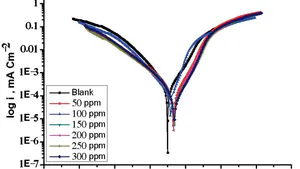
The results are drawn in nonexistence and with existence deferent doses of metronidazole drug in Fig. 2. The obtained potentio-dynamic polarization parameters are given in Table 4. These results indicating that the cathodic, and an anodic curve according to Tafel-type behavior. The form of the curves is slightly similar either in the cathodic or in the anodic side, which indicates that the mechanisms of MS dissolution, and hydrogen reduction apparently remain in the presence of the inhibitor. Addition of metronidazole decreased both the cathodic, and anodic current densities. The carves are shown mainly parallel displacement to the more negative and positive values respectively, i.e. the presence of metronidazole in solution inhibit both the hydrogen evolution, and the anodic dissolution processes with overall shift of to slightly fewer negative values.
The graphical also are shown that the anodic, and the cathodic Tafel slopes ( and ) are slightly changed on increment of the doses of the metronidazole. It obvious that no change of the mechanism of inhibition in existence, and nonexistence of metronidazole drug. The fact that the values of are slightly higher than the values of refer to the cathodic action of the metronidazole inhibitor. It is obvious that the action of inhibitor control over the electrochemical reaction slightly cathodic control. This means that the metronidazole is mixed type inhibitor, but the cathodic is more specially polarized than the anodic. The values of Tafel slope is higher referred to the surface kinetic process instead of the diffusion-controlled process [25]. Ether the cathodic slope that obtained from the electrochemical measurements confirm the hydrogen evolution reaction was activation or cathodic controlled [26].
The addition of the inhibitor did not modify the mechanism of this process but appears that the inhibition mode of the metronidazole was used by simple adheres of the surface by adsorption process.
{"image_source":{"path":"images/a3231aae5b95e745aac3d3b3d50e869947bec2a7c1ade58e0e93f24c5d7887e4.jpg"},"content":"","chart_caption":[{"type":"text","content":"Fig. 2: PP curves for the corrosion of MS in 1 M HCl in the nonexistence and existence of various doses of metronidazole at "},{"type":"equation_inline","content":"25^{\circ}"},{"type":"text","content":" C"}],"chart_footnote":[]}
| Conc. ppm | C. R. Mpy | % IE | |||||
| 0.0 | 147.0 | 498 | 153 | 344 | 96.5 | ---- | ---- |
| 50 | 61.1 | 465 | 77.1 | 94.4 | 27.9 | 0.71 | 71 |
| 100 | 78.6 | 464 | 97.9 | 99.1 | 35.9 | 0.628 | 62.8 |
| 150 | 92.7 | 465 | 109.9 | 110.2 | 42.4 | 0.561 | 56.1 |
| 200 | 125 | 466 | 95.9 | 106.2 | 57.3 | 0.406 | 40.6 |
| 250 | 129 | 467 | 152.2 | 129.9 | 58.8 | 0.391 | 39.1 |
| 300 | 136 | 469 | 105.7 | 136 | 62.2 | 0.355 | 35.5 |
3.3.3 Electrochemical Impedance Spectroscopy (EIS)
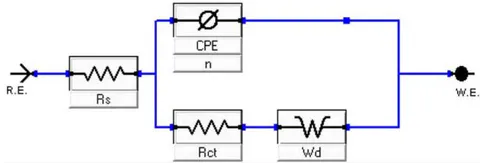
The Nyquist, and Bode impedance diagrams studies between 0.1 Hz and 100KHz frequencies rang abundance signal at for MS in 1M HCl in the nonexistence, and with existence of various doses of metronidazole are obtained. The equivalent circuit that describe for metal, and electrolyte are seen in Fig. 3, EIS variables and (% IE) are determination, and recorded in Table 5.
The obtained Nyquist, and Bode plotting for metronidazole are shown in Figs. 4 a,b. Nyquist spectrum is characterized by a single full half-circle. The curves are shown, that the corrosion of mild steel is controlled by a charge transfer process [27]. The diameters of the capacitive loop obtained increases in the presence of metronidazole are indicated that the increasing the inhibition process [28]. It was observed from the obtained EIS data, that increases but decreases with the increasing of inhibitor concentrations. The increases of values deal the increasing of the inhibition efficiency, due to the gradual replacement of water molecules by the adsorption of the inhibitor molecules on the metal surface to form an adherence film on the metal surface. This suggests the degree of coverage on the metal surface by formation film decreases the double layer thickness. Also, enhance the decreasing of with increasing the inhibitor concentration, that occurs as a result from a decreases in local dielectric constant, and replacement water molecules by inhibitor molecules which, indicating that, the inhibitor was adsorbed on the surface of both anodic, and cover somewhat of cathodic sites [29].
{"image_source":{"path":"images/ef7c77c2c8265d959b06b43eff9a6f0c2e6bf6d3447b336d770a664135af8d01.jpg"},"content":"","chart_caption":[{"type":"text","content":"(b) Bode"}],"chart_footnote":[]}
Figs. 4 a, b: The Nyquist (a), and Bode (b) curves for corrosion of MS in 1 M HCl in the nonexistence and with existence of various doses of metronidazole at 25 °C Table 5: Electrochemical kinetic variables obtained by EIS technique for MS in 1 M HCl without and with various doses of metronidazole at 25 °C
| Conc. ppm | Ω cm2 | μF cm2 | θ | % IE |
| 0.0 | 8.5 | 908.5 | ---- | ---- |
| 50 | 31.2 | 879.2 | 0.564 | 56.4 |
| 100 | 35.4 | 864.9 | 0.616 | 61.6 |
| 150 | 69.5 | 863.4 | 0.804 | 80.4 |
| 200 | 133.7 | 852.3 | 0.898 | 89.8 |
| 250 | 190.6 | 849.8 | 0.929 | 92.9 |
| 300 | 193.2 | 841.5 | 0.930 | 93.0 |
3.3.4 Electrochemical Frequency Modulation technique (EFM)
EFM is regarded a very good technique to determination corrosion information directly, and quickly because EFM is nondestructive technique to determination corrosion . The measurements data of EFM are became a valid data when the practical causality factors (CF2 and CF3) are equals or near the hypothetical values (2 and 3) which determination from the frequency spectrum of the current reaction. Fig. 5, illustrated the EFM inter-modulation spectrum of MS in 1 M HCl in nonexistence, and existence deferent concentrations of metronidazole drug. It is clearly that, the treatment EFM data utilizing two various models: (1) the activation model by solved three nonlinear equation, and assuming no change of the corrosion potential due to the polarization of the working electrode (2) cathodic reaction controlled by complete diffusion .
The corrosion current density , , , CF2, and CF3 are calculated from the two large peaks of inter-modulation spectrum, and then are listed in Table 6. It is obviously, that the addition of the metronidazole drug at different doses to the corrosive medium reducing the , indicating that, the metronidazole drug inhibits the corrosion of MS by the adsorption process. The CF2 and CF3 are equal or near the hypothetical values 2 and 3 indicating that, the estimation information data are valid, and good value [32]. The% IE values are incremented by expanding the doses of metronidazole drug, which determination and are recorded in Table 6.
{"image_source":{"path":"images/8e52cce1c6a30d2c9645812c89b0564b3372d45ada6614792dfeaa748defd747.jpg"},"content":"","chart_caption":[{"type":"text","content":"Fig. 5: EFM for MS in 1M HCl unlucky deficiency and vicinity of distinctive convergences of metronidazole"}],"chart_footnote":[]}
| Comp. | Conc. ppm | μAcm-2 | mVdec-1 | mVdec-1 | CF (2) | CF (3) | CR Mpy | Θ | % IE |
| Blank | 0.0 | 425.8 | 69.5 | 91 | 1.9 | 2.8 | 203.2 | ---- | ---- |
| Metronidazole | 50 | 138 | 801 | 102.3 | 2.1 | 2.2 | 63.1 | 0.676 | 67.6 |
| 100 | 114.9 | 101.6 | 113.6 | 2.5 | 2.2 | 52.5 | 0.73 | 73 | |
| 150 | 107.9 | 88.7 | 113.8 | 1.9 | 1.7 | 49.3 | 0.746 | 74.6 | |
| 200 | 103.6 | 83.8 | 106.1 | 2.2 | 2.9 | 47.4 | 0.757 | 75.7 | |
| 250 | 86.2 | 79.5 | 85.9 | 2.0 | 3.2 | 39.4 | 0.798 | 79.8 | |
| 300 | 84.6 | 85.5 | 92.6 | 1.9 | 3.5 | 38.7 | 0.80 | 80 |
3.3.5 Scanning Electron Microscopy (SEM)
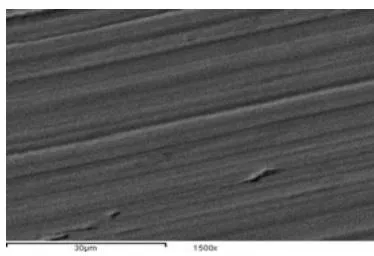
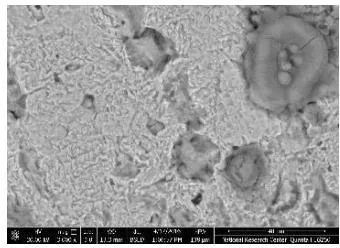
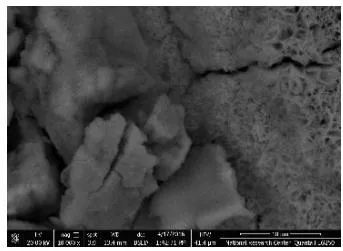
The micrographs are obtained for MS specimens in the nonexistence, and in the existence of 300 ppm of metronidazole drug after exposure for immersion one day in corrosive medium 1M HCl. It is clear, that the MS has suitable surfaces for corrosion attack in the blank or corrosive medium only `b and c. When add the metronidazole to the corrosive medium, the morphology of MS surfaces was shown quite different from the previous one, and the specimen surface was seen smoother. It is clear that the formation of a thin film layer adsorbed on the metal surface, which distributed in a disorder way overall the surface of the metal [33]. This may be due to the adsorption of the metronidazole on the MS surface, and made up the passive film that block and attract to the active site on the metal surface. The metronidazole molecule is interacted with active sites of MS surface, resulting the be decreasing contact between MS, and the corrosive medium. From the above sequentially metronidazole is exhibited excellent inhibition effect.
3.3.6 Energy Dispersion Spectroscopy (EDX) [34]
To determination the elements, and molecules, that existence are adsorbed on the surface of MS after one day that immersion in acid with optimum doses of metronidazole by using the EDX spectra. The EDX analysis of MS in 1M HCl with in the presence of 300 ppm of the metronidazole is given in Fig. 7. The spectra show additional lines, demonstrating the existence of C (owing to the carbon atoms of some metronidazole). These data show that the carbon, nitrogen, and oxygen atoms are covered the specimen surface. The EDX analysis is indicated that only carbon, nitrogen, and oxygen are detected, and are shown that the passivation film is contained the chemical formula of the metronidazole drag, that adsorbed on the MS surface. It is clear that, the percent weight of adsorbed elements C, N, and O were presented in the spectra, and recorded in Table 7.
{"image_source":{"path":"images/b5e356edfdb6dffbba40cf9230b61dd20532772c0462ee711d6aa778c0e747a8.jpg"},"content":"","chart_caption":[{"type":"text","content":"Fig. 7: EDS analysis on the MS in the existence 300 ppm of the metronidazole drug for 1 day that immersion in 1M HCl."}],"chart_footnote":[]}
| Wt% | Fe | C | N | O |
| Metronidazole | 75.97 | 43 | 5.21 |
3.3.7 Atomic Force Microscopy (AFM)
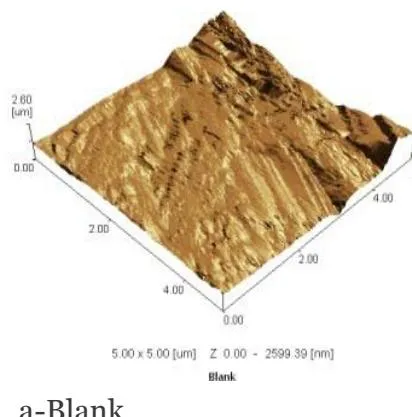
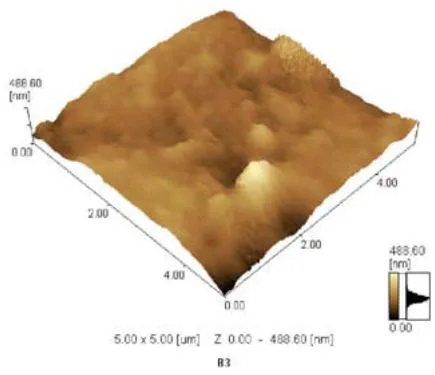
AFM is a powerful tool to investigate the surface morphology of various samples at nano- micro scale, that is currently used to study the influence of corrosion inhibitor on the metal solution interface. From the analysis, it can be gained regarding the roughness on the surface. The roughness profile values are played an important role to identifying, and reported the efficiency of the inhibitor under study. Among the roughness is tacked a role for the explanation of adsorption, and illustrated the nature of the adsorbed film on the metal surface . Fig. 8 a and b, show the 3D images as well as elevation profiles of polished of the MS in the absence, and the presence the metronidazole an inhibitor. From analysis the values, indicating that the higher value of Z parameter reached, which found (2.60 m) for the blank solution which placed in 1M HCl one day and analyzed. The observation of the metal surface which immersed in 1M HCl in the presence of 300 ppm of the metronidazole as an inhibitor possess small roughness (488.6 nm) compared with the blank solution. It can be noted that the value is lower than that of the blank value. The decrease in the roughness value reflected to the adsorption of inhibitor molecule on metal surface thereby reducing the rate of corrosion.
Conclusion: The image (a) is exposed to corroded solution affected the structure with large vales, and deep crack but the image (b) the surface reveal that is covering by thin film, that adsorbed on the metal surface. The adsorption film is protected the surface of the metal from corrosion process.
3.3.8 Fourier transforms infrared spectra (FT - IR)
The (FT – IR) spectrophotometer is a powerful instrument, that can be used to identify the function group, that presence in metronidazole, and the type of interaction that occur between function group with metal surface. Since, pharmaceutical drug compound contain variety of organic compound, and these organic compounds (inhibitor) are adsorbed on the metal surface by formation thin film that protection them against corrosion, they can be analyzed by using (FT – IR). To confirm the nature of the chemical constituent that adsorbed on the metal surface, by the Fourier transform infrared (FT – IR) spectra .
The pharmaceutical drug compounds are contained certain function group according to the chemical formula like OH, N=C, C=C and N=O. In order to find the nature of constituents involved in the adsorption using (FT – IR) spectrum of material that are coated the metal surface gives in Fig. 9. The spectrum of metronidazole before, and after adsorption that seen the wave number of the function groups OH abroad peak at starching, C=C is sharp peak at starching, and N=O a sharp peak between starching. It is clear that the function groups of metronidazole inhibitor appear on the metal surface that confirm to the adsorption process [38].
{"image_source":{"path":"images/2d953ac8502444f83c2382eb6351a811157f0b8b95129c272439611dd9e2dc67.jpg"},"content":"","chart_caption":[{"type":"text","content":"Fig. 9: FT – IR spectrum of metronidazole before and after adsorption on the MS surface."}],"chart_footnote":[]}
3.4 Mechanism of inhibition
To illustrate the mechanism of inhibition of corrosion on the MS surface in acid medium by using pharmaceutical drug compound as an inhibitor, it is must be knowing the nature of metal surface, and the nature of the component of inhibitor structure. The MS is regarded the metal -phase [39], It is obvious that -phase state consists of grains, and grain boundaries in the surface of the metal, Fig. 10. A cross-section of a piece or specimen of the metal that is a corroding to clarify that there are both anodic, and cathodic sites in the metal surface structure.
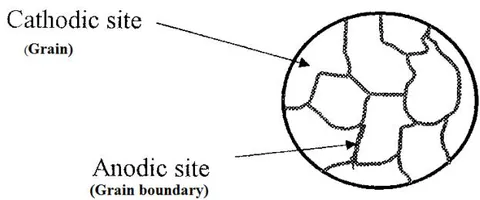
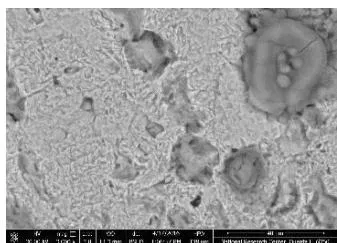
The surface of iron is usually, coated with a thin film of iron oxide. However, if this iron oxide film develops some cracks, anodic area are created on the surface, while other metal parts acts as cathodic sets. It follows that the anodic areas are small surface, while nearly the rest of the surface of the metal large cathodes. Electrochemical corrosion involves flow of electric current between the anodic, and cathodic areas called inter-granular corrosion. Fig. 11, SEM image is shown the corrosion of the MS in 1M HCl in one day immersion that illustrated inter-granular corrosion.
All previous results prove that the pharmaceutical drug compound under study were actually inhibit the corrosion of the MS in 1M HCl solution as a corrosive medium. The corrosion inhibition is due to their physical, and chemical adsorption for formation of protection thin film adsorbed on the metal surface. The effect of metronidazole as inhibitor may be corresponding to the accumulation of the inhibitor molecules on the metal surface, which prevent the direction contact of the metal surface with corrosive environment. The surface of the MS sample has positively charge in aqueous acid solution, and the adsorption occur according to :
1- The unshared electrons of nitrogen and oxygen atoms, and the electron density ofbonding donate to the vacant orbital on the metal surface, making chemisorption.
2- The partial negative charge that is present in functional groups containing oxygen and nitrogen, and the electron density of-bond in metronidazole may be adsorbed on the positively charged metal surface like electrostatic attraction between opposite charges, in the form of neutral molecules, involving displacement of water molecules from the metal surface.
The inhibition action of the metronidazole can be accounted by the interaction between the lone pair of electrons in the nitrogen, oxygen, and electron density of -bond with positively charged (anodic sites) on the metal surface, and the skeleton of inhibitor compound cover the cathodic sites this action form thin layer adsorbed on the metal surface and prevent corrosion processes Fig. 12.
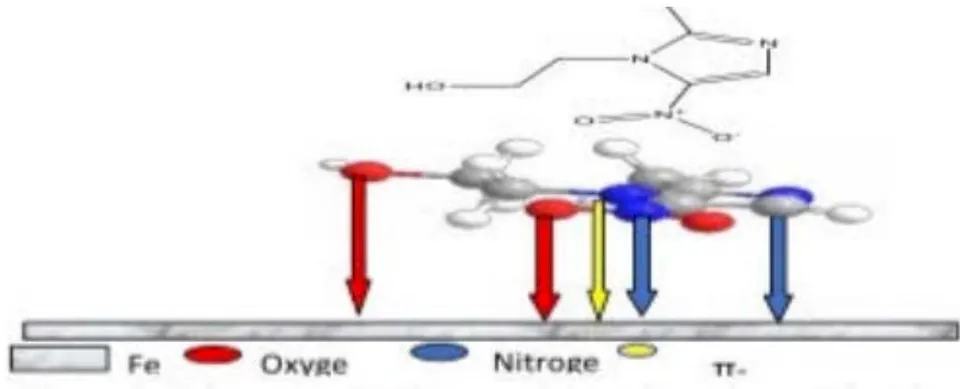
This meaning, the metronidazole molecule attached with anodic site, and covered somewhat of cathodic area, so that the corrosion rate in presence of metronidazole is anodic-cathodic control.
IV. CONCLUSION
Inhibition of the corrosion of the MS in 1M HCl solution by metronidazole is determine by potentio-dynamic polarization, Evans techniques, and surface examination by Scanning Electron Microscopy (SEM), Energy Dispersive X-ray (EDX), Atomic Force Microscopy (AFM), and Fourier Transforms Infrared (FT-IR). It was found that the inhibition efficiency depends on concentration, nature of metal surface, and the type of adsorption of the inhibitor. The observed corrosion data in the presence the metronidazole as an inhibitor:
The tested metronidazole inhibitor establishes very good inhibition efficiency for MS corrosion in 1M HCl solution.
Metronidazole inhibits the MS corrosion by adsorption on its surface, making a thin film layer protective against corrosion processes.
The inhibition efficiencies of metronidazole increase with the increasing concentrations.
The values of inhibition efficiencies obtained from all techniques used are seen as validating the obtained results.
The metronidazole molecule attaches to anodic sites and covers some of the cathodic area, so that the corrosion rate in the presence of metronidazole is under anodic-cathodic control.
Conflict of Interest
The authors declare no conflict of interest.
Ethical Approval
Not applicable
Data Availability
The datasets used in this study are openly available at [repository link] and the source code is available on GitHub at [GitHub link].
Funding
This work did not receive any external funding.
References
Cite this article
Related Research

Special Issue
Launch a focused special issue to highlight research, emerging trends, and expert insights in your academic field.