


IntelliPaper
Abstract
Personal financial management is a crucial concern for everyone in the society especially women as they have lack of financial skills needed for financial decisions. The current study aims to examine the influence of various financial socialization agents including family, peers, financial education, media and self-learning on personal financial management behaviour and also to determine the mediating role of digital financial literacy on this relationship. The study used quantitative techniques to collect data from 390 women respondents aged 18-45 to check their financial socialization through a self-administered structured questionnaire. The results of multiple regression revealed that various financial socialization agents significantly influence personal financial management behaviour and digital financial literacy partially mediate this relationship. This study's importance lies in its careful examination of the mediation pathways, which offers useful information to financial institutions, educators, and legislators. The uniqueness is in how digital financial literacy is combined with financial socialisation to provide a comprehensive grasp of the mechanisms driving women personal financial behaviour and empower them in the digital age. This study addresses the complex relationships examined in this multiple regression investigation, which helps to guide the creation of focused interventions to promote favourable financial outcomes.
Explore Digital Article Text
I. INTRODUCTION
Financial Socialization refers to the process of acquiring financial knowledge, behaviour and norms from social agents like parents, peers, media, and educators. The complexity of financial products from physical to digital makes financial choices more difficult. People with lower levels of financial literacy find it difficult to understand digitalised financial products and make the right financial decisions. Digital Financial Literacy enhances one's ability to apply this knowledge in a digital environment—such as using mobile banking, UPI payments, budgeting apps, or digital investment platforms. Individuals who are socialized financially may not always be able to act effectively unless they are digitally literate. Especially in rural or underprivileged settings, DFL enables better access to formal financial services, thereby amplifying the effect of financial socialization. Basically, financial socialisation starts from home through interaction and communication on financial matters among family members. According to Ward (1974), individuals acquire the abilities, information, and mindset from family which is necessary to optimize their position as financial market consumers. (Gudmunson and Danes 2011; Kim & Chatterjee, 2013; Serido and Deenanath 2016) Financial socialization theory points out that children receive financial knowledge from their parents, which shapes their financial comprehension as they grow up and results in financial capacity, behaviour, and financial wellness. (Antoni et al, 2019; LeBaron, Marks,
Rosa & Hill 2020) As individuals grew up, they learned the importance of money from their families, which helped them form lifelong positive attitudes toward personal financial management.
Social learning theories suggest that people are mostly affected by their social relationships like family, friends, colleagues and others. (Copur & Gutter 2019; Hoffmann and Plotkina 2021) Besides family there are other socialisation agents like peers, financial education and media which contribute in personal financial management behaviour. Similarly, financial socialisation can be acquired through self-learning from reading newspapers, journals, searching the internet and through financial experience. (Chowdhury A, 2019) explored the new ways for parents to teach financial socialisation through digital technologies by which they can easily teach financial skills and also keep a check on their financial transactions through various digital apps. Studies (Aziz and Akhtar 2021; White et al, 2021; Haudi 2023) have consistently shown that individuals who acquire socialization skills from their families tend to demonstrate better personal financial management behaviour such as budgeting, saving, investing, and prudent spending. The current study aims to examine the effect of financial socialisation agents on personal financial management behaviour of young women of Punjab and also to determine the mediating effect of digital financial literacy in this relationship.
II. LITERATURE REVIEW
Financial Socialisation is the social process through which one can acquire the various financial skills from different sources including family interaction, different financial socialisation agents including peers, financial education, social media & internet and self-Learning which is one's capability to handle all the financial issues independently. There is a comprehensive literature on financial socialisation.
2.1 Family Interaction & Relationship
Financial socialisation agents provide valuable financial information for personal financial management. An individual acquires skill, knowledge, capabilities, financial attitude & behaviour through family. (Sohn et al, 2012) Demographic and sociodemographic characteristics of family members including age, gender, parental relationship, and economic status also help to socialize each other. (Van Campenhout 2015) examined that financial socialization can take place explicitly through financial teaching and practice and implicitly through daily interactions which is considered to be more effective than explicit learning. (Serido and Deenanath 2016; Rosa et al 2018) These family interactions may be financial as well as non-financial. Financial interaction like parental role modelling may occur through observation and imitation like paying bills and shopping with parents whereas non-financial can occur through family interpersonal communication. (Lanz et al. 2019; Fan & Chatterjee, 2019; Sabri et al., 2020) The involvement of parents in financial socialisation acts as a key to acquiring financial skills in emerging adults. (Bucciol, et al, 2022) highlighted the importance of family financial socialisation along with acquiring financial education for wealth decisions which are beneficial for youngsters to develop positive attitudes throughout their life. (Antoni, X. 2023) discovered the significance of structure of family in developing techniques of financial socialisation to improve financial behaviour. (Agnew & Sotardi, 2024) explored that openness in family financial discussions has a substantial effect on financial independence, confidence and financial behaviour of adults in taking financial decisions.
2.2 Other Socialisation Agents
There are different financial socialisation channels in addition to family financial socialisation like formal financial education, peers, colleagues and media. Formal financial education through class, workshop, seminar in school, colleges, universities, online courses on financial management are also considered to be important source of financial socialisation. (Estelami, 2014; Ameer and Khan 2020) Since consumers rely more on social media and internet for financial decision-making, these are also emerged as socializing agents in addition to family, peers, and coworkers, despite of their validity and reliability difficulties. (Supinah et al, 2016) argued that different financial socialisation agents like reading material, social and electronic media, part time job and other life experiences change the financial attitude of individual and ultimately the financial management behaviour. (Goyal et al. 2023), argued that young working professionals' personal financial management behaviours are influenced by their financial attitude, peers, media, and parental guidance. (Vidhi Miglani, 2024) conducted a study on women in Kaithal, Haryana and discovered that peer groups has a substantial effect on women's financial behaviour and the open financial discussions among peer groups help to enhance the decision-making skills.
2.3 Self-Learning
These are the personal skills and confidence in financial decisions based on one's financial experience and self-learning which occur by attending online/ offline workshops/seminars; reading any book/ magazine/ journal on financial management; by searching financial information or checking any website regarding personal financial management with the help of social media, internet. (Loibal & Hira 2005; Livingstone and Helsper, 2007) analysis the effect of self-directed financial learning through digital resources, newsletters, websites, the internet etc on financial management and results revealed that financial self-directed learning positively affects financial satisfaction as they offer wider opportunities and experience. (Chowa and Despard 2014) found that the adults show healthy and positive financial behaviour when they started earning their own money. (Odo et al, 2017) online professional webinars helps in the formation of positive and negative thoughts of community as they shared their valuable experience with others and gain mutual support on financial matters. (Damian et al 2019) observed that the children learn from the experience of their parent's spending behaviour and show positive financial behaviour in managing money. (LeBaron et al 2019) name it as experiential learning in which parents use life experiences to give practical experience with money to financially socialise their young ones.
(White et al, 2020) discovered in their survey that digital messages regarding saving & investment help to shape the financial behaviour of students. (Schaefer et al, 2020; Yusof et al, 2022) argued that online learning through various social networking sites and digital educational apps provides valuable contents for self-socialisation and knowledge construction without any physical tutor. (Koskelainen et al, 2023) examined that the use of digital technologies contributes to a great extent in financial socialisation and personal financial management behaviour.
2.4 Digital Financial Literacy
Digital Financial Literacy stands for basic awareness of digital tools, making use of these digital platforms and knowledge about safety and self-protection while using digital apps. Individuals with positive financial socialisation are more adaptable to use digital financial platforms which are quite helpful for self-learning or self-socialisation. (Valentina et al, 2018) emphasis on media socialisation in this modern age as social media and digital media are widely used by youth for interaction which is quite helpful in developing digital literacy and attitudes. (Tiwari et al. 2020; Golden & Cordie 2022) examined a wide range of literature to explore how digital financial literacy may be utilized to enhance financial education using digital technologies, improving learning, expanding access to digital financial services, and equipping users with the skills they need to use financial technologies. (Abhijith, P. S. 2022) conducted a study on 349 middle-aged mothers of Kerala and proposed a concept known as "reverse fintech socialization, in which youngsters serve as socialization facilitators to teach their parents about technology and strengthen their attitude towards digital financial literacy and increase their confidence in using various digital platforms. (Chabra & Gupta 2023) investigated how different digital media resources affect personal financial literacy and discovered that people use these resources to improve their financial literacy through understanding of fundamental financial concepts that can aid in financial decision-making. (Frisancho V. et al 2023), investigated the impact of mobile apps on the financial literacy and behaviour of young people through a 27-week programme in Peru by giving them text messages and an easy-to-use budget recording tool. By providing students with experience learning through digital technology, the study helps to socialize young people with money and has a substantial effect on their financial behaviour. (Abdallah et al, 2024) The digital financial knowledge, skills, awareness and experience of online digital apps positively affect financial behaviour of individuals.
2.5 Personal Financial Management Behaviour
A personal financial plan is essential for everyone to satisfy their financial obligations and goals, help them retire comfortably, attain financial independence, make wise financial decisions, and take advantage of every opportunity to make money. To understand investment and financial planning, it is not enough to only listen to family, friends and peers but it is really beneficial to read books, attend seminars and search on financial websites. (Qamar et al, 2016) examined a positive effect of money attitudes, financial knowledge and self-efficacy on personal financial management behaviour. (Ameliawati and Setiyani 2018), found a positive and significant impact of financial socialisation on financial management behaviour with financial literacy as a mediating variable. (Antoni et al 2019), revealed that parents mostly use financial teaching & monitoring, modelling and reinforcement of financial behaviour to improve the financial behaviour of students. (LeBaron et al 2020) financial education from parents during childhood has greater influence on healthy personal financial behaviour in emerging adulthood. (Zhao & Zhang, 2020; Ndou, A. 2023) emphasis on more and more financial discussions by parents at home as these communications has stronger effects on financial literacy and behaviour. (Phuong et al, 2023) examined the investment experience, financial self-confidence and an individual's own financial intentions positively affect personal financial management behaviour.
2.6 Research Gap
The vast literature study clearly indicates that most of the prior research has focused on coordinating the childhood financial experience with adolescent financial socialisation. However, limited attention has been given to the influence of financial socialisation on young women's personal financial management behaviour. Previous studies have also highlighted the absence of comprehensive research examining the role of various financial socialisation agents including family interaction & relationships, peers, financial education, media and Self-Learning in shaping personal financial management practices. Further, there is a scarcity of studies investigating the mediating role of digital financial literacy within this relationship. Although, financial socialisation has been widely studied across different countries, little effort has been made earlier to explore its dynamics among young women in Punjab. The present study attempts to fill these gaps by analysing the impact of financial socialisation agents on young women's personal financial management behaviour in Punjab directly and through the mediating role of digital financial literacy. The following are the Research Questions:
RQ1: How do different financial socialisation agents (family interaction & relationships, peers, financial education, media & self-learning) influence personal financial management behaviour of women in Punjab?
RQ2: What is the effect of financial socialisation agents on digital financial literacy of women in Punjab?
RQ3: Does digital financial literacy mediate the relationship between financial socialisation agents and women's personal financial management behaviour in Punjab?
2.7 Conceptual Framework & Hypothesis
The conceptual framework highlighted the relationships between independent and dependent constructs. This framework is developed with the help of literature study which is further helpful in framing hypothesis. The financial socialisation agents is examined through family, peers, colleagues, financial education, media and self-learning which together provide a deeper understanding of independent construct. The following figure depicts the effect of financial socialisation agents on personal financial management behaviour with digital financial literacy as a mediating variable.
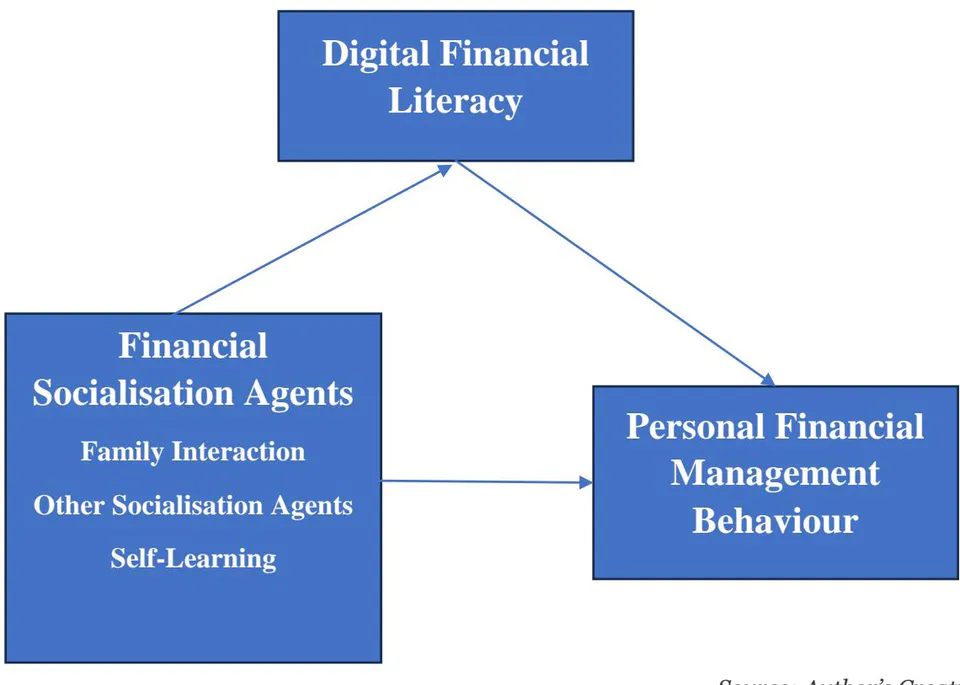
Figure: 2.1: Proposed Model
Hypothesis
The following hypothesis has been formulated:
H1a: There is a significant influence of family interaction & relationships on personal financial management behaviour.
H1b: There is a significant influence of other financial socialisation agents on personal financial management behaviour.
H1c: There is a significant influence of Self-Learning on personal financial management behaviour.
H2: There is a significant influence of Financial Socialisation agents on Digital Financial Literacy.
H3: Digital Financial Literacy mediates the relationship between Financial Socialisation Agents and Personal Financial Management Behaviour.
III. RESEARCH METHODOLOGY
The study adopted descriptive research design and employed a quantitative research methodology. It is a cross-sectional study in which data is collected only once. Further, the study used purposive sampling technique which is a non-probability sampling technique and used for sampling to select only those respondents who fulfil the purpose of study. The following section cover the sampling design, questionnaire design and data analysis.
3.1 Sampling Design
The study used women of age 18-45 years and included both working and non-working from the state of Punjab. The working women were sampled from educational sector, corporate sector and banking sector. Non-Working were homemakers. The sample size for the present study as per Rao soft is 385 and the final sample collection is 390 women from 22 districts of Punjab.
3.2 Questionnaire Design
The present study is based on primary data collection and used the instrument questionnaire to collect the data from respondents. Firstly, check the content validity of questionnaire by panel of experts and professionals and final questionnaire is prepared after incorporating the recommendations of panel members. The pilot testing was conducted by getting first 40 responses to check the reliability of questionnaire and then responses were collected online through google forms and offline through printed copies to cover the both type of respondents who are familiar to fill the form online and those who are unaware about digital forms. The snow balling technique was used to collect online responses in which women were further directed to share the questionnaire to working and non-working women through their social/professional network and about 10% was filled through offline mode. The questionnaire contains the following sections:
Section 1: cover the demographic part including the questions about age, marital status, income, education, current job profile, residence area. This section used a nominal scale to ask questions.
Section 2: The questions on independent variable financial socialisation agents were covered based on 5-point Likert scale. This section covers the dimensions family interaction & relationships, other financial socialisation agents and financial self-learning by asking 14 questions. The scale was adapted with some modifications from Shim et al. (2010), Shim et al. (2015), Gudmunson & Danes (2011), and Le Baron et al (2020).
Section 3: covers the mediating variable digital financial literacy including dimensions, basic digital awareness, use of digital platforms and digital self-protection. A total of 15 questions were asked which were taken from the scale developed by (INFE OECD 2022; Lyons & Kass Hanna 2021).
Section 4: is concerned with dependent variable personal financial management behaviour covering dimensions regarding management of taxes, retirement, investment, insurance and financial planning. This section asked 14 questions based on 5-point Likert scale and adapted the scale from (Lai & Tan 2009; Patel & Kumar 2017; OECD/INFE 2018).
3.3 Data Analysis
In order to study the association between independent and dependent variables the data is first checked for missing values and after coding the excel data file is transferred to SPSS 25 for analysis. Since, the scale is adapted from the previous studies with some modifications. An exploratory factor analysis was conducted to measure the construct validity of the measuring instrument. The items with a factor loading of 0.5 and more were considered significant (Hair et al, 2010). The tools used for analysis is descriptive analysis, exploratory factor analysis, Cronbach alpha to check reliability and multiple regression analysis to check the causal relationship between independent and dependent variable.
IV. RESULTS & DISCUSSION
The results of the analysis of 390 questionnaires were done in SPSS 25, and descriptive analysis was performed to collect demographic information of the respondents.
| Demographic Characteristics | Classes | Frequency | Percentages |
| Age (Years) | 18 – 25 | 134 | 34.4% |
| 26 – 35 | 147 | 37.7% | |
| 36 – 45 | 109 | 27.9% | |
| Level of Income | Less than ₹ 5 lakh | 245 | 62.8% |
| ₹ 5 lakh - ₹10 lakh | 120 | 30.8% | |
| ₹ 10 lakh - ₹ 15 lakh | 21 | 5.4% | |
| ₹ 15 lakh - ₹ 20 lakh | 4 | 1.02% | |
| Educational Qualification | Sr. Sec | 45 | 11.53% |
| Graduation | 153 | 39.2% | |
| Post-Graduation | 178 | 45.6% | |
| Other | 14 | 3.6% | |
| Marital Status | Married | 157 | 40.3% |
| Unmarried | 207 | 53.1% | |
| Divorced | 16 | 4.1% | |
| Separated | 10 | 2.56% | |
| Area | Rural | 175 | 44.9% |
| Urban | 215 | 55.1% | |
| Current Status | Working | 214 | 54.9% |
| Non- Working | 176 | 45.1% | |
| Type of Family | Nuclear | 192 | 49.2% |
| Joint Family | 198 | 50.8% |
The above table indicated the demographic profile of respondents. Most of the women 37.7% belong to age group 26-35. Nearly 39.2% sampled women were graduates and 45.6% were post-graduate. The maximum respondents 62.8% come under income bracket less than ₹ 5 lakh and approximately 30.8% from income range ₹ 5 lakh - ₹10 lakh. Further, most of the respondents were unmarried 53.1% and those who married were 40.3%. The status of working women 54.9% and non-working were 45.1%. Moreover, 44.9% ladies belong to rural areas and 55.1% from urban areas and lastly, 49.2% from nuclear families and 50.8% lived in joint families.
4.2 Results of EFA
The Exploratory Factor Analysis was performed by using a principal component analysis and varimax rotation. The minimum factor loading threshold of 0.5 were considered significant (Hair et al, 2010). The communalities indicated the variance in each dimension and show that all values were above 0.5. and finally, the three-factor solution is explaining 67.75% variance in the total data. The results of rotated factor matrix are provided in table 3.
Initially, we did not get the results as desired as some of the items were loading on other factors. We removed these items in steps. Firstly, we remove 3 items as failed to load on any dimension and these are (FIR1: "I freely discuss financial matters with my family", FSA5: "I read magazines, newspapers, searching online financial news and watch market trend to update my financial knowledge", FSL3: "I learnt from my life experiences how to deal with financial matters") and after that we remove those items which were loaded on more than one factor like (FSA1: "I get influenced by my family, friends, colleagues, financial advisors before taking any financial decision", FSL2: "I host parties at home or pay for my friends if we go out for dinner", FSL5 "I depend upon my family for taking any financial decision"). Finally, we repeated the EFA without considering these items and get the following final results.
| Kaiser-Meyer-Olkin Measure of Sampling Adequacy | .770 | |
| Bartlett's Test of Sphericity | Approx. Chi-Square | 762.824 |
| Df | 28 | |
| Sig. | .000 | |
The KMO value of 0.770, which is more than 0.7 indicates the sample is adequate to run analysis. Barlett's test of sphericity with a p-value less than 0.05 shows the significance of data. We reject the null hypothesis, which means the correlation matrix is not an identity matrix, and hence, it is good to run factor analysis.
| Factor1: Family Interaction & Relationship | Cronbach's Alpha (CA): 0.702 | ||
| Statements | Factor loading | Mean | Std. Deviation |
| FIR2. I take financial support from my family in case of need | 0.794 | 3.7897 | 0.87048 |
| FIR3. I take financial decisions based on what my family/friends have done in similar situations | 0.766 | 3.6769 | 0.80053 |
| FIR4. My family is my role model for financial management | 0.740 | 3.9821 | 0.90254 |
| Factor 2: Other Financial Socialisation Agents | Cronbach's Alpha (CA): 0.733 | ||
| Statements | Factor loading | Mean | Std. Deviation |
| FSA2. My financial decisions are influenced by Internet/ Social- media | 0.847 | 3.559 | 1.09467 |
| FSA3. I rely on financial company's website for financial information | 0.797 | 3.5385 | 1.01521 |
| FSA4. I update my financial knowledge by joining online financial education workshops and seminars. | 0.631 | 3.4667 | 1.05024 |
| Factor 3: Self-Learning | Cronbach's Alpha (CA): 0.717 | ||
| Statements | Factor loading | Mean | Std. Deviation |
| FSL1. I handle all financial responsibilities independently | 0.798 | 3.6744 | 0.9905 |
| FSL4. I use to prepare my daily household budget independently | 0.829 | 3.8051 | 0.95824 |
Factor 3: Self-Learning Statements Factor loading Mean Std. Deviation FSL1. I handle all financial responsibilities independently 0.798 3.6744 0.9905 FSL4. I use to perpare my daily household budget independently 0.829 3.8051 0.95824 Cronbach's Alpha (CA): 0.717
| Factor 3: Self-Learning | Cronbach's Alpha (CA): 0.717 | ||
|---|---|---|---|
| Statements | Factor loading | Mean | Std. Deviation |
| FSL1. I handle all financial responsibilities independently | 0.798 | 3.6744 | 0.9905 |
| FSL4. I use to perpare my daily household budget independently | 0.829 | 3.8051 | 0.95824 |
The above table indicates the results of EFA with the 3-factor solution as expected. All items are loading on their own factors and also showed the results of Cronbach's Alpha and Descriptive statistics for the factors of study. Factor 1 is Family Interaction & Relationships covering three statements (FIR2, FIR3, FIR4) having factor loadings (0.794, 0.766, 0.740 respectively and showing mean and std deviation within the desired range and showing the variations in the responses given by respondents. Factor 2 is Financial Socialisation Agents including statements (FSA2, FSA3, FSA4) with factor
Source: SPSS 25 loadings (0.847, 0.797, 0.631) and again showing mean and std deviation within the range indicating the correctness of responses. Factor 3 is related to Self-learning with statements (FSL1 and FSL4) showing factor loadings (0.798 and 0.829) and a valid range of mean and std deviation. The results of Cronbach Alpha are (0.702, 0.782, 0.717) for all the 3 factors. The Cronbach Alpha measure is used to check reliability and a value greater than 0.7 is considered acceptable (Collis & Hussey, 2021). Therefore, it shows the internal reliability of the construct.
| ModelDependent Variable: PFMB | Un std B | Std Beta | T value | P value | F value | Hypothesis | |
| H1 | (Constant) | 57.092 | 182.320 | .000 | 115.812 | Supported | |
| Family Interaction | 3.321 | .391 | 10.591 | .000 | |||
| Other Financial Socialisation Agents | 1.767 | .208 | 5.636 | .000 | |||
| Self-Learning | 4.473 | .527 | 14.266 | .000 | |||
| R Square = 0.474 means 47.4% | |||||||
| Dependent Variable: DFL | |||||||
| H2 | (Constant) | 56.985 | 169.775 | .000 | 89.006 | Supported | |
| Family Interaction | 3.901 | .454 | 11.607 | .000 | |||
| Other Financial Socialisation Agents | 1.196 | .139 | 3.558 | .000 | |||
| Self-Learning | 3.676 | .428 | 10.938 | .000 | |||
| R Square = 0.409 means 40.9% | |||||||
The above table indicated the results of multiple regression analysis which shows the effect of independent variable (family interaction & relationships, other financial socialization agents
Source: SPSS 25 and self-learning) on dependent variable (PFMB for H1 and DFL for H2). The regression coefficient shows the magnitude and direction of relationship between dependent and independent variable.
The table shows the beta values (0.391, 0.208, 0.527) and all the p values of independent variables are 0.000 which are less than 0.05 as the level of significance we reject the null hypothesis that all beta coefficients are equal to zero. Therefore, it is claimed that family interaction & relationships, other financial socialization agents (peer, financial education & media) and self-learning significantly affect personal financial management behaviour. The R Square value 0.474 indicates that 47.4% variance in the personal financial management behaviour is explained by financial socialization. The F Value (115.812) and p value (0.000) revealed the significance of financial socialization in developing personal financial management behaviour of young women. Hence, the hypothesis H1 is accepted. These results are supported by (Anthoni et al, 2022; Kaur & Singh, 2024; Agnew and Roger, 2025; Salazar and Solis, 2025).
Further, the table also indicated the beta values of (0.454, 0.139, 0.428) and all the p values are 0.000 less than the significance level of 0.05 which shows that financial socialization agents has a substantial effect on digital financial literacy. The R Square value (0.409) indicates that model explain 40.9% of the variance in digital financial literacy. Further, from the Anova table, F Value (89.006) and p value (0.000) shows that family interaction, other financial socialization agents and self-learning exhibit the significant association with digital financial literacy of young women. Therefore, the hypothesis H2 is accepted. These results coincide with the studies conducted by (Ravikumar et al, 2022; Adnan et al, 2023; Kaur & Sahni, 2023; Mishra et al, 2024; Lone, 2025).
| Model | Un std B | Std Beta | T value | P value | F value | Hypothesis Supported | ||
| Dependent Variable: PFMB | ||||||||
| H3 | (Constant) | 27.150 | 12.046 | .000 | 171.594 | Supported | ||
| Family Interaction | 1.271 | .150 | 4.219 | .000 | ||||
| Other Financial Socialisation Agents | 1.139 | .134 | 4.319 | .000 | ||||
| Self-Learning | 2.541 | .299 | 8.559 | .000 | ||||
| DFL | .525 | .531 | 13.374 | .000 | ||||
| R Square: 0.641 means 64.1% | ||||||||
Table 6: Excluded Variables
| Model | Beta In | T | Sig. | Partial Correlation | Collinearity Statistics | |||
| Tolerance | VIF | Minimum Tolerance | ||||||
| 1 | DFL | 13.374 | .000 | .563 | .591 | 1.692 | .591 | |
| a. Dependent Variable: PFMB | ||||||||
| b. Predictors in the Model: (Constant), Self-Learning, Other Financial Socialisation Agents, Family Interaction | ||||||||
The above table 5 shows the results of mediation analysis which was tested using Kenny's approach. According to (Baron & Kenny 1986) In the case of perfect mediation, the inclusion of the mediating variable in the regression equation will eliminate the statistically significant association between the independent and dependent variables. Alternatively, partial mediation will result in a reduced link when the mediating variable is included in the equation, but the association between the variables will still persist.
The table 5 shows the beta values (0.150, 0.134, 0.299); F Value (171.594) and p values are 0.000 which is less than 5% of significance level which depicted that family interaction & relationships, other financial socialisation agents and self-learning positively and significantly influence personal financial management behaviour mediated by digital financial literacy with beta value (0.531) and p values is (0.000). Further, the F Value (171.594) and R Square value (0.641) indicated that 64.1% of variance in dependent variables is explained by financial socialisation agents through digital financial literacy. This analysis revealed the partial mediation effect of digital financial literacy in the relationship between independent and dependent variables. The change comes in R Square by including the mediating variable DFL is 0.167 which means 16.7% more variance is explained by the model. These results are associated with the previous studies (P Kumar et al, 2022; Qamar et al, 2023; Jusoh, A. M. M. 2024; Showkat et al, 2025).
V. CONCLUSION AND RECOMMENDATIONS
The results of the analysis indicated the significant role of financial socialisation in determining individual's money management practices. The various financial socialisation agents like: peers, colleagues, Family interaction and relationship, financial education, media and self-learning positively influence personal financial management behaviour and digital financial literacy. Additionally, the study demonstrated how digital financial literacy partially mediates the association between young women's personal financial management practices and different financial socialization agents. Therefore, it is recommended that authorities and policymakers should focus more on the digital financial literacy of young women and provide them with a platform for open discussions on financial matters to improve their personal financial management behaviour as women are more influenced by their peer groups. Further, it is also recommended that as young women use social media and the internet, more financial informative programs need to be started for their self-learning. It is advisable to organize various digital financial literacy programs for hands on practice by women and to achieve this it is further, advisable for banks and financial institutions to celebrate women's day and daughter's day by inviting women of the area and arrange such digital financial literacy workshops to give them practical training to use various digital financial apps with safety. The working women are more independent in their financial decisions as they earn their own money as compared to non-working women whose financial decisions are somehow influenced by their family interaction & relationships. There is a need to empower them with digital financial literacy as it gives them financial independence to control their own financial decisions. The financial educators are recommended to develop various online and offline financial education programs and make these programs as part of the curriculum.
VI. LIMITATIONS AND FUTURE SCOPE
The study is not free from limitations. Firstly, the study is conducted in Punjab state only the financial socialisation of other states can also be explored. Secondly, the study's respondents were limited to the women from Punjab, other respondents can be the participants for research in future studies. Thirdly, the size of the sample can also be enlarged for future studies to generalize the results. Fourthly, the study is limited to only three dimensions of financial socialisation; there is a need to explore other dimensions of financial socialisation in future studies. Fifthly, digital financial literacy is considered as a mediator in this study which can be taken as a dependent variable for future studies and also some other mediators can be examined. Finally, the technique of analysis used in the study is multiple regression on SPSS to check the relationships of independent and dependent variables, in future studies, more complex relationships can be studied with some other analysis techniques like SEM in Smart PLS.
Funding Statement: The authors received no financial support for the research, authorship, and/or publication of this article.
Competing Interest: The author has no competing interest.
Conflict of Interest
The authors declare no conflict of interest.
Ethical Approval
Not applicable
Data Availability
The datasets used in this study are openly available at [repository link] and the source code is available on GitHub at [GitHub link].
Funding
This work did not receive any external funding.
References
Cite this article
Related Research

Special Issue
Launch a focused special issue to highlight research, emerging trends, and expert insights in your academic field.