


IntelliPaper
Abstract
In an era marked by hybrid threats, rapid technological advancement, and increasingly complex battlefields, the effectiveness of the Malaysian Armed Forces (MAF) hinges on the preparedness of its military personnel to evolve into Smart Soldiers. This article highlights the pivotal role of Professional Military Education (PME) in developing military personnel who are capable of operating across diverse operational domains. By focusing on the individual development of military personnel, the article identifies key areas of study that examine how PME enhances critical competencies such as decision-making, leadership, adaptability, and strategic thinking, ultimately equipping them to meet both contemporary and future operational challenges
Explore Digital Article Text
I. INTRODUCTION
The evolving nature of modern warfare, characterized by hybrid threats, multi-domain operations and technological convergence demand a new breed of military personnel who are not only tactically proficient but also cognitively agile, strategically minded, and technologically literate. As nations prepare for increasingly complex security environments, the concept of a Future Force has emerged to represent armed forces that are flexible, adaptive, and future-ready. Within this context, the Malaysian Armed Forces (MAF) must prioritize the structured development of its personnel to meet both current operational demands and future strategic challenges.
A central pillar in shaping this transformation is Professional Military Education (PME). PME refers to the deliberate, structured, and progressive educational pathways designed to cultivate the intellectual and leadership capacities of military personnel across all levels of command (Letovaltseva et al., 2026, Enstad & Hagen, 2025; Kucera, 2025; Serrano et al., 2025, Hampson & Taber, 2023; Kelley & Johnson-Freese, 2014). It is not limited to classroom instruction but extends to scenario-based training, joint operations education, strategic analysis, and the continuous development of mission-critical skills. For the MAF, a robust PME system is essential in cultivating the Smart Soldier, one who combines traditional military effectiveness with enhanced decision-making, adaptability, and the ability to operate effectively in dynamic and unpredictable environments (Ministry of Defence, 2020).
This article explores the development of PME within the MAF, with particular emphasis on its role in enhancing the competencies of military personnel, who serve as the backbone of tactical, operational and strategic levels of military organization. It critically explores how core areas of study in PME can be aligned with the demands of modern warfare and transformed to meet future expectations. PME is vital to preparing Malaysia's military personnel for the Future Force.
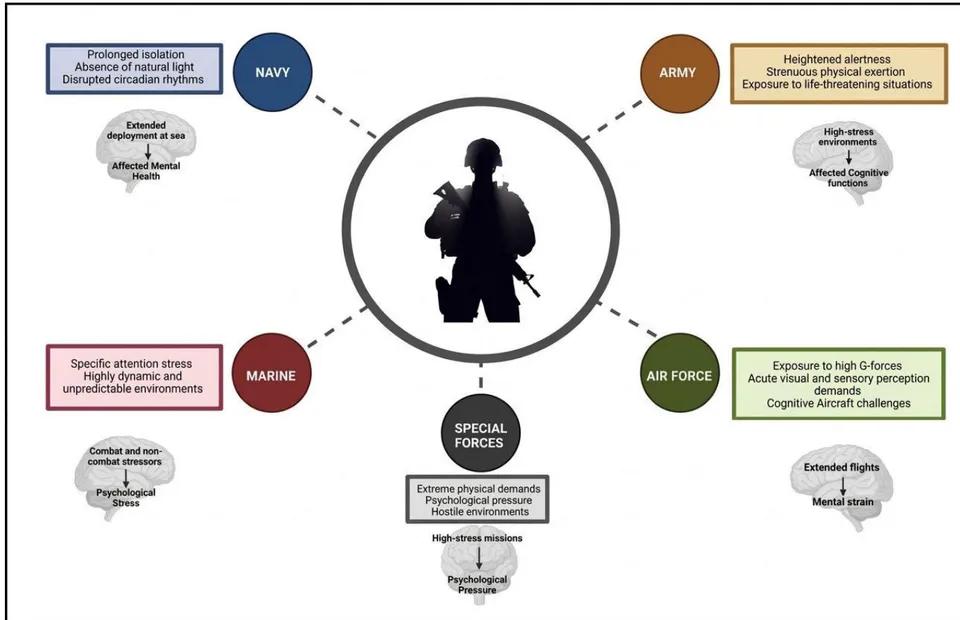
Future Force development demands a PME system that cultivates intellectual agility, operational adaptability, and strategic foresight. Designed around future-focused, multi-domain scenarios, PME must integrate joint operations, emerging threats, and technology-enabled learning (Zhang et al., 2026). Recognizing the varied psychophysiological demands across service branches, PME should be modular, progressive and tailored-ensuring personnel are cognitively, emotionally and physically prepared for high-stress, complex environments. Ultimately, PME is the foundation for a smart, resilient and future-ready force. Tornero-Aguilera et al. (2024) emphasized the importance of bridging the gap between theoretical knowledge and practical implementation in military training programs to effectively develop military personnel, as illustrated in Figure 1.0.
II. FUTURE FORCES
Developing the Future Force is essential to implementing Concentric Deterrence, the first pillar of Malaysia's Defence White Paper (DWP). As the "Nation's Shield," the Malaysian Armed Forces (MAF) are entrusted by the Government to uphold the National Defence Objectives at all times. In fulfilling this mandate, the MAF performs both primary and secondary roles. The primary role is to protect national interests by defending Malaysia's sovereignty and territorial integrity from both traditional and non-traditional threats through joint operations across the maritime, air, land, and cyber-electromagnetic domains. The secondary role involves conducting Military Operations Other Than War (MOOTW), such as Humanitarian Assistance and Disaster Relief (HADR), Search and Rescue (SAR), and Non-Combatant Evacuation Operations (NEO). The MAF also supports civil authorities in enforcement and nation-building tasks, while contributing to global peace and security through United Nations (UN) Peacekeeping Operations (PKOs). The uniform outlook will help the reader to follow the article easily. This can be obtained effectively if author uses this template file to construct his or her paper.
The force structure and posture of the Malaysian Armed Forces (MAF) must be reshaped to effectively address the evolving and uncertain security environment. Although the overall force size will be maintained at its current level
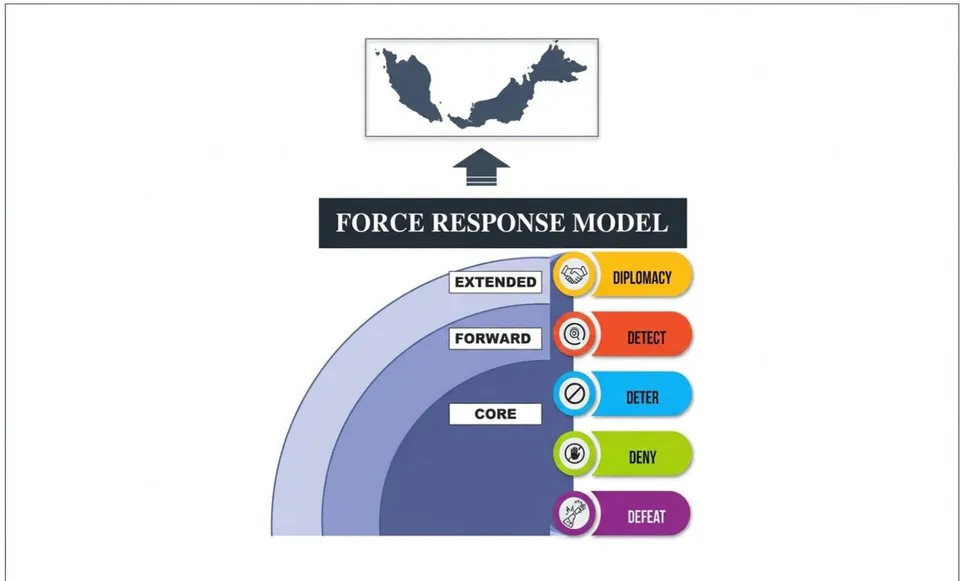
throughout the Defence White Paper (DWP) period, efforts will focus on repurposing and reprioritising existing capabilities to meet future operational demands. Greater emphasis will be placed on enhancing joint capabilities to ensure readiness for a broad spectrum of contingencies, ranging from armed interventions to natural disaster responses. Additionally, the MAF will strengthen its capacity to conduct simultaneous two-theatre operations across Peninsular Malaysia, Sabah, and Sarawak. This strategic capability is supported by the integration of the Threat Response Model, as illustrated in Figure 2.0, which enables coordinated, multi-domain readiness and rapid response across diverse geographic theatres.
The Government aims to shape the Malaysian Armed Forces (MAF) into an integrated, agile, and focused force, capable of responding to traditional and non-traditional threats in both peace and conflict. This transformation focuses on enhancing readiness through long-term investment in modern assets, equipment, and a skilled, knowledge-based workforce aligned with the Smart Soldier concept. The force will be integrated through joint cooperation across all Services, agile in adapting to diverse threats, and focused on priority-based capability development. The Future Force will be characterised by jointness, interoperability, technological readiness, two-theatre operational capability, and mission orientation—ensuring it is rapid, deployable, and effective across land, maritime, air, and cyber-electromagnetic domains within the concentric defence areas.
III. SMART SOLDIER
The Smart Soldier concept represents the evolution of the Malaysian Armed Forces (MAF) towards a technologically adept, cognitively prepared and highly adaptable military workforce. This initiative focuses on equipping personnel with advanced technical skills, critical thinking abilities, and leadership qualities required to operate in complex, multi-domain environments. Embracing digital technologies, data-driven decision-making, and integrated warfare systems, Smart Soldiers are trained to respond swiftly to emerging threats, both kinetic and non-kinetic. This transformation aligns with the national agenda of developing a knowledge-based defence force, ensuring that MAF personnel are not only physically capable but also intellectually agile to meet future operational demands.
To develop new capabilities for future operations, the Malaysian Armed Forces (MAF) will realign its existing structure and review personnel deployment over the next decade. Strengthening human resource management is essential to enhance preparedness and ensure operational effectiveness. Mission success hinges on the ability to recruit, develop, and retain skilled personnel capable of addressing evolving security challenges. This requires a renewed focus on the principles of raising, training, and maintaining the force, aligned with the concept of Comprehensive Defence.
In response to the shifting security landscape, the Government will continue to modernise the MAF by reinforcing recruitment, career development, and retention strategies in accordance with the Future Force requirements. A key element of this transformation is the Government's recognition of education as a cornerstone of career development and professional growth. By integrating training, education, and self-development programmes, the MAF aims to cultivate a highly professional military workforce. Emphasis will be placed on enhancing technical and managerial expertise to meet the demands of increasingly complex operational scenarios and technological advancements. This shift supports the development of Smart Soldiers and aligns with the national agenda of building a knowledge-based society.
The evolving operational environment demands new levels of knowledge and skills beyond those previously required (Bareebe, 2026; Sellberg & Lindwall, 2026, Barry et al., 2025; Melby, 2025; Martinez Machain, 2021). In response, the Malaysian Armed Forces (MAF) will continue to adopt the Knowledge Force (K-Force) concept, which emphasises the acquisition of high-quality knowledge and the cultivation of a continuous learning culture within the force. To support this initiative, the Government will establish a specialised expert pool particularly in critical areas such as cybersecurity comprising academics and industry professionals to strengthen national defence capabilities.
Professional Military Education (PME) plays a pivotal role in developing the Smart Soldier by equipping military personnel with the intellectual, technical, and leadership competencies necessary for modern operations. The Smart Soldier is not only physically prepared but also cognitively ready to operate in dynamic, joint, and multi-domain environments. PME achieves this by focusing on key Core Areas of Study (CAOS) that align with strategic, operational, and tactical requirements of the MAF.
IV. PROFESSIONAL MILITARY EDUCATION
Professional Military Education (PME) is a structured and progressive learning system designed to enhance the intellectual, ethical, and leadership competencies of military personnel across all ranks and services. Unlike technical or physical training, PME focuses on developing cognitive readiness, critical thinking, and decision-making skills essential for operating in complex, multi-domain environments. It forms a core component of military career development and supports the strategic vision of building a future-ready, professional force.
PME spans the full spectrum of a military career, from junior-level foundational education to advanced courses for senior leadership (Powell & Townley, 2025; Smith et al. 2025). It is delivered through dedicated institutions such as military academies, staff colleges, and war colleges, offering education tailored to strategic, operational, and tactical roles. Key areas of study typically include leadership and ethics, joint operations, military strategy, logistics, technology and cyber defence, and communication. This holistic approach ensures that personnel are equipped to lead in joint and interagency environments and to respond effectively to evolving security challenges.
Within the Malaysian Armed Forces (MAF), PME plays a critical role in developing the Smart
Soldier a knowledge-based, technologically proficient, and adaptable military professional. By prioritising lifelong learning and cultivating a culture of continuous professional development, PME supports the MAF's transformation into an integrated, agile, and mission-oriented force capable of upholding national defence objectives. Central to this effort are the Core Areas of Study (COAS), which form the foundation of PME curricula. These COAS are designed to address current and future operational demands. By aligning education with these strategic domains, PME ensures that MAF personnel are not only prepared for multi-domain operations but also capable of leading, innovating, and making sound decisions in high-tempo and complex environments. This approach directly supports the transformation of the MAF into an integrated, agile, and mission-focused force, in line with the national agenda of building a knowledge-based and future-ready defence ecosystem.
V. CORE AREAS OF STUDY
The Core Areas of Study (COAS) are the foundational academic and professional disciplines within the PME system, designed to systematically prepare MAF personnel for the demands of modern military service. These areas include leadership and ethics, military strategy and security studies, joint and combined operations, logistics and sustainment, technology and cyber defence, military history and doctrine, and strategic communication. Each area is carefully selected to ensure comprehensive knowledge development that spans strategic, operational, and tactical levels of warfare. COAS provides the intellectual backbone for training adaptive, mission-oriented personnel capable of operating in complex, multi-domain environments.
The purpose of COAS is to transform new recruits often civilians with minimal military background into Smart Soldiers who possess not only physical endurance and combat skills but also high levels of cognitive readiness, analytical thinking, and decision-making ability. This transformation begins at the initial entry phase, where foundational military values and discipline are instilled. As personnel progress through their careers, they undergo PME phases tailored to their rank and responsibilities. Through structured education pathways, each COAS develops key competencies: leadership training fosters command readiness; military strategy enhances strategic foresight; cyber defence builds digital resilience; and logistics improves operational sustainability. This staged, layered approach ensures that military professionals are intellectually agile and ready to meet future challenges across the concentric layers of national defence.
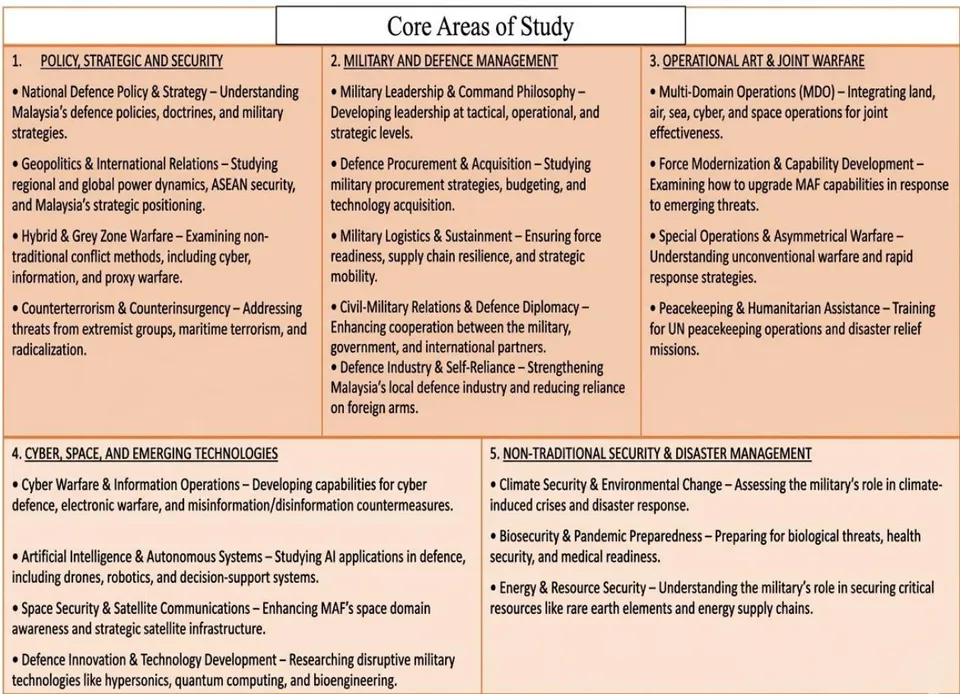
The Core Areas of Study for the Malaysian Armed Forces (MAF) reflect a comprehensive approach to preparing military personnel for contemporary and future challenges. These areas include: Policy, Strategic and Security Studies, which focus on national defense strategies, geopolitics, hybrid warfare, and counterterrorism; Military and Defence Management, emphasizing leadership, logistics, procurement, and self-reliance; Operational Art and Joint Warfare, covering multi-domain operations (MDO), force modernization, special operations, and peacekeeping; Cyber, Space and Emerging Technologies, which advance capabilities in cyber warfare, AI systems, satellite security, and disruptive defense innovations; and Non-Traditional Security and Disaster Management, which prepares the military for roles in climate response, pandemic preparedness, and resource security. Together, these domains ensure the MAF remains strategically aligned, operationally agile, and technologically advanced. Figure 3.0 illustrated core areas of study for the MAF.
The COAS framework is applied progressively throughout a military career, beginning from basic military training and junior leadership courses, continuing through intermediate staff education and culminating in advanced strategic-level education for senior commanders. Civilian recruits start with core military values, general service knowledge, and basic tactics. As they advance, education shifts towards specialized roles, joint operations understanding, and strategic thinking. PME institutions, particularly military training establishments, serve as critical platforms where the COAS are delivered and seamlessly integrated into career progression.
This continuum of learning ensures that, by the time a service member advances to higher leadership roles, they are fully developed as Smart Soldiers knowledge-driven, adaptable, and equipped to lead in joint, multi-domain, and technologically advanced operational environments.
VI. CONCLUSION
In an era defined by hybrid threats, technological convergence, and the growing complexity of multi-domain operations, the transformation of the Malaysian Armed Forces (MAF) into a Future Force is not merely a strategic ambition but a national necessity. Central to this transformation is the development of Smart Soldiers military professionals who are not only physically resilient but also intellectually agile, technologically competent, and capable of executing joint operations in high-tempo and uncertain environments. The Smart Soldier concept, supported by the Government's commitment to modernisation, human capital development, and the Knowledge Force (K-Force) agenda, represents the future of Malaysia's defence capability.
Professional Military Education (PME), anchored by the Core Areas of Study (COAS), serves as the cornerstone in realising this vision. By embedding leadership, strategy, technology, and operational excellence into every stage of a military career from civilian entry to senior command. PME ensures a structured, continuous, and mission-oriented learning pathway. Through this framework, the MAF cultivates a professional force that is integrated, agile, and future-ready. Ultimately, PME does not merely prepare individuals for military service it shapes the intellectual foundation of Malaysia's national defence and secures the nation's strategic posture for the challenges of tomorrow.
ACKNOWLEDGEMENT
The authors would like to express their sincere appreciation to the Malaysian Armed Forces (MAF) for their valuable support and the provision of relevant information that contributed to this work. The views and opinions expressed in this article are solely those of the authors and do not necessarily reflect the official policy or position of the Malaysian Armed Forces (MAF) or the Government of Malaysia.
Conflict of Interest
The authors declare no conflict of interest.
Ethical Approval
Not applicable
Data Availability
The datasets used in this study are openly available at [repository link] and the source code is available on GitHub at [GitHub link].
Funding
This work did not receive any external funding.
References
Cite this article
Related Research

Special Issue
Launch a focused special issue to highlight research, emerging trends, and expert insights in your academic field.