

IntelliPaper
Abstract
At close analysis, we can easily identify numerous medieval and early modern texts where the modern reader might find him/herself rather puzzled because the narrator seems to defy deliberately the essential purposes and strategies of all storytelling, that is, providing a logical plot, clear and unequivocal messages, relying on rational coherence, and offering a concrete conclusion. Of course, when we turn to didactic literature, which was highly popular throughout the Middle Ages and far beyond, such as the fable, the opposite was the case because the moralizing ending commonly and explicitly tells the audience what to expect and what to make out of the fictional account in moral, ethical, religious, or philosophical terms. But, what is also true, didactic accounts still require interpretation, even when there is no intentional obscurity. In essence, however, we might misunderstand the very meaning of many literary, especially courtly texts if we attempt to identify the critical lesson or the poet’s motivation in straightforward terms, especially when we distinguish between the author and the text as an independent entity. In other words, we would go badly wrong if we searched for rigid and straightforward messages within the narrative framework of many medieval accounts because human words tend to defy all those didactic purposes or are used for very different ones than we might have expected. Of course, to look at it from another perspective, there were countless instructional texts (chronicles, letters, wills, medical treatises, sermons, etc.) which are clearly determined by the writer’s intention and do not leave much wriggle room for the audience. At the same time, especially when we consider courtly literature, the entire issue becomes rather murky, which might be closely associated with the phenomenon itself, courtly love, a paradox in itself. This paper will highlight a number of major medieval narratives where obscurity, ambivalence, even confusion and duplicity, all the result of intentional poetic strategies, emerge as significant literary strategies that force the audience to become actively involved and to engage with the text as an intellectual, ethical, religious, or philosophical challenge. An intensive reading from the modern perspective actually confirms that medieval audiences must have felt similarly puzzled and provoked to discuss a specific text, even if the manuscript record does not necessarily confirm this. Identifying this epistemological phenomenon will enable us to grasp much more in depth the actual intellectual process behind the presentation of a fictional text to a medieval audience, which then will shed innovative light on the ultimate purpose of much of pre-modern but also modern and postmodern literature.
Explore Digital Article Text
Introduction
As recent scholarship has discovered, we can and must move away from a purely structural approach to pre-modern literature and recognize here, at least many times, narrative operations that allow the individual to find his/her interiority and also selfhood, contrasting the person with the social context and thus building meaningful connections between the protagonist and the audience, i.e., the outside reality as a mirror of the fictional world (Brookes 2025). If we can uphold this new perception, we can recognize a major strategy by many of the major poets to engage critically with their audiences and to reach out to them in a provocative, didactic, but also religious and philosophical manner. While the contributors to The Medieval Literary (Meyer-Lee and Sanok, eds., 2018) explore the relevance of form for the content to come to the fore, the purpose of this paper is to identify the deliberate strategy by numerous pre-modern authors to resort to obscurity in order to provoke their audiences into more intensive reflections upon the deep message of their texts. Obscurity, however, does not mean the same thing as secrecy or the mysterious (cf. the contributions to Conermann, Wolter-von dem Knesebeck, and Quiering, eds., 2022). Instead, this phenomenon emerges when poets intentionally confound their audiences and include narrative barriers that prevent an easy understanding. In medieval German literature, for instance, the term ‘wilde’ (wild) indicated that a narrator withdrew into the mysteries of an obscuring account which defied a rational explanation at first sight. Both mystical narratives and allegorical poems were commonly predicated on obscuritas (see the contributions to Köbele and Frick, eds., 2018; none, however, engages with the literary material this paper will investigate), but obscurity often makes its presence felt also in courtly romances, poetry, and verse narratives (for the phenomenon of nonsense, somewhat related to obscurity, see, e.g., Classen 2012; Kirk 2021). And, most importantly, the Bible itself, God’s divine narrative message, proved to be obscure and in great need of examination and exegesis (Evans 1991).
The Mystery of Love
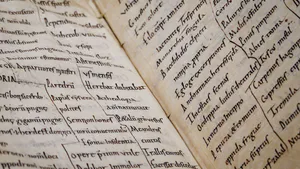
When the Anglo-Norman writer Marie de France (fl. ca. 1160–ca. 1200) reflected upon the best approaches in composing courtly narratives, she faced numerous options and then chose one of them for her own purposes that mirrored the emphasis on obscurity. On the one hand, she created erotic tales, lais, on the other, fables, and she also authored a religious tale, Espurgatoire seint Partiz. My focus here will rest on the first corpus of narratives contained in the British Library MS Harley 978 because the latter two fall into a very different category which is not relevant for this study. In the lais, by contrast, the poet offers narrative accounts pertaining to love and marriage that challenge the audience extensively and raise numerous questions we continue to struggle with until today (for a good overview, McCallum 1993; she refers, for instance to Dante’s Divina Commedia [ca. 1320], fourteenth-century Italian dolce stil nuovo by Cavalcanti or Guinzelli, to Boccaccio’s Genealogia deorum gentium, and then quickly moves to sixteenth-century English literature).
This phenomenon actually goes to the heart of any good literary text which intends to provide more than just entertainment, creating layers of meaning, a mise en abyme. In the general prologue, Marie addresses the key notion about literature as already formulated by the Roman grammarian Priscian (fl. ca. 500), emphasizing that a good writer would deliberately implement obscurity in his/her text: “Assez oscurement diseient” (Waters, ed., 2018, 12) so that the readers or listeners would be encouraged to search for the meaning and to figure out what the messages might entail. She envisioned, in other words, an intensive interaction between the poet and the audience, transforming the literary text into a medium for self-reflection, critical investigations, and, in short, for epistemology at large, or an intellectual challenge. After all, these lais address fundamental questions pertaining to human happiness, love, marriage, and the quest for self-fulfillment within an erotic relationship. Moreover, Marie’s verse narratives address a number of social, political, economic, and religious issues that have not lost any of their significance in modern times. Hence, as she emphasizes in the prologue, “Whoever wishes to protect himself from wrongdoing / should study and understand / and begin a heavy task; / through this he can further distance himself / and deliver himself from great sorrow” (23–27).
In other words, the fictional account turns into a narrative platform for fundamental if not existential issues pertaining to happiness, though Marie did not, as far as I can tell, address Boethian concepts in explicit terms. Of course, we see throughout her collection how much the notion of fortune and misfortune (the wheel of fortune) matters centrally, with the lives of the various individuals going up and down without them having much control, if any, over it – see the mysterious ship in “Guigemar,” the fairy lady in “Lanval,” or the falcon man in “Yonec” – but she does not engage specifically with Boethius’s Consolatio de philosophiae (ca. 524). To this we would have to add the contributions by Martianus Capella in his famous De nuptiis Philologiae et Mercurii (early fifth century), both being the essential textbooks in late antiquity and the Middle Ages, but again, Marie hides her familiarity also with this influential treatise behind her fictional account (Mickel 2011, 50–51). Obscurity was not a literary failure but a major strategy to invite the audience into a conversation with her about the essence of love, certainly a most difficult topic (Mickel 2011, 59).
Instead of drawing on Latin sources for her own literary enterprise, Marie decided to turn her attention to ancient Breton tales which obviously carried deep wisdom for her and which she wanted to share with her audience, though she systematically incorporated a shield of obscurity, as she said earlier, to encourage the readers/listeners to embark on a thorough investigation of what the ultimate meaning of her lais might be. Whereas Latin sources would not help her to demonstrate her own creativity and inventiveness, because many other writers had already utilized them, those vernacular texts proved to be most productive for Marie because the ancient poets “made them for remembrance” (35). Although the poet uses the term “aventures” (36; adventures), the deeper meaning easily proves to be much more profound than simple entertainment, especially because she dedicated her stories to the king whom she praised as the representative of all joy and courtly values: “in whose heart every good thing takes root” (46) (Bloch 2003; Kinoshita and McCracken 2012; see also the contributions to Whalen, ed., 2011, where the focus, though, rests on source questions and not on obscurity as a philosophical concept).
At first sight, most of Marie’s lais appear to be fairly straightforward, composed almost in the vein of a fairy tale, highlighting erotic conflicts, people’s wrongdoings, and presenting individuals in search of happiness. However, as soon as we take a second look, we realize massive problems for the various lovers or marital couples, and many times, nothing is really clear since the outcomes appear to be baffling and astounding, if not contradictory, such as in the sweet and painful “Laüstic” with its many layers of meaning that draw us ever more deeply into the text (Small 2013). In “Guigemar,” a miraculous force enters the lives of the two protagonists and makes it possible for them to marry. In “Lanval,” the social and legal conditions break down, which forces Lanval to depart from this world and to join his beloved who disappears in the utopian world of Avalon. In “Equitan,” adultery and cheating ultimately kill both lovers, which leaves the audience with many questions because the meaning of each one of those stories remains obscure.
In “Bisclavret,” for instance, a married woman deeply worries about the troubling disappearance of her husband for three days every week without any explanation. She finally forces him to reveal the secret, although he is truly worried that this could be catastrophic for himself: “Trouble will come to me if I tell you, / for I will divide you from my love / and destroy myself in doing so” (54–56). This does not deter her, and instead she pushes on until she has learned the horrifying and for her incomprehensible truth. Moreover, once she has subsequently learned where he hides his clothing, which would be essential for his re-transformation back into his human shape, Bisclavret’s destiny is sealed. She requests from a knight who had loved her for a long time to remove the clothing, which then, indeed, makes it impossible for the werewolf to recover his previous identity. The lady did not love that other knight but used him for her strategy. Curiously, though, she had insisted to him, “ ‘I love you more than all the world: / you should hide nothing from me, / nor mistrust me in any way’’ (80–82). But once she has all the knowledge needed, she basically betrays and destroys her husband, who is subsequently forced to roam the forest as a wild beast (for various recent interpretations of this and other verse narratives in the context of ‘bestiality,’ see the contributions to Stuhmiller, ed. 2025, which, however, ultimately do not make much sense because theory here trumps philological accuracy; cf. my review, 2026; as to werewolves, see Sconduto 2008).
Bisclavret is lucky, however, in his worst moment when hunters have caught up with him and are about to kill him. In his desperation, the werewolf submits under the king and demonstrates, as Arthur clearly recognizes, his understanding and acceptance of the feudal rules and customs. Thus, he reveals a certain degree of human reason, so the king spares his life and includes him in a most friendly manner in his court company: “He commanded all his people / to take good care of it for love of him / and not ill-treat it in any way” (170–72). Everything then looks normal, and no one seems to notice Bisclavret’s monstrous appearance for some time until he encounters first the knight who had stolen his clothing, and then his wife, both of whom he attacks ferociously, while he treats everyone else peacefully. A wise advisor realizes this difference, alerts the king to this phenomenon, and once the wife has been forced to reveal the truth – after the werewolf has bitten off her nose – Bisclavret is given back his clothing, so he can finally regain his human shape, whereas his former wife has to live in shame and disgrace.
The conclusion, which consists of King Arthur welcoming and embracing the long-lost knight: “he hugs and kisses him” (301), seems to signal the glorification of masculinity and the dismissal of the female, but there are numerous motifs and themes hidden in the story that give us much reason to pause. Scholars have long debated who might be at fault in this lai. Was the lady correct in forcing her husband to reveal the truth? Was Bisclavret to be blamed for his secret and lack of communication with his wife? Why was she so horrified about the idea that her husband regularly turns into a werewolf, while King Arthur displayed magnanimity and respect for the noble beast behind the horrible appearance? Can we so easily dispense with guilt and blame as the outcome seems to indicate?
There are, to be sure, many different perspectives to be considered because both sides in this marriage demonstrate an extensive degree of character flaws, with open and trusting communication being the first victim in their fractured marriage. Even though the outcome implies that the narrator condemns the wife for her betrayal, especially because the king “drove her out of the region” (306) and that the homosocial friendship receives the highest respect, there are troublesome aspects altogether that force us to reflect more deeply about the consequences and reasons for the various developments.
The wife was basically justified in being concerned about her husband’s mysterious disappearance on a regular basis, which forced her to suspect him of having an affair with another woman. And he was at fault of not having revealed to her his secret, denying her any opportunity to share this strange experience with her husband. Referring to her allegedly deep love for him, she forces him to reveal that he transforms into that beast once every week, but she is not strong enough to handle this shocking revelation. But we also need to keep in mind how the hunters react when they track down and circle the werewolf, immediately ready to kill the beast (144–45). We could hence view the entire marriage relationship as deeply flawed, with both sides being rather weak characters (for some relevant and recent research, see, e.g., Creamer 2002; Schneider 2016). Although scholars have claimed that there is a virtual agreement that the wife carries most of the guilt (Martin 2013), at closer analysis, this is not necessarily the case because Bisclavret reveals a considerably weak character as well and deserves much criticism because he hides his secret even from his own wife, does not trust her inner strength to cope with the truth of his shape-shifting – maybe rightly so – and then takes vicious revenge of her and her descendants over generations because of her understandable terror once she has learned what he is doing in private far away from her. Granted, Arthur acknowledges him as a noble creature, and among the men at his court, Bisclavret manages to operate successfully. However, he is not a man destined to maintain his marriage, so his transformation might well be a symbol of his inability to come to terms with his wife, their conjugal love, and the necessity for a married couple to communicate effectively. We never learn why this shape-shifting takes place, but it is certainly the cause of the breakdown of their marriage. While the narrator explicitly puts blame on the wife, calling her behavior ‘treason’ (125), it would seem unfair to expect that she acted differently in light of the hunters’ desire to tear the beast apart as soon as they can, if their king did not withhold them in the last minute because he recognized the werewolf’s inner nobility.
Marie provokes us deeply with this ancient Breton tale, which proves to be considerably more complex than a superficial reading indicates. Even though the narrator evaluates the wife rather harshly, it would not be fully appropriate to put all the blame on her alone. This is especially the case because Bisclavret had promised to tell her everything she would ask him (39–41), and yet then demurred when she touched on his secret. The conflict comes to a head after she had probed the issue long enough: “Many times she asked him” (59), and although he knows only too well that the revelation will destroy both, he finally yields. He even tells her where he hides his clothing, and this despite the fact that it extremely endangers him: “for if I should lose them / and were discovered due to this, / I would be a werewolf always” (73–75). Again, emphasizing her love and their marriage, the lady succeeds in extracting that secret from him as well, which bodes his doom, as he had been fully aware.
We really have to wonder about Bisclavret’s weakness in this matter, whereas the narrator badly maligns the lady who uses her coaxing, flattery, and pestering so much that she can overpower her husband (for the typical misogyny in this episode, which was reflected throughout the entire period from late the antiquity to the nineteenth century and beyond, see Blamires, ed., 1992): “he could not do otherwise, and so he told her” (88). But the poet also emphasizes that the wife is deeply terrified about the truth of the matter and feels horrified about the idea of lying in bed next to a man who turns into a werewolf on a regular basis (102).
Only the king is able to recognize the noble character in Bisclavret, apart from the advisor who prevents the court from exploding in physical violence against the werewolf because he can perceive some of the hidden causes for its aggression against the knight and then the latter’s wife, Bisclavret’s former spouse. The obscurity cast over the entire story represents, as we may conclude, a narrative veil the readers/listeners have to penetrate in order to recognize the spiritual dimension behind the physical form. The king and his advisor know how to do that, but no one else.
Considering the lady’s destiny, we might have to identify her a tragic figure, whereas Bisclavret remains a mysterious character, just as all werewolves were most strange and deeply feared. Not surprisingly, there remains much to be discussed, and although Marie concludes on a rather satisfactory note, at least for the knight, there is no real resolution. Does Bisclavret, for instance, never return to his werewolf shape? Does he not love women, although he actually professes the opposite to his wife early on (23 and 55)? Is he really happy about turning into a werewolf, as Larissa Tracy recently claimed (Tracy 2025, 155; she even assumes that he is “frolicking naked in the woods,” which is clearly made up and not stated in the text)? On the contrary, he is greatly afraid that he might lose her love, might not be able to return to his human shape, and thus would have to face, in the narrator’s words, his “maubailiz” (126). And finally, the king and his men express great delight about Bisclavret’s recovery and welcome him back to human society (300–01), so it would be erroneous to identify his existence as a werewolf as a desired stage for the protagonist, although Cohen (2012) assumes the very opposite counter to the actual textual account. Lycanthropy has always been viewed with horror and as a devastating transgression of human existence; so, considering it as an ideal in contrast to the triviality, banality, and maybe corruption of human society (again, see Cohen 2012) represents, as far as I can see it, a grave misreading (for the history of werewolves, see Otten, ed., 1985; Hertz and Leubuscher 1850/2018; for a concise survey, see Glosecki 2000).
Intriguingly, when we turn to Marie’s “Eliduc,” the last lai in her collection as contained in the Harley 978 manuscript, the audience is exposed to yet another huge puzzle which has not yet been fully solved until today, but here seen from the opposite perspective compared to “Bisclavret.” Again, the issues at stake are love and marriage, although the broader context addresses political concerns, which we can leave aside for the current investigation, that is, Eliduc’s banishment from the court and his exile in England. Marie engages here with the general problem of corrupt courts and the dangerous impact of cabals negatively influencing the idealized protagonist (Classen 2024, 115–39). However, during his stay in Exeter where Eliduc fights for a threatened king and achieves a major military victory, the princess falls in love with him and begins to woo him, to which he quickly responds enthusiastically, although he is married and left his loyal wife behind. Marie thus focuses on the dilemma which Eliduc faces, being in love with this young woman and yet distraught over his disloyalty to his wife (Whitfield 1999; Classen 2015; cf. also the discussion by Kinoshita and McCracken 2012, 125–39, 209–10; regarding the issue of marriage, see now Krueger, Jahner, and Nelson 2022).
Not uncharacteristic of all of Marie’s lais, the male protagonist knows well how to fight and to command his army, easily achieving his military goals, but when emotional matters surface, the intervention by the female figure becomes necessary, unless she herself turns into the vehicle for the hero’s downfall and death (e.g., “Equitan”). As in the case of “Bisclavret,” my intention here is not to probe the issue of marriage as such, as important as it certainly proves to be. I also do not need to investigate the role of the weasel which finds a magical petal with which the wife can recover her husband’s beloved from her coma. All what matters for us is the highly complex and fascinating figure of his first wife, Guildelüec, who demonstrates a shocking level of understanding, grace, and tolerance toward her husband, who has fallen in love with the English princess, Guilliadun, and who is now crest-fallen over her seeming death.
Several factors within the lai deserve to be highlighted before we can turn to the critical topic itself. The princess had been the active agent in this love relationship, but she had never inquired about Eliduc’s marital status. She agreed to their elopement, but when their ship, with which they cross the Channel, runs into a mighty storm and thus could sink, a sailor calls out, warning Eliduc that this would be God’s punishment for breaking his marital vows; hence, he urges them to throw the young woman over board as a kind of sacrifice. Eliduc is aghast, takes an oar, slays the sailor, and pushes his body into the water. Then, he takes over the rudder and manages to steer the ship safely into the harbor. However, the maid is so distraught about the truth of the matter that she falls into a coma. Eliduc then carries her body to an abandoned hermit’s cell and places it on the altar. From that time on, he begins a ritual of praying to his beloved, but nothing changes. However, his wife notices his sorrowful appearance and discovers what is going on, but instead of fighting against the unavoidable, that is, the loss of her marriage, she acknowledges her husband’s new feelings and simply accepts this situation. She is no longer Eliduc’s wife and pursues the goal of turning into the abbess of a newly established monastery.
We face, however, a rather amazing situation because the wife had certainly loved her husband and she continues to treat him with the greatest respect. In fact, she continues in her efforts to make him happy even after she has realized that he has broken his marriage vows and that he is actually hurting her badly. But Guildelüec is full of admiration of the princess whose beauty appears to be unmatched by any other woman. As she tells her servant, “For pity on the one hand, for love on the other, / I will never be happy again” (1027–28). There is no indication that she might be queer, so her expression can only indicate that she is truly impressed by Guilliadun’s physical appearance and regards her as a nearly divine creature.
However, once the young woman has woken up, she bitterly complains about Eliduc who had betrayed and abandoned her, had lied to her about his marital status, and so had deceived her. She goes so far as to condemn all men: “Mut est fole que humme creit!” (1084), but Guildelüec calms her down, assures her of Eliduc’s love for her and hence his great grief over her presumed death. Moreover, she underscores her great joy seeing her ‘competitor’ alive again and emphasizes that she would withdraw voluntarily from their marriage and thus free Eliduc to join hands with the English princess. We might wonder who this highly honorable and dignified wife might be who has no hesitation to turn away from the world and take the veil (1102), not because she feels a particularly religious calling but because serving God would be an elegant solution for all three of them. Eliduc demonstrates great happiness and “tenderly thanks his wife” (1114), subsequently granting her all the land and resources needed to build a monastery.
Intriguingly, when the new couple has grown old, they also decide to join a monastic community. Guilliadun is warmly welcomed by Guildelüec, and Eliduc enters his own monastery, but all three stay in close contact with each other, exchanging greetings and inquiries via a messenger, all three striving hard to lead a good religious life. As the narrator emphasizes: “They would pray to God for their beloved, / that He should be merciful to him” (1171–72), which intimately merges the erotic-human dimension with the spiritual-divine (Kestle 2022).
Although the princess voices considerable criticism of her lover because he is not present the very moment she wakes up from her coma, she is well taken care of by the wife, and then everything else develops harmoniously as if divorcing, even for religious reasons, was such a light matter (for marriage policies and laws, at least within Middle High German literature, see now Martin 2025; see also Cartlidge 1997; Santinelle-Foltz 2022). We are confronted with numerous mystifying figures and animals, above all Eliduc’s wife as a most generous and honorable individual and the weasel which procures the magical petal to revive its dead companion. We also would have to ask whom the young princess might represent because her physical beauty seems to be out of this world, since even Guildelüec admires her profoundly.
It is understandable that, when the protagonist and his beloved travel across the Channel to return to his country, one of the sailors calls out what Eliduc was doing wrongly, and yet, asking for the sacrifice of the princess would have been murder. But even though Eliduc then manages to steer the ship to the safe harbor, he had killed the sailor, which is never mentioned again. Placing the body of his beloved on the altar and embarking on a long-term ritual of constant prayer translates the young woman into a religious symbol, almost like the host itself. However, the chapel constitutes an equally puzzling space because it has been abandoned after the hermit who had lived there had died. Death and life, love and hatred intricately interweave throughout this lai, and to this we could also add the combination of politics (Eliduc’s malignment and forced exile) with the military aspects – bad and good at the same time. Eliduc is eventually redeemed and called back by his king whom he rescues from his enemies, reestablishing peace and control of the kingdom (741–44).
Whenever we see him in action, either on the battlefield or at court, Eliduc demonstrates to be a superior protagonist. But as soon as love has affected him, he loses his agency and depends both on the princess and then his own wife to solve the dilemma in his marriage. Finally, even though he greatly respects his first wife and deeply loves his second one, eventually, all three join a monastic community and thus serve God. There is much sorrow throughout the narrative, and much joy, especially at the end because Eliduc can marry the princess and his wife can begin a new life as an abbess.
All this, however, does not simply dissolve the general unease embedded in this text because the protagonist, while being portrayed in glorious terms when he resolutely fights for his king and then the English one, ultimately seems to be almost helpless with regard to women. It is Guilliadun who woos Eliduc and wins his heart. And it is Guildelüec who takes charge after she has discovered the princess, paving the way for her husband to find his personal happiness, and this to her own disadvantage.
Not surprisingly, this lai concludes the collection because its deliberate obscurity invites so many questions that must have kept the courtly audience busy for a long time, weighing the various options presented here, balancing out the evaluations of the male character and his female partners. Whenever choices have to be made, as in this story, fundamental problems emerge, but those also invite critical discussions, which could be considered as the ultimate purpose of any good literary text (Rothschild 2011, 97). We know of another tale, Ille et Galeron by Gautier d’Arras, where the protagonist faces the same dilemma of two wives, most likely modeled after Marie’s “Eliduc” (Kinoshita and McCracken 2012, 209–10), and each time, the audience was asked to reflect upon this critical problem and to make up their minds, especially because the ideals of knighthood and courtly love are pitted against each other.
An Explanation or Teaching Gone Wrong, or Simply Practicing ‘Obscurity’
Modern scholarship continues to struggle hard when it turns to the curious love treatise, De amore, by the Parisian cleric Andreas Capellanus (ca. 1180/1190). Here, a teacher addresses, so it seems, his student Walter and announces that he wants to help him understand the intricacies of the powerful experience of love. In the first two books, there is only one authorial thrust, outlining ways for the realization of a love affair, outside of the bonds of marriage. This is fully confirmed many times through legal statements regarding the universal value of love or allegorical and literary comments confirming that as well. However, in the third book, Andreas completely turns around and argues vehemently against women and against courtly love as a force threatening to destroy the individual and his salvation because such an affair outside of the bonds of marriage would be entirely against God’s rules. We undoubtedly observe strong contradictions within the treatise, beginning in the preface, continuing in the many dialogues between a man and a women – most of the time of different classes, meaning that the wooer clashes with the lady in social terms – and being confirmed in the radical, almost hostile conclusion.
Most scholars have basically abandoned their efforts to make sense out of De amore and read only selections to avoid some of the aporias contained in the treatise (e.g., Monson 2005; Baldwin 1994; Allen 1992). However, a simple way out of these dilemmas would be to tackle the problems head-on and to accept those as a given, probably intentionally so, in order to play with various narrative traditions (primarily Ovid, of course, but then also the Arthurian romance and allegorical poems) and to demonstrate the phenomenon of dialectics in the first place (Parry, trans., 1941/1969; for the critical edition, along with a German translation, see Knapp, trans., 2006).
In his preface, Andreas confesses his love for his student and friend Walter and pronounces that he wants to teach him how “love between two lovers may be kept unharmed” (27) and how that same love can be overcome, which echoes Ovid’s Ars amatoria. However, the narrator admits that he speaks from personal experiences which he does not qualify in any specific ways. Even though he opines that no prudent person should dedicate him/herself much to the issue of love, his “affection” for Walter coerces him to approach the topic after all. Once he would have learned the lesson, his “progress in it will be more cautious” (27). The subsequent sections of Book One and Two unequivocally lay out the principles of love, what it means, and how to pursue it. There is no question left at the end that love outside of the bonds of marriage is an ideal Andreas strongly advocates despite a number of satirical or only ironic comments here and there that shed an odd light on the treatise and the narrator. Andreas seems to discuss every possible feature of love in a rational, transparent fashion – maybe based on his own experiences – and we are repeatedly informed about the fundamental features of this emotional phenomenon no one can extricate him/herself from. In fact, there are several passages where a legal discourse confirms the value of love, such as at the end of the Arthurian tale concluding Book Two, consisting of thirty-one rules and explanations, such as no. 8: “No one should be deprived of love without the very best of reasons” (185). Or no. 14: “The easy attainment of love makes it of little value; difficultly of attainment makes it prized” (185).
However, beginning with Book Three, the very opposite comes to the fore; Andreas suddenly no longer wants to appear as an advocate of love, on the contrary, since he then launches a vehement cannonade against women at large and hence also against love. He had provided Walter with his instructions not with the intention to advise to pursue love, “but for fear lest you might think us stupid” (187). Now, we are suddenly told that “any man who devotes his efforts to love loses all his usefulness” (187). But ‘usefulness’ for what or for whom? As the first two books have taught us, love proves to be of high value to develop one’s eloquence, character, and social role. Yet, here, Andreas embarks on a radical crusade against all love outside the bonds of marriage and also against women at large. He goes so far as to accuse them of never returning a man’s love and blocking men’s passage to heaven in the afterlife (210). Heterosexual love would deprive the man from his friendships and from God’s love (211), but Andreas also reveals his internal contradictions because he absolutizes the third book over the two others and hence entirely dismisses everything he had stated before (211). Whereas before, he spoke as an expert of love, as a teacher, and loyal advisor, here the narrator turns into a sour preacher and doomsayer talking only about imminent death and a person’s need to prepare him/herself for the last moment in life (212).
Overall, as I would suggest, De amore does not ultimately provide a clear message; instead it provokes readers, operates with much obscurity and ambivalence, and teases the recipient of the treatise, Walter, with first outlining at length how to woo a lady, what to say and how to act, which is all undergirded with definitive and legal comments about the nature and importance of love, and subsequently rejecting it all in a dialectical fashion (Classen 2013). The reader, until today, is left in a stage of bewilderment, but the topic of love would be bewildering at any rate all by itself, so the contradictory nature of Andreas’s treatise only confirms the value of obscurity as an epistemological tool to explore even the most evanescent themes in life, such as love, then God, and human erotic desire. De amore is, as Constance Brittain Bouchard has argued (2003), “a balance between opposites” (142), and she comments, viewing the major trends in twelfth-century philosophy, “Andreas found a narrative technique in a play of opposites” (143).
The Cruel Husband and the Patient Wife
For further confirmation of this literary phenomenon predicated on obscurity, ambivalence, and provocation, we can most effectively refer to the last, the tenth, story told on day ten in Boccaccio’s Decameron (ca. 1350) where the issue presented reflects a much darker and psychologically violent dimension. Here, Griselda, the daughter of an impoverished peasant, is chosen by the Marquise of Saluzzo, Gualtieri, as his wife, but he imposes terrible and cruel tests of loyalty upon her which last many years. She does not even know why he treats her so viciously and learns only at the very end the secret purpose of his harsh words and horrible actions against her. Finally, once he has fully recognized that he can completely rely on her loyalty and obedience as his wife, he reveals his hidden strategy, and happiness thus enters also her life because her two children are returned to her, and her husband embraces her with love and honor (McWilliam, trans., 1972/1995). He had increasingly pretended to hate her, and had ultimately played the mean game of seemingly sending her away and marrying another woman, who then turns out to be their own daughter.
The story of Griselda was hotly debated following Boccaccio’s publication, translated, adapted, and transformed (Marabito 1988; Landi, ed., 2001; Rüegg 2019) both in Italy (Petrarch) and in Germany (Aurnhammer and Schiewer, eds., 2010), for instance. Her suffering in this bad marriage aroused many opinions, which explains the rich reception history. Here we face the difficult situation of a tyrannical husband who badly abuses his wife not out of sadism or cruelty but simply because he wants to test her, which, however, turns into cruelty after all. Gualtieri’s subjects vehemently object to his behavior, especially because they believe that he had murdered his children. As the narrator emphasizes: “His subjects . . . roundly condemned him . . . [while] the women . . . offered her their sympathy in the loss of her children” (789). Moreover, he praises Griselda as the worthiest person alive who demonstrated greatest endurance under her terrible husband, whose strategies were “cruel and unheard of” (795). Strangely, however, once the story has been concluded, there are no further discussions amongst the entire group of storytellers; instead, the focus then turns to the preparations for the return home to Florence. This odd silence, another form of obscurity, certainly served to prod the audience to reflect on and argue about this curious marriage relationship.
By contrast, in the French Heptaméron (1558/1559) by Marguerite de Navarre, which was a literary enterprise to outdo the Decameron particularly from a female perspective, the discussions prove to be rather heated revealing considerable differences between the men and women (Chilton, trans, 1984). At the end of story no. 3, for instance, we hear: “During this exchange one of the ladies had started to laugh. She knew that the lady who had just taken Saffredent’s words to be aimed at her was not in fact so much the object of his affections that he would put up with cuckoldry, disgrace or injury of any kind for her sake” (89). Or, before story no. 6 begins, the narrator emphasizes: “I want to tell a story to show you that women can exercise their [cleverness] for bad purposes as well as for good ones” (101). This kind of argumentation then continues throughout the entire book, and while the fictional characters carry out their intensive debates, the actual audiences outside of the text are given a narrative platform to explore the issues presented in the stories, in which gender conflicts and tensions make up the center attention. Obscurity might not be at play here, but in a certain sense, it is present after all in the form of ambivalent narrative perspectives, contrasting views about the protagonists, and discussions among the storytellers.
There are, both in Boccaccio’s example of Griselda and in Marguerite’s collection of tales, plenty examples of difficult issues involved in the storytelling. Just as Marie de France, these two late medieval poets also relied on ambivalence and provocation to energize their listeners/readers and to trigger new conversations relevant for society at large. The term ‘obscurity,’ however, hence would have to be translated into something like ‘deliberate ambivalence’ which would serve as an intellectual challenge or motivator to investigate the issue presented more deeply, whether it is the werewolf Bisclavret or the patient Griselda. Consistently, the fictional accounts present considerable challenges and require deeper analysis to come to terms with the sometimes even dialectical or paradoxical conditions within the respective texts. Let us briefly consider this phenomenon further as it appears in other late medieval verse narratives, before we conclude this study (for parallel cases involving especially the two famous lover Abelard and Heloise, see Godman 2009).
The Obscurity of the World
In the verse narratives by the South German poet Heinrich Kaufringer living in the vicinity of Augsburg and active around 1400, we encounter many intriguing examples of puzzling topics and themes (Classen, trans., 2014/2019). In several cases, obscurity, provocation, ambivalence, and also incomprehensibility dominate and challenge the readers/listeners to come to terms with the messages conveyed. In no. 14, “The Innocent Murderess,” for instance, we are confronted with a strongly paradoxical case involving a young countess who is about to marry the king but is terribly abused first by a vicious knight who pretends to be her fiancé and forces her to sleep with him. When she later realizes the deception, she manages to cut off his head, but she cannot carry the corpse away and drop it in the castle well. When she asks her own gatekeeper for help, he agrees, but only on the condition of her granting sex with him. She has no alternative but to agree, and yet she subsequently manages to throw him into the well as well. Finally, before the first wedding night, she asks her most trustworthy maid to sleep with her husband to avoid him finding out that she had lost her virginity (79–80). Tragically, the maid then betrays her lady and insists on staying in the marital bed because she wants to become the new queen. In her desperation, the countess sets fire to the room, drags her husband out of the bed and leaves with him, locking the door behind her, which condemns the maid to death.
So, altogether, she has murdered three people, but the narrator subsequently identifies her as ‘innocent’ because she had been forced to commit those deeds to protect herself, her husband, and their marriage. Nevertheless, she feels guilty for the rest of her life and finally, thirty years later, reveals the truth to the king. However, he views all this very differently than we might have expected: “ ’You had to pay dearly for me, . . . I want to live with you forever as your loyal servant because you have suffered much on my behalf, no doubt about it. Neither your honor nor my appreciation of you will ever be diminished through any punishment, either secretly or publicly, because of this story” (81–82).
In strictly legal terms, the countess was certainly guilty of murder, but the narrator commented on her crime quite differently: “the noble king acted properly because the lady never did anything evil and yet fell into great sorrow without guilt or intention” (82). The last word is repeated several times to assure us as the audience that she had acted innocently and only defended herself, as gruesome as her actions appear to be. She fought with all her energy and amazing resoluteness to defend herself and to protect the king’s honor as well.
From here on we could move to numerous other mæren by Kaufringer, such as no. 1 “The Hermit and the Angel,” no. 4 “The Mayor and the Prince,” or no. 6 “The Search for the Happily Married Couple.” Each time, the audience is definitively stunned and invited to reflect deeply on the ultimate meaning of the story addressing either religious or erotic themes. The more challenging the literary account proves to be, that is, ‘obscure,’ the more deeply the listener/reader is tasked with probing the ultimate meaning of the text. Thus, the narrator, very much like in all previous cases, engages his audience in an intellectual exchange and thus initiates a public debate about fundamental ethical, moral, religious, and philosophical issues (for major and fundamental studies on Kaufringer’s texts, see Stede 1993; Rippl 2014).
Conclusion
As Marie de France expressed it explicitly, and as we have observed it in many other cases as well, obscurity, ambivalence, and hence conceptual and thematic provocations served those medieval poets exceedingly well to highlight the thinly hidden messages and to provoke the audience to venture out of their comfort zone. We could easily cite countless other examples of obscurity, or ‘wilde’ in Middle High German, as a deliberate literary strategy, such as Wolfram von Eschenbach’s Parzival, Gottfried von Strassburg’s Tristan, the anonymous Sir Gawain and the Green Knight, the Pearl poem, the stories contained in the Cent Nouvelles Nouvelles, or Fernando de Rojas’s La Celestina, and then trace this intricate literary strategy also in early modern and modern literature (for a focus on the ‘wild’ narration, see Schuler-Lang 2014). Nowhere do we observe any example of plain entertainment; pre-modern literature was deeply determined by the impetus to investigate, discuss, teach, convey, preach, or instruct, inviting the audience to uncover the various layers of meaning (from the historical to the moral, to the allegorical, and possibly also to the anagogical; cf. Lubac 1959/2009).
While didactic literature pursued those goals rather explicitly, much of erotic and other courtly literature relied more heavily on the elements of deliberate confusion, symbolism, metaphors, mystical visions, and allegory. Interestingly, the strategy of implementing obscurity, or the hermetic, as an aesthetic and intellectual tool can also be discovered in modern literature (Baeumler 1967; De Man, 1983; Mehtonen, ed., 2007; Tucker 2011; Mellors 2024; and, most recently, Thomas B. in a blog at https://heavyfeatherreview.org/2026/02/25/obscurity/), but this is not the topic of the current paper. Nevertheless, discovering the huge impact of the narrative veil (obscurity) that prevents superficial reading and requires a serious investigation within medieval and early modern literature builds a significant hermeneutic bridge between the past and the present in cultural-historical, philosophical, and spiritual terms while shedding much new light on many rather problematic pre-modern fictional works and promises to solve numerous puzzles (cf. also the contributions to Doležalová, Rider, and Zironi, ed., 2013, though those do not address any of the texts discussed here and do not recognize the hermeneutic valence of obscurity particularly in medieval literature).
Conflict of Interest
The authors declare no conflict of interest.
Ethical Approval
Not applicable
Data Availability
The datasets used in this study are openly available at [repository link] and the source code is available on GitHub at [GitHub link].
Funding
This work did not receive any external funding.
References
Cite this article
Related Research

Special Issue
Launch a focused special issue to highlight research, emerging trends, and expert insights in your academic field.