


IntelliPaper
Abstract
?? la continuazione della sperimentazione svolta in una scuola secondaria di I grado sull??avvio all??uso di ARDUINO. La prima sperimentazione ?? stata presentata a DIDAMATICA 2016 1 . Quest??anno, sono stati replicati e rinnovati i progetti ponendo un??attenzione maggiore ai processi di apprendimento. Una volta rilevata la presenza di ??misconcetti? ?? stata elaborata una strategia per superarli e giungere ad un ??conceptual change? per affrontare in modo consono la progettazione con ARDUINO. ?? illustrato un semplice ??sketch? e alcune considerazioni sulla curva di apprendimento degli allievi sulle competenze acquisite.
Explore Digital Article Text
I. INTRODUCTION
This work represents the evolution of a project on ARDUINO suggested in 2016 in classes of a Middle School (grades 6 to 8) with extended hours program. The first aim is to correct the orientation of the so-called "misconceptions", clichés and preconceptions that represent their hibernated knowledge and act as obstacles against the foundations of a correct knowledge among young people. Next goal is to evaluate the progress in these young people's learning at the end of the course.
The choice of Arduino, with the entrance into the world of makers and "physical computing", is due to the students' perceived necessity of "learning by doing ", and fosters the following more specific purposes:
"Physical computing" favors educational and computing thinking;
Students and IT structures are allowed to "cooperate" in making decisions and controlling complex situations;
We work with precision and accuracy for an efficient CODING.
The duration of the workshop is a quarter, with two afternoons every week and lessons of two hours. Every quarter sees the participation of two groups of about 15 students; a group of novices ( grade) and a group of more expert pupils, who had already attended the workshop the previous year ( or grade). Every group usually attend 14-15 lessons.
II. STARTING PHASE
In the beginning, the novice pupils are offered a simple questionnaire, aimed to test their IT knowledge. For the sake of shortness, only the test is offered, together with a chart of data.
It was made clear that, in case they were not sure about the answer, they had to select "I don't know".
- What do you mean by the word IT?
2. Who invented IT?
3. Is Mathematics related to IT?
4. Which tools does IT use?
- Could you briefly describe the aspects of IT in modern life?
6. Who are digital natives?
7. What is the "net"?
8. What are "logic gates"
| coerenza risposte | comprensione domande | |
| buono | 41% | 12% |
| suff | 18% | 35% |
| scarsa | 41% | 53% |
| quest 1 | 35% |
| quest 2 | 88% |
| quest 3 | 0% |
| quest 4 | 18% |
| quest 5 | 29% |
| quest 6 | 41% |
| quest 7 | 0% |
| quest 8 | 100% |
| quest 1 | 35% |
| quest 2 | 88% |
| quest 3 | 0% |
| quest 4 | 18% |
| quest 5 | 29% |
| quest 6 | 41% |
| quest 7 | 0% |
| quest 8 | 100% |
The perception the so-called "digital natives" have of the IT universe and of how it is involved in everyday life is very confused, with a mishmash of clichés, still always poorly digested.
The answers give rise to misconceptions, which should be considered as "wrong interpretations" or incorrect specific beliefs; others (the "I don't know" answers) just reveal lack of knowledge on the subject. All of which can represent an actual "barrier against learning". Therefore, the need arises of starting a process of "conceptual change", able to lead to a correct formalization of the considered subjects.
III. CONCEPTUAL CHANGE MODEL
The "conceptual change" here used is the following one:
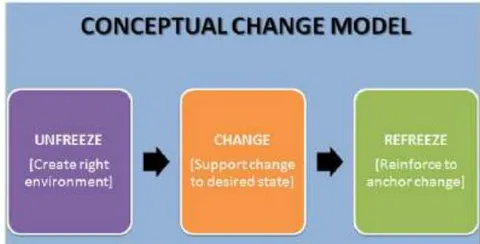
UNFREEZE: in order to create the right environment
CHANGE: a change in support to the desired status
REFREEZE: reinforce, in order to anchor the change.
UNFREEZE: The first proposition was to work together in order to build a timeline of the IT thinking. The timeline was focused on the historical characters who have led to the IT revolution. We started with Aristotle (T/F concept), going on to Leibniz (0,1 binary system), Boole (AND, OR, NOT) Shannon (switching circuits), until we came to the definition of LOGIC GATES.
That was the UNFREEZE phase, which allowed the unfreezing and the creation of a proper environment (background) in which we could insert the useful knowledge and expertise, in order to work later with ARDUINO. Everything was then channeled into a presentation, whose protagonist is, in the role of a guide, "Alice in the Wonderland", leading the students along the historical path to build all those concepts that are useful for the IT thinking.
CHANGE: building a circuit on a cardboard. We have then manually built, on A3 cardboards, the main logic gates: AND (two in series switches), OR (two parallel switches), NOT (one inverter switch). That was an important phase in increasing self-confidence, in securing the concepts related to the three main gates and gaining familiarity with Boole algebra.
REFREEZE: ARDUINO. We go on with the creation of a circuit, the presentation of the IDE (Integrated Development Environment) and sketch planning, as shown in the following paragraph.
IV. ARDUINO AND SKETCH PLANNING
ARDUINO is an "open source" board that allows the planning of detectors and actuators such as LEDs, photocells, etc. We enter the "Physical Computing".
Problem study, related closed path and coding, in order to show how ARDUINO interprets signals from the outer world (detectors) and modulates the answers with the actuators. Different projects are performed, starting from the simplest ones, such as LED management, up to the project that sees the simulation of a traffic light.
We build the circuit on the breadboard and we write the necessary Code in order to make it work in the IDE environment of Arduino. This project is suitable for further adulterations, which allow the introduction of control structures: simple traffic light (simple sequence of instructions); traffic light with flashing yellow – in this case we pass from the simple sequence to the repetition of the situation of flashing yellow, and therefore to the introduction of the instruction FOR (repetition of a block of instructions); traffic light with demand – we leave the flashing yellow, introducing a button that activates the real traffic light when pressed, and that is possible with the introduction of the instruction IF (conditional structure).
The workshop experience goes on with the study and introduction of other detectors, such as, for example, ultrasound, RGB, TMP, servomotor...
At first, we face coding and circuit, copying from manuals. Once we gain familiarity with the main structures of the language and with the breadboard for the circuit , we go to the most interesting part. Given a problem, the students must find the suggestions for a solution. The surprise is the discovery that, thanks to this procedure, the process of INSIGHT is boosted in some of them, allowing the resolution of the problem, leading them to obtain sure expertise.
V. LEARNING
This workshop promotes consideration and focus, encouraging a significant learning: "learning by doing" is fit for the internalization of a learning methodology, which makes the subject gradually independent in the learning processes (deutero-learning ):
Phase I: getting close to the contents, through different methods and strategies
Phase II: once the contents are discovered, the process of imitation is natural, with which the pupil tries to repeat and to play with contents.
Phase III: INSIGHT, where every learning process needs an "activation energy", otherwise the contents stay still, without contributing to the formation of expertise. Here the pupil becomes independent in the resolution of problems.
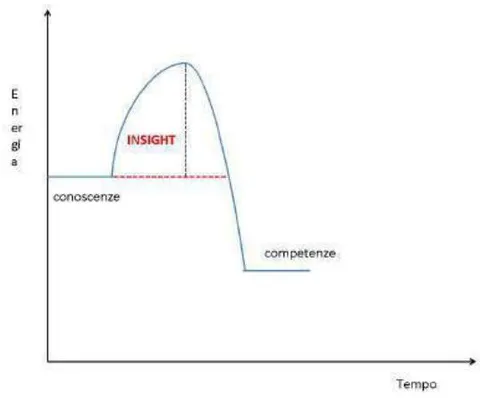
The catalyst of this reaction, the sparkle that triggers the reaction, depends on the emotional and relational dynamics established in the working groups, and on the fact 'does it work or not?', therefore on the continuous search for mistakes.
The continuous control is necessary to verify the correct functioning, and must be performed on two levels. The first is the one of Coding, the second in the construction of a circuit. It is difficult for the circuit to work at the first attempt, and that creates a strong sense of discomfort! They think they have made everything in the right way, and this search for the mistake makes them gradually more confident and aware of their skills. With the following proposal, their acquired self-confidence makes them more proficient.
- Quel sol che pria d'amor mi scald'o il petto Di bella verit'a m'avea scoverto Provando e riprovando, il dolce aspetto. Paradiso, canto terzo, 1-3. [That sun which erst had warmed my heart with love, by proving and refuting, had revealed to me the pleasing face of lovely truth] Paradise, III, 1-3.
"Proving and refuting" is the motto of modern science!
VI. CONCLUSION
Concluding, we can say that the students obtain, through this workshop:
Secure mastering of disciplinary knowledge
Mastery of methodologies - Involvement of the emotional-relational dimension
Achievement of meta-cognitive skills
9. Dante Alighieri Paradiso canto 3.
Conflict of Interest
The authors declare no conflict of interest.
Ethical Approval
Not applicable
Data Availability
The datasets used in this study are openly available at [repository link] and the source code is available on GitHub at [GitHub link].
Funding
This work did not receive any external funding.
References
Cite this article
Related Research

Special Issue
Launch a focused special issue to highlight research, emerging trends, and expert insights in your academic field.