


IntelliPaper
Abstract
India's sports ecosystem is undergoing a meaningful transformation. Government investment in sport has reached its highest-ever level in the Union Budget 2026-27, with a total allocation of Rs. 4,479.88 crore for the Ministry of Youth Affairs and Sports, reflecting an 18% year-on-year increase. Programs such as Khelo India, the Target Olympic Podium Scheme (TOPS), and the newly launched Khelo India Mission signal a decisive shift toward structured, long-term athlete development. While structural challenges persist in areas of governance coordination, equitable state-level fund distribution, and post-retirement athlete support, the overall direction is encouraging. This paper examines India's sports governance landscape with updated data as of 2026, highlights ongoing reform efforts, and recommends targeted measures to strengthen athlete welfare, transparency, and cross-disciplinary growth across the country.
Explore Digital Article Text
Introduction
India's journey as a sporting nation is gaining momentum. The Union Budget 2026-27 presented by Finance Minister Nirmala Sitharaman marked a landmark moment, allocating Rs. 4,479.88 crore to the Ministry of Youth Affairs and Sports. This is the highest-ever budget allocation for sports in India's history and reflects a strong national commitment to building a world-class sports ecosystem (Ministry of Youth Affairs and Sports [MYAS], 2026).
The government has set an ambitious but achievable target: position India among the top 10 sporting nations globally by 2036 and among the top 5 by 2047, aligned with the Viksit Bharat vision. These goals are backed by concrete policy tools. The Khelo India Mission, launched in the 2026-27 budget, is envisioned as a ten-year, end-to-end athlete development framework that covers talent identification, training progression, and elite performance support at scale.
Despite this encouraging momentum, challenges remain. Governance coordination among the Sports Authority of India (SAI), the Indian Olympic Association (IOA), and over 50 National Sports Federations (NSFs) still requires improvement. State-level fund distribution under flagship schemes shows disparities. Non-cricketing athletes, though increasingly supported, continue to face barriers in visibility and financial access. This paper examines these dynamics with updated 2025-2026 data, adopting a constructive lens to understand both the progress made and the road ahead.
Rising Investment in Sports: a Historic Budget Commitment
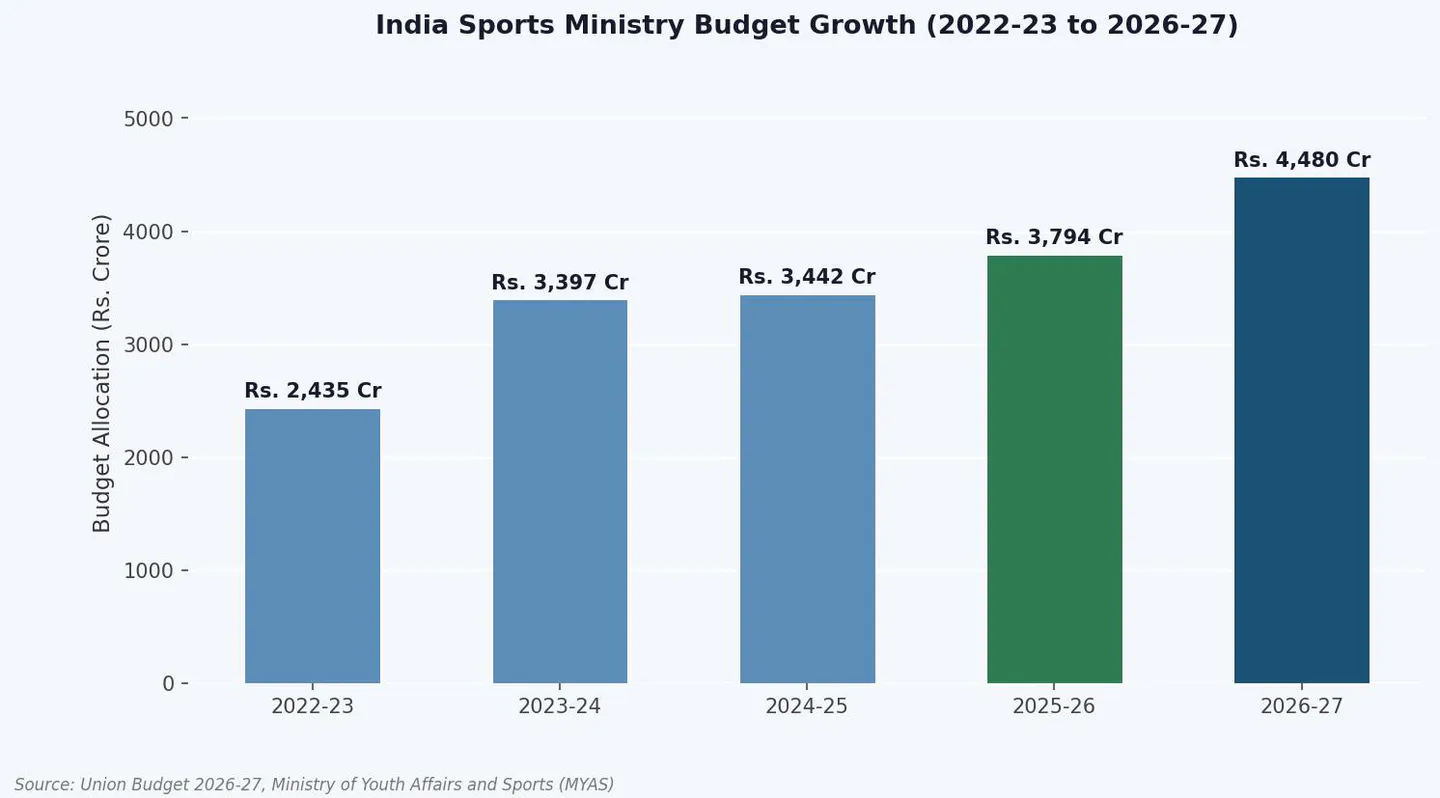
The Union Budget 2026-27 introduced the most comprehensive sports funding package India has seen. The overall sports ministry allocation of Rs. 4,479.88 crore represents a rise of Rs. 1,133 crore from the revised estimates of 2025-26 (Rs. 3,346.54 crore), or an 18% increase from the 2025-26 budget estimate of Rs. 3,794.30 crore. This upward trend over five years reflects a sustained policy commitment (MYAS, 2026).
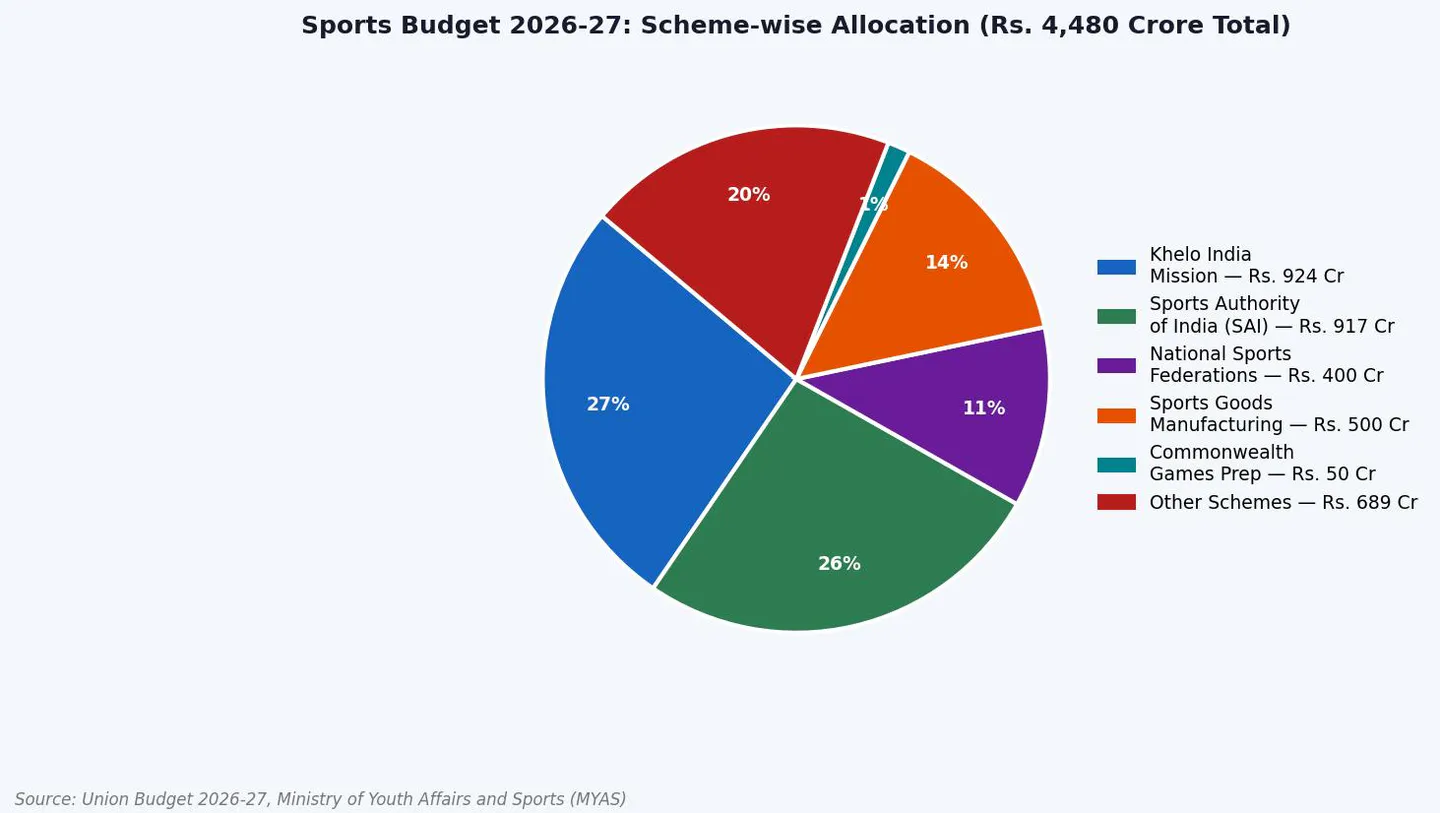
Among the key allocations in 2026-27, the Khelo India Mission received Rs. 924.35 crore, making it the single largest sports-specific line item. The Sports Authority of India (SAI) was allocated Rs. 917.38 crore to support national camps, athlete training logistics, and infrastructure upgrades. Assistance to National Sports Federations was raised to Rs. 400 crore, an increase from the previous year's Rs. 340 crore, enabling better support for disciplines beyond cricket. A first-of-its-kind Rs. 500 crore allocation was made for the promotion of sports goods manufacturing, recognising the sector's employment and export potential (MYAS, 2026; KPMG Budget Analysis, 2026).
In addition, a National Sports Board has been established with a seed allocation of Rs. 31.85 crore to coordinate national-level policy across disciplines, reduce overlapping jurisdictions, and bring professional management to sports governance. These allocations, taken together, represent a deliberate effort to build a well-funded and structured sports pipeline from grassroots to elite competition.
Khelo India: Building a Grassroots Foundation
The Khelo India Programme, launched in 2018, has grown into India's most comprehensive grassroots sports initiative. What began as a talent scouting exercise has evolved into a multi-layered platform encompassing the Khelo India Youth Games, University Games, Winter Games, Para Games, and a network of State Centres of Excellence. In 2026, this programme was elevated into the Khelo India Mission, a ten-year framework designed to provide structured, end-to-end athlete progression from school-level identification to elite competition (MYAS, 2026).
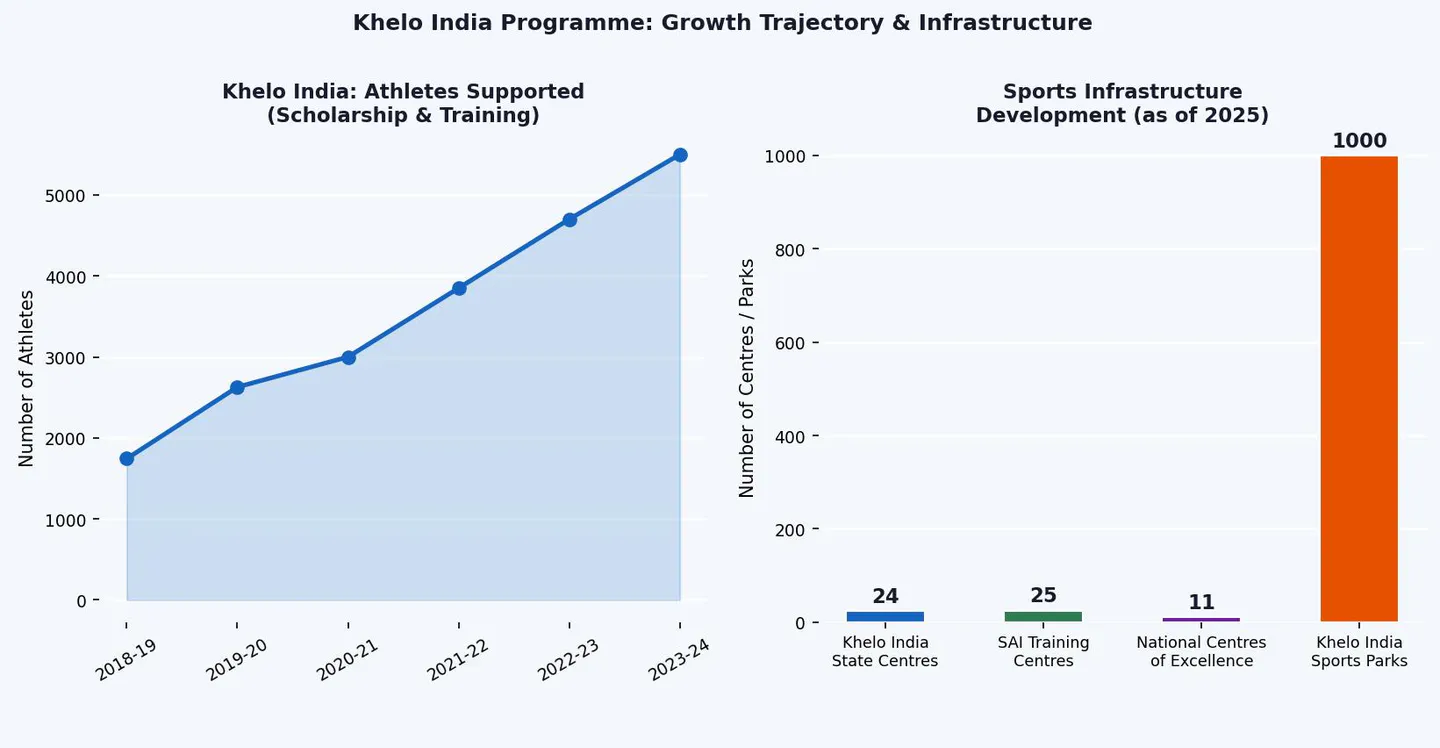
The programme's reach has grown substantially. From supporting 1,744 athletes with scholarships in 2018-19, Khelo India had expanded its athlete support to an estimated 5,500 by 2023-24. The scheme's infrastructure component has funded sports projects across states, with 24 Khelo India State Centres of Excellence established alongside 25 SAI Training Centres and 11 National Centres of Excellence (SAI, 2024). An ambitious plan to develop 1,000 Khelo India Sports Parks in Tier 2 and Tier 3 cities further extends the programme's reach into underserved areas.
The Khelo India Youth Games have also proven effective as a talent pipeline. Athletes who excel at the Games are evaluated for admission to the Target Olympic Podium Scheme, creating a direct link between grassroots participation and elite support. This structured progression is a significant improvement over the ad hoc talent identification processes of the past.
Target Olympic Podium Scheme (tops): Powering Elite performance
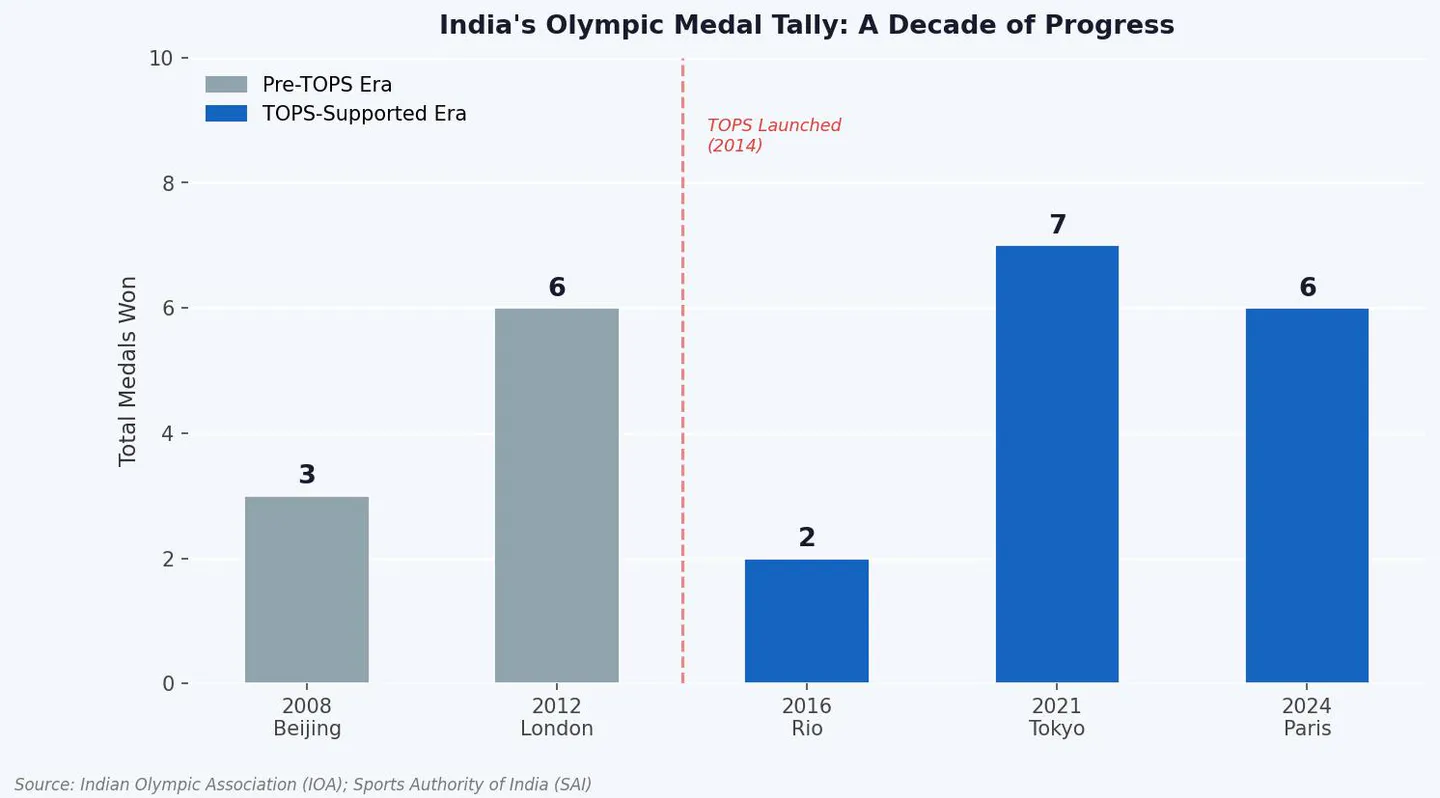
The Target Olympic Podium Scheme (TOPS), launched in September 2014 by the Ministry of Youth Affairs and Sports, has been one of India's most effective interventions in elite athlete support. The scheme identifies athletes with genuine medal potential at the Olympics and provides them with customised training at world-class facilities, access to foreign training camps, specialised coaching, sports science support, physiotherapy, sports psychology, and equipment assistance (SAI, 2024).
The scheme operates through two groups: the Core Group, which comprises athletes with a strong chance of a medal at the next Olympics, and the Development Group, targeting athletes building towards future Games. As of 2025, TOPS supported 98 Core Group athletes across 13 disciplines and 165 Development Group athletes across 12 disciplines, with both the men's and women's hockey teams also included (SAI, 2024).
The results demonstrate the scheme's effectiveness. At the 2018 Commonwealth Games in Gold Coast, approximately 67 to 71 percent of India's medal winners were TOPS-supported athletes, showing that targeted investment yields measurable returns. India's best-ever Olympic performance, seven medals at the Tokyo 2020 Games, came entirely from athletes supported under the TOPS framework, including Neeraj Chopra's historic gold medal in javelin throw and PV Sindhu's bronze in badminton. The scheme has since expanded to include junior athletes and para-sport disciplines, broadening its impact across age groups and ability levels (India Sports Hub, 2026).
State-wise Fund Allocation: Understanding the Landscape
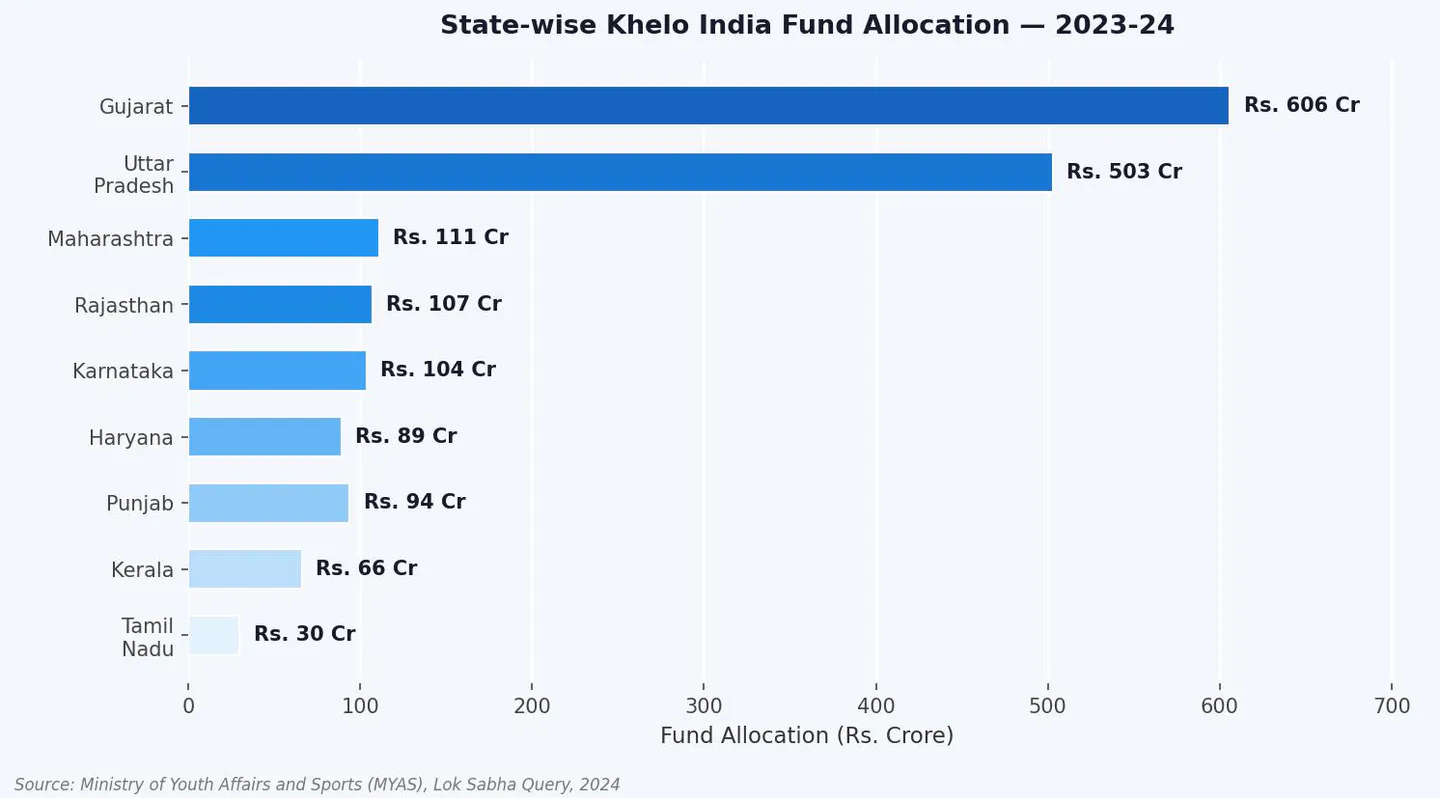
One area that calls for further attention is the equitable distribution of Khelo India funds across Indian states. Data from the Ministry of Youth Affairs and Sports, shared in response to a Lok Sabha query in 2024, shows that in 2023-24, Gujarat received the highest state-level Khelo India allocation at Rs. 606.37 crore, followed by Uttar Pradesh at Rs. 503.02 crore. States with strong recent sporting track records, including Maharashtra (Rs. 110.8 crore), Haryana (Rs. 88.89 crore), and Punjab (Rs. 93.71 crore), received notably smaller shares relative to their medal contributions at the Asian Games in Hangzhou (MYAS, 2024; National Herald India, 2023).
Tamil Nadu, which won 14 gold medals at the Khelo India Youth Games 2025 and consistently performs well in national competition, received an allocation of only Rs. 20.4 crore against a proposal of Rs. 120 crore for 2024-25. Kerala, another strong-performing state, received Rs. 49.63 crore. Questions around the criteria for fund allocation have been raised in Parliament, with the Ministry stating that funds are allocated scheme-wise rather than purely on a performance or proposal basis (The Federal, 2025).
It is worth noting that the allocation formula reflects multiple priorities, including correcting infrastructure deficits in historically underserved states and backing large-scale projects. However, a more transparent, performance-linked, and need-based allocation framework would strengthen trust and ensure that high-performing states receive support proportionate to their sporting output and athlete base. The establishment of the National Sports Board in 2026-27 creates a promising platform to review and formalise such criteria.
Governance Reforms: Progress and the Path Forward
India's sports governance structure has historically been fragmented, with overlapping jurisdictions between the SAI, IOA, and NSFs leading to coordination delays. However, recent reforms signal a shift toward more professional management. The Sports Governance Bill of 2025, developed alongside the National Sports Policy, introduces mandatory term limits for federation heads, transparent election procedures, and audit requirements for federations receiving government funding. These measures directly address long-standing concerns about political dominance in sports bodies (MYAS, 2026).
The newly created National Sports Board under the 2026-27 budget provides a unified coordination mechanism to reduce duplication and ensure coherent athlete development strategies across bodies. The Board's mandate includes reviewing federation governance standards, tracking fund utilisation, and recommending policy changes to the Ministry. This institutionalised oversight is a meaningful structural improvement.
The RESET policy (Recognising and Empowering Sportspersons for Excellence in Transition), introduced in August 2024, addresses the post-career challenges faced by athletes. The policy provides financial assistance, job placements, and skills training for retired athletes. While its implementation is still in early stages and awareness among athletes remains limited, the policy framework itself is a welcome step toward holistic athlete welfare. Strengthening the coordination between federations, the government, and private employers will be essential to realising the policy's full potential (Reset Policy Documentation, 2024).
Supporting Athletes Across All Disciplines
A recurring theme in India's sports narrative is the visibility gap between cricket and other disciplines. Cricket's dominance in media coverage and private sponsorship is a commercial reality, but recent years have seen encouraging signs of broadening interest. Neeraj Chopra's golden performance in athletics, India's hockey teams winning medals after decades, and the global achievements of athletes in shooting, badminton, and boxing have brought non-cricketing sports into public consciousness.
The government's increased allocation of Rs. 400 crore to National Sports Federations in 2026-27 aims to strengthen the administrative and training support available to sports bodies outside cricket. The TOPS scheme's inclusion of disciplines such as archery, shooting, wrestling, weightlifting, table tennis, sailing, and para-sports demonstrates a broadening of elite support.
Athletes in disciplines such as chess, billiards, and martial arts continue to deliver at the world stage with comparatively limited institutional backing. The case of world billiards champion Pankaj Advani and the achievements of grandmaster Dronavalli Harika in chess illustrate both the depth of India's non-cricketing talent and the importance of extending structured support to these athletes. Expanding the TOPS Development Group to include high-achieving athletes from such disciplines, alongside targeted media engagement programs, would help close the visibility and support gap (Advani, 2023; Harika, 2023).
Coaching and Physical Education: Strengthening the Base
Coaches and Physical Education (PE) teachers are the backbone of India's sports talent pipeline. The current recruitment model for PE teachers, which prioritises general Bachelor of Physical Education (BPED) and Master of Physical Education (MPED) qualifications over sport-specific expertise, limits the depth of coaching available to young athletes, particularly in rural and semi-urban schools. Bringing in coaches with professional certifications in specific disciplines such as wrestling, swimming, and athletics would meaningfully improve early talent development (Business Today, 2024).
The Khelo India Mission addresses part of this challenge by planning to expand the national coaching network through dedicated regional coaching hubs tied to the three-tier training centre structure: foundational, intermediate, and elite. Investment in coach education programmes, mentorship systems, and competitive compensation for PE teachers will be critical to making this ambition a reality.
A competitive and dignified career path for sports coaches is essential. The current average monthly salary for PE teachers in India ranges from Rs. 8,000 to Rs. 18,000, well below what is needed to attract and retain talented individuals in the profession (Business Today, 2024). Reforms to salary structures, combined with role clarity that focuses PE teachers on coaching and mentoring rather than administrative duties, would go a long way in building a more effective grassroots sports culture.
Remaining Challenges and Opportunities
While the overall direction of India's sports governance is positive, acknowledging the areas that still need attention strengthens the reform agenda rather than undermining it:
Equitable Fund Distribution: State-wise fund allocation under Khelo India needs a clearer, transparent, performance-informed framework to ensure that high-performing and infrastructure-deficient states both receive appropriate support.
Athlete Access to Schemes: Many athletes, particularly in lesser-known disciplines, still face difficulty accessing government schemes, scholarships, and post-retirement support. Simplifying application processes and raising awareness would increase uptake.
Gender Equity in Sports: Women athletes continue to face disparities in pay, sponsorship, and media visibility. Dedicated gender equity targets within federations and allocation frameworks would help address this gap.
Post-Retirement Support: The RESET policy for career transition offers a strong framework but requires better coordination between federations, government agencies, and private employers to deliver effective outcomes for retired athletes.
Broadening Elite Support: Expanding TOPS coverage to include high achievers in disciplines such as billiards, chess, kabaddi, and indigenous sports would reflect India's full range of sporting excellence.
Recommendations
Building on the significant progress made, the following targeted reforms would accelerate India's journey to becoming a top-10 sporting nation:
Formalise Fund Allocation Criteria: Establish a transparent, data-driven fund allocation model under Khelo India that balances state performance, infrastructure gaps, and athlete density (MYAS, 2026).
Strengthen Coaching Infrastructure: Invest in sport-specific coach certification programmes and offer competitive salaries to PE teachers to build a strong talent pipeline at the school level (Business Today, 2024).
Implement Career Transition Support: Accelerate implementation of the RESET policy through public-private partnerships and structured job placement programmes that align with athletes' skills and experience (Reset Policy Documentation, 2024).
Expand TOPS Coverage: Expand the TOPS Development Group to include world-class performers in under-recognised disciplines, and integrate TOPS metrics with Khelo India talent pipelines for seamless progression (SAI, 2024).
Enforce the Sports Governance Bill 2025: Leverage the newly formed National Sports Board to standardise NSF governance, mandate timely elections, audit financial reporting, and enforce the Sports Governance Bill 2025 across all funded federations (MYAS, 2026).
Promote Multi-Sport Media Coverage: Create dedicated visibility and media programmes for non-cricketing athletes in partnership with broadcasters and digital platforms, ensuring equitable recognition of excellence across all disciplines.
Conclusion
India's sports governance story in 2026 is one of genuine and accelerating progress. The historic budget of Rs. 4,479.88 crore, the launch of the Khelo India Mission, the strengthening of TOPS, and the introduction of the Sports Governance Bill collectively represent the most comprehensive investment in Indian sport the country has seen. Athletes today have access to a more structured, funded, and supported environment than at any point in India's sporting history.
At the same time, the journey toward equitable, transparent, and athlete-centred governance is ongoing. Ensuring that funds reach the right states, that athletes in all disciplines receive recognition, and that governance bodies are held to consistent professional standards are the next frontiers. The foundations are in place. With focused implementation and continued commitment, India is on a credible path to becoming a global sporting powerhouse by 2036 and beyond (UNESCO, 2021; MYAS, 2026).
Conflict of Interest
The authors declare no conflict of interest.
Ethical Approval
Not applicable
Data Availability
The datasets used in this study are openly available at [repository link] and the source code is available on GitHub at [GitHub link].
Funding
This work did not receive any external funding.
Cite this article
Related Research

Special Issue
Launch a focused special issue to highlight research, emerging trends, and expert insights in your academic field.