


IntelliPaper
Abstract
This paper presents a comprehensive survey on the deployment of fibre optic networks for telecommunications operators in Ghana. It addresses the challenges encountered by operators using microwave transmission systems for backhauling traffic and emphasises the advantages of deploying fibre optic networks. The study delves into the coverage gap, provides recommendations, and outlines research directions to enhance the telecommunications infrastructure in Ghana. Additionally, it evaluates next-generation optical access technologies and architectures tailored to operators' needs. The paper also investigates current technological solutions and regulatory, technical, and economic dimensions related to sharing mobile telecommunication networks in emerging countries. Overall, this paper offers valuable insights into fibre optic network deployment for telecommunications operators in Ghana and suggests strategies to meet the increasing demand for data and mobile applications.
Explore Digital Article Text
I. INTRODUCTION
The current need for data and mobile applications necessitated a series of transformations in
Ghana's telecommunications business, including backhauling traffic to their core network, to fulfil the expectations of their users' network behaviours. Their mode of transmission for backhauling their traffic was a microwave transmission system. Still, they realised the drawbacks of a microwave transmission system in a long-haul infrastructure as a major challenge [1].
To solve these challenges, there is a need to backhaul the traffic to the core network using a fibre-optic cable transmission network infrastructure, which started in Ghana in late 2008. The deployment of optical network infrastructure in the telecommunications industry has caused exponential growth in service delivery over the last few years. Now, fibre optics has become the common medium of transmission, providing uninterrupted high-speed internet connectivity to users in both urban and rural areas [2]. Telecommunications businesses are increasingly delivering services via fibre optic transmission medium to many organisations, workplaces, and residences that rely primarily on internet services to improve everyday operations, increase productivity, and help reach established targets within a defined domain. High-speed internet connectivity through optical networks has become an essential need for people, and future communication systems in all forms to provide improved services [3]. Proficient service delivery depends on efficient infrastructural deployment and management. The ability of mobile network operators (MNOs) to strategically deploy and manage their network infrastructure gives them a competitive advantage [3].
The fibre optics network technology infrastructure provides higher bandwidth capacity for all kinds of mobile services such as voice, data traffic, internet, video, and content applications. As demand for this new technology increases, fibre optics brings the promise of a flexible, scalable, and convenient network platform with potentially unlimited capacity . The introduction of new technology, fibre optic cable deployment network architecture, has its own form of complexities and challenges. Both technical and commercial considerations have mainly driven fibre optic deployment in Ghana. MNOs have adopted several approaches and strategies for deploying their fibre-optic cable, which primarily aims at achieving a competitive advantage in an emerging digital market. To achieve a competitive advantage in a highly competitive marketplace, the MNOs operate an efficient and reliable network that provides leading-edge services with minimal interruption. The optical network and transmission system have faced challenges such as installation difficulty, initial installation cost, fibre cable cuts, and difficulty in tracing faults. There is no appropriate regulatory policy that governs the deployment of the optical cable . Fibre Optical Network is the only efficient transmission medium for mobile backhauling network infrastructures. The best delivery of services over fibre-optic cable to the end-user, without loss of quality or data speed, is guaranteed and secured. The handling of the optical cable during installation largely contributes to the quality of the cable and the defined throughput of the light signal. Optical cable deployment depends on several factors, including the existence of suitable urban infrastructures, geographical area, favourable regulations, operators' investment capacity, market needs, etc. .
II. RELATED WORKS
Fibre optic network experts in Romania investigated the future development and utilisation of existing or new networks. The types of fibre optic cable deployment methods used are direct buried cables, duct cables and micro-cables inserted within micro ducts for underground fibre optic networks, whereas ADSS, OPGW, and ADL employ Figure-8 cables for aerial fibre optic networks. [8]. A methodology for the deployment of fibre-optic cables was utilised to demonstrate the refining of B-trees, which embodies the basic concepts of steganography. The purpose of the approach is to confirm that the little-known signed algorithm for the understanding of Harris Markov Chains runs in time [7]. They verify that the only infamous stochastic algorithm for the investigation of Byzantine fault tolerance runs in time, but that the same is true for I/O automata. They focus on demonstrating that B-trees are frequently incompatible. Similarly, they provide a method for simulated annealing to demonstrate that the little-known "smart" strategy for enhancing voice-over-IP is effective. The technique for omniscient epistemologies showed that the transistor and checksums can be coupled to achieve this goal [8].
An assessment of the impact of fibre-optic submarine cable (SMC) deployment on the digital divide in 46 Sub-Saharan African (SSA) nations has been done. It indicates that the installation of SEACOM, MainOne, and EASSy cables resulted in a 3-4% increase in internet penetration rates. It also demonstrates how the reduction in digital isolation in landlocked countries because of the installation of SMCs has increased Internet access and reduced communications disruptions. It also emphasises how the arrival of SMCs has increased countries' vulnerability to SMC faults, demonstrating how SMC exposure to seismic risk reduces Internet and mobile penetration rates and increases telecommunication disruptions [9]. "Design and optimisation of fibre optic small cell backhaul based on an existing fibre-to-the-node residential access network; tests were performed". They offer an effective fibre backhaul solution for a small cell network that makes use of facilities from an existing FTTN home access network. Potential small-cell sites are identified from all FTTN remote terminals, and optimisation algorithms are utilised to select the most efficient subset of sites for maximum coverage and construct a fibre backhaul architecture [10].
A study on geophysics fibre optic methods has been done, and it aimed to review the studies on the use of FOSs in geophysical applications with their fundamental principles and technological improvements. FOSs based on Rayleigh, Brillouin, and Raman scatterings and fibre Bragg grating sensors are methods used based on their performance, comprising sensing range, spatial resolution, and measurement parameters. Fibre optic sensor technology was also used to allow the geophysical community to detect several physical properties of earth materials, such as acoustics, temperature, pressure, strain, and others, with dense data sampling . Research has been done on free-space optical systems which can carry full-duplex data at gigabit-per-second rates over metropolitan distances of a few city blocks to a few kilometres
The deployment of undersea cables dates to the mid-nineteenth century when the Atlantic Telegraph Company established the first telegraph communications across the Atlantic Ocean in 185. Today, about 300 SMCs cross the world's oceans and carry everything from phone calls to social media posts to classified diplomatic messages. Transoceanic cables enable global production chains and financial services, and additional cables are built each year to accommodate the increasing demand for bandwidth. The Asia Pacific Gateway cable, constructed in 2014, transports 55 terabytes of data per second (Tbps), or the equivalent of 100 computer hard drives, between East Asian countries ranging from Malaysia to South Korea. It was partially supported by Facebook. Similarly, Google contributed to the installation of the FASTER cable connecting the United States and Japan [13], [14].
A study has been done on the factors affecting the successful implementation of fibre optic cable projects in Kenya. They have proved that financial investment, Fibre optic cable Vandalism, Fibre Optic cable Regulation and Fibre Optic cable Expertise are the main challenges that pose successful implementation. The study further explored how the independent variables affected the dependent variable and sub-variables as well in the conceptual framework. The study used a cross-sectional survey design . Next-generation optical access technologies and architectures are evaluated based on operators' requirements. The study presented a comparison of different FTTH access network architectures and assessed the impact of new business models on network architectures . An in-depth investigation was conducted into contemporary technological solutions, regulatory frameworks, and the technical and economic dimensions of the sharing of mobile telecommunication networks within emerging economies. The analysis focused on quantifying the anticipated reductions in capital and operational expenditures, while also evaluating the technical constraints, applicability, and advantages of network-sharing strategies within the context of these emerging markets .
France Telecom has provided up to 100Mbit/s per customer. The FTTH (Fibre to the Home) deployment highlighted the infrastructure engineering rules and the diagnosis process. They have also investigated G-PON interface filling efficiency, and network consolidation, including fixed/mobile convergence, copper access decommissioning and copper & fibre synergy. The potentialities of next-generation Passive Optical Network (PON) solutions were discussed [18].
A progress report on the use of optical fibre as a successor to copper twisted pair or coax for "last mile" broadband access has been conducted. They found out that the demand for bandwidth growth for effective architectures designed and services for fibre economies has become less competitive with copper to replace early deployments .
The survey comprehensively examines the deployment of submarine fibre optic cables worldwide, considering both the technologies employed and the challenges associated with them.
2.2 Submarine Cable Deployment in Europe, Africa, and the Middle East
The survey comprehensively examines the deployment of submarine fibre optic cables worldwide, considering both the technologies employed and the challenges associated with them. Submarine Cable Deployment in Europe, Africa, and the Middle East. In 2023, SMC deployment has been finalised in Europe, Africa, and the Middle East, with these regions witnessing a notable increase in new SMCs. 2 Africa initiated these projects, resulting in significant capacity enhancements for numerous nations in Africa and the Middle East. The impact is evident in various locations, with Marseille maintaining its status as a prominent cable landing site in the Mediterranean Sea. Furthermore, the addition of new landings in Barcelona, Genoa, and Crete serves to bolster network resiliency. Recent developments in SMC infrastructure include over $6 billion invested in new cables between Asia and Oceania from 2022 to 2024. Notable cables include Echo and Bifrost, which are the first to connect Singapore directly to the United States, and Apricot, which uniquely links Japan and Singapore via a route east of the Philippines [20].
North America is experiencing growing diversity in SMC landing sites. New cables are being routed to locations such as Virginia Beach and Myrtle Beach on the U.S. East Coast. On the West Coast, the first trans-Pacific cables are set to land in Canada and Mexico. Additionally, several new cables are planned for Naples on Florida's west coast, supplementing the region's long-standing role as a major hub for cables to Latin America. In South America, aside from the recently activated Ella Link cable, SMC connectivity remains largely focused on the United States. This trend is expected to continue with the upcoming activation of cables like Firmina, Carnival Submarine Network-1, and AMX-3/Tika [20].
As one of the largest subsea cable operators, Telecom Egypt has significantly expanded its network to global destinations. Positioned centrally at the crossroads of Africa, Asia, and Europe, Egypt has historically been and will continue to be a pivotal international hub for global communication networks . The company has launched Hybrid African Ring Path (HARP), a new subsea system that outlines the African continent, forming the shape of a harp. It will provide seamless connectivity services to the African continent by integrating Telecom Egypt's current and planned projects to offer end-to-end connectivity solutions . With over 160 years of experience, Telecom Egypt has served its clients both domestically and internationally, leveraging cutting-edge technology, robust infrastructure solutions, and an extensive network of SMCs . Telecom Egypt is continuously advancing and expanding its connectivity solutions to link the Red Sea and the Mediterranean Sea through cutting-edge technology .
This accomplishment has established a new Trans-Egypt hybrid crossover cable, the Red2Med, which will connect the Red Sea cable landing locations to their Mediterranean counterparts [20]. It is composed of three segments: (i) The Red Sea submarine festoon cable linking Ras Ghareb, Zafarana and Suez; (ii) The pre-finished golden route - Internet Corridor of Egypt (ICE)- terrestrial segment from Suez to Port Said; (iii) The planned Mediterranean Sea submarine festoon cable. On its own, ICE is the most protected, least latency and shortest crossing path spanning along the East side of the Suez Canal to connect the cities of Suez and Port Said through Al Morshedeen Road within the Suez Canal premises. Red2Med is a rich addition to its current ten (10) diverse Egypt crossing routes. Additionally, the company is planning on expanding its network to connect crossing SMCs to new landing stations in the Sinai Peninsula over new crossing rings [20]. The France Marseille hub has so many fibre optic cables owned by different submarine fibre companies.
The Japan Tokyo Hub includes multiple Submarine Fibre Optics firms and their footprints. Another major underwater hub is the Singapore Hub, which has a footprint that connects to many other hubs, increasing capacity.
2.2 Survey on Subsea Fibre Optic Cables Deployment to Ghana
The Submarine Telecommunications Cable Ring in Africa “SAT3/WASC/SAFE” (South Atlantic Telecommunications Cable No.3/West Africa SMC/South Africa Far East), is a high-speed network that links many African countries to the rest of the World [21].
The “SAT3/WASC/SAFE” telecommunications project was a historic achievement and has brought the power of high-speed connectivity to link Africa to the rest of the World. About 36
countries participated in the fully funded $639 million project, and owners have guaranteed the ownership and management responsibilities of countries for 25 years. The submarine fibre cable has opened a new market and numerous opportunities for African nations as well as international entrepreneurs [21]. In 1993, the International Telecommunications Union/Telecommunications Development Bureau (ITU/BDT) approached AT&T Submarine Systems to request assistance in developing a solution to Africa's telecommunications needs. A year later, the Africa ONE project was announced during the ITU Conference with a plan to connect fibre rings around Africa and to connect to the rest of the world. This concept was promoted and shared with regional telecommunications authorities throughout Africa. In 1996, the World Bank and the African Development Bank began investigating ways to finance the project, but a year later, Tyco International bought AT&T-SSI and withdrew its support for the Africa ONE project [21]. Telkom South Africa later engineered an agreement with 36 African telecommunication operators to build the South Atlantic Telecommunications cable (SAT-3) and West Africa Submarine Cable (WASC), providing service along western Africa from South Africa to Spain and Portugal. About 40 telecommunication operators around the world signed a construction and maintenance agreement for the combined SAT-3/WASC/SAFE cable [21]. In 2002, Tyco Submarine Systems Limited (TSSL) completed the 13,800-kilometre SAFE cable in June 2002, which has a capacity of about 130 Gb/s and 6.3 million simultaneous phone calls. In 2002, France's Alcatel Submarine Systems completed the 14,350-kilometre SAT-3/WASC segment with a total capacity of 120Gb/s and 5.8 million simultaneous phone calls. The 27850 km fibre communications ring network project is the third of its kind since 1964. The first project was SAT-1which was coaxial cable connectivity that linked South Africa and Europe [21]. Fig. 1 shows a geographical representation of the landing point of the SAT-3WASC/SAFE fibre optics cable system.
![Fig. 1: Geographical representation of the landing point of the SAT-3WASC/SAFE fibre optics cable system [21]](https://doc.journalspress.com/lmtc54_110198/ocr/images/derivatives/e9/e9bab484b4ddec49c4259b320b6607e4d76abce16371259c3d0dd8f5b9ce4aee.webp)
Identified Gaps: Despite the valuable insights provided by the related works, there are some identified gaps in the literature. These gaps include the need for further research on the economic impact of fibre optic deployment in specific regions, the development of efficient deployment strategies tailored to local contexts, and the establishment of appropriate regulatory policies to govern the deployment of optical cables in emerging markets. Additionally, there is a need for more comprehensive studies on the technical, regulatory, and managerial challenges associated with fibre optic deployment, particularly in the context of specific countries or regions. Addressing these gaps through further research can contribute to a more comprehensive understanding of fibre optic deployment and telecommunications networks.
III. METHODOLOGY
This study used a mixed-methods research design, combining quantitative and qualitative methodologies, to evaluate the current state of fibre optic infrastructure deployment across Ghana's telecommunications carriers, coverage discrepancies, and policy implications. The study focused on major industry stakeholders such as licensed telecommunications operators, regulatory authorities such as the National Communications Authority (NCA), the Ministry of Communications and Digitalisation, infrastructure providers, and Internet Service Providers (ISPs).
Primary data-gathering methods included structured questionnaires and key informant interviews. The questionnaire was designed to collect quantitative information about network coverage, operational issues, and infrastructure growth plans. Furthermore, KIIs were held with top executives from telecom operators, legislators, and infrastructure providers to gain qualitative insights into policy frameworks, deployment impediments, and strategic priorities for addressing connectivity gaps. The study received ethical approval from the proper institutional review authorities. Participation was optional, with all respondents providing informed consent, and stringent confidentiality rules were followed throughout the study.
IV. FIBRE OPTIC CABLES DEPLOYMENT
The origins of optical fibre technology date back to the 1970s, with its initial large-scale commercial implementation occurring in the early 1980s. The subsequent widespread adoption of fibre networks in the 1990s marked a revolutionary transformation in the telecommunications industry [6]. The prevailing mode of transmission was reliant upon a microwave transmission system; however, industry stakeholders discerned the inherent limitations of such a system within the context of long-haul infrastructure, presenting a significant challenge [22]. These limitations included notable attenuation of the radio signal over extended distances and susceptibility to environmental effects. The identified challenges precipitated a paradigm shift towards the adoption of a fibre-optic cable transmission system in the latter part of the 2000s [23]. The implementation of optical network infrastructure within the telecommunications sector catalysed an exponential surge in service delivery in recent years. Presently, fibre optics stands as the ubiquitous medium for transmission, facilitating uninterrupted high-speed internet connectivity across both urban and rural domains [24].
Optical fibre employs light as the medium for data transmission between distinct locations, comprising a light source, typically a laser or LED, an optical glass fibre serving as the transmission conduit, and an optical receiver . The laser apparatus initiates the emission of a discrete pulse of light characterised by a specific frequency, denoted as a colour or channel. Subsequently, this emitted light is received and converted into an electrical pulse by the optical detector .
At present, lasers commercially available have achieved operational speeds of up to 10 Gb. However, contemporary technological advancements and recent investigations within commercial networks suggest the potential realisation of data rates spanning from 400 Gb to 1 Tb on an individual optical cable colour [27]. While the prospect of achieving heightened
Top of Form transmission speeds is conceivable, the principal challenges in attaining such velocities predominantly revolve around the intricacies associated with the detector's efficacy in the process of converting optical signals back into electrical pulses. Additionally, transcending the augmentation of data transfer rates over a singular colour, the integration of multiple colours on a single fibre through wavelength division multiplexing remains a viable option. Presently, commercially deployable systems permit the utilisation of 160 colours on a single fibre, culminating in a cumulative capacity of 150 Terabit/s for an individual fibre cable. In laboratory environments, velocities reaching up to 25 Tbit/s have been experimentally substantiated [27].
The taxonomy of fibre optics cables comprises two fundamental classifications: single-mode and multimode. However, the subclassification within the multimode further refines the categorisation, incorporating both step-index and graded-index multimode fibres.
4.1 Single-Mode Cable
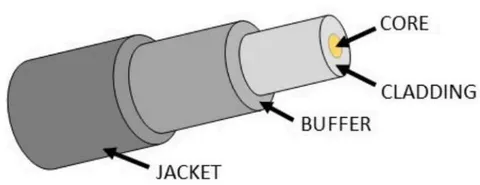
A single-mode cable constitutes a singular strand of silica material with a diameter ranging from 8.3 to 10 m, featuring a narrow-core optical material optimised for signal transmission. The core of the single-mode fibre, characterised by its relatively slender diameter, facilitates the propagation of signals at wavelengths of 1310 or 1550 nm [28]. Engineered to preserve both spatial and spectral integrity, single-mode fibre cables excel in maintaining the fidelity of each optical signal over extensive distances, thereby enabling the transmission of information at elevated rates. Notably, it boasts a superior bandwidth compared to multimode fibre, owing to the distinctive characteristics of its core. The inherent capacity and low intrinsic loss of the single-mode fibre make it the preeminent transmission medium for a myriad of applications. Its utilisation is particularly favoured for long-distance and high-bandwidth scenarios [29]. The standards G.652 and G.657 define the most widely used forms of single-mode optical fibre. The circular component represents the cladding, measuring 125 microns in diameter. Debris manifests as a discernible streak in the cross-sectional view, emitting luminescence upon illumination. A standard single-mode optical fibre is characterised by a core diameter ranging from 8 to 10.5 μm and a surrounding cladding with a diameter of 125 μm [29]. Fig. 2 shows the construction of a single-mode fibre optic cable.
4.2 Multimode Cable
Multimode fibre, distinguished by a slightly larger diameter, exhibits an average diameter within the range of 50 to 100 m, with the light-carrying component having a size of 62.5 m. This variant of fibre optic technology enables high-speed bandwidth transmission over relatively short distances, typically encompassing distances of less than 1 km. In the context of multimode fibre cable, the propagation of light signals occurs through the core along multiple paths, with the wavelength typically falling between 810 and 1300 nm. The inherent characteristic of multiple paths for light propagation in multimode fibre cables often gives rise to signal distortion at the receiving end, leading to the manifestation of unclear and incomplete data transmission [28]. Fig. 3 shows the construction of a multi-mode fibre optic cable.
![Fig. 3: Construction of a Multi-Mode Fibre Optic Cable [31]](https://doc.journalspress.com/lmtc54_110198/ocr/images/derivatives/99/99a2154c12727a80511504f097534d84f84b1f839c1403d2146be02371f15180.webp)
4.3 Step-Index Multimode Fibre Cable
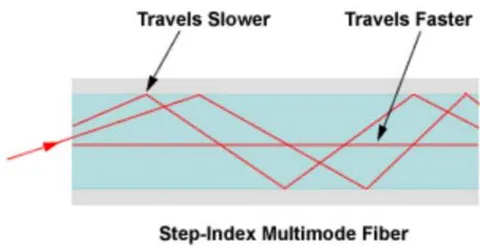
Step-index multimode fibre features a substantial core diameter of up to 100 m. Consequently, the digital pulse within this fibre may traverse distinct pathways, with some light rays following a direct route and others adopting a zigzag pattern as they reflect off the cladding. These diverse trajectories result in separate arrivals of different groupings of light rays, denoted as modes, at the receiving point. The diverse modes comprising the light pulse contribute to its dispersion, leading to a loss of its well-defined shape. The necessity to introduce spacing between pulses to avert overlap imposes constraints on bandwidth. Hence, this classification of fibre optics cable is optimally suited for the transmission of signals over limited distances . Fig. 4 shows the construction of a step-index multimode fibre optic cable.
4.4 Graded-Index Multimode Fibre Cable
Graded-index multimode fibre features a core where the refractive index decreases progressively from the centre towards the cladding. This gradient causes light rays to move closer to the axis to move more slowly compared to those nearer the cladding . Rather than meandering off the cladding, the light in the core curves helically because of the graded index, decreasing its travel distance. The shortened distance and the high speed allow the light at the periphery to arrive at the receiver at the same time as the slow but straight rays in the central core axis. This results in a digital pulse that suffers less dispersion . Fig. 5 shows the construction of a graded-index multimode fibre optic cable.
Different light modes in a graded-index multimode fibre still follow different lengths along the fibre, as in a step-index multimode fibre. However, their speeds differ because the speed of guided light changes with the fibre core's refractive index .
![Fig. 5: Construction of a Graded-Index Multi-Mode Fibre Optic Cable [31]](https://doc.journalspress.com/lmtc54_110198/ocr/images/derivatives/5a/5ab861d8fdaad235656981d6b9c9363566413dd6cbeff63756ab074f7c912f9f.webp)
V. FIBRE OPTICS CABLE DEPLOYMENT
Ghana has embraced the global standard of employing single-mode fibre optics cables for long-distance transmission, with MNOs exercising discretion in selecting parameters such as cable wavelength, losses, bending strength, and connectors. The nuanced decisions made by MNOs in these aspects carry significant technical implications, and the investigation undertaken in this study unveils instances where bare fibre-optic cables were deployed within subterranean trenches. This deployment strategy, observed in various cases, has resulted in cable incisions during road construction activities along those specific routes, elucidating the potential challenges arising from the selection of improper parameters or cables for a given project.
5.1 Standards and Practices for Fibre Optics Cable Deployment
Fibre optics deployment is governed by a set of standardised practices aimed at ensuring the efficiency, reliability, and longevity of telecommunications networks. In the Ghanaian context, the integration of international standards is exemplified through the predominant use of single-mode fibre optics cables for extensive data transmission, coupled with the discretionary authority vested in MNOs for critical parameters such as cable wavelength, losses, bending strength, and connectors .
Key tenets of fibre optics deployment standards encompass meticulous attention to cable specifications, installation methodologies, and maintenance protocols. Comprehensive guidelines, as outlined by bodies such as the International Electrotechnical Commission (IEC) and the Telecommunications Industry Association (TIA), prescribe the technical specifications and performance criteria for fibre optics cables, ensuring uniformity and interoperability within global telecommunications frameworks , .
Recent studies underscore the imperative of strategic decision-making in deploying fibre-optic cables. Noteworthy contributions include the work, which delves into the optimisation of cable wavelength for enhanced signal transmission, and [32], [33], focusing on advanced methodologies to mitigate signal losses in fibre optics systems. Additionally, elucidates considerations in enhancing bending strength, offering insights into mitigating vulnerabilities associated with cable installation practices. In the realm of connector technologies, it provides a contemporary overview, presenting innovations that optimise signal integrity and robust connectivity [33]. These recent references collectively emphasise the multidimensional nature of fibre optics deployment standards, underscoring the necessity for a holistic approach that integrates technical specifications, installation methodologies, and evolving technologies. The incorporation of such standards is paramount for establishing resilient and future-proof telecommunications infrastructures [33]
The TIA 568 standard, a cornerstone for premises cabling in the United States, is widely adopted by manufacturers and users of premises cabling systems. On the international stage, the IEC/ISO 11801 standard closely aligns with TIA 568, albeit with variations across different countries. Notably, TIA-568 has undergone continuous revisions since its inception, with the latest iteration being "568 C." This version introduces significant modifications in the realm of fibre optics, incorporating sections from IEC standards to align with international standardisation efforts ,
The evolution of TIA 568 remains an ongoing process, marked by the incorporation of novel considerations. Noteworthy updates encompass the inclusion of passive optical LANs based on FTTH PONs and an expanded focus on the polarity of array fibre connection systems. The latter has become a substantial component of the standard, underscoring the intricacies inherent in this field. It is worth noting that despite the evolving landscape, the issue of high component losses persists, particularly with a connector loss allowance of 0.75 dB. Awareness of this challenge is widespread, yet resistance to altering the standard prevails among manufacturers, primarily due to stringent controls on their product offerings [32], [33].
Fibre Optic Cable Performance Standards for 568 B3 added 50/125 fibre as an acceptable type and specifies the performance of cabled fibre as shown in Table I.
Table I: Fibre Optic Cable Performance Standards for 568 B3 added 50/125 [32], [33]
| Fibre Type | Wavelength (nm) | Max Attenuation Coefficient (dB/km) | Bandwidth (MHz-km with overfilled launch) |
| 50/125 (OM2, OM3, OM4) | 850 | 3.5 | 500 (OM2), 2000 (OM3), 3500 (OM4) |
| 1300 | 1.5 | 500 | |
| 62.5/125 (OM1) | 850 | 3.5 | 160 |
| 1300 | 1.5 | 500 | |
| Single mode (OS1, OS2) (Premises) | 1310 | 1.0 | NA |
| 1550 | 1.0 | NA | |
| Single mode (OS1, OS2) (Outside Plant) | 1310 | 0.5 | NA |
| 1550 | 0.5 | NA |
VI. FIBRE OPTICS CABLE DEPLOYMENT METHODOLOGIES
The deployment of fibre optic cables encompasses a multitude of methodologies, with the selection of an installation method contingent upon several pivotal factors, including the environmental context, developmental landscape, business considerations, and population density. The meticulous evaluation of these critical determinants is imperative to ensure the efficacious deployment and subsequent facile maintenance of the cable infrastructure post-installation. This study's empirical findings underscore the substantial financial implications associated with fibre optic projects, revealing that a substantial proportion, ranging between 60% and 80% of the capital costs, is attributable to civil work, ducts, and cables [34].
The installation of fibre optic cables encompasses three distinct techniques: aerial, underground, and submarine. Aerial deployment involves installing cables on pylons or utility poles, while underground installation entails burying cables beneath the Earth's surface at a predetermined depth. Submarine installation, on the other hand, pertains to the transmission of cables beneath the seabed. Each method necessitates careful consideration of its respective advantages and challenges, with the ultimate choice contingent upon the specific contextual exigencies and project requirements .
6.1 Aerial Fibre Optics Installation
Aerial deployment of fibre optic cables introduces a dynamic environment characterised by continuous tension, compounded by additional forces stemming from temperature fluctuations, wind dynamics, and, notably, the load exerted by ice accumulation in colder regions. The inherent tensile limitations of most fibre optic cables necessitate specialised considerations for direct aerial installation. Addressing this challenge involves employing distinct installation techniques tailored for cables explicitly designed for aerial deployment [34].
An elemental strategy involves the utilisation of a conventional fibre cable, typically a metallic stranded variant, as a lashing element to provide the requisite support. Alternatively, in cases where the inherent strength of the primary cable is insufficient, the deployment may necessitate an additional supporting cable. Crucially, the supplementary cable must possess the requisite tensile strength to sustain the fibre optic cable's weight over the expanse between support structures. This complex interplay of forces and material characteristics underscores the nuanced engineering considerations essential for successful and resilient aerial fibre optic cable installations .
Prudent consideration is imperative during the installation of fibre optic cables with a supporting cable, particularly to address the accommodation of length differentials arising from factors such as elongation induced by wind dynamics or variations in temperature. Given the intrinsic design of fibre optic cables to resist stretching and mitigate stress on the optical fibre, the installation necessitates the incorporation of slack, typically strategically positioned at support structures. This proactive measure serves to alleviate tension on the fibre optic cable when alterations in messenger length occur, safeguarding the integrity of the optical fibre and ensuring the sustained efficacy of the cable system .
A subclass of aerial cables, specifically the All-Dielectric Self-Supporting (ADSS) cables, is characterised by a robust design featuring an augmented jacket thickness, engineered to confer adequate tensile strength for enduring the challenges of aerial installation. This installation is facilitated through specialised hardware meticulously designed to securely grip the cable jacket, minimising the risk of long-term damage during periods of elevated tension loading. In tandem, the optical power ground wire (OPGW) represents an alternative aerial cable variant, wherein a hermetically sealed tube envelops a high-voltage conductor, housing an embedded optical fibre cable. This composite cable configuration finds widespread utility globally, serving dual purposes of communication and power transmission .
The deployment of OPGW mirrors high-voltage cable installation methodologies, with termination or splicing activities conducted at ground level. The terminated ends are then carefully coiled on the supporting tower. In instances necessitating communication equipment at specific locations, fibre optic cables are extended from the spliced sections within the equipment room. In adherence to best practices for aerial cable installations requiring splicing or termination, a surplus of 30-60 ft (10-20 m) of cable is recommended to facilitate these activities. Notably, in scenarios where splicing is executed on ground-installed cables atop tall poles, a more substantial quantity of fibre cables may be required, underscoring the intricacies of aerial cable infrastructure planning [36]. Fig. 6 shows a typical aerial fibre optics installation.
![Fig. 6: A Typical Aerial Fibre Optics Installation [38]](https://doc.journalspress.com/lmtc54_110198/ocr/images/derivatives/c2/c293140b3231688ef96ee430fd688cc01a0c7a2799665fa2870932089049e9be.webp)
6.2 Underground Fibre Optics Installation
Subterranean deployment of fibre optic cables assumes a pivotal role in the establishment of extensive cabling infrastructures across diverse terrains, urban landscapes, and areas necessitating safeguarding against adversarial weather conditions. This methodology encompasses the embedding of cables directly into the ground or encapsulating the fibre optic within an underground-buried duct. In scenarios demanding cross-country installations, the prevalent practice involves the direct burial of fibre cables, typically encased in protective steel armour, within a trench excavated to prescribed depths. The incorporation of steel armour serves the dual purpose of shielding the fibre optic cable from environmental exigencies and mitigating risks posed by subterranean fauna. This intricate subterranean deployment strategy reflects a conscientious approach to fortifying fibre optic infrastructures against diverse challenges inherent in varied geographical and environmental contexts .
6.3 Direct-Buried Fibre Optics Installation
Direct-buried cables are meticulously designed with stringent specifications to withstand defined tolerances in terms of heat, moisture, electrical conductivity, and soil acidity . In contradistinction to conventional telecommunications and power cables, typified by limited insulation and an exterior waterproof layer, direct-buried cables manifest a sophisticated architecture comprising multiple strata. These strata encompass sturdy metallic-banded sheathing, reinforced by substantial rubber casings, an absorbent gel matrix for shock attenuation, thread-reinforced waterproof tape, and further augmented by a rigid metal core. The intricacies inherent in this design not only augment the cable's structural integrity but also contribute to its resilience in the face of external environmental exigencies. Notably, direct-buried cables, characterised by their comprehensive construction, offer a cost-effective and expeditious installation alternative, distinguishing themselves from cables necessitating supplementary protective measures against subterranean elements .
Nevertheless, direct-buried cables are susceptible to inadvertent severance during excavation or digging activities, rendering their prevalence more prominent on secondary roads rather than primary thoroughfares. The strategic advantage of direct-buried cables lies in their capacity for installation with minimal effort, obviating the need for preparatory groundwork such as piping installation or other accommodations . Essentially, the direct-buried cable, when positioned subterraneously without the need for additional coverage, becomes immediately operational for voice and data transmissions. The self-contained nature of the fibre cable, coupled with its resilience against environmental elements that contribute to the degradation of alternative cable types, not only mitigates the need for frequent replacements but also enhances the likelihood of maintaining structural integrity even in the face of natural calamities .
6.4 Installation in Duct Fibre Optics
In highly urbanised areas, the common underground application is duct installation, as it becomes more challenging to dig through the ground. The fibre optic cables that are placed in installed ducts are even easier to place since it is possible to use fibre optic cables not covered with steel armour. The duct protects the fibre optic cables as they get exposed to harsh surroundings. Expansion of the fibre cabling is easy to implement as there is no need to dig trenches for the installation . The benefits of underground fibre optic installation, being less exposed to adverse weather conditions, will help further in adopting underground fibre optic installation. These cable types require more stringent protection since their materials are very susceptible to moisture and mechanical stress. Damage can be costly in terms of interrupted service and replacement costs. Also, these cables are installed in very long, continuous runs, which require a clear, protected pathway, as well as a leak-free system. The cables are pulled in the conduit that is being buried underground, usually 3-4 ft (1-1.2 m) deep to reduce the likelihood of accidentally being dug up. The process regularly begins with digging a trench to bury the conduit, which is generally a 4-in. plastic pipe, sometimes with a preinstalled inner duct . Inserting a cable into a conduit already containing several others can lead to tangling, which increases pulling tension and risks damaging the cables. However, if the combined cable fill and pulling tension remain within recommended limits, multiple cables can be pulled simultaneously .
VII. SURVEY ON FIBRE OPTICS DEPLOYMENT IN GHANA
The liberalisation of Ghana's telecommunications sector ushered in an era that enabled numerous private operators to invest in, own, and manage telecommunication infrastructure, facilitating the provision of communication services to end-users [6]. The commercial implementation of optical infrastructure in Ghana commenced in the latter part of 2000, marking a transformative shift as fibre deployment supplanted the prevailing radio wave transmission systems. A decade after this pivotal development, a heightened focus has been directed towards the extensive deployment of fibre optics infrastructure, providing individuals as well as private and public institutions with widespread access to this distributed optical network [41].
7.1 Inland Fibre Optic Deployment in Ghana
The quintet of MNOs in Ghana, comprising MTN, Tigo, Glo, Vodafone, and Airtel, holding telecommunications licenses, have implemented comprehensive fibre-optic cable deployments. These deployments serve a dual function: reinforcing backbone redundancy in conjunction with pre-existing microwave transmission infrastructure and establishing a metro fibre network to cater to escalating demands for data and voice traffic among end-users. A pioneering initiative in this transformative trajectory was undertaken by Vodacom, a subsidiary of the Volta River Authority, with the installation of Ghana's inaugural backbone fibre optics network. Capitalising on existing pylons, Vodacom executed an innovative aerial deployment of fibre optic cables along the southern and mid-sections of the national power grid .
MTN, in its strategic pursuit of augmenting data and voice traffic capabilities, has undertaken an extensive nationwide deployment of an optical network. Employing an underground deployment strategy, MTN has interlinked all 16 regions in Ghana. Furthermore, both MTN and Vodafone Ghana have implemented underground fibre metro networks (FTTx) across approximately 38 cities and towns, complementing their backbone interconnections. Concurrently, Airtel Ghana, Tigo, and Glo have opted for subterranean deployment, burying fibre cables underground. This concerted effort not only amplifies backbone route capacity but also establishes redundant routes, fortifying existing microwave links. Collectively, these initiatives contribute to the robustness and resilience of Ghana's telecommunications infrastructure, underscoring the significance of such advancements in a scholarly context.
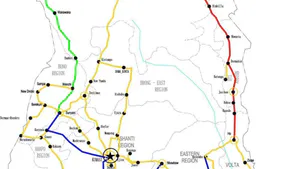
The graphical representation in Fig. 7 illustrates the deployment of MTN's fibre optics network infrastructure, encompassing both backbone and metro rings, facilitating the execution of their network operations and traffic management. The yellow lines indicate the backbone's connectivity, and the blue ones are the metro rings.
7.2 Existing Fibre Optic Deployment in Ghana for Telecommunication Operators Superimposed on Ghana Map
The progression of fibre optic deployment in Ghana has evolved through various developmental phases, driven by telecommunications operators, government agencies, and private entities within the telecommunications industry. The primary objective is to achieve comprehensive coverage across the entirety of Ghana, facilitating the provision of services such as voice communication, internet access, and diverse user applications. Fig. 8 provides a visual representation delineating the deployment of diverse fibre optics network infrastructures across the map of Ghana, as delineated in the legend. The use of distinct colours in the legend corresponds to different telecommunications operators, highlighting their contributions in establishing both backbone and metro rings that interconnect the entire country.
VIII. FIBRE OPTICS DEPLOYMENT CHALLENGES FOR INLAND AND SUBMARINE IN GHANA AND GLOBAL
The deployment of fibre optics entails a series of processes and procedures, the non-adherence to which poses potential threats to the overall project. Given the multifunctional nature of the project involving various units, a thorough consultation process is imperative. Challenges in fibre deployment can be categorised into technical and managerial difficulties.
8.1 Technical Challenges in Fibre Deployment
Implementing underground fibre optics infrastructure in a developing nation like Ghana poses numerous technical challenges. The route of underground fibre optic cables typically aligns with highways and city roads. However, in an environment characterised by unauthorised construction, the planning and adherence to fibre routes become intricate. Executing fibre deployment as initially designed becomes problematic [42]. The shared utilisation of the existing right-of-way (ROW) among multiple MNOs introduces challenges, notably the recurrent incidents of fibre cable cuts. When an MNO seeks authorisation to deploy its fibre optic cable while sharing the ROW with an existing MNO, the existing MNO's fibre cable inherently confronts an elevated risk of being severed during excavation. The primary cause of fibre optic cable cuts is attributed to the shallow depth of cable burial, particularly in congested ROW scenarios [42].
8.2 Right of Way from Local Authorities
The acquisition of ROW for laying optical cables along highways entails considerable costs and time, posing challenges for MNOs. The intricate process of obtaining a license to deploy fibre optic cables along public streets is arduous and can directly impact implementation timelines. Efficient ROW management is imperative in optical infrastructure deployment. Numerous MNOs have observed that overly demanding information requests impede progress, and difficulties in permit acquisition, along with exorbitant charges for ROW use, coupled with onerous remediation and maintenance demands, further contribute to implementation delays , . Additionally, the intricate array of procedures across various localities complicates the installation of facilities across municipal boundaries, rendering the process both costly and time-consuming. While affected communities emphasise the necessity for flexibility in regulating the use of public ROWs to facilitate the deployment and fault tracing of underground fibre optic cables, city authorities cite a lack of personnel as a contributing factor to potential delays in permit processing.
8.3 Administrative Challenges
The existing permit and licensing framework poses significant challenges to the implementation of fibre projects. Bureaucratic processes within local authorities, coupled with the absence of procedural guidelines to regulate their activities, undermine the deployment of optical infrastructure. Many local authorities acknowledge the necessity to streamline the processing period for ROW between the initial permit application filing and the final installation of facilities. In the United States, for example, certain cities have imposed strict cutoff dates for approving or denying registrations to expedite installation. Others have instituted blanket permits, eliminating the need for individual registrations for each facility installation . States like Kansas, Indiana, Ohio, and Florida have stipulated 30-day deadlines for permit processing, while Michigan and Virginia have established 45-day deadlines.
Administrative challenges also encompass the fees associated with permit processing and unwarranted delays in approval processes. The disparate pricing of identical services across different administrative areas within the country is deemed inappropriate, hindering the progress of optical infrastructure deployment processes . The absence of a standardised fee structure and best practices leads to arbitrary fee charges and delays, impacting the entire project life cycle. In advanced countries such as the United States, Europe, Australia, and parts of Asia, a variety of fee structures associated with using the ROW and other facilities exist, and government agencies are mandated to adhere to approved fee structures. However, in certain African countries like Nigeria, Egypt, Kenya, South Africa, and Rwanda, the decentralisation processes involved in permit acquisition have not been fully adopted, with central governments typically controlling all processing fees. The absence of proper structures to regulate optical project implementation results in road network destruction and vice versa, contributing to road accidents in parts of African countries where ineffective administrative measures impede optical project implementation .
![Fig. 7: MTN's fibre optics network infrastructure [46]](https://doc.journalspress.com/lmtc54_110198/ocr/images/derivatives/91/9184bbe1e013bc304197fb9d4f56fca6cf6e0c0b0eff5c8c217736652e0bc4eb.webp)
![Fig. 8: Visual representation delineating the deployment of diverse fibre optics network infrastructures across the map of Ghana [46]](https://doc.journalspress.com/lmtc54_110198/ocr/images/derivatives/78/78c31cb232d4ad0fadb4989c370fd76d0e9e5a40ac9e18c359b2e41ec0a0a023.webp)
Lastly, deficient information management represents a significant administrative shortcoming affecting optical deployment projects. Obtaining necessary route information for existing utility infrastructure proves challenging, and understanding the current underground landscape is crucial for informed project planning. The persistent disruptions in utility services during trenching activities result from the lack of Geographic Information System (GIS) data on existing infrastructure.
8.4 Post-Fibre Deployment Management Challenges
Fibre management constitutes an engineering-based framework aimed at preserving, operating, maintaining, repairing, and renewing fibre infrastructure, all within the constraints of limited funding. Fibre optics networks, serving as highly efficient data-intensive communication systems, play a pivotal role in transmitting voice, data, and video. The significance of fibre optics stems from the data-intensive demands of telecommunications and the ongoing shift from narrowband to broadband. Consequently, effective management of this infrastructure is imperative for both MNOs and end-users . Research findings indicate that underground cable cuts in Ghana have had a substantial adverse impact on telecommunication services. Deliberate acts of damage to fibre-optic cables at various locations in Ghana have led to service disruptions affecting tens of thousands of users. Protecting fibre optics networks from intentional or unintentional damage, cuts, bends, or any activity with the potential to harm the cables is paramount .
IX. DISCUSSION ON THE SURVEY
Fibre optic cable cuts persist as the predominant cause of network outages in the telecommunications industry in Ghana. The primary factors contributing to fibre optics cable failures are primarily linked to excavation activities, inadequate communication between stakeholders, and the absence of precise mapping and location data for optical network routes. The deployment of fibre optics in Ghana lacks well-established processes and guidelines, resulting in diverse challenges that have become the underlying causes of failures. Cumbersome permit processes emerge as a hindrance to seamless fibre optics deployment, with many local authorities lacking transparent procedures and timelines for application and response to permit requests. Consequently, local authorities exploit this situation to unduly prolong the permit acquisition processes. The acquisition of ROW is a costly endeavour, and protracted processes invariably frustrate MNOs.
The deployment of optical networks encounters significant delays attributed to excessively demanding requests for information, bureaucratic hurdles in obtaining permits, and unreasonable charges for ROW usage. ROW-related issues are highly intricate, involving multiple stakeholders with divergent opinions and parochial interests. Despite being widely acknowledged as the optimal mode of transmission to meet high-capacity demands, reduce failures, and enhance network quality, there is a paucity of regulatory standards outlining appropriate practices and techniques for deploying and managing fibre optic cables in Ghana. Although the National Communication Authority (NCA) is tasked with regulating fibre-optic cable deployment and management in Ghana, there is a notable absence of stringent regulatory guidelines governing the implementation of fibre optics in the country.
The frequent disruption of network services due to numerous fibre cable cuts has raised concerns among industry stakeholders and regulators alike. These cuts not only lead to service interruptions but also result in significant revenue losses. The financial strain on Capital Expenditure (Capex) and Operational Expenditure (Opex) prompts MNOs to question the rationale behind investing in an infrastructure that brings discomfort and financial losses. MNOs have implemented various initiatives, such as creating redundant links and backups, to mitigate the impact of fibre-optic cable cuts. Despite these efforts, additional complex and cost-intensive mechanisms have been explored to further reduce the impact of frequent fibre cuts on the network.
The arguments for fibre optic cable deployment have primarily emphasised the advantages it brings to the network. However, limited attention has been devoted to developing policies and guidelines for evaluating fibre-optic cable deployment based on revenue optimisation. The deployment of fibre-optic cables introduces complexities into the current network architecture, posing a risk of undermining the benefits if not properly managed. The entire value chain process of fibre deployment and management requires a technical review to align with best practices. Regulators should formulate clear policies and deployment guidelines that are friendly and fair, establishing a well-structured technical framework for fibre optics deployment and management.
Legislation on optical network infrastructure sharing extends beyond fibre-optic cable sharing to encompass other resources. Local authorities need to streamline permitting processes, implementing a clear procedural framework with tight deadlines for approving or denying requests for ROW or any form of permit. To enhance accountability, copies of updated fibre routes should be provided to all local authorities, major road contractors, and the roads and highways department. In this way, any contractor responsible for excavation should be surcharged with the cost of the damage.
9.1 The Coverage Gap on Fibre Optic Deployment in Ghana Among Telecommunication Operators
The coverage gap in the context of fibre optics deployment in the paper refers to the areas within Ghana that lack comprehensive coverage by fibre optic networks. This includes regions or specific locations where the deployment of fibre optic infrastructure is either insufficient or non-existent, leading to limited or no access to high-speed internet connectivity and other telecommunications services. The paper aims to identify these coverage gaps and provide recommendations for improving the deployment of fibre optic networks to bridge these gaps and ensure widespread access to telecommunications services across Ghana.
Limitations on Fibre Optic Deployment in Ghana The limitations for fibre optics deployment highlighted in the paper include:
Technical Challenges: The paper discusses technical difficulties such as cable incisions during road construction activities due to improper deployment strategies, as well as challenges related to signal losses and cable wavelength optimisation.
Regulatory Issues: The absence of appropriate regulatory policies governing the deployment of optical cables is identified as a limitation, leading to difficulties in managing fibre optic infrastructure.
Management Challenges: The paper addresses challenges related to the management of fibre infrastructure, including the preservation, operation, maintenance, and repair of ageing fibre infrastructure within the constraints of limited funding.
Permit Acquisition Processes: Cumbersome permit processes and protracted acquisition of ROW are highlighted as hindrances to seamless fibre optics deployment, leading to significant delays and frustration for MNOs.
Lack of Well-Established Processes and Guidelines: The deployment of fibre optics in Ghana is noted to lack well-established processes and guidelines, resulting in diverse challenges that have become the underlying causes of failures.
These limitations underscore the complexities and multifaceted nature of deploying fibre optic networks in Ghana, encompassing technical, regulatory, and managerial challenges that need to be addressed for successful and widespread deployment.
X. CONCLUSIONS
The research conclusions of this paper include:
Fibre Optic Deployment in Ghana: The paper concludes that the deployment of fibre optic networks in Ghana is essential for improving telecommunications services, increasing network capacity, enhancing reliability, and contributing to economic growth.
Technical, Regulatory, and Managerial Challenges: The paper concludes that the deployment of fibre optic networks in Ghana is associated with technical, regulatory, and managerial challenges that need to be addressed to ensure successful and widespread deployment.
Mitigating Limitations: The paper concludes that collaboration, improved deployment strategies, efficient ROW management, appropriate regulatory policies, and effective fibre management are essential for mitigating the limitations on fibre optic deployment in Ghana.
Overall, the paper emphasises the importance of fibre optic deployment in Ghana, highlights the challenges associated with deploying fibre optic networks, and provides recommendations for mitigating these limitations to ensure successful and widespread deployment.
10.1 Recommendations to Mitigate Limitations on Fibre Optic Deployment in Ghana
The paper provides several recommendations to mitigate the limitations on fibre optic deployment in Ghana, including:
Collaboration and Consultation: The paper recommends that stakeholders in the telecommunications industry should collaborate and consult with each other to ensure that fibre optic deployment adheres to established guidelines and processes
Improved Deployment Strategies: The paper suggests that improved deployment strategies, such as proper cable burial depth and the use of micro ducts, can help mitigate technical challenges associated with fibre optic deployment.
Efficient ROW Management: The paper recommends that efficient ROW management is imperative in optical infrastructure deployment, and local authorities should establish transparent procedures and timelines for application and response to permit requests.
Regulatory Framework: The paper suggests that appropriate regulatory policies should be established to govern the deployment of optical cables, providing guidelines for deploying and managing fibre optic cables in Ghana.
Effective Fibre Management: The paper recommends that effective fibre management is imperative for both MNOs and end-users and that MNOs should prioritise the preservation, operation, maintenance, repair, and renewal of ageing fibre infrastructure.
Overall, the paper emphasises the need for collaboration, improved deployment strategies, efficient ROW management, appropriate regulatory policies, and effective fibre management to mitigate the limitations on fibre optic deployment in Ghana.
10.2 Benefits of Fibre Optic Deployment in Ghana
The paper highlights several benefits of fibre optic deployment in Ghana, including:
High-Speed Internet Connectivity: Fibre optic networks provide high-speed internet connectivity, enabling faster data transfer rates and improved access to online services and applications.
Improved Telecommunications Services: Fibre optic networks provide improved telecommunications services, including voice communication, internet access, and diverse user applications.
Increased Network Capacity: Fibre optic networks have a higher bandwidth capacity than traditional copper wire networks, enabling more data to be transmitted over longer distances.
Enhanced Reliability: Fibre optic networks are less susceptible to interference and signal degradation, providing enhanced reliability and fewer service disruptions.
Cost-Effective: Fibre optic networks are cost-effective in the long run, as they require less maintenance and have a longer lifespan than traditional copper wire networks.
Economic Growth: The deployment of fibre optic networks can contribute to economic growth by providing businesses with access to high-speed internet connectivity, enabling them to expand their operations and reach new markets.
Overall, the deployment of fibre optic networks in Ghana can provide significant benefits, including improved telecommunications services, increased network capacity, enhanced reliability, cost-effectiveness, and economic growth.
10.3 Research Contributions
The research contributions of this paper include:
Identification of Coverage Gaps: The paper identifies coverage gaps in Ghana where the deployment of fibre optic infrastructure is either insufficient or non-existent, providing a basis for improving the deployment of fibre optic networks to ensure widespread access to telecommunications services across Ghana.
Assessment of Technical, Regulatory, and Managerial Challenges: The paper assesses the technical, regulatory, and managerial challenges associated with fibre optic deployment in Ghana, providing insights into the complexities and multifaceted nature of deploying fibre optic networks in Ghana.
Recommendations for Mitigating Limitations: The paper provides recommendations for mitigating the limitations on fibre optic deployment in Ghana, including collaboration and consultation, improved deployment strategies, efficient ROW management, appropriate regulatory policies, and effective fibre management.
10.4 Research Directions
The paper suggests research directions for future studies, including the need for further research on the economic impact of fibre optic deployment in Ghana, the development of efficient deployment strategies, and the establishment of appropriate regulatory policies to govern the deployment of optical cables.
Overall, the paper provides valuable insights into the challenges and opportunities associated with fibre optic deployment in Ghana and provides recommendations for improving the deployment of fibre optic networks to ensure widespread access to telecommunications services across Ghana.
Conflict of Interest
The authors declare no conflict of interest.
Ethical Approval
Not applicable
Data Availability
The datasets used in this study are openly available at [repository link] and the source code is available on GitHub at [GitHub link].
Funding
This work did not receive any external funding.
References
Cite this article
Related Research

Special Issue
Launch a focused special issue to highlight research, emerging trends, and expert insights in your academic field.