



IntelliPaper
Explore Digital Article Text
I. INTRODUCTION/BACKGROUND
Considerable literature is available relating to knowledge management in higher education institutions. This literature indicates that knowledge management is still a problem in developing economies (Chen, Nunes, & Ragsdell, 2018). This review specifically focuses on tacit knowledge management in HEIs of developing economies. For this particular study, developing economies were taken to be those countries not listed in the high-income bracket by the World Bank in the 2022 financial year. In this financial year, the World Bank placed 80 countries in the high-income category (World Bank, 2022). Notably Taiwan, Macau, and Hong Kong in China are listed under the high-income bracket; whereas China Mainland is listed in the high middle-income bracket. It is worth noting that none of the African countries in 2022 was listed in the high-income bracket.
According to Suknunan and Maharaj (2019), there are inadequate knowledge management practices in African higher education institutions. Whereas in developed economies knowledge management efforts are significant, HEIs in developing economies are apparently not investing enough to manage knowledge-based strategic assets (Nunes, Kanwal & Arif, 2017). Consequently, not enough is being invested in managing their tacit knowledge.
Available literature indicates that tacit knowledge is increasingly walking out of higher education institutions -especially if such knowledge is undocumented (Umpierrez, 2021; Mezghani, Exposito, and Drira, 2016). Unfortunately, when academics leave, the institution loses that knowledge. Based on the ideas of Hadjimichael and Tsoukas (2019), tacit knowledge resides in the head of the academic and is relatively difficult to document.
Higher education institutions (HEIs) are knowledge organisations charged with the creation and distribution of large amounts of knowledge processes. Therefore, the business and process of knowledge management is a fair and realistic assessment of an HEI's core activities (Natek and Lesjak, 2013).
Tacit knowledge is the knowledge that is complex, ambiguous, and subjective; since it exists in people's heads (Hadjimichael and Tsoukas, 2019). This knowledge basically corresponds to know-how (Malamed, 2017; Mezghani, Exposito and Drira, 2016). Cunliffe & Scaratti (2017), note that tacit knowledge is at the core of research impact within higher education institutions.
According to Veer-Ramjeawon and Rowley (2019), knowledge lies at the heart of the university. Whereas in the developed economies knowledge management efforts may be far much better, according to (Nunes, Kanwal & Arif, 2017), HEIs in developing economies are comparably not investing enough to manage knowledge-based strategic assets. Consequently, not enough is being invested in managing their tacit knowledge.
One of the documented causes for knowledge departure from HEIs is staff turnover. In Kenya for example, job-hopping and high staff turnover rates are reported (Murumba, Kwanya, Maina and Wangamathi, 2020). The issue of staff turnover is not unique to developing economies alone. In developed economies, there is also increasing staff turnover in public HEIs (Universities and Colleges Employers Association, 2019).
For example, 42% of UK academics are considering greener pastures due to Brexit (Study International, 2017). These academics are the main source of knowledge generation in higher education institutions.
Staff turnover in both developed and developing economies is exacerbated by the fact that (HEIs) are competing in terms of ranking (Nunes, Kanwal & Arif, 2017). In Nigeria for instance, staff turnover is much more pronounced in private HEIs than in public HEIs (Alo & Dada, 2020).
Other causes of staff turnover include death, disparities in salaries and wages of HEI academic staff (Eno, 2021; Mushemeza, 2016); remuneration which did not fulfill the financial and material desires of academic staff (Kyaligonza & Kamagara, 2017); burnout (Umpierrez, 2021; da Silva, 2020; Valbrun, 2020); as well as uncertainty and mistrust that may prevail in the institution thus getting in the way of good employer/employee relationships and consequently injuring talent retention (Munns, 2021); as well as top management in HEIs failing to appoint appropriate line and middle managers who do administrative work (Seeletse & Thabane, 2016).
Several studies indicate undesirable effects staff turnover has in higher education institutions within developing economies. In the developing world, particularly in sub-Saharan African (SSA) countries, there is an exodus of highly trained, qualified, and competent human resources to mainly developed economies (Gurmessa, Ferreira & Wissink, 2017).
Oliinyk, Bilan, Mishchuk, Akimov & Vasa (2021), note that the immigration of workers with higher education has a significant impact on the competitiveness and economic development of countries. Barkhuizen, Lesenyeho and Schutte (2020), also point to additional costs for induction and training of new staff, loss of research output, and organisational productivity. In addition, staff departure may reduce the quality of teaching due to mid-semester replacements of lecturers. According to Mushemeza (2016), the institution from which members of staff depart may as well experience undesirable student-to-staff ratios. (Umpierrez, 2021; da Silva, 2020; Valbrun, 2020; Coetzer, Inma, Poisat, Redmond, and Standing, 2018), also note that innovation plays a key role in the competitive advantage of the institution. Therefore, when members of staff leave the institution, innovation capacity in the institution is injured since members of staff have departed with their knowledge; yet innovation behaviour in an academic institution is chiefly enabled by the academic employees of that institution. According to (Veer-Ramjeawon and Rowley, 2019), knowledge retention in HEIs is important because knowledge lies at the heart of the role of universities.
The main aim of this review therefore, was to base on existing literature published in relation to tacit knowledge management in HEIs of developing economies, to understand the current state-of-the-art in these economies in relation to factors that influence tacit knowledge management and the various information systems applied to manage tacit knowledge (in other words, how much are HEIs in developing economies putting in to harness and manage tacit knowledge resident in the brain power of their academic staff).
According to Nunes, Kanwal & Arif (2017), countries in the developed world comprehend the importance of organizational knowledge and are applying innovative technology-based systems to manage that knowledge as a strategic asset.
However, according to (Suknunan and Maharaj, 2019), in African countries (all of which are listed in the developing bracket), there is reportedly a lack of powerful knowledge management systems in their higher education institutions.
Based on the aim stated above, this review, therefore, wished to achieve the following two specific objectives: 1. Understand factors (enablers and barriers) that influence tacit knowledge management in higher education institutions of developing economies.
- Understand extant tacit knowledge management systems and efforts in place in HEIs of developing economies to harness tacit knowledge held by their academic staff.
The Rest of the paper covers the following: Section 2 handles the systematic literature review, section 3 describes the methodology that was applied, section 4 presents the findings, section 5 provides the analysis and discussion, section 6 looks at the implications of the study, section 7 notes the limitations, section 8 provides the conclusion and section 9 gives the recommendations and future research.
II. THE SYSTEMATIC LITERATURE REVIEW
This systematic literature review evaluates the factors worth considering to inspire tacit knowledge management in HEIs. It also looks at the extant tacit knowledge efforts by HEIs in developing economies.
Factors that influenced tacit knowledge management were majorly grouped into four superordinate categories as inspired by Horban, Babenko, Lomachinska, Hura and Martych (2021), namely: institutional management practices/behaviour factors; institutional environment factors, factors relating to institutional culture, and individual/personal factors. Specifically, these factors included the following: recognition, attitude to tacit knowledge sharing, management styles (applied in various higher education institutions), staff remuneration, staff turnover (in form of resignation, mandatory retirement, termination of service, secondment), recognition, uncertainty, and mistrust as well as burnout. These factors basically influenced the tacit knowledge management in HEIs.
2.1 Procedure for Conducting the Study
The first steps of the systematic review involved a search for credible publishers of academic literature on knowledge management. We considered the credible publishers of academic literature as those who were not listed in Beall's list of predatory journals and publishers found at http://beallslist.net, and had a reputation spanning a considerably long period of time in scholarly publishing. The scholars identified credible academic journals and selected relevant articles published therein under a blind peer review policy.
2.2 Sources of Credible Academic Knowledge Management Literature
The searches were, therefore, conducted through Emerald Insight, Elsevier, and ProQuest academic research journal publishers. These publishers were chosen because they were known to be credible on the basis that they were not listed in Beall's list of predatory publishers; and in addition, were known to publish double-blind peer-reviewed journal articles and had a reputation in scholarly journal publishing spanning a considerably long period of time. They were also well known to have an edge in publishing academic literature relating to knowledge management.
Academic research articles were selected for those articles published between 2012 and 2022. Much of the review was based on research articles in these journals; save two dissertations, one on 'succession planning in HEIs' by Richards (2016), found to be quite relevant for this study, and another on 'retention of tacit knowledge in higher learning administration' by Muniz (2013).
2.3 Identification of Keywords and Production of Search Queries
The focus of this review was to identify TKM research in HEIs. The following keywords were found necessary: tacit knowledge (TK); tacit knowledge management (TKM); knowledge management systems (KMSs); higher education institutions (HEIs); developing countries; and other keywords as elaborated in 2.4.
2.4 Search Terms and Keywords
The Boolean equations applied combinations of keywords with the operators "AND" and "OR." The keywords associated with the subject or the search terms used in this study for the subject included the following: "tacit knowledge"; "knowledge management" and "higher education"; "tacit knowledge"; "higher education institutions"; "tacit knowledge AND higher education institutions"; "knowledge management". However, the overriding search term was "tacit knowledge", followed by "knowledge management". The overarching keyword the authors applied in all the searches was "tacit knowledge".
The keywords associated with the geographical location included: "LDCs"; "developing countries" "developing economies"; "medium-income countries". The geographical location searches were modified with: "low-income countries"; "lower-medium-income countries"; "low-income countries"; "low developed countries"; "developing countries"; "lower-middle-income countries" and "high-middle-income countries".
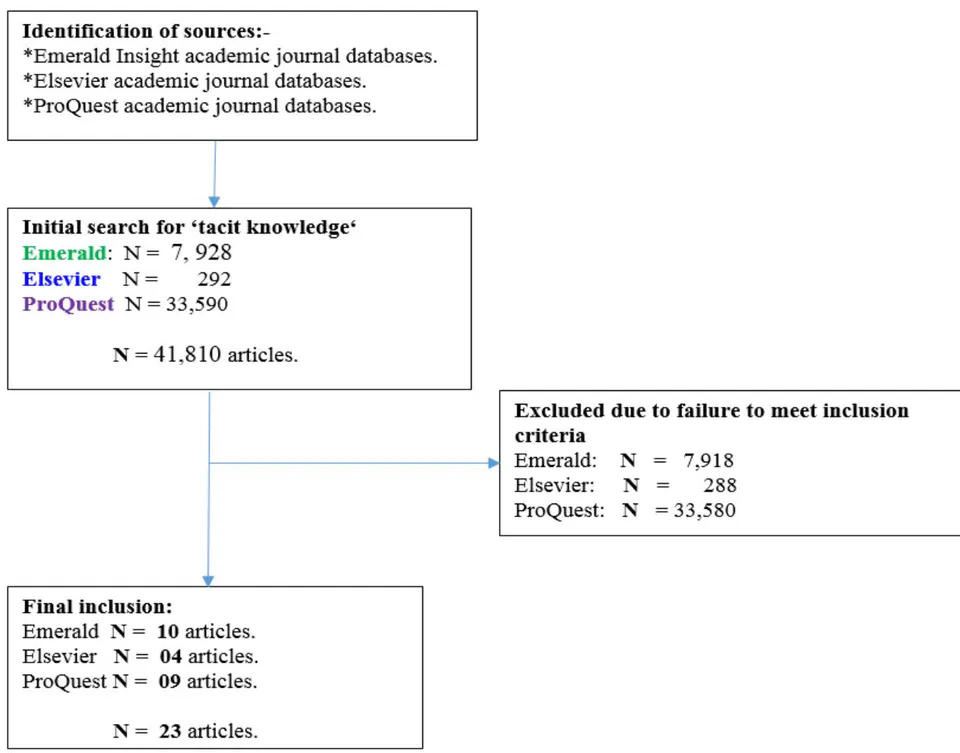
This process identified 41,810 preliminary academic journal papers and two dissertations. The inclusion and exclusion criteria were then considered.
We then filtered all the studies through the following inclusion/exclusion rules:-
Rule #1: The document reports evidence of knowledge management.
Rule #2: The document reports evidence of a higher education institution.
Rule #3: The document was based in a country that qualified as a developing economy.
A total of twenty-three (23) articles from three key publishers of academic literature were finally isolated after satisfying the inclusion criteria.
Papers/articles were gathered if they were related to the following keywords: "Tacit knowledge (TK)"; "Knowledge management (KM)"; "Higher education institutions (HEIs)" in their title, abstract, and/or in the text. We decided to restrict the study to a few keywords because of the restricted focus of the paper. The paper strictly focussed on "higher education institutions", "tacit knowledge", "knowledge management", and 'developing countries'
2.5 Study Period
This review was conducted between January 2022 and August 2022.
2.6 Time Period for Articles Published
A time period of ten years was deemed sufficient enough to inform us of issues affecting 'tacit knowledge management in higher education institutions in developing economies'; and efforts made by HEIs to harness tacit knowledge management.
2.8 Inclusion Criteria
The study focused on literature between January 2012 and August 2022. Studies included qualitative, quantitative, and mixed-method studies. Only studies subjected to a blind peer review policy were considered. The inclusion criteria included a mention of the geographical location of the study (e.g. the country where the study was conducted or from where data was collected). The number of studies that met the inclusion criteria (23 articles) is illustrated in Figure 1.
2.9 Exclusion Criteria
The exclusion criteria included studies not related to 'knowledge management' in HEIs; studies that were published before 2012; studies in languages other than English and German; studies in high-income countries; studies not guided by a blind peer review policy.
2.10 Data Extraction Format
Data were extracted from the selected articles by the authors following the inclusion criteria checklist. The authors drafted the checklist and a data extraction form was developed.
2.11 Data Extraction Form
The data extraction form involved the author; the year of publication; the title, keywords, the purpose (and gap), the methodology (research design and data collection; where under 'data collection' the sample size where given and the country or countries from where data were collected, were noted); and the findings.
2.12 Managing Results
The results of the search outputs were managed using the reference manager software Mendeley. Mendeley supported the identification and removal of duplicates. This was necessary in order to keep accurate records of the review process. The two authors initially reviewed all titles and abstracts of the studies identified. This was done following the earlier specified search strategy. All published articles were reviewed by the authors independently.
This helped in ensuring consistency. Both authors unanimously shared their findings. Findings were shared after each author independently reviewed the articles. This was important to ensure that requirements were addressed. The rigor used in the selection and analysis of the articles helped to eliminate bias.
2.13 Data Review and Synthesis
Independent selections were merged and compared. A number of studies noted to be duplicates were removed. The authors independently reviewed the abstracts (and where necessary the full text) of the shortlisted articles. Articles were reviewed against the stated inclusion criteria.
III. METHODOLOGY
The study was conducted following a combination of ideas suggested by Jesson, Matheson and Lacey (2011); as well as ideas by Nunes, McPherson, Annansingh, Bashir and Patterson (2009). The latter suggested a methodology that has the following steps: 1. Identification of keywords;
Production of search queries;
Definition of inclusion and exclusion criteria;
Identification of relevant databases;
Query of databases and selection of relevant documents;
Analysis of the dataset selected.
In this study, the researchers added in aspects like the 'research gap' which the author(s) of the research article had sought to bridge, under 'methodology', the 'study design' and 'data collection'; involving aspects relating to population, 'sample size' and 'country' where the study was conducted, in case these elements were mentioned in the article.
3.1 Methodology Phases
This systematic literature review involved three phases namely: planning the review; conducting the review and reporting the review.
| Background | Tacit knowledge continues to flow out of higher education and institutions when academic staff members leave for one reason or another leading to undesirable effects. |
| Research question | What factors influenced and were essential for tacit knowledge management in HEIs of developing economies? |
| Literature selection strategy | Credible academic research journal articles related to tacit knowledge management in HEIs in developing economies. Sources included the following: Emerald Insight; Elsevier and ProQuest journal article databases of academic literature. |
| Literature selection criteria | Academic journal articles related to tacit knowledge management published from 2012 to 2022. Search types involved the following rules:-Rule #1: The study reports evidence of knowledge management.Rule #2: The study reports evidence of higher education institutions.Rule #3: The study was based in a country that qualifies as a developing economy. |
| Literature selection procedure | Journal articles that contained any kind of review, evaluation or assessment about knowledge management in HEIs with special focus on tacit knowledge management. |
| Data extraction strategy | Data were extracted from each journal paper as follows:-*Author, Year of publication, Source, Title, Keywords, country (economy) Purpose, Gap, Methodology (Research design, Data collection and Country where the study was conducted); and Findings. |
3.2 Planning the Review
The planning started with deciding on the review protocol. The review protocol was examined to ensure that it aligned with the purpose of the study and the research objectives. The protocol was then modified to our satisfaction and scrutinised to ensure that the selected keywords were resulting from the research objectives of the study relating to factors that influence tacit knowledge management in HEIs of developing economies, and the various efforts applied in HEIs in developing economies to manage tacit knowledge. The protocol was checked to ensure that the data extracted and the data analysis would address the research objectives.
3.3 Conducting the Review
This research used a systematic review of specialized literature to achieve its objectives. It searched and evaluated primary studies from primary information sources - specifically academic journal articles - collected evidence, summarized the results, and finally drew further conclusions. The search with the keywords was run for each criterion in the search field.
The results for a particular search were reduced according to the following inclusion criterion:-
The journal paper must have been published between 2012 and 2022. A period of 10 years was considered adequate time to examine the factors that influence tacit knowledge management in these institutions; as well as the information systems applied to manage tacit knowledge in these institutions.
The focus of the journal paper was factors affecting tacit knowledge management in HEIs.
The HEI onto which the study was based had to be largely in a developing economy.
The journal paper had to have been published in an authoritative journal not listed in Beall's list of predatory journals.
The data collected had to be largely from countries considered to be having a developing economy.
The first step of the review research process involved carrying out preliminary searches relating to credible academic journal publishers. Then a search was carried out for publishers of knowledge management literature. Various relevant journals were then identified per publisher. The relevant research articles within each journal worth reviewing were identified. The preliminary searches were aimed at establishing research articles found to be relevant. Several sets of keywords were used to combine the concepts; for example, "tacit knowledge", and "higher education".
3.4 Reporting the Review
A general search for articles containing "tacit knowledge" in Emerald Publishers, yielded 7,928 journal articles spanning a period of 10 years. The same search in Elsevier yielded 292 journal articles spanning a period of 10 years. The same search in ProQuest yielded 33,590 journal articles spanning a period of 10 years.
IV. FINDINGS
In the following sections, we present the results relating to the objectives set out which included investigating the factors that influenced tacit knowledge retention and management in HEIs of developing economies; as well as the extant tacit knowledge management systems applied/used in HEIs of developing economies. The study established that the majority of the research studies were generic to knowledge management in HEIs and not particularly specific to tacit knowledge management. These findings, therefore, include research studies focusing on knowledge management in general, in addition to titles that were specific to tacit knowledge management in HEIs of developing economies.
Consequently, few studies were found to specifically handle tacit knowledge management in HEIs of countries in developing economies.
4.1 Methodologies Applied in Various Studies Reviewed
The studies reviewed were noted to have applied a variety of study research designs. These included: qualitative; quantitative and mixed designs.
4.2 Sample Sizes in Various Studies Reviewed
Studies were of various sizes and used between 60 and 370 participants. The largest sample size so far was from a research study in Pakistan done by Zreen and Khalid, (2020), with 370 participants. Each article was then analysed and summarized as shown in Tables 2, 3, and 4.
4.3 Search Results from Emerald Academic Journal Databases
The generic search term "tacit knowledge" in Emerald Insight academic journal databases for 'scholarly journals' for the 'last ten years', 'full text' and 'peer reviewed' at the following site: (https://www.emerald.com/insight/search?q=tacit+knowledge&advanced=true&fromYear=2012&t oYear=2022), yielded 7, 928 articles. Following elimination by the exclusion criteria, ten (10) articles were found to fit the inclusion criteria. A summary of the results is given in Table 2.
| Author/Year | Title | Purpose | Methodology | Findings |
| Chen, Y., Xu, Y. & Zhai, Q. (2022). | Networking of corporate universities in knowledge management.Keywords: China, Corporate university, Evolution,Knowledge activities, Networking. | To investigate the evolution of knowledge activities of a corporate university and their relationship, particularly the role of networking in the knowledge management system (KMS).A corporate university is a knowledge management institution established within an enterprise.Gap: Knowledge gap on the role of networking in a KMS. | Study design:Case study design using grounded theory for data analysis.Data collection:Interviews and documentary analysis of Haier's Corporate University in China. | First:Corporate universities were engaged in three kinds of activities: -*Enterprise operational knowledge transfer.*Networking activities.*Scientific and technological activities.Second: Networking activities play a key role in the development of corporate universities into knowledge management centres. |
| Author/Year | Title | Purpose | Methodology | Findings |
| Fayda-Kinik, S. F. (2022). | The role of organisational commitment in knowledge sharing amongst academics: an insight into the critical perspectives for higher education.Keywords: Academics; Knowledge sharing; Higher education. | To establish whether there were interrelationships between the components of perceived organisational commitment and KS in higher education institutions (HEIs).Gap: Knowledge gap on an empirical examination relating to the interrelationships between components of perceived organisational commitment and KS behaviours in HEIs. | Study design: Quantitative case study design using correlational path analysis.Data collection: Data was collected from employees in a state university in Turkey. | There were significant correlations between organisational commitment components and TKS. |
| Nanjundeswaras wamy, T.S. & Swamy, D.R. (2022). | Knowledge management processes and organizational culture in the higher educational technical institutions.Keywords: Knowledge; management; Organisational culture; Higher educational technical Institutions. | To evaluate the relationship between knowledge management and organizational culture.The rationale of the study was to explore the stages of knowledge management, types of organizational culture and their relationship in higherGap: Knowledge gap on the relationship between KM and organisational culture. | Study design:A cross-sectional quantitative survey using structural equation modelling.Data collection: Data was collected from 233 faculty from the eight educational technical institutions (HETIs) Bangalore, India. | A positive relationship existed between the knowledge management process and organisational culture in HETIs. |
| Author/Year | Title | Purpose | Methodology | Findings |
| Mona, A.M. (2021). | Persuasion of tacit knowledge in teaching information technology and information systems.Keywords: Externalization; Internalization; Ba; Decontextualization; Taicitization; Synergism. | To examine information technology and information systems (IT/IS) technology teaching and learning (T&L) as affected by three key factors of tacit knowledge (TK).Gap: Knowledge gap on how IT teaching and learning was affected by the three factors of TK. | Study design: Qualitative study design using intensive literature review.Data Collection: From mainstream literature publications. | These factors include: the de-contextualization, the faculty and students' mental model gap and the intrinsic inability of faculty to teach what they know (i.e. the know-how-know what gap). |
| Paudel, K.P., Bhattarai, P.C. & Chalise, M. (2021). | Interdependencies between knowledge management and academic performance in higher educational institutions.Keywords:Knowledge management;Knowledge protection;Higher learning institutions;Intellectual capital. | To examine the interdependent relationship between knowledge management (KM) and the academic performance of faculty members in higher educational institutions (HEIs) in Nepal.Gap:Knowledge gap on whether KM practices enhanced academic performance. | Study design:Quantitative survey design using factor analysis and canonical correlation analysis.Data Collection:Data was collected from 445-academic university staff in Nepal. | There was an interdependence between knowledge management and academic performance. |
| Author/Year | Title | Purpose | Methodology | Findings |
| Farrukh, M., Sajid, M., Zreen, A. & Khalid, R. (2020). | Knowledge sharing in higher education institutes: An empirical investigation of individual characteristics.Keywords:Personality traits;Knowledge sharing;Religiosity;Five-factor model of Personality. | To investigate the relationship between individual personal characteristics and knowledge sharing (KS) in higher education institutions (HEIs).Gap:No previous study had empirically investigated the relationship between individual personal characteristics and KS in HEIs. | Study design:Quantitative survey design.Data collection:Data was collected from 370 respondents from the academic staff of six HEIs in Pakistan. | First:Dispositional factors like extroversion, emotional intelligence and religiosity were found to significantly affect KS.Second:Neuroticism was found to be negatively associated with KS. |
| Jain, N. & Gupta, V. (2019). | The impact of knowledge management system on student performance: A case study of the University of Delhi.Keywords: Knowledge management system; Rankings; Higher educational institutions; Student performance. | To empirically test the role of knowledge management systems (K MSs) on the performance of students in higher educational institutionsGap: Knowledge gap on the role of KMSs on student performance in HEIs. | Study design: Quantitative design using structural equation modelling.Data collection: Data was collected from undergraduate students in India. | Empirical evidence supported the view that KMS had a direct significant impact on student performance (SP) in HEIs. |
| Author/Year | Title | Purpose | Methodology | Findings |
| Nair, B. V. & Munusami, C. (2019). | Knowledge management practices: An exploratory study at the Malaysian higher education institutions.Keywords: Knowledge management; Knowledge sharing; Tacit knowledge management. | -To investigate knowledge management practices in higher education institutions in Malaysian higher education institutions (HEIs).-To establish whether knowledge management practices were made known to employees in the HEIs.Gap: No study had previously empirically surveyed HEI KM practices in Malaysia. | Study design:-Exploratory Quantitative survey.Data collection: From 273 employees of HEIs in Malaysia. | First:KM practices were important for innovation in HEIs.Second:A knowledge sharing culture was noted to be important in HEIs.Third:A knowledge acquisition culture from experts was noted to be important in HEIs.Fourth:Creating KM awareness among employees was important. |
| Rahman, M.S., Mannan,M., Hossain,A., Zaman, M.Habib & Hassan,H. (2018). | Tacit knowledge-sharing behaviour among the academic staff:Trust, self-efficacy,motivation and Big Five personality traits embedded model.Keywords:Bangladesh;Higher learning institutions;Tacit knowledge-sharing behaviour. | To examine the critical success factors relating to tacit knowledge-sharing (TKS) behaviour among the academic staff of higher education institutions (HEIs).Gap:Knowledge gap on an empirical exploration on critical successFactors relating to TKS behaviour among academic staff of HEIs. | Study design:Exploratory quantitative survey.Data collection:-150 usable responses from academic staff of higher learning institutions in Bangladesh. | There were significant correlations between organisational commitment components and TKS. |
| Author/Year | Title | Purpose | Methodology | Findings |
| Gera, R. (2012). | Bridging the gap in knowledge transfer between academia and practitioners.Keywords:Knowledge organizations;Higher education institutions;Knowledge transfer barriers;Knowledge transfer cycle;Information and communication technologies;Human resource management (HRM). | -To identify gaps in the transfer of managerial knowledge from the academia to industry.-To suggest a strategic approach in form of a framework, based on the KM cycle.Gap:Knowledge gap on strategic approach (or framework) relating to knowledge transfer from academia to industry based on the knowledge transfer cycle, HRM and IT practices. | Study design:Qualitative survey design.Data collection:Literature survey relating to academicians' experiences in India. | First:There was little transfer of research knowledge from HEIs to industry due to barriers in its creation, diffusion, adoption and utilisation by practitioners.Second:A framework was developed based on the KM cycle, IT and HRM practices to overcome those gaps. |
4.4 Search Results from Elsevier Academic Journal Databases
The generic search term "tacit knowledge" in Elsevier academic journal databases for 'scholarly journals' for the 'last ten years', 'full text' and 'peer reviewed' at the following address:
(https://www.elsevier.com/search-results?query=tacit%20knowledge&page=1), yielded 452 journals. The study browsed through the 452 journals to identify those that were thought to contain articles on 'knowledge management' based on the journal-title.
Ten (10) out of the 452 journals were selected based on the journal-title and these included the following: Knowledge Engineering Journal; Knowledge-based Systems Journal; Journal of Innovation and Knowledge; International Journal of Information Management; Data and Information Management; Library and Information Science Research; Telematics and Informatics; Information Processing and Management; International Journal of
Information Management; and International Journal of Project Management.
Each one of the ten (10) journals was cross-checked to identify those that had articles relating to "knowledge management" based on the title of the article. A total of 292 articles were selected from six (6) journals and these included: - Data and Information Management; Data and Knowledge Engineering Journal; International Journal of Information Management; Journal of Innovation and Knowledge; Knowledge-based Systems Journal; Library and Information Science Research.
A search from the six (6) journals for articles that fitted the inclusion criteria was successful from four (4) journals namely: International Journal of Information Management, Journal of Innovation & Knowledge, International Journal of Information Management, and Library & Information Science Research. A summary of the articles extracted is given in Table 3.
| Author/Year | Title | Purpose | Methodology | Findings |
| Abbas, A., Avdic A., Xiaobao, P., Hasan, M. M. & Ming, W. (2019). | University-government collaboration for the generation and commercialization of new knowledge for use in industry.Keywords: Research collaboration; University-government; Industry; New knowledge; Generation; Creation; Commercialisation; China. | To establish how bilateral research collaboration could be a source of knowledge generation and commercialisation for use in industry.Gap: Knowledge gap on how bilateral collaboration could be a source of knowledge generation and commercialisation. | Study design:Qualitative design using SECI knowledge creation method for data analysis.Data collection:Focus group discussions with university team leaders and team members in China. | First:Government played a dominant role in the knowledge creation and commercialisation process.Second:Government played a key role in funding universities and creating a research environment that meets the policy requirements of industry today. |
| Al-Kurdia, O.F., | The role of organisational | To assesses the role of organisational | Study design: | Results indicated |
| El-Haddadehb, R. & Eldabib, T. (2020). | climate in managing knowledge sharing among academics in higher education.Keywords: Organisational climate; Knowledge sharing; Higher education; Theory of planned behavior. | climate, organisational leadership and trust in knowledge sharing (KS) by academics in higher education institutions (HEIs).Gap: Knowledge gap on the role organisational climate played in KS among academics in HEIs. | Quantitative design using partial least squares and variance-based structural equation modelling.Data collection: Data was collected from 257 academics in universities from countries like Saudi Arabia, UAE, Bahrain, Kuwait, Qatar, Oman, Jordan, Egypt and the UK. | organisational climate having a strong influence on academics' KS practices. |
| Author/Year | Title | Purpose | Methodology | Findings |
| Chidambaranathan, K. & Rani, S. B. S. (2015). | Knowledge management and organizational culture in higher educational libraries in Qatar: An empirical study.Keywords: Not given. | To examine the relationship between knowledge management (KM) and organizational culture (OC) in higher educational libraries.Gap: Knowledge gap on relationship between KM and OC. | Study design: Quantitative study design using the competing values framework.Data collection: From 122 library staff 16 higher education libraries in Qatar. | First: KM activities were not affected by the demographic profile of the employee.Second: Clan, adhocracy, and market culture were positively correlated to KM.Third: Hierarchy culture was negatively correlated to KM.Fourth: Clan and market culture types were conducive to the success of KM. |
| Vick, T. E., Nagano, M. S. & Popadiuk, S. (2015). | Information culture and its influences in knowledge creation: Evidence from university teams engaged in collaborative innovation projects.Keywords: Information culture Innovation project Knowledge creation Teamwork | To empirically analyse the typology of information cultures.Gap:Knowledge gap on information behaviour and values that described information culture in the context of project teamwork. | Study design:Mixture of qualitative study design using categorical content analysis and quantitative descriptive analysis using a t-test and correlation analysis.Data collection:Data was collected from 12 university project teams in Brazil. | First:Two dominant culture profiles were confirmed.Second:There were relationships between the risk-taking culture and knowledge externalisation. |
Tacit Knowledge Management System Practices in Higher Education Institutions (HEIs) in Developing Economies: A Systematic Literature Review
4.5 Search results from Pro-Quest academic journal databases
The generic search term "tacit knowledge" was filtered and sorted by 'relevance', 'full text' and 'peer reviewed'; source type: 'scholarly journal' for the last ten years; in ProQuest academic journal databases at the following address:
(https://www.proquest.com/resultsol/898FE42C28A74E03PQ/2#scrollTo), yielded 33,590 articles. Following elimination by the exclusion criteria, ten (10) articles were found to fit the inclusion criteria. A summary of the results is given in Table 4.
| Author/Year | Title | Purpose | Methodology | Findings |
| Hidayat, D.S. & Sensuse, D. I. (2022). | Knowledge Management model for smart campus in Indonesia.Keywords: Knowledge management; Information systems; Model; Smart campus (SC); Higher education institution (HEI);Systematic literature review (SLR); Preferred reporting items for systematic reviews and meta-analyses (PRISMA); Analytic hierarchy process (AHP). | To identify the components of the KM model for smart campuses.Gap: Knowledge gap relating to the components of the KM model for smart campuses.In addition, the use of KM to support SC was less clearly discussed. | Study design: Systematic literature review (SLR) technique with PRISMA procedures.Data collection: Interviews were used for validation and model development.Interviews were collected from various HEIs in Indonesia. | First: KM, IoT, and big data; governance, people, and smart education have the highest trends.Second: IT is the highest priority component.Third: The KM model for SC has five main layers grouped in phases of the system cycle.Fourth:The knowledge cycle at HEIs focuses on education, research, and community service. |
| Author/Year | Title | Purpose | Methodology | Findings |
| Li, J. (2022). | Research on collaborative interaction model of knowledge sharing in industry-university cooperation.Key words: Not given | To identify key factors which companies and universities are faced with to improve knowledge sharing performance.Gap:Knowledge gap on operation and knowledge sharing and interaction model. | Study design:Qualitative and quantitative designs and analysis.Data collection:From literature search, normative analyses and academic surveys in China. | An operation and knowledge-sharing and interaction model of compound industry-university cooperation based on role play. |
| Mabunda, T. T., Du Plessis, T. (2022). | Knowledge management as a change enabler in academic libraries in the digital age.Keywords:Knowledge management; Academic libraries; Change enabler; Change management; Digital age | To explore the potential of KM as a change enabler in the academic libraries in the digital age.Gap:Knowledge gap on the role of KM as a change enabler in academic libraries. | Study design:Mixture of qualitative and quantitative designs.Data collection:From four campus libraries within the University of Johannesburg in South Africa. | Employees resisted change when their comfort zone was threatened; since change may not be aligned with their current knowledge and skills. |
| Mazorodze, A. H., Mkhiz, P. (2022). | Factors and variables to promote a knowledge-sharing culture change in higher education institutions of developing countries.Keywords:Knowledge-sharing (KS);Higher education institution;Organisational culture;Recognition;Rewards;Promotion;Motivation. | -To examine the factors that promote knowledge-sharing culture change-To recommend strategies that encourage knowledge-sharingGap:Knowledge gap on factors that promote KS in HEIs. | Study design:Qualitative survey design.Data collection:Data gathered from a higher education institution in Zimbabwe. | Rewards,recognition,promotion and bonuses were important factors that encouraged a knowledge-sharing culture. |
| Author/Year | Title | Purpose | Methodology | Findings |
| Pakpahan, D. H.S. R. (2022). | The impact of knowledge sharing on employee performance at Palangka Raya's health college.Keywords:Leader-member exchange,Satisfaction,Innovation,Knowledge Sharing,Performance. | To establish the impact of KS on employee performance.Gap:Knowledge gap on influence/impact of KS on employee performance. | Study design:Quantitative survey design using descriptive and inferential statistical analysis.Data collection:From 75 randomly sampled respondents in Indonesia. | KS had a positively moderating effect on employee performance. |
| Phaladi, M. & Ngulube, P. (2022). | Mitigating risks of tacit knowledge loss in state-owned enterprises in South Africa through knowledge management practices.Keywords:Knowledge management (KM) practices;Knowledge loss; South Africa;State-owned enterprises (SOEs);knowledge transfer; knowledge retention- | To explore KM practices in the South African SOEs to mitigate the risks inherent in tacit knowledge loss.Gap:Knowledge gap on KM practices in South African SOEs that mitigate the risk of knowledge loss. | Study design:Mixed methods research strategy using an exploratory sequential design.Data collection:Quantitative data -Collected from 145 respondents in three SOEs.Qualitative data: through interviews and document analysis of 2018 annual reports in 9 SOEs across five market sectors in South Africa. | Majority of the SOEs lacked KM practices in their structures. |
| Author/Year | Title | Purpose | Methodology | Findings |
| Zhao, J. (2022). | Influence of knowledge sharing on students' learning ability under the background of "5G+AI".Keywords: "5G+AI";Knowledge sharing; Student; Learning ability. | To analyse the impact of knowledge sharing on students' learning ability.Gap:Knowledge gap on role played by "5g + AI" technology in improving learning ability. | Study design: Quantitative survey design using confirmatory factor analysis.Data collection: From 153 university teachers and students in China. | First:The willingness to share knowledge had a positive role in promoting the improvement of students' learning ability.Second:"5G + AI" technology played an intermediary role in promoting knowledge sharing behaviour and improving learning ability. |
| Halaf, M. S. & Dawood, S. J. (2020). | Factors affecting knowledge sharing among faculty members specializing in information and libraries: An exploratory study prepare.Keywords:Knowledge sharing; Information and libraries; | To identify the factors affecting the practice of knowledge sharing (KS) among faculty members who specialize in information and libraries in Iraqi universities.Gap:Knowledge gap on factors affecting KS among staff | Study design: Quantitative design using descriptive statistics and analysis of variance.Data collection: From staff who specialised in library work and information work | First:Personal factors were found to be affecting KS among staff.Second: Organisational & administrative factors were found to be affecting KS among staff. |
| Teachers; Universities; Iraq. | specialising in library work and information work in HEIs. | in universities in Iraq. | ||
| Author/Year | Title | Purpose | Methodology | Findings |
| Seeletse, S. M. & Thabane, J. L. (2016). | Foremost causes of high academic turnover rate at some South African universities.Keywords: Academic turnover; Job satisfaction; Recruitment; Retention. | To understand the experiences of resigning academics in higher education institutions (HEIs) of South Africa.Gap:Knowledge gap on experiences of resigning academics. | Study design:Qualitative survey design.Data Collection:136 resigned respondents were interviewed directly and 56 provided copies of exit interviews from HEI employees in South Africa. | First:HEIs were negligent by failing to develop the appropriate policies for the new dispensation.Second:Bad practices of appointing line and middle managers. |
4.6 Categorisation of factors affecting TKM in HEIs in developing economies
The study, therefore, identified four superordinate themes relating to factors affecting tacit knowledge management systems (TKMS) in higher education institutions (HEIs) in developing economies. The themes were grouped in four superordinate categories borrowed from
Horban, Babenko, Lomachinska, Hura and Martych (2021), as follows: individual and personal factors, institutional practice factors (hereinafter also known as institutional management practice factors), institutional environment factors, and factors relating to institutional culture. A summary of these factors is provided in Table 5.
| Theme | Factors |
| Individual and personal factors | Share/hoard dilemma, interpersonal trust and willingness of staff to communicate and share knowledge, personal commitment to the institution, fear of job loss, burnout. |
| Institutional management practice factors | Strategies for TKM in HEIs, initiatives in HEIs for TKM, staff remuneration, level of awareness of the need to manage TK within the institution, leadership practices. |
| Institutional environment factors | Institutional /organisational structure, KM formalisation, knowledge-sharing and networking among academics, working conditions, institutional/organisational policies. |
| Individual and personal factors | Share/hoard dilemma, interpersonal trust, and willingness of staff to communicate and share knowledge, personal commitment to the institution, fear of job loss, burnout. |
4.6.1 Individual and personal factors
Some experts may not be willing to part with their tacit knowledge for fear of job loss if they shared all their knowledge (Hislop, 2018). Some academics deliberately hide especially their tacit knowledge (Hernaus, Cerne, Connelly and Po, 2018). Interpersonal trust and willingness of staff to communicate and impart their knowledge are important factors (Chandran & Almmari, 2021). This review also notes that scholars get affected by burnout (Kabunga, 2020). Commitment to the institution/organisation is another personal factor as (Fayda-Kinik, 2022) notes.
According to Supermane (2019), a teacher's tacit knowledge was deeply rooted in the mind. Such knowledge includes ideas, emotion, cognition, teaching organization management capacity, teaching methods, and teaching skill. Teacher tacit knowledge was transformed through socialization and internalization. Socialization of knowledge achieved knowledge conversion through discussion, watching instructional videos, and listening to the lectures of outstanding teachers. Internalization of knowledge realised the knowledge conversion from explicit knowledge to tacit knowledge. This was achieved through "learning by doing", which translated into an excellent teaching experience, which teachers applied in the actual teaching.
4.6.2 Institutional environment factors (Rules, Regulations, Policies and the social environment)
Policies on succession planning do lack in a number of HEIs (Richards, 2016). One study noted that there were no formalised knowledge-sharing mechanisms (Charles and Nawe, 2018). No HEI in developing economies had formalised TKMs. No study was noted to relate to TKM formalisation in an HEI in these economies.
One study based in a developed economy noted knowledge reciprocity as positively associated with tacit knowledge sharing. In addition, relational social capital and cognitive social capital were positively associated with tacit knowledge sharing (Ganguly, Talukdar, Chatterjee 2019).
In the same vein, both tacit knowledge sharing and the quality of knowledge were positively associated with innovation capability. However, in a number of developing economies, some corporate universities were noted to be networking in knowledge management (Chen, 2022).
4.6.3 Institutional management practice factors
According to Charles and Nawe (2018), there was a low level of awareness of KM in HEIs. The need to establish knowledge management capacity in key areas within the institution was also noted by Nair and Munusami (2019). There was frustration with line managers who did not understand academic issues and challenges (Seeletse and Thabane, 2016). In addition, authentic leadership had a significant impact on employee creativity, job performance, and knowledge sharing (Alzghoul, Elrehail, Emeagwali and AlShboul, 2018).
4.6.4 Institutional culture factors
Available literature indicated a need to modify organisational culture in order to support desired knowledge behaviour. The argument was that culture had an influence on one's attitude towards knowledge behaviour (Ali and Ibrahim, 2021). The need for a culture of knowledge sharing was noted (Hislop, Bosua, and Helms, 2018). Organisational culture was also noted to stimulate scientific research (Horban, Babenko, Lomachinska, Hura and Martych, 2012).
Karnani (2013), notes that transferring tacit knowledge into explicit knowledge would basically depend on the institutional culture and the structure of the university in question. Horban, Babenko, Lomachinska, Hura and Martych (2021), point out that the culture of knowledge management is considered at three main levels namely: cognitive level, management level, and technological level.
Cognitive level: The cognitive level implies a change in the style of thinking; mobilisation of intellectual potential and creativity.
Management level: At the management level, the use of analytics and innovative leadership is necessary. The argument here was that it was not in the culture of the HEIs to put in much effort to mobilise the harnessing of intellectual potential possessed by staff members in the HEI.
However, according to Burnette (2017), the element of trust was found to be important in knowledge-sharing behaviour. Mentoring/mentee roles were noted to be significant drivers of tacit knowledge exchange. A better understanding of the nature of tacit knowledge by the management of the HEI was, therefore, necessary.
According to (Al-Kurdia, Haddadehb and Eldabib, 2020), organisational culture, specifically relating to leadership culture; and the culture of trust among academics were all noted to be important in promoting knowledge-sharing activities.
Technological level: At the technological level, the use of information and communication technology in the accumulation, transfer, and use of knowledge was called for. Some HEIs apparently lacked the culture of creativity in harnessing knowledge retention and management. In addition, some HEIs lacked the culture of applying information and communication technology applications in KM.
(Hidayat and Sensuse, 2022), note that HEIs that had implemented ICT used different terms, such as 'campus information systems', 'academic information systems (AIS)', 'e-learning', 'digital campuses', and even 'smart universities' or 'smart campuses'. The difference between these terms is that there is no agreed standard or indicator.
In some countries like China, 5G technology and artificial intelligence (AI) were already in use by a number of HEIs (Zhao, 2022) to manage knowledge. In some institutions, cloud-based knowledge management had been embraced (Noor, Younas, & Arshad (2019).
4.7 Extant tacit knowledge management efforts in place in HEIs of developing economies
A knowledge management system (KMS), based on mainstream literature, is generally known as any type of information technology (IT) system designed to do the following: Locate knowledge sources; Capture knowledge; Process the knowledge captured, Store knowledge; Retrieve knowledge; Mine knowledge repositories for hidden knowledge; Improve collaboration, and Utilise knowledge.
A KMS has been defined by different scholars in diverse dimensions. According to Ikenwe and Igbinovia (2017), a KMS is a tool or information and communication technologies (ICTs) that can be used to store, disseminate, collaborate and identify sources of knowledge, in order to support the generation, capture, share, retrieval and use of knowledge to enhance access to sources of information and knowledge by individuals, organizations, and nations as a whole.
According to Laudon and Laudon (2020), knowledge management systems (KMSs) are used to harness the knowledge base of staff, users, clients, or customers of an organisation. There are three types of knowledge management systems in organisations namely: enterprise-wide systems, knowledge work systems, and intelligent techniques. Basing on this review, existing knowledge management systems in HEIs of developing economies were mainly related to knowledge work systems. These systems chiefly involved getting easy access to external knowledge bases, document management, and provision of communication capabilities. In this review, systematic and deliberate tacit knowledge management systems in HEIs in developing countries were noted to be virtually absent.
None of the literature reviewed brought evidence of the application of enterprise-wide KMSs systems and intelligent techniques specifically focusing on tacit knowledge management in HEIs of developing economies. In addition, this literature review does not indicate evidence of frameworks that have been adopted to harness tacit knowledge in HEIs of developing economies. One framework - the KMPro framework developed by Ibrahim & Ali (2021), merely provides guidelines.
4.8 Knowledge management practices in HEIs of developing economies
There has been little empirical research we came across to examine TKM practices in HEIs. Mainstream literature notes that HEIs were aware that knowledge today is the "world's gold standard". They know that a knowledge-based economy can help a country attain sustainable rapid growth. Such an economy can help a country become globally competitive in the long run. We came across studies relating to knowledge networks of researchers who meet on various knowledge-sharing platforms to share knowledge (tacit and explicit knowledge).
Based on this review, knowledge management (KM) was not yet fully institutionalised in a number of HEIs of developing economies. There were though existing knowledge networks of researchers and academics unwittingly sharing both tacit and explicit academic knowledge, and apparently trusting each other and feeling obliged to share insights with each other. One example of such a network was the ResearchGate network which has a good number of researchers based in various HEIs in developing economies actively participating and sharing knowledge related to academic research.
V. ANALYSIS AND DISCUSSION
This review so far reveals that there are several factors that affect tacit knowledge management systems (TKMSs) in HEIs in developing economies. These factors vary from one country to another. The authors unanimously agreed to thematise the findings.
After a rigorous process, the authors concluded with the following superordinate themes borrowed from Horban, Babenko, Lomachinska, Hura and Martych (2021), in relation to factors identified: individual personal factors, institutional management practice factors, institutional environmental factors, factors relating to institutional culture.
VI. THE IMPLICATION OF THE STUDY
The knowledge obtained from this review is essential in informing policy relating to TKM in HEIs. The knowledge is a stepping stone in evolving future models and frameworks to support tacit knowledge management in HEIs.
VII. LIMITATIONS OF THE STUDY
This study is limited to TKM in developing economies. This study's findings and implications were based on the information obtained from the selected articles and biased to the observations made by the authors.
VIII. CONCLUSION
This study concludes with a discussion of the need to support tacit knowledge management especially its retention within higher education institutions. This is important because tacit knowledge keeps flowing out of these institutions unrestrained. Tacit knowledge in HEIs was generally under-researched in HEIs of developing economies. The study also reveals that tacit knowledge management in HEIs in developing economies is still an area that is under-researched based on the number of relevant articles that met the inclusion criteria in this study.
IX. RECOMMENDATIONS AND FUTURE RESEARCH
The study recommends more studies on tacit knowledge management in HEIs of developing economies. This review asserts that in order to improve knowledge management, higher education institutions (HEIs), should integrate their process models and data models in conjunction with the knowledge management perspective and give special treatment as well to tacit knowledge management.
This study recommends that any models and frameworks that may be developed for TKM in HEIs should take care of the four factors identified namely: personal factors, institutional environment factors, and institutional practice factors and factors relating to institutional culture. These factors are applicable to both explicit knowledge and tacit knowledge.
The study also recommends that there is a need to develop a unified baseline system, framework, methodology, or model that all other HEIs could use as a benchmark to support the management of institutional tacit knowledge.
Future research should, therefore, delve into mechanisms, systems frameworks, and methodologies that HEIs can adopt to improve/support tacit knowledge management in HEIs. Future research may as well handle studies like 'influence of personality on tacit knowledge sharing' in HEIs. This is because according to Hislop, Bosua and Helms (2018), tacit knowledge sharing is known to be key in enhancing innovation in HEIs; yet issues related to 'influence of personality' though thought important to consider in relation to innovative behaviour, are under-researched.
ACKNOWLEDGEMENTS
The authors would like to thank the English Language Editor who edited the language in this article.
Funding information
This research received no specific grant from any funding agency in the public, commercial or not-for-profit sectors.
Authors' contributions
L.G. collected the academic research articles from publishers of academic literature, reviewed all of them, and wrote and typeset the research paper. A.H.E as the study supervisor gave direction and all the necessary support in reviewing the articles and in writing the research paper. Both writers read and approved the final draft of the document.
Competing interests
The authors declare that they had no financial or personal interests whatsoever that may have inappropriately influenced them in writing this article.
Abbas, A., Avdic, A., Xiaobao, P., & Ming, W. (2019). University-government collaboration for the generation and commercialization of new knowledge for use in industry. Journal of Innovation & Knowledge, 4(1), 23-31. https://www.sciencedirect.com/science/article/pii/S2444569X18300301
Al-Kurdia, O. F.; El-Haddadehb, R. & Eldabib, T. (2020). The role of organisational climate in managing knowledge sharing among academics in higher education. International Journal of Information Management, 50, 217-227. https://www.sciencedirect.com/science/article/abs/pii/S0268401218312465
Alo, E. A. P., & Dada, D. A. P. (2020). Employees' turnover intention: A survey of academic staff of selected private universities in Ondo State, Nigeria. International Journal of Scientific and Research Publications (IJSRP) 10(02), 2250-3153. https://www.ijsrp.org/research-paper-0220.php?rp=P989661
Alzghoul, A., Elrehail, H., Emeagwali, O. L. & AlShboul, M. K. (2018). Knowledge management, workplace climate, creativity and performance: The role of authentic leadership. Journal of Workplace Learning, 30 (8), 592-612. https://www.emerald.com/insight/content/doi/10.1108/JWL-12-2017-0111/full/html
Barkhuizen, N., Lesenyeho, D., & Schutte, N. (2020). Talent retention of academic staff in South African higher education institutions. International Journal of Business and Management Studies, 12(1), 191-207. https://dergipark.org.tr/en/pub/ijbms/issue/52544/676826
Burnette, M. (2017). Tacit knowledge sharing among library colleagues: A pilot study. Reference Services Review, 45(3), 2017, 382-39. https://www.emerald.com/insight/content/doi/10.1108/RSR-11-2016-0082/full/html
Charles, W. & Nawe, J. (2017). Knowledge management practices in institutions of higher learning in Tanzania with reference to Mbeya University of Science and Technology. University of Dar-Es-Slaam Library Journal.
- https://www.ajol.info/index.php/udslj/article/view/164196
Chen, H., Nunes, M. & Ragsdell, G. (2018). Extrinsic and intrinsic motivation for experience grounded tacit knowledge-sharing in Chinese software organisations. Journal of Knowledge Management 22(2), 478–498. https://www.emerald.com/insight/content/doi/10.1108/JKM-03-2017-0101/full/html
Chen, Y., Xu, Y. & Zhai, Q. (2022). Networking of corporate universities in knowledge management. Management Decision Journal. https://www.emerald.com/insight/content/doi/10.1108/MD-05-2021-0679/full/html
Chidambaranathan K. & Rani, S.B.S. (2015). Knowledge management and organizational culture in higher educational libraries in Qatar: An empirical study. Library & Information Science Research, 37 (2015), 363–369. https://www.sciencedirect.com/science/article/abs/pii/S0740818815000808
Coetzer, A.; Inma, C.; Poisat P.; Redmond, J. & Standing, C. (2018). Job embeddedness and employee enactment of innovation-related work behaviours. International Journal of Manpower, 39 (2), 222-239. https://www.emerald.com/insight/content/doi/10.1108/IJM-04-2016-0095/full/html
Cunliffe, A., & Scaratti, G. (2017). Embedding impact in engaged research: Developing socially useful knowledge through dialogical sense making. British Journal of Management, 28(1), 29-44. https://online library.wiley.com/doi/full/10.1111/1467-8551.12204
Da Silva, J.A.T. (2020). On the fate of social networking sites of deceased academics in the Covid-19 era and beyond. Current Research in Behavioural Sciences, 1, 100007. https://www.sciencedirect.com/science/article/pii/S2666518220300073
Eno, V. (2021). The African brain drain: Evaluating the political and governance imperatives. In Perspectives on International Research on Science in Africa, 128. https://www.researchgate.net/profile/Joachim-Kapalanga/publication/353305490_Perspectives_on_International_Research_on_Science_in_Africa/links/60f258bco859317dbde
- a40be/Perspectives-on-International-Research-on-Science-in-Africa.pdf#page=156
Conflict of Interest
The authors declare no conflict of interest.
Ethical Approval
Not applicable
Data Availability
The datasets used in this study are openly available at [repository link] and the source code is available on GitHub at [GitHub link].
Funding
This work did not receive any external funding.
References
Cite this article
Related Research

Special Issue
Launch a focused special issue to highlight research, emerging trends, and expert insights in your academic field.