

Abstract
This study proposes the epistemological foundations of Territorial Amazonian Psychology as a situated theoretical-practical perspective for understanding subjectivities, experiences of psychological suffering, and collective forms of care produced within Amazonian territorialities. The study is a theoretical-epistemological essay grounded in a qualitative approach and based on a critical and interdisciplinary bibliographic review that articulates contributions from Latin American Community Psychology, Collective Mental Health, Epistemologies of the South, and decolonial studies. The analysis begins with a critique of the universalization of Eurocentric and urban-centered psychological models historically detached from the territorial, racial, cultural, and communal specificities of the Brazilian Amazon. It is argued that the coloniality of knowledge has contributed to the epistemological invisibilization of Amazonian experiences and to the marginalization of communal and ancestral care practices historically developed by Black, quilombola, Indigenous, riverine, and peripheral populations in the region. Within this context, Territorial Amazonian Psychology proposes understanding the Amazon not merely as a geographical space or empirical field of investigation, but as a territory that produces subjectivities, knowledge systems, and analytical categories for interpreting human experience. The study discusses the relationships among territory, coloniality, subjectivity, and psychological suffering, proposing the concept of the territorialization of suffering as a central category for understanding psychosocial inequalities in the Brazilian Amazon. Furthermore, the study recognizes Afro-Amazonian cultural practices, ancestral knowledge systems, and collective technologies of care as important strategies for subjective strengthening, cultural resistance, and the production of collective mental health. It is concluded that Territorial Amazonian Psychology constitutes a critical and situated epistemological possibility committed to valuing Amazonian territorialities, Black and traditional ancestralities, and collective care practices historically rendered invisible by hegemonic paradigms of modern science. The proposal expands the theoretical horizons of Brazilian Psychology by affirming the Amazon as a legitimate territory for the production of psychological knowledge.
Explore Digital Article Text
Introduction
The historical development of Psychology as a modern scientific discipline occurred predominantly under the influence of Eurocentric, universalizing, and urban-centered epistemological frameworks. These frameworks were originally produced within specific European sociocultural contexts and later disseminated as universal models for understanding human subjectivity. In Latin America, and particularly in Brazil, this legacy contributed to the consolidation of psychological practices frequently detached from the historical, territorial, racial, and cultural specificities that shape the social experiences of diverse populations. Although Brazilian Psychology has increasingly incorporated social, community-based, and political perspectives over recent decades, theoretical frameworks capable of understanding the Amazon as a territory that produces subjectivities, psychosocial experiences, and collective forms of care remain insufficient.
Historically, the Amazon has often been interpreted through external narratives that positioned it either as an exotic space or as an economic, environmental, and civilizational frontier. Such perspectives contributed to a continuous process of epistemological invisibilization of Amazonian experiences, particularly those of Black, quilombola, Indigenous, riverine, and peripheral populations. Their ways of life, community-based forms of organization, and ancestral care practices have frequently been marginalized by the rationality of modern Western science. In this context, Quijano’s (2005) concept of the coloniality of power becomes particularly relevant, as it explains how colonial structures continue to shape the hierarchization of knowledge and the delegitimization of epistemologies produced outside hegemonic centers of power.
Boaventura de Sousa Santos (2010) argues that Western modernity established an “abyssal line” separating forms of knowledge considered scientifically legitimate from those classified as nonexistent or inferior. In the Brazilian Amazon, this dynamic is reflected in the fragility of situated theoretical production, the limited academic visibility of Amazonian experiences, and the recurrent application of psychological models developed in sociocultural realities profoundly different from Amazonian territorialities. Consequently, the psychological suffering experienced by Amazonian populations is often interpreted through decontextualized and individualizing frameworks that overlook the territorial, racial, historical, and collective dimensions involved in the production of subjectivity.
This issue becomes even more evident when considering the multiple forms of inequality present in the Brazilian Amazon. Structural racism, the precariousness of public policies, territorial invisibility, social violence, unequal access to mental health services, and the persistence of colonial legacies are directly associated with experiences of psychological suffering in the region. Fanon (2008) demonstrated that colonialism operates not only through economic and political domination but also through the subjective constitution of racialized individuals, producing profound psychosocial consequences associated with inferiorization, exclusion, and the denial of belonging. In the Amazon, these processes assume specific configurations shaped by Amazonian territorialities and by historical experiences of social and epistemological marginalization.
At the same time, the Amazon constitutes a territory of intense cultural, collective, and ancestral production. Collective practices such as Marabaixo, healing blessings, litanies, community rituals, oral traditions, and traditional knowledge systems represent not merely cultural expressions, but also historically constructed forms of collective elaboration of suffering, identity strengthening, and psychosocial care. These experiences challenge the limits of psychological approaches centered exclusively on individualizing models and biomedical rationalities, demanding perspectives capable of recognizing territory, ancestry, and collectivity as constitutive dimensions of Amazonian subjective experience.
It is within this context that the proposal of Territorial Amazonian Psychology emerges. More than a thematic or regional field within Psychology, Territorial Amazonian Psychology constitutes a situated theoretical-practical perspective committed to understanding subjective processes, experiences of psychological suffering, and collective forms of care from the standpoint of Amazonian territorialities. This proposal understands the Amazon not merely as a geographical space or empirical field of investigation, but as a legitimate epistemological territory capable of producing its own analytical categories for interpreting human experience in the region.
Unlike approaches that simply apply traditional psychological models to Amazonian realities, Territorial Amazonian Psychology seeks to produce Psychology from the Amazon. It recognizes that ways of existing, suffering, resisting, and caring in the region are shaped by specific historical, cultural, racial, environmental, and collective dimensions. Within this perspective, territory ceases to function merely as the background of human experience and becomes understood as an active element in the constitution of subjectivities, social relations, and practices of care.
Territorial Amazonian Psychology dialogues with contributions from Latin American Community Psychology, Collective Mental Health, Epistemologies of the South, and studies on coloniality and racial relations. However, its purpose is not merely to combine preexisting theoretical frameworks, but rather to construct a situated epistemological perspective capable of affirming the Amazon as a legitimate territory for the production of psychological knowledge. In this sense, the proposal seeks to challenge the universalizing limits of hegemonic Psychology and to expand the psychological field through experiences produced within Amazonian territories.
Therefore, this study aims to propose the epistemological foundations of Territorial Amazonian Psychology as a situated theoretical-practical perspective for understanding subjective processes, experiences of psychological suffering, and collective forms of care in the Brazilian Amazon. Specifically, the study seeks to: (a) discuss the universalizing limits of traditional Psychology in understanding Amazonian experiences; (b) analyze the relationships between territory, coloniality, and subjectivity; (c) understand Afro-Amazonian cultural practices as collective technologies of care; and (d) present the theoretical foundations of Territorial Amazonian Psychology as a possibility for constructing a Psychology produced from the Amazon.
Method
This study is characterized as a theoretical-epistemological essay grounded in a qualitative approach and based on the critical and interdisciplinary analysis of theoretical frameworks related to Psychology, territoriality, coloniality, collective mental health, racial relations, and Epistemologies of the South. The theoretical essay constitutes a modality of scientific production aimed at the reflective construction of concepts, analytical categories, and critical interpretations concerning a given phenomenon, enabling the questioning of consolidated paradigms and the formulation of new epistemological perspectives within the scientific field (Demo, 2000; Meneghetti, 2011).
The choice of this methodological design is justified by the nature of the proposal developed in this study, whose objective is to construct the epistemological foundations of Territorial Amazonian Psychology as a situated theoretical-practical perspective for understanding subjectivities, experiences of psychological suffering, and collective forms of care produced within Amazonian territorialities. In this sense, the study is not oriented toward the production of quantitative empirical evidence or the testing of experimental hypotheses. Rather, it is based on the critical articulation of theoretical frameworks capable of supporting the conceptual construction of the proposed perspective.
The investigation was developed through a narrative and interpretative bibliographic review involving national and international authors from the fields of Latin American Community Psychology, Collective Mental Health, decolonial studies, racial relations, territoriality studies, and critical epistemologies. The main theoretical references mobilized include the contributions of Fanon (1968, 2008), Quijano (2005), Mbembe (2018), Santos (2000, 2010), Santos (2006, 2019), Haesbaert (2016), Martín-Baró (2017), Montero (2004), Gonzalez (2020), Bispo dos Santos (2015, 2023), and Amarante (2007). These authors provide theoretical support for analyzing the relationships among territory, coloniality, subjectivity, and collective practices of care.
The analytical pathway was organized around five central axes:
(a) coloniality and the epistemological invisibilization of the Amazon;
(b) territory and the production of Amazonian subjectivities;
(c) collective mental health and the territorialization of psychological suffering;
(d) ancestral knowledge and Afro-Amazonian technologies of care; and
(e) epistemological foundations of Territorial Amazonian Psychology.
These axes were articulated interdisciplinarily in order to integrate contributions from Psychology, Collective Health, Sociology, Philosophy, Education, and decolonial studies into the construction of the theoretical proposal presented herein.
The methodological perspective adopted in this study recognizes that scientific knowledge is not produced in a neutral or decontextualized manner, but is traversed by historical, territorial, cultural, and political conditions (Quijano, 2005; Santos, 2010). Thus, the study is grounded in the assumption that Amazonian experiences possess their own epistemological potential and can contribute to the critical expansion of traditional forms of understanding subjectivity within the psychological field (Martín-Baró, 2017; Montero, 2004; Santos, 2010).
Furthermore, this essay adopts the epistemological position that the Brazilian Amazon should not be understood merely as an empirical field of investigation, but as a territory capable of producing legitimate knowledge, experiences, and analytical categories. Accordingly, Territorial Amazonian Psychology is developed from a critical and situated perspective committed to valuing Amazonian territorialities, Black and traditional ancestralities, and collective experiences of care historically rendered invisible by hegemonic paradigms of modern science.
Theoretical framework
Coloniality and the Invisibilization of the Amazon in Psychological Knowledge Production
The historical constitution of Psychology as a scientific field occurred predominantly under strong Eurocentric influence, marked by the universalization of theoretical models produced in urbanized and industrialized sociocultural contexts distinct from Latin American and Amazonian realities. In Brazil, this process contributed to the consolidation of a Psychology frequently centered on individualizing and universalizing perspectives, with limited sensitivity to the territorial, racial, cultural, and historical specificities that shape the country’s diverse social contexts.
Within this scenario, the Amazon was historically positioned more as an exotic object of observation than as a territory capable of producing legitimate knowledge. This dynamic is directly related to what Quijano (2005) conceptualized as the coloniality of power, that is, the persistence of colonial structures of knowledge hierarchization even after the formal end of colonialism. Coloniality produces not only economic and political inequalities, but also mechanisms of epistemological invisibilization that marginalize knowledge produced outside major hegemonic centers.
Santos (2010) argues that modern scientific knowledge historically established an “abyssal line,” separating forms of knowledge considered legitimate from those classified as nonexistent or inferior. In this context, Amazonian cultural, collective, and ancestral experiences frequently remain excluded from dominant scientific narratives, producing a process of epistemicide that affects Indigenous, quilombola, riverine, and Black populations in the Brazilian Amazon.
Fanon (2008) contributes to this discussion by demonstrating that the effects of colonialism extend beyond political and economic dimensions, profoundly affecting subjective processes and the psychic constitution of racialized individuals. In the Amazon, the impacts of coloniality manifest through historical experiences of social exclusion, structural racism, territorial precariousness, and denial of belonging, directly shaping the ways Amazonian populations suffer, exist, and resist.
Territorial Amazonian Psychology emerges precisely from the critique of this epistemological invisibilization. Its proposal is to understand the Amazon not merely as a geographical space, but as a territory that produces subjectivities, collective experiences, and its own forms of psychosocial care. It therefore constitutes an epistemological displacement aimed at producing Psychology from the Amazon, rather than merely about the Amazon.
Territory and the Production of Subjectivities in the Amazon
The concept of territory occupies a central role in the construction of Territorial Amazonian Psychology. Unlike perspectives that understand territory merely as a spatial or geographical delimitation, this proposal conceives territory as a living dimension of human experience, traversed by relations of belonging, memory, identity, violence, resistance, and subjective production.
Santos (2006) conceptualizes territory as a socially produced space constituted through human relations, economic flows, political dynamics, and forms of life organized within it. From this perspective, territory is not merely the setting of existence, but an active element in the constitution of both individual and collective subjectivities.
Haesbaert (2016) expands this understanding through the concept of multiterritoriality, emphasizing that individuals simultaneously experience multiple forms of territorial, cultural, and symbolic belonging. In the Amazon, these territorialities are shaped by experiences marked by social inequalities, historical displacements, racialization, environmental conflicts, and ongoing disputes over cultural recognition.
Within this context, Amazonian subjectivity cannot be understood separately from the concrete territorial conditions that structure social life in the region. Psychological suffering, experiences of exclusion, community bonds, and collective strategies of care are deeply influenced by the relationships established among subject, territory, and historicity.
Mbembe (2018) contributes to this discussion by demonstrating how certain racialized territories become spaces of precarious life conditions, where structural violence and the denial of rights produce specific forms of social suffering. In the Brazilian Amazon, these processes manifest through inequalities in access to mental health services, the invisibilization of traditional populations, environmental racism, and the fragility of territorialized public policies.
Territorial Amazonian Psychology therefore proposes that subjective processes should be understood through Amazonian territorialities, recognizing that territory actively participates in the production of suffering, resistance, and possibilities for collective care.
Collective Mental Health and the Territorialization of Psychological Suffering
The biomedical and individualizing tradition of mental health has historically privileged interpretations centered on the isolated individual, frequently neglecting the social, racial, cultural, and territorial determinants involved in the production of psychological suffering. In contrast, the perspective of collective mental health proposes understanding human suffering as a phenomenon traversed by historical, social, and political dimensions.
Basaglia and the Italian Psychiatric Reform played a fundamental role in shifting the understanding of madness and mental suffering from an exclusively medical field to a broader social field. In Brazil, authors such as Amarante (2007) contributed to consolidating a psychosocial perspective of care grounded in human rights, territorialized care practices, and the valorization of collective experiences.
Territorial Amazonian Psychology directly dialogues with this tradition by recognizing that psychological suffering in the Brazilian Amazon cannot be analyzed separately from territorial inequalities, structural racism, historical exclusion, and colonial legacies present in the region.
Within this context, the concept of the territorialization of psychological suffering is proposed as the process through which experiences of suffering are produced, intensified, or shaped by the territorial, racial, economic, and cultural conditions experienced by Amazonian populations.
Martín-Baró (2017) argues that psychological suffering in Latin American contexts frequently expresses broader social contradictions related to structural violence, exclusion, and historical oppression. This understanding becomes particularly relevant in the Amazon, where Black, quilombola, Indigenous, and peripheral populations coexist with multiple forms of social precariousness and institutional invisibility.
From this perspective, mental health ceases to be understood merely as an individual phenomenon and becomes recognized as a collective, territorial, and politically situated experience. Psychological care therefore requires practices sensitive to Amazonian territorialities, community networks, and cultural forms of elaborating suffering.
4.Ancestral Knowledge and Afro-Amazonian Care Practices
Amazonian ancestral knowledge systems constitute important historical forms of collectively elaborating life, suffering, and cultural resistance. These practices involve knowledge transmitted orally across generations, integrating spiritual, communal, bodily, and territorial dimensions of care.
For long periods, such practices were disqualified by modern scientific rationalism and frequently interpreted as superstition, backwardness, or folklore. However, scholars associated with Epistemologies of the South have demonstrated that these forms of knowledge constitute legitimate systems for producing knowledge and organizing collective life.
Gonzalez (2020) highlights that Black cultural experiences in Latin America generated their own forms of resistance and survival in response to the violence of structural racism. In the Amazon, Afro-Amazonian cultural manifestations such as Marabaixo represent not only artistic or religious expressions, but also collective spaces of belonging, memory, and psychosocial care.
Bispo dos Santos (2015) proposes understanding traditional knowledge systems as counter-colonial forms of existence capable of producing alternative rationalities and other ways of relating to the world. This perspective allows practices such as prayers, healing blessings, litanies, oral traditions, spirituality, and collective rituals to be recognized as ancestral technologies of care.
Within Territorial Amazonian Psychology, such practices are not interpreted as peripheral cultural elements, but as collective strategies for producing mental health, strengthening communities, and fostering subjective resistance in the face of multiple forms of territorial and racial oppression.
Thus, Afro-Amazonian care emerges as a central category for understanding collective forms of elaborating suffering in the Brazilian Amazon, expanding the traditional limits of Psychology and enabling dialogue among science, culture, ancestry, and territory.
5.Community Psychology, Epistemologies of the South, and the Construction of Territorial Amazonian Psychology
Latin American Community Psychology represents an important foundation for the construction of Territorial Amazonian Psychology because it understands individuals through their community, historical, and political relationships. Unlike perspectives centered exclusively on individual adaptation, this approach emphasizes social participation, community strengthening, and the transformation of living conditions.
Montero (2004) argues that Latin American Community Psychology emerged from an ethical-political commitment to historically marginalized populations, recognizing that subjective processes are inseparable from concrete conditions of existence. Similarly, Martín-Baró (2017) proposed a Psychology of Liberation committed to Latin American realities and to overcoming structures of oppression produced by coloniality.
The Epistemologies of the South, particularly developed by Santos (2010), also provide significant theoretical support for Territorial Amazonian Psychology by advocating for the recognition of forms of knowledge historically rendered invisible by hegemonic scientific thought. This perspective enables the Amazon to be understood as a legitimate space for theoretical production, challenging the logic of epistemological dependence on dominant academic centers.
Territorial Amazonian Psychology thus emerges as a situated theoretical-practical proposal committed to understanding Amazonian subjectivities in their territorial, cultural, racial, collective, and historical dimensions. Its construction does not seek to reject classical psychological frameworks, but rather to challenge their universalizing limits and expand the psychological field through experiences produced within the Brazilian Amazon.
In this sense, the proposal affirms the Amazon not merely as an empirical field of research, but as a territory capable of producing concepts, analytical categories, and new possibilities for understanding human experience.
6.Epistemological Foundations of Territorial Amazonian Psychology
The construction of Territorial Amazonian Psychology emerges from the need to develop a situated psychological perspective capable of understanding subjective experiences produced within Amazonian territorialities through their historical, racial, cultural, communal, and political specificities. More than a thematic expansion of Brazilian Psychology, this proposal constitutes an epistemological displacement that challenges the universalizing limits of modern psychological traditions and claims the Amazon as a legitimate territory for conceptual production.
Historically, Psychology consolidated itself as a scientific field guided by the search for universal models capable of explaining human behavior, often detached from the concrete conditions of existence experienced by individuals. Although critical approaches have expanded the understanding of the relationships between subjectivity and social context, theoretical frameworks produced in urban and academic centers distant from Amazonian realities continue to predominate. Consequently, territorial experiences marked by ancestry, collectivity, racialization, and coloniality remain insufficiently contemplated within traditional psychological categories.
Territorial Amazonian Psychology seeks to overcome this limitation through the construction of a situated epistemology. The concept of situated epistemology refers to the understanding that all knowledge is produced within specific historical, cultural, territorial, and political contexts. Absolute neutrality in scientific production does not exist; every theory emerges from particular historical experiences and social arrangements. Producing Psychology from the Amazon therefore implies recognizing that Amazonian experiences possess their own epistemological potential.
The proposal is grounded in five interconnected epistemological axes: territoriality, coloniality, collectivity, ancestry, and cultural resistance. These axes should not be understood as isolated categories, but as interconnected dimensions of Amazonian subjective experience.
Territoriality constitutes the first epistemological foundation of Territorial Amazonian Psychology. Territory is understood not merely as physical space, but as a constitutive dimension of subjectivity. Human experiences are produced through direct relationships with ways of life, social inequalities, collective memories, community bonds, and forms of territorial belonging (Haesbaert, 2016; Santos, 2006). In the Amazon, territory actively participates in the production of suffering, resistance, and psychosocial care possibilities, particularly in contexts shaped by historical inequalities, racialization, and socioenvironmental conflicts (Costa, 2020; Porto-Gonçalves, 2001). This understanding also dialogues with international perspectives that recognize territory and place as central dimensions of subjective constitution and psychosocial experience (Hook, 2005; Massey, 1994; Tuan, 1977).
Coloniality represents the second epistemological axis of the proposal. The Brazilian Amazon has historically been traversed by processes of exploitation, racialization, and epistemological invisibilization that directly affect the constitution of Amazonian subjectivities (Quijano, 2005; Santos, 2010). Coloniality operates not only at political and economic levels, but also in the production of identities, modes of belonging, and forms of psychological suffering (Fanon, 2008; Mbembe, 2018). In the Amazon, these processes are related to the historical persistence of structural racism, territorial marginalization, and the denial of social recognition experienced by Black, Indigenous, quilombola, and riverine populations (Gonzalez, 2020; Porto-Gonçalves, 2001). Understanding Amazonian subjectivity therefore requires recognizing the psychosocial effects of colonial legacies, especially their implications for identity, territorial belonging, and social suffering (Hook, 2005; Martín-Baró, 2017).
The third foundation corresponds to collectivity as a structuring dimension of Amazonian experience. Unlike the individualizing rationalities predominant in Western modernity, many Amazonian experiences are organized through community relations, solidarity networks, and collective forms of elaborating life (Martín-Baró, 2017; Montero, 2004). In the Amazon, communal practices historically constituted important mechanisms of social survival, territorial belonging, and identity strengthening among Black, Indigenous, quilombola, and riverine populations (Bispo dos Santos, 2015; Porto-Gonçalves, 2001). Subjectivity, from this perspective, is produced relationally and collectively, inseparable from the social, cultural, and territorial bonds established by individuals (Bruner, 1997; Vygotsky, 1991). This understanding also dialogues with critical perspectives in Community Psychology and Cultural Psychology, which recognize subjective processes as historically situated and socially shared constructions (Geertz, 1989; Hook, 2005).
Ancestry constitutes the fourth epistemological axis of Territorial Amazonian Psychology. Afro-Amazonian cultural practices, traditional knowledge systems, oral traditions, community rituals, and ancestral technologies of care represent important forms of mental health production and subjective strengthening (Bispo dos Santos, 2015; Hampâté Bâ, 2010). In the Amazon, cultural experiences such as Marabaixo, prayers, healing blessings, and collective spiritual practices constitute important mechanisms of community belonging, memory preservation, and cultural resistance in the face of the persistence of coloniality and structural racism (Gonzalez, 2020; Nascimento, 1980).
Ancestry is not understood merely as the preservation of the past, but as a living dimension of collective experience capable of organizing belonging, sustaining memory, and producing strategies of resistance against historical inequalities (Mbembe, 2018; Sodré, 2017). This understanding also dialogues with African and Afro-diasporic perspectives that recognize ancestral memory and oral traditions as legitimate forms of knowledge production, subjectivity construction, and collective care (Oyěwùmí, 1997; Wiredu, 1998).
Finally, cultural resistance emerges as the fifth epistemological foundation of the proposal. Amazonian cultural practices do not merely represent symbolic manifestations, but also collective strategies of psychosocial survival in the face of coloniality, structural racism, and territorial precariousness (Fanon, 2008; Mbembe, 2018). In the Amazon, Afro-Amazonian cultural manifestations such as Marabaixo, collective rituals, oral traditions, and communal forms of care constitute important mechanisms of identity strengthening, collective memory preservation, and the elaboration of social suffering (Bispo dos Santos, 2015; Gonzalez, 2020).
These practices operate as forms of cultural and territorial resistance against historical processes of invisibilization and social exclusion experienced by Black and traditional Amazonian populations (Nascimento, 1980; Porto-Gonçalves, 2001). Furthermore, perspectives from Community Psychology and Collective Mental Health recognize that collective cultural experiences can produce belonging, subjective strengthening, and psychosocial support in contexts marked by inequality and social vulnerability (Amarante, 2007; Montero, 2004).
Territorial Amazonian Psychology therefore argues that subjective processes cannot be understood separately from Amazonian territorialities. Psychological suffering, forms of care, community bonds, and experiences of cultural resistance are produced within specific historical contexts profoundly shaped by the relationships among territory, coloniality, race, culture, and social inequality.
This perspective also implies reconsidering the methodological limits of Psychology itself. The exclusive valorization of modern technical-scientific rationalities proves insufficient for understanding the complexity of Amazonian experiences. Territorial Amazonian Psychology therefore advocates for dialogue among science, ancestral knowledge systems, community practices, and Epistemologies of the South, recognizing the plurality of legitimate forms of knowledge production.
Rather than establishing a new closed or homogeneous psychological approach, Territorial Amazonian Psychology seeks to open possibilities for constructing a Psychology committed to Amazonian realities and to populations historically rendered invisible by the hegemonic paradigms of modern science. It therefore affirms the Amazon not merely as an empirical field of investigation, but as an epistemological territory capable of producing concepts, analytical categories, and new possibilities for understanding human experience.
In this sense, Figure 1 below synthesizes the main conceptual foundations of Territorial Amazonian Psychology, illustrating the relationships among coloniality, Amazonian territorialities, subjectivity, territorial suffering, and collective technologies of care in the constitution of the epistemological proposal presented in this study.
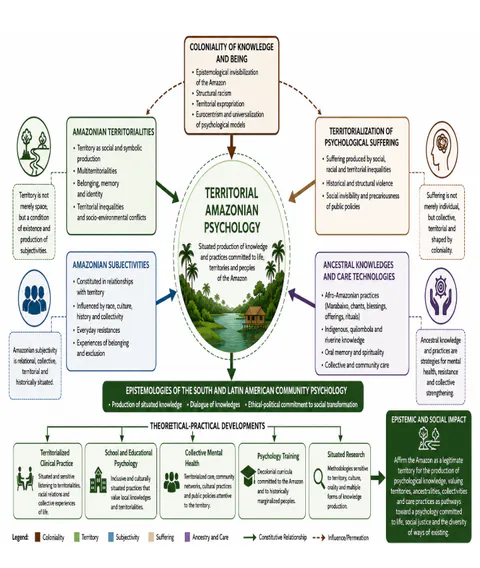
Epistemological Foundations of Territorial Amazonian Psychology
7. Theoretical and Practical Developments of Territorial Amazonian Psychology
The consolidation of Territorial Amazonian Psychology as a situated epistemological proposal implies not only the formulation of new theoretical frameworks, but also the construction of concrete possibilities for psychological intervention committed to Amazonian territorialities. In this sense, the proposal extends beyond the limits of an exclusively conceptual discussion by presenting direct implications for clinical psychology, collective mental health, school and educational psychology, professional training, and psychological research.
By recognizing that subjective processes are traversed by territory, coloniality, race, ancestry, and collectivity, Territorial Amazonian Psychology proposes important shifts in traditional ways of understanding psychological care. Its purpose is to challenge universalizing models and promote practices that are more sensitive to the historical and cultural specificities of the Brazilian Amazon.
Territorialized Clinical Psychology and Situated Listening
Within the clinical field, Territorial Amazonian Psychology proposes an expanded understanding of psychological suffering. Unlike approaches centered exclusively on intrapsychic or individual dimensions, this perspective recognizes that human suffering is produced in constant relation to territorial, racial, historical, and communal experiences.
A territorialized clinical practice requires a psychologically situated form of listening capable of recognizing the social, cultural, and territorial dimensions involved in the subjective constitution of Amazonian individuals. This implies understanding that experiences related to structural racism, territorial exclusion, social invisibility, and the precariousness of public policies directly participate in the production of psychological suffering in the Amazon.
Within this framework, clinical listening no longer seeks exclusively the individual adaptation of the subject, but also considers the concrete conditions of existence shaping subjective experience. Amazonian subjectivity is understood as the result of multiple relationships involving territory, collective memory, cultural belonging, ancestry, and social inequality.
Territorial Amazonian Psychology also proposes expanding the dialogue between clinical psychology and collective practices of care. Afro-Amazonian cultural experiences, spirituality, oral traditions, community bonds, and ancestral technologies of care may constitute important resources for subjective strengthening and collective elaboration of suffering, particularly within contexts historically marked by territorial and racial invisibilization.
School Psychology, Inclusion, and Amazonian Territorialities
In the field of school and educational psychology, the proposal highlights the need to construct practices committed to the cultural and territorial specificities of the Brazilian Amazon. Traditional schooling models frequently disregard Amazonian realities, reproducing curricula, methodologies, and pedagogical practices insufficiently sensitive to the collective and cultural experiences present in the region.
Territorial Amazonian Psychology proposes understanding educational processes beyond individualizing interpretations of school difficulties. Issues related to school failure, educational exclusion, learning difficulties, and inclusion processes must also be analyzed in relation to territorial inequalities, concrete living conditions, and processes of cultural invisibilization present within Amazonian educational contexts.
Within this scenario, Universal Design for Learning (UDL) may be reinterpreted through Amazonian territorialities, expanding its pedagogical dimension to include cultural diversity, traditional knowledge systems, and community-based experiences. School inclusion, from this perspective, is not limited to formal access to educational spaces, but also involves territorial recognition, cultural belonging, and the valorization of multiple forms of knowledge production.
The proposal also emphasizes the importance of strengthening territorialized school psychological practices capable of engaging with Amazonian community experiences and recognizing Amazonian individuals as legitimate producers of culture, knowledge, and educational practices.
Collective Mental Health and the Territorialization of Care
Within the field of collective mental health, Territorial Amazonian Psychology proposes strengthening territorialized and culturally situated practices of care. Although the Brazilian Psychosocial Care Network (RAPS) represents an important advance in national mental health policy, it still faces significant implementation challenges within Amazonian territories, particularly due to regional inequalities and the historical fragility of public policies in the region.
The territorialization of care implies recognizing that mental health practices must directly engage with the communal, cultural, and territorial experiences of Amazonian populations. Psychosocial care therefore ceases to be understood merely as the technical provision of specialized services and begins to include community networks, collective cultural practices, ancestral knowledge systems, and local experiences of subjective strengthening.
Within this context, Afro-Amazonian cultural experiences may play an important role in promoting collective mental health. Practices such as Marabaixo, community circles, collective rituals, healing blessings, and oral traditions foster belonging, community strengthening, and symbolic elaboration of suffering, constituting important strategies of psychosocial resistance.
Territorial Amazonian Psychology therefore proposes an expanded understanding of mental health committed to the territorial determinants of psychological suffering and to the valorization of collective care practices present within Amazonian experiences.
Psychology Training and the Production of Situated Knowledge
Another important development of this proposal concerns professional training in Psychology. Psychology curricula in Brazil remain strongly influenced by Eurocentric and urban-centered frameworks, frequently neglecting the historical and territorial specificities of the Brazilian Amazon.
Territorial Amazonian Psychology advocates for educational processes committed to Amazonian realities and to populations historically rendered invisible by modern science. This implies expanding discussions concerning coloniality, territory, racial relations, ancestry, collective mental health, and Epistemologies of the South within Psychology training programs.
More than simply including regional content in curricula, the proposal seeks to recognize the Amazon as a legitimate territory for the production of psychological knowledge. Professional training in Psychology should therefore enable future psychologists to understand the relationships among subjectivity, territory, social inequality, and culture, strengthening territorialized psychological practices committed to Amazonian realities.
Within the field of research, the proposal also highlights the importance of developing methodologies sensitive to Amazonian territorialities. Oral traditions, collective memory, community narratives, and traditional cultural practices should be recognized as important methodological possibilities for the production of situated psychological knowledge.
Thus, the theoretical and practical developments of Territorial Amazonian Psychology demonstrate that the proposal extends beyond the construction of an abstract conceptual category. Rather, it constitutes a perspective committed to transforming psychological practices, professional training, scientific production, and mental health policies in the Brazilian Amazon.
continuar
Final Considerations
This study sought to propose the epistemological foundations of Territorial Amazonian Psychology as a situated theoretical-practical perspective for understanding subjectivities, experiences of psychological suffering, and collective forms of care produced within Amazonian territorialities. Throughout the study, it was argued that the Brazilian Amazon should no longer be understood merely as a peripheral space for the application of psychological models developed in distinct sociocultural contexts, but rather as a legitimate territory for conceptual, epistemological, and scientific production within the field of Psychology.
The critique of the universalization of Eurocentric psychological frameworks demonstrated that subjective processes do not develop in an abstract or decontextualized manner. Instead, they are traversed by territory, race, ancestry, coloniality, social inequality, and collective experiences of existence. In this sense, Territorial Amazonian Psychology proposes a fundamental epistemological displacement: understanding Amazonian subjectivity through Amazonian territorialities and recognizing that the forms of suffering, resistance, belonging, and care produced in the region possess their own historical and cultural specificities.
By articulating contributions from Latin American Community Psychology, Collective Mental Health, Epistemologies of the South, and decolonial studies, the proposal presented here challenges the individualizing and universalizing limits of modern Psychology. More than simply incorporating regional themes into the psychological field, Territorial Amazonian Psychology affirms the need to construct analytical categories produced from Amazonian experiences themselves, capable of recognizing the centrality of territory, collectivity, ancestry, and cultural practices in the constitution of Amazonian subjectivities.
The notion of the territorialization of psychological suffering developed throughout this study demonstrated that experiences of suffering in the Brazilian Amazon are deeply related to territorial inequalities, structural racism, the precariousness of public policies, social invisibility, and the persistence of coloniality. From this perspective, psychological suffering ceases to be interpreted exclusively as an individual phenomenon and becomes understood as a territorially situated experience produced through the relationships among subject, territory, history, and social structure.
Similarly, recognizing collective technologies of care and Afro-Amazonian practices of community strengthening expands the epistemological horizons of Psychology itself. Experiences such as Marabaixo, oral traditions, healing blessings, collective rituals, Amazonian spiritualities, and ancestral knowledge systems reveal historically constructed forms of elaborating suffering, producing belonging, and sustaining subjectivity in the face of multiple forms of social violence present in the region. Such experiences should not be interpreted as peripheral or folkloric elements, but as legitimate expressions of psychosocial care and cultural resistance.
Territorial Amazonian Psychology does not seek to completely replace classical psychological frameworks, nor does it aim to establish an isolated regional perspective detached from broader scientific debates. Rather, its proposal is to critically expand the epistemological horizons of Brazilian Psychology by incorporating Amazonian territorialities as central dimensions of subjective production and mental health care. In this sense, the proposal advocates for a Psychology committed to populations historically rendered invisible by the coloniality of knowledge and sensitive to the multiple forms of existence present within the Brazilian Amazon.
Beyond its theoretical implications, the proposal also points toward important practical developments in clinical psychology, collective mental health, school and educational psychology, professional training, and scientific research. The defense of territorialized and culturally situated psychological practices represents a concrete possibility for strengthening public policies that are more responsive to Amazonian realities and to collective forms of care produced within regional territories.
Finally, Territorial Amazonian Psychology should be understood less as a completed theory than as an open epistemological, political, and ethical agenda. Its consolidation will depend on the strengthening of future research, the expansion of academic networks committed to decolonial and territorial perspectives, the valorization of traditional knowledge systems, and the construction of psychological practices committed to the plurality of Amazonian experiences.
By affirming the Amazon as a territory that produces subjectivities, knowledge, and its own forms of collective care, this study advocates for the possibility of constructing a Psychology produced from the Amazon, capable of recognizing territory, ancestry, collectivity, and cultural resistance as constitutive dimensions of human experience. More than proposing a new theoretical category, Territorial Amazonian Psychology represents the defense of a psychological science committed to life, memory, Amazonian peoples, and the construction of alternative possibilities for existence and care within the contemporary Brazilian context.
Conflict of Interest
The authors declare no conflict of interest.
Ethical Approval
Not applicable
Data Availability
The datasets used in this study are openly available at [repository link] and the source code is available on GitHub at [GitHub link].
Funding
This work did not receive any external funding.
References
Cite this article
Related Research

Special Issue
Launch a focused special issue to highlight research, emerging trends, and expert insights in your academic field.