



IntelliPaper
Abstract
The authors have recently published the book New Celestial Mechanics Mechanics, which presents the Theory of Dynamic Interactions (TDI), a conceptual proposal aimed at reconsidering the dynamics of rotating celestial bodies and, more generally, rotational mechanics.
Unlike the classical framework—based on the law of universal gravitation and its relativistic extensions—this approach introduces dynamic criteria applicable to systems subjected to non-coaxial rotations. It proposes that the interaction between intrinsic rotation and translational motion may generate closed trajectories and states of dynamic equilibrium.
TDI seeks to provide a unified description of the effect of non-coaxial torques on the trajectories of rigid bodies, including precession phenomena and possible stationary orbital states under specific dynamic conditions.
Although this is a non-conventional hypothesis, the proposed framework is intended to stimulate the theoretical and experimental analysis of complex rotational systems, with possible applications in satellite dynamics, aerospace engineering, and the modelling of accelerated physical systems.
Explore Digital Article Text
Introduction
Rotational dynamics has historically developed within the framework of classical mechanics, based on universal gravitation and the principles of Newtonian dynamics. Traditionally, this field has assumed that gravitational forces determine orbital trajectories, as formulated by Kepler and Newton, with subsequent extensions in relativity and astrophysics.
In the recently published work mentioned above, New Celestial Mechanics, structured around the Theory of Dynamic Interactions (TDI), an alternative conceptual approach to classical mechanics1 is proposed. In this approach, the effects of intrinsic rotation and non-coaxial accelerations play a relevant role in the dynamic description of celestial systems and, more generally, of rotating bodies subjected to additional rotational excitations.
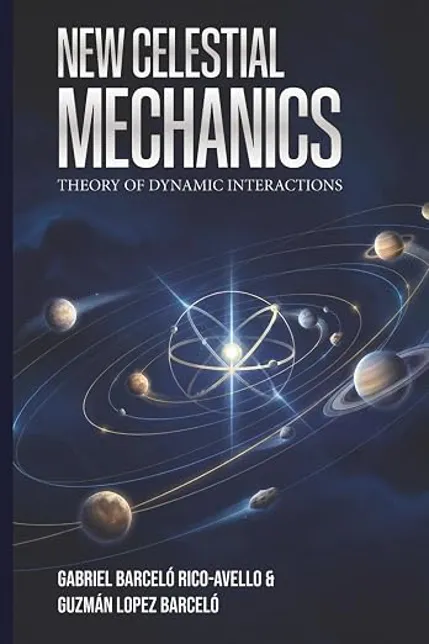
Cover of the book New Celestial Mechanics.
In the Newton2-Euler3 formalism, translation and rotation are treated as strictly independent, and rotation is regarded as a purely kinematic state. In TDI, rotation is reformulated as a physical field distributed in space and time. The initial intrinsic angular momentum of the moving body is likewise treated as a distributed quantity, and the presence of actions that generate additional rotations gives rise to novel dynamic phenomena.
When the new excitation tends to generate non-coaxial rotations, a dynamic coupling naturally begins between the newly generated induced rotational motion and the translational motion. This produces coupling terms of the form , interpreted as a genuine dynamic interaction, where:
: intrinsic angular velocity induced, which causes a new rotation of the mass;
: translational velocity.
We propose the hypothesis that, in systems with constant intrinsic rotation subjected to non-coaxial rotational excitations, effective induced-acceleration terms may arise in proportion to the vector product of angular velocity and translational velocity:
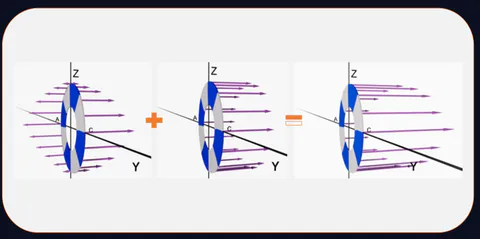
Coupling of the field of the second rotation with the translational velocity field.
Its inclusion in the dynamic formalism could modify the description of certain trajectories under specific conditions.
We consider that the effects of intrinsic rotations and non-inertial accelerations play a fundamental role in the dynamic description of celestial systems4 and, more generally, of bodies with intrinsic rotation subjected to new non-coaxial excitations.
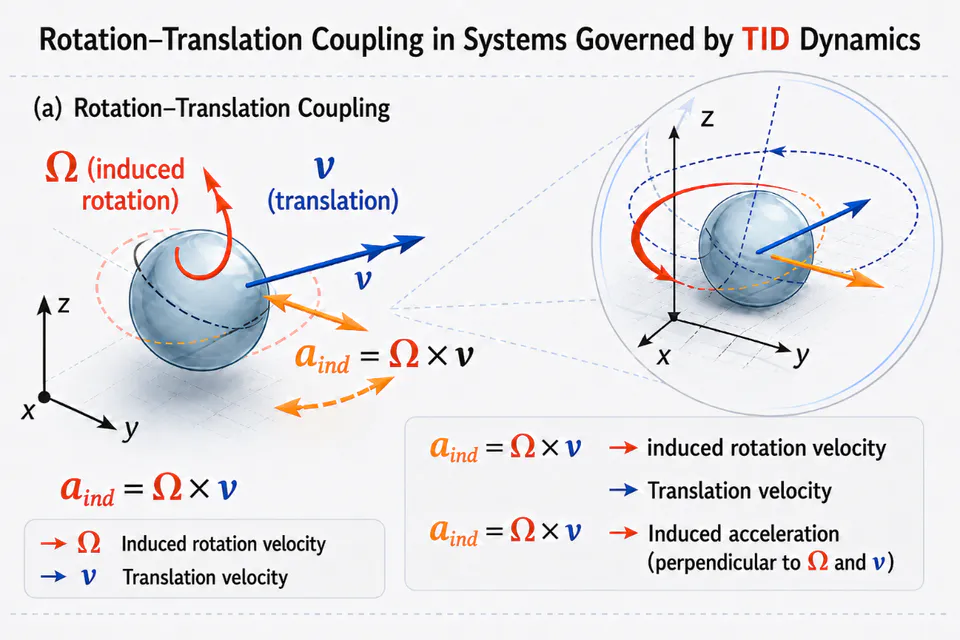
Dynamic scheme of TDI.
Figure [fig:tdi-scheme] schematically shows the variables involved in rotation-translation coupling, when it is due to actions not coaxial with the existing intrinsic rotation, showing the induced acceleration aind introduced by the TDI.
General Concept of TDI
TDI proposes that, in systems with constant intrinsic rotation, the interaction between that rotation and non-coaxial accelerations may generate a dynamic coupling capable of producing curved closed trajectories and states of dynamic equilibrium.
This approach proposes an expanded framework for jointly analysing rotational and translational dynamics, reinterpreting the relationship between angular momentum, secondary torques, and variations in the translational velocity of a rigid body.5
Within this theoretical framework, rotation is interpreted as a quantity distributed spatially and temporally, allowing coupling terms to be introduced between translational and angular variables. The initial intrinsic angular momentum is regarded as a distributed quantity, and the presence of additional non-coaxial rotations gives rise to interaction terms of the form:
where represents the induced intrinsic angular velocity, which causes a new rotation of the mass, and the translational velocity.
Generalized Translational Dynamics
Consequently, the translational dynamic equation would adopt the generalized form:
It can be noted that in our proposal, the second Law of Newton is modified, incorporating a term that does not correspond to the incidence of external forces, but rather to the simple coupling of two dynamic effects that act: the induced non-coaxial rotation, and the existing translational speed of the moving object, expressed by the term: m ().
A Newtonian limit exists: if , the classical Newtonian equation is recovered as a limiting case. Also in the case that the new actions are coaxial with the existing intrinsic rotation.
From a geometric standpoint, the vector product generates an acceleration orthogonal to both and , leading to curved trajectories without explicitly introducing central forces.
Throughout the development of this research project on rotational dynamics, its mathematical analysis has also been described in various written works, including New Paradigm in Physics,6 Theory of Rotational Fields,7 and the aforementioned New Celestial Mechanics.8
Critical Review of Classical Assumptions
In conventional celestial mechanics, the trajectories of bodies are described as solutions to equations governed by central forces.9
TDI suggests that these models could be interpreted as particular cases within a more general framework in which intrinsic rotations and non-coaxial excitations influence observable orbital dynamics.10
Our formulation is intended to broaden the conceptual scope of analysis rather than replace existing models, proposing a reconsideration of certain assumptions concerning the independence of translational and rotational degrees of freedom.
Specifically, the text refers exclusively to classical rotational dynamics. When a body with intrinsic rotation around its own axis is subjected to new non-coaxial rotations, it does not comply with the composition of movements predicted by the classical Newton-Euler equations. Instead, non-coaxial actions that induce rotation generate precession and orbiting, extending the analytical assumptions beyond cases of central force models in classical rotational dynamics.
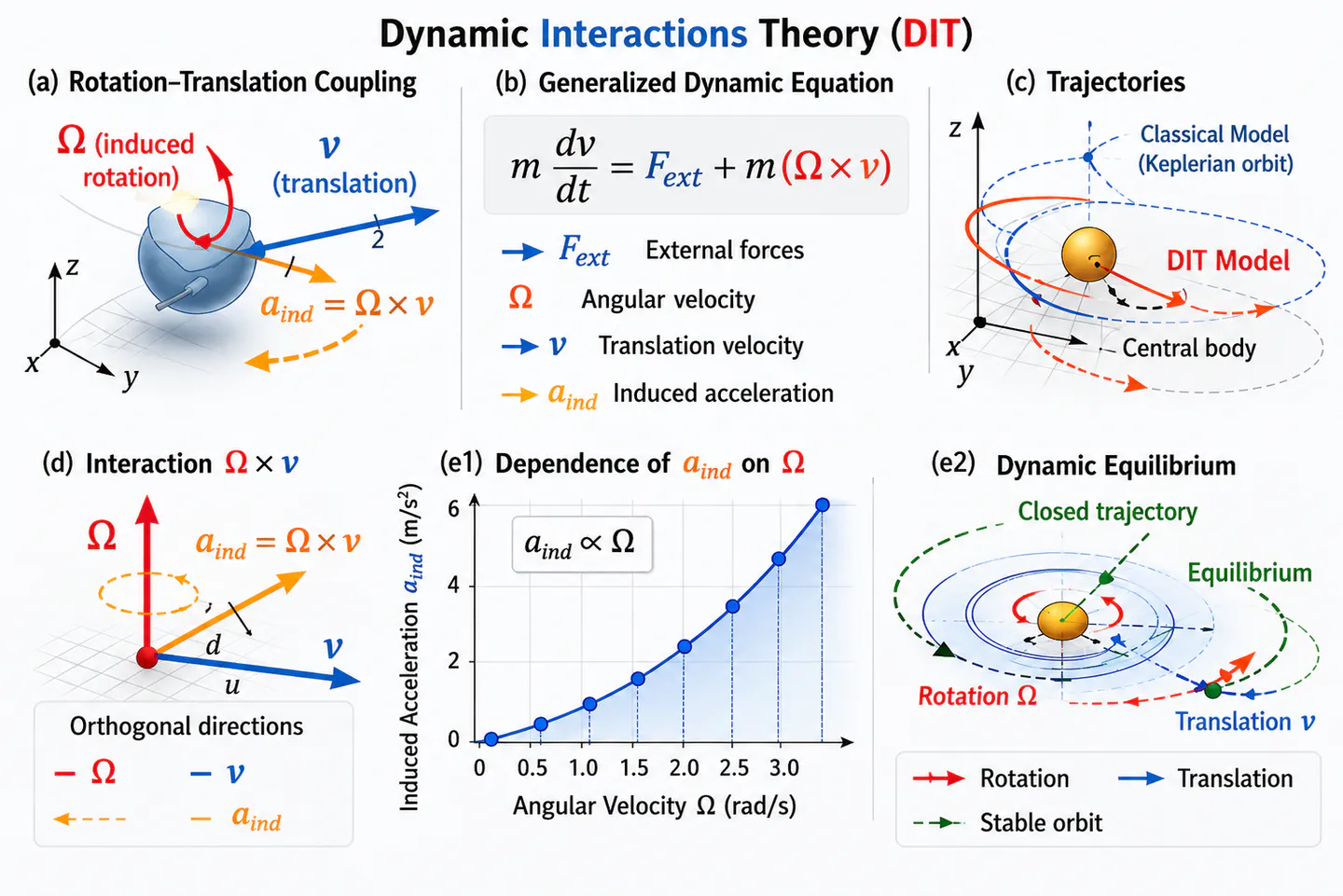
Dynamic scheme of TDI II.
In Figure [fig:tdi-scheme-ii], some of the criteria obtained from our research project are schematically presented, as a result of the natural coupling of speeds that occurs in these cases.
Conceptual Implications and Possible Applications
Although TDI is still not an accepted paradigm within the scientific consensus, its formulation proposes conceptual criteria that could stimulate debate in areas, such as the dynamics of accelerated systems, satellite inertial navigation, and the modelling of complex rotational systems.11
Experimental Methodology and Preliminary Observations
The development of this line of research included an experimental programme based on the construction of prototypes designed to analyse the behaviour of rigid bodies subjected to simultaneous non-coaxial rotations.
These devices were designed to generate controlled rotational states in which translational and angular variables could be measured and compared with predictions derived from classical rigid-body dynamics.12
The experimental systems evaluated included submerged configurations subjected to external torques, simple and compound gyroscopic devices, gyroscopic pendulums, disks, and bodies with intrinsic rotation subjected to additional angular excitations, as well as analogous mechanical systems used as comparative models.
Across multiple experimental campaigns, the following classes of prototypes and test devices were constructed and evaluated:
A submerged model-the “submarine configuration”-subjected to non-coaxial external torques under fluid resistance.
Land-based mobile systems designed as mechanical analogues of the submarine experiments, under lower-resistance conditions.
Gyroscopic devices, including simple and compound gyroscopes.
Gyroscopic pendulum configurations designed to analyse coupled rotational-translational responses.
Disks, cans, and balls with intrinsic rotation subjected to simultaneous non-coaxial angular accelerations.
Traditional spinning toys, including spinning tops, hoops, boomerangs, and other configurations used as reference systems for rotational-coupling phenomena.
The results confirmed the predicted dynamic effects, which are not described in the classical Eulerian formulation. In particular, they showed the appearance of induced translational components and distributed field-like interactions, under simultaneous rotational accelerations.
These observations challenge the conventional assumption-rooted in Newton-Euler mechanics-that translational and rotational dynamics can be treated as independent degrees of freedom.
The integration of theoretical formulation, prototype engineering, and empirical testing enabled the TDI framework to move towards a regime of experimental verifiability and falsifiability, establishing a methodological basis consistent with the standards expected in both theoretical and applied physics.
The observations obtained show behaviours compatible with the existence of dynamic coupling terms between rotation and translation. Nevertheless, these results must be regarded as preliminary and remain subject to independent verification, experimental reproducibility, and detailed quantitative analysis.
Supplementary audiovisual material documents some of these experimental tests and may be consulted as supporting material.
The model proposes the following experimentally testable predictions:
The appearance of systematic deviations from trajectories predicted by classical models in non-coaxial rotational systems.
A quantifiable dependence of those deviations on the magnitude of .
Reproducibility of the effect under equivalent geometric configurations.
Discussion
The integration of theoretical formulation and experimental testing suggests the possibility of describing certain dynamic systems by means of models that explicitly include rotational-translational coupling.
From this perspective, TDI is proposed as an exploratory framework intended to assess whether such terms may play a relevant role in specific dynamic regimes.
The future development of this proposal requires confirmation of the proposed mathematical formulations, rigorous dimensional analyses, comparison with known solutions, and reproducible experimental validation.
Conclusion
The Theory of Dynamic Interactions proposes an alternative conceptual framework for the analysis of complex rotational systems by explicitly integrating coupling effects between rotation and translation. Rather than replacing classical models,13 this proposal seeks to expand them conceptually and promote new research aimed at evaluating its scope, validity, and applicability to real physical systems.14
The incorporation of further independent experimental studies, detailed mathematical analyses, and comparisons with observational data will be essential in determining the role that this approach may play in the future development of rotational dynamics and celestial mechanics.
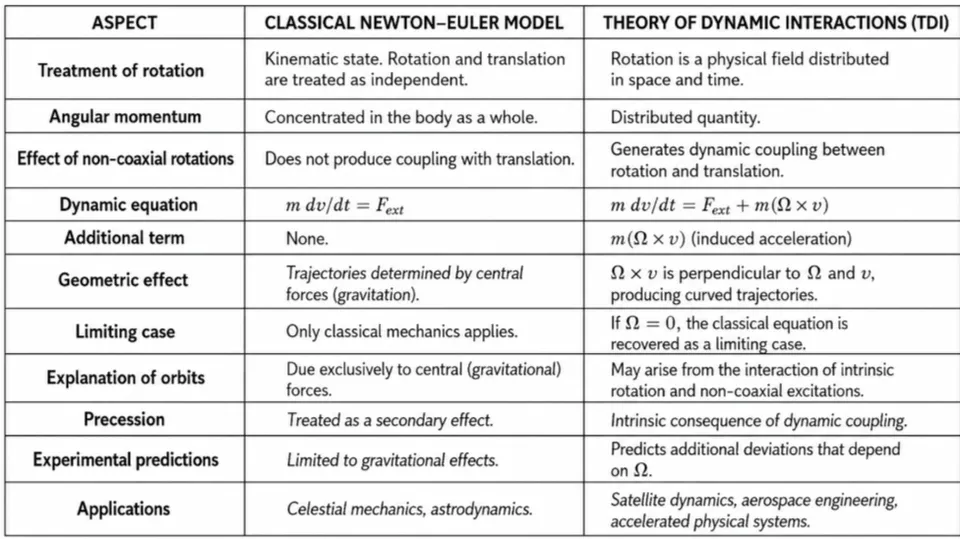
Comparative table between the classical Newton-Euler model and the Theory of Dynamic Interactions.
Additional current comments on the proposed model:
The mathematical formalism has been fully developed.
Independent experimental validation carried out by other specialists has been published.
No systematic comparisons with standard numerical simulations have yet been performed.
Its astrophysical applicability remains an open hypothesis.
An artificial-intelligence system has been developed and applied to confirm the coherence of the research project, its results, and the text of the completed book, with the aim of identifying possible conceptual or mathematical errors.
The proposal presented should be regarded as an exploratory framework whose validity will depend on comparison with other rigorous mathematical analyses and with new reproducible experimental evidence.
The result of the comparison between the Newton-Euler formulation and the TDI is clear and obvious: Newton-Euler suggests a composition of rotations in all cases. TDI proposes maintaining the existing intrinsic rotation, without changes, and the start of precession, which turns into orbiting when the forces acting on the masses remain constant. For the case of coaxial rotations, the Newton-Euler formulation is maintained.
This work presents an exploratory conceptual proposal whose objective is to encourage critical analysis and academic debate concerning possible extensions of existing dynamic frameworks.
Footnotes
Goldstein, H., Poole, C., & Safko, J. (2002). Classical Mechanics (3rd ed.). San Francisco: Addison-Wesley.
Newton, I. (1687). Philosophiæ Naturalis Principia Mathematica. London: Royal Society.
Euler, L. (1758). Theoria motus corporum solidorum seu rigidorum. Rostock: Typis et Sumptibus
https://dinamicafundacion.com/una-teoria-cientifica-propone-una-nueva-mecanica-celeste/ “Una teoría científica propone una nueva Mecánica Celeste”
https://advanceddynamics.net/embed/?utm_source=chatgpt.com Advanced Dynamics.
Barceló, Gabriel: New Paradigm in Physics: Assumptions and applications of the theory of dynamic interactions, Volume II: Theory of Dynamics Interactions, Amazon, 2018. (Español e inglés), https://advanceddynamics.net/
Rodríguez Palenzuela, Arturo: Teoría de Campos Rotacionales: La Teoría de Interacciones Dinámicas, Campos Rotacionales y el movimiento de Chandler, Editorial Amazon, 2022. Prologo: Barceló, Gabriel.
Barceló Rico-Avello, Gabriel y Lopez Barceló, Guzman: New celestial mechanics. Ed. Amazon, 2026. https://www.amazon.es/Celesctial-Mechanics-Gabriel-Barcel%C3%B3-Rico-Avello/dp/8412773195?ref_=ast_author_dp_rw&th=1&psc=1&dib=eyJ2IjoiMSJ9.PMsyD0TqTePNYV3cy38TPOhAE9JX2T_Vd2GBRFa6v-w.DuN7iC14zV3QaSjMwW3FiTonR8YqRdJ-CCaxkbvwck0&dib_tag=AUTHOR
Greenwood, D. T. (2003). Principles of Dynamics (2nd ed.). Upper Saddle River: Prentice Hall.
https://advanceddynamics.net/entrada_prensa/?utm_source=chatgpt.com
Barceló, G. (2024). New celestial mechanics. Madrid: Dinámica Fundación.
Kane, T. R., & Levinson, D. A. (1985). Dynamics: Theory and Applications. New York: McGraw-Hill.
Landau, L. D., & Lifshitz, E. M. (1976). Mechanics (3rd ed.). Oxford: Butterworth-Heinemann.
Marion, J. B., & Thornton, S. T. (2004). Classical Dynamics of Particles and Systems (5th ed.). Belmont: Brooks/Cole.
Conflict of Interest
The authors declare no conflict of interest.
Ethical Approval
Not applicable
Data Availability
The datasets used in this study are openly available at [repository link] and the source code is available on GitHub at [GitHub link].
Funding
This work did not receive any external funding.
References
Cite this article
Related Research

Special Issue
Launch a focused special issue to highlight research, emerging trends, and expert insights in your academic field.