


IntelliPaper
Abstract
With three decades of embracing a neoliberal immigration policy in New Zealand, the number of the China-born new migrants has grown significantly in the country. Consequently, businesses run by these new Chinese migrants have contributed significantly to the country’s economy and are an integral part of the country's urban economic landscape. However, research on their entrepreneurship remains limited. This research aims to use multiple methods to examine the entrepreneurial activities of this group of migrants in Auckland, New Zealand, focusing on business types, industry sectors, and factors that drive their business choices from the macro, meso, and micro perspectives. Data from Skykiwi Orange Page, Chinese Herald, and interviews with 29 new Chinese migrant business owners reveals concentrations in Retail Trade, Professional Services, and Construction, influenced by personal interests, market demand, and experience.
Explore Digital Article Text
I. INTRODUCTION
Within three decades of embracing a neoliberal immigration policy in New Zealand, the number of new Chinese migrants has grown significantly in the country. Today, China-born migrants constitute 53.64% of New Zealand's ethnic Chinese population (Statistics New Zealand, 2018), and China has become the second largest migrant source country for New Zealand since 1997, just after Great Britain (Liu, 2018; Liu & Ran, 2022). The increasing presence of China-born new migrants has contributed to the formation of a large Chinese consumer market and the rapid development of new Chinese migrant businesses, particularly in Auckland. As New Zealand's most diverse city, Auckland has witnessed a surge in new Chinese migrant entrepreneurs who have established businesses across various sectors and contributed to the shaping of its economic landscape and cultural landscape. Navigating business establishment in a new country has become a central aspect of their immigrant and entrepreneurial journey and presents both challenges and opportunities. This research aims to examine the entrepreneurial activities of the China-born new migrants in Auckland, New Zealand, focusing on identifying their preferred business types, industry sectors, and revealing factors that drive their business choices.
Internationally, diasporic Chinese entrepreneurship is a longstanding subject of scholarly research (Lin & Zhou, 2022). Some existing literature focuses on the relations between diasporic Chinese entrepreneurs and their ancestral homeland from historical and cultural perspectives (Chan & Cheung, 1985; Zhang, 2020; Zhou, 2021). There is also literature which takes on the perspectives of migrant-receiving countries and draws on the diverse adaptation or integration experiences of Chinese migrant business owners and their descendants to develop concepts such as ethnic enclaves, social capital, embeddedness, and bounded solidary (Portes & Zhou, 1992; You & Zhou, 2019). More recently, in reflection on China's rising economy, some scholars have increasingly shifted their focus to consider a rising China as the context from which contemporary Chinese entrepreneurship is developed and globalised. Most of this literature is situated in the social context of the USA, Canada, and Australia (Liu & Louw, 2009; Perry et al., 2020; Wang, 2014; Wang & Warn, 2018; Xu et al., 2019; Zhou, 2021). These studies explore Chinese business networks, ethnic enclaves, and transnational ties, often contextualizing entrepreneurship within China's economic rise.
In New Zealand, while extensive research on new Chinese migration exists, including settlement, language adaptation, and economic contributions (Cain & Spoonley, 2013; Casson, 2004; Chan, 2008; Friesen, 2001; Liu et al., 2022; Meares et al., 2011; Spoonley & Meares, 2011; Xue et al., 2012), there is a lack of systematic research on their entrepreneurial activities. Quite often, new Chinese migrant businesses have been studied under an overarching framework of exploring migrant or Asian migrant businesses (Hamilton-Hart et al., 2017; North & Trlin, 2004; Watts & Trlin, 1999). Some research on employment issues of migrants from non-English-speaking backgrounds gave a passing mention to new Chinese migrant businesses (Watts & Trlin, 2000). There is also some micro-level research on new Chinese migrant businesses, such as research on e-commerce in small Chinese firms in New Zealand (Chen & McQueen, 2008), Chinese ethnic precincts in Auckland (Spoonley & Meares, 2011), Chinese business management practices (Casson, 2004), Chinese business owners' co-ethnic networks in Auckland (Meares et al., 2011) and the clustering of Chinese businesses in Auckland's ethnoburbs (Liu et al., 2022). While these studies provide important insights on new Chinese migrant entrepreneurship, a more systematic research approach is needed.
To remedy this research gap, the paper delves deep into the intricate intersections of the theories of transnational migration (Glick-Schiller et al., 1995) and ethnic entrepreneurship (Gold & Light, 2000) to form the conceptual framework and adopts the multi-dimensional mixed embeddedness (Yamamura & Lassalle, 2022) as an analytical tool to analyse the macro, meso, and micro-level factors that influence their business choices. The central research questions for this paper are twofold. The first is what the preferred business types and industry sectors chosen by the new Chinese migrant entrepreneurs are, and the second is what factors influence the selection of these business types and industry sectors.
In pursuit of answering the research questions, multiple methods were used to collect empirical data. Firstly, this research analyses the classification of new Chinese migrant businesses on Skykiwi Orange Page and the commercial advertisements on the Chinese Herald . Secondly, this study conducted in-depth interviews with 29 selected new Chinese migrant business owners . This integrated approach, which combines quantitative and qualitative methods, ensures a comprehensive understanding of the preferred types of businesses and industrial sectors of the new Chinese migrant entrepreneurs and the underlying reasons for their preferences. Understanding these dynamics offers insights into migrant entrepreneurship's role in New Zealand's economy, contributing to broader discussions on migration, economic integration and transnational business networks. The research also provides policy recommendations to support the entrepreneurial diversification of Chinese migrants, emphasizing their growing role in shaping New Zealand's urban and economic landscape.
This paper commences with introducing the theoretical underpinning of the research. It then discusses the research methods used to collect and analyse data followed by the empirical findings. The paper concludes with a discussion of the research implications and theoretical scholarly significance.
II. THEORETICAL FRAMEWORK: TRANSNATIONAL MIGRATION, TRANSNATIONAL MIGRANT ENTREPRENEURSHIP AND ETHNIC ENTREPRENEURSHIP
The theoretical framework of this research integrates three key areas: transnational migration, transnational migrant entrepreneurship and ethnic entrepreneurship. These theories collectively provide a robust foundation for the research. Transnational migration theory (Glick-Schiller et al., 1995) provides insight into the ongoing cross-border connections and activities of
Chinese migrants. Ethnic entrepreneurship emphasises the role of ethnic resources and networks in business creation and sustainability (Gold & Light, 2000). Transnational migrant entrepreneurship highlights the entrepreneurial activities that maintain ties across borders (Portes et al., 2002).
The theory of transnational migration serves as the overarching theoretical framework for this research. Transnational migration encompasses the movement of people across national borders while simultaneously engaging in activities and relationships that span multiple countries (Landolt, 2001; Portes et al., 1999; Sassen, 2001). It underscores the interconnectedness between home and host countries and emphasizes migrants' ongoing ties and activities in across different national contexts (Landolt, 2005; Portes et al., 2002; Zhou & Liu, 2017).
Under the overall framework of transnational migration, Yamamura and Lassalle (2022) defined transnational entrepreneurship as the activities of transnational migrants who actively engage in cross-border trade, seek customers, suppliers and investors, and access resources in a transnational context. Situated at the cross-border intersection of different social, economic, and political contexts, transnational entrepreneurs are those migrants who draw on transnational migration experiences and social networks to operate businesses that operate across more than one country and are embedded in the transnational environment as a result of their migration and entrepreneurial experiences (Nawojczyk & Nowicka, 2018; Nowicka, 2013; Portes et al., 2002; Sandoz et al., 2022; Sinkovics & Reuber, 2021). Transnational migrant entrepreneurship therefore is characterised by the ability of migrants to leverage resources, knowledge and connections from both their home and host countries (Landolt, 2001; Portes et al., 2002; Waldinger, 1995; Zhou & Liu, 2017).
Closely connected with the theory of transnational migrant entrepreneurship is the concept of ethnic entrepreneurship. The theory of ethnic entrepreneurship examines the role of ethnicity in the entrepreneurial process, including business creation, management, and growth (Rahman et al., 2021). It is defined as business activities in a certain area driven or undertaken by people of a different ethnic or cultural origin than the indigenous population (Masurel et al., 2004). In other words, ethnic entrepreneurship refers to the process through which members of ethnic minority groups create and operate businesses that are strongly connected to their ethnic identity and culture and use their cultural and social capital to establish and run businesses (Waldinger et al. 1990; Zhou 2004). These businesses often serve the needs of the ethnic community and are connected to the social and economic networks of the ethnic group. Ethnic entrepreneurship is characterised by a strong sense of identity and belonging to the ethnic group, and a desire to preserve and promote the cultural traditions of the group through business activities (Rahman et al., 2021). On the positive side, ethnic entrepreneurship can benefit business owners by giving them access to networks, markets, and knowledge that are unique to their ethnic group (Zhou, 2004). On the negative side, ethnic entrepreneurship can be subject to discrimination and exclusion, which come from the economic and political structures of the host country and from the dominant ethnic groups in society (Light & Bonacich 1988; Min 1990; Waldinger et al. 1990). Furthermore, ethnic entrepreneurship can be constrained by cultural norms and customs that may not be supportive of innovation and venture taking (Chan, 2008).
While transnational migrant entrepreneurship and ethnic entrepreneurship share some similarities, they differ in terms of their research focus and orientation. Transnational migrant entrepreneurship is focused on creating businesses that operate across national borders, while ethnic entrepreneurship is focused on creating businesses that are strongly connected to the ethnic identity and culture of the entrepreneur (Henn, 2012; Honig, 2021). This concept refers to a theoretical approach that captures how migrant entrepreneurs are embedded simultaneously in multiple contexts including structural, market and individual environments. It recognises that entrepreneurial behaviour is shaped not only by individual capabilities but also by broader institutional and market environments. For this research, these two theories are not mutually exclusive; rather, the two together indicate a new direction to the research, requiring the new Chinese migrant businesses to be examined from both ethnic as well as transnational perspectives.
III. METHODOLOGICAL NOTES
3.1 Research Approach and Design
Multi-dimensional mixed embeddedness was used as a guiding principle to design the fieldwork research and develop the analytical framework. This concept refers to a theoretical approach that captures how migrant entrepreneurs are embedded simultaneously in multiple contexts including structural, market, and individual environments (Yamamura & Lassalle, 2022). It recognises that entrepreneurial behaviour is shaped not only by individual capabilities but also by broader institutional and market environments. This approach not only identifies the interaction and interplay of wider institutional regulatory constraint (i.e. macro factor), market factors (i.e. meso factor), and individual resources (such as human capital resources, financial resources and socio-cultural resources) of entrepreneur (i.e. micro factor) as crucial factors in influencing entrepreneurial behaviour (Kloosterman & Rath, 2010), but also provides a framework to investigate different contextual dimensions of the influential factors; for example, the social, political and economic contexts. This approach can clarify the activities and actions of transnational migrant entrepreneurs, while also explain what factors in their surrounding entrepreneurial environment might play a crucial role in the initiation and development of transnational migrant entrepreneurship (Solano, 2019; Yamamura & Lassalle, 2022).
To further elucidate the underlying dynamics influencing Chinese migrant entrepreneurs' industry selection, this study proposes a conceptual model based on the framework of multi-dimensional mixed embeddedness. As illustrated in Figure 1, the model comprises three interacting levels: Macro-level factors refer to the institutional and regulatory environment, such as immigration policy, industry-specific entry barriers and broader business regulations. These set the structural context for entrepreneurial opportunities. Meso-level dynamics focus on market conditions and social networks, including demand from the ethnic market, support from co-ethnic business networks, and culturally rooted social capital. These factors shape access to information, customers, and trust networks. Micro-level resources highlight the personal capacities of the entrepreneurs, including their educational background, financial capital, and socio-cultural adaptability, which directly influence their ability to navigate the entrepreneurial landscape. These three levels collectively inform the industry selection. This layered framework visually connects the empirical results of this study with the broader theoretical insights from transnational migration and ethnic entrepreneurship literature, offering a comprehensive understanding of Chinese migrant entrepreneurial patterns in Auckland.
A Multi-Level Embeddedness Model of Industry Selection Among New Chinese Migrant Entrepreneurs in Auckland
Macro-Level: Institutional and Regulatory Environment
Immigration policy
Industry entry barriers
Business regulations
Meso-Level: Market Conditions and Social Networks
Ethnic market demand
Co-ethnic networks
Cultural/social support
Micro-Level: Individual Entrepreneurial Resources
Education and skill sets
Financial resources
Personal motivations
Outcome: Industry Selection
High: Retail, Construction, Professional Services
Low: Capital-intensive sectors
Figure 1: A Multi-Level Embeddedness Model of Industry Selection Among New Chinese Migrant Entrepreneurs in Auckland
Guided by the multi-dimensional mixed multiple methods to collect empirical data, embeddedness, the research was designed to use including a quantitative analysis of the classification of new Chinese migrant businesses on Skykiwi Orange Page and Chinese migrant business advertisements on the Chinese Herald, and in-depth interviews with selected new Chinese migrant business owners from different industries. The quantitative component aims to identify the business types preferred by new Chinese migrants and the distribution of these Chinese businesses in different industry sectors. The qualitative component mainly aims to understand how and why the new Chinese migrant business owners established their businesses with certain types and in the chosen industries.
3.2 The Quantitative Analysis
As for the analysis of the classification of new Chinese migrant businesses on the SkyKiwi Orange Page, firstly, the numbers of Chinese businesses that are classified by the SkyKiwi Orange Page under each business category were counted. Non-Chinese businesses were ruled out. Secondly, the proportions of different business types was calculated against 1) the total classified Chinese businesses on the SkyKiwi Orange Page, and 2) the New Zealand business industry distribution from New Zealand business demography statistics of 2022 (https://www.stats.govt.nz/information-releases/new-zeal and-business-demography-statistics-at-february-2022/). In this way, new Chinese migrant businesses can be aligned with the coding of the New Zealand business industry classification.
As for the analysis of the new Chinese migrant business advertisements on the Chinese Herald, firstly, all Chinese business advertisements in a defined period of time (from 1 November 2022 to 30 April 2023) in the newspaper were collected. Six months of data can ensure the sample pool is big enough to provide indicative data for the research. Secondly, the total number of those collected business advertisements were calculated. Thirdly, all collected business advertisements were categorised into different business and industry types according to the established Business Industry Classification Code of New Zealand (https://www.businessdescription.co.nz). Lastly, the number of business advertisements in each category and their proportions to the total number of the collected advertisements was calculated. In this way, the preferred business types and industry sectors of new Chinese migrants can be identified. Results from these two research components can allow an assessment of internal validity.
In order to identify the preferred industries of the new Chinese migrant businesses, the last step of the quantitative analysis is to compare the business industry distribution shown on the two Chinese platforms with the business industry distribution of New Zealand nationwide. Chi-square tests were performed to assess whether the differences are statistically meaningful.
3.3 The In-Depth Interviews
The in-depth interviews conducted with selected new Chinese migrant business owners included a series of open-ended questions about their migration experience, business start-up motivation and process, company information, challenges in creating and running businesses, and business development strategies.
The recruitment of interview participants was firstly based on the researchers' personal network, then snowballing techniques were used to recruit more interview participants. Purposive Sampling method were used to determine qualified interviewees for the research. They had to be new Chinese migrant business owners who were adults (over 18 years old) and had immigrated to New Zealand from China after the introduction of the Immigration Act 1987, and whose businesses were officially registered with the New Zealand Companies Office (www.companiesoffice.govt.nz).
In total, 29 in-depth interviews were conducted, with interviewees coming from different industry categories. All their businesses are all set up in Auckland. To ensure confidentiality, all interviewees were assigned pseudonyms during the process of data analysis. With the consent of the interviewees, all interviews were digitally recorded and researcher also take notes during the interview. All interviewees preferred to conduct their interviews in Mandarin.
The interviews were transcribed to Chinese then translated to English for data analysis. Thematic analysis was performed in which the interview transcripts were coded then themes emerged. Once the themes were firmly established, relevant interview quotations were categorised into each theme and used to validate the data interpretation.
IV. RESEARCH RESULTS
4.1 A Linear Analysis of Chinese Businesses Listed on Skykiwi Orange Page and Chinese Commercial Advertisements in the Chinese Herald
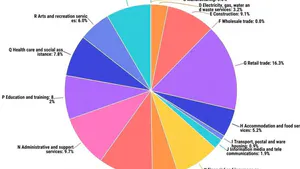
Chinese businesses listed on Skykiwi Orange Page were re-classified according to the New Zealand Business Industry Classification Code. During the data collection period, there were 4,745 Chinese businesses in the Auckland region listed on the Skykiwi Orange Page, accounting for 66.62% of the total 7,122 Chinese businesses registered on the Skykiwi Orange Page. Figure 2 shows that these Chinese migrant businesses in Auckland as shown on Skykiwi Orange Page span across 14 diverse industries. Four prominent industries stand out: Retail Trade (G), Professional, Scientific and Technical Services (M), Administrative and Support Services (N), and Construction (E). The industry of Retail Trade (G) emerges as the leading industry of Chinese businesses in Auckland with 774 businesses, comprising 16.3% of the total Chinese businesses in Auckland shown on the Skykiwi Orange Page. The industry of Professional, Scientific, and Technical Services (M) includes 483 businesses, making up 10.2% of the total Chinese businesses in Auckland. The industry of Administrative and Support Services (N) are also notable, with 459 businesses, accounting for 9.7% of the total Chinese businesses in Auckland. This industry encompasses a range of businesses sectors, providing essential support to other industries, such as employment services, travel agency and tour arrangement services, building cleaning, pest control and gardening services, packaging Services and other administrative services. The industry of Construction (E) is also significant, comprising 433 businesses, accounting for 9.1% of the total Chinese businesses in Auckland. The top four industries are followed by Other Services (S) (8.4%), Finance and Insurance Services (K) and Education and Training (P), accounting for 8.4%, 8.3% and 8.2% of the total Chinese businesses in Auckland respectively. Intriguingly, there is an absence of Chinese businesses in five business industries as shown on Skykiwi Orange Page, including Agriculture, Forestry, and Fishing (A), Mining (B), Manufacturing (C), Wholesale Trade (F), and Public Administration and Safety (O).
{"image_source":{"path":"images/3638e8419f1a900bbefb946972df08d09fa864310c8d21fb57b535ae03727133.jpg"},"content":"","chart_caption":[{"type":"text","content":"Figure 2: Industry distribution of Chinese business classification in Auckland on Skykiwi Orange Page"}],"chart_footnote":[]}
The analysis of the data collection from the Chinese Herald shows that there are 546 commercial advertisements in total during the defined period of time (see Figure 3). These advertisements were distributed across 11 industries. Chinese businesses in the industry of Construction (E) have the highest representation with 132 advertisements, comprising 24.1% of the total advertisements collected. This is followed closely by the industry of Professional, Scientific, and Technical Services (M) with 108 Chinese business advertisements, constituting 19.7% of the total Chinese business advertisements. The industry of Education and Training (P) and Manufacturing (C) are equally ranked in the third position, which have 72 advertisements, accounting 13.2% of the total Chinese business advertisements respectively. The fourth biggest industry shown on Chinese Herald are Rental, Hiring and Real Estate Services (L) and Retail Trade (L), both accounting for 36 advertisements; namely, 6.6% of the total advertisements collected. These four top industries are followed by Other Services (S) (30 advertisements, 5.5%), Administrative and Support Services (N) (24 advertisements; namely, 4.4%), Financial and
Insurance Services (K) (12 advertisement; namely, 2.2%), Transport, Postal, and Warehousing (I) (12 advertisements; namely, 2.2%), Health Care and Social Assistance (Q) (12 advertisements; namely, 2.2%), and Arts and Recreation Services (R) (6 advertisements; namely, 1.1%). The analysis reveals that there are no Chinese commercial advertisements in seven industries in the Chinese Herald, including Agriculture, Forestry, and Fishing (A), Mining (B), Electricity, Gas, Water, and Waste Services (D), Wholesale Trade (F), Accommodation and Food Services (H), Information Media and Telecommunications (J) and Public Administration and Safety (O).
{"image_source":{"path":"images/7cfa7ff399e860445d0700c94e23813ba36f079341ccf6f5275647c04250155a.jpg"},"content":"","chart_caption":[{"type":"text","content":"Figure 3: Industry distribution of Chinese migrant business advertisements indicated by the Chinese Herald (From 1 November 2022 to 30 April 2023)"}],"chart_footnote":[]}
Comparison of the Chinese business distribution between Skykiwi Orange Page and the Chinese Herald reflects some convergences as well as some divergences. Firstly, both platforms show consistently that the dominance of the Chinese businesses are in four industry sectors. They are Retail Trade (G), Professional, Scientific, and Technical Services (M), Construction (E) and Education and Training (P). While the data from Skykiwi Orange Page revealed that Retail Trade (G) is the top one industry, it is ranked as the fourth largest industry in Chinese Herald. This suggests that Retail Trade (G) is a thriving industry within the Chinese migrant businesses. It is worth noting that retail is also a main industry sector for New Zealand, with a total of 29,436 companies in the country are in Retail industry, comprising 5.0% of the total businesses nationwide (Statistics New Zealand, 2022). Secondly, both Chinese Herald and SkyKiwi Orange Page show that Chinese businesses in the Professional, Scientific and Technical Services (M) is ranked as the second largest industry.
Thirdly, while Construction (E) stands as the first largest industry sector in Chinese Herald, it is ranked in the fourth largest industry in SkyKiwi Orange Page. Fourthly, while Education and Training (P) stands as the third largest industry in Chinese Herald, it falls out from the top four industries in SkyKiwi Orange Page. In addition, Manufacturing (C) and Rental, hiring, and Real Estate (L) stand in the top four industries in Chinese Herald, but it is absent in Skykiwi Orange Page. Lastly, both Chinese Herald and Skykiwi Orange Page have an absence of Chinese businesses in Agriculture, Forestry, and Fishing (A), Mining (B), Wholesale Trade (F), and Public Administration and Safety (O).
4.2 Comparison between the Business Industry Distribution of Chinese Businesses in Both Two Chinese Platforms and the Business Industry Distribution of New Zealand Nationwide
The research also conducted comparison between the business industry distribution of Chinese businesses in both two Chinese platforms and the business industry distribution of New Zealand nationwide. A chi-square test was performed to determine the results from the comparison are less than 0.05 was considered statistically statistically meaningful (see table 1). A p-value of significant.
{"image_source":{"path":"images/793de60ecc73ca60d0431721e827a6669332f79ba92882cb9b26598733f5d18c.jpg"},"content":"","chart_caption":[],"chart_footnote":[]}
Figure 4: Comparison between the business industry distribution in two Chinese platforms and business industry distribution of New Zealand nationwide
Figure 4 shows that there is something remarkably different between the Chinese business industry distribution shown on the two Chinese platforms and business industry distribution of New Zealand nationwide. To validate that what can be seen from the figure is statistically significant, a chi-square test between the Chinese business industry distribution in SkyKiwi Orange Page, the Chinese Herald and of NZ nationwide was conducted. The chi-square test result ( , df=36, p<0.001) indicates that there are some significant differences between the Chinese business industry distribution shown on the two Chinese platforms and the business industry distribution of New Zealand nationwide. In detail, firstly, as for the Professional, Scientific and Technical Services (M), the chi-square test showed a significant difference (p <0.05) between New Zealand Business Statistics (11.7%) and Chinese Herald (19.8%) and Skykiwi Orange Page (10.2%). The significantly higher proportion reported in the Chinese Herald suggests an overrepresentation of Chinese migrant businesses in this high-skilled sector, while in contrast, the proportion on the Skykiwi Orange Page remains relatively close to the national average. The high concentration of the Chinese migrant businesses in Professional, Scientific and Technical Services (M) may indicate a substantial demand for professional, technical and high skills-related services in both the mainstream market and local Chinese community. This situation is consistent with the mixed embeddedness theory proposed by Kloosterman and Rath (2010), which emphasises that migrant entrepreneurship is influenced not only by macro-economic conditions but also meso-level factors such as market demand and micro-level factors such as individual skills of migrants. While the high concentration in the Professional, Scientific and Technical Service (M) arguably reflects the neoliberal immigration regime of New Zealand which prefers highly skilled and business migrants who can make substantial economic contributions to the country (Liu & Ran, 2022), it also reveals the fact that the economic and social advancement in contemporary China enables the provision of qualified skilled and business migrants who can meet the high skill demand of New Zealand's labour market and high financial threshold of the country's immigration system.
Secondly, the Construction (E) industry also has a significantly higher concentration of new Chinese migrant businesses as shown on both Chinese Herald (24.1%) and Skykiwi Orange Page (9.1%) compared with the industry distribution of New Zealand nationwide (13.0%). The chi-square test shows the p-value is less than 0.05, which means that the result is statistically meaningful. It is well known that the Construction (E) accounts for a significant share of business in New Zealand nationwide, with 77,157 (13.0%) construction companies in total. The data of the research shows that Chinese businesses in construction contribute a good share in this industry. This on one hand indicates that there is a huge demand for housing and infrastructure in the New Zealand local market. On the other hand, it reveals that new Chinese migrant entrepreneurs are highly sensitive to market demand and thereby able to catch up and ride on the wave of the ample opportunities occurred in the local market. This situation is well aligned with what Meares et al. (2011) suggested that migrants often take their technical skills to meet the demands of the local market and contribute to the local economy.
Thirdly, the Retail Trade (G) accounts for the largest proportion of Chinese migrant businesses on the Skykiwi Orange Page (16.3%) which is much higher than its overall New Zealand business industry distributions (5%). The chi-square test result of p < 0.05 indicates the result is statistically significant. As Wang and
Warn suggested (2018), the high concentration of migrant retail businesses is largely due to the relatively lower cost to enter into this market. The high concentration of the Chinese retail businesses in Auckland bears out this assumption. The theory of ethnic entrepreneurship can be also used to explain why there are so many Chinese businesses concentrating in the Retail and Trade (G) industry. The theory suggests that migrants often utilise their social networks and cultural knowledge to enter industries which are easy to enter into and/or are familiar by their co-ethnic peers (Jones et al., 2014). This is perhaps another reason that why so many new Chinese migrants engage into businesses in Retail Trade (G) industry.
In contrast, in those capital-intensive industries such as Agriculture, forestry, and fishing (A), Mining (B), Wholesale trade (F), Chinese migrant businesses in Skykiwi Orange Page and Chinese Herald are almost non-existent. This is statistically different from the overall New Zealand business industry distribution which has 10.9%, 0.1%, and 2.9% distribution of the New Zealand overall businesses in these three industries respectively. Light and Bonacich (1988) pointed out that migrants are often reluctant to enter into industries that require significant financial and/or technological investment and industry-specific training. The absence of new Chinese migrant businesses in these capital-intensive industries highlights the resource constraints and lack of professional advice and support the new Chinese business migrants face.
| New Zealand Business Industry Classification | New Zealand business statistics (N=592707) | Chinese Hera ld statistics (N=546) | Skykiwi orange page statistics (N=4745) |
| A Agriculture, forestry & fishing | 64353(10.9)b | o(o)a | o(o)a |
| B Mining | 699(0.1)a | o(o)a | o(o)a |
| C Manufacturing | 22614(3.8)b | 66(12.1)a | o(o)c |
| D Electricity, gas, water & waste services | 1224(0.2)a | o(o)a | 150(3.2)b |
| E Construction | 77157(13)b | 132(24.2)a | 433(9.1)c |
| F Wholesale trade | 17073(2.9)b | o(o)a | o(o)a |
| G Retail trade | 29436(5)a | 36(6.6)a | 774(16.3)b |
| H Accommodation & food services | 24159(4.1)b | o(o)a | 248(5.2)c |
| I Transport, postal & warehousing | 16032(2.7)a | 12(2.2)a | 44(0.9)b |
| J Information media & telecommunications | 7557(1.3)b | o(o)a | 90(1.9)c |
| K Financial & insurance services | 42597(7.2)b | 12(2.2)a | 393(8.3)c |
| L Rental, hiring & real estate services | 127830(21.6)b | 36(6.6)a | 230(4.8)a |
| M Professional, scientific & technical services | 69639(11.7)b | 108(19.8)a | 483(10.2)c |
| N Administrative & support services | 19545(3.3)a | 24(4.4)a | 459(9.7)b |
| O Public administration & safety | 1326(0.2)b | o(o)b | o(o)a |
| P Education & training | 9981(1.7)b | 72(13.2)a | 388(8.2)c |
| Q Health care & social assistance | 23205(3.9)a | 12(2.2)a | 369(7.8)b |
| R Arts & recreation services | 11244(1.9)a | 6(1.1)a | 287(6)b |
| S Other services | 27036(4.6)b | 30(5.5)b | 397(8.4)a |
In summary, the statistics above not only underscore the diverse presence of Chinese businesses in Auckland across various industries, highlighting their significant contributions to the local business landscape, but also indicate the preferred industries that new Chinese migrants engage in. Their preferred business industries intend to be those which are popular among their ethnic communities, easy to enter into and require less investment funding and specific technological skills and training. The preference reveals certain strength or limits those new Chinese migrant businesses face. The qualitative data presented below provides in-depth and further evidence to validate this point.
4.3 Reasons of Industry Selection Among New Chinese Migrant Businesses in Auckland, New Zealand
Based on in-depth interviews with selected 29 new Chinese migrant business owners, the researchers gained insights into their reasons for starting their business, basic information on the companies and the factors influencing their choices of business industries, types and scales. The 29 respondents were from 12 different industries, including 19 male and 10 female entrepreneurs (see Table 2). The participants ranged in age from 26 to 55, with three aged 26–30, six aged 31–35, eight aged 36-40, another eight aged 41–45, three aged 46-50, and one aged 51–55. In terms of education, they are well-educated generally. Most of them have tertiary education, including 15 respondents with a bachelor's degree and 9 respondents with a Master's degree. The rest 5 respondents include 3 diploma and 2 high school education. Regarding immigration pathways, 26 respondents migrated to New Zealand through the skilled migration category and 3 through the business category. Their length of residence in New Zealand varied, ranging from 5 to 27 years, with most having lived in New Zealand for over a decade. To improve the analytical clarity and reflect the different stages of migration adaptation, participants were grouped into 9 recently arrived migrant entrepreneurs (0-10 years), 9 mid-term migrant entrepreneurs (11-20 years) and 11 long-term migrant entrepreneurs (21+years). This sample reflects a diverse and highly educated group of Chinese migrant entrepreneurs, shaped predominantly by New Zealand's skills-based immigration policy. The diversity in gender, industry, educational background, immigration category, and years of residency ensures a balanced perspective on their entrepreneurial activities across a range of industries in the Auckland.
Three characteristics of their businesses can be drawn. Firstly, there are more sole proprietorship companies than joint-stock companies. Secondly, those businesses are predominantly small businesses with less than 19 employees. This is in line with the trend that most businesses in New Zealand are small businesses. Small Business Council officially defines businesses with less than 20 employees as small businesses. Official statistics shows that there are approximately 546,000 small businesses in New Zealand, accounting for 97% of all businesses nationwide (New Zealand Small Business Council, 2019). Thirdly, the employees of the interviewed business owners are mainly Chinese.
| Category | Values | Frequency | Percentage |
| Age | 26-30 | 3 | 10.3% |
| 31-35 | 6 | 20.7% | |
| 36-40 | 8 | 27.6% | |
| 41-45 | 8 | 27.6% | |
| 46-50 | 3 | 10.3% | |
| 51-55 | 1 | 3.4% | |
| Totals | 29 | 100.0% | |
| Years in New Zealand | Recently arrived migrants (0-10 years) | 9 | 31.0% |
| Mid-term migrants (11-20 years) | 9 | 31.0% | |
| Long-term migrants (21+ years) | 11 | 37.9% | |
| Totals | 29 | 100.0% | |
| Gender | Male | 19 | 65.5% |
| Female | 10 | 34.5% | |
| Totals | 29 | 100.0% | |
| Immigration Pathway | Skilled | 26 | 89.7% |
| Business | 3 | 10.3% | |
| Totals | 29 | 100.0% | |
| Academic Qualification | Master' degree | 9 | 31.0% |
| Bachelor's degree | 15 | 51.7% | |
| Diploma | 3 | 10.3% | |
| High school | 2 | 6.9% | |
| Totals | 29 | 100.0% | |
| Nature of Company | Sole proprietorship company | 19 | 65.5% |
| Joint-stock company | 10 | 34.5% | |
| Totals | 29 | 100.0% | |
| Industry Sector | E. Construction | 3 | 10.3% |
| F. Wholesale trade | 1 | 3.4% | |
| G. Retail trade | 4 | 13.8% | |
| H. Accommodation & food services | 5 | 17.2% | |
| I. Transport, postal, & warehousing | 2 | 6.9% | |
| L. Rental, hiring, & real estate services | 1 | 3.4% | |
| M. Professional, scientific, & technical services | 3 | 10.3% | |
| N. Administrative & support services | 2 | 6.9% | |
| P. Education & training | 3 | 10.3% | |
| Q. Health care & social assistance | 1 | 3.4% | |
| R. Arts & recreation services | 1 | 3.4% | |
| S. Other services | 3 | 10.3% | |
| Totals | 29 | 100.0% |
The thematic analysis of the interview data reveals that the industry selection of new Chinese migrant entrepreneurs in Auckland is driven by a combination of personal, social and economic factors. Four primary factors emerged as influential in determining the industry choices of new Chinese migrant entrepreneurs in New
Zealand. These factors include personal interest, market demand, work experience and academic background. These factors provide a comprehensive understanding of the motivations and strategies behind the business choices of new Chinese migrants entrepreneurs in a new cultural and economic context.
Personal Interest
Personal interests have become an important factor in the industry selection process for new Chinese migrant entrepreneurs. Many respondents stated that their passion for specific industries drives them to pursue entrepreneurship. Entrepreneurs who pursue industries they have passion with often exhibit higher levels of satisfaction and long-term commitment to their businesses. This personal interest-driven motivation provides them determination needed to cope with the complexity of starting their businesses in a new environment; namely, New Zealand, the immigrant-receiving country they chose. For example, Kent, who chose to enter the tourism industry, explained, "I chose tourism because I love it. I've always been passionate about traveling and helping others discover new places". His enthusiasm for the industry not only drove his business choice but also sustained his motivation and resilience to keep up the business during challenging times, such as the COVID-19 pandemic.
Ben shared a similar sentiment about the eatery industry he is in: "I've always loved food, which is why I studied Western cuisine and eventually entered the restaurant business". His passion for cooking and culinary arts was the key driver behind his decision to learn gastronomy as well as to open his own restaurant. These examples align with the theories proposed by Light and Gold (2000) who argued that migrant entrepreneurs often choose industries they are familiar with and passionate about to maximize their personal advantages and achieve success. Additionally, Duan et al. (2023) also emphasise that personal interest and passion are crucial internal drivers of immigrant entrepreneurship, enabling entrepreneurs to remain committed and innovative in their chosen fields.
Market Demand
Market demand was another critical factor influencing the industry choices of new Chinese migrant entrepreneurs in Auckland. The decision to enter specific sectors was often driven by a careful assessment of local market needs and opportunities, particularly the needs and opportunities among the Chinese ethnic community. Many entrepreneurs conducted informal market research or relied on insights from their community to identify gaps in the market. By aligning their business ventures with high-demand sectors, they were able to ensure profitability and sustainability. For illustration, Yong decided to open a Lanzhou beef noodle restaurant after observing a lack of such restaurants in Auckland. He shared: "At that time, there were not many noodle restaurants in Auckland, and Lanzhou beef noodles are very famous in China. I realised this could be a niche market, so I decided to fill that gap". Similarly, Miao, who initially started an e-commerce business of selling photography equipment, recognised a market demand for more efficient logistics services. She explained: "I started helping friends consolidate shipments because it was faster and cheaper. Over time, I noticed a growing demand for this service, so I moved into the logistics industry."
These findings are consistent with the work of Portes and Zhou (1996), who argued that migrant entrepreneurs often succeed by identifying and capitalising on market niches that are underserved by mainstream businesses. The ability to recognise and respond to these opportunities is crucial for ensuring the profitability and long-term operation of businesses.
It should also be noted that the growing Chinese population in Auckland has created specific market demands for culturally relevant goods and services. Entrepreneurs who recognised and responded to these needs were able to establish businesses that served directly to their own ethnic community, ensuring a steady customer base. Yong, who operates a Chinese restaurant, observed: "The demand for authentic Chinese food here is huge, especially among the local Chinese community. We have many repeat customers who come back for the taste of home". Jason, the owner of the Lanzhou beef noodle shop, emphasised the similar idea: "There are many Chinese people here, and they miss the taste of home. That is why I decided to open a noodle shop that offers the flavours they grew up with".
The focus on community-driven demand underscores the role of ethnic networks in sustaining migrant businesses, as Bedford et al. (2001) noted that market demand, especially within ethnic communities, directly influences the industry distribution and growth of migrant enterprises.
Work Experience
The work experience of new Chinese migrants prior to moving to New Zealand also significantly influenced the industry choice of new Chinese migrant businesses. Entrepreneurs with industry-specific experience were more likely to establish businesses in their related fields. This allowed them to draw on their existing knowledge and skills, providing a competitive advantage in the marketplace. For instance, Kun shared that prior to establish his own tourism company, he had worked for a tourism company for a year in Auckland. Leveraging the existing customer base of his former workplace, he seamlessly transitioned into running his own business in the same industry. This strategic move allowed his company to quickly establish itself and spared him the challenges of building a customer base during the initial stages of entrepreneurship. He reflected:
At first, I worked for a tourism company, but after a period of time the owner quit, and I bought the company. Because this company already had some stable customers, I took over and then expanded the business through my own network.
Similarly, Mark, who has a background in software development, stated: "Software development is my profession. Before moving here, my company in China specialised in software development. It made sense for me to continue in the same field because I already had the expertise". Wang, an engineer, also explained how his previous experience shaped his business choice: "I have been an engineer for ten years, so I am confident in starting a business in this industry. I had a clear plan for the company's positioning and future development before starting my own business".
These discussion supports the conclusions of Bedford et al. (2001) and Zhou (2004), who suggested that migrants' prior work experiences play a critical role in determining their entrepreneurial paths, often leading to the replication of familiar business models in new settings.
In some cases, new Chinese migrant entrepreneurs learnt new skills and identified new business opportunities when running their previous businesses and then they establish new business ventures in different industries. For example, before running a logistics company, Miao had a digital camera store. With years of experience in arranging cargo for her camera store, marine logistics, she eventually opened a logistics company:
I had already known the logistics industry very well before I started my business and I did not need to do any more market research because I had been familiar with cargo due to the camera store. And there were very few competitors, just a few peers on the market when I started my own logistic business.
These examples illustrate how work experience provides a foundation for migrant entrepreneurs, allowing them to leverage existing skills, knowledge and business network in new and sometimes unfamiliar environments. This aligns with Zhou's argument (2004) that the professional skills and work experience of migrants are important factors affecting their entrepreneurial success. This strategic use of prior experience often reduces the risks associated with starting a business in a foreign country.
Academic Background
The academic background of new Chinese migrant entrepreneurs was another significant factor influencing their industry choices, particularly for those who entered knowledge-intensive sectors. Higher education and specialised qualifications provided these entrepreneurs with the skills and knowledge necessary to succeed in competitive and technically demanding industries. Entrepreneurs with higher education degrees were more likely to engage in industries requiring advanced technical skills or professional expertise, such as technology, engineering and specialised consulting services. Among the 29 respondents, 24 have a bachelor's degree or above, with 9 holding a master's degree. The interviews showed that their academic qualifications not only facilitated their entry into these sectors but also enhanced their ability to compete effectively. For example, Ting's decision to operate a liquor store was influenced by her academic background in winemaking and viticulture during her university studies. She explained:
My major in university is winemaking and viticulture. And I have worked in both wineries and vineyards. I think I chose this industry probably because it is related to my major and I also like wine tasting. My academic knowledge is quite helpful when running a wine shop. For example, when recommending wines to customers, I can provide them with more professional knowledge.
As can be seen, her specialised knowledge provided the essential skills and support required for her entrepreneurial venture. The research shows that it is often that new Chinese migrant entrepreneurs intended to integrate their theoretical knowledge into their business practices, leading to a well-planned venture. This approach contributed to the long-term success and sustainability of their businesses. Wang, an engineer by training, used his academic knowledge to establish a business in the engineering services sector. He emphasised that his education provided him with the tools to strategically plan his company's growth and navigate through technical challenges. These findings align with the research of Zhou (2004), and Wang and Warn (2018), which highlight the critical role of academic qualifications in shaping the entrepreneurial outcomes of migrants, particularly in sectors that require specialized expertise.
In summary, the qualitative findings from this study reveal that the industry selection among new Chinese migrant entrepreneurs in Auckland is influenced by a combination of personal interest, market demand, work experience, and academic background. These factors not only guide the initial choice of industry but also might impact on the long-term viability and success of the businesses. In addition, the findings suggest that industry preferences are also influenced by their ethnic identity and also the specific demands of the local Chinese community. This situation is in line with ethnic entrepreneurship theory which suggests that migrant entrepreneurs tend to rely on their cultural capital and ethnic networks to develop their businesses (Waldinger, 1986; Rahman et al., 2021). One overarching finding of the qualitative interviews was that new Chinese migrant businesses can easily draw customer resources from their ethnic Chinese community by providing culturally relevant products and services.
V. CONCLUSION
This research adopted multiple methods to highlight how industry distribution of new Chinese migrant business in Auckland differs from mainstream New Zealand enterprises and explored the underpinning reasons of the concentration of new Chinese migrant businesses in certain industries. The quantitative analysis shows that Retail Trade, Professional, Scientific and Technical Services, and Construction are the most popular industries chosen by new Chinese migrant entrepreneurs. Whereas earlier migrants predominantly focused on small niche and labour-intensive businesses, new Chinese migrants generally have higher educational profiles and rich financial resources, which has enabled many of them to engage with businesses which require more investment funding and specific knowledge of modern technologies and professional services. However, the quantitative analysis also shows that new Chinese migrant businesses are underrepresented in industries such as Agriculture, Forestry and Fishing, Mining, Wholesale trade and Public Administration and Safety. These industries often have higher barriers for entry, including strict national regulatory requirements and also require a large amount of upfront capital investment. These conditions may prevent new Chinese migrants from entering them; instead, the new Chinese migrant entrepreneurs intended to enter industries with lower costs, less specific training requirements, and fewer regulatory barriers. It is important to realise that their absence from these industries indicates certain structural factors that constrain these migrant entrepreneurs to adventure into those sectors.
By using a multi-dimensional mixed embeddedness framework, the research illustrated how macro-, meso-and micro-level factors interact with each other to influence the business industry preferences of new Chinese migrant businesses. The macro- level institutional and regulatory environment in New Zealand plays an important role in constraining new Chinese migrant entrepreneurs to enter certain industries.
At the meso level, market conditions and ethnic social networks are key determinants of the industry choices of new Chinese migrant entrepreneurs. The high concentration of Chinese migrant businesses in sectors such as professional services reflect both the needs of the Chinese community and the accessibility of ethnic social networks to facilitate business operations. The qualitative data highlights how these Chinese ethnic and social networks provide access to key resources such as information about market opportunities and connections to suppliers and customers.
At the micro level, personal resources such as skill, education, prior work experience and personal networks are also crucial determinants of the industry preferences of new Chinese migrant entrepreneurs. These personal resources not only enabled them to successfully establish and effectively manage their businesses but also enabled them to respond to market demands accordingly.
To conclude, the research provides empirical support to consolidate the existing transnational and ethnic entrepreneurship theories and enrich the literature in this area of research. The adoption of the multi-dimensional mixed-embeddedness framework as an analytical tool verifies how market demand, ethnic networks, personal resources, and macro-level regulatory environments interact with each other in influencing migrant business choice and preference. Future research can consider longitudinal studies to track migrant business growth, compare different migrant groups, explore regional differences, and examine how new technology and innovation, such as the application of AI shape migrant entrepreneurship.
Conflict of Interest
The authors declare no conflict of interest.
Ethical Approval
Not applicable
Data Availability
The datasets used in this study are openly available at [repository link] and the source code is available on GitHub at [GitHub link].
Funding
This work did not receive any external funding.
References
Cite this article
Related Research

Special Issue
Launch a focused special issue to highlight research, emerging trends, and expert insights in your academic field.