




IntelliPaper
Abstract
This chapter aims to analyse the challenges of permanence and success faced by students in Youth and Adult Education integrated with Vocational Education at the Federal Institute of Goiás in the context of the Covid-19 pandemic, when the Emergency Education System was adopted due to social isolation. Methodologically, the study is qualitative and quantitative, and the data analysed is part of a survey carried out by the Observatory of the Brazilian Welfare State in partnership with the IFG's Observatory of the World of Work, using information gathered from EJA-EPT students at the Federal Institute of Goiás. The study profiled the EJA student population at the institution, pointing out that this population has been severely impacted by the effects of the Covid-19 pandemic. The institutional effort was important in terms of guaranteeing the conditions of permanence during the term of the SEE, with even higher rates compared to the period immediately before the health crisis. However, although success rates, understood as approval, were considered high, the study pointed out that the objective conditions of the teaching and learning process did not satisfactorily fulfil the conditions for acquiring the knowledge provided for in the course curricula
Explore Digital Article Text
I. INTRODUÇÃO
A Educação de Jovens e Adultos, modalidade constituinte da educação básica brasileira, conforme disposto na Lei de Diretrizes e Bases da Educação Nacional no 9.394 de 20 de dezembro de 1996, jamais chegou a se tornar prioridade no âmbito das políticas educacionais do Estado brasileiro. Mesmo quando foi inserida de modo tardio na política de financiamento do Estado através do Fundo de Manutenção e Desenvolvimento da Educação Básica – Fundeb no ano de 2007, verificou-se seu status marginal pela atribuição de fatores de ponderação de cálculo do custo-aluno de modo ainda depreciado em relação à outras modalidades.
Embora a inserção da modalidade no Fundeb tenha representado um enorme avanço em termos de garantia do direito à educação, deve-se assinalar que a política estatal não tem sido minimamente efetiva no sentido de promover a concretização desse direito social fundamental pelo seu público-alvo. É isto que evidencia os dados de matrículas do Censo da Educação Básica do Instituto Nacional de Estudos e Pesquisas Educacionais Anísio Teixeira, segundo o qual a totalidade das matrículas registradas da EJA em 2007 foi de 5.034.606 (INEP, 2008), retraindo em dois milhões de matrículas em 13 anos, quando em 2020 registrou 3.002.749 estudantes matriculados (INEP, 2021). Esse quadro torna-se mais dramático quando se constata, segundo dados na Pesquisa Nacional por Amostra de Domicílio – PNAD do Instituto Brasileiro de Estatística – IBGE, que 69,5 milhões de pessoas com mais de 25 anos de idade – ou 51,2% da população, em 2018 não haviam concluído a Educação Básica (IBGE, 2019).
O contexto pós golpe parlamentar-empresarial de 2016 que conduziu ao poder central a hegemonia político-tecnocrata neoliberal extremada representou um duro recuo nas políticas sociais – e, portanto, na educação pública, sobretudo através da aprovação da Emenda Constitucional no 95 de 2016, que congela os gastos sociais por duas décadas. A ascensão da extrema direita a partir de 2019 como que corou esse movimento de retrocessos, quando convergiu a manutenção das políticas econômicas ultraneoliberais com a focalização da educação e da cultura como campo de combate por parte do Estado brasileiro, do qual resulta um contínuo processo de desmantelamento dos avanços obtidos nas últimas décadas da Nova República.
O advento da Pandemia da Covid19 no início do ano letivo de 2020, a qual implicou na paralisação inicial das atividades acadêmicas e posteriormente na adoção do modelo de Ensino Remoto Emergencial no Instituto Federal de Goiás, fez com que as dificuldades enfrentadas no contexto assinalado anteriormente, tornasse ainda mais dramático o quadro da EJA nesse novo contexto, tanto do ponto de vista dos desafios institucionais quando da realidade enfrentada cotidianamente pelo público da Educação de Jovens e Adultos. Este capítulo tem, portanto, como objetivo analisar os desafios enfrentados pelos estudantes da EJA/EPT no IFG durante a vigência do sistema de Ensino Remoto Emergencial.
Metodologicamente este texto se configura enquanto um estudo quali-quantitativo, cujos dados analisados consistem de levantamento realizado no Instituto Federal de Goiás pelo Observatório do Estado Social Brasileiro – doravante OESB, em parceria com o Observatório do Mundo do Trabalho do IFG doravante OMT/IFG, o qual envolveu também outras instituições públicas de educação superior no Estado de Goiás, com o objetivo de apreender o impacto da Pandemia da Covid-19 nas condições de permanência e êxito dos estudantes do Ensino Médio Integrado, nos cursos de Ensino Médio Integrado à Educação Profissional na Modalidade EJA – EJA-EPT, bem como nos cursos superiores. Especificamente para a presente análise, utilizou-se os dados levantados junto aos estudantes matriculados na EJA-EPT na maioria dos campi do Instituto Federal de Goiás, conforme consta no quadro 01, nos quais foram pesquisados 266 discentes.
Quadro 1: Cursos de EJA/EPT ofertados no IFG objetos desta pesquisa
| Câmpus/Cidade | Curso |
| Águas Lindas | Técnico Integrado em Enfermagem na Modalidade de Educação de Jovens e Adultos |
| Anápolis | Técnico Integrado em Secretaria Escolar na Modalidade de Educação de Jovens e Adultos |
| Anápolis | Técnico Integrado em Transporte de Cargas na Modalidade de Educação de Jovens e Adultos |
| Aparecida de Goiânia | Técnico Integrado em Alimentos na Modalidade de Educação de Jovens e Adultos |
| Aparecida de Goiânia | Técnico Integrado em Modelagem do Vestuário na Modalidade de Educação de Jovens e Adultos |
| Formosa | Técnico Integrado em Edificações na Modalidade de Educação de Jovens e Adultos |
| Goiânia | Técnico Integrado em Cozinha na Modalidade de Educação de Jovens e Adultos |
| Goiânia | Técnico Integrado em Transporte Rodoviário na Modalidade de Educação de Jovens e Adultos |
| Goiânia | Técnico Integrado em Desenvolvimento de Sistemas na Modalidade de Educação de Jovens e Adultos |
| Goiânia Oeste | Técnico Integrado em Enfermagem na Modalidade de Educação de Jovens e Adultos |
| Inhumas | Técnico Integrado em Panificação na Modalidade de Educação de Jovens e Adultos |
| Itumbiara | Técnico Integrado em Agroindústria na Modalidade de Educação de Jovens e Adultos |
| Jataí | Técnico Integrado em Secretariado na Modalidade de Educação de Jovens e Adultos |
| Luziânia | Técnico Integrado em Manutenção e Suporte em Informática na Modalidade de Educação de Jovens e Adultos |
| Senador Canedo | Técnico Integrado em Refrigeração e Climatização na Modalidade de Educação de Jovens e Adultos |
| Uruaçu | Técnico Integrado em Comércio na Modalidade de Educação de Jovens e Adultos |
| Valparaíso | Técnico Integrado em Eletrotécnica na Modalidade de Educação de Jovens e Adultos |
Sujeitos da Educação de Jovens e Adultos: estudar ou sobreviver?
A modalidade Educação de Jovens e Adultos se justifica legalmente pela existência de um enorme contingente populacional – conforme apontado na introdução, excluído das oportunidades de escolarização no que se pode entender como tempo ideal, situado entre mais ou menos 6 e 18 anos de idade para a conclusão da educação básica. Em Ideologia Alemã, Marx e Engels (2007) ainda no século XIX apresentavam argumentos que se mostram atuais enquanto força explicativa dos altos índices de exclusão da escolarização de imensas maiorias populacionais, sobretudo na periferia dos países de formação capitalista:
Mas, para viver, é preciso antes de tudo beber, comer, morar, vestir-se e algumas outras coisas mais. O primeiro fato histórico é, portanto, a produção dos meios que permitem satisfazer essas necessidades, a produção da própria vida material; e isso mesmo constitui um fato histórico, uma condição fundamental de toda a história que se deve, ainda hoje como há milhares de anos, preencher dia a dia, hora a hora, simplesmente para manter os homens com vida. (p.21)
Tem-se, portanto, que a despeito de outras disposições que eventualmente contribuem para o não acesso ou a interrupção dos processos de escolarização de crianças e jovens, a luta pela sobrevivência se impõe como imperativo categórico. Entende-se, desse modo, que a própria existência da EJA enquanto modalidade resulta da própria dinâmica do modo de produção capitalista, o qual a despeito do histórico chavão liberal da igualdade de direitos, na realidade concreta da sociedade o que se verifica-se é o contínuo aprofundamento das desigualdades de acesso aos bens materiais e culturais.
Em "Passageiros da Noite: do trabalho para a EJA", Miguel Arroyo (2017) nos mostra de modo extremamente sensível o perfil dos sujeitos da Educação de Jovens e Adultos no Brasil. O aludido título sintetiza a realidade de milhões de brasileiros impedidos de frequentar a escola na idade de direito, tornando-os obrigados a fazê-lo após exaustivas jornadas de trabalho, geralmente trabalho penoso, relegado por aqueles que lograram alcançar melhores posições na carreira escolar/universitária.
Tal como no título do livro de Miguel Arroyo, citado anteriormente, há farta literatura no campo da EJA que nos indica o dilema enfrentado pelas maiorias excluídas da escola no Brasil. Num estudo realizado na Faculdade de Educação da Universidade Federal de Goiás em 2004, a pesquisadora Ivonete Maria da Silva parece ter sido capaz de resumir com absoluta precisão a dura realidade do/a trabalhador/a estudante da EJA "Ou trabalha e come ou fica com fome e estuda: o trabalho e a não permanência dos adolescentes, jovens e adultos nas escolas de Goiânia".
Tanto em Arroyo (2017) quanto em Silva (2004), fica patente o trabalho como imperativo categórico na vida dos sujeitos da Educação de Jovens e Adultos, corroborando o que Marx e Engels já assinalavam ainda no Século XIX. Tanto a existência do trabalho – na maioria das vezes, penoso, degradante, mal remunerado, como elemento mais essencial da sobrevivência, mas também a própria inexistência de trabalho, vem cada dia se constituindo em modelo explicativo tanto da exclusão da escola, mas também na própria desilusão numa instituição, que como diz Gentili (1998), já não mais cumpre a sua promessa de integração social, tão propalada no auge da sociedade industrial.
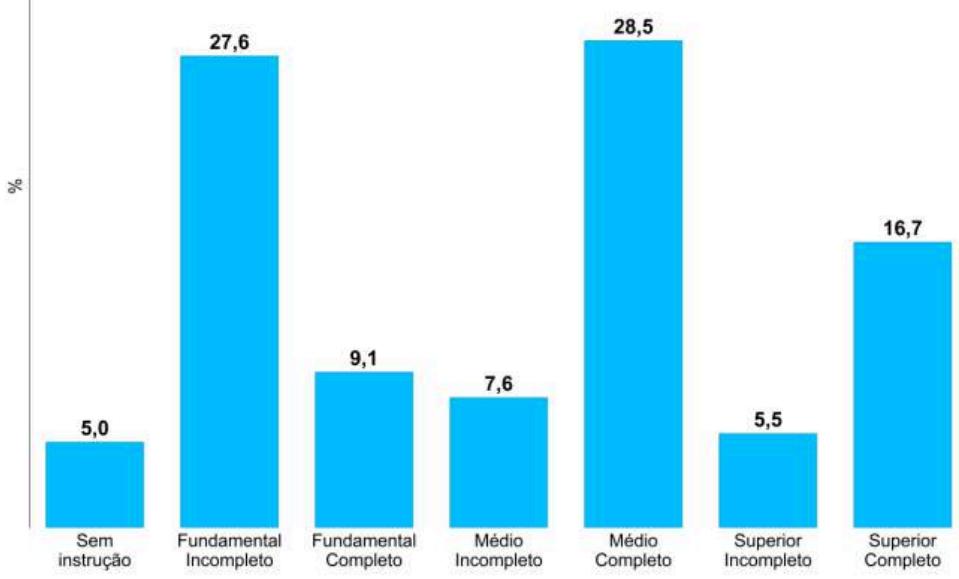
A fim de apresentar um perfil do trabalhador brasileiro em vista de identificar os sujeitos da EJA em seu conjunto, recorre-se neste estudo, à Pesquisa Nacional por Amostra de Domicílio – PNAD do Instituto Brasileiro de Geografia e Estatística – IBGE de 2021. O gráfico 01 apresenta a distribuição dos grupos etários em idade ativa por nível de instrução a partir dos 14 anos.
{"image_source":{"path":"images/450c61500e910ec17f257cf49b12bc3380459fb0632c82f1e5b9f8b052ac4b6b.jpg"},"content":"","chart_caption":[{"type":"text","content":"Gráfico 1: Distribuição percentual das pessoas com 14 anos ou mais de idade por nível de instrução no Brasil – 2021"}],"chart_footnote":[]}
De acordo com a pesquisa, entre as pessoas em idade de trabalhar, portanto, a partir dos 14 anos de idade, 5% afirmavam que não possuíam qualquer nível de instrução formal, 32,6% declararam que não tinham concluído o ensino fundamental, 49,3% não haviam concluído o ensino médio e apenas 28,5% haviam concluído a esta etapa, e, portanto, a educação básica. Um dado bastante interessante – mas nem por isto surpreendente da pesquisa, no que diz respeito à relação ocupação versus taxa de escolarização é que o levantamento aponta que, da totalidade dos que se declararam ocupados, 21,7% possuíam o ensino fundamental completo, 64,6% o ensino médio completo e 24,5% o ensino superior completo, contrastando claramente com o explicitado no gráfico 1, que em suma aponta para o perfil socioeconômico e cultural do público da EJA.
Em relação ao recorte étnico-racial, a PNAD (IBGE, 2021), identificou que 176,9 milhões de pessoas em idade de trabalhar, dentre os quais, 44,8% se declararam de cor parda, 45% de cor branca e 9% de cor preta. Segundo o estudo, "(...) no 1o trimestre de 2021, 56,8% da população em idade de trabalhar estava na força de trabalho (taxa de participação). Deste contingente, 85,3% se encontravam ocupados e 14,7% desocupados (p. 11).
O supracitado estudo revela ainda o aprofundamento das desigualdades entre os principais grandes grupos étnicos que compõem a população em idade ativa, mas que por sua vez engrossam as fileiras dos desocupados no país entre os anos de 2012 e 2021. Havia no 1o trimestre de 2012 uma estimativa de 7,6 milhões de pessoas desocupadas no país, sendo que 59,1% era composto por pardos e pretos e 40,2% por brancos. No 1o trimestre de 2021, o contingente de desocupados do país saltou para 14,8 milhões de pessoas, sendo que a participação dos pardos e pretos aumentou para 63,1% enquanto a dos brancos reduziu para 36,3%.
A compreensão da reversão dos avanços sociais no Brasil – sabidamente um dos países de maior concentração de renda do mundo, sobretudo a partir do golpe parlamentar-empresarial de 2016 deve ser entendida a partir de uma perspectiva crítica. A nossa perspectiva é a do materialismo histórico-dialético, que pressupõe, conforme Pereira (2021), retomar os pressupostos analíticos do pensamento de Francisco de Oliveira em seu clássico "A da dependência imperfeita".
Distintamente de outras correntes de pensamento como os neoclássicos e estruturalistas que acreditavam que de modo ou outro (liberalização ou intervenção) era possível alcançar o pleno desenvolvimento de um país periférico como o Brasil, Oliveira (1984) nos mostra que nos diversos estágios de desenvolvimento, desde a passagem do que ele denomina como modo de produção escravista colonial para o modo de produção de mercadorias – que vai mais ou menos dos anos 1840 a 1930, até chegar ao capitalismo industrial brasileiro, a economia nacional foi marcada por duas características complementares: 1a – a redução constante dos custos de reprodução da força de trabalho e, 2o - a importação de ciência e tecnologia, inclusive financiada com capital externo, seja inglês sob hegemonia britânica do século XIX ou dos EUA no século XX.
Desse modo o processo de industrialização por substituição de importações, que inclusive, colocado em xeque após o processo de abertura de modo subordinado do país na ordem globalizada e na nova ordem internacional do trabalho, assinala um processo constante, em que pese não se tratar de um fenômeno especificamente brasileiro, contudo, no seu conjunto como diz Oliveira (1984), trata-se da recomposição dos processos de dependência de um país de capitalismo periférico e subordinado.
As diversas reformas realizadas no âmbito do Estado brasileiro no últimos anos, tais como reforma da previdência, independência do Banco Central, Reforma Trabalhista, o congelamento do gasto social por 20 anos através da Emenda Constitucional no 95 de 2016, a perspectiva de aprovação da Reforma Administrativa que traz consigo a lógica da privatização a partir de dentro e o estrangulamento dos serviços públicos e outro projeto em pauta no congresso como a cobrança de mensalidade em Universidades Federais, corroboram com precisão a perspectiva do referido autor, e aponta para o aprofundamento das desigualdades sociais, da concentração de renda, e, portanto, com efeitos previsíveis para grandes parcelas excluídas dos bens sociais e culturais no nosso país.
II. OS SUJEITOS DA EJA NO INSTITUTO FEDERAL DE GOIÁS
A pesquisa realizada pelo Observatório do Estado Social Brasileiro em parceria com o Observatório do Mundo do Trabalho/IFG, buscou traçar o perfil socioeconômico e cultural dos discentes atendidos em cada uma das instituições onde o estudo foi realizado. Conforme já assinalado anteriormente, este capítulo visa apresentar os dados relativos aos estudantes matriculados nos cursos da modalidade Educação de Jovens e Adultos até o segundo semestre de 2021.
Para delinear o perfil socioeconômico e cultural dos discentes da EJA-EPT no IFG, foram considerados os seguintes atributos: gênero, recorte étnico, estado civil, número de crianças e/ou dependentes/ condições de trabalho/ocupação, nível de rendimento, ocupação/rendimentos durante a Pandemia da Covid19 e condições de moradia. O gráfico 2 apresenta o perfil de gênero dos discentes.
{"image_source":{"path":"images/61e9782545e7546b2e5a0ff5d90392b015302aebe1777a89275c7f84c5a2b012.jpg"},"content":"","chart_caption":[{"type":"text","content":"Fonte: elaboração deste estudo com dados do OESB/OMT-IFG"}],"chart_footnote":[]}
Gráfico 2: Gênero dos discentes da EJA-EPT/IFG
O gráfico 02 apresenta um dado bastante relevante para pensar as ofertas da EJA-EPT no IFG. Deve-se considerar que a amostra da pesquisa alcançou o número muito significativo de cursos espalhados em todas as regiões do Estado de Goiás, evidenciando, portanto, que aproximadamente 80% do público da modalidade na instituição é constituído por mulheres. Uma consulta aos microdados do INEP através do Laboratório de Dados Educacionais referentes ao ano de 2020, aponta que havia 22.473 matrículas para o sexo masculino e 20.414 para o sexo feminino.
Esse dado pode indicar que a possibilidade de elevação de escolarização articulada com a profissionalização via currículo integrado tem se constituído em grande atrativo para o público feminino outrora preterido dos espaços formais de escolarização. É importante ressaltar, conforme consta no quadro 01, que esse fenômeno ocorre a despeito da oferta de muitos cursos que historicamente estão associados ao exercício de ocupações masculinas, a exemplo dos cursos de Eletrotécnica e Refrigeração. O gráfico 3 apresenta a composição étnica dos estudantes da EJA-EPT no IFG.
{"image_source":{"path":"images/a2076eb3c7df31b26d4853ecae7326c9baf8834619aa5637825c714853ae8078.jpg"},"content":"","chart_caption":[{"type":"text","content":"Fonte: elaboração deste estudo com dados do OESB/OMT-IFG"},{"type":"text","content":"Gráfico 3: Composição étnica dos discentes da EJA-EPT/IFG"}],"chart_footnote":[]}
O gráfico 3 evidencia uma realidade que não destoa da lógica da sociedade brasileira, na qual os excluídos da escolarização na idade de direito são maioria de não brancos. No IFG, conforme demonstrado no gráfico acima os pretos e pardos somam 68,4% do total dos estudantes. Em termos comparativos, no Estado de Goiás, para o ano de 2020, segundo o Laboratório de Dados Educacionais, estavam matriculados 11.909 pretos e pardos e 2.744 pessoas de cor branca. O gráfico 4 apresenta o estado civil dos discentes da EJA-EPT do IFG.
{"image_source":{"path":"images/cf943987c4b387602338c0d119edb809abda820f79daeafd10420c247044e06e.jpg"},"content":"","chart_caption":[{"type":"text","content":"Fonte: elaboração deste estudo com dados do OESB/OMT-IFG"},{"type":"text","content":"Gráfico 4: Estado civil dos/as discentes da EJA-EPT/IFG"}],"chart_footnote":[]}
De acordo com o gráfico 4, a maioria do público da EJA-EPT no IFG é formada por pessoas solteiras, 44,4%, seguido pelos casados com 40,2% e pelos divorciados com 10,9%. A questão seguinte está diretamente relacionada com o status conjugal do discente para efeitos na sua vida escolar tanto pregressa quanto atual, ou seja, se tem ou não filhos. O gráfico 5, portanto, inquire o discente a respeito de filhos.
{"image_source":{"path":"images/333e51de30ef41495a9c8a3e5121ae473336a3da4514e09a38d5a6706361557d.jpg"},"content":"","chart_caption":[{"type":"text","content":"Fonte: elaboração deste estudo com dados do OESB/OMT-IFG"}],"chart_footnote":[]}
Gráfico 5: Possui filhos?
Os dados informados nos gráficos 4 e 5 nos indicam uma aproximação com a realidade complexa da Educação Jovens e Adultos. A maioria são mulheres, mães e solteiras. Na literatura científica da área da EJA e no cotidiano dos professores da modalidade, é lugar-comum encontrar mulheres que tiveram que abandonar a escola muito cedo por conta de uma gravidez precoce. Muitas dessas mulheres precisaram primeiro criar e educar seus filhos para depois retornarem aos espaços escolares. Evidentemente, que não se estamos aqui culpabilizando as mulheres pelas dificuldades na continuidade da sua formação escolar, mas sim as lacunas deixadas pelas ausências de políticas públicas que inclusive poderiam – caso fossem implementadas, evitar o fenômeno da juvenilização da EJA. O gráfico 6, trata da quantidade de crianças de até 12 anos que moram na mesma residência do discente da EJA-EPT do IFG.
{"image_source":{"path":"images/3d56bad25151e8a148fd4f2e4d9a94543e201c2c2368577987671e61f844ad57.jpg"},"content":"","chart_caption":[{"type":"text","content":"Fonte: elaboração deste estudo com dados do OESB/OMT-IFG"},{"type":"text","content":"Gráfico 6: Quantidade de crianças de até 12 anos na mesma residência"}],"chart_footnote":[]} As taxas apresentadas no gráfico 6, indicam que 36,8% do público pesquisado convivia com 1 criança de até 12 anos na residência, se somarmos aos 14,2% que declararam possuir 2 crianças nessa faixa etária convivendo na residência, tem-se, portanto, um total de 51% de até 2 duas crianças por residência do/a estudante da EJA/EPT do IFG. Por outro lado 40,6%, declararam não haver nenhuma criança vivendo no mesmo domicílio. Tal fato deve precisamente se relacionar as faixas etárias mais maduras da EJA-EPT, uma vez que as turmas são compostas por faixas etárias muito heterogêneas, muitas vezes comportando desde jovens de vinte (20) anos até idosos e idosas de sessenta ou setenta anos de idade. O gráfico 7 apresenta a totalidade de pessoas que vivem no mesmo domicílio do estudante da EJA-EPT do IFG.
{"image_source":{"path":"images/0ba3421e694f02e4e7d654e33212310d8b922ff6eba0c569fc84204390262f19.jpg"},"content":"","chart_caption":[{"type":"text","content":"Fonte: elaboração deste estudo com dados do OESB/OMT-IFG"}],"chart_footnote":[]}
Gráfico 7: Número de residentes no domicílio do discente
Como tudo que diz respeito à EJA tende a heterogeneidade, assim também se dá a composição do perfil familiar. 15,9% dos pesquisados declararam que suas famílias são compostas por 5 pessoas. 27,3% por 4 pessoas e 27,7 por 3 pessoas. Fora da curva, apenas 4,9 por cento dos pesquisados declararam possuir famílias com 7 membros ou mais. De qualquer modo, 70,9% dos pesquisados declararam ter famílias formadas em média por 4 pessoas. Esse indicador terá um impacto importante na análise da renda, que será objeto de análise posterior. O gráfico 8 apresenta a situação de moradia do discente da EJA-EPT quanto ao tipo vínculo/posse do imóvel.
{"image_source":{"path":"images/3af349a7571905831901f484d1d33fb6cc16e8bb9d971dc0185b314a701e5a4f.jpg"},"content":"","chart_caption":[{"type":"text","content":"Fonte: elaboração deste estudo com dados do OESB/OMT-IFG"},{"type":"text","content":"Gráfico 8: Tipo de vínculo/posse do imóvel dos discentes da EJA-EPT/IFG"}],"chart_footnote":[]}
Observa-se a partir do gráfico 8, que há uma diversidade de tipo de vínculos do discente residente com imóvel no qual vive com sua família. É bastante relevante para análise do perfil socioeconômico dessa imensa fração da sociedade, observar que apenas 1/3 residem em moradia própria. Quase um terço declarou viver como na condição de agregado em imóveis da família e 29,1% vivem em imóvel alugado por conta própria ou com a ajuda dos pais. O gráfico 9 apresenta a situação ocupacional do discente da EJA-EPT do IFG.
{"image_source":{"path":"images/72c5ac8e4590fd435dab6d1c84af69748f306c3dc4f7810b986f8b0f39c25f64.jpg"},"content":"","chart_caption":[{"type":"text","content":"Fonte: elaboração deste estudo com dados do OESB/OMT-IFG"}],"chart_footnote":[]}
Gráfico 9: Situação ocupacional do discente da EJA-EPT/IFG. Está trabalhando atualmente?
Ao analisar a realidade explicitada no gráfico acima, deve-se atentar para o fato de que a Pandemia da Covid19 impactou severamente o mundo do trabalho. Contudo, as altas taxas de desocupação ou desemprego ou ocupação em empregos precários são bem característicos do público da EJA, que se constitui-se numa fração expressiva da força de trabalho ociosa da sociedade por razões muito anteriores e alheias à atual crise sanitária. O gráfico 10 apresenta o rendimento das famílias que residem nos domicílios dos discentes pesquisados no estudo.
{"image_source":{"path":"images/736165b0fe032d00f26ac23c15904fdc9a920cf6689b04e9178597419c3b8cb0.jpg"},"content":"","chart_caption":[{"type":"text","content":"Fonte: elaboração deste estudo com dados do OESB/OMT-IFG"}],"chart_footnote":[]}
Gráfico 10: Valor aproximado da renda das pessoas que vivem na mesma casa
Os números apresentados no gráfico 10 expõem com a mais absoluta clareza o real concreto, a desigualdade social que grassa as maiorias excluídas dos direitos sociais no Brasil e que desse modo se constitui no público da Educação de Jovens e Adultos. Conforme se pode observar, nada menos que 48,3% das famílias sobre (vivem) com até 1 salário-mínimo por mês. Outros 34,3% vivem com entre 1 e 2 salários-mínimos mensalmente. São nada menos que 82,6% dos discentes pesquisados – cuja maioria das famílias são formadas por até 4 pessoas (71%), vivem com até 2 salários mínimos mensalmente.
Em síntese, tem-se que o estudante da Educação de Jovens e Adultos do IFG no contexto da Pandemia da Covid19 apresenta o seguinte perfil: é mulher, mãe, solteira, negra ou parda, empregada ou subempregada, com rendimento máximo de até 2 salários mínimos e com até 4 pessoas para alimentar no seu domicílio, vivendo como inquilina ou agregada da família.
III. A PANDEMIA DA COVID19: NOVOS DESAFIOS PARA PERMANÊNCIA E ÉXITO NA EJA-EPT NO IFG
Conforme já assinalado na introdução deste capítulo, havia já anteriormente ao advento da crise sanitária da Covid19 uma realidade complexa, determinada pelas estruturas socioeconômicas e políticas da sociedade capitalista brasileira, que se constituía em enormes dificuldades para a permanência e o êxito dos educandos da EJA. Há uma vasta literatura analisando a questão da permanência e do êxito na EJA e na EJA-EPT. No último caso, inclusive convém citar o estudo de Pereira (2011) realizado na EJA-EPT do IFG, quando esses cursos ainda eram denominados como Proeja, o qual apresenta uma série de apontamentos a respeito das dificuldades enfrentadas no cotidiano dos educandos em vista do acesso, permanência e êxito na escola.
Todavia, não bastasse todos os retrocessos das políticas sociais, com impactos severos no campo da educação, que o país vem amargando desde o golpe parlamentar-empresarial de 2016, cujos impactos se fizeram sentir de modo agudo na redução drástica do financiamento da educação – com impactos por exemplo na assistência estudantil, eis que surge no horizonte a crise sanitária da Covid19, de proporções mundiais, que determinou de modo brusco o encerramento temporário das atividades e a subsequente criação de soluções para retomada as atividades educacionais em vista de um cenário de uma crise foi se estabelecendo e forçando a elaboração do que no Instituto Federal de Goiás ficou denominado através da Instrução normativa no 07 de 17 de agosto de 2020 (IFG, 2020) como Sistema de Ensino Emergencial – SEE, mas que foi se estabelecendo na quotidiano institucional como Ensino Remoto Emergencial (ERE).
No capítulo III do supracitado documento institucional, são elencados os seus princípios norteadores:
I – Defesa e preservação da saúde física e mental dos (as) discentes, dos (as) servidores e dos funcionários terceirizados; II – Promoção de ações contextualizadas ao cenário de emergência sanitária que possibilitem a permanência e êxito dos alunos; III – Garantia e manutenção da qualidade das atividades acadêmicas voltadas para o desenvolvimento de uma formação integrada e humanizadora que integre a formação histórico-crítica e a formação técnico-científica; IV – Garantia de uma educação inclusiva e de qualidade socialmente referenciada, a partir dos princípios da Constituição Federal, da LDB 9394/96 e dos documentos institucionais do IFG; V – Garantia de acesso aos recursos tecnológicos a toda comunidade acadêmica, que viabilize a participação no SEE, bem como a educação inclusiva e de qualidade socialmente referenciada; VI – Garantia das condições de aprendizado aos alunos com necessidades educacionais específicas; VII – Garantia de suporte e formação técnica e pedagógica continuados para o ensino remoto aos servidores e discentes; VIII – Garantia da isonomia, equidade, inclusão de condições de acesso e permanência ao Ensino Remoto Emergencial (ERE) enquanto perdurar o período de excepcionalidade; IX – Respeito aos princípios da gestão democrática, participativa e transparente no processo de discussão e definição quanto às atividades institucionais e retorno das atividades acadêmicas; X – Garantia e promoção da avaliação contínua e processual dos cenários sanitários com vistas ao restabelecimento da dinâmica pedagógica na modalidade presencial quando houver segurança à saúde da comunidade acadêmica; XI – Garantia e promoção da avaliação contínua e processual da dinâmica didático-pedagógica do Sistema de Ensino Emergencial; XII – Salvaguarda e defesa dos direitos trabalhistas dos servidores, de forma a evitar a precarização de suas condições de trabalho; Garantia da autonomia institucional; XIII – Defesa da manutenção dos princípios e objetivos formativos presentes nos Projetos Pedagógicos de Cursos quando do processo de planejamento das ações para implementação do SEE, estando essas ações restritas ao tratamento dos motivos que a suscitaram, bem como delimitadas quanto aos seus efeitos, sendo mantidas apenas enquanto a situação extraordinária que justificou a exceção vigorar; XIV – Respeito à diversidade de contextos educacionais de cada Câmpus, resguardando, ainda, as particularidades dos cursos e eixos tecnológicos. (IFG, 2020, p. 2-3).
Em que pese a observância dos princípios norteadores explicitados acima – que se resulta, evidentemente do fato de se tratar de uma Instituição pública com acúmulos históricos na defesa de uma educação de qualidade socialmente referenciada, do respeito aos direitos individuais e coletivos, deve-se atentar para o fato de que se trata da uma adoção de um modelo de ensino-aprendizagem – ainda que "emergencial", que vai de encontro a uma realidade socioeconômica (vide perfil do discentes anteriormente explicitado) e cultural, sobretudo no caso específico do público da EJA-EPT, com potencial arrasador tanto nos indicadores de permanência quanto de êxito escolar.
O artigo 7o da Instrução Normativa no 07/2020, tratou de conceituar o Sistema de Ensino Emergencial, segundo a qual, "(...) é o conjunto de procedimentos pedagógicos, didáticos e acadêmicos, presenciais e/ou remoto, síncronos e assíncronos, por meio ou não das tecnologias digitais da informação e da comunicação (TDICs), em circunstâncias específicas, desde que atendidos os procedimentos postos nesta instrução" (IFG, 2020, p. 3). Com isso verificou-se um processo inédito de flexibilização dos processos didático-pedagógicos, de modo a minimizar as perdas provocadas pelo isolamento social imposto pela crise sanitária.
A referida instrução normativa, regulamentou, portanto, os modos de funcionamento do SEE, a partir de dois tempos distintos no que diz respeito aos tempos dos do trabalho com os discentes. O tempo síncrono, por meio da utilização de ferramentas como o Google Meet, no qual a comunicação ocorre de modo bidirecional e em tempo real. Neste caso, independente do quantitativo de aulas de cada disciplina prevista por semana no modelo convencional, o docente teria o tempo máximo de 60 minutos de trabalho. O tempo assíncrono, o qual se desenvolve por meio de ferramentas como a exemplo do Moodle, as atividades podem ocorrer em tempos diferentes entre docentes e discentes, embora os docentes tenham a autonomia para o estabelecimento de finalização e entrega de atividades nas plataformas ou aplicativos do tipo assíncronos. Tem-se, portanto, que a maior parte da carga horária prevista no currículo de todos os cursos analisados, foram realizadas através do tempo e das ferramentas assíncronas.
O levantamento realizado pelo Observatório do Estado Social Brasileiro em parceria com o Observatório do Mundo do Trabalho/IFG, cujos dados analisamos neste trabalho, buscou então apreender empiricamente as diferentes variáveis que apresentam elevado potencial de impacto no ensino-aprendizagem e, portanto, na permanência e êxito dos estudantes durante a vigência do Sistema de Ensino Emergencial. Apresentaremos na sequência as variáveis ligadas às questões da própria infecção pela Covid19, de infraestrutura, da recepção pelos discentes do SEE, e por último a avaliação pelos discentes do processo de desenvolvimento das atividades de ensino-aprendizagem sob o regime do Ensino Remoto Emergencial. O gráfico 11, apresenta o percentual de diagnósticos da doença nos domicílios do total da amostra de discentes pesquisados no estudo.
{"image_source":{"path":"images/e3607fd1f836f8fb3e13f8b60337483751918ed97dea93cc13b6077e1908f1da.jpg"},"content":"","chart_caption":[{"type":"text","content":"Fonte: elaboração deste estudo com dados do OESB/OMT-IFG"},{"type":"text","content":"Gráfico 11: Percentual de domicílios de discentes da EJA-EPT do IFG com diagnósticos de COVID-19 até setembro de 2021"}],"chart_footnote":[]}
A comparação dos percentuais indicados no gráfico 11 com os dados oficiais divulgados pelo Boletim Epidemiológico Covid19 no 70 de 10/09/2021 da Secretaria de Saúde do Estado de Goiás, apontam para um panorama muito de muito contraste, neste caso desfavorável aos domicílios de estudantes da EJA-EPT do IFG. Para corroborar a nossa análise, reproduzimos abaixo a tabela disponibilizada no referido boletim, que por sua vez reproduz os dados dos Sistema Único de Saúde – SUS.
Tabela 1: Casos confirmados de COVID-19 segundo evolução, Goiás, 04 de fevereiro de 2020 a 04 de setembro de 2021 FONTE: e-SUS Notifica e SIVEP Gripe
| N=827.487 | ||
| Evolução | n | % |
| Recuperados (Cura) $^{2}$ | 792.563 | 95,8 |
| Em acompanhamento $^{3}$ | 9.881 | 1,2 |
| Óbito | 22.710 | 2,7 |
| Ignorado | 2.333 | 0,3 |
| Total | 827.487 | 100,0 |
Conforme se percebe na tabela 1, até a data do levantamento, menos de 12% da população goiana havia oficialmente sido alcançada pelo vírus da Covid 19, enquanto nos domicílios de estudantes da EJA-EPT do IFG este percentual quase chega aos 40%. Podemos então aventar duas hipóteses que nos parecem bastante críveis e convergentes: a primeira diz respeito ao alto índice de subnotificação da doença no sistema oficial de
Fonte: reprodução (SES, GO, 2021)
saúde, que estava relacionado diretamente à política negacionista liderada pelo Governo Federal. A segunda diz respeito ao fato de que nos lares das famílias mais pobres, as condições de moradia tendem a dificultar o isolamento e demais cuidados para de higiene para evitar o contágio pelo vírus. Há ainda, outro dado digno de nota, conforme podemos observar no gráfico 12, que diz respeito ao recorte étnico da infecção.
{"image_source":{"path":"images/aaed9103f9e1619e96d0ef25a4be4177da1db645cad9620b63837b10438253fa.jpg"},"content":"","chart_caption":[{"type":"text","content":"Fonte: reprodução (SES, GO, 2021)"}],"chart_footnote":[]}
Gráfico 12: Diagnósticos de Covid19 em Goiás de 04 de fevereiro de 2020 a 04 de setembro de 2020 por grupos étnicos
Conforme se observa no gráfico 12, a maior parte da população com diagnóstico de Covid19 em Goiás, é formada precisamente por pretos e pardos enquanto os brancos respondem por apenas 20,96% do total. Parece-nos, que aqui possa haver algum nível de relação entre o pertencimento a determinado grupo étnico, no caso pretos e pardos, que conforme demonstramos no gráfico 3, constituem quase 70% da população pesquisada, ou seja, discentes da EJA-EPT. Sendo o público da EJA-EPT, formado majoritariamente por pretos e pardos, com as condições socioeconômicas já delineadas neste estudo, não nos parece estranho que seja essa a fração mais potencialmente vitimada pelos impactos da Covid19, o que evidentemente apresentou e continuará a apresentar por tempo indeterminado, efeito deletérios para a permanência o êxito desses educandos na modalidade EJA-EPT. O gráfico 13 apresenta os dados referentes ao ambiente no qual o discente assistia às aulas sob o regime do SEE.
{"image_source":{"path":"images/1c9b9de087438aebf3978290f6dc283eb91ea60fbb5dae97b58f8270a8d94b4d.jpg"},"content":"","chart_caption":[{"type":"text","content":"Fonte: elaboração deste estudo com dados do OESB/OMT-IFG"},{"type":"text","content":"Gráfico 13: Ambiente onde o discente da EJA-EPT/IFG assiste as aulas remotas"}],"chart_footnote":[]}
Observa-se, portanto, no gráfico acima que a quase totalidade dos discentes assistia às aulas diretamente da sua residência, o que implica necessariamente compreendermos sob quais condições este ambiente domiciliar estava organizado para o atendimento das exigências necessárias por exemplo para a concentração do educando, dentre outros fatores que serão destacados mais à frente. Por enquanto analisemos o gráfico 14, que demonstra em qual espaço do domicílio o estudante se acomodava para assistir ou participar das aulas remotas.
{"image_source":{"path":"images/eccc4d9883b450f6947cfe352433b2ac4fc54c999f948f633e733e9beea19cfd.jpg"},"content":"","chart_caption":[{"type":"text","content":"Fonte: elaboração deste estudo com dados do OESB/OMT-IFG"}],"chart_footnote":[]}
Gráfico 14: Ambiente do domicílio no qual o discente assistia às aulas remotas
O gráfico 14 nos aponta para uma realidade na qual 53,6% dos estudantes da EJA-EPT do IFG precisavam utilizar espaços compartilhados para assistir e quando possível participar de modo ativo das aulas remotas. Tal situação se torna extremamente problemática quando observamos o gráfico 7, segundo o qual em 70,9% dos domicílios havia uma média de 4 pessoas, das quais 2 eram crianças de até 12 anos compondo o núcleo familiar da residência. Infere-se, portanto, a ocorrência de determinados níveis de dificuldades de concentração, exigência básica para o processo de aprendizagem dos educandos.
O gráfico 15 a seguir, trata especificamente dos ruídos ou demandas surgidas no ambiente onde o estudante assiste e/ou participa das aulas pelo SEE.
{"image_source":{"path":"images/de69498953f5ee085504c39e023792ae94278db7b9ec59e443e807c236290c3c.jpg"},"content":"","chart_caption":[{"type":"text","content":"Fonte: elaboração deste estudo com dados do OESB/OMT-IFG"},{"type":"text","content":"Gráfico 15: Intervenções externas que impactam na atenção do estudante durante as aulas remotas, tais como ruídos e demandas de filhos entre outros"}],"chart_footnote":[]}
De acordo com o gráfico 15, 53% dos respondentes declararam sofrer interferências de ruídos ou demandas de filhos ou outras pessoas da residência durante os encontros síncronos, sendo que destes 35,6 tais interrupções ocorriam com muita frequência, praticamente todos os dias. Apenas 25,7% da população pesquisada declarou não sofrer com esse tipo de interferência. Os dados até aqui analisados já nos permitem inferir um nível considerável de comprometimento das condições requeridas para o adequado acompanhamento, tendo em vista o bom rendimento em nível de aprendizagem e aquisição do conhecimento por parte do educando da EJA-EPT no IFG. Contudo, outros fatores de ordem infraestrutural podem ser agregados a essa complexa realidade em que se constituiu o SEE na instituição analisada neste estudo. O gráfico 16 apresenta o tipo de equipamento computacional utilizado pelo estudante da EJA-EPT/IFG para assistir e/ou participar das aulas remotas.
{"image_source":{"path":"images/4836e04c9c09512b2bad768e5a194213f18951fdd084d914a68c954221f48c47.jpg"},"content":"","chart_caption":[{"type":"text","content":"Fonte: elaboração deste estudo com dados do OESB/OMT-IFG"}],"chart_footnote":[]}
Gráfico 16: Tipo de equipamento utilizado para assistir aulas remotas
Verifica-se no gráfico 16 que dentre os tipos de equipamentos utilizados pelo discentes para estudos por meio do SEE, se destaca o uso do celular (smartphone) por 44,7% dos respondentes. O dado em si já se apresenta de modo problemático, uma vez que o tamanho da tela desse tipo equipamento não permite melhores possibilidades de acessibilidade, tais como visualização satisfatória das telas de ferramentas de aulas síncronas a exemplo do Google Meet.
Também dificulta enormemente o uso da principal ferramenta assíncrona utilizada pela instituição no Ensino Remoto Emergencial – o Moddle. Não se deve ignorar a heterogeneidade, como fator identitário das turmas de EJA, o que significa dizer que frações expressivas das turmas são compostas por pessoas com muita dificuldade de uso das TICs, além dos problemas de visão causados pelo avanço da idade. Nesse sentido, em que pese as altas taxas de analfabetismo digital {"image_source":{"path":"images/d8c67b97006348381156a9b8c6ddc72939b723be46f832238f8d369a94fc67b9.jpg"},"content":"","chart_caption":[],"chart_footnote":[]}
{"image_source":{"path":"images/3aa997900e5f9e4c618a7380d01c831eff4bfe4205a58e775d2886bf5de36e1e.jpg"},"content":"","chart_caption":[],"chart_footnote":[]} existentes, sobretudo nos grupos de meia idade para cima, é de se esperar que o uso de notebooks e desktops sejam mais apropriados, tanto pelo tamanho das telas, quando pelo uso do teclado físico e do mouse para uso do cursor que movimenta os elementos que compõem os aplicativos. O levantamento também avançou no sentido de identificar o peso da assistência da Instituição em relação aos discentes que não possuíam os equipamentos, conforme demonstra o gráfico 17.
{"image_source":{"path":"images/06bd740a0acafd66daf7264044d01cca356d127483209c9426de105a794da218.jpg"},"content":"","chart_caption":[{"type":"text","content":"Fonte: elaboração deste estudo com dados do OESB/OMT-IFG"}],"chart_footnote":[]}
Gráfico 17: A quem pertence o equipamento utilizado no SEE
Segundo o gráfico 17, 50,4% dos discentes pesquisados, possuíam equipamentos próprios de uso individual. Os demais que constituem praticamente metade do levantamento ou usava equipamento emprestado de terceiro para uso compartilhado, caso de 4,5%, ou utilizava equipamento próprio de uso compartilhado – 9,8%, ou no caso mais expressivo com 35% de respondentes, os quais utilizava equipamento emprestado pela Instituição de Ensino. Este último dado, tem relevância no contexto deste estudo, uma vez que mais de 1/3 dos estudantes da EJA/EPT no IFG provavelmente seriam excluídos sumariamente do acesso ao processo de ensino e aprendizagem na Instituição durante o período de isolamento social provocado pelas altas taxas de transmissão do novo coronavírus. Destaca-se aqui a importância do papel da assistência da Instituição em vista de minimizar um quadro tão dramático de evasão escolar, conforme estabelecido na Instrução Normativa no 07/2020.
Na sequência analisaremos categorias nas quais estão implícitas questões que mesclam condições infraestrutura com outras de ordens mais subjetivas e/ou culturais, que na nossa avaliação apresenta importantes impactos no processo de ensino e aprendizagem. O gráfico 18 trata sobre a frequência de uso da câmera nos encontros síncronos durante o Ensino Remoto Emergencial.
- Não tenho câmera no meu equipamento
- Raramente abro minha câmera
- Em algumas aulas abro minha câmera
- Abro minha câmera apenas em ocas...
- Nunca abro minha câmera
- Abro minha câmera em todas as aulas
- Abro minha câmera na maioria das v...
- Prefiro não prefiro não responder
- Prefiro não responder
Gráfico 18: Frequência de abertura da câmera no encontro síncronos
De cordo com o gráfico 18, nada menos que 87,3% dos discentes da EJA-EPT do IFG declararam não ter o hábito de abrir suas câmeras durante os momentos síncronos. Destes, 22,6% afirmaram não dispor do dispositivo no equipamento computacional de transmissão das aulas. 12, 8% desse recorte afirmaram que só o fazem quando o docente impõe a abertura da câmera como algo obrigatório. Apenas 5% declararam abrir a câmera durante todos os encontros síncronos. Este último dado foi bem perceptível para os professores, constantemente mencionaram as dificuldades de interação durante os momentos síncronos, sendo que na maioria deles, um ou no máximo dois discentes ficavam de fato com suas câmeras abertas. O gráfico 19, busca apreender as razões explicativas para tais dificuldades de interação com imagem por parte dos discentes.
{"image_source":{"path":"images/55cd1e8cf3fd345210ae5e54918929454f30949c75b6091447ddfc68f80cb247.jpg"},"content":"","chart_caption":[],"chart_footnote":[]} {"image_source":{"path":"images/53d0497d6040ff69ba8c379417ec9e2636f5a1d7667957914ccaffd243d032fa.jpg"},"content":"","chart_caption":[{"type":"text","content":"Fonte: elaboração deste estudo com dados do OESB/OMT-IFG"}],"chart_footnote":[]}
Gráfico 19: Motivo para não abertura ou abertura com pouca frequência da câmera nos encontros síncronos
Conforme demonstrado no gráfico 19, são várias as razões alegadas para a não abertura da câmera durante as transmissões das aulas. 39,2% afirmaram que não o faziam por questões de limitações infraestruturais, ou pode estar relacionado por exemplo a fatores ambientais já analisados, conforme visto no gráfico 15, no qual mais da metade dos pesquisados declararam sofrer com intervenções externas, inclusive pelo uso de ambientes compartilhados e demandas de crianças do domicílio, mas também pode-se especular que os pacotes de dados limitados de transmissão, conforme muitos alegavam nos encontros síncronos, se constituíam em obstáculo à uma participação mais interativa. O percentual agregado de 29,8% dos pesquisados declararam que abriam suas câmeras pelo fato de que os demais também não abriam – 18%, e não concordavam com e exposição no ambiente privado – 11,8%. 20% dos discentes preferiram não responder e 8,2% alegaram questões diversas.
Sejam quais forem as razões, de infraestrutura, subjetiva ou cultural, o fato é que os dados acima explicitados corroboram a nossa experiência no SEE, no qual o professor via de regra se deparava com uma tela do Google Meet com dezenas de ícones representando um discente da EJA, as vezes apenas supostamente presente na sala virtual, uma vez que ao fechar o as câmeras e o microfone, resta apenas a área de chat da sala para eventuais manifestações, podendo o estudante estar envolvido em outras atividades ao mesmo tempo em que consta como presente na aula virtual. Tem-se, portanto, que os prejuízos nos processos de ensino e aprendizagem são incalculáveis.
Passamos então a analisar como os estudantes da EJA-EPT do IFG, avaliaram os processos de desenvolvimento do Ensino Remoto Emergencial na Instituição. O gráfico 20 apresenta a percepção dos discentes acerca da quantidade e da duração das aulas síncronas.
{"image_source":{"path":"images/796b9c2ddd16f816d6a1faced5f2d774f57ff1ceb3b35b2ceb4d851ae8b06a58.jpg"},"content":"","chart_caption":[{"type":"text","content":"Fonte: elaboração deste estudo com dados do OESB/OMT-IFG"},{"type":"text","content":"Gráfico 20: Percepção dos discentes sobre a quantidade e a duração das aulas síncronas"}],"chart_footnote":[]}
Segundo o gráfico 20, quase metade dos pesquisados – 49,8%, avaliaram como suficientes para o adequado processo de aprendizagem dos conteúdos propostos. Porém, 32,8% dos estudantes indicaram como insuficientes a quantidade e a duração das aulas em vista dos conteúdos propostos. 14% dos pesquisados preferiram não responder. É possível especular, em que pese razões de ordem mais subjetiva – que fogem ao escopo do presente estudo, que parte dos declarantes que afirmaram pela suficiência da quantidade e duração dos encontros, acabaram por se conformar ou adaptar de algum modo ao Ensino Remoto Emergencial, inclusive pelas eventuais conveniências relacionadas por exemplo a questão como a não necessidade do uso do caótico transporte público, sobretudo na Região Metropolitana de Goiânia. O gráfico 21 trata da avaliação pelos discentes das atividades assíncronas.
{"image_source":{"path":"images/d2ce2b5a66fa8e5beb504c35a584ed30783dd7fe1648cb6ba7521aa7b3178654.jpg"},"content":"","chart_caption":[{"type":"text","content":"Fonte: elaboração deste estudo com dados do OESB/OMT-IFG"}],"chart_footnote":[]}
Gráfico 21: Percepção dos discentes sobre a quantidade de atividades assíncronas
Verifica-se no gráfico 21, que cerca de metade dos discentes – 50,2% consideravam a quantidade de atividades assíncronas. 23,8% consideraram excessivas e apenas 12,1% insuficientes. Deve-se ter claro que as atividades assíncronas são de natureza muito diversa daquela do tipo síncrona. São atividades orientadas pelos docentes em que os discentes terão determinado tempo para sua elaboração e entrega. A principal ferramenta assíncrona utilizada na Instituição, conforme já assinalado neste trabalho foi o Moodle, que inclusive na nossa avaliação apresenta grande potencial para o subsídio do trabalho docente para além da vigência do SEE. Ocorre, que o seu uso, sobretudo pelo público da EJA deve ser pensado a partir de uma realidade em que parte expressiva dos discentes não dispõe de equipamentos apropriados para suas diversas possibilidades de aplicações, mas também pelo próprio domínio da ferramenta em si, o que pode se constituir, e foi o que de fato se constatou – em grande frustração para o educando da EJA-EPT do IFG, que muitas vezes contando com a boa vontade de determinados docentes, encaminha {"image_source":{"path":"images/e630cac7979b685b6ea5bcbec24c41ccb25909e0c939de8854fca80b09f61e45.jpg"},"content":"","chart_caption":[{"type":"text","content":"Fonte: elaboração deste estudo com dados do OESB/OMT-IFG"},{"type":"text","content":"Gráfico 22: Percepção os discentes sobre o impacto do SEE na aprendizagem"}],"chart_footnote":[]}
Da totalidade dos pesquisados, segundo gráfico acima, 22,3% afirmaram que o SEE dificultou muito a aprendizagem dificultando que fossem atingidos muitos dos objetivos propostos. 7,2% declararam que o Ensino Remoto inviabilizou a aprendizagem dificultando que fossem atingidos a maior parte dos objetivos propostos. Para 45,7% da população pesquisada, o SEE prejudicou muito a aprendizagem, mas permitiu que fossem atingidos a maior parte dos objetivos propostos. Tem-se que, portanto, para 75,2% do total de discentes da EJA-EPT do IFG, houve prejuízos no alcance dos objetivos de aprendizagens anunciados nos planos de ensino das disciplinas. Apenas 16% dos pesquisados afirmaram que não houve prejuízos e outros 8,7% preferiram não opinar.
O gráfico 22 nos dá a dimensão do impacto da adoção do Ensino Remoto Emergencial na EJA-EPT do IFG sob o prisma dos próprios discentes, seguramente, enquanto pertencente a determinado segmento de classe social – os mais afetados sob todos os aspectos da crise sanitária provocada pelo novo coronavírus conforme corrobora este estudo, tanto do ponto de vista socioeconômico, mas também em relação diretamente à permanência e êxito na Instituição.
IV. CONSIDERAÇÕES FINAIS
Este estudo teve como objetivo analisar as condições de permanência e êxito dos estudantes da EJA-EPT do IFG no contexto da mais grave crise sanitária vivenciada nos últimos 100 anos, no Brasil e no mundo. As assimetrias sociais decorrentes de um modelo socioeconômico brasileiro que tem suas origens no modo de produção escravista colonial (Oliveira, 1984), revelam que em momentos de graves contingências como a que vivenciamos na Pandemia da Covid19, as classes subalternas, quase que totalmente desamparadas pelas políticas sociais do Estado, são as mais severamente afetadas pelos efeitos imediatos e de longo prazo tanto no aspecto direto sobre as questões sobre a saúde, alimentação, trabalho, mas também sobre a própria escolarização – objeto principal da presente análise.
Deve-se, antes de prosseguirmos, reiterarmos que os dados apresentados neste estudo, se constituem numa amostra significativa da EJA-
EPT no IFG, com 266 respondentes discentes, dentre os 1568 matriculados em todos os cursos da modalidade na Instituição em 2021, de acordo com a Plataforma Nilo Peçanha, do Ministério da Educação. O total de respondentes, envolvidos no estudo distribuídos em quase todos os campi e cursos da Instituição, conforme apontado no quadro 1, representa, portanto, 17% do público da modalidade no IFG, o que proporciona uma dimensão estatística bastante satisfatória para os propósitos da análise realizada.
Feitas as considerações de cunho metodológico, deve-se ressaltar que a adoção do SEE na Instituição, e suas implicações imediatas, mediatas e longo prazo da EJA-EPT, se justificavam num contexto de isolamento social determinado pelo alto nível de transmissão de um vírus, para cuja doença sequer ainda havia imunizante disponível no mercado. Portanto, o isolamento social e o fechamento das escolas se constituíam num imperativo de sobrevivência que antecede ao próprio direito à escolarização.
O conjunto dos dados analisados nestes estudos nos apresentam um panorama que converge de um lado o esforço institucional, para assegurar a permanência e o êxito do público da EJA-EPT, constituído por uma fração da sociedade marcada por uma história de exclusão do acesso aos bens materiais e culturais, conforme demonstrado no perfil socioeconômico delineado ao longo deste estudo. As estratégias institucionais, embora tenham sido relevantes para manter o vínculo de muitos estudantes da modalidade com o IFG foram, contudo, limitadas pelas frágeis políticas governamentais de assistência social e estudantil, não parecem ter sido suficientes para minimizar os efeitos deletérios resultantes da mudança emergencial do modo de oferta – do regular para o remoto, bem como das dinâmicas da própria crise sanitária.
De acordo com os dados da Plataforma Nilo Peçanha, no primeiro ano da crise sanitária, quando então foi adotado o Ensino Remoto Emergencial, o IFG possuía 1440 matrículas na EJA-EPT, dos quais 240 foram registrados como retidos, o que representa, portanto 14% de retenção em relação ao número total de matriculados. Porém ao percentual de retidos, somam-se 198 discentes evadidos. Somados os percentuais de retidos aos de evadidos chega-se ao total de 23% de insucesso escolar. Em 2021 as matrículas na modalidade EJA-EPT totalizaram 1568, com registro de 404 discentes retidos – 21%, e 125 estudantes evadidos. A soma dos percentuais de retidos e evadidos no referido ano equivale, portanto, a 26%, de taxa objetiva de insucesso escolar na EJA-EPT no IFG, com ligeiro avanço em 2021, em relação ao ano de 2020.
Convém registrar que os dados disponíveis na Plataforma Nilo Peçanha para os anos anteriores à Pandemia da Covid19, não são, todavia, mais auspiciosos que os observados durante a vigência do SEE. Ao contrário, em 2018 por exemplo, de 1347 matriculados na EJA-EPT no IFG, foi registrado 393 discentes evadidos, o que equivale a 23%, os quais somados aos 173 retidos nos mesmos anos, chegaria a 30% de insucesso escolar. Outro dado comparativo importante para fins deste estudo, é que durante a vigência do SEE, a média de retenção na Instituição em geral é muito superior à da EJA-EPT. Em 2020, dos 9383 matriculados em todas as modalidades, 27% ficaram retidos. Em 2021, dos 9479 estudantes matriculados, foram registradas 5617 retenções, portanto, muito acima de 50% do total de matriculados.
Deve-se, contudo, ponderar, em que pese as boas taxas de permanência registradas nos cursos de EJA-EPT no IFG – produto do esforço institucional, ou seja, de toda a comunidade escolar, que não se pode escamotear o fato de que o termo "êxito" neste estudo assume um caráter polissêmico e subjetivo. Primeiramente não se deve ignorar como exitoso o alcance dos índices de permanência/vínculo conforme indicado anteriormente, sobretudo num contexto de enormes contingências socioeconômicas e pedagógicas. Contudo, há que se considerar que durante a vigência do SEE, a Instrução Normativa no 07/2020 orientava que os processo avaliativos deveriam considerar preponderância dos aspectos qualitativos sobre os quantitativos. Tal orientação somada à flexibilização da maior parte das atividades para o modelo remoto assíncrono, num contexto de introdução forçada de um modelo de Ensino Remoto Emergencial, trouxe, conforme demonstrado no gráfico 22 enormes prejuízos de aprendizagens, chegando a alcançar 75% dos discentes da EJA-EPT no IFG.
Com isso é possível afirmar que a aprovação entendida enquanto êxito dos discentes, pode não se traduzir efetivamente em satisfatório rendimento escolar, portanto, em aprendizagem significativa, o que na nossa avaliação não necessariamente invalida o trabalho realizado pela Instituição em vista de assegurar as melhores condições de permanência e aprendizagem, sobretudo num contexto que até há pouco tempo poderia ser caracterizado como de ficção científica.
Conflict of Interest
The authors declare no conflict of interest.
Ethical Approval
Not applicable
Data Availability
The datasets used in this study are openly available at [repository link] and the source code is available on GitHub at [GitHub link].
Funding
This work did not receive any external funding.
References
Cite this article
Related Research



Special Issue
Launch a focused special issue to highlight research, emerging trends, and expert insights in your academic field.
