

IntelliPaper
Abstract
It was originally believed that only mass could create Black Holes. It is the purpose of this paper to prove that the charge from White Dwarf Stars creates the majority of Black Holes. Stars with mass below 1.44 Solar mass known as the Chandrasekhar Limit create White Dwarf Stars. Using the energy in charge, Energy = /(24 where n corresponds to the number of electrons, White Dwarfs are responsible for Solar Mass type or smaller Black Holes with charge. Stars bigger than 1.44 Solar Mass create bigger size Black Holes without charge such as those from Neutron Stars or those located at the center of a galaxy using the energy of mass, Energy = m . Since there are more stars smaller in size than the sun, a majority of charged Black Holes are created by White Dwarf Stars. We calculate the size of the Schwarzschild Radius of the White Dwarf as R = /(12 ) where n corresponds to the number of electrons drawn from the White Dwarf and sent into the Black Hole created. Only White Dwarf Stars can create Black Holes with Mass, Angular Momentum, and Charge, albeit these Black Holes will be smaller in size than those created by mass.
Explore Digital Article Text
I. INTRODUCTION
Charge is more effective on a microscopic level while mass is more effective on a macroscopic level. Therefore, charge creates smaller sized Black Holes while mass creates larger sized Black Holes.
produces bigger Black Holes without charge.
which can be written as for (Reference 1), produces smaller size charged Black Holes.
The material in a White Dwarf no longer undergoes fusion reactions, so the Star has no source of energy. As a result, it cannot support itself by the heat generated by fusion against gravitational collapse, but it is supported only by electron- degeneracy pressure, causing it to become extremely dense. Physics of degeneracy yields a maximum Mass for a White Dwarf Star, the Chandrasekhar Limit approximately 1.44 times the Mass of the Sun beyond which a White Dwarf Star cannot be created. The charge of electrons from the White Dwarf are responsible for creating all the charged Black Holes. For Black Holes created by the bigger Stars using their mass, the electrons are tied to their individual atoms, and so all the mass: the neutrons, protons and electrons are bound together within the atom, and act as one unit being drawn in by the Black Hole they create, even if the atoms are converted to neutrons, positive ions and electrons by the gravity of the Black Hole. Since there is no net charge in matter, a charged Black Hole cannot be created by the neutral matter of these bigger Stars.
The inward force due to gravity that is not being cancelled by the outward force of fusion heat energy changes the Carbon-Oxygen (C-O) atoms in the White Dwarf into a plasma of C-O ions and electrons. Since electrons are lighter than the C-O nuclei they accelerate much faster under the gravitational force to reach relativistic velocities. The inward gravitational force pushes the more massive C-O nuclei toward the center of the White Dwarf Star while the electrons bouncing off the heavier material accelerate remaining closer to its outer surface. The energy of the charge of electrons near the surface of a White Dwarf creates space-time curvature around it. The faster electrons located near the surface will enter the curved space-time into the potential well created by the White Dwarf Star. Once their number equals n, the electrons will create a Black Hole of radius .
If more Energy (more electrons) from the White Dwarf goes into creating a bigger Black Hole, then the remaining net positive Energy being greater will blow up as a Supernovae. If less Energy (fewer electrons) from the White Dwarf goes into creating a smaller Black Hole, then the remaining net positive Energy being smaller will blow up as a Novae. An explosion is only possible if a Black Hole is created. If not, then the electrons will be drawn back into the White Dwarf by its net positive charge to stabilize the White Dwarf by making its total charge neutral.
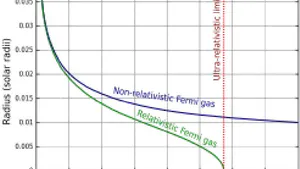
R(max) < 4.25 km for the Chandrasekhar Limit of 1.44 Solar Mass and n(max.) < 4.54x10 where n corresponds to the number of electrons drawn in from the White Dwarf to create the Black Hole. Smaller White Dwarf Stars near the Chandrasekhar Limit will create the larger sized Black Holes and larger explosions with R closer to R(max) and n closer to n(max), while larger White Dwarf Stars at the opposite end of the graph will create smaller sized Black Holes and smaller explosions.
The size of the Schwarzschild Radius for charge is given by which is the corresponding equation for mass given by for creating Black Holes. Since for "n" electrons at rest (K.E.=0), the Potential Energy (P.E.) of a White Dwarf will be . From Conservation of Energy at the location of the Schwarzschild radius, with r = R and v = c, and . We use the same method as was used to calculate R for mass M noting that GM has now been replaced by .
for a single electron or for n electrons, and that is the reason the charge of electrons can create Black Holes while the mass of electrons cannot.
Setting R(e) = R(M), and M = . This is mainly due to the big difference in the values of k and G, the constants of electric charge and gravitational mass. The formula above implies that the charge of a single electron, , is equivalent to a mass of to create a Black Hole of the same Schwarzschild Radius R. Hence the charge of electrons in the White Dwarf Star are clearly superior to the mass of electrons at creating Black Holes. This is the same reason that on a microscopic level charge dominates over mass since for the force exerted between a proton and an electron due to its dependence on k/G.
Most Stars end their lives as White Dwarfs (Reference 3). Hence most Black Holes from White Dwarfs that are created with charge are plentiful. All Solar Masses beyond the Chandrasekhar Limit will create
Neutron Stars and neutral Black Holes with only Mass and Angular Momentum, but these are in a minority since there exist more stars with mass less than the sun than greater than the sun.
Graph of radius–mass relations for a model White Dwarf (Reference 2).
{"image_source":{"path":"images/d1873991efacc41731d0a4cc3bb69d2b00194bd04e25ba2297b1a0f2779a3e72.jpg"},"content":"","chart_caption":[{"type":"text","content":"Case 1: At the ChandraseFrom the Graph:"}],"chart_footnote":[]} khar Limit, the radius of the White Dwarf Star is 0 and therefore it cannot create a Black Hole. R(max) < 4.25 km and n(max.) < 4.54x10 .
Case 2: A White Dwarf size of 1.25 (Solar Mass) = 0.005 (Solar Radius) = m, Density = 1.39 x kg/m , R = 3.69 km, n = 3.94 x .
Case 3: The majority of White Dwarfs have a size of 0.6 (Solar Mass) = 0.0125 (Solar Radius) = 8.7x10 m for the Relativistic Fermi gas case. Density = 4.18x10 kg/m , R = 1.77 km, n = 1.89x10 .
Case 4: A White Dwarf size of 0.125 (Solar Mass) = 0.025 (Solar Radius) = m, Density = 1.11x kg/m , R = 369 m, n = 3.94x .
Case 5: In the extreme situation, a White Dwarf size of 0.04 (Solar Mass) = 0.04 (Solar Radius) = 2.8x , Density = , , .
The three stages of creating a Black Hole that are portals to the fourth spatial dimension are:
Through a White Dwarf's charge to create the smallest sized Black Holes with mass, angular momentum, and charge.
Through a Neutron Star's mass between 1.44 and 5 Solar Masses to create medium sized Black Holes with mass and angular momentum. Neutron Stars have a radius of at the lower end and about at the larger end beyond which the Neutron Star will turn into a Black Hole.
Directly through the mass of Stars bigger than 5 Solar Masses with a radius R between 15 km and 2.95x km (100 billion Solar Mass Black Hole known as Phoenix A) to create the largest known size Black Hole with mass and angular momentum.
II. CONCLUSION
While it takes the Sun's Mass of to create a Black Hole with , it takes the charge of electrons or 0.5 Coulombs (mass of electrons) from a White Dwarf to create the same size Black Hole of . It is not the Sun's mass but rather the charge of the White Dwarf electrons that creates the Black Hole of this size. Hence our Sun must go through the stages of becoming a Red Giant and then a White Dwarf before it can become a Black Hole.
Energy in charge will always dominate Black Hole creation over Energy in mass unless the Star is larger as in the case of Stars above the Chandrasekhar Limit of 1.44 Solar Masses. These larger stars do not become White Dwarf Stars but rather they become Neutron Stars or bigger sized Black Holes.
APPENDIX
Radius Calculations:
Starting with the radius of the electron = m (Reference 4) and the radius of the electron neutrino = 2x m (Reference 5) and the mass of the electron = 0.511 MeV/ and the mass of the electron neutrino = 2.2 eV/ from the Standard Model of Particle Physics, we see that the ratio of their radius is equal to the ratio of their masses.
. We use this equality ratio of the radius and mass to calculate the radius of the proton, the neutron, and the Up and Down Quarks.
For the Neutron: , .
For the Up Quark: , .
Using this same ratio of radius to mass, the radius of the Carbon nucleus would be m and its Density would be kg/m . The Densities of all stable nuclei from Hydrogen to Lead varies from kg/m to kg/m (Reference 6) which clearly contradicts what exists in Physics College Books that all Nuclei have the same Density of kg/m (Reference 7) based on the wrong assumption that the radius of most nuclei is proportional to where A is their Mass Number.
Conflict of Interest
The authors declare no conflict of interest.
Ethical Approval
Not applicable
Data Availability
The datasets used in this study are openly available at [repository link] and the source code is available on GitHub at [GitHub link].
Funding
This work did not receive any external funding.
References
Cite this article
Related Research

Special Issue
Launch a focused special issue to highlight research, emerging trends, and expert insights in your academic field.