




IntelliPaper
Abstract
Until the 1800s, art historians considered the Venetian artist Carlo Crivelli (circa 1435– 1495) to be a secondary if not a minor painter. This lack of recognition stems essentially from the dissemination of his paintings in churches and convents throughout the provincial region of Marche (central-eastern Italy), where Crivelli spent the most productive period of his life from 1468 until his death in 1495. As a consequence of this limited accessibility, his paintings could not be seen by mainstream art dealers and historians such as the scrupulous Giorgio Vasari (1511–1574). More than anybody else, the British demonstrated a great interest in Crivelli’s art in the late 1800s by acquiring many of his dispersed Earth Sciences History Vol. 43, No. 2, 2024 pp. 303–326 paintings that eventually ended up in the National Gallery of London, where the richest collection of the artist’s paintings is preserved today. Among them, ‘The Vision of the Blessed Gabriele’ is the one that attracted our attention not so much for its pictorial qualities and symbolic significance typical of Renaissance paintings, but rather for the many details making up the background of the painting, which accurately depicted the geological and environmental characteristics of the Adriatic port city of Ancona and the nearby Monte Cònero mountain. In this research, besides a meticulous study of architectural, geomorphologic, faunal, and floral details, we focused on the representation of a large outcrop of strikingly pink, thinly stratified rocks, which we studied through a quantitative RGB (red, green, blue) chromatic analysis and then compared the results with those from an analogous analysis of rock samples and outcrop images of all the more-or less red formations of the Umbria-Marche lithostratigraphic succession. This led us to the conclusion that Crivelli’s pink rocks represent the lower Paleogene Scaglia Rossa limestone exposed at Monte Cònero. Thus, the background of Crivelli’s painting ‘The Vision of the Blessed Gabriele’ is no longer an idealized landscape put there as a symbolic or simple wing of a theater stage, but a realistic representation of the physical environment surrounding the main subject of the painting as only a few Renaissance maestros like Piero della Francesca, Andrea Mantegna, and Leonardo da Vinci incorporated in their most famous and studied masterpieces.
Explore Digital Article Text
I. INTRODUCTION
1.1 Carlo Crivelli's painting of 'The Vision of the Blessed Gabriele'
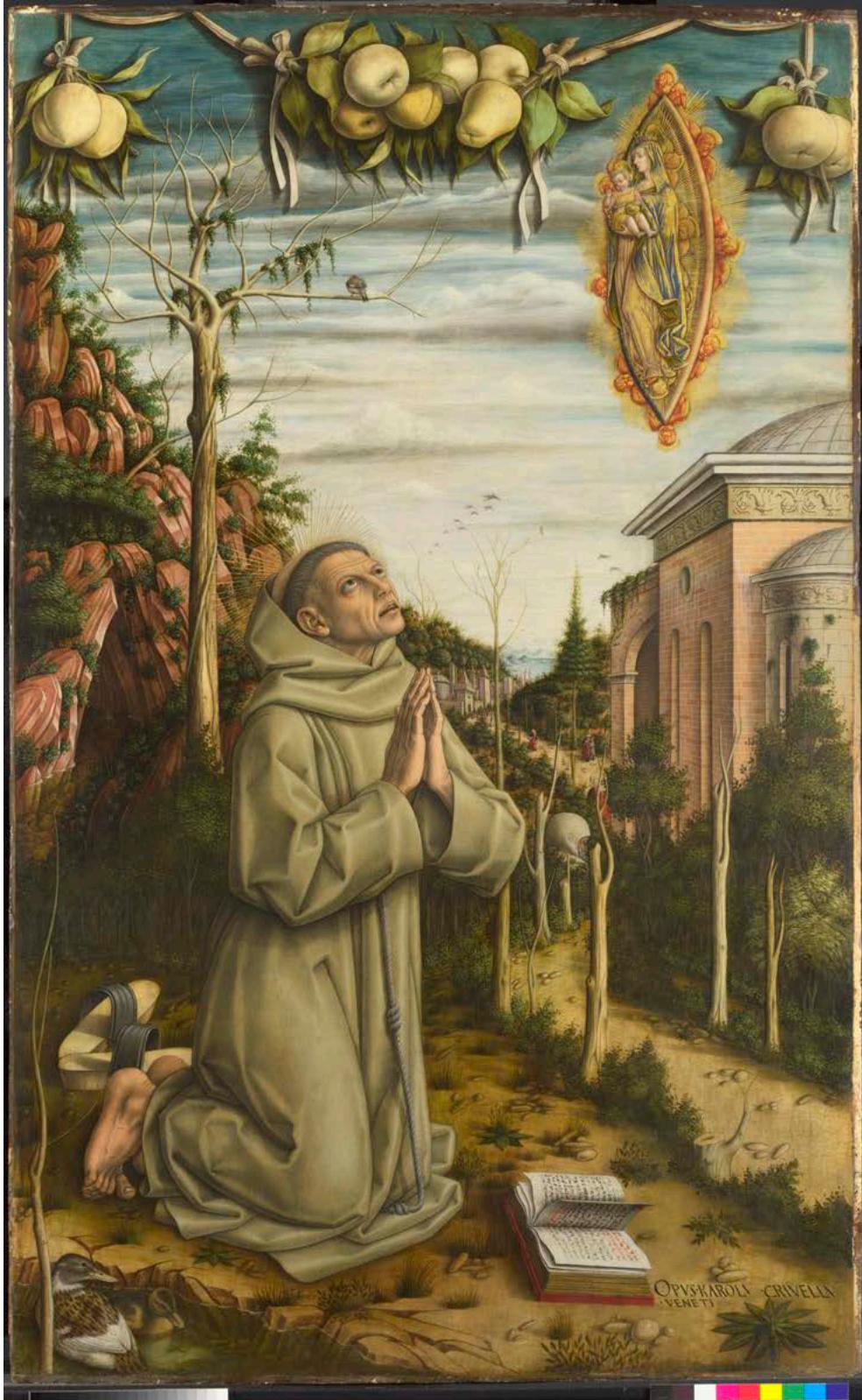
Around 1489, the Venetian artist Carlo Crivelli painted a work in gold and tempera grassa (i.e., fat egg tempera emulsion) on a 141 x 87 cm poplar panel, of the Franciscan Friar Gabriele Ferretti praying to the apparition of the Virgin Mary and Child suspended in the sky above the convent of San Francesco ad Alto in Ancona. The painting, which was a commission funded by the Ferretti local nobility, is now preserved in the National Gallery of London, and it is known as 'The Vision of the Blessed Gabriele' (Figure 1). Besides the central figure of the kneeling Gabriele, the background is divided into two vertical halves. The right half portrays images of Ancona including the church of San Francesco ad Alto, and the left side portrays geological, faunal, and floral details including a range of iconographical subjects set in a naturalistic environment surrounding Ancona. The image of a large natural exposure, which comprises about 1/6 of the picture plane, is comprised of thinly bedded rocks exhibiting a peculiar pink color, an uncommon color used by contemporary Renaissance artists for representing rocks, with the exception of Andrea Mantegna (see Section 4 below). As a working hypothesis, we have identified these pink rocks as the upper Cretaceous-lower Paleogene Scaglia Rossa Formation, the peculiar color of which must have impressed the artist during his sojourn in Ancona in the late 1480s. This would be the very first iconographic representation of this geological formation, which is famous in the scientific community all over the world (e.g., Alvarez 2019, and references therein). With this working hypothesis in mind, we have undertaken a study of the environmental details of this painting, including a RGB (red, green, blue) chromatic analysis of Crivelli's pink rocks and, for comparison, of all the more-or-less red rocks of the Umbria-Marche (U-M) lithostratigraphic succession.
1.2 History of the Franciscan convent and church of San Francesco ad Alto in Ancona
We summarize here the information gathered from various historical sources and used to reconstruct the aspect of the convent of San Francesco ad Alto and, above all, the homonym church at the time Carlo Crivelli depicted it around 1489. The monastic convent and its enclosed church of San Francesco ad Alto are on the hill of Colle Astagno on the outskirts of the city of Ancona (see Figures 2A-B for location). The convent was built in the 13th century by Franciscan minor friars. It later became an important sacred place for local noble families and went through profound architectural changes and remodeling in the following centuries. Eventually, following the suppression of religious orders during the Napoleonic occupation of Ancona in 1797, and the utilization of the whole San Francesco complex as a French military compound in 1798, the transformation became definitive following the Italian royal Decree Valerio on 3 January 1861. In 1815, after the fall of the Napoleonic government, the complex was returned to the Order of the Franciscan Minor Friars and, after various vicissitudes, in 1862 the church and the surrounding complex were definitively annexed to the State. The property was granted to the Command of the Army of Ancona to be transformed into a military hospital with the complete dismantling of altars, chapels, and apse, and the removal of all liturgical furnishings and artistic objects (Mariano 2017; Cogliandro and Tittarelli 2019).
The San Francesco complex was transformed after the Second World War into an Italian Military District and, in more recent years became the headquarters of the Military Command of the Army of Marche (CME) and the center of military archival documentation of Ancona (Figure 2C). Today only the cloister, which was completed by Friar Nicolò Bonarelli in 1614, remains intact, and of the cycle of frescoes in the lunettes by 17th century painters Domenico and Giovanni Peruzzini, only few small shreds are still preserved (Mariano 2017). In summary, we are reporting here relevant pieces of information to reconstruct the historical vicissitudes and above all the representation of the San Francesco church and its surroundings at the time when Carlo Crivelli portrayed them in 1489 (Figure 1).
The actual painting by Crivelli, which represents the vision of the Beato (i.e., blessed) Gabriele Ferretti in ecstasy in front of the church, was commissioned by Friar Bernardino Ferretti, who was the nephew of the eminent Gabriele (Ancona, 1385–1456). More detailed information about the church can be found in a manuscript by Friar Carlo Gasparini (Gasparini 1648) following notes previously provided by Bernabei (1497), Ferretti (1580), and Gonzaga (1587).
Figure 1: 'The Vision of the Blessed Gabriele': oil and tempera on board, 141 x 87 cm, by Carlo Crivelli (circa 1489), reproduced with permission from the National Gallery of London.
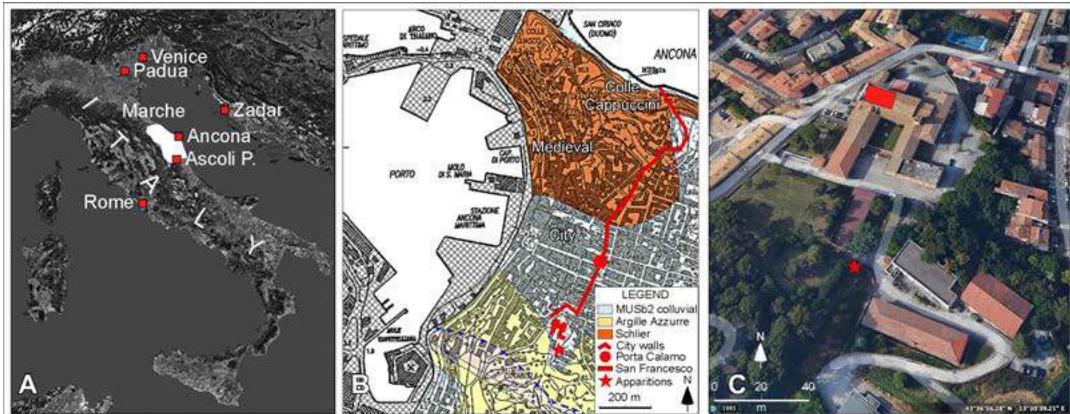
Figure 2: (A) Italy with locations mentioned in the text; (B) Geologic map of the city of Ancona (from Regione Marche 2003) with location of the convent of San Francesco ad Alto and the no longer existing Porta del Calamo; (C) Aerial view of the complex of San Francesco ad Alto and presumed location and orientation of the San Francesco church rebuilt in 1480 (red rectangle: see text for explanation).
First of all, the building of the church and the annexed convent dates back to 1219 according to tradition or 1220 from other sources. Annus Domini 1219 would be the year when Saint Francis of Assisi passed by Ancona before leaving for Damietta (Egypt) during the 5th Crusade to meet with Malik al-Kamil, the sultan of Egypt and Palestine, and nephew of Saladin. In reality, this encounter is not supported by historical sources, and for the same reason it is not ascertainable whether Saint Francis was present in Ancona in those years.
For certain, in the 13th century there was a small Franciscan church outside the medieval city walls of Ancona, an isolated and high (alto in Italian) place, which was appropriate for, and typical of the characteristics and hermitage spirit of original Franciscan friars. The first report of the existence of a Franciscan settlement in Ancona can be found in a document dated 19 September 1239, which records "... apud ecclesiam S. Francisci de Ancona" (Talamonti 1936).
The Franciscan settlement on the Colle Astagno hill fell into disuse after construction in the city center of a new church dedicated to Saint Mary Major (later San Francesco alle Scale), and a new convent of minor friars probably in 1323, which was better suited to the new Franciscan mission aimed at a direct relationship with the citizens.
The old convent on the Colle Astagno hill, regained life thanks to Gabriele Ferretti who entered the order of the Friars Minor Observant in 1403 when he was eighteen, and the Franciscans established their headquarters at the convent of San Francesco ad Alto. In 1425, Friar Gabriele was nominated guardian of the church and he planned the enlargement of the dormitory and the construction of new walls around the complex in addition to restructuring the church by "... constructing a certain addition on the front of said church on the side that looks toward the Cassero" (Albertini 1824; Cogliandro and Tittarelli 2019). The 'Cassero', as it was named by military architect Giacomo Fontana in 1588, refers to the fortification walls that were built by architect Antonio da Sangallo in the 1530s, which were located on the Colle dei Cappuccini hill, then called Colle di San Cataldo, along the line of the ancient 14th century city walls on the north eastern side of the Colle Cardeto hill, not far from the north-facing coastal cliffs (see Figure 2B for location).
New radical restructuring projects in the late 15th century were conducted by Friar Bernardino Ferretti, nephew of blessed Gabriele Ferretti. Consequently, in addition to the enlargement and also a reorientation of the church, the new façade and its stepped churchyard were now facing no longer toward the northeast but toward the northwest (Figure 2C). Therefore, the San Francesco church depicted by Crivelli in his 1489 painting, had its new orientation toward the northwest since 1480, with the apse on the southeastern end of the church. Gabriele Ferretti was particularly devoted to the Virgin Mary, who supposedly appeared to him with baby Jesus in the woods of the convent where the pious friar used to go to pray in solitude.
1.3 Carlo Crivelli's Painting of the Blessed Gabriele Ferretti: A Hectic Life Story
Carlo Crivelli's painting of 'The Vision of the Blessed Gabriele' was originally located above the monumental sarcophagus containing the body of the blessed friar. The sarcophagus was commissioned in 1483 to the Istrian sculptor Giannetto di Domenico da Brioni and the two Lombard sculptors Baldassarre and Taddeo, who finished it in 1489, and it was decorated with elaborated bas-relief festoons, which were inspired by the paintings of Crivelli himself. Right after his death on 12 December 1456, the body of the reverend friar was buried in the ground to the left of the entrance to the church. In 1489 Gabriele's body was exhumed and translated in his new precious urn following some prodigies that occurred near the original humble tomb.
Four years after the beatification of Gabriele Ferretti by Pope Benedict XIV in 1753, the body was moved again to a dedicated chapel in the same church, the first chapel on the left entering from the main portal. On that occasion, Crivelli's painting was replaced with the painting 'Visione del Beato' by Stefano Parrocel in 1756. Parrocel reproduced with a certain fidelity many symbolic details of the original painting, such as the central figure of a praying Gabriele, the San Francesco church, the gold finch roosting on a branch of an apparently dead tree, and the glimpse of the fortified city of Ancona. However, he omitted many other details that had environmental or naturalistic meanings, such as the pond with the mallard ducks, the profile of the Apennine mountains in the far background, and above all the conspicuous exposure of thinly bedded pink rocks, which Parrocell reproduced as massive rocks using a reddish-brown color (see: https://www.museodiocesanoancona.it/sala-10/). Eventually, the original Crivelli was returned to the Ferretti family, who sold it in order to pay debts incurred by Archbishop Raimondo Ferretti. It was the husband of Maria Elisabetta Ferretti, the daughter of Raimondo, who sold the precious painting to the art collector Alexander Barker and it was ultimately acquired by the National Gallery of London in 1874. Following the suppression of the religious order of the minor friars, the body of blessed Gabriele was temporarily placed in the cathedral of San Ciriaco until 1884 when the San Giovanni Battista church in the Capodimonte quarter of Ancona, also on the Colle Astagno hill, was assigned to the Franciscans. The body was then placed in this new Franciscan church and it is still preserved there along with the copy of Crivelli's painting by Stefano Parrocel.
II. MATERIALS AND METHODS
We used a high-resolution JPG image with a RGB scale of Carlo Crivelli's painting depicting Gabriele Ferretti, which was provided by the National Gallery of London, to carry out an environmental study of architectural, faunal, floral, and landscape images portrayed in the painting, and a chromatic RGB analysis of the pink rocks outcrop portrayed on the left side of the same painting (Figure 1). The result of this chromatic analysis was then compared with the results of an analogous RGB analysis of rock samples and exemplar outcrop images of all the more-or less red lithostratigraphic units of the Umbria-Marche succession (Figure 3). We utilized the same high-resolution image of Crivelli's painting to analyze and identify any other faunal and floral feature that could be related, or not related, to the anthropic or naturalistic environment of Ancona and the nearby Monte Cònero mountain.
III. ANALYTICAL RESULTS
3.1 General description
Carlo Crivelli's masterpiece titled 'The Vision of the Blessed Gabriele' was painted with oil and tempera on poplar panel, and it represents a kneeling and praying Friar Gabriele Ferretti looking up to the apparition of the Virgin Mary with the Child (Figure 1). The right side of the painting depicts a number of images of Ancona, namely a side view of the San Francesco ad Alto church, a glimpse of the fortified medieval city, and a panorama of the gulf of Ancona in the far back-
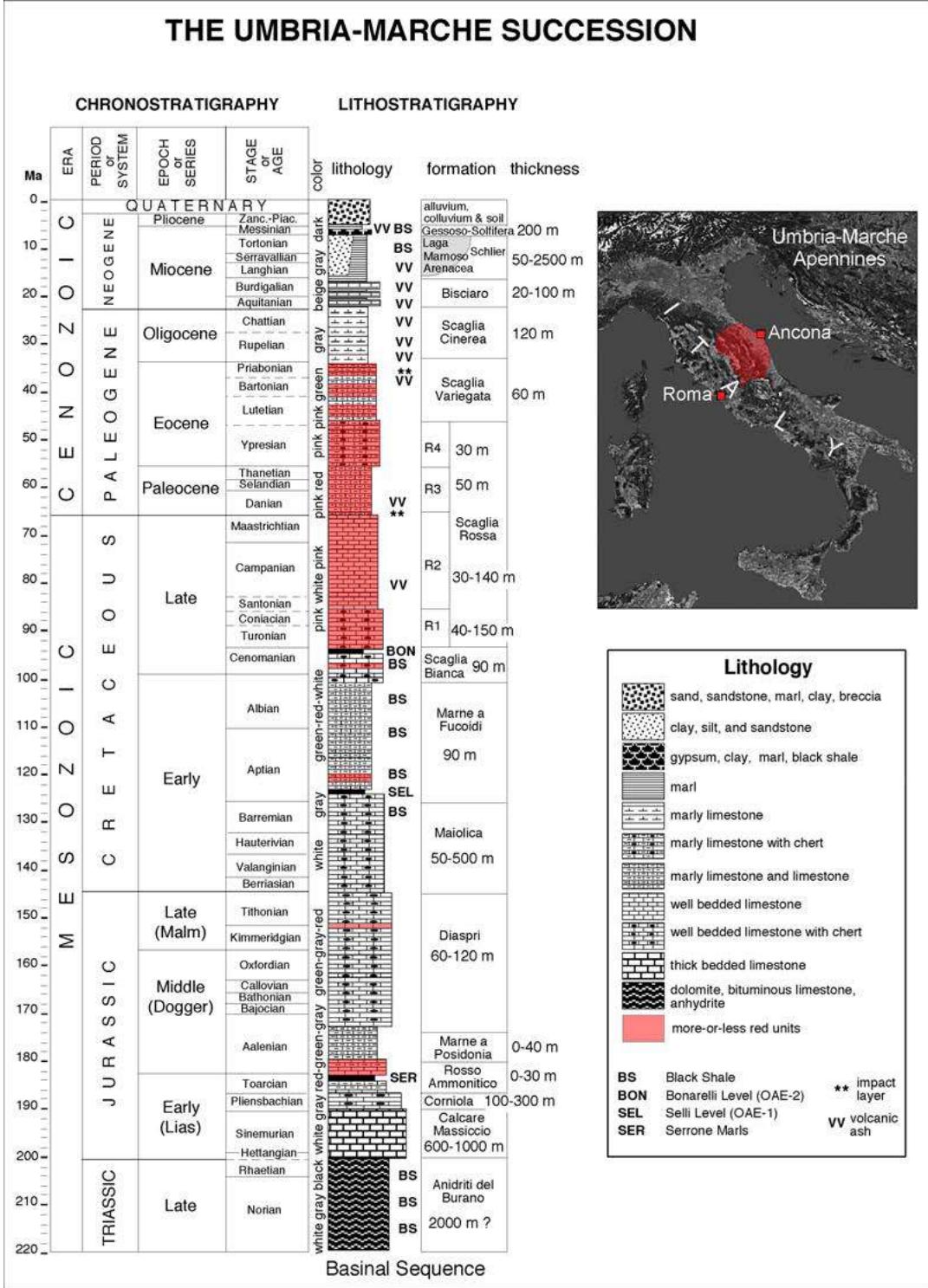 Figure 3: The lithostratigraphic succession of the Umbria-Marche Apennines.
ground. The left side of the painting is dominated by a large exposure of thinly bedded rocks exhibiting a peculiar pink color, and other naturalistic details such as a water spring, a thick forest, a water pool with two ducks in it, and various plants growing on a rocky floor disseminated with rounded pebbles. Gabriele Ferretti is not the only human figure in the painting. Hidden in the bushes in the center of the painting, one can notice the profile of a man wearing a white hood, a mysterious figure described as a generic monk of unknown identity by Peers (2005). By comparing the traits of this human figure with the three-quarter-profile in Crivelli's Saint Paul depicted in the Sant'Emidio polyptych altarpiece in Ascoli Piceno, which was recently identified as a self-portrait painted in 1473 by professional restorer Rossana Allegri (Dal Bello 2021), it emerges that the profile of this mysterious monk in Beato Gabriele is also a self-portrait of an older Carlo Crivelli (Figure 4 ABC). As a matter of fact, it was very common for Renaissance painters to insert, besides the likeness of saints, popes, or princes, their own portraits sometimes hidden in a corner of the painting or as representing a particular historical or mythological personage, e.g., the self-portrait of Crivelli as Saint Paul in his polyptych of Sant'Emidio in Ascoli.
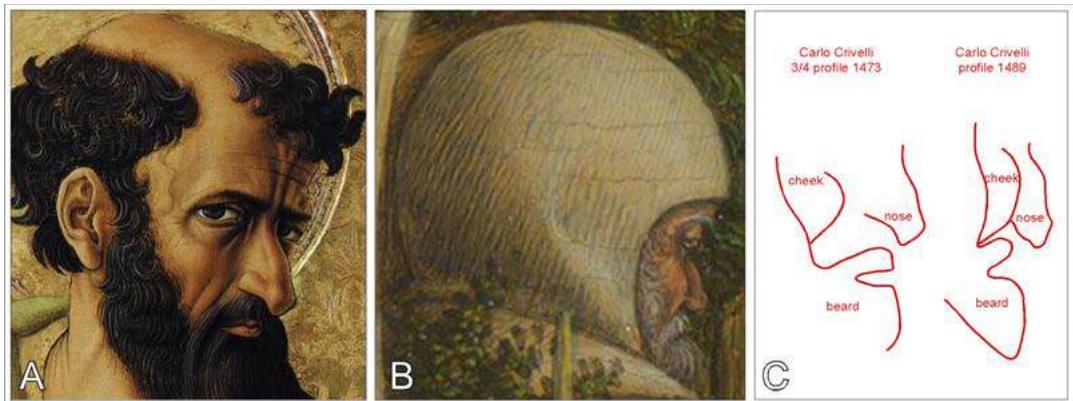
Figure 4: Self-portrait analysis of Carlo Crivelli. (A) Self-portrait impersonating Saint Paul in Crivelli's polyptych altarpiece of Sant'Emidio in the cathedral of Ascoli Piceno, 1473 (Casalini 2004). Note that the original image was flipped horizontally for correlating it with the profile in B; (B) Herein proposed self-portrait in Crivelli's Beato Gabriele Ferretti, 1489, National Gallery of London; C) Trait line profiling of cheek, beard, and nose comparing the profiles in A and B.
3.2 Architectural and landscape features
On the right half of Crivelli's 1489 painting, the main architectural feature is a partial view of the northeastern side of the San Francesco ad Alto church, which was restructured in 1480 by Friar Bernardino Ferretti, nephew of blessed Gabriele (Figure 5A). The church and the frontal (i.e., northwestern) porch were built with red terracotta bricks, whereas the apse on the southeastern side of the church, as well as the typically Renaissance decorative moulding, were made with squared white limestone blocks. From there, a dirt road descends toward the no-longer-existing access, through the walls of medieval Ancona, of Porta del Calamo built in 1329 (Figure 5B). While the picture of Ancona by Crivelli is somewhat stylized, the crenellated walls can be recognized in a realistic painting by local artist Barnaba Mariotti (mid-19th century; Figure 5C). The church with its campanile visible in Mariotti's painting may represent the original 13th century San Domenico church, then rebuilt in 1771. Nevertheless, from this elevated position and therefore looking toward the northeast, Crivelli could see the city from above, including the medieval walls, the door of Porta del Calamo, and the church of San Domenico. However, in the far background of this view, he would see the Colle dei Cappuccini hill (at 106 m above sea level (asl); see Figure 2B for orientation), and not the gulf of Ancona surrounded by coastal hills, as seen in the far background of the painting (Figure 6A). In effect, from the top of the Colle Astagno hill (109 m asl) currently occupied by the 16th century fortress of La Cittadella, one can enjoy a beautiful view of the gulf of Ancona with its hilly coast and, on a clear day looking toward the west-southwest, one can distinctly see the Marche Ridge of the Apennine mountains (Figure 6B) with its most prominent peak of Monte San Vicino (1480 m asl).
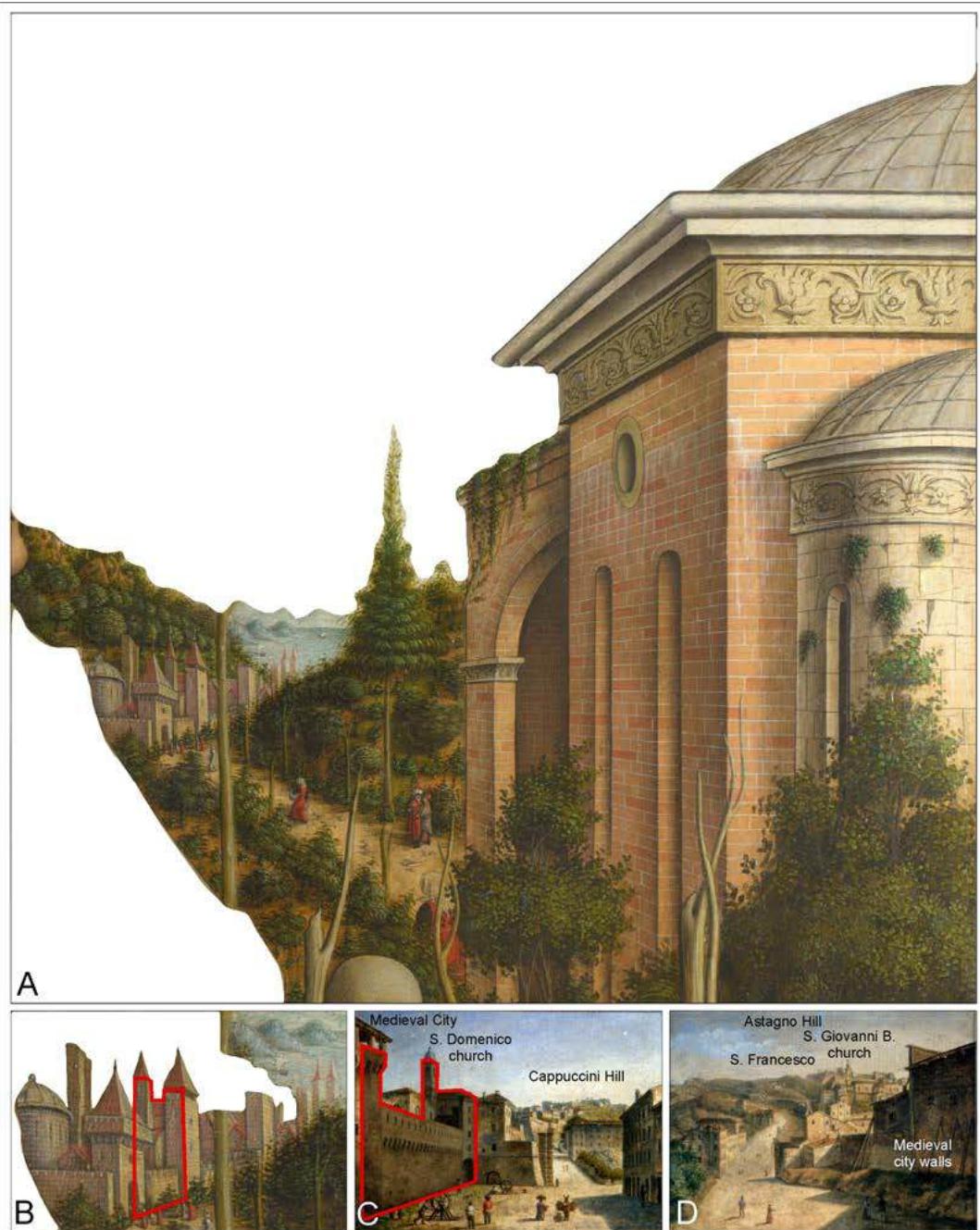
Figure 5: (A) Crop of the right side of Crivelli's painting depicting architectural and landscape details of the 15th century city of Ancona; (B) Detail of the fortified city of Ancona at the walls' eastern entrance of Porta del Calamo; (C) A realistic portrait of the no-longer existing Porta del Calamo by Barnaba Mariotti (second half of 19th century) with the Colle dei Cappuccini hill in the far distance (with permission from the Pinacoteca di Ancona); (D). Mariotti's portrait of the Colle Astagno hill as it used to be seen from the walls of Porta del Calamo.
3.3 Geological features
In order to test our hypothesis that the peculiarly pink rocks of Carlo Crivelli's painting represent the Scaglia Rossa Fm of the northeastern Apennines, we have collected and analyzed the RGB color of polished hand samples from all the more-or-less red formations of the Umbria-Marche lithostratigraphic succession of Figure 3. The results of this analysis are shown in Table 1. Despite
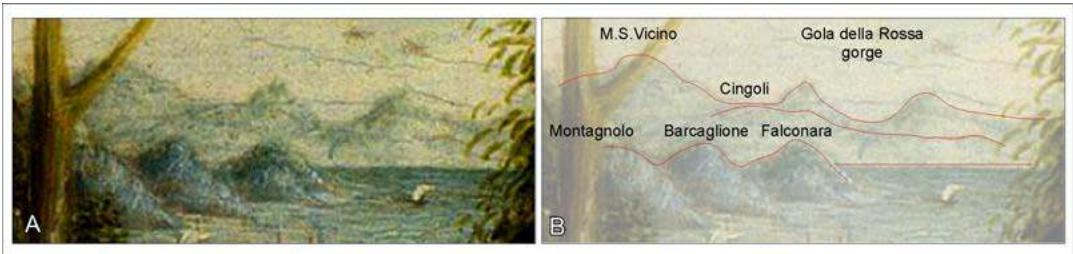 Figure 6: (A) Crop of the far background of Crivelli's painting of Beato Gabriele Ferretti; (B) Geomorphological interpretation of the hills and mountains visible from the top of the Colle Astagno hill looking WSW.
{"image_source":{"path":"images/4e0af0e0098a728d22b803927c097963921c1318760c41ec8fb7b70c6a003636.jpg"},"content":"","chart_caption":[{"type":"text","content":"Table 1: Red rocks of the Umbria-Marche lithostratigraphic succession. Numbers in brackets in column headings refer to: [1] Adobe RGB (1998), [2] Adobe RGB (1998) to CIE Lab*, and [3] Adobe RGB (1998) to Munsell."}],"chart_footnote":[]} the very large variety of objective colors with a red component from these samples, whether as reflected from a dry or wet polished surface, once compared visually with the mean color of Crivelli's pink rocks (Figure 7), it seems that the pink color of the Paleogene R3 and R4 members of the Scaglia Rossa Fm of Monte Cònero (samples FORW-SRR3 and FORW-SRR4, respectively), provides the closest match. Nevertheless, it must be considered that with the color space CIE RGB, with 256 tonalities for each primary color, the display of a computer is able to reproduce ~16.7 million colors (e.g., Peruggi 2020), each one of which is identified with a hexadecimal alphanumeric code preceded by the symbol '#' (e.g., the HEX code for the color white is #ffffff). However, it must be said that Crivelli did not see and photograph these pink rocks on polished hand samples with a digital camera but he must have seen them in natural exposures and, somewhat impressed by such an unusual pink color, he would have 'photographed' them mentally. Consequently, we toured the Umbria-Marche Apennines looking for exemplar outcrops of those more-or-less red formations, took panoramic photographs of them, and selected areas on those exposures that exhibited a reddish color typical of that formation.
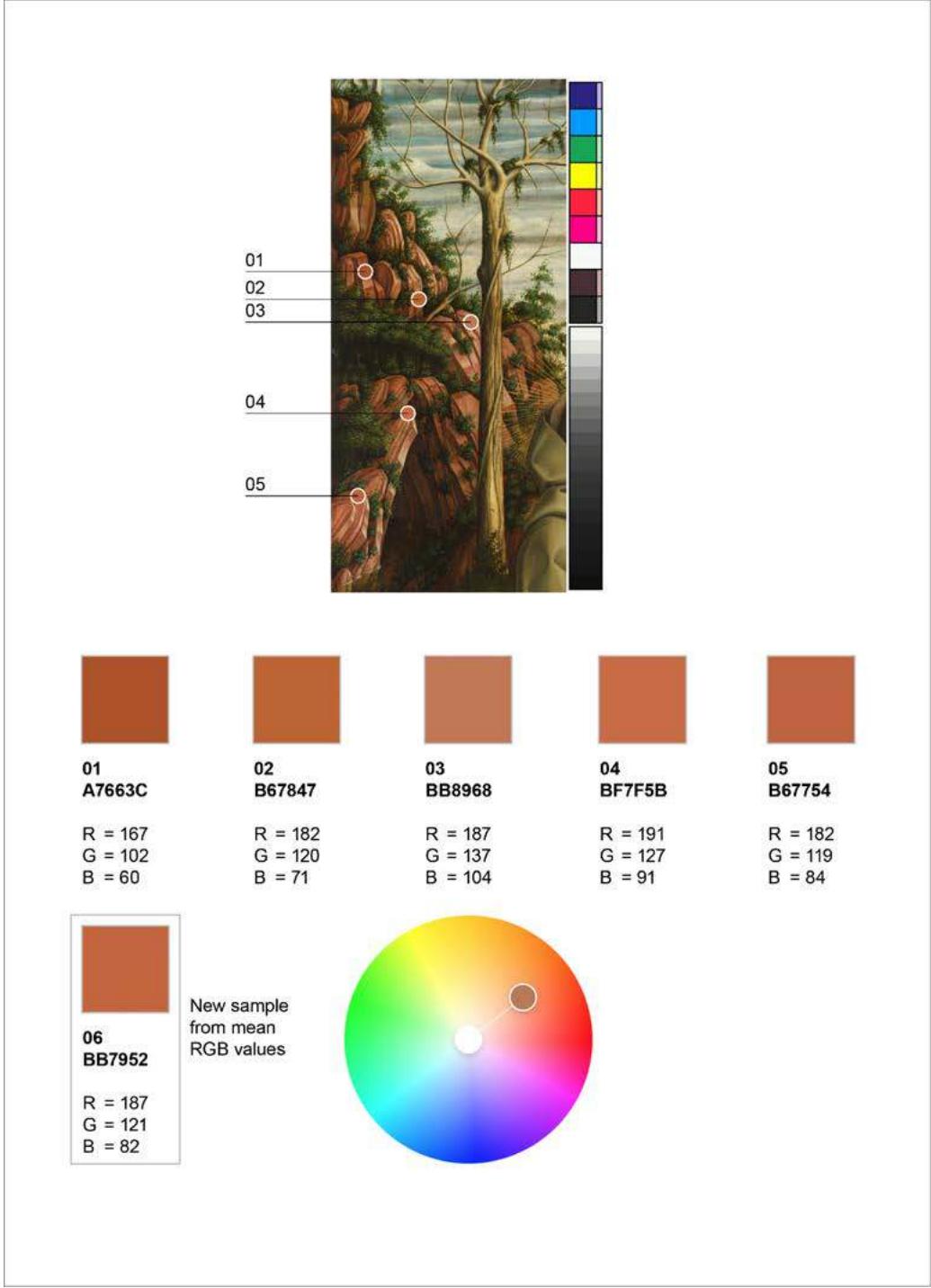
{"image_source":{"path":"images/61fbaa636d9cc93430f7006ea5b3a5f31e4a49c077f2f366969c8fd4a8958251.jpg"},"content":"","chart_caption":[{"type":"text","content":"Figure 7: Synoptic figure of the RGB color values analysis of the outcrop of pink stratified rocks in Crivelli's Beato Gabriele Ferretti painting."}],"chart_footnote":[]}
Starting from the oldest reddish formations of the Umbria-Marche succession, i.e., Rosso Ammonitico and Diaspri, we have selected the outcrops of La Predella near Scheggia, on the right bank of the Sentino River at the foot of Monte Serrone (Baldanza et al. 2022), and the road outcrop of Gattuccio, near Genga (Montanari and Pignocchi 2022, p. 29), which are shown in Figures 8A and 8B, respectively. As for other Umbria-Marche formations that include reddish lithostratigraphic units, we have analyzed, using the same criterion, the spectacular exposure of the Vispi Quarry, near Gubbio (Alvarez 2019), with its thinly bedded pelagic limestones continuously covering some 50 million years of Earth's history (see Figure 3), from the Maiolica to the Scaglia Rossa formations. From this exceptional outcrop, we photo-sampled the Brown member of the Marne a Fucoidi Fm (Coccioni 2020), the W2 member of the Scaglia Bianca Fm (Coccioni and Galeotti 2003), and the basal member R1 of the Scaglia Rossa Fm (Montanari et al. 1989). The results are shown in synoptic Figure 9.
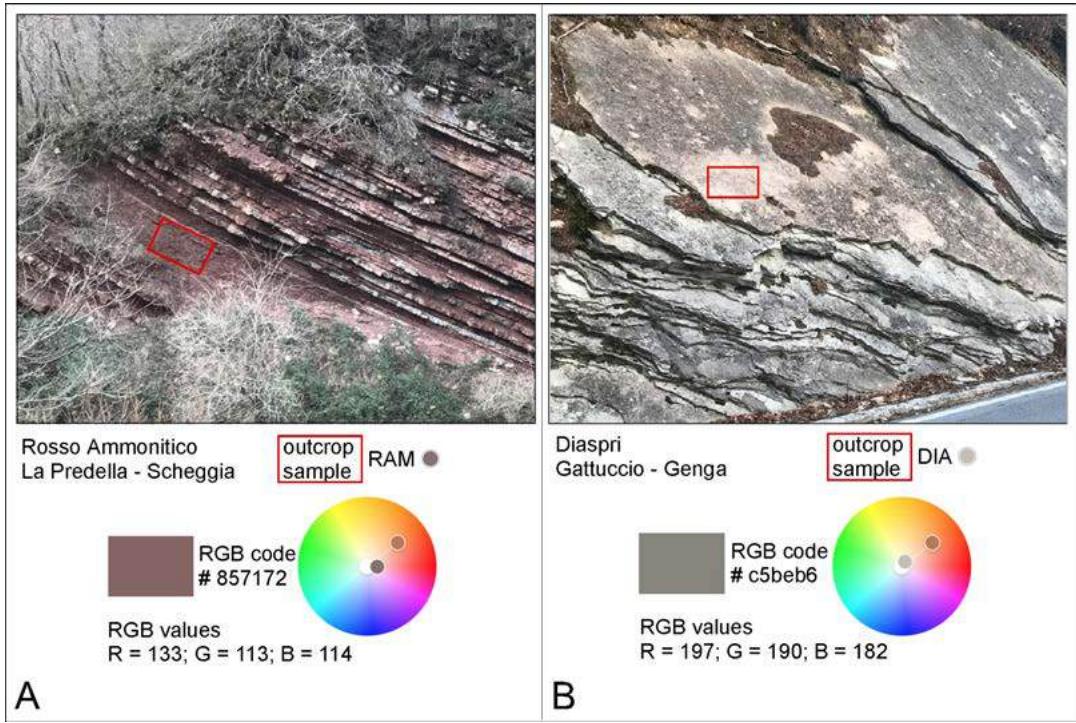
Figure 8 (A): Outcrop of the Rosso Ammonitico Fm. at La Predella, near Scheggia, exhibiting its classic Bordeaux red color identified with RGB code #857172. This lower Jurassic formation is widespread in the whole western Tethyan domain, including the pre-Alpine Venetian region where it is quarried and commercialized under the name of Marmo Rosso di Verona; (B) A layer of pinkish siliceous limestone in the otherwise greenish Diaspri Fm exposed in the Gattuccio quarries near Genga, identified with RGB code #c5beb6. These color codes are represented by a dot plotted on the wheel of colors, and therein compared with the dot that represents the mean color code #BB7952 of Crivelli's pink rocks shown in As for the upper Cretaceous-lower Paleogene Scaglia Rossa Fm, which is the thickest and most widespread formation in the Umbria-Marche Apennines, we analyzed exemplar outcrops exposed along the old 340-km-long Via Flaminia, the modern state highway SS n.3. This Roman road crosses the Scheggia Pass in Umbria to enter in the Marche region, and continues northeastward across the whole NW-SE trending Umbria-Marche thrust-and-fold mountain belt eventually reaching the Adriatic coastal city of Fano, some 50 km south of the terminal city of Rimini. The first impressive exposure of the Scaglia Rossa Fm a traveler will see after the Scheggia Pass is at the Ponte a Botte bridge, which crosses the deep canyon of Fosso La Foce. There, the whole mountain on the eastern side of Via Flaminia is made up of Scaglia Rossa limestone, which contrasts with the low topography of gray
Miocene formations exposed on the hills to the west of the calcareous mountain slope (see panoramic view in Figure 10A). A photo sample of this outcrop yielded a RGB color code #62463b plotted on the respective color wheel in Figure 10A. From there, the Via Flaminia continues its northeastward route running along the Burano River, which, past the town of Cantiano, flows between hills and mountains that expose extensive outcrops of the Scaglia Rossa Fm exhibiting its most characteristic pink color. One of these exposures was sampled in the Smirra Quarry, located between the towns of Cagli and Acqualagna (Franceschi et al. 2015). The results of our RGB color analysis of this outcrop are reported in Figure 10B. Past Acqualagna, the Burano River merges into the Candigliano River and the Via Flaminia road is forced through the Furlo Gorge, which cuts the Monte Paganuccio Monte Pietralata anticline, the northernmost anticlinal structure of the Marche Ridge. At Furlo, the Via Flaminia is surrounded by large exposures of the Scaglia Rossa Fm (Alvarez and Lowrie 1983; Bice et al. 2007, Alvarez 2009, and references therein), exhibiting a facies that is characterized by white biocalcarenitic turbidites interbedded with the typically pink pelagic limestone (see panoramic view in Figure 10C). The results of our RGB color analysis of this outcrop are reported in Figure 10C.
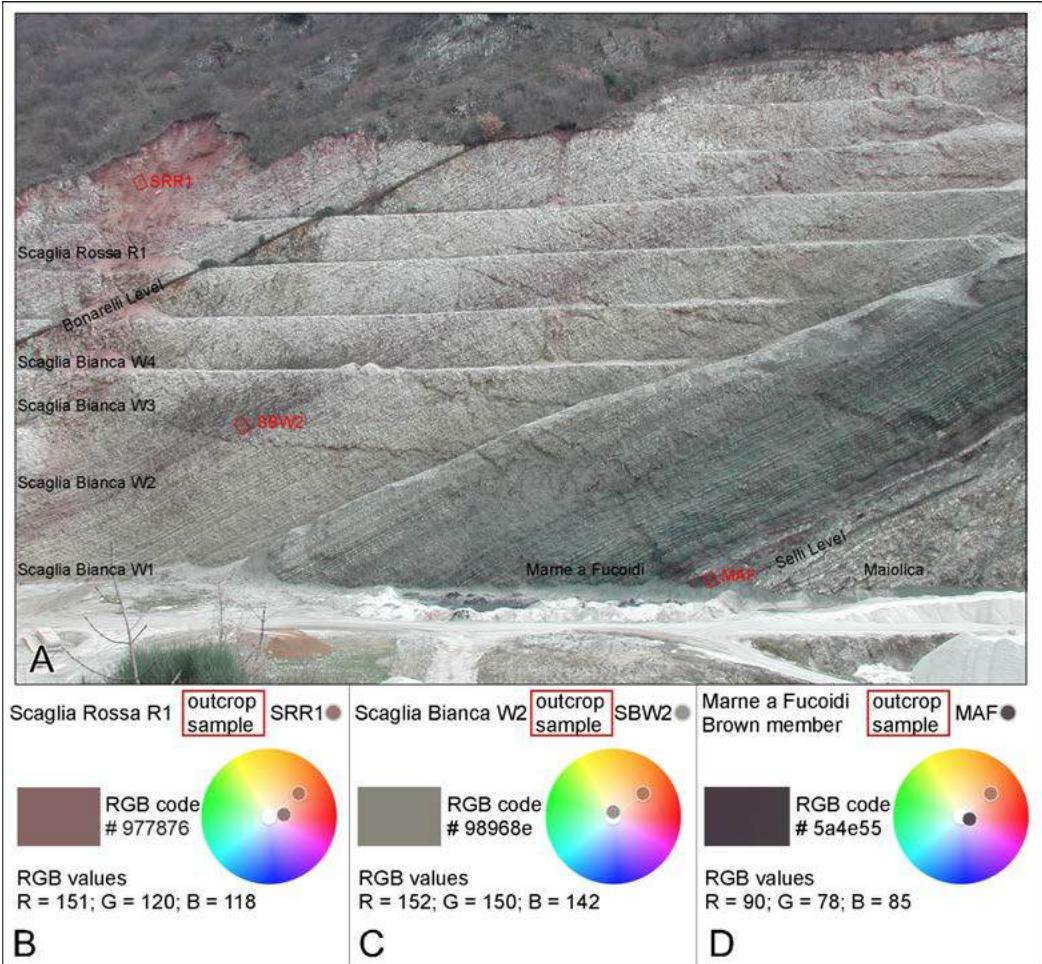
Figure 9: (A) Panoramic view of the Vispi Quarry near Gubbio with the various Umbria-Marche lithostratigraphic units from the Maiolica to the Scaglia Rossa formations; (B) RGB color values analysis results from the sampled area of the Scaglia Rossa R1 member, which yielded a #97776 color code represented by a dot plotted on the wheel of colors, and therein compared with the dot that represents the mean color code #BB7952 of Crivelli's pink rocks shown in
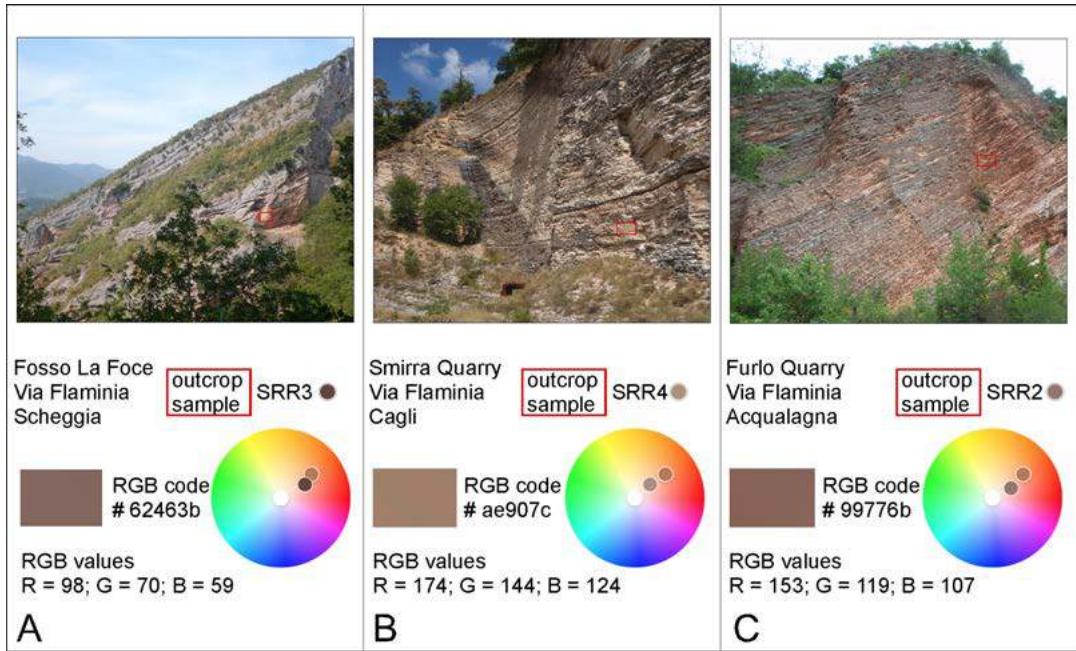
Figure 10: (A) Panoramic view of the Scaglia Rossa mountain slope as seen from the Via Flaminia near Scheggia (photo courtesy of Walter Alvarez), with the results of a RGB chromatic analysis of a sampled area indicated by a red rectangle; (B) Panoramic view of the Scaglia Rossa Fm exposed in the Smirra Quarry near Cagli, with the results of a RGB color values analysis of a sampled area indicated by a red rectangle; (C) Panoramic view of the Scaglia Rossa Fm exposed in a quarry along the Via Flaminia at Furlo, with the results of a RGB color values analysis of a sampled area indicated by a red rectangle.
During his restless young life, Carlo Crivelli never travelled across the Umbria-Marche Apennines. After leaving Venice where he served 6 months in jail following a trial for sexual abuse, he found refuge in Padua where he came in contact with the famous Paduan artist Andrea Mantegna, and other contemporary painters such as Cosmé Tura from Ferrara and, most importantly, with Giorgio Chulinovich aka 'Schiavone', a Dalmatian painter who became his best friend. In 1465, when he was 35, Crivelli migrated with his beloved friend Schiavone to Zara (today the Croatian city of Zadar; see Figure 2A for location), and eventually he crossed the Adriatic Sea to reach the Marche region where he spent the rest of his life until his death in Ascoli Piceno at age 65 (Dal Bello 2021). Therefore, Crivelli must have seen the Scaglia Rossa Fm somewhere else in the Marche region, certainly not in the Umbria-Marche anticlinorium, nor at Montagna dei Fiori, the closest Apennine mountain to Ascoli Piceno, where the Scaglia Rossa Fm actually exhibits a whitish color (Montanari et al. 1989; Montanari and Koeberl 2000, p. 247). The only place where Crivelli could have seen a large exposure of the typically pink Scaglia Rossa Fm is at Monte Cònero, some 8 km southeast of Ancona (Figure 11A).
One may ask: for what reason would Crivelli have gone to Monte Cònero during his stay in the convent of San Francesco ad Alto in Ancona? One plausible reason may be that at Portonovo, at the foot of Monte Cònero, which represents the easternmost blind thrust anticline of the Umbria-Marche foreland fold-and-thrust belt, there used to be an important Benedictine abbey with its 11th century Romanesque church dedicated to the Blessed Virgin Mary. The Benedictine enclave of Portonovo, despite being an isolated and difficult-to-reach coastal site with no practical communication with the hinterland, flourished for some three centuries thanks to a relatively large coastal lake of fresh water, which was fed by a copious perennial spring gushing out water from the foot of the mountain at a very short distance from the sea. In short, the coastal lake was used as a harbor (i.e. Novo Porto, today's Portonovo) where long distance commercial freighters and military ships could safely dock and get refurbished with uncontaminated drinking water (Montanari et al. 2016). And yet, in 1319 A.D., five million cubic meters of rock catastrophically slumped down from the sheer northwestern side of Monte Cònero almost completely burying the fresh water lake and the small harbor with palisades open to the sea, but sparing the old Santa Maria church. Consequently, the surviving Benedictine monks immediately evacuated Portonovo and moved to the convent of Saint Martin in Ancona (Montanari et al. 2016, and references therein). After the catastrophic event, Portonovo was occasionally frequented by local fishermen, pirates, and pilgrims devoted to Saint Mary, just as Carlo Crivelli used to be. This may have motivated Crivelli's short pilgrimage to Monte Cònero, where he would have seen, for the first time, the peculiarly pink rocks of the Scaglia Rossa Fm (Figure 11A) exposed on the western mountain slope near Poggio di Ancona. From there, he could have descended down to Portonovo via a "nasty and steep little trail" (see figure 11 in Montanari et al. 2016). In summary, the results of our RGB chromatic analysis of the Scaglia Rossa Fm of Monte Cònero exposed at Poggio di Ancona are shown in Figures 11B, C, and D.
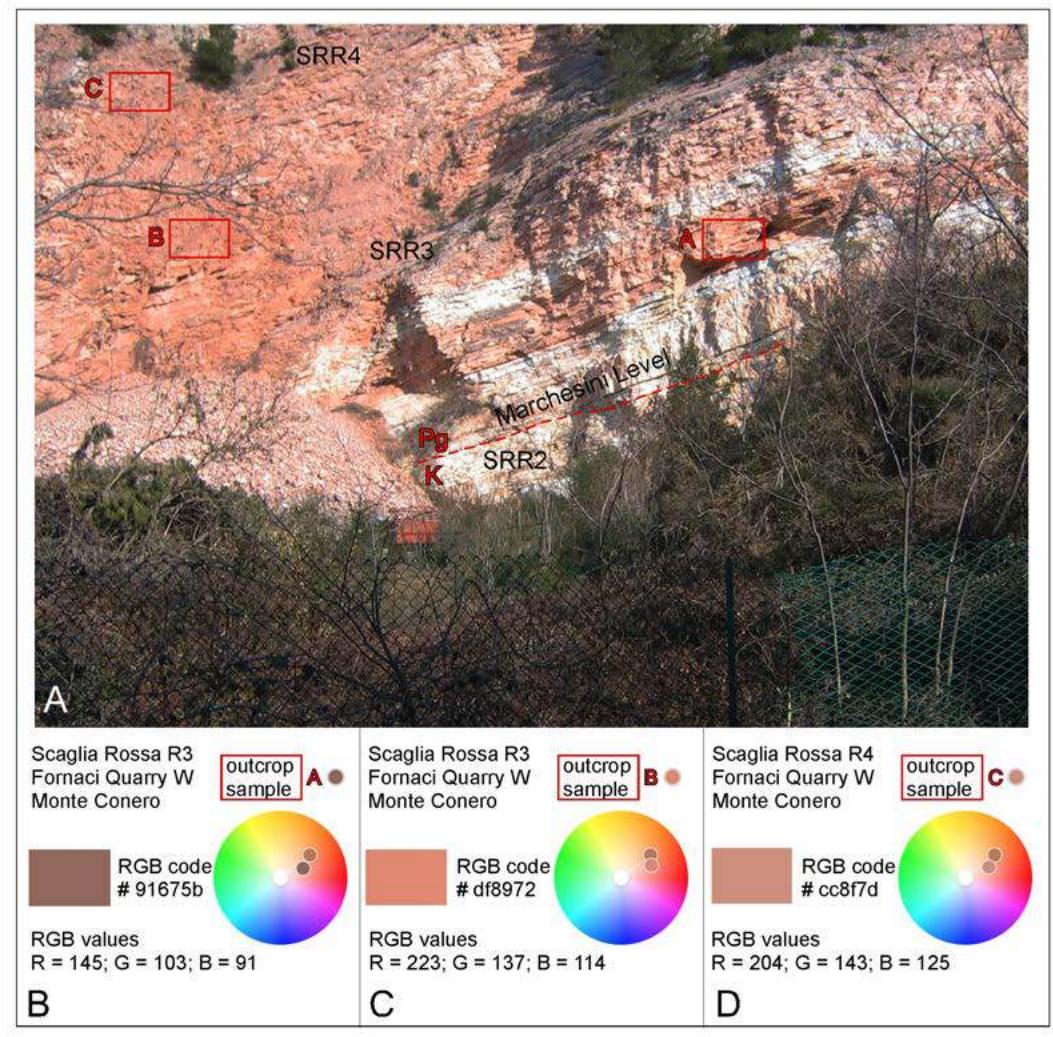
Figure 11: (A) Panoramic view of the Scaglia Rossa exposed in the disused quarry front of Fornaci, on the right side of the Betelico Creek valley near Poggio di Ancona of Monte Cònero (Burattini 2019). The results of RGB chromatic analyses of sampled areas indicated by red rectangles on the panoramic picture, are respectively reported in (B), (C), and (D). SRR2, SRR3, and SRR4 refer to the R2, R3, R4 members of the Scaglia Rossa Fm (see fig. 5).
3.4. Naturalistic, Faunal, and Floral Features
Crivelli's painting of 'Blessed Gabriele Ferretti', besides containing architectural and landscape features all referring to the city of Ancona as described above, is a collage of images that may refer to Monte Cònero (i.e., the eye-catching pink rocks of the Scaglia Rossa Fm described above), and the natural environment of the outskirts of Ancona, including the nearby bay of Portonovo.
Here follows a description of the faunal and floral images of the painting. Birds: Up high roosting on a branch of a tall tree in front of the large outcrop of pink rocks, there is a European gold finch (Carduelis carduelis, cardellino in Italian) seen from the back, looking at the far horizon (i.e., the Marche Apennine mountains as discussed above). The little bird is reproduced with formidable ornithological accuracy (Figures 12A and 12B), and was considered to have a profound symbolic significance by Renaissance painters (Anonymous 2024; Mortaruolo 2023) being a representation of the Passion of Christ. For instance, de Marchi and Mazzalupi (2008) interpreted Crivelli's gold finch roosting on a seemingly dead tree as wanting to regain life and ready to take flight toward the sky (i.e., symbolic for the Resurrection of Christ). On the other hand, due to its colorful plumage (red, yellow, beige, black, and white), the gold finch was represented in naturalistic paintings and mosaics since Roman times (Figure 12C).
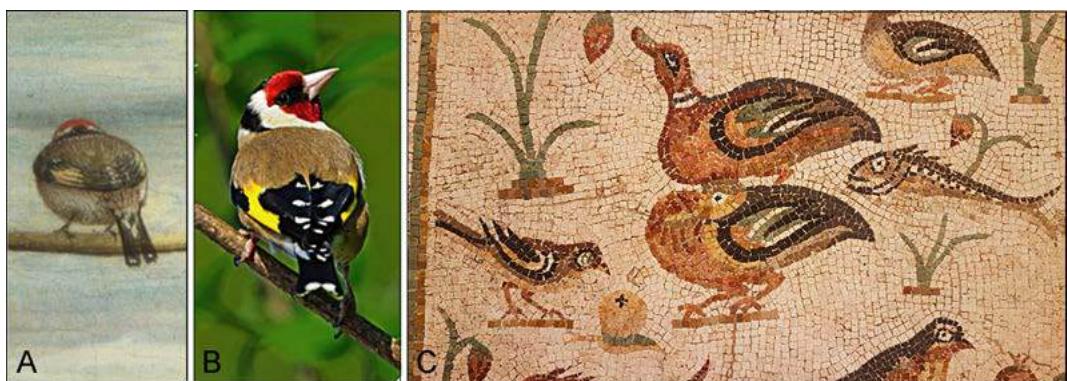 Figure 12: (A) The gold finch in Crivelli's painting of blessed Gabriele Ferretti; (B) A live European gold finch seen from the back; (C) A gold finch and 3 mallard ducks in a 1st century Roman floor mosaic.
In addition to the symbolic gold finch, Crivelli reproduced, with equal ornithological accuracy, a female mallard duck (Anas platyrhinchos) swimming with her duckling in a shallow pool of clear water (Figure 13A). In various cultures since antiquity, mallard ducks symbolized adaptability, grace, and emotional depth. The vibrant colors of the male mallard's plumage are certainly an aesthetic aspect that gratifies the birdwatcher's eye. Coincidentally, gold finch and mallards, both male and female, were pictured together in the 1st century mosaic of a Roman floor shown in Figure 12C, which was discovered in 1980 during road works under a main street in downtown Ancona. Moreover, In Christianity, the mallard duck's Spring return from migration represents spiritual renewal, rebirth, and the awakening of faith. Their annual homecoming reminds us of the resurrection and eternity of the soul (Oliver 2023).
This symbolism is interesting inasmuch as it may give significance to the flock of birds flying in formation toward the San Francesco ad Alto church in the background sky of Crivelli's painting (Figure 1). Furthermore, mallards are endemic species to the Portonovo lake (Figure 13B).
The mallard water pool in Crivelli's painting actually bears some additional geological features, which are worth mentioning. At the bottom of the pond, one can see well-rounded pebbles. Similar pebbles are also present scattered around on the rocky shore of the pond as well as on the dirt road that leads down to the medieval city of Ancona (see Figure 1). Rounded pebbles are the kind of sediment that geologists expect to find in a fluvial deposit, certainly not at the bottom of a still water pool. And yet, there are no rivers flowing near Ancona. Therefore the pebbles in Crivelli's painting may well represent the well-rounded pebbles making up the beaches around Monte Cònero, including the popular beach of Portonovo Bay. Another geological feature visible in the left side of the painting, is a spring pouring water inside a flooded cave at the bottom of the large outcrop of pink rocks. At the bottom of the cave's lake, there are several rounded boulders, and more boulders can be seen at the bottom of a stream that disappears outside in a thicket of dark trees. If on the one hand the only important water spring we know of at Monte Cònero is the one at Portonovo (see Montanari et al., 2016, figure 11, caption n. 27 "Fountain with a big Water Head which falls from above"), on the other hand there are no caves nor pink rocks over there. Nevertheless, there used to be a large, now legendary cavern open to the sea on the rocky coast a couple of kilometers to the south of the church of Santa Maria in Portonovo, known as Grotta degli Schiavi Cave (De Bosis 1861), which can only be reached from the sea. Crivelli may not have seen this sea cave but he may have heard about it, and he used his imaginary vision of it to insert it into his painting.
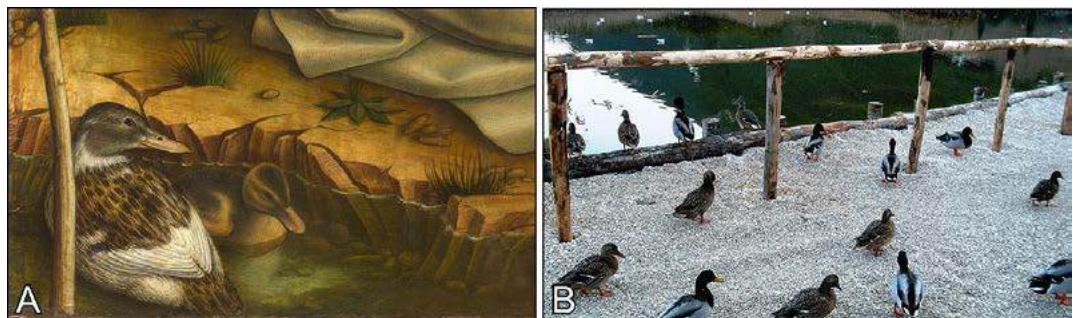
Figure 13: (A) A female mallard duck with her duckling swimming in a pond in Crivelli's painting of 'Blessed Gabriele Ferretti'; (B) Female and male mallard ducks hanging around the lake of Portonovo at the foot of Monte Cònero (Photo by Claudio Stanco, from Wikimedia Commons).
Trees: The tree that immediately gets noticed by the observer of Crivelli's painting, is a tall plant towering between the outcrop of pink rocks and the back of Blessed Gabriele (see Figure 1 for location). The long, straight trunk of the tree is wrapped by a climbing ivy, probably the common Hedera helix, with wisps of green leaves hanging from bare branches, (Figure 14A). The bark of the tree exhibits a gray-beige color and is scored by long furrows (see inset in Figure 14A). The branches extend radially and horizontally from a clump at the top of the trunk except for the central stalk, which extends vertically from there. These botanical features are consistent with a walnut tree (Juglans regia; see Figure 14B for comparison), which, in any case, is not a particularly common or characteristic plant of Ancona or Monte Cònero. On the other hand, Crivelli's walnut tree, as with the afore-discussed gold finch roosting on its branch, bears a profound symbolic meaning for the artist. In fact, this tree may recall the holy walnut tree of Saint Antony of Padua, painted by Lazzaro Bastiani around 1450 for the Franciscan church in Padua (Catalogo Generale dei Beni Culturali 1995), a city where Carlo Crivelli lived and worked in the Squarcione workshop until 1465 after his departure from Venice. A symbolic meaning may also be attributed to the dead, bone-dry trees, which line the dirt road that descends from the San Francesco church down to the medieval city of Ancona (see Figure 1). As suggested by Mariano (2017), they may represent common Mediterranean cypresses (Cupressus sempervirens) but, apart from upwards-pointing branches close to the straight trunk, there are no other botanical characteristics that can assure this classification. For certain they are all dead, whatever symbolic meaning Crivelli wanted to express. On the other hand, the tall green conifer tree on the right slope of the dirt road may represent a common white fir (Abies alba) whereas the roundish low trees around it, as well as the ones growing in rows on the hill slope behind the city, may represent olive trees (Olea europea), yet another environmental aspect of the outskirts of Ancona.
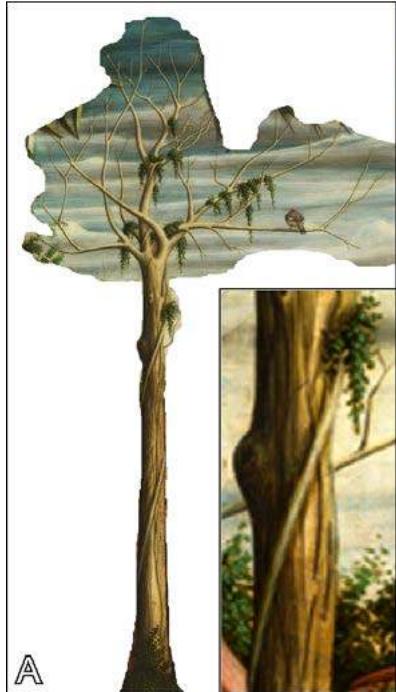
Figure 7.
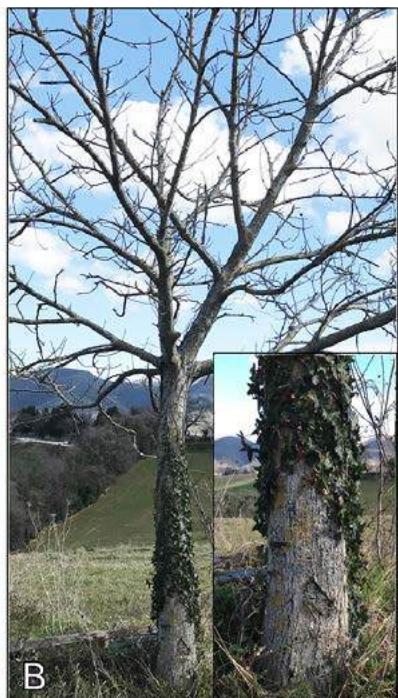
Figure 14: (A) The tall walnut tree in Crivelli's painting of Blessed Gabriele Ferretti. In the inset, a close-up image of the tree trunk wrapped by a climbing ivy; (B) A live walnut tree (Juglans regia) from a plantation in the village of Moscosi (Cingoli) with the trunk wrapped by a climbing ivy (Hedera helix).
In Crivelli's painting (Figure 1), between the outcrop of pink rocks and the shore of the pond with the ducks there is a thick forest, which separates the Cònero landscape on the left from the Ancona landscape on the right (Figure 15A). The trees may be holm oaks (Quercus ilex), an evergreen plant endemic to Monte Cònero (Figure 15B) and other Mediterranean forests. Finally, along the side of the San Francesco church, there are shrubs, which may represent strawberry trees (Arbutus unedo) (Figure 16A). This plant, called corbezzolo in Italian and a main component of the macchia mediterranea (Mediterranean scrub), is the one that gave the name to Monte Cònero. In fact, the word Cònero derives from the old Greek word κομαροσ (pronounced κὸmaros). This evergreen plant, which produces bright red lychee-like fruits in late autumn, besides its symbolic significance of eternal life and hospitality, is still used today as a gardening decorative plant all over the world but grows spontaneously everywhere in the holm oak forests of Monte Cònero (Figure 16B).
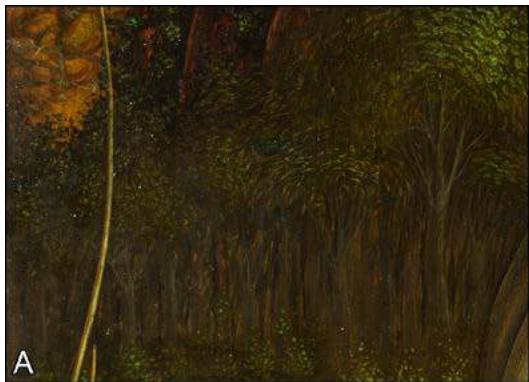
Figure 7. (C) and D) are the RGB color values analysis from the W2 member of the Scaglia Bianca and the Brown member of the Marne a Fucoidi formations, respectively.
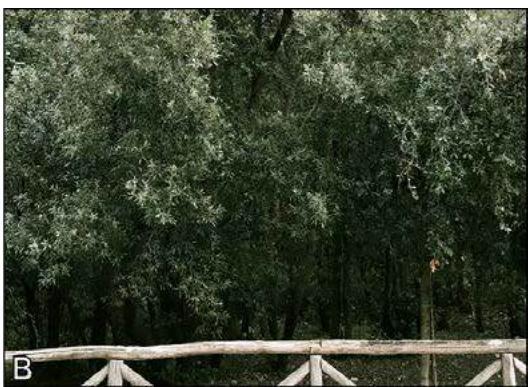 Figure 15: (A) The dark thicket of trees at the foot of the pink rocks in Crivelli's painting of 'Blessed Gabriele Ferretti'; (B) A thicket of holm oaks (Quercus ilex) near the lake of Portonovo at the foot of Monte Cònero.
Grasses: Sparse on the rocky floor surrounding the pond in Crivelli's painting, there are numerous tufts of grass exhibiting different foliage. However, it must be said that in this case
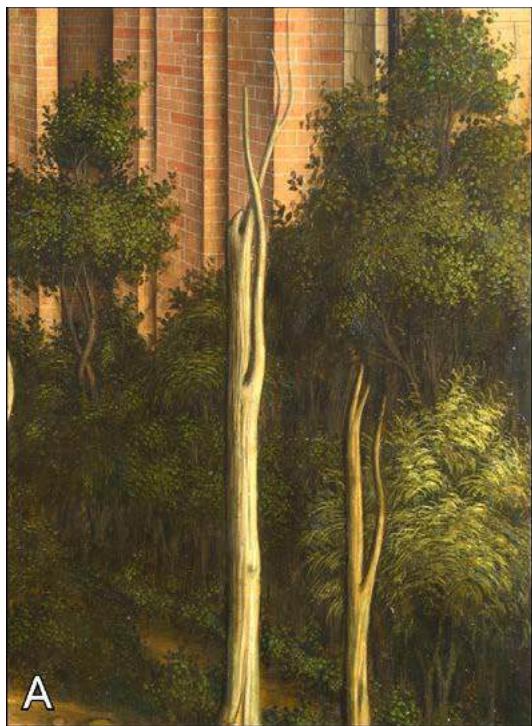
Figure 3). Note that the R2 member of the Scaglia Rossa at Monte Cònero exhibits a whitish color unlike in the rest of the Umbria-Marche Apennines (Montanari et al. 1989); K = Cretaceous; Pg = Paleogene. The Marchesini Level aka MegaT is a thick turbiditic calcarenite found about 80 cm above the K-Pg chronostratigraphic boundary (Montanari et al. 2016,
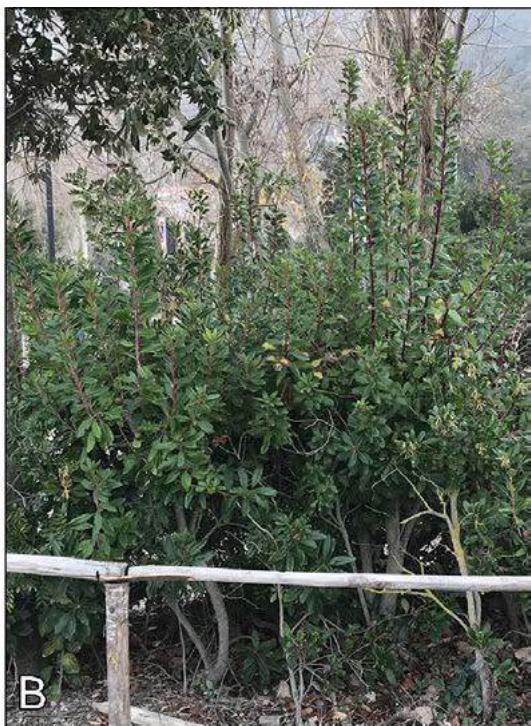 Figure 16: (A) Shrubs along the side of the San Francesco ad Alto church in Clivelli's painting of 'Blessed Gabriele Ferretti'; (B) Strawberry tree shrubs (Arbutus nuedo) in the parking lot near the lake of Portonovo at the foot of Monte Cònero.
Crivelli did not manifest the same remarkable scientific accuracy he used in portraying the gold finch and the mallard ducks described above. Nevertheless, these botanical features may also refer to the environment surrounding the lake of Portonovo. This brackish lake is today surrounded by, and partially engulfed with, common swamp reeds (e.g., Phragmites cf. australis) but also rare spiny rushes such as Juncus acutus, a plant particularly adapted to saline environments (e.g., Montanari et al. 2021, p. 4 and references therein). Such a widespread profusion of swamp reeds is actually absent in Crivelli's painting. Instead, the sparse tufts of reed plants on the rocky surrounding of the pond (Figure 17A1) may represent Calamagrotis cf. acutiflora, a common plant growing in the holm oak and strawberry tree underbrush of Portonovo (Figure 17A2). Yet, this plant also grows on dry, soil-less rocky surfaces (Figure 17A3), such as the probable desolate landscape of Portonovo after the catastrophic landslide of 1319 A.D. (Montanari et al. 2016).
A small leafed grass growing on bare rock (Figure 17B1) in Crivelli's painting, may represent a typical plant of the rocky Riviera of Monte Cònero known locally as 'paccasassi' (meaning rock splitter in local dialect), which represents the edible marine fennel (Crithmum maritimum; Figure 17B2). This species is the terrestrial plant that grows nearest to the sea in a rocky supralittoral zone (e.g., figure 5 in Montanari et al. 2019). On the other hand, a grass resembling an edible sow-thistle in Crivelli's painting, which is characterized by pinnate leaves (Figure 17C1), probably represents the common and widespread Sonchus oleraceus locally known as 'crispigna' (Figure 17C2). Finally, a star-shaped, flat-on-the-ground plant characterized by oblong-attenuated basal leaves, which Crivelli placed below his signature (Figure 17D1), may bear a symbolic significance. The same kind of basal rosetta-leafed plant in Crivelli's painting have sprouts of tiny purple flowers (Figure 17D2). This plant may represent an orchid similar to Orchis cf. simian (Figure 17D3), a common spontaneous orchid of Monte Cònero.
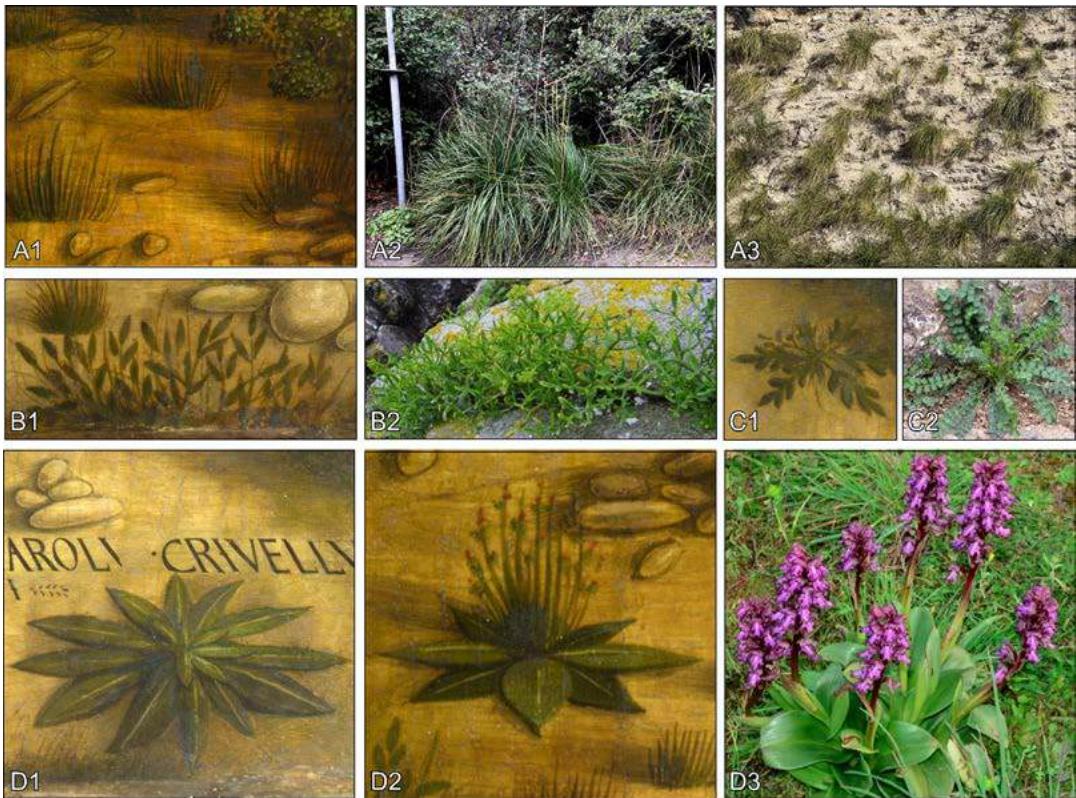
Figure 17: (A1) Turfs of reed grass in Crivelli's painting Beato Gabriele Ferretti; (A2) Turfs of reed grass Calamagrotis cf. acutiflora in the underbrush of the strawberry tree and holm oak forest at Portonovo of Monte Cònero; (A3) Turfs of reed grass growing on an outcrop of Scaglia Variegata marly limestone;(B1) Small leafed grass, probably Crithmum maritimum, aka sea fennel, in Crivelli's painting of 'Blessed Gabriele Ferretti'; (B2) Crithmum maritimum of Monte Cònero also known as 'paccasassi' in local dialect, which means rock splitter in English; (C1) A grass resembling a sow-thistle (Sonchus oleraceus) grass in Crivelli's painting of 'Blessed Gabriele Ferretti'; (C2) Sonchus oleraceus of Monte Cònero locally known as 'crispigna'; (D1) A star-shaped, flat-on-the-ground plant in Crivelli's painting of 'Blessed Gabriele Ferretti' characterized by oblong-attenuated basal leaves; (D2) The same kind of leafed plant in Crivelli's painting but with a sprout of tiny purple flowers; (D3) Orchis simian, a common spontaneous orchid of Monte Cònero.
IV. THE LANDSCAPE AND GEOLOGY IN 15TH CENTURY RENAISSANCE PAINTINGS
The landscape, as no longer a secondary element in pictorial art, starts to have a relevant role in century Flemish paintings where it is often represented realistically with great attention but always as the background of human figures and architectural features. In Florence in the 1400s, concurrently with the study of, and great attention to the perspective, the landscape, while depicted with precision, still constituted the prospective plan of a painting in which figures, architecture, and events are the protagonists of the foreground in the center of the pictorial composition.
Absolutely innovative are the portraits of the Dukes of Urbino by Piero della Francesca (1473–1475), in which the landscape in the background, in addition to giving prominence to the imposing portraits of the Duke and Duchess, represented a precise territorial context. In this masterpiece, the landscape acquired an extraordinary uniqueness rich in details, with panoramic as well as naturalistic glimpses eventually touching topographic perfection. Borchia and Nesci (2012) were able to demonstrate the perfect resemblance with some specific features of the Montefeltro landscape (i.e., the Apennine region in the northern Marche under the domain of the Duke of Urbino), today partially modified and reshaped after successive geomorphological events. Thus, it is no longer an ideal landscape put there as a symbolic or simple wing of a theater stage but a realistic landscape.
In the same way, in the paintings of Antonio del Pollaiolo (1433–1498) emerged an initial interest for the realistic representation of the Tuscan and the Arno River valley landscapes, which were observed and reproduced with Flemish expertise, and with evident references to the scientific naturalism from the canonical paintings of Leon Battista Alberti, particularly his architectural treatise De re aedificatoria (1443–1452), first printed in Florence in 1485.
Some Venetian artists between the end of the 1400s and the beginning of the 1500s also inserted realistic landscapes in their paintings but no longer relegated to the background or as a simple supporting actor of the protagonist human figure and the actions of mythological or Renaissance men, but as an element gifted with autonomous life. In the Venetian region, this new spatiality is evident in the paintings of Andrea Mantegna, probably influenced by Leon Battista Alberti, and his brother-in-law Giovanni Bellini, as one can see in his two versions of Orazione nell'Orto(1455 and 1459, respectively), which are on display next to each other in the National Gallery of London.
This innovative pictorial process culminated with Leonardo da Vinci, who thanks to the combination of his extraordinary artistic talent and his immense scientific knowledge, instilled in the landscape a new dimension rightly admired for the meticulous depiction of reality and for the attention to the multiple and changing aspects of nature, including geological and hydrological phenomena.
Only these few painters, like Mantegna and above all Leonardo, had the ability to faithfully paint the geology of a territory, long before Ulisse Aldrovandi from Bologna coined the term Geologia in 1603, and Niccolò Stenone (aka Steno), enunciated the fundamental laws of stratigraphy in the second half of the 17th century, (Coccioni 2019; Sdao 2021; Vai 2003, 2021).
In his architectural treatise, Leon Battista Alberti mentioned the various lithologies normally used in building construction, which he simply called 'pietre' (i.e., stones) stating that he did not want to talk at length about these stones and take a position about the various theories proposed in the past on the 'origini delle pietre' (the origins of the stones). Nevertheless, he briefly discussed the possible processes that could occur during the diagenesis of once loose sediments "... que' principii viscosi per la commistione dell'acqua, e della terra, prima in fango, dipoi in pietra s'induriscono" (... which at first viscous due to the mixing with water and dirt, first as mud and then in stone they become hard) (Romano 2019).
Leonardo's Vergine delle Rocce (1483–1486), amazes the viewer with the precision and accuracy with which the artist represents complex rock formations to be the setting of his pictorial composition. In the famous painting Cristo Morto by Mantegna (circa 1470–1483), art students tried to give a name to the unction stone, which is identified as two sedimentary carbonate rocks, i.e., the pink stone from the Lessini Mountains (near Padua) or the pink 'marble' of Asiago (northern Venetian region), whereas in the painting Madonna delle Cave, Andrea Mantegna actually illustrated the quarrying operation of these building stones (Conti 2021; Vai 2009).
V. CONCLUSIONS
A close analysis of Carlo Crivelli's painting, which portrays the central subject of a blessed Friar Gabriele Ferretti praying in ecstasy at the miraculous apparition of the Virgin Mary on the Colle Astagno hill of Ancona (Marche region of central-eastern Italy), reveals to us that most of the various particular details making up the background of this painting, refer to architectural, scenic, and environmental features of the medieval city of Ancona, where the artist actually made this masterpiece around 1489, and the nearby Monte Cònero, also known as Il Monte di Ancona. The panoramic scenery of the far background is undoubtedly that of the Adriatic gulf of Ancona surrounded by coastal hills, while a view of the Apennine Mountains in the distance would be the first iconographic representation of the central Marche Ridge. On the other hand, a large outcrop of thinly bedded rocks exhibiting an unusual pink color, is chromatically consistent with the upper Cretaceous-lower Paleogene pelagic limestone of the Scaglia Rossa Fm, the most widespread geological formation exposed throughout the Umbria-Marche Apennines. Considering the geographic and environmental context of Crivelli's painting, we deduce that Crivelli's pink rocks represent the Scaglia Rossa Fm exposed on the western slope of Monte Cònero, whereas various faunal and floral details surrounding these rocks refer to the Portonovo Bay, at the northern foot of the northwest-facing slope of Monte Cònero. This would be the first iconographic representation of the Scaglia Rossa Formation.
In conclusion, the pink rocks of Carlo Crivelli represent the Scaglia Rossa pelagic limestone, which today is famous worldwide in the Earth sciences community for the innumerable pioneering studies dealing with major events that punctuated the history of Earth leading to sensational discoveries and discontinuities in scientific thinking. In fact, it is the Scaglia Rossa Fm that provided the basis for the first direct correlation of the upper Cretaceous-lower Paleogene magnetostratigraphy with the biostratigraphic time scale, thereby permitting a precise estimate of the age of the Marine Magnetic Anomalies and oceanic seafloor spreading rates (Alvarez et al. 1977; Lowrie 2016). Moreover, the Scaglia Rossa Fm bears the record of a major Cretaceous anoxic event expressed by the Bonarelli Level (see Alvarez and Sannipoli 2016; Batenburg et al. 2016, and references therein), which represents the much-debated global Oceanic Anoxic Event 2 (OAE-2). The Scaglia Rossa Fm also contains the striking Cretaceous-Paleogene (K-Pg) boundary event including the first evidence for a global mass extinction caused by a catastrophic extraterrestrial impact (Alvarez et al. 1980; Montanari et al. 1983; Montanari and Coccioni 2019, and references therein), and the hyperthermal events of the Eocene Epoch (e.g., Coccioni et al. 2016). Ultimately, this amazing formation allowed the calibration of portions of the astrochronological time scale via multiproxy cyclostratigraphic analysis (Franceschi et al. 2015; Sinnesael et al. 2016; Coccioni et al. 2022; Gale et al. 2023). And Carlo Crivelli was the first to notice such an attractive pink rock, which was destined to become a major protagonist in Earth Sciences history.
ACKNOWLEDGEMENTS
This research was financially supported by the non-profit Association "Le Montagne di San Francesco" (www.coldigioco.org). We would like to thank Dr Nathan Church (Norwegian University of Science and Technology) who first brought to our attention Crivelli's painting that he serendipitously saw in the National Gallery of London, and for proof-reading the first draft of this paper. A special thanks goes to Ten. Col. Emanuele Vergine, Infrastructure Manager of the military presidium of Ancona, for kindly having accompanied us in a surveying tour of the former San Francesco ad Alto convent. We would like to thank artist and art historian Paula Metallo (www.paulametallo.com) for helping us in the study of Crivelli's self portraits. A special thank goes to Editor John Diemer, for accepting our manuscript for publication in Earth Sciences History, pending minor revisions, Prof Gian Battista Vai (University of Bologna) for his constructive yet positive review of the original manuscript, and an anonymous second reviewer for interesting comments about some Renaissance humanistic aspects of our scientific research work. Last but not least, we would like to thank Dr Viviana Caravaggi Vivian and Dr Roberto Barbini from the civic gallery Pinacoteca of Ancona for granting us the permission to reproduce images of Barnaba Mariotti's paintings of Porta del Calamo, and the National Gallery of London for granting us the permission to reproduce the image of Crivelli's painting 'The Vision of the Blessed Gabriele'.
-
Albertini, Camillo.
-
Storia d'Ancona dal 1400 al 1480. Luciano Benincasa, Municipal library of Ancona, 22 libri mss.
-
Alvarez, Walter.
-
The Mountains of Saint Francis. New York: W. W. Norton, 304 pp. Alvarez, Walter.
-
A review of the Earth history record in the Cretaceous, Paleogene, and Neogene pelagic carbonates of the Umbria-Marche Apennines (Italy): Twenty years of the Geological Observatory of Coldigioco. In: 250 Million Years of Earth History in Central Italy: Celebrating 25 years of the Geological Observatory of Coldigioco, edited by C. Koeberl, and D. M. Bice, 1–58. Geological Society of America Special Paper 542.
-
Alvarez, Walter, and Sannipoli, Ettore.
-
Guido Bonarelli and the geological discovery of the Bottaccione Gorge at Gubbio. In: The Stratigraphic Record of Gubbio, edited by M. Menichetti, R. Coccioni, and A. Montanari, 1–11. Geological Society of America Special Paper 524.
-
Alvarez, Walter, et al.
-
Upper Cretaceous–Paleocene magnetic stratigraphy at Gubbio, Italy;
V. Type section for the Late Cretaceous– Paleocene geomagnetic reversal time scale. Geological Society of America Bulletin 88: 383–389.
-
Alvarez, Luis Walter, Alvarez, Walter, Asaro, Frank, and Michel, Helen.
-
Extraterrestrial cause for the Cretaceous-Tertiary extinction. Science 208: 1095–1108.
-
Anonymous.
-
Uccelluzzi o cardellini? digilander.libero.it/cardellini1/Ita/cardellino2.htm. Alvarez, Walter, and Lowrie, William.
-
Magnetic stratigraphy applied to synsedimentary slumps, turbidites, and basin analysis: The Scaglia limestone at Furlo (Italy). Geological Society of America Bulletin 95: 324–336.
-
Baldanza, Angela, et al.
-
The Jurassic structural high of Sasso di Pale (Umbria-Marche Basin, Italy): How a small Apennine structure recorded Early to Middle Jurassic global perturbations. In: From the Guajira Desert to the Apennines, and from Mediterranean Microplates to the Mexican Killer Asteroid: Honoring the Career of Walter Alvarez, edited by C. Koeberl, P. Claeys, and A. Montanari, 267–309. Geological Society of America Special Paper 557.
-
Battenburg, Sietske, J. et al. 2016, Orbital control on the timing of oceanic anoxia in the Late Cretaceous. Climate of the Past 12: 1995–2009.
-
Beni Culturali.
1995. Sant'Antonio da Padova sulnoce e Santi. http://catalogo.beniculturali.it/detail/HistoricOrArtisticProperty/0500402380.
-
Bernabei, Lazzaro.
-
Croniche Anconitane transcription et insieme reducte per me Lazzaro. de'Bernabei Anconitano, Manuscript in Luciano Benincasa municipal library of Ancona, n. 235, ff.102v 103r.
-
Bice, David M., Montanari, Alessandro, and Rusciadelli, Giovanni.
-
Earthquake-induced turbidites triggered by sea level oscillations in the Upper Cretaceous of Italy. Terra Nova 18:387–392. Borchia, Rosetta, and Nesci, Olivia.
-
The Invisible Landscape. Ancona: Il Lavoro Editoriale Ed. Burattini, Francesco.
-
I sentieri del lavoro e del piacere. Guida escursionistica al Parco del Conero con carta escursionistica e carta panoramica allegate. Author published, Grafiche Ricciarelli di Monsano (AN). 437 pp.
-
Casalini, Primo.
-
Il politico di Sant'Emidio. Arengario. http://arengario.net/momenti/momenti51.html Coccioni, Rodolfo.
-
Leonardo da Vinci: Rocce, fossili e altre simili cose. Aras Edizioni, 241 pp. Coccioni, Rodolfo.
2020. Revised upper-Barremian-upper Aptian planktonic foraminiferal biostratigraphy of the Gorgo a Cerbara section (central Italy). Newsletter on Stratigraphy 53/3: 275–295. DOI: 10.1127/nos/2019/0539.
-
Coccioni, Rodolfo, and Galeotti, Simone.
-
The mid-Cenomanian event; prelude to OAE 2. Palaeogeography, Palaeoclimatology, Palaeoecology 190: 427–440.
-
Coccioni, Rodolfo, et al.
-
An integrated stratigraphic record of the Palaeocene–lower Eocene at Gubbio (Italy): New insights into the early Palaeogene hyperthermals and carbon isotope excursions. Terra Nova 24: 380–386.
-
Coccioni, Rodolfo, et al.
-
Integrated stratigraphy of the Lutetian-Priabonian pelagic section at Bottaccione (Gubbio, central Italy): A proposal for defining and positioning the Global Stratotype Section and Point (GSSP) for the base of the Bartonian Stage (Paleogene System, Eocene Series). In: From the Guajira Desert to the Apennines, and from Mediterranean Microplates to the Mexican Killer Asteroid: Honoring the Career of Walter Alvarez, edited by C. Koeberl, P. Claeys, and A. Montanari, A., 311–346. Geological Society of America Special Paper 557.
-
Cogliandro, Fabiola, and Tittarelli, Marco.
-
Insiedamenti Francescani ad Ancona. La chiesa di San Francesco ad Alto. In: Atti del Convegno Internazionale (10-11 may 2021). Roma: Sapienza Università Editrice.
-
Conti, Silvia.
-
Quella passione del Mantegna per la geologia. Artribune https://www.artribune.com/arti-visive/archeologia-arte-antica/2021/05/andrea-mantegna-geologia/Dal Bello, Mario.
-
Crivelli torna a splendere. Città Nuova. Cultura e informazione, October 12, 2021. Città Nuova (cittanuova.it).
-
De Bosis, Francesco.
-
La Grotta degli Schiavi. Società Italiana di Scienze Naturali 3: 1–6. De Marchi, Andrea, and Mazzalupi, Matteo.
2008. Pittori ad Ancona nel Quattrocento. Federico Motta editore. ISBN 978-88-7179607-9 (p. 304).
-
Ferretti, Lando.
-
Historia d'Ancona. Manuscript, Luciano Benincasa municipal library of Ancona.
-
Franceschi, Marco, et al.
-
Terrestrial Laser Scanner imaging for the cyclostratigraphy and astronomical tuning of the Ypresian–Lutetian pelagic section of Smirra (Umbria–Marche Basin, Italy). Palaeogeography, Palaeoclimatology, Palaeoecology 440: 33–46.
-
Gale, Andy, et al.
-
The Global Boundary Stratotype Section and Point (GSSP) of the Campanian Stage at Bottaccione (Gubbio, Italy) and its auxiliary sections: Seaford Head (UK), Bocieniec (Poland), Postalm (Austria), Smoky Hill, Kansas (U.S.A), Tepayac (Mexico). Episodes 46:451–490.
-
Gasparini, Carlo.
-
Le Glorie Francescane nell'Ill.ma Provincia del Piceno, In variati Capitoli distinte, e poste, da Me fra Carlo Gasparini, uno dei suoi Figli. Manuscript, Biblioteca Comunale, Ancona. Gonzaga, Francesco.
-
De origine seraphicae religionis Franciscanae, eiusque progressibus, de regularis observantiae institutione, forma administration, ac legibus, admirabilique eius propagazione. Ex Typographia Dominici Basae, Roma.
-
Lowrie, William.
-
A history of paleomagnetic investigations in the Umbria-Marche Apennines. In: The Stratigraphic Record of Gubbio, edited by M. Menichetti, R. Coccioni, and A. Montanari, 19–33. Geological Society of America Special Paper 524.
-
Mariano, Fabio.
-
Il complesso di San Francesco ad Alto a Capodimonte. Storia, architettura, restauri del primo insediamento francescano in Ancona. Fermo: Andrea Livi Ed. 64 pp.
-
Montanari, Alessandro, Chan, Lung San, and Alvarez, Walter.
-
Synsedimentary tectonics in the Late Cretaceous-Early Tertiary pelagic basin of the Northern Apennines. In: Controls on Carbonate Platforms and Basin Development, edited by P. Crevello, J. L. Wilson, R. Sarg, and F. Reed, 379–399. SEPM Special Publication 44.
-
Montanari, Alessandro, and Coccioni, Rodolfo.
-
The serendipitous discovery of an extraterrestrial iridium anomaly at the Cretaceous-Palaeogene boundary in Gubbio and the rise of a far-reaching theory. Bollettino della Società Paleontologica Italiana 58: 77–83.
-
Montanari, Alessandro, et al.
-
Spheroids at the Cretaceous-Tertiary boundary are altered impact droplets of basaltic composition. Geology: 11 668–671.
-
Montanari, Alessandro, et al.
-
Pelagosite revisited: The origin and significance of a laminated aragonitic encrustation of Mediterranean supralittoral rocks. In: 250 Million Years of Earth History in Central Italy: Celebrating 25 Years of the Geological Observatory of Coldigioco, edited by C. Koeberl, and D. M. Bice, 501–532. Geological Society of America Special Paper 542.
-
Montanari, Alessandro, et al.
2021. Stygobitic crustaceans in an anchialine cave with an archeological heritage at Vodeni Rat (Island of Sveti Klement, Hvar, Croatia). International Journal of Speleology 50: 1–14.
-
Montanari, Alessandro, and Koeberl, Christian.
-
Impact Stratigraphy: The Italian Record. Lecture Notes in Earth Sciences. Springer, 364 pp.
-
Montanari, Alessandro, Mainiero, Maurizio, Coccioni, Rodolfo, and Pignocchi, Gaia.
-
Catastrophic landslide of Medieval Portonovo (Ancona, Italy). Geological Society of America Bulletin 118: 1660–1678.
-
Montanari, Alessandro, and Pignocchi, Gaia.
2022. Frasassi: La Piccola Grande Storia delle Grotte. E Book, Federazione Speleologica Marchigiana Ed. www.speleomarche.it.
-
Mortaruolo, Ivano.
-
La rondine, il cardellino e il rigogolo nelle opere del pittore Carlo Crivelli (1430/35-1494/95). Italia Ornitologica, F.O.I. Onlus 3: 23–28.
-
Oliver.
2023. The Spiritual Symbolism and Meaning of Mallard Ducks. Sacred Symbo. https://sacredsymbo.com/spiritual-meaning/mallard-ducks
-
Peers, C. R.
-
The Early Italian Painters. White Fish, USA: Kessinger Publishing, 272 pp. Peruggi, Fulvio.
-
Fisica della Visione, Lezione 17. Università degli Studi di Napoli Federico II. http://www.docenti.unina.it/webdocenti-be/allegati/materiale-didattico/34241541. Regione Marche.
2003. Carta Geologica Progetto "Unico Territoriale Geologico" 1:10,000: Centro Cartografico Regione Marche, scale 1:10,000, http://www.ambiente.marche.it/
-
Romano, Marco. 2019. "L'uomo universale del primo Rinascimento": la geologia nel De re aedificatoria di Leon Battista Alberti. Rendiconti Online della Società Geologica Italiana 47:185–201. https://doi.org/10.3301/ROL.2018.72
-
Sdao, Francesco.
-
Leonardo da Vinci nel V centenario della morte. https://iris.unibas.it/retrieve/dd9e0b51-79a5-1e84-e053-3a05feoaa940/Leonardo_Geologia.pdf Sinnesael, Matthias, et al.
-
High-resolution multiproxy cyclostratigraphic analysis of environmental and climatic events across the Cretaceous-Paleogene boundary in the classic pelagic succession of Gubbio (Italy). In: The Stratigraphic Record of Gubbio: Integrated Stratigraphy of the Late Cretaceous–Paleogene Umbria-Marche Pelagic Basin, edited by M. Menichetti, R. Coccioni, and A. Montanari, 115–137. Geological Society of America Special Paper 524.
-
Talamonti, Antonio.
-
Cronistoria dei frati Minori della Provincia Lauretana delle Marche, II, Sassoferrato 1939, pp. 27–108.
-
Vai, Gian Battista.
-
The Scientific Revolution and Nicholas Steno's twofold conversion. In: The Revolution in Geology from the Renaissance to the Enlightenment, edited by G. D. Rosenberg, 187–208. Geological Society of America Memoir 203.
-
Vai, Gian Battista.
-
Leonardo da Vinci's and Nicolaus Steno's geology. Earth Sciences History 40(2): 293–331.
-
Vai, Gian Battista.
-
Aldrovandi's will introducing the term 'Geology' in 1603. In: Four Centuries of the Word Geology: Ulisse Aldrovandi 1603 in Bologna, edited by G. B. Vai and W. Cavazza, 65–111. Bologna: Minerva Edizioni.
Conflict of Interest
The authors declare no conflict of interest.
Ethical Approval
Not applicable
Data Availability
The datasets used in this study are openly available at [repository link] and the source code is available on GitHub at [GitHub link].
Funding
This work did not receive any external funding.
References
Cite this article
Related Research


Special Issue
Launch a focused special issue to highlight research, emerging trends, and expert insights in your academic field.
