




IntelliPaper
Abstract
The growing body of publications on the synthesis of 1,3-diazine-bridged systems has drawn increasing attention to these compounds. The aim of our work was to synthesise novel bisazomethines derived from 4,6-dihydroxy-2-methylpyrimidine-5-carbaldehyde (1). A series of Schiff bases was obtained via nucleophilic addition of aliphatic diamines to the carbonyl group of substrate 1. Water was employed as the sole solvent during synthesis, affording target products in 85–90% isolated yields. Structural confirmation was achieved by ¹H and ¹³C nuclear magnetic resonance (NMR) spectroscopy. In silico screening (PASS Online, CLC-pred, Antivir-pred, and GUSAR Online) revealed that the synthesised bisazomethines exhibit broad-spectrum bioactivity, including antihypertensive, antibacterial, and anticancer properties, while maintaining Class 4 toxicity (low risk). Thus, we report novel bridged bisazomethines based on a 5-formyl derivative of 2-methylpyrimidine-4,6-diol, which combine a promising safety profile with multifaceted biological activity.
Explore Digital Article Text
I. INTRODUCTION
Nitrogen-containing heterocyclic systems are among the most significant structures used in the synthesis of active pharmaceutical ingredients. Classically, compounds containing 1,3-diazine cycle are used in the therapy of oncological, cardiovascular and infectious diseases [1]. Active pharmaceutical substances such as imatinib, bosentan, trimethoprim, voriconazole and many others owe their pharmacological action also to the pyrimidine moiety (Fig. 1). It is pertinent to note that compounds containing azomethine groups exhibit a broad spectrum of biological activity, including antibacterial, antidepressant, and neuroprotective properties [2,3]. Importantly, metal-organic complexes derived from pyrimidine-based bisazomethines demonstrate significant promise as antibacterial and antifungal agents [4,5]. However, as is well documented, microbial resistance to antimicrobial agents continues to rise inexorably, while oncological and cardiovascular diseases remain unconquered. This is what makes it necessary to continuously search for new biologically active molecules potentially capable of prolonging human life and improving its quality. The aim of our study was to synthesise novel bisazomethines derived from 4,6-dihydroxy-2-methylpyrimidine-5-carbaldehyde, which preliminary in silico screening suggests may exhibit antihypertensive, antibacterial, and antitumour activities. In this work, we developed a laboratory-scale synthetic route to both 5,5'-{1,2-ethylenebis [azanylylenem ethylidenyl]}bis(2-methylpyrimidine-4,6-diol) and 5,5'-{propane-1,2-diylbis [azaniliden emethylidenyl]}bis(2-methylpyrimidine-4,6-diol) with high isolated yields (80% and 90%, respectively).
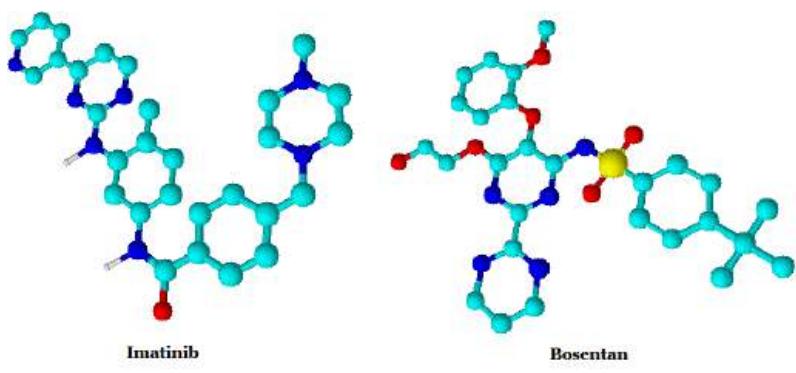 Figure 1: Structural formulas of imatinib and bosentan
II. MATERIAL AND METHODS
Preliminary screening of biological activity was performed using specialised web resources. PASS-online [6] was used as the most extensive database in terms of the number of putative activities, CLC-pred was used to analyse the possibility of antitumour activity, and Antivir-pred was necessary to study the obtained structures for antiviral activity. The estimated acute toxicity profile was assessed using the GUSAR-online web resource.
The carbonyl component used was 4,6-dihydroxy-2-methylpyrimidine-5-carbaldehyde (1), which was prepared according to previously developed method by the interaction of 2-methylpyrimidin-4,6-diol with Vilsmeyer's reagent in the ratio of phosphorus chloride to substrate 1:1 in dimethylformamide [7].
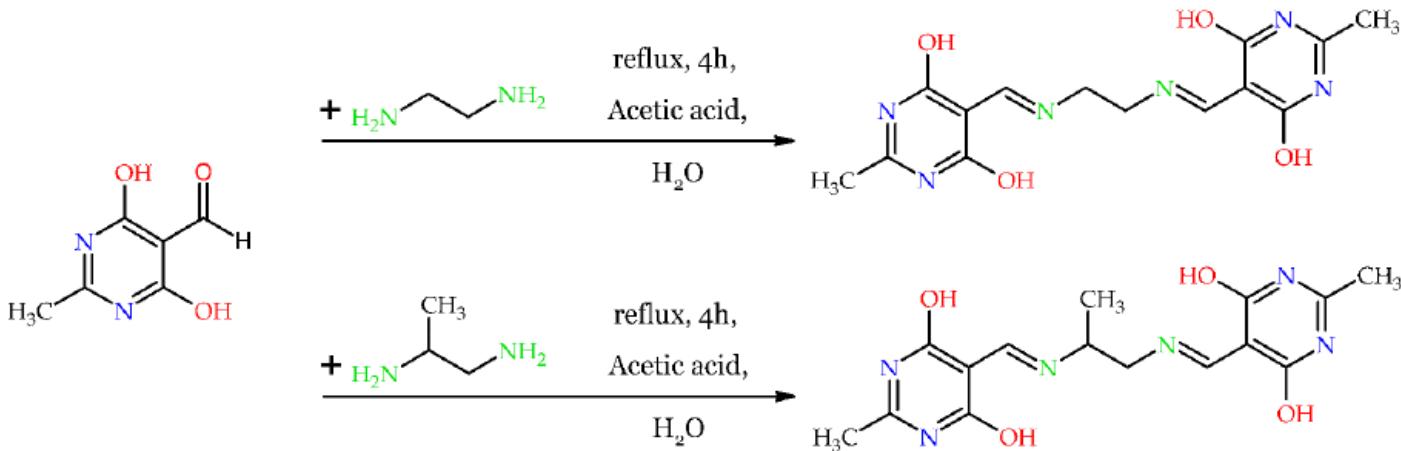
The target bisazomethines, 5,5'-{1,2-ethylenebis [azanilidenemethylidene]} bis (2-methylpyrimidine -4,6-diol) and 5,5'-{propane-1,2-diylbis [azanilidenemethylidene]} bis (2-methylpyrimidine-4,6-diol), were prepared by the interaction of 4,6-dihydroxy -2-methylpyrimidine-5-carbaldehyde with bisnucleophilic components such as ethane-1,2-diamine and propane-1,2-diamine in a ratio of 2:1 in aqueous medium with the addition of catalytic amounts of acetic acid (Fig. 2).
 Figure 2: Scheme for the synthesis of bisazomethine derivatives based on
4,6-dihydroxy-2-methylpyrimidine-5-carbaldehyde
The synthesis was monitored by thin-layer chromatography by the absence of substrate 1 in the reaction mass. A mixture consisting of methanol, dichloromethane and hexane in the ratio of 1:9:1 was used as a mobile phase. Detection was performed at 254 nm (UV). The structure of the products was proved by H and C nuclear magnetic resonance spectroscopy.
2.1. Synthesis of 5,5'-lethane-1,2-diylbis bis(2-methylpyrimidine-4,6-diol) (2)
4,6-dihydroxy-2-methylpyrimidine-5-carbaldehyde was suspended in 20 mL of water in an amount of 0.22 grams (1.42 mmol) and to this suspension was added 0.04 grams (0.7 mmol) of ethane-1,2-diamine and a catalytic amount of acetic acid (0.03 mmol). The reaction mixture was further heated with a reflux condenser for 4 hours under constant stirring. The synthesis was monitored by thin layer chromatography by the absence of substrate 1 in the reaction mixture. The obtained beige precipitate was filtered off. The practical yield of product 2 was 85%.
Nuclear magnetic resonance spectrum data H (400 MHz, DMSO- ), δ, ppm, of product 2: 2.23 s (5.99H, -CH ), 3.62 s (3.78 H, -CH -), 8,49 s (1.98 H, N=CH-), 11,44 s (3.64 H, -OH).
Nuclear magnetic resonance spectrum data C (100 MHz, DMSO- ), δ, ppm, of product 2: 19.39 (-CH ), 59.64 (-CH -), 98.77 (C ), 160.12 (C ), 163.57 (C , C ), 166.87 (N=CH-).
2.2. Synthesis of 5,5'-bis(2-methylpyrimidine-4,6-diol) (3)
0.22 grams (1.42 mmol) of 4,6-dihydroxy-2-methylpyrimidine-5-carbaldehyde was suspended in 20 mL of water, 0.05 grams (0.7 mmol) of propane-1,2-diamine and a catalytic amount of acetic acid (0.03 mmol) were added to this suspension. The reaction mixture was further heated with a reflux condenser for 4 hours under constant stirring. The synthesis was monitored by thin layer chromatography by the absence of substrate 1 in the reaction mixture. The obtained beige precipitate was filtered off. The practical yield of product 3 was 90% (Fig. 3).
Nuclear magnetic resonance spectrum data H (400 MHz, DMSO- ), δ, ppm, of product 3: 1.26 d (3.02H, ), 2.11 s (5.95 H, , ), 3.76 m (1.96 H, ), 4.08 s (1.07 H, ), 8.29 s (2H, , ), 11.38 (3.25H, -OH).
Nuclear magnetic resonance spectrum data C (100 MHz, DMSO- ), δ, ppm, of product 3: 18.39 ( ), 20.19 ( ), 47.64 ( ), 53.74 ( ), 98.07 ( ), 160.12 ( ), 162.77 ( , ), 167.47 ( ).
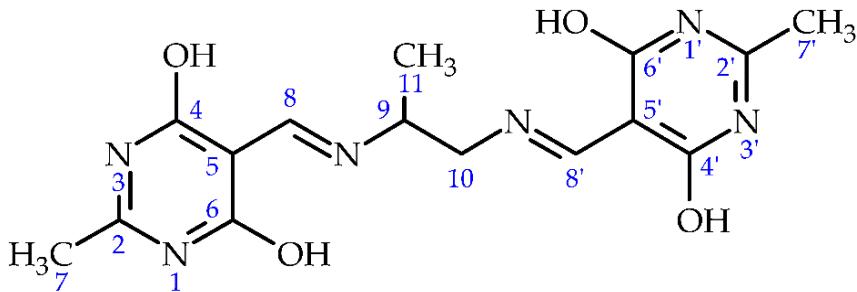 Fig. 3: Structural formula of 5,5'-{propane-1,2-diylbis [azanilidenemethylidene]} bis (2-methylpyrimidine-4,6-diol)
III. RESULTS
Based on screening data using the web resources PASS Online, CLC-pred, and Antivir-pred, the obtained compounds exhibit a high probability of antihypertensive activity, oligodendroglioma-targeted activity, and antiviral activity against Dengue virus serotype 2 (Table 1).
Table 1: Results of in silico biological activity screening.
| Web resource | Activity | predicted probability, Pa |
| PASS online | I1-imidazoline receptor agonist (antihypertensive) | 0.8 |
| CLC-pred | Activity against oligodendroglioma | 0.5 |
| Antivir-pred | Antiviral activity against Dengue virus serotype 2 | 0.3 |
According to the predicted values of acute toxicity using the web resource GUSAR online, the studied structures belong to class 4 toxicity for intravenous, oral and subcutaneous administration, to class 5 toxicity for intraperitoneal administration (Table 2).
Table 2: Predicted LD50 values depending on route of administration in mg/kg with preliminary assignment to OECD* toxicity classes.
| Intraperitoneal | Intravenous | Oral | Subcutaneous |
| 504 | 158 | 1785 | 822 |
| Class 5 | Class 4 | Class 4 | Class 4 |
*The organisation for economic co-operation and development From the above data, it is evident that the compounds potentially have a high safety profile.
The target compounds were obtained by condensation reaction between pyrimidine-5-carbaldehyde and aliphatic diamines. Their structure was reliably proved by H and C NMR spectroscopy.
Figure 4 shows the 1H NMR (DMSO-d6) spectrum of product 3. The spectrum is characterised by the presence of a singlet signal of the protons of azomethine groups in the region of 8.29 ppm with an integrated intensity of 2.00, a signal of methyl groups bound to pyrimidine rings in the region of 2.11 ppm with an integrated intensity of 5.95 and a hydrogen atom at the tertiary carbon atom in the bridging fragment in the region of 4.08 ppm with an integrated intensity of 1.07. There is also a characteristic multiplet signal of hydrogen atoms of the methylene group of the propylene bridge fragment in the region of 3.76 ppm with an integrated intensity of 1.96, a doublet signal of the methyl group of the bridge fragment in the region of 1.28 ppm with an integrated intensity of 3.02 and a signal of acidic protons of hydroxyl groups in the region of 11.28 ppm.
{"image_source":{"path":"images/b46560875be0159e9537c901e85dcf865b1fa05d08e88429279a2fcaea166e0e.jpg"},"content":"","chart_caption":,"chart_footnote":[]}
IV. CONCLUSIONS
The synthesised compounds are class 4 and 5 according to preliminary acute toxicity screening data. Antihypertensive activity against oligodendroglioma and antiviral activity against Dengue virus serotype 2 are predicted for new bisazomethines with high probability of effect.
The reaction between 4,6-dihydroxy-2-methylpyrimidine-5-carbaldehyde and aliphatic diamines in a 2:1 molar ratio yields novel bisazomethine compounds with isolated yields of 85% and 90%. These derivatives show dual promise as both pharmacologically active agents per se and as synthons for novel metal-organic complexes, which likewise exhibit potential broad-spectrum bioactivity.
Conflict of Interest
The authors declare no conflict of interest.
Ethical Approval
Not applicable
Data Availability
The datasets used in this study are openly available at [repository link] and the source code is available on GitHub at [GitHub link].
Funding
This work did not receive any external funding.
References
Cite this article
Related Research

Special Issue
Launch a focused special issue to highlight research, emerging trends, and expert insights in your academic field.
