


IntelliPaper
Abstract
We pointed out 3 general concerns and 12 problems in Einstein’s theory of special relativity in [1-4], which got positive feedback. Here we present a newly derived “Limited Effect Principle of a Relativistic System.” This research followed our method of analyzing mathematical models from the perspective of reviewing the rationality of physical models first, and used this method to derive the Limited Effect Principle of a Relativistic System. This Limited Effect Principle gives obvious evidence that the theory of relativity is misunderstanding the mathematical world from the physical world, which gives us further confidence that the theory of relativity should no longer lead the scientific and technological thinking of mankind.
Explore Digital Article Text
I. INTRODUCTION
In the Third Concern of [2], we pointed out that "The model of the light ray and the rigid rod does not explain how the two reference bodies are bound to each other? How do they form a relative system?" This caused many problems.
Assuming there are 100 rigid rods, how could Einstein make his ray form a relative system with the No.4 rigid rod he wanted to be relative to? Is there any way to bind his ray and No.4 rod to each other so that they can be relative without disturbed by other rods?
For another example, in the experiment of a clock on the airplane and a ground navy clock, how does the airplane clock know it should be relative to the navy clock? Does the airplane clock also be relative to the clocks on space shuttles, on trains, or on cars....?
Since there are no strict definitions of relative systems, when the two reference bodies that make up the relative system are independent of each other, any object or system that moves inertially will often become the reference body in the relative system unconsciously or passively. We define this situation as Passively Relative.
For example, when using an atomic clock on a spaceship and an atomic clock placed on the ground to do a relativity time dilation test, experts only focus on whether or not the data gained from the ground clock and the clock on the spaceship are different. In reality, however, these two clocks are simultaneously passively relative to many different reference bodies, such as white clouds, airplanes, and even birds flying at a constant speed in the air, the rotation of the Earth, countless cars and trains moving at a constant speed, the African lion running at a constant speed, the whales in the sea ... They all can be passively relative to these two clocks, and there is no way to stop them from being so.
Of course, anyone can imagine one object as only being relative to another specific object, but in reality, there is no way to specify such an exclusively relative object, let alone prevent an object from being passively relative to any other moving objects.
There are many moving objects with different speeds that are passively relative to the atomic clocks on the spaceship and on the ground. According to Einstein's calculations in theory of relativity, they each will have different effects on the time changes of the two clocks. In fact, for Einstein's system, which maintains relative simultaneity, since the participating reference bodies are completely independent of each other, there will be no connection or link between them. Therefore, in actual application calculations, when a reference body is set to be relative to many other moving reference bodies with different speeds at the same time, the relative calculation will produce contradictory results. But we have not had any way to solve the contradiction yet.
Therefore, we first derive a principle to resolve this contradiction, which is the Limited Effect Principle of a Relativistic System, and then use it to resolve this contradiction.
II. DERIVATION OF THE LIMITED EFFECT PRINCIPLE OF A RELATIVISTIC SYSTEM
Einstein's physical models often fail to take into account the application conditions, leading to various errors. Here is an example.
In Section V of [6], Einstein's model shown below gives us a new protagonist, the raven in Figure 1 below:
V. THE PRINCIPLE OF RELATIVITY (IN THE RESTRICTED SENSE)
In order to attain the greatest possible cleanness, let us return to our example of the railway carriage supposed to be travelling uniformly. We call its motion a uniform translation ("uniform" because it is of constant velocity and direction, "translation" because although the carriage changes its position relative to the embankment yet it does not rotate in so doing). Let us imagine a raven flying through the air in such a manner that its motion, as observed from the embankment, is uniform and in a straight line. If we were to observe the flying raven from the moving railway carriage, we should find that the motion of the raven would be one of different velocity and direction, but that it would still be uniform and in a straight line. Expressed in an abstract manner we may say: If a mass is moving uniformly in a straight line with respect to a co-ordinate system , then it will also be moving uniformly and in a straight line relative to a second co-ordinate system , provided that the latter is executing a uniform translatory motion with respect to . In accordance with the discussion contained in the preceding section, it follows that:
If is a Galileian co-ordinate system, then every other co-ordinate system is a Galileian one, when, in relation to , it is in a condition of uniform motion of translation. Relative to the mechanical laws of Galilei-Newton hold good exactly as they do with respect to .
We advance a step farther in our generalization when we express the tenet thus: If, relative to K, K1 is a uniformly moving co-ordinate system devoid of rotation, then natural phenomena run their course with respect to K1 according to exactly the same general laws as with respect to K. This statement is called the principle of relativity (in the restricted sense).
Figure 1: Einstein's Quotation is an excerpt from Section V of [2].
This example of raven caused several errors in the physical model which we discussed in [1, 2]. The more important role of the raven is that it provides a powerful and intuitive example for the doubts in the following questions and the derivation of the principle of Limited Influence of Relative Systems.
Example in Figure 1 provided two relative systems, one is the static system of the raven and the embankment, and the other is the dynamic system of the raven and the moving carriage. When the raven is viewed from the embankment, it keeps flying at a uniform speed; when the raven is viewed from the carriage, the speed of the raven in different directions is different.
Now the question is: when watching the raven's movement from the moving carriage, does the raven's speed really change, or is it just the "feeling" of the man watching the raven in the carriage (i.e., the raven's speed has not really changed)?
Einstein believed that the raven's speed really changed. (Figure 1)
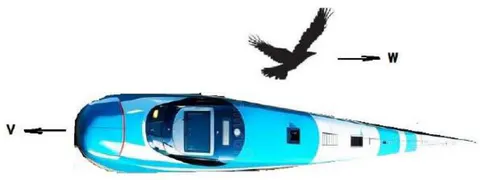
Figure 2: A train moving at a uniform speed and a raven flying at a uniform speed
Einstein's vision focuses on the relative system composed of two uniformly moving objects, the raven and the carriage, as shown in Figure 1. As can be seen from Figure 1 above, when the raven moves in the opposite direction with a uniform speed w, and the train moving at a uniform speed v, the speed of the raven observed by the man in the carriage is w + v; the speed of the carriage observed by the raven is also v + w. This is the result of the mutual observation of the two reference bodies within the relative system, and it is also the result of Einstein's separation of the relative system and its surrounding environment.
A relative system consisting of a pair of independent reference bodies relatively moving at uniform speeds, such as a raven and a train carriage, is limited to the relative system, that is, between the raven and the train carriage (Figure 1). More precisely, it is limited to the senses of the man observing the raven in the train carriage. When the man in the carriage observes the flight of the raven, the speed observed for the movement of the raven in the same direction as the carriage or in the opposite direction is different. This is the data obtained by subjective observation and measurement, which is real to the man in the train as a reference body.
But if we consider the relative system in the real-world environment, as shown in Figure 3:

Figure 3: A train moving at a uniform speed, a raven flying at a uniform speed, and the surrounding real-world environment. Please imagine that when a raven is flying in the sky, a train comes, a train leaves, or a train is near the flying raven as shown in the picture. Will the train have any effect on the raven's flight speed? Will the observation, relative calculation, imagination, etc. of the man in the train have any effect on the raven's flight? There is another lady in the train who wants to keep the raven in a cage.
From Figure 3 as a whole, apart from the train, whether observed from the embankment or from the surrounding trees and land, the raven's flight state and speed have not changed, and are not affected by the thoughts or measurements of the man in the carriage. From this, the following principle can be deduced.
Limited Effect Principle of a Relativistic System: The calculation results within a relative system are only applicable to the two reference bodies within this relative system; the calculation results cannot be taken outside the relative system to apply to the same two objects that are no longer reference bodies.
That is to say, any relative calculation performed in a relative system only applies to the two reference bodies that constitute this relative system, and changes their states as the reference bodies of the system. However, such calculations performed inside this relative system cannot be taken outside the relative system to change the states of the same two objects when they are outside the relative system and are no longer the reference bodies of the system.
This sentence may be difficult to understand. Let's use the relative system of the raven and the train in Figure 3 to further explain.
Assume that the raven moves at a uniform speed , in the opposite direction to the train moving at a uniform speed . In the relative system of the raven and the train, the speeds of the two reference bodies, the raven and the train, can be obtained through their own calculations. The man in the train calculates the speed of the reference body raven as , and the speed of the reference body train calculated from the perspective of the raven is . In this relative system, the speeds of the two reference bodies, the raven and the train, moving at a uniform speed, are determined in this way.
However, such calculation results cannot be extended to these 2 objects outside the relative system. Refer to Figure 3. When observing these two objects from any place or object outside the relative system (note that they are not reference bodies at this time), the speed of the raven is still w, and the speed of the train is still v, without any change. When observing from the embankment, from the tree, from the land, from anywhere outside the relative system consisting of the raven and the carriage as reference bodies, their speeds have not changed at all.
From this, we can see that when the raven and the train are used as reference bodies in the relative system, their motion state changes with different observation angles within the system, but this change is only a change within the system. When the motion of these two objects is observed from outside the system instead of being the reference bodies, their motion states are not affected by the changes caused by the relative states.
The conclusion is: when the raven and the train carriage form a relative system as reference bodies, the change of their motion states within the relative system do not affect their motion states when they are outside the relative system and not as reference bodies but as ordinary objects.
This is the essence of the Limited Effect Principle of a Relativistic System: the calculation results obtained when an object in a relative system is used as a reference body cannot be applied outside the relative system when the object is not a reference body.
As can be seen from Figure 2, when the train and the raven are not used as reference bodies to form a relative system, no matter how the man in the train thinks or calculates, it has no effect on the actual movement of the raven. Of course, the raven has no effect on the movement of the train.
Now let's use the following Figure 4 for further analysis.
In Figure 4, two trains are being relative to a raven at the same time. Let's use the Limited Effect Principle of a Relativistic System discussed above to analyze it in detail.
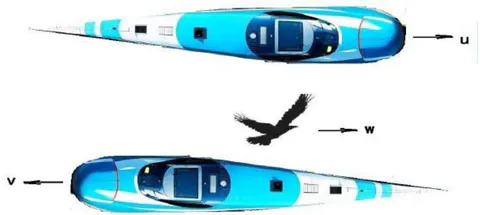
Figure 4: Two trains are running in opposite directions at uniform speeds u and v respectively. How should the relative speed of the raven flying at a uniform speed w be calculated when it forms two relative systems with each of the two trains?
When the raven is relative to the above train running at speed , the speed of the raven observed by the person in the above train is ; the speed of the raven observed by the man in the below train is . However, according to the Limited Effect Principle of a Relativistic System discussed above, the speed of the raven outside the relative system does not change at all and remains .
This proves that the raven can have multiple relative values as being different reference bodies at the same time when it is used as different reference bodies in each different relative system for each of the relative calculations. It also proves that these multiple calculation values can only be used within the relative system. Outside the relative system, the raven, a non-reference body, always maintains its original velocity value w.
Consider this situation: the raven's flying speed . Then, from Figure 4, we can see that the two different relative systems produce completely different results, that is, the same raven forms two relative systems with the upper and lower trains at the same time.
- When the raven and the upper train in the figure form a relative system called "raven-train-upper", the relative speeds of the reference bodies "raven" and "train-upper" are zero (suppose ), that is, the raven and the upper train appear to be stationary. At this time, within this relative system, the speeds of these two reference bodies raven and train-upper are both zero.
- At the same time the same raven and the lower train in the figure form a relative system called "raven-train-lower", the relative speeds of the reference body "raven" and the reference body "train-lower" are , that is, the raven and the lower train appear to be speeding. At this time, within this relative system, the speeds of these two reference bodies raven and train-lower are both .
- However, when we put the raven and the train that constitute these two relative systems back to their application environment, as shown in Figure 3 below, the trees, rails, roadbed... do not feel any change in the speeds of the raven and the trains. The speed of the raven is still w, the speed of the upper train is still u, and the speed of the lower train is still v.

Figure 5: Put the raven and trains from Figure 4 into a real application environment for observation
- What we have concluded is that when an object is included in a relative system as a reference body, the state data of the reference body in the relative system will change accordingly with the different conditions of the system. However, this change is limited to the fact that the object is taken as a reference body in this relative system; when the object is separated from the relative system and no longer serves as a reference body, this change of state loses its effectiveness. This means that for the objective world outside the subjectively constructed relative system, any calculation results within the subjectively constructed relative system cannot affect the objective world outside the relative system at all!
- So, in Figure 5, when the raven consists of the upper train to be a relativity system, it had one speed while as a reference body of the relativity system of the "raven" and "train-upper". At the same time, outside this relativity system, the raven becomes itself again, and can be used simultaneously as the reference body of the relativity system of the "raven" and "train-lower", thus got a different speed at the same time as the reference body of another relativity system.
This conclusion can be extended to the entire Einstein's relative systems, but it does not apply to relative systems where two reference bodies are interdependent. Coincidentally, Einstein resolutely and consistently denied the existence of a system that maintains absolute simultaneity for decades, so it has no effect on our criticism of the Limited Effect Principle of a Relativistic System in Einstein's imaginary theory of relativity.
The movement of light relative to any object is independent, and therefore will not be affected by any behavior of another reference body that together with it constitutes a relative system. The invariance of the speed of a light ray is due to the independence of the light ray, not anything else.
Combined with the four key points that need to be paid attention to in the relative system mentioned above, the essential problem revealed by the Limited Effect Principle of a Relativistic System is: in a relative system composed of two objects that are purely mentally bound and named as reference bodies, the results obtained through relative calculations are purely imaginary data and do not have any effect on the motion states or other states of the two objects after they leave the relative system and no longer serve as reference bodies.
The movement of celestial bodies does not change because of relative observation by humans on Earth. All observation results made on a moving reference body can only be used for the reference body, and cannot be used for the object outside the relative system.
This fully illustrates the fantasy nature of Einstein's theory of relativity.
However, Einstein believed that the movement speed of the raven in Figure 1 really changed. He applied the results of the relative motion of relative systems derived from this to the Lorentz transformation, and derived the erroneous results that "the moving ruler becomes shorter" and "the moving clock becomes slower". [5]
III. TIME DILATION IS A PURE RELATIVE ILLUSION
By tracking the conflicting results of simultaneous relative calculations of a single ground-based clock paired with multiple clocks of different speeds, we show you why we say that time dilation is purely an illusion.
We first construct some relative systems to perform time dilation calculations in mind.
Relative experiments were conducted on one ground clock relative to four clocks in the space shuttles and constructed four relative systems at the same time. (Figure 6)
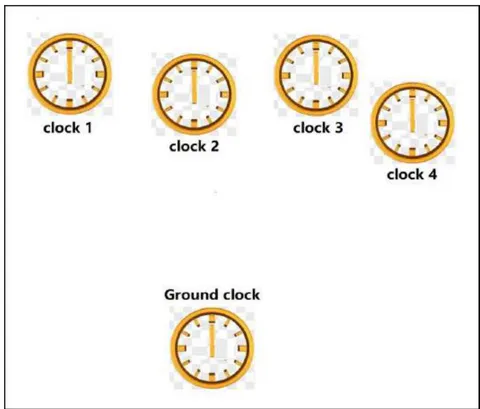
Figure 6: Ground clock is simultaneously relative to four clocks on spacecraft with different speeds.
The time dilation calculator in Figure 7 was used for calculation. The experiment started at 12 noon. One second later, the first set of experimental data was obtained using the time dilation calculator, as shown in the experimental results in the first four rows of Table 1. The spaceship continued to fly until 1800 seconds later, and the second set of experimental data was obtained, as shown in the last four rows of Table 1.
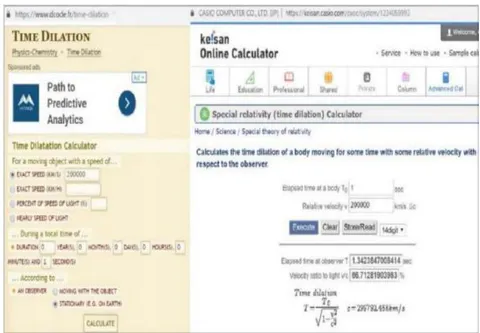
Figure 7: Strictly relativistic time dilation calculator provided by CASC COMPUTER CO, LTD
As can be seen from Table 1, as the duration increases, the time dilation value also increases greatly. Therefore, it is easy to verify whether time dilation is true in the experiment.
Table 1 Calculation results of the ground clock at the same time is relative to multiple spacecraft clocks with different speeds
| Experiment time second | Spacecraft speed (m/s) | Ground clock time second | Spacecraft time second |
| 1 | 200000 | 0.74494293578673 | 1.3423847008414 |
| 1 | 150000 | 0.86582546589248 | 1.1549671837952 |
| 1 | 100000 | 0.94272742316888 | 1.0607520004442 |
| 1 | 10000 | 0.99944352013705 | 1.0005567897052 |
| 1800 | 200000 | 59.3589994339 | 0.64122891504257 |
| 1800 | 150000 | 58.48583860647 | 38.940930831342 |
| 1800 | 100000 | 16.909361703985 | 49.353600799567 |
| 1800 | 10000 | 58.998336246698 | 1.0022214693684 |
For these calculation results, we have to ask:
The ground clock in Table 1 obtained 4 calculation results at 12:01 and 4 results at 12:30. So, at 12:01, which of the four experimental results in the first four rows of Table 1 should the ground clock point to? At 12:30, which of the four of the time data in the last four rows of Table 1 should the ground clock point to?
According to existing knowledge, Einstein's theory of relativity cannot answer such questions.
Such questions have been raised in our related works published over the years, and we were unable to answer them before. We can only think that they are problems with the theory of relativity itself.
However, using the Limited Effect Principle of a Relativistic System derived above, this problem can be answered now.
Put the clocks in Figure 6 into a real-world context (Figure 8).
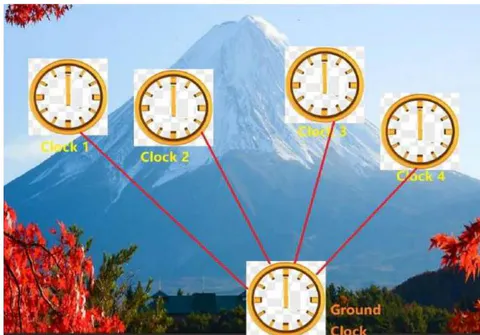
Figure 8: The ground clock is relative to the clocks in four spacecraft simultaneously. It should be noted that this relative is the product of imagination. People have no other way to bind the relativity among the clocks, and Einstein did not stipulate how two reference bodies should be relative. People can also Imagine that these clocks can be relative to each other at the same time, and many clocks on planes, trains and cars can be relative to each other at the same time... What a chaotic scene that would be.
According to the Limited Effect Principle of a Relativistic System derived in the previous section, when a spacecraft with a speed of 200,000 and a ground clock form a relative system, the clock in the spacecraft and the ground clock become the reference bodies of the relative system. The clock time of these two reference bodies is calculated using a standard time dilation calculator (Figure 7) to obtain the results in the first row of Table 1. However, this calculation result only exists in this relative system composed of imagination (is there any other way to make these two objects become the reference bodies of this relative system?), and cannot be applied outside this relative system.
Similarly, three other relative systems can be formed at the same time, and the time values of the clocks on each spacecraft obtained simultaneously and the different time values calculated by the ground clock as different reference bodies in these three different relative systems were calculated and displayed in Table 1.
In fact, it is impossible for a ground clock to have four different time indications at the same time. The Limited Effect Principle of a Relativistic System tells us that the four different time values calculated by the ground clock as different reference bodies are not values in the real world and cannot be applied outside each of the four relative systems.
This actually tells us: the time dilation of a relative system is only a kind of data that applies within each relative system and cannot be applied to the real world. Time dilation is essentially an illusion of relativity.
IV. ANOTHER APPLICATION EXAMPLE OF THE LIMITED EFFECT PRINCIPLE OF A RELATIVISTIC SYSTEM
Next, we apply the Limited Effect Principle of a Relativistic System to solve the problem of "conflicting results when a ground clock and multiple clocks with different speeds perform relative calculations at the same time" (Table 1).
The conflict calculation results in the previous section are the result of previous research, while the use of the Limited Effect Principle of a Relativistic System to resolve the conflict is a new research result. This solution itself further proves the correctness of the Limited Effect Principle of a Relativistic System.
When the ground clock forms a relative system with the spacecraft at 12 o'clock and the speed of the clock is , after 1 second of flight, the time measured by the ground clock as the reference body is 0.74494293578673 seconds. However, from the outside of this relative system, the time indicated by the ground clock is 12 hours and 1 second. Similarly, at 12:00 when the ground clock forms a relative system with the spacecraft at 150,000 km/s, after 1 second of flight, the time measured by the ground clock as a reference body is 0.74494293578673 seconds. However, from the outside of this relative system, the time indicated by the ground clock is still 12 hours and 1 second. This inference is also valid for the relative systems consisting of other two spacecrafts.
This shows that according to the Limited Effect Principle of a Relativistic System, it can explain the phenomenon that when multiple objects form multiple relative systems with a certain object at the same time, multiple different relative results will be calculated when the object is used as a different reference body in different relative systems.
This also shows that the Limited Effect Principle of a Relativistic System is correct, reasonable and effective to limit the calculation results within the relative system to the relative system. It can explain the situation when an object is used as different reference bodies in multiple relativistic systems at the same time, and each of these reference bodies is relative to another reference body in different relativistic systems.
V. CONCLUSION
The Limited Effect Principle of a Relativistic System reveals the essence of theory of relativity that the application results of the theory are limited inside the relativistic system, more specifically, limited within the two reference bodies of the system. Those calculated results have no effect outside the reference bodies. And more importantly, when the reference bodies are looked as normal objects and no longer reference bodies, the calculated results applied no more on the reference bodies.
This tells us the theory of special relativity cannot be applied in the real world, cannot extend outside the reference bodies and the relativistic system. It is basically not useful in the real world.
Conflict of Interest
The authors declare no conflict of interest.
Ethical Approval
Not applicable
Data Availability
The datasets used in this study are openly available at [repository link] and the source code is available on GitHub at [GitHub link].
Funding
This work did not receive any external funding.
Cite this article
Related Research

Special Issue
Launch a focused special issue to highlight research, emerging trends, and expert insights in your academic field.