



IntelliPaper
Abstract
Teacher preparation in Palestine operates within a complex educational landscape shaped by political constraints, limited resources, and increasing demands for inclusive and innovative pedagogy. This study systematically reviews 2020-2025 literature related to teacher education, inclusive practices, curriculum development, and the role of English literature in shaping effective teaching following PRISMA guidelines. Drawing on both Palestinian and international scholarship, the review synthesizes empirical and theoretical studies to identify key patterns, challenges, and gaps in current educational practices. The findings indicate that while teacher preparation programs emphasize subject knowledge and pedagogy, limited integration exists between inclusive education, curriculum innovation, and literature-based teaching approaches. Moreover, English and Palestinian literature emerges as underutilized yet powerful tools for enhancing critical thinking, cultural awareness, and reflective practice among teachers. By establishing these connections, the study provides a conceptual bridge between theory and practice, leading directly to a deeper interpretive discussion of the reviewed findings.
Explore Digital Article Text
I. INTRODUCTION
Education in Palestine faces complex and persistent challenges shaped by historical, political, and sociocultural conditions that directly influence teacher preparation and student learning outcomes (Albadawi & Sabbah, 2022; Snounu, 2019). Prolonged instability, limited resources and disruptions to schooling have placed additional pressure on the educational system, particularly on teacher education programmes and curriculum development processes (Farag, 2025; Jassim, 2024). Within this context, the demand for well-prepared teachers has become increasingly urgent, especially in relation to inclusive education, curriculum innovation and culturally responsive pedagogy that addresses the diverse needs of learners (Aleghfeli, 2024; Lucena-Rodriguez et al., 2025).
English language education occupies a central position within Palestinian schooling; however, it is often delivered with a predominant focus on grammar instruction and reading comprehension. While these components are essential, English literature remains underutilised despite its recognised potential to enhance holistic learning outcomes (Farag, 2025; Jassim, 2024). When integrated effectively, English literature functions not only as content but also as pedagogy, offering meaningful opportunities to develop critical thinking, ethical reasoning, cultural awareness, and reflective teaching practices.
Existing research has examined teacher preparation, inclusive education, and curriculum development in Palestine as separate domains. Nevertheless, studies such as Snounu (2019) indicate a noticeable gap in systematically connecting these components with the role of English literature in classroom practice. This absence limits a comprehensive understanding of how teacher education programmes can prepare educators to implement inclusive, contextually relevant, and pedagogically innovative approaches through literary instruction.
Incorporating English literature into teacher preparation and curriculum design can contribute significantly to linguistic proficiency, analytical skills, and cross-cultural understanding. Moreover, it supports professional development by enabling teachers to adopt reflective and student-centred Pedagogies aligned with contemporary educational trends. Accordingly, this systematic review preparation and curriculum development in Palestine, with particular attention to its potential to strengthen inclusive practices and enhance pedagogical effectiveness. (Farag, 2025; Jassim, 2024).
Teacher preparation and curriculum innovation are central to achieving equity and quality in education, particularly in contexts affected by political instability and resource constraints, such as Palestine. Literature-based pedagogy, both English and Palestinian, offers opportunities to enhance critical thinking, cultural awareness, and reflective teaching practices. Despite progress in teacher education, there remains a gap in systematically integrating literature-based approaches, inclusive education strategies, and curriculum development. This review addresses these gaps, providing evidence-based insights and recommendations for policymakers, educators, and researchers.
II. STATEMENT OF THE PROBLEM
Although Palestinian education has advanced in teacher preparation and curriculum development, integration of inclusive practices, pedagogical innovation, and literature-based instruction remains limited. This gap affects teachers' ability to address diverse student needs, promote equity, and implement culturally and contextually responsive practices.
2.1 Significance of the Study
This review is significant because it:
-
Provides insights into effective teacher preparation and inclusive education in a Palestine.
-
Offers guidance for curriculum developers and policymakers on integrating literature-based pedagogy.
-
Bridges the gap between theory, practice, and culturally responsive education.
2.2 Objectives of the Study
The objectives of this paper are to
-
Examine current practices in teacher preparation and professional development in Palestine.
-
Explore the implementation of inclusive education and its challenges.
-
Investigate the role of curriculum development and pedagogical innovation.
-
Analyze how English literature supports critical thinking, cultural awareness, and reflective pedagogy.
-
Identify gaps and propose strategies for improve teacher education and literature-based pedagogy.
2.3 Review Questions
-
What are the current practices in Palestinian teacher preparation?
-
How are inclusive education strategies implemented in teacher training?
-
What challenges exist in curriculum development and pedagogical innovation?
-
How does English literature contribute to teacher professional growth?
-
How can literature-based pedagogy enhance student learning outcomes?
By addressing these objectives and questions, the following literature review systematically examines research on teacher preparation, inclusive education, curriculum innovation and the role of English literature. This review highlights key findings, identifies gaps, and establishes a foundation for understanding how these components collectively strengthen teacher education and enhance student outcomes in Palestinian classrooms.
III. LITERATURE REVIEW
3.1 Teacher Preparation and Professional Development
Effective teacher preparation is the foundational for quality education. Palestinian classrooms, affected by social-political and infrastructural challenges, require teachers equipped with theoretical knowledge, practical skills, and reflective capacities (Darling-Hammond & Bransford, 2020; Abadawi & Sabbah, 2022). Professional learning communities and mentoring programs strengthen teacher growth and prepare educators to address diverse classroom needs (Opfer and Pedder, 2011; Muhammad & Liu, 2025). Cochran-Smith and Zeichner (2005) further argue that bridging academic theory with real-world classroom experiences is essential for meaningful teacher development. In the Palestinian context, Albadawi and Subbah (2022) and Khaldi and Wahbeh (2002) show that reflective practice and contextual responsiveness are critical for effective teacher preparation. Recent international research supports that preserve teacher initiatives, coupled with authentic field experiences, strengthen self-efficacy and readiness for inclusive classrooms (Muhammad & Liu, 2025). Together, these studies underline that teacher preparation must be multidimensional, blending theory, reflection, and practice.
Understanding teacher preparation sets the stage for examining inclusive education practices, which ensure all students can benefit from these competencies.
3.2 Inclusive Education and Equity
Inclusive education guarantees equitable learning opportunities for all students. While teachers generally demonstrate positive attitudes toward inclusion, structural barriers and curriculum hinder implementation (ALadini, 2020; Barriers to Inclusive Education under Occupation, 2023). International studies emphasize that inclusion is most effective when teachers receive targeted training and ongoing support aligned with curriculum goals (Forlin et al., 2013; Lucena-Rodriguez et al., 2025). Regardless of ability, gender, or background. Aleghfeli (2024) and Ainscow & Sandill, (2010) demonstrate how inclusive teaching strategies in Palestinian classrooms enhance literacy in reading and science, providing practical approaches to reduce educational marginalization. International literature confirms that teacher attitudes and preparation are pivotal: systematic reviews indicate that inclusion-focused teacher training significantly improves classroom practices and equity (Lucena-Rodriguez et al., 2025; Forlin et al., 2013; Cochran-Smith, 2005). Collectively, these studies show that inclusive education relies on both competent teachers and supportive systemic policies. Building on teacher preparation and inclusive practices, curriculum development becomes crucial in translating these principles into effective classroom teaching.
3.3 Curriculum Development and Pedagogical Innovation
Curriculum development bridges policy and classroom practice. Innovations, including blended and technology-enhanced learning, improve student engagement and adaptability when supported by teacher training (Al-Qudsi, 2923; Karaduman & Akman, 2024). Albadawi and Sabbah (2022) stress that curriculum innovation requires corresponding professional development to ensure successful implementation. Globally, Shulman (1987) introduced the concept of pedagogical content knowledge (PCK), emphasizing the importance of linking subject knowledge with instructional strategies. Fullan (2007) adds that sustained professional learning is vital for curricular reform to have lasting effects. The TPACK framework links technology, pedagogy, and content knowledge, providing a foundation for reflective and inclusive teaching. Further supports integration of technology, pedagogy, and content knowledge to enhance curriculum implementation (Karaduman & Akman, 2024). Internationally, teachers emphasize the need for dynamic, evidence-based, and culturally aligned curricula (Jurado-delos-Santos et al., 2021).
3.4 Role of English Literature and Teacher Education
English literature fosters critical thinking, empathy, cultural awareness and reflective practice. English and Palestinian texts enable teachers to explore social, ethical, and human issues, connecting professional learning with students' lived realities (Farage, 2025; Jassim, 2024). Interactive methods such as debates, role-playing, group interpretation, and reflective writing enhance learner engagement and bridge theory and practice (Lazar, 1993; Wajnryb, 1990). (Farrell, 2015) said that development of critical thinking skills the study of literature enhances critical thinking by encouraging close reading, interpretation and evaluation of complex ideas and perspectives analytically (Bloom, 1956; Lazar, 1993). It also enhances cultural awareness and empathy through diverse cultural and historical contexts promote empathy and intercultural understanding. Through exposure to varied voices and narratives, poetry, drama which supports inclusive pedagogy in multilingual classrooms (Bank, 2016). With innovative teaching strategies, literature provides rich opportunities for the use of interactive and learner-centered teaching strategies, such as role-playing, debates, group interpretation and reflective writing (Lazar, 1993).
English literature contributes to curriculum design through serving as a source of authentic language input. Literary texts present language in natural, meaningful contexts, allowing learners to encounter vocabulary, idiomatic expression, and discourse patterns as they occur in real communicative situations. This authenticity enhances linguistic competence and communicative awareness (Hall, 2005). further, a literature-based curriculum supports the integrated development of reading, writing, listening, and speaking skills (Carter, & Long, 1991). the pedagogical in English literature is clearly articulated in Carter and Long's (1991) three-model framework like the cultural model which focuses on introducing learners to different cultures and traditions; the model of language which uses literary texts as resources for teaching grammar, vocabulary and stylistic features in meaningful contexts. Finally, the personal growth model which encourages learners to engage emotionally and intellectually with texts, connecting literature into their personal experiences. Beyond linguistic and cognitive goals, literature plays a crucial role in moral and ethical development. Through characters, conflicts and narrative outcomes, students are encouraged to reflect on values like justice, responsibility and critical moral judgment (Bloom, 1956; Lazar, 1993).
English literature serves as both subject content and a pedagogical tool, fostering critical thinking and reflective practice. Farag (2025) shows that Palestinian women's anglophone writing acts as cultural commentary and a resource for teacher development, enhancing analytical and interpretive skills. Jassim (2024) emphasizes Palestinian literature as a record of social struggle, providing teachers with contextual understanding of learners' realities. International research supports literature's role in developing empathy, literacy, and inclusive pedagogy (Wajnryb, 1990; Lazar, 1993). Florian and Spratt (2013) provide a framework for integrating literature into inclusive pedagogy, allowing teachers to address diverse student needs and learning styles. Collectively, literature enriches teacher preparation and curriculum innovation, bridging theory, practice and cultural awareness.
English literature dominates a privileged status in the curriculum of teacher preparation as well as curriculum development in Palestine. The use of English literature provides beneficial benefits, such as language proficiency, since narratives offer authentic, interacting contexts for reading and writing, in addition to communication. Critical thinking, provides analyzing characters, themes and literary devices develops higher-order cognitive skills. as for cultural awareness. Exposure to local and global texts enhances empathy, identity formation, and cross-cultural understanding. Along with all these benefits, pedagogical focus on literature-based instruction motivates interactive, student-centered learning and strengthens teacher competency and classroom engagement.
3.5 Challenges and Opportunities
Challenges include limited resources, insufficient training, political instability and curriculum gaps. Opportunities include digital tools, local literature and innovative teaching approaches, enabling teachers to implement literature-based pedagogy effectively. remain, while the advantages of literature combining research are obvious. Thus, Numerous studies like Farag (2025; Wajnryb, 1990) argued that limited access to quality English narratives or literary works, are insufficient as well as poor instructor training, and political instability are essential restrictions. Particularly, the identical challenges also reveal opportunities. By positively making use of digital resources, innovative teaching strategies and local authors, educators are able to overcome resource restrictions and employ efficient literature-based curricula (Farag, 2025).
Besides, systematic unification and institution-wide incorporation and coordination of literature into Palestinian curricula should encourage long-term educational resilience and flexibility for teachers and learners to work effectively and to take part in English language learning considerably and contextually in specific related track (Farag, 2025).
3.6 New Contribution to Teaching-Learning Process
This review fills a critical gap in Palestinian education by presenting a framework for literature-based pedagogy, teacher training and curriculum innovation, highlighting the role of literature in enhancing language proficiency, critical thinking and cultural consciousness.
IV. METHODOLOGY (FLOWCHART IN APPENDIX)
This study utilized a systematic review design to examine how English literature contributes to teacher preparation and curriculum development in Palestinian schools and universities. Systematic reviews provided a stringent approach to synthesizing existing research, ensuring that findings are evidence-based, comprehensive and applicable (Moher et al., 2009).
4.1 Inclusion and Exclusion Criteria
- The following criteria were applied to select studies that included in the review:
In terms of inclusion criteria:
-
Focused on English literature and its role in pedagogy or curriculum development.
-
Conducted in or relevant to Palestinian educational contexts.
-
published between 2020 and 2025
-
Peer-reviewed journals, theses, books and institutional reports.
-
As for exclusion criteria: The review excluded the following data:
-
Studies relevant to literature incorporation or curriculum design are excluded.
-
English language instruction studies without a literature component are excluded.
-
None-peer-reviewed sources lacking sufficient rigor are excluded.
4.2 Search Strategy
The literature search was conducted across multiple databases, including Google Scholar, ERIC, Scopus, JSTOR, and SpringerLink.
Keywords used included: English literature, Palestinian curriculum, teacher preparation and literature-based pedagogy.
Boolean operators (AND, OR) were applied to refine search results. Titles, abstracts, and full text were screened for relevance by the researcher.
4.3 Study Selection-PRISMA Guide
Following the PRISMA framework (Moher et al., 2009), the study selection process involved:
-
Identification: 51 articles retrieved from databases.
-
Screening: 32 duplicates removed; 38 articles screened for relevance.
-
Eligibility: 18 articles excluded due to lack of relevance or methodological rigor.
-
Included: 15 study met all inclusion criteria and were included in the review.
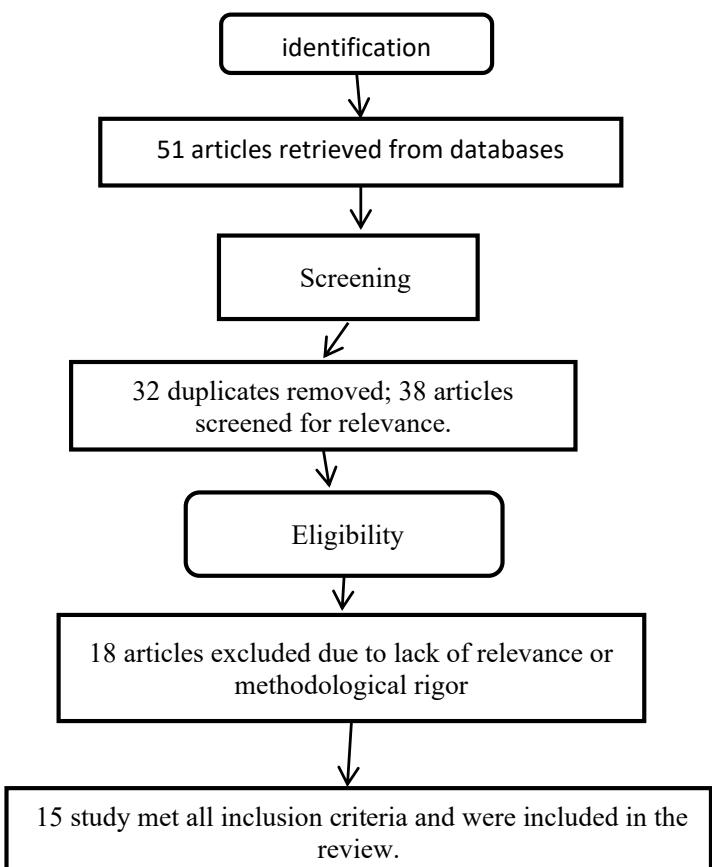 (Adapted from Moher et al., 2009) Figure 1: Flowchart of the systematic review process examining the role of English Literature in teacher preparation and curriculum development in Palestine.
Figure 1 shows the real process of systematic review from identification, screened, eligibility, excluded and to included studies.
Data were obtained via systematic template recording:
Author(s) and year, study setting and context, research methodology, key findings related to literature integration, teacher preparation and curriculum development, implications for practice and policy. Synthesis was done using thematic analysis, which revealed language proficiency improvement, critical awareness and ethic innovation and teacher professional development, identifying key themes across studies. Language proficiency enhancement, critical awareness and ethical reasoning, pedagogical innovation and teacher professional development, opportunities for implementation.
-
Identification: Records identified from databases and sources (peer-reviewed journals, theses, books, institutional reports); Time frame: 2020-2025; context: Palestinian schools and universities.
-
Screening: Removal of duplicate records, title and abstract screening, excluded: studies unrelated to English literature.
-
Eligibility: Full-text articles assessed for eligibility; inclusion criteria: focus on English literature in pedagogy/curriculum; relevance to Palestinian educational context; exclusion criteria: English language instruction without literature, studies not related to teacher preparation
-
Inclusion: Final studies included in the systematic review synthesis and analysis.
Checklist
V. FINDINGS AND DISCUSSION
These findings show a strong interdependence between teacher preparation, inclusive education, curriculum development, and literature-based pedagogy. While Palestinian teachers generally support inclusive education, structural barriers, limited training, and insufficient curriculum integration hinder effectiveness. Literature-based pedagogy, particularly using English and Palestinian texts, fosters critical thinking, cultural awareness, empathy, and reflective practice, but remains underutilized in formal teacher preparation programs.
5.1 Detail Discussion
Align with broader international debates on teacher education, while highlighting context-specific challenges unique to the Palestinian educational system, the findings of this literature review reveal a clear interdependence between teacher preparation, inclusive education, curriculum development and literature-based pedagogy. Across both Palestinian and international studies, teacher preparation is consistently identified as a foundational factor influencing classroom effectiveness and student outcomes. However, the literature suggests that preparation programs often prioritize theoretical knowledge over integrated, context-responsive practices that address diversity and inclusion (Albadawi & Sabbah, 2022; Darling-Hammond & Bransford, 2020). Inclusive education emerges as a central yet challenging goal within Palestinian classrooms. While teachers generally demonstrate positive attitudes toward inclusion, structural barriers, limited professional development, and curriculum constraints hinder effective implementation (Aleghfeli, 2024; Aladini, 2020). International research reinforces that inclusive practices are most successful when teachers receive targeted training and ongoing support aligned with curriculum goals (Forlin et al., 2013; Lucena-Rodriguez et al., 2025). This alignment, however, remains inconsistent in the Palestinian context.
Curriculum development serves as a critical bridge between policy and classroom practice. The reviewed studies highlight that curriculum innovation, particularly through blended and technology-enhanced learning, can improve engagement and accessibility when supported by teacher training (Al-Qudsi, 2023; Karaduman & Akman, 2024). Nevertheless, gaps persist between curriculum design and teachers' practical capacity to implement inclusive and reflective Pedagogies. Notably, the role of English and Palestinian literature is insufficiently integrated into teacher preparation despite its demonstrated potential. Literature fosters critical thinking, empathy, and cultural awareness, enabling teachers to connect pedagogy with students' lived realities (Farag, 2025; Jassim, 2024). Palestinian literature, in particular, offers culturally grounded narratives that support identity formation and contextual understanding, yet remains underrepresented in formal teacher education frameworks. This omission represents a significant missed opportunity for holistic and culturally responsive teaching.
Collectively, the literature underscores the need for an integrated approach to teacher education, one that aligns preparation programs, inclusive practices, curriculum development, and literature-based pedagogy within a coherent framework.
VI. RECOMMENDATIONS
Based on the systematic review, the author highly proposes the following recommendations:
-
Integrate English and Palestinian literature across all grades to enhance language skills, critical thinking, and cultural awareness.
-
Conduct longitudinal research to measure literature's impact on student proficiency, cognition, and ethical reasoning.
-
Use a multi-genre approach: poetry for linguistic sensitivity, novels for narrative comprehension, and drama for interactive learning.
-
Provide pre-service and in-service training in literature-based pedagogy, lesson planning, and student-centered methods.
-
Implement mentorship and peer-learning programs to support teacher confidence.
-
Use digital tools and multimedia to enrich classroom instruction.
-
Develop policy frameworks and culturally relevant materials, emphasizing Palestinian texts to foster identity and empathy.
-
Monitor curriculum effectiveness using teacher feedback, student assessment and longitudinal studies.
VII. LIMITATIONS
Despite that, this review informative, but numerous limitations:
-
Political instability and limited resources may restrict implementation.
-
Few empirical studies limit generalizability.
-
Language and transformation barriers may have excluded much relevant studies, specially Arabic-language literature on pedagogy.
Despite such limitations, the review provides important insights into teacher preparation, curriculum reform, and literature-based pedagogy. for advancing teacher preparation and curriculum reform via English literature.
VIII. CONCLUSION
This systematic review provides a comprehensive, context-sensitive synthesis of teacher preparation, curriculum development, and literature-based pedagogy. In Palestine. Integrating English and Palestinian literature into teacher education enhances critical thinking, empathy, cultural awareness and reflective practice, while systematic curriculum alignment and professional development support effective implementation. The study offers a roadmap for policymakers, educators and researchers to modernize curricula, strengthen teacher preparation and improve student outcomes, advancing equity, quality and innovation in Palestinian classrooms.
Ethical Statement
This study follows ethical research standards in accordance with APA guidelines. All sources are properly cited to ensure academic integrity and to avoid plagiarism. As the review based exclusively on published secondary sources and does not involve human participants, personal data or field experimentation, formal ethical approval was not required. Intellectual property rights are respected and transparency is maintained throughout the analysis.
Funding and Disclosure
The author did not receive funding from any specific agency and there isn't any award. The author also declares no conflict of interest regarding authorship, research, or publication. No other researchers contributed to this study. It is fully the author's. The author also declares no certain awards from any area.
REFERENCES (7 EDITION)
Conflict of Interest
The authors declare no conflict of interest.
Ethical Approval
Not applicable
Data Availability
The datasets used in this study are openly available at [repository link] and the source code is available on GitHub at [GitHub link].
Funding
This work did not receive any external funding.
References
Cite this article
Related Research

Special Issue
Launch a focused special issue to highlight research, emerging trends, and expert insights in your academic field.
