


IntelliPaper
Explore Digital Article Text
I. INTRODUCTION
In recent world, the number of vehicle is increasing day by day. According to a recent survey, the number of vehicle on the roads reached more millions last year which creates new challenges for traffic police such as red light violations, wrong lane violations, parking problems, & toll booth violations. There need various automate processes to control that violation in addition to increasing traffic police. To resolve this issue traffic police installed plenty of surveillance devices such as traffic light cameras, parking booth cameras or toll booth cameras. It requires man-power to check these images, note down the vehicle's registration number and forward it to the appropriate department to take an action on rule violators . Extraction of vehicle registration numbers and alphanumeric characters is the main topic of our research. Vehicle registration number is a unique identity for all vehicles in a given state. It represents a legal license to ply on the road. Therefore, the registration number is the primary, most widely accepted, human readable and mandatory identifier for motor vehicles.
II. LITERATURE REVIEW
Chittode J S has developed an algorithm based on morphological operations for number plate recognition to monitor and manage parking services . The ROI is another method area which includes the number plate from which alphanumeric characters are recognized. Paunwala proposed a method for directional segmentation which finds ROI using morphological processing . In the case of image acquisition and number plate recognition system Lekhna proposed an effective algorithm which is NPR algorithm . Chunyu C et al. has developed a technique named global matching of CBP for recognition of vehicle license number plate from vehicle image. This technique has implemented using MATLAB and characters are recognized using edge detection segmentation. Singh M et al. developed an efficient approach works on opening and closing of morphological operations. It has been done for segmentation process of alphanumeric characters. Recognition is done using the template matching. Kranti S et al. presented a methodology for number plate extraction name. This methodology mainly deals with edge detection and window filtering method which are used in this methodology and give efficient results. Ganapathy V et al. developed a methodology for Malaysian vehicles. This methodology is mainly based on morphological analysis and results extraction of number plate with 95% accuracy.
III. PROPOSED METHOD
These sections include a proposed algorithm for vehicle number plate extraction and alphanumeric number recognition. The algorithm of proposed method is shown below.
Proposed algorithm consists of following steps:
1. Image acquisition
2. RGB to gray scale image
3. Gray scale to binary image
4. Vertical Edge Detection
5. Dilation of an Image
6. Extraction of number plate
7. Enhance number plate
8. Segmentation of characters
9. Load and read templates
10. Comparison and recognition
11. Storing in file
3.1 Image acquisition
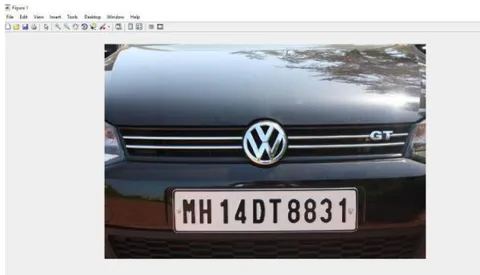
The first section is "Image acquisition. Images and videos is taken by a high resolution cameras. With the help of the image acquisition toolbox in MATLAB we can detect a camera easily. Using a camera, the project accepts an image path in MATLAB code. This research is suitable for all kinds of image. Figure 1 shows an input image.
3.2 RGB to gray scale image
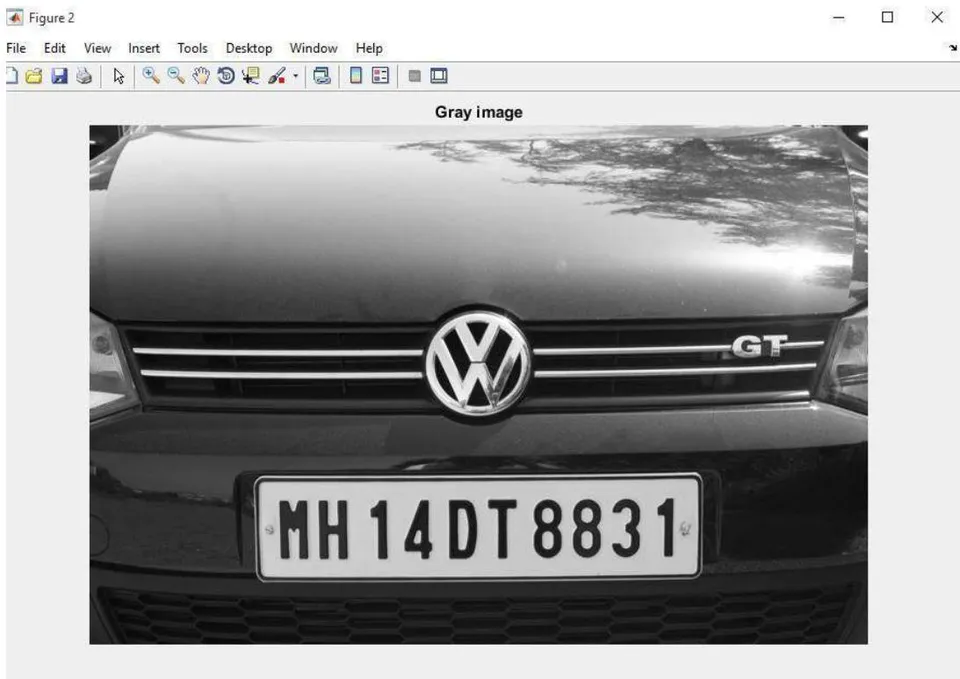
In this section RGB to grayscale conversion takes place by using rgb to gray function. A gray scale image is also known as a black and white image in which. Black is the weakest intensity and white is the strongest intensity. RGB to gray image is shown in figure 2.
3.3 Gray scale to binary image
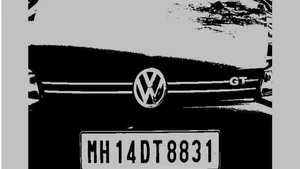
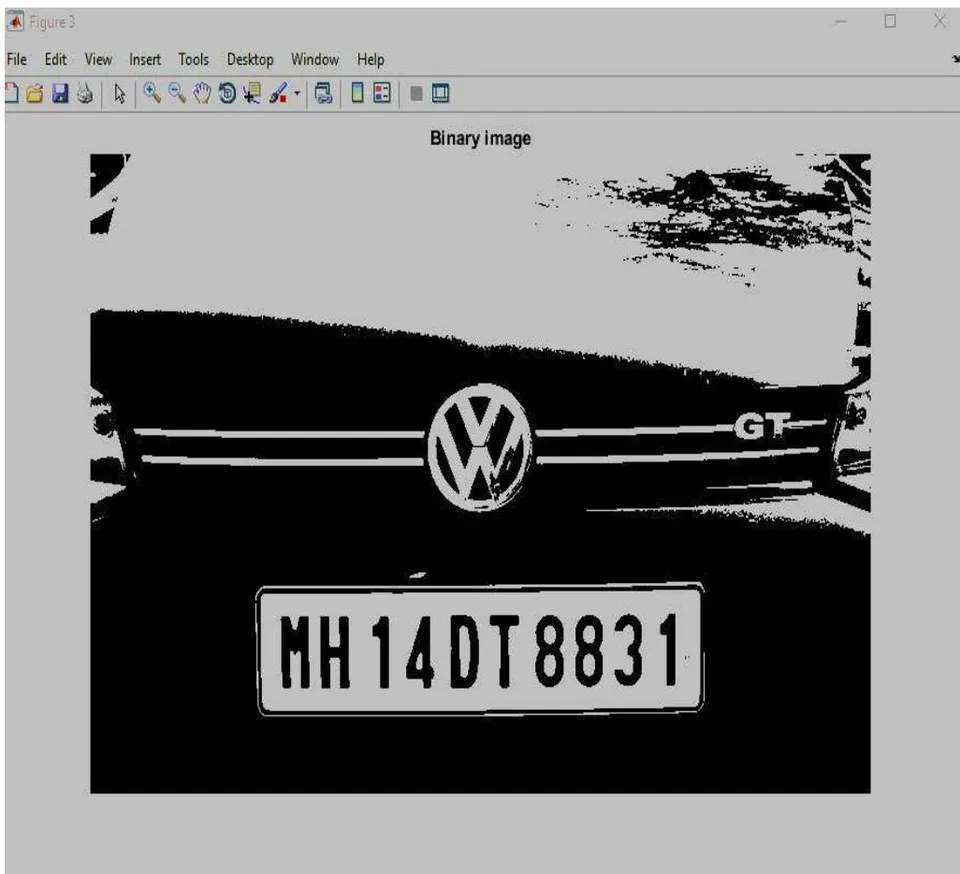
In this case im2bw' function is used for binarization of an image. The Otsu method has been used to converter into two color images black and white. The pixel values above this threshold value turn into white and values below this threshold turns into black. Binary image is shown in figure 3.
3.4 Vertical Edge Detection
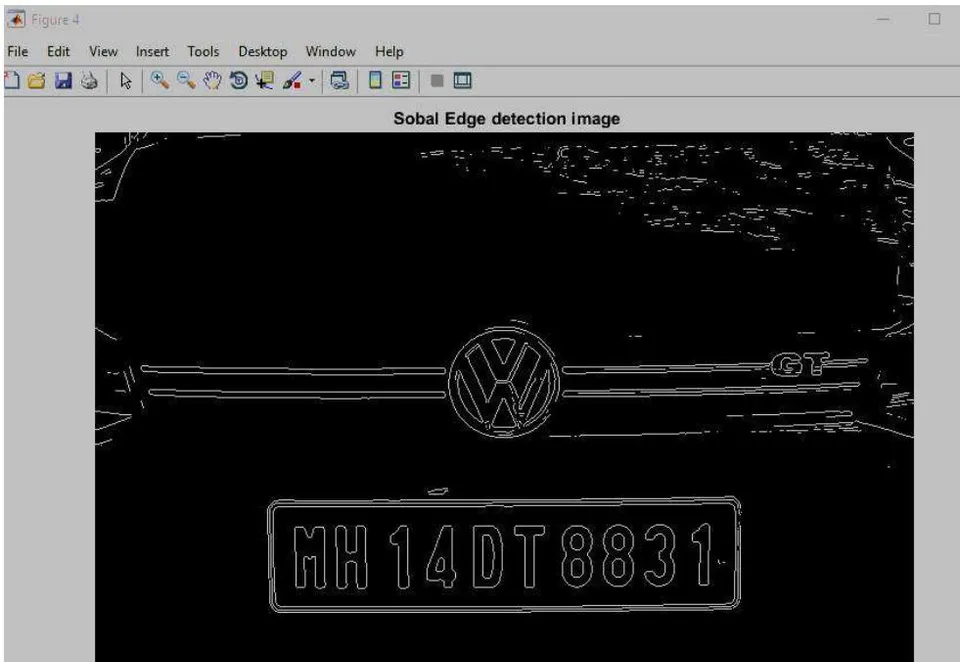
This section used to detect vertical edge by using Sobel operator and the result is shown in figure 4 after applying Sobel operator to binary image.
3.5 Dilation of an Image
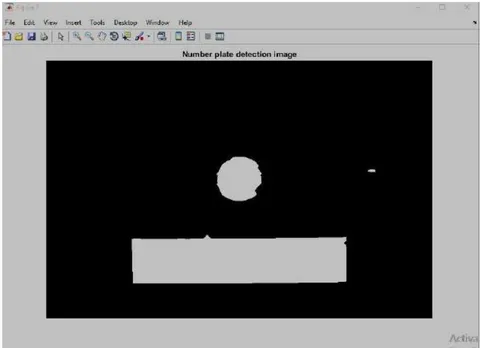
These operations are mainly used to remove unwanted noise from the image. In this step, image has been dilated. Dilation is a process for filling holes by using MATLAB toolbox imfill function in an image, sharpen edges of an object maximize brightness and connect the broken lines. Dilation of an image is shown in figure 5 and after filling holes is shown in figure 6. Then morphological opening and erode operations are used to detect the of candidate number plate area by using imerode function and its result in shown in figure 7.
3.6 Extraction of number plate
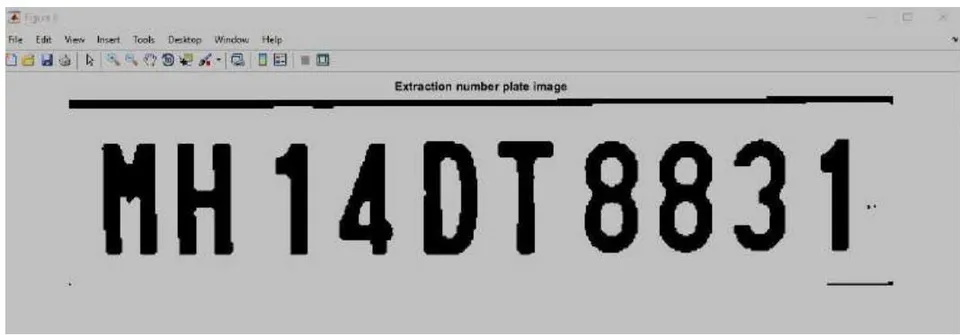
After the number plate detection, the original number plate area is extracted and the row and column indices of plate area by connected component analysis. Original extracted number plate area is shown in figure 8.
Extraction number plate image
MH 14DT8831
Figure 8: Extraction of number plate.
3.7 Enhance number plate
The original extracted number plate consists of various noise or unwanted holes. So the enhancement of the original number plate is done and the result of enhancement number plate is shown in figure 9.
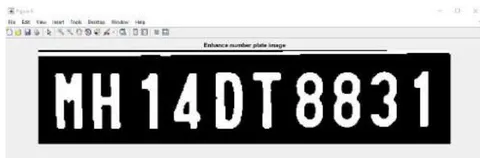
MH 14DT8831
Figure 9: Enhance number plate
3.8 Segmentation of characters
After enhancing plate, the 'bwlabel' function helps for the segmentation and labeling of the characters. It is used to separate each character and labels them according to the sequence. 'imresize' is another function which is used to resize the segmented images and make them same size. Moreover, the 'imcrop' function is use to crop the segmented characters. Horizontal and vertical histogram has been used for segmentation based on threshold value. Depend on Starting and ending points by horizontal direction each character is extracted is shown in figure 10.
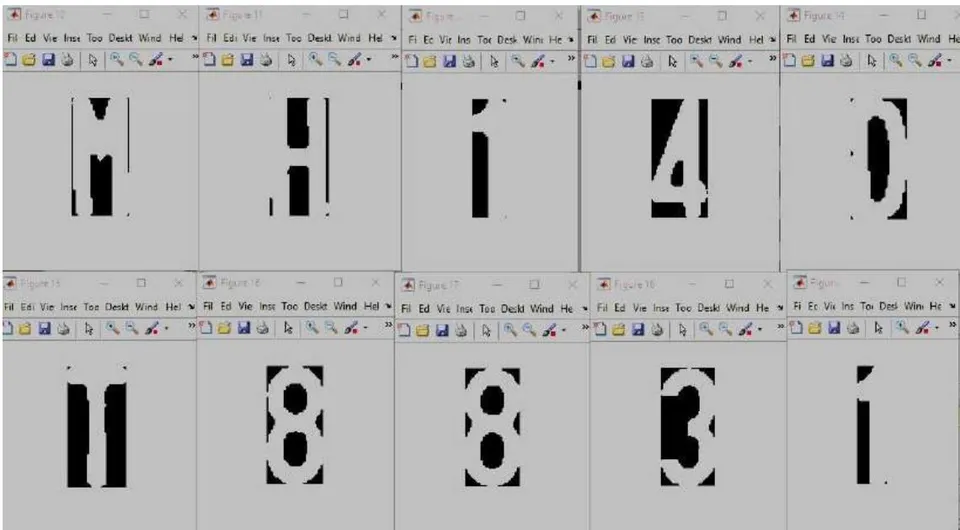
3.9 Load and read templates
In this step, we loads template image including 0 to 9 and a to z character for the comparison of characters for recognition.
is the extracted letters or characters. It is easier to check and read each and every segment. The 'corr2' function compares and finds the minimum difference between the pixels. Recognition of each character is shown in figure 11.
3.10 Comparison and recognition
In this step, comparison of extracted characters with templates takes place and output of this step
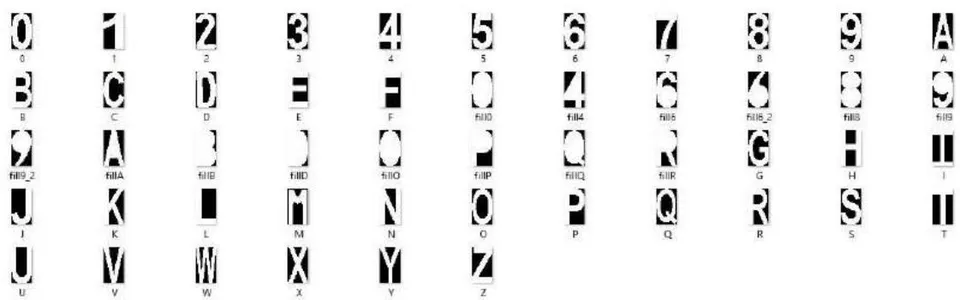
3.11 Storing in file
In this step, after extracting character from number plate with complete information is stored in file as shown in figure 12.
New Text Document - Notepad
File Edit Format View Help
Extracted Number: M H 1 4 D T 8 8 3 1
IV. EXPERIMENTAL RESULTS
This proposed system work all types of input image for number plate extraction and recognition. In this case we have tested more than 133 input images which are different sizes and colors. This system work all time a day more accurately and user friendly. The input images are taken in different illumination. The result of proposed system is shown in table 1.
| Total Image | Successfully number plate Extracted and Recognition | Success Rate (%) |
| 133 | 132 | 99.25 |
V. CONCLUSION
This research is able to process an input image of any format and successfully computed all the modules. Moreover, all the functions have been implemented perfectly. Users can directly find the extracted alphanumeric characters in the result text file. The results provided by car registration number plate extraction and recognition system are successfully tested on various images with accuracy 99.25%.
Conflict of Interest
The authors declare no conflict of interest.
Ethical Approval
Not applicable
Data Availability
The datasets used in this study are openly available at [repository link] and the source code is available on GitHub at [GitHub link].
Funding
This work did not receive any external funding.
References
Cite this article
Related Research


Special Issue
Launch a focused special issue to highlight research, emerging trends, and expert insights in your academic field.