

IntelliPaper
Abstract
Despite the dramatic improvements in construction safety made over the past few decades, the construction industry as a whole is still nowhere near reaching the Zero Injury goal, let alone the Zero Incident goal. The purpose of this paper is to provide an approach to continue improvements of safety performance in order to reach the Zero Incident goal.
Since the concept of "Zero Injury" emerged in the 1990s, increasing numbers of owners and contractors have achieved the Zero Injury goal on construction projects. The key to these achievements is the Nine Zero Injury Principles established by Construction Industry Institute (CII). However, the research on which the Nine Zero Injury Principles is relied on a questionnaire survey rather than theoretical analysis. Without theoretical analysis supporting the research, the conclusions are often challenged, making the concept of Zero Injury difficult to promote throughout the industry.
Thus, there exists the need to develop the theory of Zero Incident Safety Management (ZISM) and re-define the concept of "Zero Incident" to provide theoretical insight into the practical application of ZISM techniques and make Zero Incident more acceptable.
Drawing on previous theories of construction accident causation and prevention, a new update accident causation theory was developed. This research then identified the management factors that can eliminate the corresponding accident causation factors. Developing the theory of ZISM can not only helps construction leaders deeply understand and accept the concept of Zero Incident, but also guide how to make Zero Incident come true.
To facilitate the most rapid implementation of the Nine Principles, a ZISM standard benchmark tool with leading metrics was created. This tool can be easily used to assess the extent of implementation of safety program in construction projects.
Explore Digital Article Text
I. INTRODUCTION
The "Zero Injury" concept was first described by CII in the fall of 1993 to show owners and contractors how to achieve zero accidents on construction projects. CII sought to convince management of the value of an effective safety program by researching and identifying techniques most successful in achieving zero accidents.
The Zero Injury philosophy is based on the belief that eliminating all worker injuries on projects is possible and is the only acceptable goal. "Zero Injury," including Zero Lost Time Injury and Zero OSHA Recordable Injury, defines a unique attitude on projects achieving the category of "safety excellence." This attitude appears as a zealous commitment by top management to the concept that Zero Injury is the only acceptable goal. The Zero Injury concept means that all serious injury to workers can be successfully prevented.
Emmit J. Nelson [1] offers his take on the potential scope or application of the Zero Injury concept:
"The essence of the Zero Injury concept is for a company or organization to adopt the notion that employee injury is not a desirable or an acceptable result of work execution. Thus, these devotees wish to experience Zero Injury for as long a period or for as many work hours as they can. They first strive for zero lost workday cases, then—when successful—for zero recordable, and then for zero first-aids."
The majority of construction companies have comprehensive safety programs, as reflected in their contractors' selection, training, inspections, enforcement, as well as efforts towards fostering a strong safety culture, and behavior-based safety plans aimed at decreasing the construction accidents incidence rate. The construction accident statistics from OSHA and the BLS from recent decades show that these companies have enjoyed significant improvements in their safety performance in the past decade. However, the industry is still nowhere near reaching the Zero-Injury goal, let alone the Zero Incident goal. The problem of not knowing how to continue improving safety performance to reach Zero Injury has been pervasive throughout the construction industry for a long time .
This paper targeted an approach known as Zero Incident Safety Management (ZISM) to achieve the Zero Incident goal. The essential questions of this paper are: what is the theory behind Zero Incident Safety Management and how can construction leaders use this theory to improve project safety performance to achieve the Zero Incident goal?
The challenge for this research is that safety management as part of the overall management process is affected by many factors, and it is difficult to identify and measure which factors are involved in developing the theory of ZISM. The main challenge lies in the difficulty in determining what to measure and how to effect improvements, particularly with respect to those intangible aspects of safety.
Therefore, this paper intends to provide theoretical insight into the practical use of ZISM within the field of construction safety. It will not only analyze the theory of ZISM—including theory, process, methodology and tools—it will also develop a measurement tool to make the findings from this study easily applicable to construction projects. This would allow a strategic move towards a high performing and continuously improving safety culture, with the result of achieving and sustaining the goal of Zero Incident.
II. LITERATURE REVIEW
The first known construction contractor to exceed one million hours worked with zero OSHA recordable injuries was Zachry, a contractor based in San Antonio, Texas, while working on a Shell Chemical project near Baton Rouge, Louisiana in 1989. Since that time, increasing reports of zero recordable injuries were submitted. As a result of all CII attention the "one million" hour threshold became a commonly used measure of safety achievement that was beyond the norm and thus worthy of attention. According to the latest data, by 2015, 32 companies had reported a total of 92 occasions where projects had logged zero recordable injuries exceeding one million hours.
The National Academy of Construction (NAC) lists the names of known contractors (see Table 1) reported to have reached and exceeded the one million hour milestone, though a large number of them have exceeded two million hours and even three million hours worked with zero OSHA recordable injuries. In addition, two have reported exceeding four million hours recordable-injury free.[3] {"code_caption":[],"code_content":[{"type":"text","content":"OVER 1,000,000\nZachry – 1,020,000\nShell Chemical, LA,1989\nNPS Energy Services* - 1,000,000+\nPeach Bottom Power Plant. –1999\nParsons - 1,229,585\nExxon, Baytown, TX - 2002\nJ. H. Kelley*– 1,036,746\nConoco Phillips–OK, 2005\nBMCD – 1,000,000+\nConoco/Phillips, TX- 2005\nCherne Contracting Corporation* –1,500,000+\nSunoco & E. KY Power, MN – 2005\nSuperior Construction* – 1,000,000+\nBP Whiting, IN – 2006\nMcCarl's* – 1,020,785\nYork Haven, PA - 2008\nCECO Construction - 1,100,000\nHouston. TX, Companywide – 2005, 2006\nChapman Corporation* – 1,081,486\nCanonsburg, PA – 2009\nD.E. Harvey – 1,149,192 Chapman San Antonio, TX - 2010\nAltairStrickland – 1,371,269\nBP Texas City, TX Operations - April 2011\nM.A. Mortenson Construction – 1,034,847\nMinneapolis, MN – Company Wide – May 2011\nBechtel – 1,145,123\nBSII – Savanna River Water Treat, GA - 2011\nBechtel – 1,118,005\nWatts Bar Unit 2, Knoxville, TN - 2011\nAltairStrickland - 1,201,865\nInternal own employees Company Wide Jan 20, 2011 – through June 7, 2011\n\nOVER 2,000,000\nFluor – 2,080,000\nLake Charles LA - CITGO, 1996\nCherne Contracting Corporation* – 2,547,240\nMinn., MN – Company Wide, 2000-2001\nSolid Platforms, Inc.* – 2,569,257\nWhiting, IN – BP Refinery - 2007\nCherne Contracting Corporation* – 2,150,000\nCompanywide - Minn., MN- 2010-2011\nS&B E&C Construction – 2,541,797\nOn site hours, Port Allen, LA – 2011\nOVER 3,000,000\nS&B E&C – 3,288,884\nPort Allen, LA – Total Project Hours, 2011\nOVER 4,000,000\nS&B E&C – 4,649,000\nHouston, TX, Company Wide- Oct 2003/\nDec 2004\nKiewit-Southwest – 4,180,752,\nPhoenix, AZ – District Wide 2011\n*Union"}],"code_language":"csv"}
These remarkable achievements raise the questions of "how did they do that?" What kind of safety program does this company use to achieve such heights in the avoidance of employee injury? What are the key ingredients of a Zero Injury safety initiative?
The answers lie in the fact that these companies take full advantage of the Zero Accidents research done by the CII. This research details the major categories of safety leadership required to implement the highly successful "Zero Injury Safety Management Concept." Hundreds of other contractors across the USA have joined in successfully using this landmark research (NAC papers).
2.1 CII Nine Principles
The Nine Principles established by the CII research indicate how to attain their safety goals. The Zero Injury approach is becoming more widely accepted by both owners and contractors, both domestically and internationally.
The CII Report 32.1 "Zero Injury Techniques" in 1998, the subsequent studies in 2001 and 2002, and the follow-up research "Making Zero Injuries a Reality", defined Nine Principles to attain Zero Injury objective.
These nine CII Zero Injury Safety Management principles are as follows:
1. Demonstrated management commitment
2. Staffing for safety
3. Safety planning
4. Safety training and education
5. Worker participation and involvement
6. Recognition and rewards
7. Sub-contractor management
8. Accident/incident reporting and investigation
9. Drug and alcohol testing
The research demonstrated that companies utilizing the Zero Injury Nine Principles achieved better safety performance results than companies that did not utilize the techniques.
2.2 Implementation of the Nine Principles
Since publication of the report in 1993, several contractors using the Zero Injury safety principles continued to improve their safety performance, with some contractors experiencing zero recordable injuries [4]. Researchers named these practice policies "Zero Injuries Safety
Management." These participating companies have had a large impact on the improvement of the RIR in the construction industry during the past two decades. In fact, as shown in Figure 1, the RIR statistics of CII member companies are an order of magnitude better than the construction industry ratings as a whole. Most, if not all, CII members have instituted the Zero Injuries Safety Management principles and philosophy. As a result, their total recordable injury rates are 10 times better than the industry average. Considering the actual labor-hours worked by the industry is about 12.6 billion man hours, the total number of injuries avoided should every construction company adopt the principles and philosophy of Zero Injury Safety Management would be in the neighborhood of 235,000 injuries per year (New Safety Initiative for the Construction Industry in the City of New York).
As a result of CII members' accomplishments, the Nine Principles are becoming more widely accepted by construction owners and contractors to attain Zero Injury goal. Some organizations, like the NAC and Zero Injury Institute (ZII), are actively advocating for the use the nine major categories of safety leadership cited above and for the more than 200 techniques found.
{"image_source":{"path":"images/5bcd9700fce304c397b0a3f765e9eed94ffa4f2a9eff4b55f42d947e48c39fc9.jpg"},"content":"","chart_caption":[{"type":"text","content":"Figure 1: RIR of Industry and CII Member"}],"chart_footnote":[]}
It has been proved that successful safety programs consist of three primary parts: content, process and safety culture (Nelson, 2003). To achieve an effective safety culture, leaders must be engaged for the right reasons. If leaders engage in safety programs only because it is required by law, the result will likely be far less excellent than engagement by leaders who truly care for their employees.
Other research from ZII also concluded that safety success is heavily dependent on three factors: (a) Top leadership's routine communication of how zero at-risk behavior should be executed at work; (b) The use of research backed by leading safety indicators; and (c) The presence of employee safety knowledge at all levels in the organization. In short: "Safety performance correlates with safety knowledge!"
The Zero Injury philosophy is based on the belief that eliminating all worker injuries on projects for significant periods of time is possible. The first essential criterion required is the acceptance of the Zero Injury concepts by those in charge and the effective communication of this to the workers. Further, it is essential that owners and contractors devote resources for the development and implementation of the safety principles that provide the highest impact on achieving Zero Injury projects (CII, 1993). The construction industry needs to recognize that elimination of injuries is vital to the efficient execution of construction projects, and that productivity and safety are so intertwined in the workplace that spending time and energy on safety not only improves safety performance, but also avoids schedule delays and reduces costs[5].
III. PROBLEM STATEMENT AND RESEARCH METHODOLOGY
3.1 Problem Statement
The Nine Principles from CII are becoming more widely accepted by construction owners and contractors who want to increase their safety performance. The CII research concluded that Nine Principles are the most effective approach to Zero Injury by collecting and analyzing project safety data. However, the research on which the Nine Zero Injury Principles is based relied on a questionnaire survey rather than theoretical analysis. Without theoretical analysis supporting this research, its conclusion is susceptible to challenges. In addition, the total of 38 interviews that CII conducted with safety management personnel on large construction projects in the U.S. was not convincing enough.
The concept of Zero Injury and the Nine Principles are often challenged due to lack of complete understanding of accident causation. There are many factors that can affect safety accidents or near-miss occurrences, a fact that makes it difficult to determine the cause of an accident. Research demonstrates that analysis of various factors is necessary to judge risk in a construction project[6]. Further, each construction site has its own conditions, location, number of workers, types of activities, and other unique characteristics. Without convincing evidence, it is difficult for owners and contractors to understand and accept the new concept completely. As a result, adoption of the Nine Principles can be a challenge for some companies. It's unfavorable for leaders to accept a new concept and spend a significant amount of money to make any changes with limited resources.
Consequently, there exists the need to conduct additional analytical research to develop the theory of ZISM by finding a method to determine the causes of accidents to 1) support the Nine Principles conclusions; and 2) develop an approach to help owners and contractors understand and accept the new concept. By doing this, more companies may be persuaded to adopt CII's Nine Principles.
3.2 Research Methodology
It is highly significant to propose a safety management methodology aimed at identifying those efforts needed to achieve continually greater periods of time worked without construction incidents. Consistent with the above goal, the objectives of the research include:
Developing the theory of ZISM for improving safety performance in the construction industry to achieve and sustain the Zero Incident goal.
Identifying the management factors involved in achieving the Zero Incident goal and developing leading metrics to measure these factors.
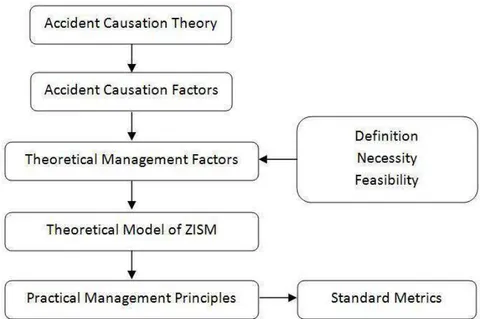
Social theory research is carried out in the tumultuous and ever-changing environment of functioning organizations. Construction projects, from the day they begin, are in a constant state of change. Research in the natural theory is typically carried out in a controlled laboratory setting that allows for the exclusion of extraneous factors; however, in this research, each construction project is unique and the question to be answered is: "Why can some contractors work a million hours without an injury while others cannot?" As an analytical research, the best way to solve the problem is based on combination of theory analysis and practical experiences. By summarizing and analyzing the related theories that have been approved and accepted in other industry and reviewing experiences from the companies that already successfully achieved the Zero Injury goal, the theory of ZISM and standard metrics will be developed. The general research work flow is shown in Fig 2.
3.3 Developing Theory of ZISM
The first phase of the research was to develop the theory of ZISM. The theory should include the underpinning theory and philosophy. To develop the underpinning theory and philosophy of Zero Incident Safety Management, it was necessary to identify the reasons why construction accidents happen. The process began with a thorough study of existing theories of accident causation and prevention. After summarizing and analyzing the conclusions of the existing theories, the most important reasons for why accidents happen were identified, and a new update to accident causation theory was developed.
After analyzing accident causation, the next step was to identify factors that might influence safety management. Based on this new theory, the management factors were concluded to eliminate the corresponding causes that lead to accident happening. The factors that involved in the theory of Zero Incident Safety Management can be defined. Then the theory of ZISM was developed. The theory is also a guide to provide direction for the following research to move closer to the Zero Incident goal.
3.4 Creating Standard Metrics
The main purpose of this phase is to create a ZISM standard benchmark tool with leading metrics, which can be easily used to assess the extent of implementation of safety programs in current projects and to compare them with safety programs of the successful projects achieved Zero Incident goal. The goal is to identify what companies that reach the Zero Injury goal do differently from companies that do not to move closer to the Zero Incident goal.
As discussed in literature review, the research conclusions found by CII can help companies achieve zero injuries. With the support of theory of ZISM, the Nine Principles, could be deemed to the most effective guides for Zero Incident. In this research, we also use this conclusion and continue to discuss how to better implement the Nine Principles.
To facilitate the most rapid implementation of the Nine Principles, specific management actions should also be developed. James B. Porter developed thirteen actions in his recent research that would enable management to meet safety performance goals to be met sustain in the most cost effective and risk sensitive ways. The leading metrics in this research were created in accordance with the Nine Principles and the thirteen actions.
IV. THEORIES OF ACCIDENT CAUSATION
It is extremely difficult to talk about construction safety management in the absence of an understanding of the causes of accidents. Before one can embark on effectively and efficiently improving safety on the project site, one must first understand the theory of accident causation and prevention.
Many attempts have been made to develop a prediction theory of accident causation, but so far none has been universally accepted. Researchers from different fields of theory and engineering have tried to develop a theory of accident causation that will help to identify, isolate and ultimately remove the factors that contribute to or cause accidents. In this article, a brief outline of various accident causation theories is presented.
• The Domino Theory (Heinrich 1959)
Heinrich[7] was a pioneer in research on the conditions and circumstances that cause industrial accidents. He developed an accident causation theory known as the "domino theory."
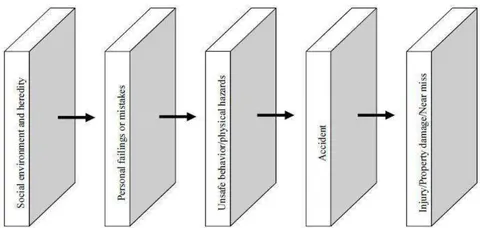
Heinrich's domino theory is comprised of five standing dominos that will fall one after the other if any domino falls (see Figure 3). An accident can be prevented only by removing one of the dominos preceding the accident. This interrupts the sequence and ensures that the accident does not happen.
The five sequential factors are as follows[8]:
i. Ancestry and social environment is the process of acquiring knowledge of customs and skills in the workplace. Lack of knowledge and skills required to perform tasks correctly and inappropriate social and environmental conditions will lead to the next domino: fault of person.
ii. Fault of person (carelessness) indicates negative features of a person's personality, although these unwanted characteristics might be acquired. Carelessness will lead to the next domino: unsafe act/conditions.
iii. Unsafe act or mechanical or physical condition includes the errors and technical failures which cause the next domino: the accident.
iv. Accidents are caused by unsafe acts or conditions and subsequently lead to injuries
v. Injury is the consequences of the accident.
Heinrich's opinions were criticized for overemphasizing the immediate causes of accidents and neglecting an important aspect of accident causation and prevention: management practice[9]; however, Heinrich's research and work was the foundation for many other researchers. Heinrich's domino theory has been modified and updated over the years with greater emphasis on management as an original cause of accidents. The management-based theories define management as responsible for causing accidents, and they attempt to recognize failures within the management system[10].
• Multiple Causation Model (Petersen, 1971)
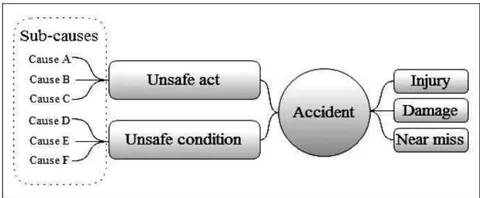
The Heinrich domino theory states that an accident is the result of a single cause. Petersen[11] developed a model based on management systems rather than individuals (See Figure 4). Petersen believed that there is more than one cause that contributes or leads to both the unsafe act, the unsafe condition, and, finally, the occurrence of an accident. Unlike in the simplified domino theory, there are causes and sub-causes that contribute to an accident. Through identification of these multiple contributing causes of an accident, the unsafe acts and unsafe conditions should be prevented.
- Updated Domino Sequence (Bird and Loftus, 1974)
Bird and Loftus (1974) also updated the domino theory to reflect the role of the management system in the domino-based model defined by Heinrich. The updated and modified domino model is illustrated in Figure 5 (Hosseinian & Torghabeh, 2012).
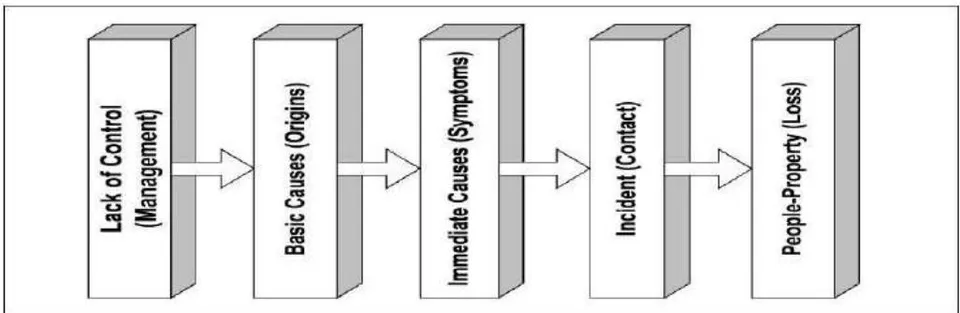
i. Lack of control/management (inadequate program, inadequate program standard, inadequate compliance to standard) ii. Basic causes/origins (basic causes: 1-personal factors, 2-job factors)
iii. Immediate causes/symptoms (sub-standard act and condition)
iv. Incident (contact with energy and substance)
v. Loss (property, people, process)
In this representation, the "Basic Causes" domino refers to factors such as a lack of motivation to work safely, or uncorrected hazards—factors over which management has a great deal of control. Each of the dominos in this sequence serves as an opportunity for intervening action, but the greatest potential for accident prevention is the first domino. When the domino theory is presented in this manner, management control is seen as the most important factor in the accident sequence[12].
V. THE THEORY OF ZERO INCIDENT SAFETY MANAGEMENT
The analytic part of the study is the development of the theory of Zero Incident Safety Management to foster understanding and acceptance of the Zero Incident concept. The discussion of the theory of ZISM will include the following aspects: definition, necessity, feasibility, underpinning theory, factors, and models.
5.1 Definition of Zero Incident
The Zero Injury concept was first described by the Construction Industry Institute (CII) in the fall of
1993. Since then, as many companies have met the Zero Injury goal, the concept of Zero Injury has become more widely accepted by owners and contractors. Some specialist organizations, like the NAC and ZII, actively advocate the use the Nine Principles. All of these safety efforts use the concept of Zero Injury. The essence of Zero Injury is working with zero OSHA recordable injuries. According to OSHA General Recording Criteria-1904.7, an OSHA recordable case involves one or more of the following:
Death
Days away from work
Restricted work
Job transfer
Medical treatment (beyond first aid)
Loss of consciousness
Other serious or significant cases diagnosed by a physician or licensed health care professional (PLHCP)
Occupational injuries and illnesses that meets special recording criteria
However, injury is not the only serious consequence of accidents. Based on Heinrich's domino theory, Peterson's 1971 accident causation model concluded that, in addition to injury, property damage and near misses are also consequences of accidents (see Figure 4). The concept of Zero Injury does not include these additional consequences; however, from the perspective of safety management, it is important to take into account damage to property and near miss. Damage could directly lead to losses, and would probably affect the project schedule, even when there isn't a personal injury involved. The cost of the project could increase, as could insurance premiums.
A near miss, as defined by the National Safety Council, is an unplanned event that does not result in injury, illness, or damage to property, but has the potential to do so. Because a near miss does not incur loss in the form of injuries or property damage, and does not lead to substantial disruption, it has long been ignored in construction safety management research, and employees do not proactively report near miss incidents. Thus, many opportunities to prevent accidents are lost. Actually, a near miss is only a fortunate break in the chain of events that prevents an injury or property damage. History has shown repeatedly that most loss-producing events (accidents) are preceded by warnings or near accidents. Recognizing and reporting near miss incidents can make a major difference to the safety of workers.
Because near misses and property damage are significant consequences that should be considered, Zero Incident was used in this research instead of Zero Injury.
5.2 Necessity of Zero Incident
Accident prevention on construction sites can be accomplished by implementing an effective safety program (Smith, Roth, 1991). To better demonstrate the necessity of Zero Incident, it is first necessary to examine the difference between ZISM and other safety management.
Any other goal of construction safety effort implies that accidents are expected and acceptable. In the very beginning of construction safety research, it was believed that accidents were a result of pure chance, and could happen to anyone at any time, though some people were more likely to suffer an accident than others. This was referred to as the accident proneness model (Cooper, 1998). In the past, the prevailing view on construction safety accidents was that not all construction accidents were preventable. However, the Zero Incident philosophy is based on the belief that eliminating all worker accidents on projects is possible. The goal of all safety efforts is to increase safety performance and achieve "safety excellence." The difference between Zero Incident and other efforts lies in the former's claim that all accidents are preventable.
The essence of Zero Injury is working for a significant period of time with zero OSHA recordable injuries, while the essence of Zero Incident is working with zero OSHA recordable injuries, zero damage and Zero near misses. Once the essence of Zero Incident is clear, we can prove the necessity of Zero Incident by the method of "Proofs by Contradiction." If safety goals were not set as Zero Injury, employers, as leaders, send the message that some accidents are acceptable. As reported in recent research on safety culture, the leader's attitude and values have a significant impact on the whole company. Without Zero Injury, employees at all levels could have the wrong safety values and attitudes, which result in unsafe behaviors. What's more, the company safety culture would be influenced, and, as a result, more accidents would occur.
In the discussion above, we analyzed the necessity of Zero Incident theoretically. In the following section, we will discuss the feasibility of Zero Incident.
5.3 Feasibility of Zero Incident
All employers should have an absolute belief that it is possible to eliminate accidents. There are plenty of companies that have gone millions of man-hours without an injury.
The logic of Zero Incident is simple: if you can work safe on a task one time you can do it twice; if you can do it twice you can do it four times; if you can do it four times you can do it eight times; and so on and so forth. Zero Incident is not only a goal, but also a thought process that begins with the premise that if a worker can work one day without an injury, that worker can work each and every additional day injury free. The fact that an injury occurs does not mean it is acceptable to the organization (Binsfeld, 2010). Because Zero Incident is possible, accident prevention is no longer just a business proposition, but a moral obligation. If you can keep people from being injured, you have a moral obligation to do so.
5.4 Underpinning Theory of Zero Incident Safety Management
As we discussed in Theories of Accident Causation, Heinrich (1959) was the pioneer in conducting research on the conditions and circumstances that caused industrial accidents. He developed an accident causation theory known as the Domino Theory.
Heinrich's research and work was foundational for many other researchers; however, his opinions were criticized for placing too much emphasis on the immediate causes of accidents while neglecting an important aspect of accident causation and prevention: management practice [9].
Therefore, the Heinrich Domino Theory has been modified and updated over the years with greater emphasis placed on management as an original cause of accidents. Bird and Loftus developed another domino theory to reflect the role of management systems in the chain of what leads to accidents.
In Bird's representation, the "Basic Causes" domino refers to factors, such as a lack of motivation to work safely and other factors such as uncorrected hazards, over which management has a great deal of control. Each of the dominos in this sequence serves as an opportunity for intervening action, but the greatest potential for accident prevention is the first domino. When the Domino Theory is presented in this manner, management control is seen as the most important factor in the accident sequence[13].
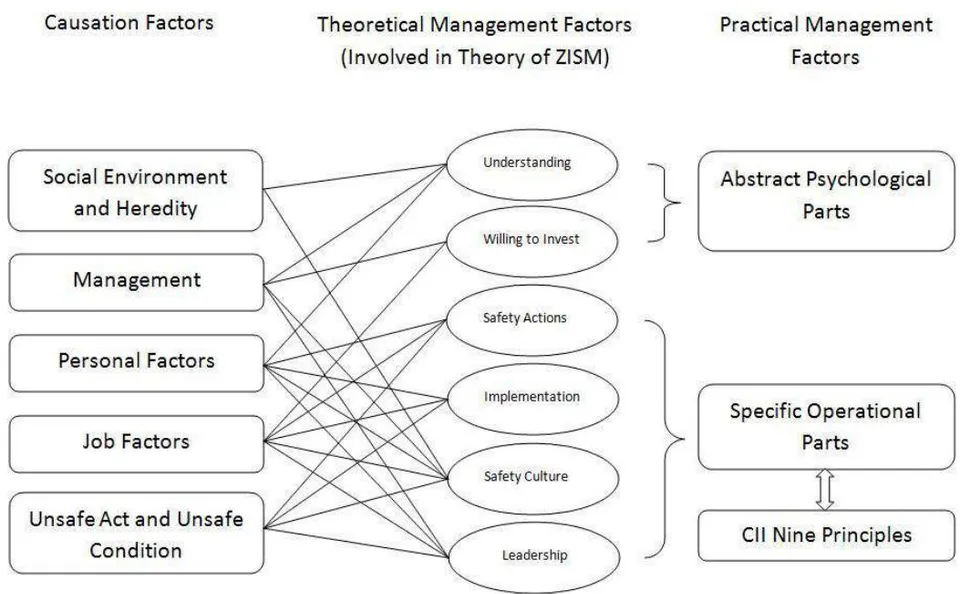
By summarizing the two theories and interviews with safety expert, the new theory of accident causes and prevention was developed, shown in Figure 6.
The five important accidents causation factors are as following:
Environment and heredity: A person's undesirable characteristics such as recklessness, stubbornness, greed, and bad temper can be passed along through inheritance or developed from their environment. In other words, such traits can be caused by nature or nurture. Environment and heredity could be defined as people's undesirable traits that are affected by the environment and can contribute to faults of person.
Management: Management is classified as the underlying cause. Management controls the factors that prevent incidents from happening, including safety planning and organizing.
Personal factors: These factors include personal undesirable characteristics such as bad temper, inconsiderateness, ignorance, recklessness, and other personal problems that are not work-related, such as mental problems, illness, bad attitude, and lack of understanding, ability or motivation.
According to Heinrich, natural or environmental flaws in the worker's family or life cause these secondary personal defects, which are themselves contributors to unsafe acts, or and the existence of unsafe conditions.
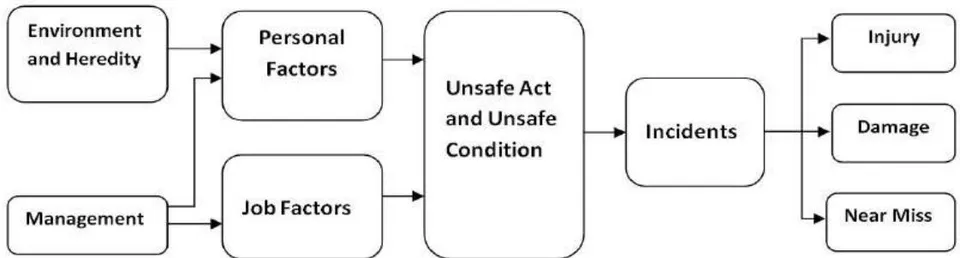
Job factors: These factors include all uncorrected hazards, such as acts of God, unsafe methods, job site conditions, unsafe equipment, inadequate work, normal or abnormal wear and tear, low-quality equipment, and bad design or maintenance.
Unsafe acts and unsafe conditions: These refer to the errors and technical failures that cause the accident and are the most significant factors that lead to accidents. Heinrich felt that unsafe acts and unsafe conditions were the central factor in preventing incidents, and the easiest causation factor to remedy, a process which he compared to removing one of the dominoes from the line.
All of the five causes were defined as the most important factors that result in construction accidents. Zero Incident Safety Management should be developed by eliminating these causes. To achieve this objective, the safety management factors should be identified based on the new theory of accident causes and prevention.
5.5 Factors Involved in Developing ZISM
Zero Incident Safety Management is an approach that considers all of the factors that might influence safety, such as leadership, workers' behavior, and companies' cultures. Because it accounts for all of these factors, ZISM can function effectively in the dynamic, complex, and competitive conditions that construction projects face.
According to the new theory of accident causes and prevention, Zero Incident Safety Management should be contributed to eliminate the five causes.
Environment and heredity. To solve this problem, all leaders and employees have to understand the Zero Incident concept. Only people who understand and accept the concept deeply can change their safety values, and therefore their behavior. In addition, safety culture and safety training can also have an impact on this cause.
Management. Management depends on leadership. Employers' willingness to invest resources, time, and money in safety plays a significant role in safety management. Safety actions and the implementation of safety programs are also affected by management.
Personal factors. This is similar to environment and heredity. Safety culture, understanding of safety, safety actions, and the implementation of safety programs can change personal undesired characteristics and other problems.
Job factors. Uncorrected hazards, even an act of God, can be managed and prevented by proactive and strong leadership. The willingness to invest in effective safety actions and the implementation of safety programs can also help eliminate undesired job factors.
Unsafe acts and unsafe conditions. Unsafe errors and technical failures are the easiest causation factor to remedy. Strong leadership, proactive safety culture, specific safety actions, and implementation of effective safety program can solve this factor.
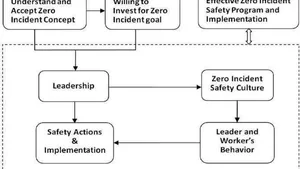
By summarizing the theoretical safety management factors that can eliminate the causation factor in preventing safety accidents incidents, we concluded the essential factors to achieve the ZISM is as follows (see Figure 7):
1. Strong and active leadership.
- The leader understands and accepts the Zero Incident concept.
3. Safety culture.
The owners and contractors are willing to invest in the implementation of the safety program.
The process of implementation of the effective safety program.
The effective safety actions that provide the highest impact on achieving Zero Incident.
The six management factors offer a theoretical guide that provides direction for where the efforts can be spent to achieve the Zero Incident goal. Among them, the understanding of Zero Incident and willingness to invest in safety are abstract psychological parts. Specific safety actions, implementation of safety programs, safety culture and leadership are all specific operational parts. The Nine Principles concluded by CII, as practical-level management factors, are included in the operational parts. The six theoretical management factors explain and support the Nine Principles found by CII.
5.6 Zero Incident Safety Management Model
Because this is the first effort to develop a Zero Incident Safety Management model, the study is exploratory in nature. There are no previous studies that identify the ZISM factors and the nature of the relationships between the factors. Thus, there are no previous findings to confirm.
The current study developed such a model directed towards the Zero Incident goal by interviewing construction safety experts and analyzing the related materials. According to the identified safety management factors that involved in developing ZISM. The developed model was developed as shown in Figure 8.
Understanding and accepting the Zero Incident concept. The essential philosophy of Zero Incident is based on the belief that eliminating all worker incidents on projects is possible. Any other goal implies that incidents are expected and acceptable. Understanding the essence of Zero Incident helps leaders completely accept the Zero Incident goal, which is the first essential criterion required to achieve that goal. After they understand and accept Zero Incident, leaders will have the right reasons to truly care for their employees. Further, leaders can communicate the Zero Incident concept to their employees effectively to achieve an effective safety culture among the whole company. Finally, it is essential that the owners and contractors are willing to devote resources, money, and time to achieve the Zero Incident goal.
Willingness to invest. Willingness to invest in safety was defined in this research how much time, energy, resources, money, and others efforts an owner and contractor want to invest in construction safety. Only if leaders are willing to invest in safety will be able to achieve the Zero Incident goal and will show that they truly care about their employees. This is required to make strong leadership and active safety culture. This part will be further discussed in other paper.
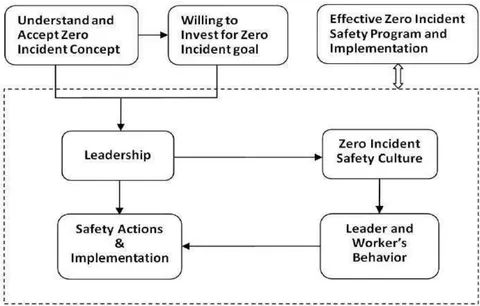
- Leadership. One important purpose of leadership is to create an organizational culture to guide the behavior of its members[14]. One of the primary duties of a leader is to create, develop, maintain and manage the culture of his or her organization. The creation of a desired organizational culture requires leadership to have a vision of the desired culture and to be active in communicating and selling that vision to the organization's members.
In a study titled Project Site Leadership Role in Improving Construction Safety, CII identified six leader behaviors that directly influence a safety culture in an organization and, ultimately, produce better safety performance. This research also concluded that developing a strong, positive safety culture requires active leadership that can influence values, attitudes, and beliefs about safety. Leadership behavior must reinforce the values, beliefs, and assumptions that constitute the desired safety culture in the project workforce and that affect worker behaviors[15].
- Zero Incident Safety Culture. A strong safety culture embraces the Zero Injury concept. An owner and contractor build a Zero Injury safety culture through strong leadership that pushes all employees at all levels to accept ownership of the safety performance objective of Zero Injury. Leadership also plays an essential role in its long-term success.
Existing research about safety culture showed that company's success in attaining a Zero Injury Safety Culture depends on a company's owners and senior leaders, who must instill, reinforce, and sustain the culture. Companies that meet this challenge with a relentless passion for Zero Injury have discovered that, regardless of the quality of safety systems, the number of safety meetings, the quality of training, the number of safety professionals or the number of processes required for a task, it is the strength of the leadership within a company that determines how close it can get to a constant zero[16].
- Safety Program and Implementation. Safety programs can be broken down into hard content or soft content. Hard content is anything that falls under the category of statutory safety procedural and compliance techniques (e.g., all OSHA and DOT and other regulatory body stipulations applying to such things as scaffolding, rigging, welding, drilling, cleaning, and driving). Soft content is anything done for the employees (e.g., how they are treated, personal evaluations, safety recognition, safety participation and other employee-focused leading indicator safety initiatives). All specific safety actions and other safety measures about leadership and safety culture are included in safety program.
Implementation covers the "how" and "when" of a safety program. For the "how" detailed plans are prepared to ensure the quality of the safety program elements implemented. For the "when," an integrated and coordinated safety leading indicator implementation schedule is made and it is executed in a timely fashion.
After the ZISM model was developed, it was instrumental in understanding the Zero Incident concept and guiding the direction of the efforts spent on the Zero Incident goal. Based on this model, there are generally three parts we need focus on to achieve the Zero Incident goal: understand and accept the Zero Incident concept; have the willingness to invest in the goal; and develop an effective Zero Incident safety program. The main purpose of theory of ZISM is to help owners and contractors to understand and accept the Zero Incident concept.
5.7 ZISM Model Validation
According to the theory of ZISM developing process, validating the ZISM model is to validate the six theoretical management factors. For the specific operational parts, in other words, the Nine principles have already been approved by CII research. The CII Report 32.1 "Zero Injury Techniques" in 1998, the subsequent studies in 2001 and 2002, and the follow-up research "Making Zero Injuries a Reality" have concluded that Nine Principles are the most effective approach to Zero Injury by collecting and analyzing project safety data. For the Willingness to Invest in safety part, the other paper "The Approach to Increase Willingness to Invest in Safety (WTI) for Zero Incident" has the details to demonstrate the definition of Willingness to Invest in safety and how it works to increase safety performance.
5.8 Standard Metrics
While the idea of Zero Incident is new, not much research has been done to develop a strategic safety management approach for the construction industry that would allow for continuous measurement and improvement of factors determining the safety performance of a construction organization. To be instrumental in reaching and sustaining the goal of zero accidents, the current study delved into developing such a standard metrics directed towards the goal of implementation of safety program.
The Nine Principles concluded by CII offer the most effective guide. In addition, James B. Porter developed thirteen actions needed to enable safety performance goals to be met and sustained in the most business effective, risk sensitive ways. In this research, to facilitate the most rapid implementation of the Nine Principles and to develop a better safety program, both CII and Porter's conclusions were combined. The management actions were developed first, and, based on these actions, the leading metrics were created.
The explanation of the Nine Principles, management points, the thirteen actions and the metrics are shown in Appendix.
The metrics were composed of two parts: a checklist and a scorecard. To standardize the value of each metric, they were quantified as fixed scores. Then the standard benchmark can be used to evaluate any other construction projects and compare their safety management with Zero Incident Safety Management. The gaps in the safety action process and missing elements in safety management will be found and leaders will be given the opportunity to retrofit these if needed, so that they can continue progressing to the Zero Incident goal.
VI. CONCLUSION
This paper mainly developed an approach, Zero Incident Safety Management (ZISM), to answer the question "How can construction leaders employ the theory of Zero Incident Safety Management to improve safety performance so as to achieve the goal of Zero Incident?"
To answer the question, the research generally had two objectives. Phase 1 of the research was to develop the theory of ZISM. Based on the literature review and current development situation of the construction safety, the new theory model of accident causes and prevention was developed. Then the safety management factors were identified and the ZISM model was created.
The theory of ZISM not only helps owners and contractors to deeply understand and accept the Zero Incident concept, but also can serve as a theoretical guide to provide direction for what we can do to continue increasing safety performance to achieve the Zero Incident goal. Based on this model, there are general three parts we need focus to achieve Zero Incident goal: understanding and accepting the Zero Incident concept, having the willingness to invest in the Zero Incident goal, and developing an effective Zero Incident safety program. The theory of ZISM includes the motivation, necessity, feasibility and the underpinning theory. The purpose developing this theory was to help owners and contractors understand and accept the Zero Incident concept.
In phase 2 of this research, based on the Nine Principles concluded by CII and thirteen actions developed by James B. Porter, the standard benchmark with leading metrics was created to facilitate the most rapid implementation of the Nine Principles to develop a better safety program.
However, the developed standard benchmark needs to be further validated by assessing the safety management in the real projects. The sample should include the projects that successfully achieved Zero Incident goal and target projects. By assessing the safety management of the projects, the collected feedback will be used to continue adjusting the leading metrics and the standard benchmark.
Eventually, the standard benchmark can be used to evaluate any other construction projects and compare those projects with Zero Injury safety management. The gap of safety techniques, process and safety management missing will be found and give leaders the opportunity to retrofit if needed, to continue progressing towards the Zero Incident goal.
Conflict of Interest
The authors declare no conflict of interest.
Ethical Approval
Not applicable
Data Availability
The datasets used in this study are openly available at [repository link] and the source code is available on GitHub at [GitHub link].
Funding
This work did not receive any external funding.
References
Cite this article
Related Research


Special Issue
Launch a focused special issue to highlight research, emerging trends, and expert insights in your academic field.