




IntelliPaper
Abstract
Melorheostos is is a rare congenital bone disorder present with insidious onset of bone pain. Diagnosing this rare condition and managing it is difficult. Knowledge of this rare entity is important for the physician who is treating patients with musculoskeletal pain.
Case Report
A 25-year-old female with right leg pain for a two-year duration. She has been seen by a lot of physicians and could not have been managed properly. Her radiographs were showing hyperostotic left ulna and right tibia. Sinister pathologies were excluded using MRI and biopsy. Her symptoms settled with intravenous Zoledronate. Pain recurred after two years and she responded well after repeated Zoledronate injection.
Conclusion
Though there are no key clinical features, diagnostic tests, or cause of this clinical condition, symptomatic management is adequate to manage patients with this clinical condition. Intravenous Zoledronic acid is an option for patients who have severe and resistant symptoms.
Explore Digital Article Text
I. INTRODUCTION
Polyostotic melorheostosis is a rare congenital non-hereditary benign sclerosing mesenchymal dysplasia involving multiple bones(1–4). Melorheostosis is presented in the second decade of life. The male and female ratio is the same. The classical description of appearance in the radiographs is "flowing candle wax"(1). The axial skeleton is rarely involved. The treatment is mainly non-operative. Surgery is reserved for the lesions complicated with fractures.
We present a case report on a patient with symptomatic polyostotic melorheostosis successfully treated with intravenous Zoledronate injection.
II. CASE REPORT
A 25-year-old female presented to the orthopaedic unit with pain over her right leg left forearm and back for two years duration. She has been seen by a lot of physicians for the same ailment and they could not help her. The pain gradually worsened over time and made her visit us. On examination, the right leg and the left forearm were swollen diffusely. There is no history of back pain.
Radiographs show hyperostosis of the right tibia and the left ulna (Figure 1). Technetium 99 bone scan revealed hyperactivity seen on the right tibia, left ulna, left fibula, left femur and the spine (Figure 2). The bone profile including serum calcium, phosphate and alkaline phosphate was normal. Bone biopsy revealed normal bony architecture. She was given an intravenous Zoledronic acid injection and became asymptomatic. She was followed up at the
Orthopaedic clinic for two years. Again, she developed pain over the same region and she was treated again with the same medication. Now she is completely pain-free and her activity of daily living has improved dramatically.
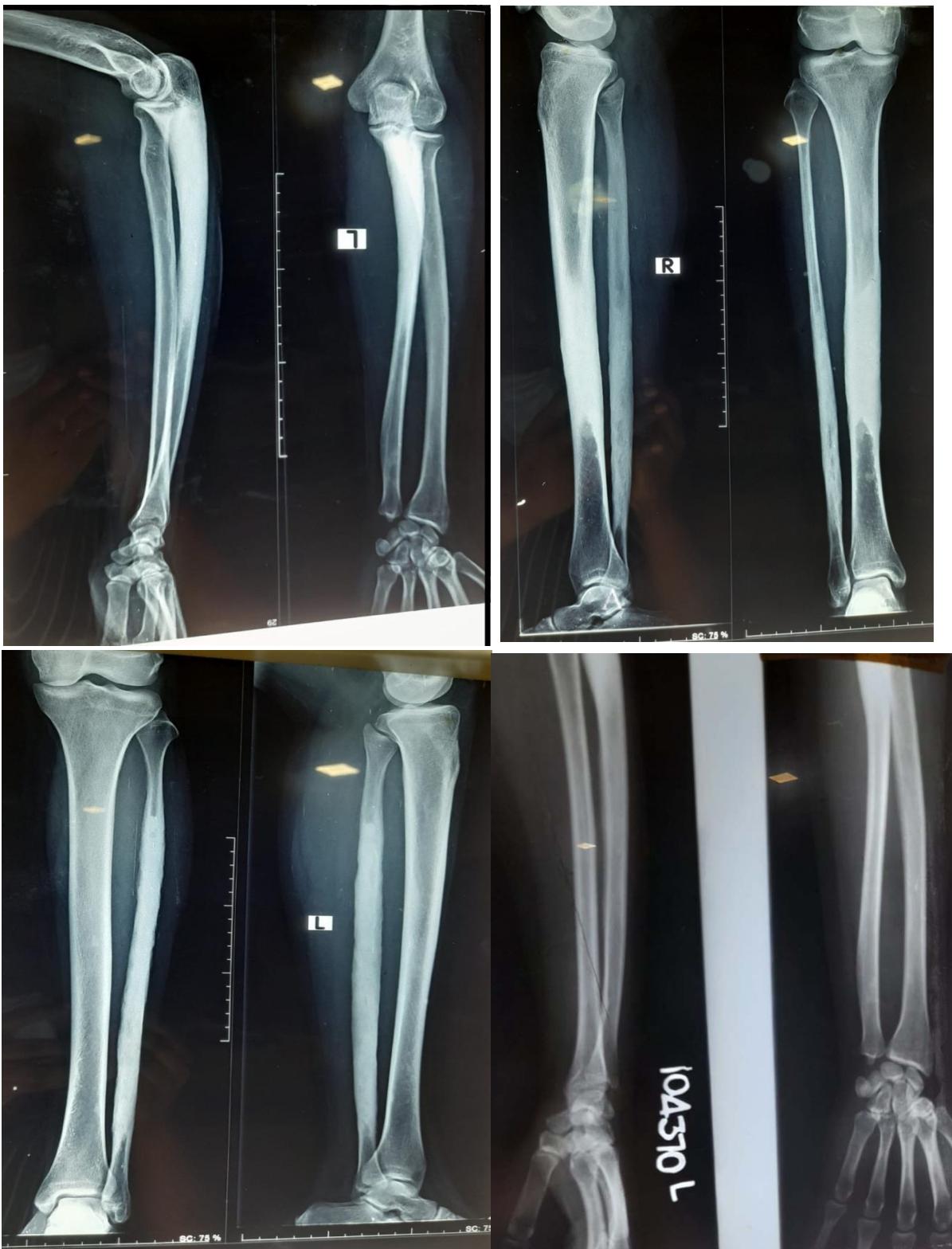 Figure 1: Shows radiographs of symptomatic anatomical regions show polyostotic sclerotic bony lesions involving the left proximal ulna (Figure 1A), right tibia (Figure 1B), left fibula (Figure 1C) and left proximal ulna (Figure 1D). All lesions are identical and have scalloping edges compatible with the classical description of the disorder.
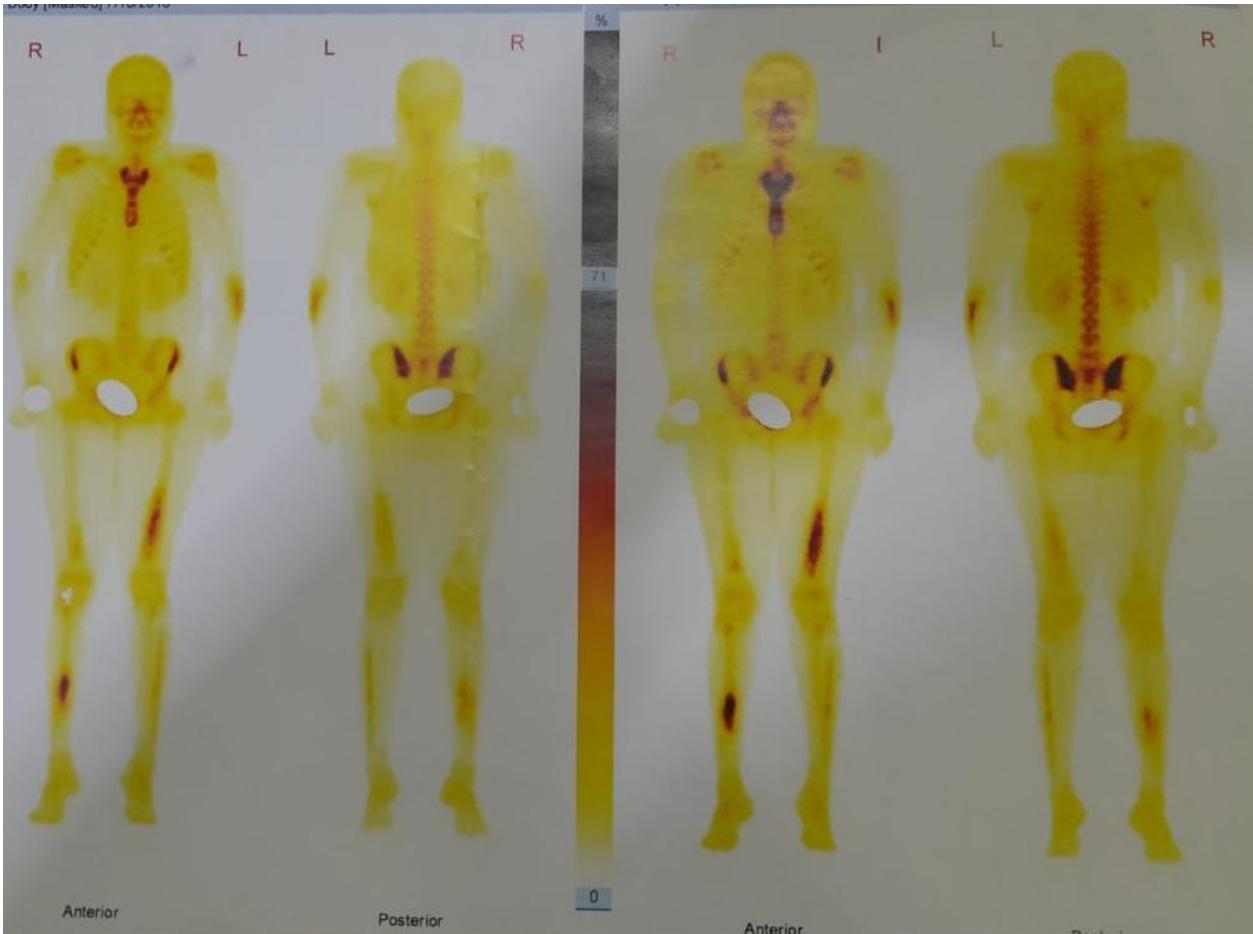 Figure 2: Shows the whole body Technetium bone scan of the same patient which revealed hyperactivity seen in the right tibia, left ulna, left femur and left fibula. In addition, the spine and pelvis also show hyperactivity.
III. DISCUSSION
Melorheostosis is a rare disorder in which sclerosing dysplasia with derangement in endochondral and intramembranous ossification of bones. The summary of demographical details is in Table 1. Figure 3: Summary of demographic details of patients with melorheostosis (1, 2, 4, 5)
| Demographic Details | ||
| 1. | Incidence | 0.9/Million |
| 2. | Male: Female | 1:1 |
| 3. | Age of presentation | 2-64 years |
| 4. | Majority of presentations at the age of | Around 20 years |
These lesions can be on one bone (Monostotic), many bones (Polyostotic), involving one limb (Monomelic) or generalized. Axial skeleton involvement is rare. According to the anatomical involvement, severity and the deformity caused by the lesions symptoms and signs will be varied.
Commonest symptoms are painful limb swelling, restricted range of motion and contractures of joints (usually asymmetric). Axial skeleton involvement may present with back, and neck pain, radicular pain, scoliosis, stiffness, giddiness, symptom of vertebrobasilar insufficiency and devidence of cord compression(1).
Melorheostosis is not a fatal condition. But it impacts significantly the activity of daily living of patients with this ailment. The management of melorheostosis varies from simple analgesics to surgery. The management depends on the anatomical site, the extent of lesions, the severity of symptoms and the degree of deformity. The primary goal of management is to relieve symptoms and achieve mobility. Pain relief, nerve blocks, braces, and physiotherapy play a vital role. Patients who are not responded to these options will undergo nerve blocks. Surgery deserves for patients with lesions complicated with fractures.
There are few case reports on the usage of intravenous zoledronate for melorheostosis(6–8). They reported successful outcomes following treatment after the injection. On our patient single dose of intravenous zoledronic acid (5mg over 30 minutes) has provided remission for two years and it worked for relapse as well after two years. Intravenous zoledronate is an effective treatment for symptomatic polyostotic melorheostosis. Zoledronate is a bisphosphonate which inhibits osteoclasts and reduces bone pain, prevents pathological fracture and reduces blood supply(6–8). Bone resorption by osteoclasts, stimulation of pain receptors and increased intraosseous pressure are major reasons for bone pain among patients with melorheostosis (6–8). Thus, zoledronate is a viable option for the ents with melorheostosis causing bone pain. Anyway, careful selection of patients and preparation is necessary before the zoledronate infusion to avoid complications (Avascular necrosis of the jaw, fever, allergic reactions etc).
IV. CONCLUSION
Symptomatic polyostotic melorheostosis may be resistant to symptomatic treatment. Intravenous zoledronate is a viable option for such patients.
Conflict of Interest
The authors declare no conflict of interest.
Ethical Approval
Not applicable
Data Availability
The datasets used in this study are openly available at [repository link] and the source code is available on GitHub at [GitHub link].
Funding
This work did not receive any external funding.
References
Cite this article
Related Research



Special Issue
Launch a focused special issue to highlight research, emerging trends, and expert insights in your academic field.
