



IntelliPaper
Abstract
Cellulite is a common aesthetic concern that may significantly impact on individuals' self-image and quality of life. Despite being a non-threatening condition, it may have a negative effect on the psychological well-being of affected individuals. This condition is multifactorial and involves several physiopathology pathways. The role of enzymes in the management of cellulite is a novel approach, particularly lipase and collagenase, which play key roles in adipocyte size reduction and collagen degradation, respectively. The potential of high-molecular-weight hyaluronic acid to promote tissue repair and regeneration is also highlighted. Our case report describes the effectiveness of an association of recombinant enzymes and high-molecular-weight hyaluronic acid by reducing cellulite manifestations in a patient, with a history of multiple unsuccessful treatments, showing visible improvements from the initial treatment session. The importance of understanding the complex physiopathology of cellulite and choosing a targeted approach is emphasized.
Explore Digital Article Text
Introduction
Cellulite represents one of the most prevalent and undesirable aesthetic concerns among women. It is a multifactorial condition that affects 85% of post-pubertal females and is characterized by a dimpled skin appearance. Several predisposing factors have been associated with cellulite, including genetic predisposition, gender, ethnicity, eating habits, sedentary lifestyle, smoking, and pregnancy. In addition, multiple hypotheses have been proposed to explain the physiopathology of cellulite, including structural and architectural alterations, anomalies of the topographic anatomy of fatty tissue, differences in the distribution of white and brown adipose tissue, vascular alterations, and hormone-dependent reactive processes, especially those linked to estrogens.
From a psychological perspective, the impact of cellulite on individuals’ self-image and quality of life is significant, even though it does not pose a direct physical threat. Cellulite may considerably influence quality of life, as demonstrated by validated scores in 84.6% of affected participants in a study. In addition, another study revealed that 70% of patients who had received treatment for cellulite perceived a substantial positive impact on their lives.
Understanding the etiology, physiopathology, and severity of cellulite is highly important for the development of targeted treatments. In aesthetic medicine, cellulite management involves pharmacological agents, device-based therapies, and, in selected cases, surgical correction. Recent advances in protein engineering and molecular biology have led to the synthesis of recombinant enzymes. In general terms, these enzymes act on the skin promoting tissue remodeling and improving skin texture, elasticity, and overall appearance. Pbserum HA 1.5 Medium consists of the combination of three recombinant enzymes (collagenase, lipase and lyase) together with high-molecular-weight hyaluronic acid (HMWHA). Although each enzyme exerts a distinct biological effect, their combined action produces synergistic outcomes in tissue regeneration and remodeling. This case report is aimed to show the beneficial effects of the therapeutic application of these recombinant enzymes in the treatment of cellulite.
Case Report
A 59-year-old female patient was evaluated in the aesthetic medicine clinic. Her history was remarkable for a healthy lifestyle, including daily physical training. In the past five years, she had several evaluations for cellulite, with multiple treatments (radiofrequency, carboxytherapy, manual massage, and lipomassage). The physical examination revealed grade 4 cellulite according to the Nuremberg-Muller scale, mainly affecting intergluteal and trochanteric areas (Fig. [fig:changes-appearance]a, [fig:changes-appearance]b). After obtaining informed consent and considering the patient’s expectations and goals, a tailored therapy with combined recombinant enzymes and HMWHA (pbserum HA 1.5 Medium, Proteos Biotech S.L.) was suggested.
The application was performed in 3 sessions, scheduled at 15-day intervals. During the first session, a final volume of 20 ml (1.5 ml of reconstituted product, 0.5 ml of 2% lidocaine without epinephrine, and 18 ml of dilution solution) was applied in the buttock, infragluteal, and trochanteric areas, using a 30-gauge needle. The area was gridded, and a dose of 0.1 ml was applied from deep to superficial in retroinjection symmetrically, with 1 cc points every 2 cm. A similar strategy was used on the areas with greater fat tissue hypertrophy.
In the first follow-up visit, a significant improvement in cellulite appearance was already reported and a new treatment session was performed. Thirty days after the first visit, skin appearance and laxity were further improved. In this final session, a similar protocol was considered. After 45 days from the first session (Fig. [fig:changes-appearance]c, [fig:changes-appearance]d), the improvement of cellulite was notable, and the patient’s weight remained unchanged from the beginning of the treatment.
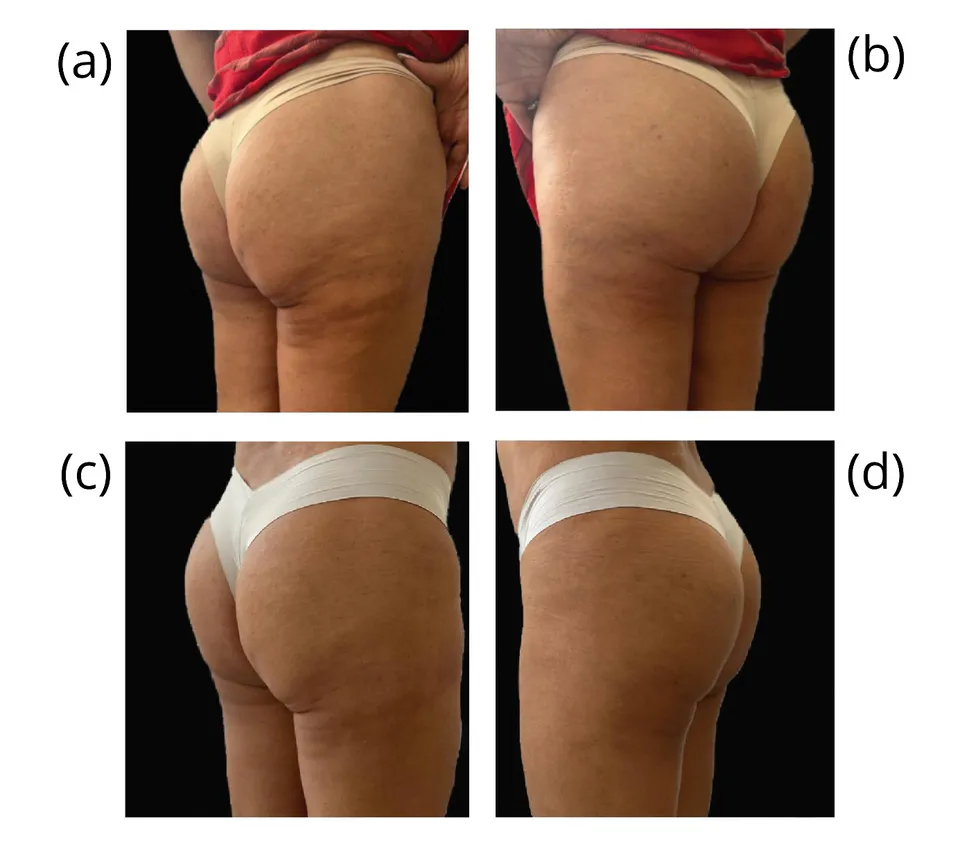
Changes in the appearance of the patient’s skin: (a) and (b) Basal conditions, grade 4 cellulite (Nurenberg-Muller scale); (c) and (d) After 45 days from the first session of treatment with pbserum HA 1.5 Medium.
Discussion
Early studies using thigh and buttock biopsies showed that cellulite histopathology is characterized by fibrotic and fibrosclerotic septa, changes in tissue thickness, and protrusion of subcutaneous fat into the dermis. These alterations are attributed to the progressive pressure of fat tissue against the fibrous septa, which transmits tension to the dermis and produces the characteristic uneven skin appearance. Since conventional therapies have limited effectiveness on these structures, there is a clear need for new strategies capable of remodeling the septa and restoring normal tissue architecture. By contrast, combined recombinant enzymatic therapy provides a comprehensive approach to cellulite management, particularly by targeting its pathogenic mechanism. The enzymes included in pbserum HA 1.5 Medium, which are commonly present in connective tissues such as the skin, tendons, blood vessels, and bones, improve the fibrous septa that contribute to the dimples and depressions associated with cellulite. Lipase facilitates the hydrolysis of triglycerides into free fatty acids and glycerol, resulting in adipocyte size reduction and contributing to the improvement of fat cell protrusion into the dermis and the visible skin irregularities. Collagenase cleaves the specific Pro-X-Gly-Pro bonds prevalent in collagen. By degrading native collagen fibrils, this enzyme plays a significant role in remodeling structural abnormalities and restoring the integrity of the collagen network. Subcutaneous injections of collagenase in minipigs were also seen to induce a decrease in the thickness of adipose tissue. And lyase, an enzyme responsible for the enzymatic degradation of GAGs, increases the permeability of the skin and connective tissue, facilitating the penetration and spread of collagenases through dense extracellular structures. The combination of these three enzymes with HMWHA offers a promising therapeutic potential for addressing cellulite.
It has been shown that hyaluronic acid, a hydrophilic GAG, accumulates during adipocyte maturation and is associated with increased expression of adipogenic markers. HMWHA enhances hydration and structural integrity of the extracellular matrix, promoting intercellular signaling, cellular proliferation, migration, and adhesion during tissue repair processes.
The clinical improvement observed in our patient adds evidence about the effectiveness of recombinant enzymes in enhancing the appearance of cellulite. This targeted application directly addressed the specific characteristics of cellulite, resulting in a significant improvement that was evident from the first session. Our results highlight the potential of enzymatic therapy as a valuable intervention for cellulite management. Further large-scale, randomized and rigorously conducted studies are warranted to obtain more robust and reliable data.
The authors provide special thanks to Proteos Biotech. We are also grateful to Dr. Estefanía Hurtado Gómez on behalf of Biopress Ediciones Médicas for her work in reviewing the writing of the article.
Conflict of Interest
Ethical Approval
Not applicable
Data Availability
Funding
This work did not receive any external funding.
Cite this article
Related Research


Special Issue
Launch a focused special issue to highlight research, emerging trends, and expert insights in your academic field.