




IntelliPaper
Abstract
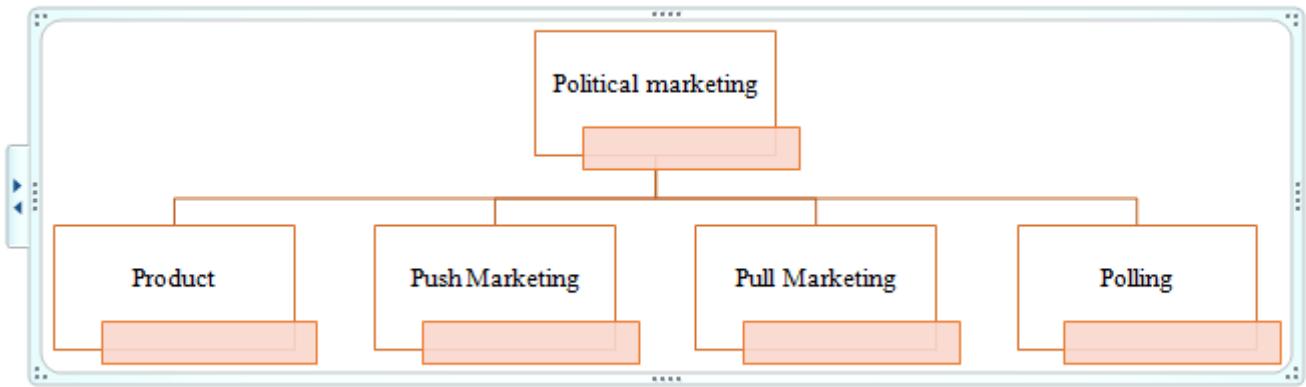
Political marketing is a way that political organizations, politicians, political leaders, political parties, governments, and NGOs use marketing methods and concepts to create and develop their products and political understanding, Its purpose is to respond to marketing and involve communicating and interacting with the political market to achieve the desired effect. Political marketing is not just advertising management, but also political communication, election campaigning, and a strategy centered on political consumers that is, voters,who act as the drivers of market dynamics and how voters make decisions based on their needs over some time.Political Marketing Elements; (1) Political Product, (2) Push Marketing, (3) Pull Marketing, and (4) Polling. However, there are 3 marketing tools for political campaigns as follows: (1) The classification of marketing segments of the elector is Political Product, Marketing Promotion, and Political Place. (2) The positioning of candidates and parties is the application of political party policies, and the rebuilding of one's image.And (3) Political Marketing Strategies were Sensation, Story, Speed, and Social Media.
Explore Digital Article Text
I. INTRODUCTION
Elections are the most important component of a democratic political system because elections are the decisions of the people, those who own sovereignty as to which person or group of persons should be entrusted to exercise sovereignty on behalf of the people (Chaicharn,
W., 2000: 24-27). Elections are activities that demonstrate the participation of the people who own sovereign power through the voting process. to independently select any person or group of persons according to their own opinion, to get representatives to act on their behalf, to use democratic powers to manage the country and protect the interests of the people (Wutdilokpraphan, S., 2011: 11). However, voting behavior in political science has evolved from the interests of academics in two fields. Namely, behaviorist sociologists and political scientists, These scholars first focused on the influence of socioeconomic status on the voting behavior of individuals such as socio-economic status is indicated by occupational education, ethnic or cultural groups, and ethnic groups, as well the stereotypes of women's political participation. Later, attention was paid to the influence of psychological factors or political sentiments such as interest in politics, group affiliation, or party affiliation. some political parties, etc. Such studies should be considered to set goals for the further systematic study of voting behavior in Thailand. (Bunbongkarn, S., & Phongphaew, P., 1984: 7).
In social sciences, the voting theory is divided into three groups: Deterministic Theories, Consciously Rational Theories, and System Theories (Bunbongkarn, S., & Phongphaew, P., 1984: 15-18. However, Klapper (1960:5) proposed the following concepts of the influence of mass media on changing people's attitudes and behaviors; (1) The mass media does not directly influence the people but has indirect influence depending on factors including; (a) Predisposition is that people will have their opinions, values, and inclinations to act before they come into contact with the media. (b) Choosing to receive a message, people will choose to receive a message that is consistent with their opinions and interests and will choose to interpret the message based on their existing beliefs and values. (c) Personal influence Sometimes news from the mass media passes through the media or opinion leaders before reaching the people. Opinion leaders often intervene with their own feelings, thereby influencing the opinions of the population. (d) Group and its norms. And. (e) Mass media system. (2) The mass media will only be a reinforcement to strengthen people's attitudes, tastes, inclinations, and behavioral tendencies and be ready to express themselves when motivated or when the opportunity arises. (3) The mass media may slightly change people's attitudes and become unstable. It is difficult to change a deeply ingrained or opposing attitude change, it may take some time and a person must be adequately informed. However, the influence of the media on change occurs only if the person is already inclined to change. And (4) The mass media can create an attitude for the people if a person has no prior knowledge and experience about it and must frequently be exposed to the same subject matter as an influence that is acquired in a not cumulative manner. Influences that produce immediate results.
In addition, it is important to affect electoral behavior, in which the importance of a candidate is a campaign, It means an attempt to inform, influence, and mobilize systematically, which could be said to be an inseparable part of the electoral process. Various efforts are made to get candidates to be elected. There are three campaign objectives (Manarat, P., & Thapmongkol, P., 2012: 23–34); (1) Voter persuasion, a group of candidate advocates, to come out and vote openly; mobilizing supporters is an important part of ensuring that candidates get the votes of their target audience. (2) Encouraging hidden supporters to come out and exercise their right to vote, because of the number of non-voting voters, there will be some who support their own candidates to get higher votes. And (3) to change the mind of supporters of opposing candidates to support one's side, to persuade voters who are not their base of voters, which proceedings are prudent and rigorous because the difficulty and limitations are quite limited.
Thus, an electoral campaign is the format and method used by a candidate to campaign to win an election, the methods used in the campaign included house visits, posting posters, handing out brochures, organizing a public speech, using public relations vehicles, etc.
Political marketing is how political organizations and politicians, political leaders, political parties, governments, and NGOs use marketing methods, and concepts to understand and develop political products and insights to respond to marketing and involve communication and interaction with the political market to achieve desired results (Lees-Marshment, 2012: 2). Political marketing is the idea of an exchange, wherein candidates exchange what they get when voters cast their votes for themselves, that is, attaining a transactional destination (Cwalina, Falkowski, & Newman, 2011: 16; Newman, 1994). Political marketing is where a political party or candidate uses opinion research and analysis of the political environment to produce or support competition for organizations to achieve their goals and make people elected and traded by voting for them (Cwalina, Falkowski, & Newman, 2011: 16; Dominic Wring (1997, 653). However, political marketing is not just about managing ads, but also political communications, and election campaigns, and has a strategy centered on political consumers, and voters, as the drivers of change. of the market and that the voters make decisions based on their needs for a particular period (Busby, 2009: 13).
However, the political environment has many factors influencing elections which may be divided into three major groups (Chantornvong, S., 1987; 60); (1) Technology change factors; include computer innovation, creation of member databases, and target groups with computer systems, research data processing, Internet use to communicate with voters, television technology. These have evolved a lot, especially the cable TV and interactive television industries. (Interactive), has a huge impact on the political campaign of the new era. Direct communication with the Direct
Mail system is aimed at building long-term relationships with the electors in the Bangkok gubernatorial elections on October 5, 2008, the technological factors are involved and have a huge effect, developing many Internet communication programs to create websites such as Hi5, Twitter, FaceBook and Kipling, among others. (2) Factors of change in political structure; namely Changes in the electoral law in various aspects, for example, the law stipulating campaign budgets, laws prohibiting election incentives through wages, regulations on the use of television and radio in campaigns, laws on donations to political parties, rules for debating by political party leaders, candidates, etc. which in the atmosphere of the Bangkok governor election campaign on October 5, 2008, there was a political conflict atmosphere that caused the campaign to be incomplete during the campaign period, it has a very limited period preventing candidates from campaigning fully. (3) Factors that change agents of power; The seven groups of people who have power in the election campaign process are: Political parties, candidates, professional advisers, poll makers, media, interest groups, and voters, the seven groups of people have a connected and continuous impact on elections,
All of which led to major power shifts in politics, and the adoption of marketing strategies in political campaigns. It is a new phenomenon that emerged in the second half of the 20 century, the use of mass media and marketing techniques in political campaigns.
Political Market Infrastructure Kotler (1998: 88) views it regarding McCarthy's Old Marketing Model, or 4'P, (1960). Strategy Like Market Research The marketing variables, namely Product, Promotion, Place, and Price, are included in the election campaign plan. In which the marketing mix model is applied to benefit a non-profit organization, not commercial marketing. This has been challenged by some who consider the "4'P" method to be outdated and flawed (Blois 1987), It is akin to the implied acceptance of the "chimerical nature of elections", with the warning of O'Shaughnessy argued that the marketing structure was too strict for politics. (O'Shaughnessy, 1990: 4). However, amid the controversy of these scholars, Kotler's (1998) model was accepted by Butler (1963:113) and many others later.
1.1 Environment Affecting Elections
Electoral Marketing Segment Classification Political Target Group Classification The idea comes from Market Segmentation. Marketers realize that their products and services cannot satisfy every consumer. Therefore, the target audience of the product must be set to meet the needs of specific consumers, in the same way politicians have to use tools to classify voters, by dividing "elector behavior" into 5 categories, namely; (1) Functional Value expectation from politicians (Functional Value), these voters look for policies that will meet their needs and solve problems, such as economic issues, unemployment, taxes, health benefits, etc. (2) Social Value Expectations, these voters will look for politicians who stand on their own values, for example, being a conservative or a liberal be a business leader, they are religious, etc. (3) Emotional Value Expectations, this group of electors looked for politicians who were in the collective mood of society at that time, for example, politicians, executives in economic downturns, moral politicians in bad social trends, etc. (4) Expectation in Conditional Value, is a group that is looking for a leader to deal with one of the immediate problems, such as the problem of terrorism international war problems, etc. And (5) Epistemic Value Expectations, is a group that seeks new things, is dissatisfied with what exists, wants change, presents innovative campaigns, new political innovations are effective for this group of people, for example, the achievements of Bill Clinton presented.
1.2 Analyzing the Environment
The repercussions of the political market may show corporate traits that focus more on the credibility of the sources in which they can invest resources in analyzing the environment rather than the credibility of politicians. That is to say, the marketing process can reduce the amount of information in large numbers to be more relevant to the issue, including: through election campaign planning, broadcasting, newspapers, specialized magazines, and summarizing numerous academic analysis reports. Including information from the Election Poll that political strategists can use as a base for decision-making and understanding of economic conditions The media and other factors that voters need to pay attention to. The Marketing Mix, however, is the opposite of the environment. (External factors) including: Self-determining the project (Hunt, 1976) defines it as "Controllable factors, this means the collection of strategic, decision-making that organizations can make in respect of their marketing program, known as the marketing mix, which comprises products and services, marketing promotions, distribution channels, and prices.
In addition, factors that are important to political marketing are "political utility", which are external stimuli caused by political activities, whether political actors political situations political processes political styles political products as well as political implications, etc. such as the popularity of the applicant Popularity in political parties reciprocal benefit distribution, voting, public policy guidelines, and future prospects, whether concrete or abstract. Either benefit yourself or benefit your participation. These stimuli influence a person's political decisions in the form of a Political observant, Political participant, or Political partnership (Kenaphoom, S. 2017). where political marketers need to create a "political partnership" which is a sense of collective ownership, such as joint ownership, exertion/funding of joint political movements, sharing responsibility, sharing political roles Sharing the benefits that arise (Kenaphoom, S. 2019). Therefore, electoral behavior based on political partnership is the behavior of people who take part in political activities, especially the exercise of voting rights. "A person always chooses the highest among all that is present."
This article, therefore, aims to analyze the elements of political marketing which is one of the conditional factors influencing the electoral behavior of the voters, details as follows.
II. POLITICAL MARKETING
In the election campaign process, unless the elector wants systematic political communication, the candidate must properly analyze the Political Market. In which the concept of Political Marketing has a great influence on political communication, academics have given the meaning as follows:
Philippe (1995: 25) Political marketing refers to the application of commercial marketing to political marketing that has only emerged a few centuries ago. Due to product promotion and sales techniques, new methods of marketing operations have advanced a lot. The definition of "marketing" traditionally refers to the methods of establishing a business organization, maintaining and developing the marketing or "customer" of a business, and satisfying its customers. Marketing, therefore, has many roles starting from the production of the product to the end of the product life cycle. In addition to that, political marketing, the purpose of stimulating the people's response to the goals of marketing and political campaigning, especially in elections, is therefore different from the goals of commercial marketing. In general, the people cannot expect direct benefits from short-term elections, the people are not satisfied with anything in return. Therefore, political marketing must take into account the objectives of practical values.
Lees-Marshment, Jennifer (2001: 692) The term "political marketing" refers to the way a political organization (political party/interest group/local government) adopts business marketing ideas and techniques. applied in the search for the needs of the people, changing organizational behavior to meet people's needs, as well as communicating effectively to present a "product" to achieve political goals.
Therefore, the term "political marketing" has been defined to mean that It is an exchange system whereby the seller offers the buyer a representation in return for gaining backing, In which politicians and policies are like products with political parties as a brand and voters as consumers of the product. Political marketing, therefore, means carrying out political activities through marketing methods, namely: Research, product development, target group classification, political positioning, advertising, and public relations. As well as strategic planning from the 4Ps principles, marketing has been applied politically to incentivize voters to vote.
Bruce I. Newman, (1999: 3) Marketing refers to the process of bartering whereby the seller or business owner takes goods or services in exchange for money from the buyer or consumer and the means of that exchange. The seller operates using a marketing strategy that consists of four components (4 Ps), which are: (1) The first P: Product or Service (2) The second P: Promotion, (3) The third P: Pricing, and (4) 4. The fourth P: Place.
The principles of business marketing are no different from political marketing principles. In other words, a successful company must have marketing goals by developing products and services to meet customer satisfaction, and by endeavoring to propose ways to improve the quality of life and maximize benefits at the lowest cost. While political parties present their policy ideas and candidates, they try to reassure the elector through the process of marketing to the electorate to make a purchasing decision on the proposed vision or policy. From the marketing 4Ps principle, it has been applied as the main political 4Ps as follows.
-
Product, a product for a political party, including policies and candidates. This is considered an important part of any political campaign plan.
-
Push Marketing, to disseminate information about Policies and candidates pass through party mechanisms. to party members and party supporters at the local level mainly using party media.
-
Pull Marketing, mainly through mass media such as newspapers, radio, and television.
-
Polling, is an important tool for obtaining information. to be used to formulate policies and monitor the effectiveness of the campaign.
 In addition, four elements of political campaign marketing tools are (1) electoral marketing segment classification, (2) candidate and party positioning, and (3) strategic and action plan.
III. POLITICAL MARKETING ELEMENTS
The principles of business marketing are no different from political marketing principles.
That is to say, a successful company must have a marketing goal of developing products and services that meet customer satisfaction, trying to offer ways to improve quality of life and maximize benefits at the lowest cost. While political parties present their policy ideas and candidates, they try to reassure the elector through the process of marketing to the electorate to make a purchasing decision on the proposed vision or policy. the 4 Ps principle, marketing has been applied to the political 4 Ps as follows (Bruce I. Newman. 1999:3).
3.1 Political Product
Political Product Strategy is a political product strategy that involves a decision-making process regarding Political Product attributes, Political Product mix, Political Product lines are things to consider about a product. For products for political parties, the policies and eligibility of candidates are considered essential parts of political campaign plans (Technology and Innovation Education. 2022). Political Product considerations are as follows; (1) Product Concept is an important feature of a product that can meet the needs of consumers. The product must be clear in that product. (2) Product attributes must know what political product is made of, and what are its attributes. (3) Product Feature: The comparison of the company's products with competitors' products has different properties. and must know that our products have something outstanding. For example, the distinguishing feature of Dior is that it is a leading product from Paris. And (4) Product Benefit considers the characteristics of the product. And what benefits does the product provide to customers between the promise of the customer and the proof of product characteristics?
3.2 Push Marketing
As the name suggests, it is a push, push, if the brand's products are sold through various retail channels, This means that the brand will use the sales force plus the promotion to the middleman, which may be a bad show shop, various retail stores. The intermediary then directs or encourages customers to purchase the brand's product, possibly through advertising or promotion, discounts, exchanges, and giveaways.
Push Strategy is the effect of products through distribution channels to the end consumers, by the manufacturer doing marketing activities which emphasize the use of salesforce and promotion, selling to middlemen who are members of the distribution channel to influence product stock and promote it to the final consumer (Kotler and other, 2005; Winit, W., 2012).
Push Strategy is the use of sales units or middlemen to push products through distribution channels to consumers, employee-level promotions, aimed at middlemen, used in the case of products with good quality and outstanding characteristics over competitors, and product prices high according to the quality level. The company wants to provide financial support to middlemen and sales associates, preferably used in the case of industrial products or products with relatively high prices or fixed products, customers are not familiar with or do not see the need to buy or maybe during product introductions (Serirat, S. et al, 2003: 152-154).
Therefore, Push Marketing is the dissemination of information about policies and candidates through Party mechanisms to party members and supporters at the local level mainly using Party media.
3.3 Pull Marketing
As for Pull, the opposite is true, brand marketing will make its own products more desirable to consumers and pull products through middlemen, and distribution channels. Simply put, brands promote their products through various tools. To the consumers themselves, whether it is advertising, or promotion to motivate consumers to buy products. And if successful, the market will need to arise, and distribution channels, middlemen, and retailers will need that product to sell.
A pull strategy is a strategy in which a manufacturer conducts marketing activities with an emphasis on advertising and promotion to the final consumer to drive demand and purchase the product if the pull strategy is effective. Consumers will need products from middlemen, middlemen will continue to demand products from manufacturers (Kotler and others, 2005; Winit, W., 2012).
The marketing tools used for the consumer market and the business market will differ if the consumer market will use a pull strategy rather than focusing on advertising followed by promotion. Sales and public relations personnel. But in accessing the business market and marketing, use a more pushing strategy. By focusing on the use of salespeople, followed by sales promotions, and advertisements. and public relations. Some product distribution companies use only a pull strategy or some direct marketing companies use only a pull strategy.
Therefore, Pull Marketing is a campaign mainly through mass media such as newspapers, radio, and television.
Political campaign marketing tools include (1) electoral marketing segment classification, (2) candidate and party positioning, and (3) political marketing strategy and operations.
IV. MARKETING TOOLS FOR POLITICAL CAMPAIGNS
3.4 Polling
Online Polls or Online Poll Creation allows us to easily create polls and reach a broader audience online, as more and more people gain access to the Internet and use the Internet. So online polls are used. To conduct a short-term poll with a certain sample only online. For example, create a poll with Google Forms, users can share links. or copy the link to send to their friends online, This includes other online poll creation websites and applications, for example. These polls are summarized and report statistical data for us to see without having to manually fill out the information for convenience, saving time and money for surveyors.
Polls are similar to online surveys where they seek to know the opinions, beliefs, and behaviors of a target audience about a particular subject at that time. Thus, using polls To survey opinions, is the opinions of certain groups of people. to represent the opinions of the entire population.
Polls allow us to collect statistical data to be used to improve or supplement our business's products and services, As well as knowing the trends and needs of the sample, we can sometimes compare the results of old and new polls to see differences and changes. Online surveys and polls are becoming more important nowadays as surveyors want to survey a large population, Most website owners understand the important role of polls, so they add surveys to their websites to allow their customers or website visitors to participate in the opinions or suggestions that website owners need.
Polling is therefore an important tool for obtaining information to formulate policies and monitor campaign effectiveness.
4.1 Electoral Marketing Segment Classification
4.1.1 Product
The product/service is an important part of the marketing mix in terms of product/service ingredient constituency, consisting of "Party Image" "Leader Image" and "Manifesto". such patterns are popular among analysts. Each of the aforementioned elements will influence the opinions of the voters in different groups not the same, therefore each segment may be influenced by a point of attention. In addition to the dominance of the image dimension of the party and its leaders, the idea of promoting the image of politicians by using the point of attention has always been a common practice in the form of nonfiction writings by content journalists. covering elections. Therefore, marketing for politicians means "strategizing to weaken competitors by building a marketing image."
Product means a political product which consists of The Policy Platform and the candidates, both the policies of political parties and politicians as products must go through a selection process,
It starts with being firm in the political ideology that the candidate has for the party, then having to have a consistent image with the party it belongs to while also having to undergo training in personality development. In communication and public speaking in the United States, the electoral campaign to compete for the party's candidate in the presidential election is as intense and resource-intensive as the presidential race but in Thailand. The selection of "candidates" on behalf of the party is primarily aimed at the goal of "election victory" by grading (grading), candidates according to their chances of being elected (Chantornvong, S., 1987: 56; Bruce I. Newman (1999: 106); (1) "Grade A" is a former member of the House of Representatives (MP) in the last election. and has a very high likelihood of being elected. (2) "Grade B" is a former member of the House of Representatives (MP) in the previous election. But failed the exam in the last election. (3) "Grade C" is a newcomer politician who has done some good for the locality. (4) A "Grade D" is a newcomer politician with little performance and little tendency to be elected.
From past elections to the present, it was found that all political parties had guidelines for selecting candidates similarly based on criteria. "Chance of victory" is the key. Therefore, the phenomenon of snatching a member of the House of Representatives, the transfer of members of the House of Representatives, and the "buying of MPs" allegations against the Thai Rak Thai Party, have been present since the start of the party. The study of political "products" may be a limitation in the process of developing this product, but it is also possible to study the "process of obtaining these products" and their origin.
Adam (2002: 30) stated that for the policies of political parties in the elections campaigns of Western countries, policy and campaign issues are very important. If a candidate can make the elector understand and accept the issue or policy presented and stand out, it will affect electoral behavior.
The way candidates choose the subject of their presentation is often the one that the candidate believes will receive the most popular points based on the polling results, the premise is that issues should be chosen that will bring the candidate's position as close as possible to the opinion of a neutral elector. The presentation of the issue must not be overly complex and at the same time cover what is popular with the masses, with the decision of the electorate based on the information obtained concerning their own basic ideas. Once the data has been gathered, the selector will weigh the importance, for example, if a voter prioritizes abortion, then they will choose a candidate who proposes the issue. Proposals that do not influence the vote could be regarded as weightless (Adam, 2002: 30).
Even in foreign countries, the focus is on the "policy of campaigning" very much, but in the past in Thailand, most of the party's policies are broad policies, lacking a plan of action to focus on leading the economy to its goals, the statement came out and it did not appear that any political party had differentiated the priorities of each policy. In addition, most of the policies have a substance and content that focuses on solutions rather than overall economic development, even the agricultural policy that all parties focus on does not appear to be anything new. And sometimes the policies of the same party conflict with each other. For example, a policy that focuses on stimulating the economy to grow rapidly but at the same time reducing the trade deficit in the country (Chantornvong, S., 1987: 60).
4.1.2 Promotion
It is well known that advertising is an important communication tool that can present a complete marketing process, for political marketing campaign ingredients can be divided into two main parts: "Paid" media usage, and "Free" media. Respect of paid media covers advertising such as posters, prints or radio and television broadcasts, covers Telephone and Direct Mail Marketing, this includes the temporary election campaign with Party Colors, Special Advertising Designs, Slogan Copywriting, and the creation of Symbols to make the election campaign more colorful. The non-paying media is the Publicity that each political party has already received. The strategy of using paid media is not to worry about editing the news, using the well-designed PR principles as a campaign tool through interesting media such as "Photo Opportunities" and News Conferences, Including other story layout designs to improve information about politicians and their political parties.
4.1.3 Place
At the heart of any sourcing or distribution strategy lies in the establishment of a regional distributor network in political terms, including balancing between political parties and representatives of grassroots political parties, for example, in England there is a systemic membership of political parties at both regional and local levels, the price or value of the political party (Price) (Rattanadilok Na Bhuket, P., 1998). Pricing: In the fourth part of the marketing mix, Philip Niffenegger (1988) gave a convincing rationale about the price ingredient in the political market by briefly discussing several components.
This is related to phenomena occurring in the environment and is interpreted by the voters. It consists of feelings for the country, the economic position of the Party, and mental expectations or suspicions. The term "price" is reflected in the observations of (Reids, 1988, et al.) as "Psychological Purchase", In other words, it is a comparison of voter behavior to be similar to policy consumer behavior. "Pricing" is necessary to promote the idea of the "Feel–Good Factor" in the electorate. Marketing Research plays an important role in modern elections, with the first recorded US electoral competition since 1951. 1930, many private polling bureaus were born. Opinion polls not only amplify the potential of political party leaders but are also challenging. For political leaders (Elite), who at one time could rely on communication channels to influence the public. Today, we have to face the frequent mistakes of unscrupulous polls to sharpen our electoral strategy and maintain a good vote. Originally, opinion polls were quantitative to explore only demographic characteristics. Recently, politicians have paid particular attention to exploring More psychographics. The rise of campaign research studies has begun to combine the old quantitative research with the Focus Group research model, and other qualitative research models. The resonance of opinion polls is a key element in designing effective marketing mixes when combined with different tactics to help market segmentation. Segmentation is the use of research to group customers into categories based on their preferences, needs, or purchasing power. Once the key characteristics of consumer share are identified, the marketing program can maintain or expand the customer base according to the desired market share. Political strategies are similar, that is, they provide tools for targeting voter groups. The market analysis highlights the benefits of voter distribution based on Demographic, Psychographic, or Geographic (Smith and Saunder, 1990).
From the point of view of political science, the tendency to determine the base Voices are still a problem caused by psychological pressures causing voters who are still undecided on who to choose, known as the Floating Group, It is, therefore, a great effort to compete for the votes of this people to win the election of the marketing strategy practically, Political organizations use the results of research to help position the party in the best position for the idea of placement. Positioning is an important aspect of political market analysis. Based on Anthony Downs' original theory of political competition, the market model was based on an analysis of how to encourage voters to vote as much as possible. The theory has been widely practiced until recently, many theorists have developed alternative ideas about party positioning, emphasizing the continuity of devotion to public activity and the importance of guiding opinions as well as listening to public opinion.
Smith and Saunders (1990) pointed out that the problem of political viability is the result of "The Fight to the Centre" where political parties fail directly. that cannot differentiate the brand value of a product. through a unique selling point.
4.1.3.1 Picture of America's economic transformation Tony Blair proposes the New Labor policy in England, etc. Targeting Segments is a search for a group of voters by categorizing them into groups that have criteria to be considered. can have many criteria. For example (1) Demographic criteria such as gender, age, education, etc. (2) Geographic criteria are The division of electoral areas into districts, provinces, regions, or states. (3) Electoral strategy criteria are The Top-End States, The Play Hard States, and The Big Challenge States.
4.1.3.2 An example of a voter classification in the United States, in the past, the Democratic Party was a party representing the poor and the minority, while the Republican Party represents the rich and the business. But in the era of political marketing, the party has created a message tailored to the electorate, causing a change in the new segment, giving rise to a phenomenon known as the "Reagan Democrat", In other words, the Democrats loyal to Ronald Reagan in 1980 and 1984. And in 1992 and 1996, some Republicans also turned to Democrat Bill Clinton.
In Thailand, such a phenomenon may not be clearly formed because there is only one political party that has been around for more than half a century, the Democratic Party, And the electoral loyalty to the Democratic Party is limited to the middle class, which is very sensitive to the political situation. Changes in electoral decisions are therefore always occurring to classify the segmentation of Thailand, Seymous Martin Lipset's "class" may be used as a criterion for consideration. For example, Rattanadilok Na Bhuket's work on elections versus classes of people in Bangkok in the 1995 and 1996 general elections found that the Democrat Party was elected by the middle class above the lower class, the People's Party elected by the lower middle class than the lower middle class, 1995.
The middle class and the lower classes exercised their voting rights in similar proportions, while in 1996, the lower classes exercised more voting rights than the middle class (Rattanadilok Na Bhuket, P., 1998: 107). However, Newman (1999: 46) argues that accurate electoral classification and proper assessment of needs for proper positioning will lead to political success.
4.2 Positioning of Candidates and Parties
Product placement is the relationship between segment and product, finding the right point in the right position and being accepted by the sampled electorate. For example, Ronald Reagan positioned Jimmy Carter's "solver problem" while Bill Clinton positioned the "New Democrat" to change. Management 12 years ago under Republican Party In the White House, political positioning is often in harmony with the political ideology of the party. In the past, political ideology was usually stable and unchanged, but nowadays the marketing approach drives political ideology to change according to research results on people's needs. The presentation of the issues in the campaign is therefore based on the results of research at that time.
Newman, B. I., (1999: 46) proposes a process of political positioning that begins with the party and candidate assessing their own strengths and weaknesses before evaluating the weaknesses and strengths of their competitors. Then the electorate's market share is allocated and the target audience is more likely to choose themselves. The next step is the process of creating an image, that is, impressing the position and personality of the candidate in the minds of the electorate (Newman, B. I., 1999: 46). Therefore, Candidate Positioning can be achieved through communication through media presentations, provided that the branding of the image must be considered to follow the intended audience. At the same time, the political policy itself can be used to emphasize the image of a candidate for positioning. Therefore, it is a political marketing tool for the voters to understand and clearly see the candidate's identity, position, and vision (Newman, B.I., 1999:86). The political position of a candidate can be achieved in two ways:
4.2.1 Use of Political Party Policies
To create an image, it must be considered following the target audience, while political policies can also be used as part of reinforcing the image of a candidate. The positioning of parties and candidates is important in politics because electors can change decisions quickly.
4.2.2 Rebuilding One's Image
Altering positions to lead to a campaign advantage, and effective communication with the electorate can lead to electoral victories. However, the positioning of the Party and Candidate using the Party's and candidate's policies and building their image must also be consistent with the current socio-political context.
4.3 Political Marketing Strategy and Operations
Definitions, principles, applications, political strategies, political market research, and critical understanding of how political parties use marketing to achieve their goals. Political branding, political marketing within stationary political marketing communication, rational communication, two-way political marketing communication, political delivery marketing, and other matters in political marketing and Democracy (Siriwichai, C.. 2021). However, Jenpasit (2021) discusses 4 marketing tactics adopted by politicians, which Ekka Patonthanakul, Chulalongkorn Business School previously addressed on Chula Radio's Biz Genius program on the topic of "Marketing strategies that politicians use in politics" is interesting because of an online election campaign can extract lessons on Digital Marketing, Strategic Marketing, and Personal Branding in many aspects, which has information and opinions Thumbsup contains to confirm some of them. In addition, Dr. Egg said that the 4S that politicians use are Sensation, Story, Speed, and Social Media, details are as follows (Jenpasit. 2019);
4.3.1 Sensation
Dr. Ek (Jenpasit. 2019) states that people use a lot of emotion to make decisions and consider their appearance. When the qualities of political leaders are similar, "Outward appearance" affects the choice of politicians. We can see that there are always celebrities, actors, singers, or famous people walking in and out of politics. Although there are other reasons to come to work here which are all five senses. "Form-taste-smell-sound-touch", Therefore it is used in politics all the time, especially in the face-to-face campaign, touch (eg handshakes, hugs, or even kisses on the cheeks), gave a thing (Give flowers or garlands), take pictures, takes selfies with politicians. These will be very effective, especially in Thailand. The most obvious foreign success is inevitable in the politics of the President of the United States, In 2008, Barack Obama won the election for using social media to represent a black politician. (according to ethnic diversity trends), and the "Change" campaign, playing with the feeling of "boredom," ultimately won the election at that time (Jenpasit. 2019).
4.3.2 Story
Notice that this election has a lot of new politicians coming in, but how can political parties make people remember this politician?. The answer is that the politician must come with Storytelling about where he came from, and what he had done. To just say that this person is good, honest, and sincere, is not enough, because the values that arise are not much. If we use a way to tell stories about how goodness, talent, or coolness comes from, it will immediately increase the value of that politician. But be careful, one thing is that the Story has to exist. This is consistent with the findings from McCann Worldgroup (2019; Jenpasit. 2019), which stated in the first point that the truth is the most valued currency, consumers question their distrust of their surroundings, even political media, social media, and global institutions. But consumers trust the brand to really understand the consumer, which political party is one of the brands that people choose. We can see that the new political parties have an advantage in this regard, but the old political parties have the advantage that they can communicate the change in the party to the fan base as well.
4.3.3 Speed
What's going on as a trend politician will focus on that, and play with emerging or ongoing trends such as gender bias, LGBTQ (Lesbian, Gay, Bisexual, Transgender, and Queer). Even the trend of legalizing marijuana affects decision-making as well can be seen from the research of Benjapornrungsikul, P. (2011) "Marketing Factors Influencing the Selection Behavior of Thai Political Party of Electoral People. in Bangkok" in 2011 stated; The results of the research group of 385 people aged at least 18 years found that most of the samples were following the news of their favorite political parties, and found that the bad news of a political party affects the decision to choose a candidate or political party. Therefore, being susceptible to currents, whether positive or negative, has all political implications, causing political parties to inevitably focus on current trends (Jenpasit. 2019).
4.3.4 Social Media
Social Media, whether Facebook, Instagram, Twitter or LINE, etc. in this era. There are tools or features used in advertising known as "Retargeting" it will immediately tell who is the target audience, then enter a message to each group of people with different needs repeatedly and will be found everywhere. That's why we feel why this politician is so honest with us Because words from politicians are often shown. Including the spontaneous trend on Social Media, especially Twitter, has a noticeable effect on the feelings of the new generation compared to 4-5 years ago (Jenpasit. 2019).
V. CONCLUSION
In conclusion, political marketing refers to the conduct of political activities through marketing methods, namely research, product development, audience classification, political positioning, public relations, as well as strategic planning from the core. 4Ps Marketing has been used politically to incentivize voters to vote; (1) Product means that there is a policy to solve urgent problems with immediate action, a novel policy, a hope for people, an interesting vision for local development, a presentation of history and work experience. of candidates running for election. The personality of the applicant's appearance attracts the decision. (2) Push Marketing means knocking on the door of homes, and workplaces in various communities, using the colors of political groups for recognition such as red, orange, green, blue, etc. Continuously held keynote forums and attended forums to show visions of development, communicated politics with people with short, memorable messages, supported by political parties. (3) Pull Marketing means having communication through social channels. Media, there is communication through local media, presenting the applicant's image, appearance, and dress, creating a new campaign sign, easy to understand communication, and doing various activities to create a trend. (4) Polling means that there is a public speaking forum to survey the popularity of the area, there is a policy satisfaction survey, a field visit to explore problems in the community to formulate a campaign guideline, and participation in the vision in academic forums. various, constantly surveying their own popularity and political groups.
Conflict of Interest
The authors declare no conflict of interest.
Ethical Approval
Not applicable
Data Availability
The datasets used in this study are openly available at [repository link] and the source code is available on GitHub at [GitHub link].
Funding
This work did not receive any external funding.
References
Cite this article
Related Research



Special Issue
Launch a focused special issue to highlight research, emerging trends, and expert insights in your academic field.
