

Abstract
I am writing this paper from two perspectives, one to argue whether public policy can reduce or end poverty and then to argue why it is appropriate for policy makers to try. I plan to use the conclusions to state avidly, poverty is not a fixed product of civilized life. To even try to believe this, we are taught, is a sin. Yet somehow our targets for eradicating poverty lag. I intend to look at the reasons we do not feel compelled to use our rich amounts of time and resources to reduce the burden of poverty on the poor and create a modern population of more educated, stable, higher incoming earning persons, and how failure to succeed violates the spirit of government.
Explore Digital Article Text
I. THE NATION VS. THE PERSON
Sovereigns and governors are told the nation comes first, and in its interests the needs of the people are optional, Loughlin (2013). People come and go, but the nation must endure. The Gospel of Matthew 20:16 says the opposite- it is the person in the most vulnerable position that comes first. We are told this is a matter of Holy Importance.
"Here it is again, the Great Reversal: many of the first ending up last, and the last first."
So what must happen so secular legislation requiring the end of poverty can be written and passed and perfect complete obedience to God is accomplished? And how do we measure said policy work and maintain its course?
Of importance is said policy matters can be directly tied to the happiness of the people. Governments exist as collectives of paid philanthropists whose disciplines and dedication ensure societies work in the interests of the happiness of the people. As with all professions, this work must be budgeted and measured. So what are the works and their measurements?
The key is "Government at a Glance", OECD (2007).
"Why measure government? How government activities are measured matters. The size and economic significance of the public sector make it a major contributor to growth and social welfare."
Beyond economics, measuring government activity is important because of the size of its activities and the consequent need to understand what it is achieving with the very significant expenditures...overall, there is very limited data availability, a troubling concern that is well-recognized in all recent analyses of public management reforms."
First we should define the major areas of reform, determine how they relate to the relief of poverty and tie this to the relief of citizen-subject unhappiness.
The big one is poverty itself, which is not considered by economists to be very well defined at all. Very often this is because of a deliberate point of view regarding the causes and duration of poverty and whether it should be addressed at all, which brings us back to the Gospels which say this is a must.
"We have all heard that the poor and minorities need only make better choices – work hard, stay in school, get married, do not have children before they can afford them. If they did all this, they wouldn't be poor.
This is an example of a simplistic view toward the complex social phenomenon. It is minimizing the impact of a societal issue caused by structure – macro-level labor market and societal conditions – on individuals' behavior. Such claims also ignore the large body of sociological science. American culture, which overemphasizes individual responsibility...does this to the point that it ignores the effect of root causes shaped by society and beyond the control of the individual." Assari, S. (2017, June 30).
II. POVERTY IS JUST A RITUAL
Poverty is a ritual, an ideology made into practice. This means a ritual for the relief of poverty can be brought into existence.
Actions taken against the advancement of poverty, in which one can see oneself as an actor require stock knowledge that goes some way in locating the self within the ideology that is counter to the existence of poverty, Darmanin (2007).
Darmanin also says the actions taken- either way- are the result of questions with predetermined answers, thereby limiting the range of possibilities policy makers will make available to themselves.
The transformation takes place after the state recognizes itself as a direct translation of the economic ambitions of an independent state into one with an educational agenda, one that recognizes the expense is an investment. One that creates a workforce of a sufficient general level that meets the needs of its clientele.
Due to the increased length and sophistication of the educational process that is usually entailed, these must eventually be measured via radical changes to the underlying national economy. Discussions about funding said increases in scope need to take place in terms of the expected changes not in terms of the political needs of the policy makers who have been placed in charge of their priorities.
The "economic ambitions" considered the most directly impactful on the poverty ritual or poverty trap focus mostly on early intervention:
"It is clearly of importance to further examine the factors that may potentially help to unveil underlying reasons for poverty perpetuation. These factors include specific aspects of an individual's perception of issues, personal experiences, behaviors, and individual abilities, which can either contribute to, or attenuate poverty.
According to Mani et al. (2013), poverty perpetuation is likely the outcome of the interplay of various forms of non-productive behaviors such as inappropriate economic decision-making, or lack of own healthcare. These factors, in particular those related to economic decisions, are often labeled as causes of poverty. In this paper, we suggest that a circular relationship might exist between the causes and consequences of poverty, with the consequences of poverty (e.g., negative affect, stress, or impeded cognitive functions) simultaneously acting as poverty triggers, thus creating a poverty cycle also known as a poverty trap," Adamkovic, M., & Martončik, M. (2017).
Poverty in America is more problematic and extreme than most are aware, Lee, (2023).
"As of January 2021, 37.9 million Americans lived in poverty, accounting for of the total population, according to the latest report from the United States Census Bureau. That's despite the fact that America ranks first as the richest nation in the world in terms of GDP.
"Poverty and economic insecurity are widely common, very commonly experienced," said Shailly Gupta Barnes, policy director at the Kairos Center for Religions, Rights, and Social Justice. "They are as much a part of the American story as successes to the American dream."
But the number reported by the Census Bureau is based on the official poverty measure, which has remained virtually unchanged since the mid-1960s. It's calculated by comparing pretax income against a threshold set at three_times the cost of a minimum food diet in 1963."
III. POLITICAL ATTITUDES ABOUT POVERTY IN AMERICA
In the section above, I mention the "self in poverty". What are the most held views about poverty and how does this affect the practice of the alleviation of poverty? In America, the answer is found within party lines which view society as either capitalistic or socialistic, Ekins, (2019). Neither of these choices provide the government with particularly good approaches to the problems facing the nation's poor and struggling classes. They are attitudes rather than strategies bearing evidence-based fruit to government employees about the efficacy of their policy work.
Even still, most Americans feel much more strongly about capitalism than socialism without bothering to ask how well they are addressing the overarching needs of every citizen in the country, and achieving the fundamental ends of government. The debate then must regard what is going into the lunchboxes of the poor not which opinion about the distribution of wealth is popular at the moment.
For this to work, to outmode the penniless arguments the government and its pundits encourage one needs facts, numeric figures that track the progress of the relief of poverty and speak to the success of the initiatives aligned with them. All the praise can go to the winner of the arguments as to which strategies and policies worked the best. Opinions be damned.
Still the opinions exist, for now, and must be understood as they will impact how much traction an objective approach to the relief of poverty will be allowed.
"Overall, most Americans tend to believe that wealthy people gain their wealth through the choices they make, such as working hard and being ambitious. Fewer people tend to emphasize external forces responsible for people's wealth, such as immutable traits like race, intelligence, or luck. Americans are more likely to say external factors cause poverty but believe that personal choices matter too." Ekins, (2019b).
Reasons include the following, except the government has not ostensibly performed Bayesian analysis on any of them, causing the relief of poverty to flag.
When asked the top three causes of poverty in this country, Americans agree that poor life choices (42%) and abuse of drugs and alcohol (40%) are key. But the public is divided about what the third factor is: about 3 in 10 think lack of job opportunities (29%), breakdown of families (29%), and a lack of work ethic (29%) are some of the most important reasons. After that, about a quarter say that a lack of educational opportunities (27%), discrimination like racism and sexism (25%), and an unfair economic system (22%) are the primary causes. Fewer say that government programs fostering dependency (14%), inadequate government programs (13%), lack of role models (8%), or a lack of delayed gratification (7%) are the most important causes of poverty in the United States. Ekins (ibid).
IV. POVERTY IN BRITIAN- VIEWS AND ACTUALS
Poverty in London and areas of the United Kingdom rivals third world countries, the perceptions of the causes rival those of America. "Booth and Rowntree found the greatest cause of poverty was not, as often believed, feckless shirking by the irresponsible lower classes, but low pay for full-time work, or inability to get regular work despite best efforts", Thane (2019).
Some groups are more likely than others to be in poverty, Devine (2023):
In 2021/22, poverty rates were highest for people in households where the head of the household is from the Pakistani or Bangladeshi ethnic groups and lowest for those from White ethnic groups.
Around 38% of working-age adults in workless families were in relative poverty before housing costs in 2021/22, compared to 10% in families where at least one adult was in work.
43% of social renters and 35% of private renters were in relatively low income after housing costs in 2021/22, compared to 15% of people who owned their home outright and 9% of those who have a mortgage.
The proportion of people in relative low income before housing costs (BHC) was 24% for families where someone is disabled, compared to 14% for people living in families where no one is disabled.
The government has not mounted a successful response to the situation and there are indications there will be increases in morbidity in the future:
"Poverty is deeply rooted in the UK, with a decade of cuts meaning millions of families across the country are struggling through financial hardship. Many more are being pushed below the breadline as the cost-of-living crisis hits low-income households the hardest.
Around 14.4 million people are living in poverty in the UK in 2021/2022, according to the government's official statistics. That is around one in five people. Around 4.2 million children are affected.
These harrowing figures were captured before the cost-of-living crisis took its toll on the country, driving hundreds of thousands more people into poverty.
Many people are struggling to afford the basics to live and rely on food banks to survive." McRae, I., Westwater, H., & Glover, E. (2023)
V. AROUND THE WORLD
"Global poverty is one of the most pressing problems that the world faces today. The poorest in the world are often undernourished, without access to basic services such as electricity and safe drinking water; they have less access to education, and suffer from much poorer health." Hasell (2023).
One of the biggest issues with curing poverty internationally is like those confronting it on the domestic level: no one really knows what it is.
"There is no single definition of poverty. Our understanding of the extent of poverty and how it is changing depends on which definition we have in mind.
In particular, richer and poorer countries set very different poverty lines in order to measure poverty in a way that is informative and relevant to the level of incomes of their citizens.
For instance, while in the United States a person is counted as being in poverty if they live on less than roughly 2.04 per day. You can read more about how these comparable national poverty lines are calculated in this footnote.
To measure poverty globally, however, we need to apply a poverty line that is consistent across countries." Hasell, ibid. For starters, this means using the UN Definition of Poverty of living wages an "International Poverty Line" of < $2.15 per day.
The global poverty headcount ratio at $2.15 as of the March 2023 revision is up slightly by 0.1 percentage points to 8.5 percent, resulting in a revision in the number of poor people from 648 to 659 million. This revision represents 11 million more people living in extreme poverty, largely driven by South Asia (5 million) and the Middle East and North Africa (4 million).
If poverty estimates are observed at the higher lines of 6.85, which are typically used for measuring poverty in lower-middle- and upper-middle-income countries, respectively. At 6.85, the global poverty rate increases by 0.2 percentage points to 46.9 percent, representing 44 million people living in poverty. The upward revision in poverty estimates at the higher lines are largely driven by South Asia and Sub-Saharan Africa, Koffi Tetteh Baah, S., Andres Castaneda Aguilar, R., Diaz-Bonilla, C., Fujs, T., Lakner, C., Cong Nyugen, M., & Viveros, M. (2023).
Even if we measure poverty by rates of daily sustenance dollars, we lack input in the causes and other ways populations around the world are failing to enjoy first world middle class conditions and privileges. We need more variables and indices and these need to make sense from a tactical perspective. One cannot index and dashboard how hard someone works versus the impact on their lifestyle. There need to be Boolean counterparts to the variables that differentiate middle class persons and their lower and deeply impoverished lookalikes.
The model would have to necessarily include household and personal data so poverty is rooted out not only at the community level but at a fully customizable level as well. This approach would give policy makers and relief specialists everything that need to aggregate and unbundle resources as fits situations that do not meet par as a result of the Boolean analysis. No one, anywhere in the world must be left behind, their poverty misunderstood or forgotten.
VI. QUANTIZING POVERTY
What are the real causes of poverty and what are their interactions? Can real poverty, deep human unsuccess and unhappiness be quantified, measured, and then tracked as policy maneuvers swoop in to sustain relief?
This will no doubt require a hearty long-term investment by the Government, so first let us dispel how government spending works in order to combat the myth taxes fund the relief of poverty and all this does is rob Peter to pay Paul.
Any first-year macroeconomics student comes to understand how governments fund themselves. Every government prints money far in advance of the expenses of the taxes it collects. The Government of the United States of America, for example, has a budget of 4.9 trillion. Somehow the government provides 43,000 paycheck every year in paid government services for free, The Federal Budget in Fiscal Year 2022. Still, there is poverty.
In Britain, these figures look very different: the budget in the UK is a fraction of that of the US, around £965 billion but it spends £1,120 billion, Government revenue and spending in the United
Kingdom 2028. The marginal benefit of overspending to the British public is much smaller, around £2.28 in free benefits. Poverty in the UK is nearly rampant.
The goals of government spending are based on demand inputs and these include budgeting for the usual services, but most especially the relief of poverty. But the relief of poverty is never funded appropriately because of prejudices and ignorance about how macroeconomics and government finance truly work. Poverty is too expensive and it is a hassle, we say. I don't want the money to come out of my purse pocket and it will take too long and too much work to put an end to it, anyway, so just leave it. Except this violates both the spirit of government and also the Holy Spirit who says in every religion, we must not abandon the poor or the effort to relieve poverty.
Job 5:15-16 (NIV)
"He saves the needy from the sword in their mouth; he saves them from the clutches of the powerful. So the poor have hope, and injustice shuts its mouth."
Job 34:17-19 (NIV)
"Can he who hates justice govern? Will you condemn the just and mighty One? Is he not the One who says to kings, 'You are worthless,' and to nobles, 'You are wicked,' who shows no partiality to princes and does not favor the rich over the poor, for they are all the work of his hands?"
Luke 4:17-19 (NIV)
"[Jesus] stood up to read, and the scroll of the prophet Isaiah was handed to him. Unrolling it, he found the place where it is written: 'The Spirit of the Lord is on me, because he has anointed me to proclaim good news to the poor. He has sent me to proclaim freedom for the prisoners and recovery of sight for the blind, to set the oppressed free, to proclaim the year of the Lord's favor.'"
The Holy Qur'an says, "and when other relations and orphans and the poor are present at the division of the heritage, give them something therefrom and speak to them words of kindness.", (Surat AL-Nisa', 8).
First, the question of how expensive government deficit spending on poverty truly is.
A balanced budget is in fact a huge no-no as it dramatically curbs the ability of the government to do what it needs to do, Wallstreet Mojo Team, & Vaidya, D. (2023).
The relief of poverty is an expectation the Most High established via religious practice early in civilization. Jewish sages mention concerns about it in the Book of Deuteronomy 15:11, around 650 BCE:
"There will always be poor people in the land. Therefore I command you to be openhanded toward your fellow Israelites who are poor and needy in your land."
If this verse and the former are received as commandments and the relief of poverty is an expectation of the economist, why have we allowed poverty to become such an entrenched feature of civilization?
The fact of the matter is we know how to relieve poverty, what it takes and how long, but we don't know how to set our expectations for doing it. The first assumption we have to address is the deficit spending aspect which is a must, and is never going to go away.
If governments do not collect enough taxes to operate as it is, how is debt of any kind financed? And what is the process for financing the complete relief of poverty and how would it differ from current levels of spending? How would this change the appearance of the government's balance sheet and demands placed upon it? And would it even work?
Every government on the planet is in debt, and depending on the structure of its banking situation either borrows money from itself and pays itself back with additional budgeting or must receive a distribution from a central bank.
Every year, the Department of Revenue projects a budget based on previous years. If there is a shortfall projected at any time, legislation needs to be passed as to how the shortfall will be dealt with. Unlike corporations, government budgets are also legal requirements stated through policy. Missing a budget causes legal problems unless legislation is reviewed for accountability and supplemental legislation is passed to continue financing the government. This process is guaranteed by the US Constitution including the Right To Borrow:
"Under the U.S. Constitution, Congress exercises the "power of the purse." This power is expressed through the application of several provisions. The power to lay and collect taxes and the power to borrow are among the enumerated powers of Congress under Article I, Section 8. Furthermore, Section 9 of Article I states that funds may be drawn from the Treasury only pursuant to appropriations made by law," Saturno (2023).
Adding expenses throws off the projection unless the debt is added to the next year's budget. This means the prior year is zeroed out, all debts are paid in the current year and then the process of financing government in a business-as-usual environment continues. And of course it happens again. Every year, the government pays itself back with a check written to itself, right-sizes its budget and off it goes. All we need for this to happen is the right kind of legislation proposed and ratified at the right time.
Contrary to popular belief, the US Government is not selling its debts to a hostile foreign partner, that is absurd. The Federal Reserve, the central bank of the United States of America pulses cash into the government's bank account using treasury bonds to make up for circumstances waits for the next time. There are indicators, there is a process, it is hardly reckless or careless. Except we don't include the relief of poverty as one of the activities we want to finance with debt, a privilege to which we perfectly avail ourselves under other conditions. The Department of the Treasury goes so far as to indicate spending to the required levels, even so far as deficit spending is a requirement of the US Constitution:
"The federal government needs to borrow money to pay its bills when its ongoing spending activities and investments cannot be funded by federal revenues alone. Decreases in federal revenue are largely due to either a decrease in tax rates or individuals or corporations making less money. The national debt enables the federal government to pay for important programs and services even if it does not have funds immediately available, often due to a decrease in revenue. Decreases in federal revenue coupled with increased government spending further increases the deficit.
Consistent with the purpose of the federal government established by the U.S. Constitution, money is spent on programs and services to ensure the well-being of U.S. residents. The Constitution's preamble states that the purpose of the federal government is "...to establish Justice, insure domestic Tranquility, provide for the common defense, promote the general Welfare, and secure the Blessings of Liberty to ourselves and our Posterity." Uninterrupted funding of programs and services is critical to residents' health, welfare, and security," Treasury.gov (n.d.).
In Britain, all laws require what is called Royal Assent. Just as the USA is not in debt to China, the British Crown is not at all a figurehead. This is a myth promulgated in America to demean the power of the King of England which is absolute. According to the British Constitution, Loughlin (2013a) the Crown cannot be prosecuted for any reason, no not one and under its Privilege can spend up to any amount, why would the British public need to suffer any of the consequences due to underspending on poverty by the Crown? Why hasn't the King used his money to finance the relief of poverty and then some?
Under the British System, only the Crown can mint money. It has apparently been doing so through the Royal Mint which the Crown wholly owns since 886 AD and performs the role for over 60 countries, Morgan (2023).
The ability to do so provides an endless supply of cash to the Crown and the economy the same way the Federal Reserve would for the United States. Except the Crown is checked in just about the only way it be by what is called the Privy Committee, which consists of Peers who have the legal right to install or take away Privies. When the privies are suspended due to misconduct by the Crown off goes the money. For everyone but a select few, who do not have the Power of Royal Assent.
Should the Crown misbehave or not feel terribly disposed towards poverty, the poor suffer along with just about every citizen within the British Commonwealth. A risky system but imagine a Crown with a good heart and a steady hand, able to write a cheque or sign any law into process that casts off all doubts about the ability of the government to end poverty for good.
Imagine if the US Government capitalized on its Constitutional Rights and duties to borrow money from itself for the purposes of permanently upgrading the general welfare of the people? Now imagine if we respected the amazing resources we have granted ourselves through the governments we have chosen to live beneath and also respect God's Commandments and were completely committed to doing whatever it takes to end poverty? We could probably do it if this is what we wished.
For this wish to come true we must, in my opinion, quantize poverty: witness it, formalize the data that match our observations and then measure our way out of it as one human race, all at once, for everyone.
VII. THE MULTIDIMENSIONAL POVERTY INDEX
The Multidimensional Poverty Index (MPI) is published by the UNDP's Human Development Report Office and tracks deprivation across three dimensions and 10 indicators: health (child mortality, nutrition), education (years of schooling, enrollment), and living standards (water, sanitation, electricity, cooking fuel, floor, assets).
All of these measurements are easily solved with appropriate policy measures, including right-sized budgeting and dedicated, skilled government managers in the following specific areas:
More specifically it would reflect the following deprivations:
1. Adult or child malnourishment
2. Disrupted or curtailed schooling (a minimum of years 1-8)
3. The absence of any household member who has completed 6 years of schooling
4. Child mortality within the household within the last 5 years
5. Lack of access to safe drinking water
6. Lack of access to basic sanitation services
7. Lack of access to clean cooking fuel
- Lack of basic modern assets (radio, TV, telephone, computer, bike, motorbike, etc.)
9. Lack of access to reliable electricity
Potential additional indicators to reflect the SDGs include work; housing; violence; social protection; quality of schooling; health system functioning; teenage marriage or pregnancy; solid waste disposal; birth registration; internet access as suggested by the MPPN; farm assets and a household's vulnerability to economic shocks and those posed by natural hazards (see MPAT's dimensions) and/or quality of work; and empowerment or psychological wellbeing, Multidimensional Poverty Index – Indicators and a Monitoring Framework. (n.d.).
All of these parameters can be dash boarded and tracked as policy measures are put in place using data that are readily available from public utilities and data aggregators. All an Administrator will need to do is set targets for budget, target, duration, and balance for each and then manage government progress.
The difficult target will be the element that suggests empowerment and psychological well-being are being addressed and these come from the commitment the state has to DEI, Diversity, Equity and Inclusion. In addition to having equal access to opportunities for wellness and employment in a society, a thriving culture guarantees equal access of impoverished persons to the same self-expression as others whom they live alongside.
VIII. DEI- DIVERSITY, EQUITY, AND INCLUSION
DEI efforts combat the prejudices that stem from religion and politics that affect the attitudes of government towards the poor and marginalized. Religious and political oppression are deadly in impact and must be curbed with ideas and actions that prevent them from positions of power. For this purpose, DEI was created in order to ensure secular laws and cultures voluntarily allow individuals regardless of their origins to take root in the greater prosperity of the nation and the planet. Dashboarding indicators of poverty will enable governments to erode and eventually end poverty but the real cause of poverty, prejudice will require DEI.
"Diversity, Equity, and Inclusion (DEI) has become ubiquitous in public and academic discourse. This is despite ongoing contests over definitions and the lack of a clear consensus about the relative importance (and even the appropriate order) of each component. For our purposes, diversity refers broadly to real or perceived physical or socio-cultural differences attributed to people and the representation of these differences in research, market spaces, and organizations. Equity refers to fairness in the treatment of people in terms of both opportunity and outcome. Inclusion refers to creating a culture that fosters belonging and incorporation of diverse groups and is usually operationalized as opposition to exclusion or marginalization. Taken together, DEI is typically accompanied by an axiological orientation toward procedural and distributive justice in organizations and institutions.
In this curation, we highlight representative research published in the Journal of Consumer Research that directly and indirectly explores DEI issues primarily along the following axes of difference illustrated in figure 1: gender, age, and body; race and ethnicity; social class and social status; and religion and cultural identity. These, in many respects, define the visible contours of everyday life," Arsel, Z., Crockett, D., & Scott, M. L. (2021).
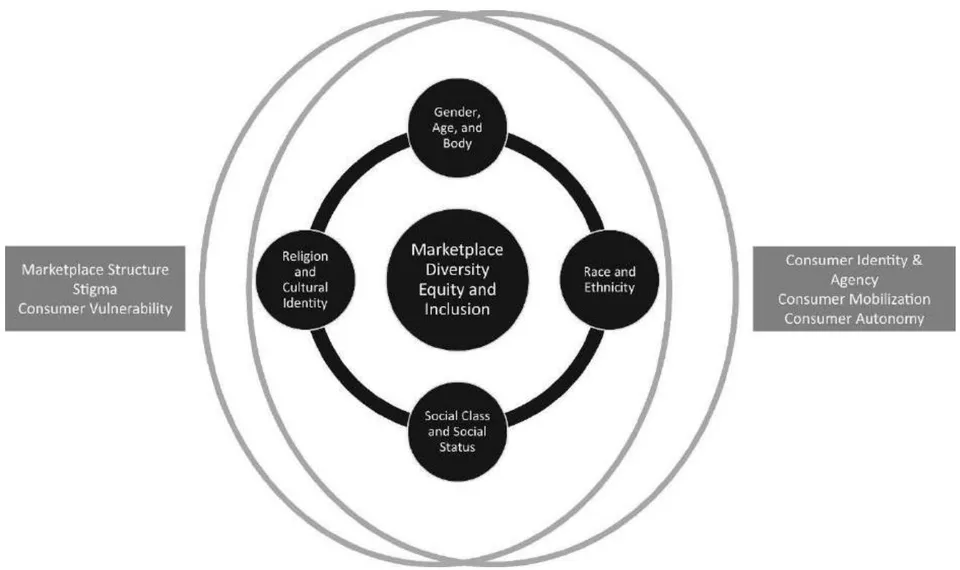
So, the more we dissolve the superstition around the poor, the more eligible for the marketplace a human being becomes, the more diverse the hub of civilization naturally evolves.
But does it work? Yes.
IX. SYSTEMS OF GOVERNMENT
The Commonwealth, a kind of Economic Imperial Monarchy, not democracy, is deemed the most successful way to guarantee the eradication of poverty and an end to human rights issues. Unlike democracies which simply guarantee the people will be represented in the government, and the people could very well be nuts, commonwealth guarantees certain aspects of human happiness will be guaranteed:
From the Declaration of Principles of the Commonwealth of Nations:
"We believe that international peace and order are essential to the security and prosperity of mankind; we therefore support the United Nations and seek to strengthen its influence for peace in the world, and its efforts to remove the causes of tension between nations.
We believe in the liberty of the individual, in equal rights for all citizens regardless of race, colour, creed or political belief, and in their inalienable right to participate by means of free and democratic political processes in framing the society in which they live. We therefore strive to promote in each of our countries those representative institutions and guarantees for personal freedom under the law that are our common heritage.
We recognize racial prejudice as a dangerous sickness threatening the healthy development of the human race and racial discrimination as an unmitigated evil of society. Each of us will vigorously combat this evil within our own nation. No country will afford to regimes which practice racial discrimination assistance which in its own judgment directly contributes to the pursuit or consolidation of this evil policy.
We oppose all forms of colonial domination and racial oppression and are committed to the principles of human dignity and equality. We will therefore use all our efforts to foster human equality and dignity everywhere, and to further the principles of self-determination and non-racialism."
Commonwealths also provide non-military answers to tensions, a solution missing for non-aligned nations, Murphy (2021). They provide interstate employment opportunities, the ability to travel abroad and exchange currency, ideas, traditions, and most importantly the orderly transfer of power from the church and the crown to the private sector.
Disadvantages include the presence of a disorganized or detached Head of State, which can be problematic until Lines of Succession are adjusted to meet the needs of the present state of the Monarchy and the people whose causes it is expected to champion, first and foremost with the generous distributions from the treasury using Royal Privilege.
As stated above, should Privies be revoked due to misconduct, the benefits of Commonwealth become nearly moot, so the presence of Deed to Title must always be accompanied by a conscience or the system, which has the power to work miracles in the relief of poverty and for the sake of the human condition simply fails to operate.
The same could be said about democracies that change their minds about the importance of General Welfare. Without a head of state that deems the needs of the people worthy of his attention and thereby that of the Department of the Treasury, all that foresight written in the US Constitution, for example, was for naught.
X. CONCLUSION: SUSTAINABLE DEVELOPMENT GOALS
The elimination of poverty can be accomplished through the sufficient funding of basic necessities across classes and certain attitude adjustments in the government. Governors and monarchs wishing to eradicate poverty, enrich their economies and witness their cultures flourish need to absolve themselves of the myths about poverty and break through the boundaries caused by bureaucracy, religious extremism, corruption, and prejudice.
Dashboarding the parameters associated with the efforts to relieve poverty are recommended. This paper suggests for instance that high speed internet encourages the relief of poverty. The number of households with and without connection to ISPs should be dash-boarded and monitored till the numbers reach 100%. Policy making should include appropriate levels of funding vs. the number of needed subscriptions to ensure success in this metric. The same logic should be applied to health insurance policies, elementary, middle, and high school enrollments, graduation rates, unemployment rates, and so forth.
Data associated with each would be tied to the balance sheet permitting elegant budgeting and accountability for the debt required to meet a nation or empires total prosperity objectives, absolving the myth money and time are being wasted by the government.
As success becomes measurable, so will the Grace of God be increasingly present in the lives of those who were formerly not considered worthy of a seat at the National Table.
Conflict of Interest
The authors declare no conflict of interest.
Ethical Approval
Not applicable
Data Availability
The datasets used in this study are openly available at [repository link] and the source code is available on GitHub at [GitHub link].
Funding
This work did not receive any external funding.
References
Cite this article
Related Research


Special Issue
Launch a focused special issue to highlight research, emerging trends, and expert insights in your academic field.