



IntelliPaper
Abstract
This research explores the nuanced connection between visual and auditory art, with a specific focus on the thematic element of "animals in the arts." The study is driven by three primary objectives: to elucidate art interpretation among individuals lacking formal art training, examine the alignment of visuals with corresponding music, and compare responses between musicians and non-musicians. Additionally, the study delves into participants' assessments of artistic performances created by animals.
Participants were adults (N=25, aged 30-74, mean 51.8), devoid of formal visual art training, of whom 11 possess an extensive musical background. In individual sessions, participants interpreted animal imagery, matched images with corresponding music, and evaluated artistic performances by animals. A pivotal finding underscores that exposure to animal-inspired music notably enhances initial visual perceptions—a phenomenon termed the 'Enrichment Effect,' more pronounced among non-musicians. The study advocates for a comprehensive, integrated approach to art-music education.
Explore Digital Article Text
I. INTRODUCTION
Across various cultures and historical epochs, animals have consistently played a crucial role in the arts (Kristeller, 1951). Often utilized metaphorically, these creatures, with their diverse visual characteristics, serve as potent symbols in visual arts and literature. Examples such as Rudyard Kipling's "The Jungle Book" (1894) and George Orwell's "Animal Farm" (1945) illustrate the significant role of animals in literary works, where visual artworks contribute to the narrative.
In the realm of Western notated art music spanning over 700 years, animal sounds have been integral (Doollitle, 2008). Composers have creatively incorporated, imitated, or recorded animal sounds using various instrumental and vocal techniques. The advent of electroacoustic devices in the 20th century further allowed the integration of actual animal calls into orchestral compositions, leading to the concept of 'biophonies' and the establishment of Bio-musicology as a field of study (Mâche, 1992; Bryant, 2013).
In this study, auditory stimuli derive from Western notated art music, representing and interpreting animal sounds. The primary objective is to highlight how the thematic focus on "animals" can act as a cohesive element, bridging music, visual art, and broader subjects like the environment and wildlife. This exploration unveils the extensive potential for interdisciplinary connections in music and art education.
This study is pioneering in its examination of animal perception through three distinct modes: visual interpretation, music-art association, and evaluation of animals' artistic abilities.
The literature review presented here encompasses three pertinent themes: (1) Artistic portrayals of animals, (2) Correlating visual art with music, and (3) Animals as artists.
II. LITERATURE REVIEW
2.1 Artistic Portrayals of Animals
Throughout history, animals have been prominent subjects in art, with historical evidence suggesting that animal blood may have been an early form of paint (Burt, 2005). Examples range from ancient cave paintings and ceremonial costumes to contemporary artworks depicting various scenes such as rural settings, markets, and family life (Coleman & Schapiro, 2021). In the modern era, animal-themed visual arts span diverse mediums, including painting, photography, exhibitions in museums, galleries, printed media, television, digital platforms, and educational programs (Arluke & Bogdan, 2010; Brower, 2005; Dunaway, 2008; Kalof, 2007; Kalof & Fitzgerald, 2003; Landes et al., 2012).
Numerous studies have explored the impact of animals in various media, including printed books (Dolins et al., 2010; Wells & Zeece, 2007), classroom programs (Dolins et al., 2010; Farnsworth, 2011; Grauerholz et al., 2020; Mariti et al., 2011; Rivet & Schneider, 2004; Rule & Zhbanova, 2012), and films (Pearson et al., 2011; Wright, 2010). Research has investigated viewers' responses to animal imagery in diverse settings, such as museum visits (Kalof et al., 2011), home television viewing (Paul, 1996), classroom presentations (Dolins et al., 2010; Kalof et al., 2016; Mariti et al., 2011; Rivet & Schneider, 2004; Rule & Zhbanova, 2012), and video watching (Pearson et al., 2011). Overall, exposure to live animals and animal imagery has been found to enhance human understanding of nature (e.g., Pearson et al., 2011), raise awareness of wildlife issues (e.g., Cox, 2017), and alert individuals to wildlife threats (Blewitt, 2010; Farnsworth, 2011; Loeffler, 2004; Rivet & Schneider, 2004). For example, Pearson et al. (2011) discovered that exposure to conservation films featuring endangered orangutans positively influenced college students' attitudes towards the species.
2.2 Correlating Visual Art with Music
The interplay between art and music, elucidated by scholars such as Shank (2003), reflects a profound connection marked by shared meaning and symbolic representation. Numerous studies, including those by Cowles (1935), Eisner (1998), Kalyuga et al. (2000), Parrott (1982), Lindner & Hynan (1987), Limbert & Polzella (1998), and Wehner (1966), have explored this relationship, emphasizing the establishment of connections between visual and auditory stimuli and the augmentation of aesthetic experiences through the fusion of music with visual context.
Eisner (1998) outlines that art perception involves forging connections between visual and auditory stimuli, a notion supported by Kalyuga et al. (2000), who contend that leveraging both auditory and visual channels enhances information processing compared to reliance on a single channel.
Research consistently indicates that individuals, irrespective of artistic background, can perceive connections between art and music (Cowles, 1935; Limbert & Polzella, 1998; Simon & Wohlwill, 1968; Wehner, 1966). Studies, such as those by Limbert and Polzella (1998), reveal participant consensus on the pairing of specific paintings with corresponding musical excerpts. For instance, their research demonstrated that matching music significantly enhanced participants' aesthetic experience of paintings, irrespective of artistic style, emphasizing the integrative impact of music on visual perception.
Audio-graphic studies, including those by Elkoshi (2014, 2017, 2019), Rainer (1925), and Vanechkina (1994), have investigated participants' creation of paintings as visual representations of musical compositions by renowned composers like Beethoven, Chopin, and Debussy. These studies underscore a robust correlation between music and visual expression, with the resultant paintings seamlessly integrating both musical and extra-musical elements.
2.3 Animals as Artists
Visual art is commonly perceived as a distinctly human endeavor for aesthetic enjoyment (Adetunji, 2015; Malloch & Trevarthen, 2018), while music is defined as "structured sounds produced directly or indirectly by humans" (McDermott & Hauser, 2005, p. 30).
Evolutionary insights propose that some animal signals exhibit human-like musical qualities (Fitch, 2006). Examples include drumming behaviors in African gorillas, chimpanzees, and bonobos (Schaller, 1963; Arcadi et al., 2004) and communication through tree striking by palm cockatoos (Wood, 1988).
Though scholars recognize differences between human and animal songs, emphasizing their distinct properties and limited resemblance (McDermott & Hauser, 2005), some argue that animal performances can still be considered music (Fitch, 2006).
Laboratory studies have explored animals' musical abilities, demonstrating, for instance, the goldfish's capacity to distinguish between classical and blues music (Chase, 2001) and pigeons' ability to differentiate compositions by Bach and Stravinsky (Porter & Neuringer, 1984).
Animals in captivity, including chimpanzees, elephants, whales, dolphins, seals, and penguins, have been trained to engage in artistic activities, such as painting and playing musical instruments (Severini, 2019; Soldier, 2017). Concerts and exhibitions featuring animal artistic contributions have been organized, raising ethical concerns regarding animal welfare (Mitchell, 2016; Singer, 2009; Smulewicz-Zucker, 2012).
Studies analyzing the ethics of animal involvement in art, such as English et al.'s (2014) observation of captive elephants' stress-related behaviors during painting sessions, underscore the need for careful consideration of the well-being of animals engaged in artistic activities.
III. THE STUDY OBJECTIVES
The study aims to achieve three objectives: (1) investigate the perception and interpretation of artistic animal imagery among viewers without an academic background in visual art, (2) examine the audio-visual matching of animal-inspired music with animal imagery and compare the matching responses between musicians and non-musicians, and (3) explore participants' opinions and feelings regarding the involvement of animals in music and art performances.
IV. METHOD
4.1 Participants
The study included 25 adults aged 30-74 (mean age: 51.8 years), with 14 males and 11 females, all lacking a formal background in visual arts. Among them, 11 were musicians, comprising musicians with extensive formal academic backgrounds in music (n=8) and music professors (n=3).
4.2 Recruitment and Ethical Considerations
The study was conducted individually with each participant in a private studio, employing chain-referral sampling for recruitment. Participants voluntarily opted to take part and were provided comprehensive information about the study's objectives and procedures before scheduling meetings with the researcher. In adherence to ethical standards, participants signed informed consent forms before the commencement of the experimental sessions. This report assures participant anonymity to preserve confidentiality.
4.3 Process
The study encompassed 25 individual sessions, each lasting 60–75 minutes, conducted through face-to-face meetings. Each session was structured into three parts: (1) interpreting artistic animal imagery, (2) pairing animal images with animal-based music, and (3) evaluating videos depicting animals performing art.
4.4 Type of Study
Qualitative analysis was employed in this study to extract insights from participants' narratives. The analysis involved systematically examining and organizing participants' actual words to identify common themes and patterns that emerged from their interpretations (Brau & Clarke, 2006; Bresler & Stake, 2012; Namey, 2012). The researcher aims to provide a comprehensive description of participants' responses in the three study experiments by categorizing and presenting direct quotes as examples.
V. THE THREE EXPERIMENTS
Experiment 1 - Interpreting Animal Imagery: Participants engaged with a series of seven artistic animal pictures displayed individually on a computer screen, each devoid of accompanying information. The artworks featured illustrations of a Cuckoo, Rooster, Cat, Horse, Bull, Goldfish, and Flying-fish (see Figure 1 a-g).
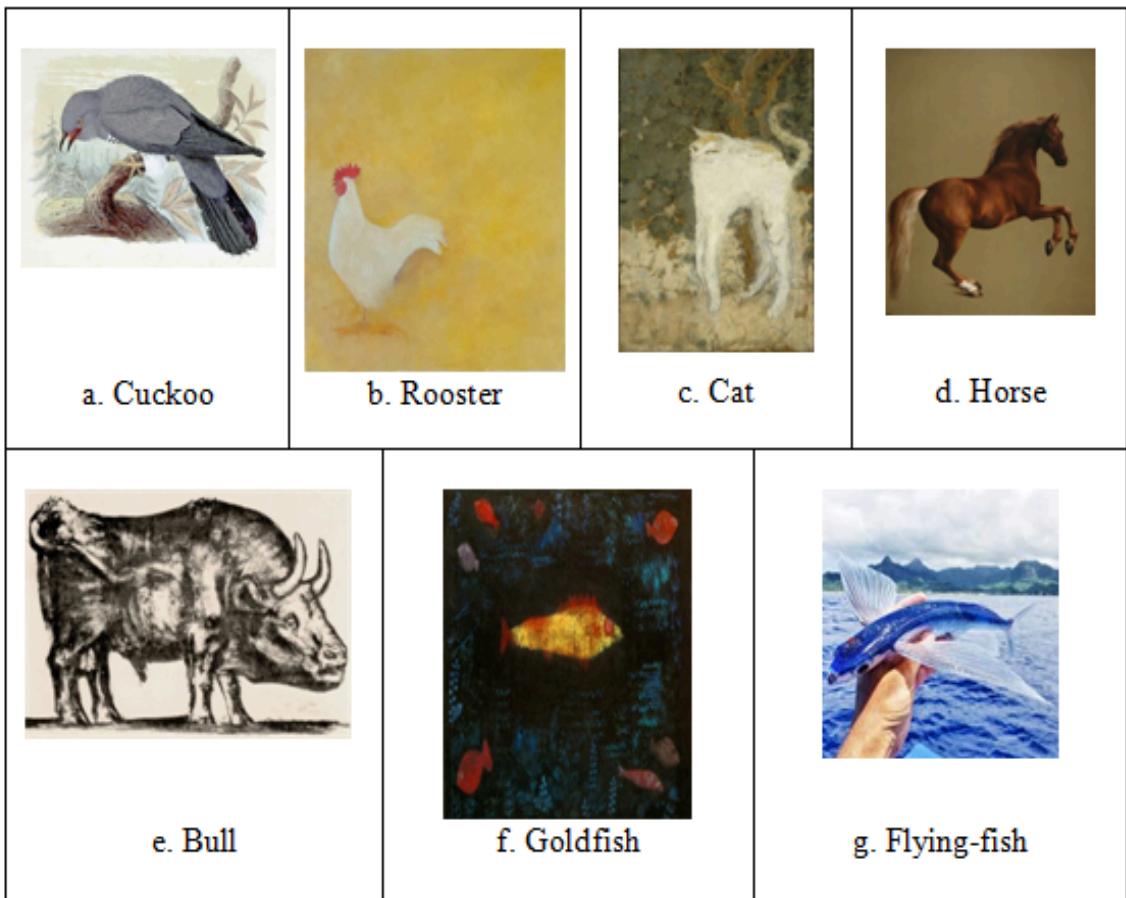 Figure 1: Animal Imagery
Animal Imagery
-
Cuckoo: An illustration from the book 'Our Birds in Home and Garden' (1873) by Dutch artist Johannes Gerardus Keulemans (1842-1912).
-
Rooster: An oil painting on canvas (80 x 60 cm) by Israeli artist Osnat Reisman Ben Shalom (b. 1947).
-
Cat: "The White Cat" (1894) by French artist Pierre Bonnard (1867-1947), featuring a cat with an arched back.
-
Horse: "Whistlejacket" (1762) by English artist George Stubbs (1724-1906), an oil on canvas painting depicting a horse in a "levade," a vertical position.
-
Bull: The second plate from the series "Le Taureau" (1945-6) by Spanish artist Pablo Picasso (1881-1973), portraying the transformation of a bull through progressive stages.
-
Goldfish: An oil and watercolor painting (1925) by Swiss artist Paul Klee (1879-1940) featuring a radiant golden fish surrounded by red fish.
-
Flying-fish: A photograph (2019) by Jamaican marine biologist Guy Harvey (b. 1955) presenting a winged fish.
Experiment 2: Matching Animal Imagery with Corresponding Animal Music
Participants paired animal illustrations with animal-inspired classical music. Seven animal-based classical compositions were randomly played through YouTube with the computer screen turned off. Participants were instructed to "Match the musical work with the most suitable animal picture(s) from those presented in the previous task or declare 'no match.'" Subsequently, participants provided reasons for their pairings.
Art-Music Pairing
The list below showcases the pairing of animal images with corresponding animal music. (Refer to the discography list for video links).
- Cuckoo (1a) paired with 'The Cuckoo' (1702) Toccata Scherzo by Italian composer
Bernardo Pasquini (1637-1710), featuring repeated cuckoo calls.
-
Rooster (1b) paired with 'La Poule', the 5th movement of Suite No. 2 in G, (1726/27) by French composer Jean-Philippe Rameau (1683-1764), featuring onomatopoeic indications for hen-and-rooster pecking.
-
'Cat' (1c) paired with "Cat" from Sonata Representativa C. 146 in A-Major (1669) by Bohemian-Austrian composer Heinrich Ignaz Franz von Biber (1644-1704), humorously imitating cat sounds through violin glissandi.
-
Horse (1d) paired with 'Grand Galop Chromatique' in E-flat S.219 (1838) by Hungarian composer Franz Liszt (1811-1886), a piano piece mimicking the galloping motion of a racehorse through virtuoso jumps and chromatic scales.
-
Bull (1e) paired with 'The Ox Tail' for clarinet and piano No. 1 in B-flat (2004) by Chinese-American composer Chen Yi (b. 1953), inspired by the ancient Chinese 'Ox Tail Dance' with clarinet sounds reminiscent of bull horn blowing.
-
Goldfish (1f) paired with 'Le Poisson d'Or' (1915) by English composer Hugh Tyrwhitt-Wilson, known as Lord Berners (1883-1950), capturing a goldfish's circling and diving movements through repeated motifs and rapid glissandi.
-
Flying-fish (1g) paired with the sixth movement of 'Six Fish' for a unique guitar quartet (2005) by Australian composer Nigel Westlake (b. 1958), capturing a flying fish leaping out of the ocean through syncopation and hocketing.
Experiment 3: Evaluating Animals as Artists
Participants were tasked with evaluating two videos featuring animals as artists.
-
Animals as Musicians: Thai Elephants in Lampang, Thailand, playing traditional percussion instruments with their trunks, led by a conductor and guided by trainers.
-
Animals as Painters: A rhinoceros, a chimpanzee, and penguins spreading paint on canvas. Keepers select the colors, guide them onto the canvases, and showcase the resulting products.
VI. CATEGORIES AND EXAMPLE RESPONSES IN EXPERIMENT 1 - 'ANIMAL VIEWERSHIP'
Four primary categories emerged from participant responses to animal artworks: Perception, Description, Interpretation, and Affect.
In the Perception category, viewers focus on aspects such as species identification, speculations about the species, artist information, or artistic style. For example, Ali, a 44-year-old male music professor, identifies 'Bull' (Figure 1e) as Picasso's work, mentioning its resemblance to Guernica. Tamar, a 55-year-old female piano teacher, speculates on the 'Bull' illustration, suggesting "it might be a 'Begamut' (Russian: hippopotamus)."
The Descriptions category engages viewers in detailing pictorial elements like colors, shapes, design, and details. Tamar describes Flying-fish (Figure 1g) as having white wings, fins, and a tail, with cold, transparent colors and green mountains on the horizon, noting its symmetrical and balanced composition.
The Interpretation category focuses on viewers' speculations about animals' temperament, actions, intentions, or anthropomorphism. For example, Sela, a 60-year-old female composer, interprets the 'Horse' picture (Figure 1d), attributing human-like characteristics and speculating about the animal's actions, intentions, and temperament:
"It's a mare who loves being in the spotlight. She takes pride in her well-groomed tail and cares about what the audience thinks of her. She winks at the crowd with one eye, just like a woman checking her impression. She stands on two legs, like a lady in high heels".
The Affect category relates to participants' personal positive or negative attitudes towards the artwork. For instance, Moshe, a 74-year-old historian, expresses his fondness for the Cat illustration (Figure 1c): "I really enjoy the painting. The soft colors and gentle contrasts are pleasing to me, as they are not overly strong." On the contrary, Rachel, a 70-year-old high school teacher, expresses her dislike for the Cat: "It's a picture I'd simply scroll past. The colors seem faded. It's just not my cup of tea."
VII. CATEGORIES AND RESPONSES IN EXPERIMENT 2 – 'ART-MUSIC PAIRING'
Four primary categories were identified from the art-music matching data:
-
Compatible pairs: These are identical to the research pairs presented above (Art-Music Pairing List).
-
Incompatible pairs: These deviate from the research pairs.
-
Multiple pairs: Referring to instances where more than one picture is paired with a musical composition.
-
Unmatched: The respondent could not find a connection between the music and a picture.
The reasons given for an art-music match fall under three categories:
-
Intra-musical considerations: Encompassing musical elements such as pitch, rhythm, tempo, instrumentation, and tonality. For example, Nafet, a 60-year-old male clarinetist, made a compatible match by pairing Picasso's Bull with Chen Yi's "Ox Tail." His decision was influenced by the instrumentation and timbre in Chen Yi's composition: "The clarinet produces sounds like blowing a bull's horn."
-
Extra-musical considerations: Encompassing programmatic or metaphorical aspects. For instance, Moshe, a 74-year-old historian, made a compatible match by pairing Ben Shalom's Rooster with Rameau's "Hen," guided by imaginative extra-musical considerations: "the music vividly portrays a lively rooster pecking, dancing, and spinning. The rooster knows how to enjoy itself and even displays courtship behavior towards the hens."
-
Compound reactions: Encompassing both intra- and extra-musical considerations. For instance, Ofik, a 33-year-old male musicologist, made multiple matches by pairing both Klee's Goldfish and Stubbs's
Horse with Westlake's piece "Flying-fish". He based his matching decision on compound considerations, both imaginative associations and musical instrumentation: "On one hand, the music evokes the imagery of sea waves which fits the goldfish. On the other hand, the Spanish horse fits the sound of guitars, a Spanish instrument."
7.1 The 'Enrichment Effect'
Participants frequently enriched their artwork descriptions after listening to the music, resulting in more profound interpretations—an occurrence encapsulated by the term 'Enrichment Effect.' Comparing pre-and post-music narratives often revealed the 'Enrichment Effect.'
For instance, when observing the Rooster in Experiment 1, Moshe remarked, "You don't see details in this picture. Your imagination has to complete the missing details." In Experiment 2, he paired the Rooster with Rameau's 'Hen' and elaborated: "The music is joyous, telling me that the rooster dances, spins, runs, then stands pecking in motion. The rooster is wooing, living, and delighting in life."
VIII. CATEGORIES OF VIDEO EVALUATION IN EXPERIMENT 3 - 'ANIMALS AS ARTISTS'
Three primary categories were identified from the video evaluation data:
-
Treatment: Assessing whether keepers enrich or abuse animals through artistic shows;
-
Skill: Assessing the animals' skills as talented or untalented artists;
-
Production: Assessing the artistic outcomes as art or non-art.
Contrasting views on whether the video activities enhance the animals' well-being or amount to abuse reflect the ongoing ethical debates in this domain. Some participants believed that art is a humane endeavor while animals are unaware of art. They mostly perceived the videos as forms of animal abuse, considering the animals tamed and unskillful, viewing the productions as non-art.
For Instance
- "Art requires a certain level of intellectual capacity that animals do not possess. I think that the animals in the videos are unaware of what they're doing." (Nach, male, lawyer, 74-year-old.)
Video 1:
- "The elephants are mere robots, trained to perform repetitive movements. The sounds are simply cacophony, not music. Just chaotic and loud noise." (Nafet, a 70-year-old male clarinetist.)
Video 2:
-
"Poor animals. It's just cruel, plain and simple. They're smearing them with paint, and you can tell the animals don't like it. If I had the chance, I'd sue those zoo keepers for what they're doing to the animals. It really bothers me, even watching it on video." (Zed, a 74-year-old male, physician.)
-
"The penguins just walk and make a mess on the page. These paintings are nonsense. It is the trainers who pre-apply the colors on the paper and move the canvas. What the animals do is nothing but unintentional scribbles." (Hana, female, 30-year-old, engineer.)
Some narratives contained mixed evaluations of the different animals' drawing abilities. For instance:
- "The rhinoceros and penguins seem unaware of their drawing, resulting in a messy page. However, the gorilla demonstrated deliberate intention and intelligence in its coloring." (Atar, female, 70-year-old school teacher.)
On the contrary, some participants held a divergent view, considering the animals' actions as enrichment, appraising their artistic skills, and perceiving their productions as art. For instance, Video 1:
- "You can tell that the elephants enjoy what they're doing by how their ears and tails move. Their movements are so precise; it's really impressive. Even though they get some help from someone nearby, they still perform with their own independence. The sounds they create are like modern art music, akin to the music by Stockhausen.
Video 2:
- "It's impressive to see animals showcasing their abilities, which demonstrates that animals can be taught! The rhino didn't mind the inedible paint, the smart ape painted with its hand, and the penguins fearlessly walked on the textured surface." (Tamar, a 55-year-old female piano teacher.)
IX. RESULTS
The results encompass three tasks: 'Animal Viewership,' 'Art-Music Pairing,' and 'Animals as Artists.'
9.1 Results in 'Animal Viewership'
The results in the 'Animal Viewership' task are categorized into Perception, Description, Interpretation, and Affect. It's essential to note that many responses fell into multiple categories.
the intended animals. Despite lacking a formal background in visual art, 26% referenced artistic facts. Some participants (16.5%) expressed ambivalence about the species' identity, especially towards 'Bull' and 'Flying-fish'.
-
Description: Participants detailed both foreground (68%) and background (50%) elements in the pictures. Color references were less frequent (35%), and mentions of the overall composition were relatively scarce (13%).
-
Interpretation: Participants mostly speculated about animals' temperament (51%), actions, and/or intended actions (49%). Symbolism, including anthropomorphism, was relatively rare (19%).
-
Affect: Personal positive and negative emotions were expressed by nearly equal proportions of participants (19.5% and 19%, respectively). Figure 2 presents the results of the 'Animal Viewership' task.
{"image_source":{"path":"images/a822bcbcc828ef68753384a7702e7f821c6a967eddc84a9fefe8777886ee6df6.jpg"},"content":"","chart_caption":[{"type":"text","content":"- Perception: Most viewers (85%) successfully identified the depicted species, recognizing"},{"type":"text","content":"Figure 2: Results in Animal Viewership"}],"chart_footnote":[]}
9.2 Results in 'Art-Music Pairing' in Musicians and Non-Musicians
The 'Art-Music Pairing' results include Compatible (55%), Incompatible (31%), Multiple (7%), and Unmatched (7%) responses. Results among musicians and non-musicians show that Compatible responses were slightly higher among non-musicians compared to musicians (29% and 26%, respectively). Incompatible pairs were more frequent among non-musicians compared to musicians (21% and 10%, respectively).
A key finding is that listening to animal-inspired music enriched the initial perceptions of the animal images. The 'Enrichment Effect' was observed in 36% of responses, with a higher percentage among non-musicians compared to musicians (22% and 16%, respectively).
Reasons for 'Art-Music Pairing' include mostly intra-musical (64%) and extra-musical (62%) considerations, with compound responses at 34%. Intra-musical considerations were more prevalent among musicians than non-musicians (35% and 29%, respectively), while extra-musical reasoning was higher among non-musicians compared to musicians (39% and 23%, respectively). Compound considerations showed similar percentages among musicians and non-musicians (15% and 19%, respectively).
Figure 3 displays the results of the 'Art-Music Pairing' task among musicians and non-musicians.
{"image_source":{"path":"images/967f8c144f99329eef63522e700029acc69cf522415153e8dcbabca965f778d4.jpg"},"content":"","chart_caption":[{"type":"text","content":"Figure 3: Results in 'Art-Music Pairing' among Musicians and Non-musicians"}],"chart_footnote":[]}
9.3 Results in 'Animal as Artists'
The distribution of evaluation responses for the videos is categorized into enrichment vs. abuse (treatment), skillful vs. unskillful (animals' artistic talent), and art vs. non-art (artistic outcome). The predominant evaluation response was that productions are non-art (44%). Non-art responses were slightly more prevalent for music compared to painting productions (24% and 20%, respectively). Few participants considered the artistic production as art (18%), with slightly higher percentages for music compared to paintings (10% and 8%, respectively).
In terms of the skill of the animals as artists, more participants regarded animals as skillful artists compared to participants who regarded them as unskillful (36% and 32%, respectively). Painters were regarded as more unskillful than music players (22% and 10%, respectively).
Concerning the ethical aspect, 28% of participants objected to the video shows, perceiving them as animal abuse, with a slight skew towards the music video compared to the painting session (16% and 12%, respectively). Only 12% appreciated the shows as enrichment activities, with an equal share of appreciation for both the music and the painting activities (6% each).
Figure 4 displays the results of the 'Animals as Artists' task.
{"image_source":{"path":"images/24eb19fe300c0789b36c78db6df425a7d2dbca7036a4e43fd08384fa884eaef7.jpg"},"content":"","chart_caption":[{"type":"text","content":"Figure 4: Results in 'Animals as Artists'"}],"chart_footnote":[]}
X. CONCLUSIONS
Several key findings emerged from the study:
-
Viewers without formal training in the visual arts referenced artistic facts, detailed pictures, and further speculated about the images.
-
The 'Enrichment Effect' was observed in more than a third of responses, with a higher percentage among non-musicians.
-
Compatibility in art-music pairing was almost the same among musicians and non-musicians, while incompatible pairs were more frequent among non-musicians.
-
More participants perceived the 'Animal as Artists' videos as constituting animal abuse rather than enrichment, with the resulting musical and visual outcomes predominantly evaluated as non-artistic. However, a higher number of participants considered animals to be skillful artists rather than unskillful.
XI. DISCUSSION
This research explores the nuanced connection between visual and auditory art, with a specific focus on the thematic element of "animals in the arts." The study elucidates art interpretation among individuals lacking formal art training ('Animal Viewership'), scrutinizes the correlation between visual imagery and animal-inspired music among individuals with and without music training (Art-Music Pairing), and delves into the way individuals evaluate non-human artistic expressions (Animals as Artists).
The findings from the 'Animal Viewership' experiment indicate that participants lacking formal education in the visual arts reference aesthetic aspects. This aligns with Schwan and colleagues (2017) proposition that "multimedia learning and knowledge acquisition not only takes place in formal education but is also found outside of schools and universities in a wide range of non-formal and informal situations and settings" (p. 148).
The accurate identification of depicted species by the majority of participants, coupled with their meticulous attention to foreground and background details in artistic portrayals of animals, reflects their familiarity with the theme. Animal-themed visual stimuli in our time are ubiquitous and permeate various mediums, including printed books (Dolins et al., 2010; Wells & Zeece, 2007), television, digital platforms, educational programs (Arluke & Bogdan, 2010; Brower, 2005; Dunaway, 2008; Kalof, 2007; Kalof & Fitzgerald, 2003; Landes et al., 2012), videos and films (Pearson et al., 2011; Wright, 2010).
The animal viewership experiment unveiled a minimal frequency of explicit color references, suggesting that viewers might have implicitly inferred the colors of the depicted animals. It is plausible that colors were perceived as assumed knowledge, requiring no explicit mention for their interpretation.
Viewers not only delineate the physical attributes of animal images but also express creative imagination and personal emotions through speculations about envisioned temperaments, behavioral inclinations, past actions, and prospective intentions. These findings align with previous research emphasizing the influence of observing animal imagery, showcasing its ability to heighten human awareness and evoke emotions in viewers (e.g., Cox, 2017; Pearson et al., 2011).
The pairing of animal artworks and corresponding animal music confirms a perceived relationship between art and music, consistent with the propositions made by Eisner (1998), Kalyuga and colleagues (2000), and Shank (2003). This finding also aligns with previous research that has explored the association between visual stimuli and matching musical excerpts (Cowles, 1935; Limbert & Polzella, 1998; Simon & Wohlwill, 1968; Wehner, 1966).
The majority of compatible matching responses indicate a commonly perceived connection between animal imagery and animal-inspired music, while incompatible, multiple, and unmatched responses underscore the subjectivity and complexity of art-music matching. Varied perceptions and interpretations in associating visual elements with music contribute to this divergence. The researcher and participants arrived at their pairing decisions from different perspectives. While the researcher relied on documented facts to support the research pairs, participants mostly made their pairings based on intuitive associations and creative thinking, rather than being grounded in formally acquired knowledge. This suggests that the factors influencing music-art pairings are diverse and shaped by personal attitudes.
Musicians' heightened dependence on intra-musical reasoning for art-music pairing can be ascribed to their profound musical expertise. Their comprehensive understanding of musical elements enables them to establish connections within the musical domain. Conversely, non-musicians, lacking this specialized knowledge, may prioritize extra-musical considerations—factors beyond the musical realm, such as personal associations.
The divergent opinions in the 'Animals as Artists' experiment underscore the subjective nature of individuals' perspectives regarding non-human art. A majority of participants voiced objection to the use of animals for artistic purposes, categorizing it as unethical animal abuse. This standpoint aligns with critiques from researchers who also denounce animal artistic displays as ethically questionable (Mitchell, 2016; Singer, 2009; Smulewicz-Zucker, 2012). Furthermore, numerous participants deemed the artistic outcomes as non-artistic, aligning with scholars who assert that art is an exclusively human endeavor (Adetunji, 2015; Malloch & Trevarthen, 2018).
Conversely, participants expressed astonishment and admiration for animal artistic performances and products, aligning their perspectives with advocates like Soldier (2017), who advocate for enrichment programs and emphasize the benefits of animals engaging in the arts. Participants claimed that animals demonstrate skillful artistic abilities and possess human-like artistic qualities—a notion supported by researchers such as Fitch (2006). The musical and visual outcomes were regarded as genuine works of art, bearing resemblance to contemporary human creations.
These contrasting views reflect ongoing debates regarding ethical considerations about ecology, wildlife, and nature preservation (e.g., English et al., 2014; Rogers & Kaplan, 2007).
XII. IMPLICATIONS: TOWARDS MUSIC-ART INTEGRATED EDUCATION
This study serves as an exemplary illustration of the interdisciplinary connections that can be forged within music and art education.
The integration of art-viewing, music-art pairing, and artistic evaluations into art-music education is underpinned by the assumption of a general validity in cross-modal connections between visual and auditory modalities (Cowles, 1935; Kalyuga et al., 2000; Lindner & Hynan, 1987; Limbert & Polzella, 1998; Shank, 2003; Wehner, 1966). Breaking down the barriers between art and music education is suggested to cultivate a comprehensive aesthetic experience for students (e.g., Bresler, 2022; Casini, 2017). Adopting a multimodality approach in art and music education programs can empower students to explore the transformative potential of the arts, facilitating the transfer of sensations across senses for a deeper, holistic understanding, and appreciation of artistic expressions (Elkoshi, 2019; Bresler, 2022; Eisner, 1998; Elkoshi, 2019; Maur, 1999; McCurdy, 1973).
The concepts of multiliteracy and multimodality, as proposed by Marks (1978) and Duncum (2004), support this notion. Marks (1978) posits that the sensory systems of the human body are incomplete differentiations of a single, evolving common sense. Duncum (2004) emphasizes that for art education to remain relevant to contemporary social practice, it must embrace interaction between communicative modes.
Art viewing, art-music pairing, and artistic evaluation acknowledge the inherent subjectivity in these experiences. In a free-exploring setting, viewers are empowered to construct their own insights about art, blending their existing knowledge, interpretation, emotions, and imagination to explore personal impressions. The synergy created through art-music matching enhances students' perception and interpretation of both mediums. By considering intra- and/or extra-musical aspects, students can articulate multi-faceted interpretations related to both art and music. Music majors can apply their knowledge of musical elements like pitch, rhythm, tempo, and tonality to draw insightful connections between visual and auditory art, deepening their appreciation for both mediums.
Evaluating art fosters critical thinking and encourages questioning, interpretation, and the development of individual opinions. Evaluating non-human art provides students with an opportunity to explore ethical considerations, as well as issues related to ecology, environment, and nature.
Last but not least, the incorporation of music into art education is proposed to foster a more enriched and interconnected learning experience, as evidenced by the heightened 'Enrichment Effect,' where musical stimuli intensify and enrich previous perceptions of corresponding visual stimuli among musicians and non-musicians alike.
XIII. LIMITATIONS OF THE STUDY AND SUGGESTIONS FOR FUTURE RESEARCH
The present study serves as an exploratory case example that investigates the connection between animals and the arts. However, further research projects are warranted to delve deeper into the intricate relationship between animals and the arts by incorporating different variables. These variables may include diverse types of music, varied visual stimuli, and participants with different characteristics.
Additionally, investigating the long-term effects of exposure to animal-inspired art and music could provide insights into the sustainability and lasting impact of such experiences. Furthermore, exploring the role of contextual factors, such as cultural backgrounds or educational settings, in shaping participants' responses would contribute to a more comprehensive understanding of the complex dynamics involved in the intersection of animals and the arts.
This study has a limited sample size and employs a qualitative analysis approach. Conducting a quantitative study or replicating this qualitative study would contribute to validating the findings and assessing the strength and reliability of the results.
Discography
- Lord Berners Le poisson d'or https://www.youtube.com/watch?v=fylDYxEsLTw&list=OLAK5uy_kYbtWP1gpW2Ioiw4BOP66XkrALCvHqbTI&index=5.
Conflict of Interest
The authors declare no conflict of interest.
Ethical Approval
Not applicable
Data Availability
The datasets used in this study are openly available at [repository link] and the source code is available on GitHub at [GitHub link].
Funding
This work did not receive any external funding.
References
Cite this article
Related Research


Special Issue
Launch a focused special issue to highlight research, emerging trends, and expert insights in your academic field.
