


Abstract
This article entails a quantitative analysis of the association between cyberbullying crude and number of user subscribers and uploads on YouTube. Of the several numbers of variables listed in the said dataset from Kaggle.com, the variables of comments, subscribers and uploads were found to be continuous. The data included 3464 YouTube user ids, and were analyzed using Descriptives, Normality Tests and Spearman’s Rho on SPSS. The findings included non-linear, positively skewed, non-normal distribution. The correlation analysis depicted a slight positive association between User subscribers and rude comments, whereas no connection between User uploads and crude comments. Future work to focus on other factors influencing hurtful commenting on YouTube.
Explore Digital Article Text
I. BACKGROUND/INTRODUCTION
A 2024 US national survey found that of youth experienced victimization on YouTube, with the common forms of cyberbullying in YouTube content and comments being offensive interactions, online harassment, and cyberstalk (Muminovic, 2025). YouTube is not only one of the platforms where such behavior persists, but through advanced machine learning techniques instances of cyberbullying within YouTube comments can be identified (Thamaraiselvi et al., 2024). Hence it is important to assess which factors contribute to offensive commenting and cyberbullying on YouTube.
The data for this paper has been used from Kaggle.com, a 2022 dataset on cyberbullying detection consisting of datasets from several sources projecting different types of cyberbullying like hate speech, aggressions, insults and toxicity. The data includes sources and social media platforms such as Twitter and YouTube. Hence, it becomes even more relevant to evaluate the associations between toxic comments on YouTube with other variables/factors.
The sample size/population sample includes a number of 3464 YouTube ids (members of different ages, having a certain number of subscribers to their channels, and those who received derogatory comments on their uploads). The measures used for the project include descriptive statistics and tests of normality for each of the variables, as well as Spearman's correlation between the variables. In order to run Spearman's correlation, the variables include a) to determine an association between the number of subscribers and the number of derogatory comments on YouTube; b) to assess the relationship between the number of YouTube uploads (by user/s) and the number of toxic comments on YouTube.
The rationale for analyzing the association between the above variables is because prevalence of toxicity in YouTube comments is still high (despite its anti-bullying regulations and policies) as per the data in recent studies. So, it seems justified to try and understand if there are variables that influence these cyberbullying behaviors and tendencies through derogatory commenting. Similarly the rationale behind using the above dataset is because it was the most readily available, relevant to the topic and easy to download dataset.
variables (like the number of user subscribers, and number of user uploads) with the number of toxic comments online would be assessed using Spearman's Rho, a non-parametric test in SPSS. Since the dataset is positively skewed with significant outliers, hence the use of non-parametric tests (such as Spearman's Rho) to assess the relationship. This large dataset of 3464 cases is unique in a way because it compiles harmful YouTube comments and provides a numeric value to it for each YouTube user or member.
1.1 Research Questions
Based on the variables in the dataset, a correlation analysis seems most appropriate to inquire about the association between the variables. These associations can be run in SPSS using the Spearman's correlation and reason needs to be provided for choosing non-parametric tests.
This could be justified by demonstrating the descriptive statistics and tests of normality results.
Thus all these above tests would be required to be run on SPSS.
The variables that I chose to focus on are the number of user subscribers and number of user uploads (as the independent variables), and the number of toxic/hurtful comments (as the dependent variable). The two research questions that have been developed are:
- Is there a relationship between the number of user subscribers and the number of toxic comments on YouTube?
- Is there an association between the number of user uploads and the number of hurtful comments on YouTube?
To be able to determine an association between the variables as stated, it would provide some insight into which factors may or may not influence offensive commenting and consequently cyber-harassment on YouTube.
Based on the above research questions for the project, the null and alternative hypotheses would be as follows:
Null Hypothesis for Research Question 1: There is no relationship between the number of user subscribers and the number of mean or toxic comments on YouTube
Alternative Hypothesis for Research Question 1: There is a relationship between the number of user subscribers and the number of mean or toxic comments on YouTube
Null Hypothesis for Research Question 2: There is no association between the number of YouTube uploads and the number of mean and toxic comments online
Alternative Hypothesis for Research Question 2: There is an association between the number of YouTube uploads and the number of hurtful comments online
Each of the research questions could be adequately answered using a non-parametric test (such a Spearman's Rho) in SPSS to assess the association between two continuous variables.
II. METHODS
Nature of the Data: The study participants include 3464 YouTube user ids (members of different ages, having a certain number of subscribers, and those who received derogatory comments on their YouTube uploads). However, it's hard to say how the data was collected, as this was found as a public dataset to use from Kaggle.com (Kaggle might have compiled all the raw data from YouTube).
The dataset appears to be a collection of data on YouTube users, analyzing their activity and toxic content of the comments. Each row with the columns represents a specific user profile, a collection of the raw text of comments received by the user, the total number hurtful comments, the user's subscriber count, his/her YouTube membership duration, total number of videos uploaded, profanity in user id, age and or label of the users.
In short, the dataset links user activity metrics (like subscribers, uploads, comments) with the text content of the mean and hurtful comments.
This is in a way to determine an association between hurtful/toxic/bullying comments with the membership duration, number of uploads, subscriptions, age, profanity in username and or labels of the users.
Measures: Pearson's correlation coefficient would have been most appropriate to analyze the data as well as address each of the research questions. However, the descriptive statistics to analyze the skewness and kurtosis values and normality tests such as , as well as looking into relevant graphs such as histograms, qq-plots and box plots, a positively skewed (with a longer tail extending to the right of the distribution), non-normal distribution would prompt a non-parametric test such as Spearman's Rho.
Spearman's Rho would be used for this dataset to measure the strength and direction of the monotonic relationship between the "continuous" variables, as stated in each of the above research questions. Because the data did not meet the assumptions for a Pearson's correlation and has significant outliers (as determined by the skewness values of descriptive statistics, significance values of KS tests and graphical representations of normality such as histograms, qq-plots and box plots); hence Spearman's correlation would be used to assess the non-linear relationship. Besides, with each of the variables having a ratio level of measurement, a correlation test to determine the association between the variables in each of the research questions would be most relevant.
Through Spearman's Rho, the correlation between the variables would be measured, whether one increases or decreases in relation to the other; however the relationship is not necessarily a straight line (Spearman's rank-order correlation using SPSS statistics, n.d.).
III. RESULTS
The results from the related tests in SPSS are as follows:
Descriptive Statistics and Tests of Normality for the Number of Comments variable:
| Mean | 15.45 |
| Median | 14.00 |
| Variance | 117.994 |
| Standard Deviation | 10.863 |
| Range | 49 |
| Skewness | .579 |
| Kurtosis | -.548 |
| KS Test Significance | <.001 |
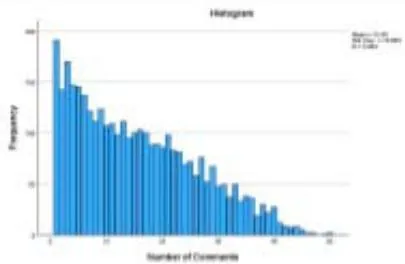
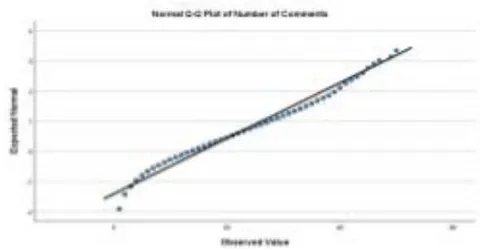
With the mean of 15.45 slightly higher than the median of 14.00, this indicates that the distribution is not perfectly symmetrical (there are outliers) and that there could be a slight pull in the positive direction (right side). A positive skewness value of .579 suggests that the tail of the distribution is longer on the right side. A KS test significance value of implies that the distribution was not random and statistically significant, thereby providing strong evidence to reject the null hypothesis. The other normality tests depict a positively skewed histogram, indicating few high-value outliers (Image in Appendix 1c). The QQ Plot also demonstrates non-normal distribution, with points deviating from the straight line (Image in Appendix 1d).
Descriptive Statistics and Tests of Normality for the Number of Subscribers variable:
| Mean | 304.32 |
| Median | 2.00 |
| Variance | 240886923.46 |
| Standard Deviation | 15520.532 |
| Range | 912377 |
| Skewness | 58.642 |
| Kurtosis | 3446.793 |
| KS Test Significance | <.001 |
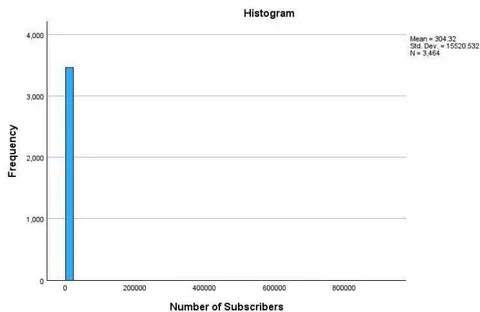
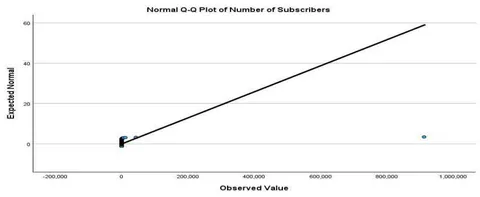
An extreme low value of 2.00 as median does inflate the mean and the variance, and there is the presence of extreme outliers in this dataset. The data is also extremely skewed (58.642), with the long tail extending towards the right. Hence it is a highly, positively skewed dataset. Similarly, a KS test significance value of implies that there is very strong evidence to reject the null hypothesis. The other normality tests (histogram
and QQ plot images in Appendix 2c and 2d) project a highly positively skewed, non-normal distribution.
Descriptive Statistics and Tests of Normality for the Number of Uploads variable:
| Mean | 10.29 |
| Median | 5.00 |
| Variance | 820.623 |
| Standard Deviation | 28.647 |
| Range | 819 |
| Skewness | 13.416 |
| Kurtosis | 274.457 |
| KS Test Significance | <.001 |
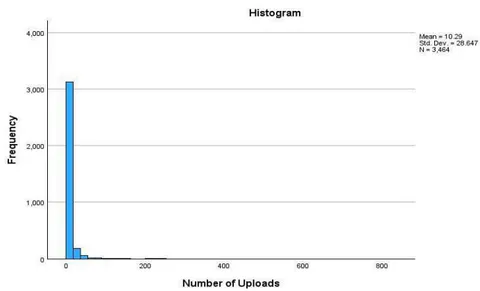
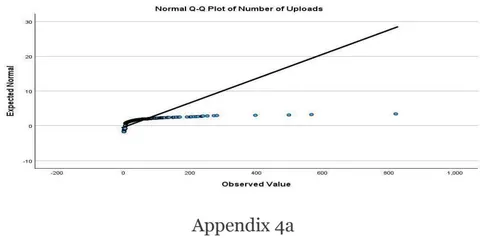
With a mean value of 10.29 higher than the median of 5.00, this shows that there are extreme outliers that are influencing the overall statistics. The data is also heavily right-skewed as 13.416 is a large positive value. With the KS test significance value of which is lower than the standard p-value, one would reject the null hypothesis. Other tests of normality (images of histogram and QQ plot in Appendix 3c and 3d), depict a non-normal distribution.
Because the data in all of the above variables are heavily right-skewed and non-normal, a Spearman's correlation would be used to assess the relationship based on the research questions. The findings are as follows:
| Spearman's Rho | Findings |
| Correlation Coefficient: Number of Comments and Number of Subscribers | .079 |
| Correlation Coefficient: Number of Comments and Number of Uploads | -.009 |
| Two-tailed Significance: Number of Comments and Number of Subscribers | <.001 |
| Two-tailed Significance: Number of Comments and Number of Uploads | .597 |
With a two-tailed significance of , it is a highly statistically significant correlation; thereby the null hypothesis can be rejected. However, a Correlation Coefficient between the Number of Comments and the Number of Subscribers being 0.079, it is a very weak- almost negligible positive relationship between the number of rude comments received and the number of user subscribers. This means that as the value of one variable increases, the other slightly tends to go up. The connection is minimal, random, close to zero with non-linear relationship between the two variables. Hence subscriber count is not a good predictor for comment count (image in Appendix 4a).
The Correlation Coefficient of -.009 between the Number of Comments and Number of Uploads indicate an extremely weak, almost non-existent linear relationship. Hence there is no connection between the number of hurtful comments received and the number of user uploads.
Besides, the two-tailed significance value of 0.597 shows that there is no statistically significant relationship between the two variables. Hence, one would fail to reject the null hypothesis. It is random, and unlikely to predict if the number of user uploads influence the number of toxic comments received (image in Appendix 4b).
Discussion/Conclusion:
Based on the findings from the statistical interpretation, it is evident that there could be a slight/very weak, almost negligible positive correlation between the number of rude comments and the number of user subscribers; thereby we reject the null hypothesis in Research Question 1. On the contrary, based on the results from the statistical procedures, there is no correlation between the number of crude comments received and the number of user uploads; thereby we fail to reject the null hypothesis in Research Question 2. In order to arrive at the above conclusions, appropriate measures were used such as non-parametric tests (Spearman's Rho) as the data was heavily right-skewed and non-normal. The Descriptive Statistics, Normality Tests, Graphs for statistical interpretation (histograms, QQ plots) for each variable helped to assess the skewness and non-normality in the data.
To further interpret the above results, future research could focus on the data and findings between the number of comments and number of user subscribers correlation. The number of crude comments and number of user uploads' association can be excluded from future studies and analysis as there is no correlation as such. Future work could also look into the possibility of other variables in datasets and their association with cyberbullying comments on YouTube. Notable Limitations and Recommendations: While analyzing the data for the Subscribers and the Uploads variables, there were significant extreme outliers that heavily influenced the output. A future recommendation would be to use more authentic, normally distributed data for statistical analysis.
Similarly, there was hardly any mention about how and/why the data was collected on YouTube user activity metrics. Going forward, another recommendation would be to provide enough background information for context regarding data collection and that might help to present more authentic data (with less or no extreme outliers).
There was also a lack of mention of timeline, as in when the data was collected. As a recommendation, this needs to be looked into and incorporated in future datasets.
Uniqueness of the Dataset and Findings and Implications: In all, the dataset was unique as it helped address the inquiry based on the research questions. The research questions developed were unique too as such inquiry was missing in the current literature. The findings presented would help advance conversations around the topic based on quantitative statistical analysis. It would encourage future research and develop quantitative data as well as the use of appropriate statistical tools to guide intervention/prevention research on cyberbullying.
APPENDIX
Appendix 1a.
Descriptives
| Statistic | Std. Error | ||
| Number of Comments | Mean | 15.45 | .185 |
| 95% Confidence Interval for Mean | Lower Bound 15.09 | ||
| Upper Bound 15.81 | |||
| 5% Trimmed Mean | 14.92 | ||
| Median | 14.00 | ||
| Variance | 117.994 | ||
| Std. Deviation | 10.863 | ||
| Minimum | 1 | ||
| Maximum | 50 | ||
| Range | 49 | ||
| Interquartile Range | 17 | ||
| Skewness | .579 | .042 | |
| Kurtosis | -.548 | .083 | |
Appendix 1b
Tests of Normality
| Kolmogorov-Smirnov | Shapiro-Wilk | |||||
| Statistic | df | Sig. | Statistic | df | Sig. | |
| Number of Comments | .095 | 3464 | <.001 | .944 | 3464 | <.001 |
Appendix 1d
Appendix 1c.
Appendix 2a
Descriptives
| Statistic | Std. Error | ||
| Number of Subscribers | Mean | 304.32 | 263.705 |
| 95% Confidence Interval for Mean | Lower Bound | -212.71 | |
| Mean | Upper Bound | 821.35 | |
| 5% Trimmed Mean | 6.15 | ||
| Median | 2.00 | ||
| Variance | 240886923.46 | ||
| Std. Deviation | 15520.532 | ||
| Minimum | 0 | ||
| Maximum | 912377 | ||
| Range | 912377 | ||
| Interquartile Range | 7 | ||
| Skewness | 58.642 | .042 | |
| Kurtosis | 3446.793 | .083 | |
Appendix 2b
Tests of Normality
| Kolmogorov-Smirnov | Shapiro-Wilk | |||||
| Statistic | df | Sig. | Statistic | df | Sig. | |
| Number of Subscribers | .492 | 3464 | <.001 | .005 | 3464 | <.001 |
a. Lilliefors Significance Correction
Appendix 2c
Appendix 2d
Appendix 3a
| Descriptives | |||
| Statistic | Std. Error | ||
| Number of Uploads | Mean | 10.29 | .487 |
| 95% Confidence Interval for Mean | Lower Bound | 9.33 | |
| Upper Bound | 11.24 | ||
| 5% Trimmed Mean | 6.30 | ||
| Median | 5.00 | ||
| Variance | 820.623 | ||
| Std. Deviation | 28.647 | ||
| Minimum | 1 | ||
| Maximum | 820 | ||
| Range | 819 | ||
| Interquartile Range | 0 | ||
| Skewness | 13.416 | .042 | |
| Kurtosis | 274.457 | .083 | |
| Tests of Normality | ||||||
| Kolmogorov-Smirnov | Shapiro-Wilk | |||||
| Statistic | df | Sig. | Statistic | df | Sig. | |
| Number of Uploads | .373 | 3464 | <.001 | .230 | 3464 | <.001 |
a. Lilliefors Significance Correction
Appendix 3b
Appendix 3c
Appendix 3d
Correlations
| Number of Comments | Number of Subscribers | |||
| Spearman's rho | Number of Comments | Correlation Coefficient | 1.000 | .079** |
| Sig. (2-tailed) | . | <.001 | ||
| N | 3464 | 3464 | ||
| Number of Subscribers | Correlation Coefficient | .079** | 1.000 | |
| Sig. (2-tailed) | <.001 | . | ||
| N | 3464 | 3464 | ||
** Correlation is significant at the 0.01 level (2-tailed).
Appendix 4b
Correlations
| Number of Comments | Number of Uploads | |||
| Spearman's rho | Number of Comments | Correlation Coefficient | 1.000 | -.009 |
| Sig. (2-tailed) | . | .597 | ||
| N | 3464 | 3464 | ||
| Number of Uploads | Correlation Coefficient | -.009 | 1.000 | |
| Sig. (2-tailed) | .597 | . | ||
| N | 3464 | 3464 | ||
Conflict of Interest
The authors declare no conflict of interest.
Ethical Approval
Not applicable
Data Availability
The datasets used in this study are openly available at [repository link] and the source code is available on GitHub at [GitHub link].
Funding
This work did not receive any external funding.
Cite this article
Related Research

Special Issue
Launch a focused special issue to highlight research, emerging trends, and expert insights in your academic field.