

Abstract
Much of Africa’s forest ecosystems heritage can be found in Cameroon. The country has since ratified numerous Conventions and enacted laws to protect and valorize these connecting ecosystems benefiting local people and global climate. These forest and non-forest ecosystems constitute Cameroon’s green infrastructure today. However, due to anthropogenic and natural processes, these ecosystems face degradation, thereby weakening their superstructure, diminishing their services value; threatening livelihoods, and contributing to climate change.
We draw in this paper, parallels between green infrastructure and traditional (hard) infrastructure, in a bid to attract to ecosystems restoration, a comparable maintenance mindset, historically reserved for hard infrastructure. We use the prisms of three ecosystems assessments for restoration, as case studies. These are; (i) the northern savannah, (ii) Sanaga-Kadey watershed and (iii) the forest transition zones of Cameroon. By analyzing some common parameters across these ecosystems, including (i) land tenure, (ii) multifunctionality, (iii) climate resilience, (iv) critical resource use efficiency, (v) carbon neutrality, (vi) connectivity, (vii) stakeholder engagement, (viii) social inclusivity and (ix) maintenance-friendliness, we simultaneously make a case for adopting analogous maintenance mindsets towards securing and re-building Cameroon’s threatened green infrastructure.
Explore Digital Article Text
I. INTRODUCTION
1.1. Traditional versus green infrastructure
Traditional infrastructure refers to the fundamental physical and organizational structures and facilities needed for the operation of a society, enterprise, or system. It includes essential services such as transportation systems (roads, bridges, airports), utilities (water supply, electricity, telecommunications), buildings (schools, hospitals, offices), and other key facilities necessary for the functioning of a community or business. Such infrastructure plays a critical role in supporting economic development, social well-being, and overall quality of life. Such traditional infrastructure can also have negative environmental impacts, such as increased pollution, habitat destruction, and water runoff .
While traditional infrastructure is primarily concerned with meeting human needs through built structures, green infrastructure emphasizes the integration of natural systems to provide multiple benefits for both people and the environment . Principally, green infrastructure focuses on incorporating natural elements and processes to provide a range of ecosystem services while also promoting sustainability and resilience. Green infrastructure typically uses nature-based solutions to mimic natural processes, enhance biodiversity, improve air and water quality, reduce heat and island effect in urban areas, to create more livable and healthy built-up communities.
At the scale of a country, green infrastructure refers to the network of natural and semi-natural areas that have evolved (modified and managed) to deliver multiple ecological, social, and economic benefits. Ideally, large-scale green infrastructure comprises interconnected green systems, such as national parks, wetlands and hydrological systems, high value forests, watersheds, agricultural and rangelands, etc. They provide ecosystem services, improve air and water quality, protect wildlife habitats and enhance biodiversity. Green infrastructure facilitates seed dissemination, agricultural crop pollination, soil fertility and regeneration; promoting human health, well-being and economic development.
Similar to the rehabilitation and maintenance needs, historically restricted to the built, urban and or traditional infrastructure, concerns about the state of green infrastructure are rising, and restoring degrading, green interconnected ecosystems and landscapes, is today of major national and global concern, yet nowhere near the maintenance mindset reserved for hard infrastructure.
1.2 Cameroon's green infrastructure endowments
Cameroon is located in Central Africa and shares borders with Nigeria, the Central African Republic, Chad, the Republic of the Congo, Gabon and Equatorial Guinea. With a population of approximately 25.7 million people as of 2020, Cameroon has a mixed economy featuring state-owned and private enterprises. Food and export crop agriculture drives the economy, accounting for 22% of GDP with export crops like cocoa, coffee, banana, and palm oil. The country also has oil and gas reserves and manufacturing sectors for textiles, food processing, and construction materials. Services contribute 50% to GDP, with a per capita income of $2,300. Challenges include corruption, infrastructure limitations, and security concerns [5]
Cameroon's green infrastructure is represented by its forests repartitioned into permanent and non-permanent estates under the Cameroon Forestry Law of 1994. The country's permanent forest estate is estimated at 15.7 million hectares, and the non-permanent estates at 6.9 million hectares. This is out of a total forest area estimated at 22.5 million hectares [6].
By 2013 had officially partitioned the national territory into five (5) Agroecological zones; two forest zones; (i) a coastal with mono-modal rainforest regime (ii), bimodal hinterland forests; (iii) a high plateau, (iv) high savannah and (v) sudano-sahel zones. Each zone possesses slightly peculiar, dominant vegetation (main component of green infrastructure) with elevation (e.g., montane forests), nearness to sea (mangrove systems), low humidity and or low soil organic matter (sudano-sahel ecosystems) being additional factors influencing the classification and functioning of ecosystems or biomes. By 2020 there were nineteen protected areas in Cameroon with at least one in each of the five agro-ecological zones. The 1994 Forestry Law and one of its texts of Application – the 1996 National Environmental Management Plan (NEMP), stipulates a network of protected areas, to ensure that a viable sample of each type of ecosystem or biome is represented/protected, continues to provide its unique ecosystems functions, and to the extent possible, is connected to other natural systems. The presence of five agro-ecological zones, including sub biomes hasn't only earned Cameroon the title of “Africa in miniature”, but Cameroon is also famously, a meeting point of two major continental biomes – the west African upper Guinean and the central African-Congolian forest systems.
1.3 Cameroon's commitments to secure her green infrastructure
To solidify her commitment to secure her green infrastructure heritage, Cameroon has signed and ratified several major multilateral environmental agreements related to forests, biodiversity, and climate change. Some of the key agreements and strategies include:
Convention on International Trade in Endangered Species of Wild Fauna and Flora (CITES): signed since 1983 and implemented to regulate the trade in endangered species.
Convention on Biological Diversity (CBD) signed in 1992 ratified in 1994, committing to conserve and sustainably use her biodiversity.
As required by the CBD Cameroon developed a National Biodiversity Strategy and Action Plan (NBSAP) in 2001 and updated, in 2015.
The Kunming – Montreal Global Biodiversity Framework, being an offshoot of the CBD was adopted by Cameroon in 2022, guiding the revision of her NBSAP in 2023.
Cameroon signed the United Nations Framework Convention on Climate Change (UNFCCC) in 1992 and ratified it in 1994.
Cameroon adopted the Declaration of the Summit of Heads of State of Central African Countries on the Conservation and Sustainable Management of Tropical Forests of 1999.
Cameroon has been a party to the United Nations Forests for People Programme (UNFP) since its inception in 2000.
Cameroon ratified the Central African Forest Commission (COMIFAC) Convergence Plan in February 2005 on harmonized, sustainable management of Congo Basin forests.
Cameroon is a signatory to the African Forest Landscape Restoration Initiative (AFR100): a continental initiative launched in 2015 to restore 100 million hectares of degraded landscapes across Africa by 2030.
Cameroon has developed a National Development Strategy with a 2030 horizon (SND30) that includes sustainable management of the country's forest and other green infrastructure.
Despite these commitments to address environmental issues such as climate change, biodiversity loss, and deforestation, and demonstrated willingness to work with global actors to achieve common goals, Cameroon's green infrastructure heritage is still confronted with degradation.
For instance, from 2001 to 2023, Cameroon lost 2.05 million ha of tree cover, equivalent to a decrease in tree cover since 2000, and equivalent to 1.23 Gt of of emissions (GFW, 2023). Amongst Cameroon's commitments, her pledge through the AFR100 and Bonn Challenge to bring 12, 062,768 hectares of degraded landscapes under restoration by 2030 stands out as particularly relevant towards rebuilding and maintaining the country's green infrastructure.
To update the country's environmental management commitments, a new forest and wildlife law no. 2024 008 of 24 July 2024 has been adopted. It builds on the 1994 framework laws and focuses on biodiversity conservation, climate change and the sustainable development goals; community rights; a landscape approach to environmental management, landscape restoration, use of advanced monitoring systems, stiffer law enforcement regulations for critically endangered species, greater transparency and much stronger alignment with international conventions.
1.4 Cross-cutting issues on the nexus of hard and green infrastructure
Like traditional (hard) infrastructure, development of green infrastructure (tree-based ecosystems), has some important prerequisites or requirements such as; land tenure, stakeholder engagement, social inclusivity and maintenance-friendliness. Any infrastructure is also expected to possess certain characteristics enabling them to deliver services in a particular manner, including; multifunctionality, climate resilience, critical resource use efficiency, carbon neutrality and connectivity, among others. Through these commonalities, green and traditional infrastructure appear to seek similar goals – that of achieving resilience, by reducing the risk of failure, improving system performance, and ensuring that infrastructure can adapt to changing conditions over time.
From a socio-cultural perspective, one overriding requirement for green infrastructure in Cameroon (equally important to traditional, hard infrastructure) – is tenure, and this deserves some emphasis.
The tenure status across all the areas of opportunities for green infrastructure development are also a reflection of Cameroon's 1974 land tenure laws. A number of exceptions to this Law can exist under specific conditions. Although rarely invoked, such exceptions in Cameroon may include land title deeds listed under the pre-independence in former west Cameroon. Even with such lands, either retroceded to traditional authorities or held in trust by customary entities such as lands within in northern Cameroon, only a land title transfers full rights of ownership from one moral entity to another; the rest being considered as lands in the . The tenure status of such lands must often be ascertained prior to developing either green or hard infrastructure.
Furthermore, in 1994, forested lands (as defined by Law n°94/01 of January 20, 1994) came under the jurisdiction of the forest and wildlife laws, and were demarcated as Permanent (PFE) and Non-Permanent Forest Estates (NPFE). Whereas PFE are “the private property” of the State (comprising protected areas, timber concessions, council forests, etc.), NPFE are defined to include agroforestry zones, comprising inter alia, community forests, and private forests, where individuals and communities can exercise ownership and control rights under certain agreements with the supervising authorities (e.g. in the case of Community forests). Given that forests have been defined to cover the national territory, such estates can occur everywhere, including in the northern regions, not traditionally considered to be “a forest zone”. Tenure statuses therefore, have implications for all types of green infrastructure development to be implemented, and who the stakeholders can be.
II. CASE STUDIES OF GREEN INFRASTRUCTURE OPPORTUNITIES ASSESSMENTS
To illustrate issues pertaining to green infrastructure development in Cameroon, three case studies are used to articulate prerequisites and requirements of successful green infrastructure development. These case studies illustrate salient issues to consider in the event of a shift in mindset towards a stronger maintenance culture for green infrastructure, similar to that hitherto reserved for hard, traditional infrastructure.
For a consistent ecological cognition rather than a hard infrastructural one, the expression “ecosystem restoration” will be used to mean “rebuilding green infrastructure”, meanwhile, the principal micro ecosystems examined in this paper are tree-based systems.
The three ecosystem restoration case studies are therefore, (i) tree savannah, northern region; (ii) the Sanaga – Kadey watershed, in the eastern region, and (iii) a forest-savannah transition zone, Centre region, all in Cameroon.
2.1 Northern tree savannah ecosystem restoration (ER) assessment – overview
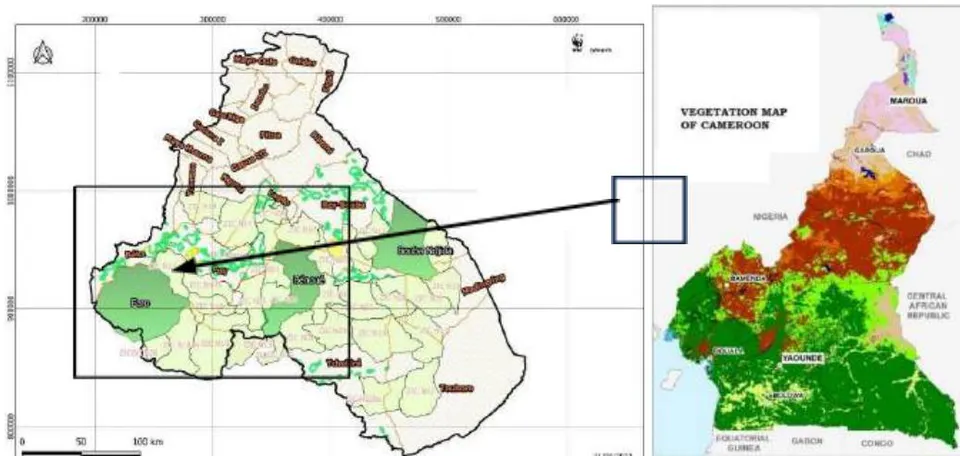
2.1.1 Survey of restoration opportunities in the northern savannah
In June of 2022 a sub national Restoration Opportunities Assessment Methodology [4], was completed here by WWF Cameroon [7]. The assessment identified 26,029 ha to be brought under ecosystem restoration. 89.59 % of this area are agricultural lands, 10.11 % agroforestry and 0.3% appropriate for woodlands. The area is densely populated, water-stressed with river banks suffering strong erosion; low soil organic matter and water retention potential; and characterized by impoverished and degraded agricultural soils (leached and low in soil nutrients). Indigenous tree species; Pterocarpus erinaceus, Afzelia Africana and Kiguelia Africana, are selectively overexploited here for fuel, timber, furniture and fodder.
The ecological needs highlighted by this case study pertain to; multifunctionality, climate resilience and critical resource use efficiency aspects of ecosystems restoration (or green infrastructure development).
2.1.2 The Sanaga - Kadey watershed assessment - overview
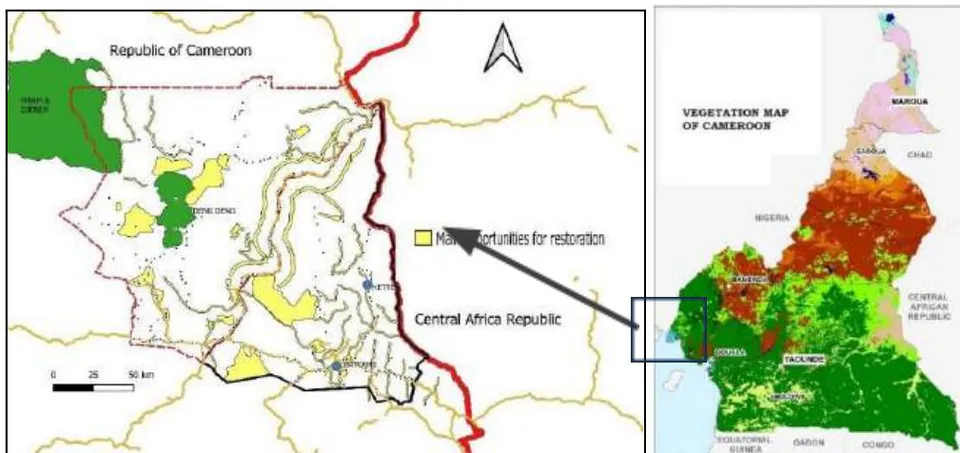
2.1.3 Survey of restoration opportunities in the Sanaga – Kadey watershed
In June of 2023 a second sub national Restoration Opportunities Assessment Methodology [4], was completed by WWF Cameroon [8] in the Sanaga-Kadey watershed and identified 426 904 ha of ecosystems restoration opportunity. 98 942 ha of this is in communal forests (state forests); 10 070 ha of abandoned mines within the national domain; 65 062 ha of micro zoned areas also in the national domain; 107 001 of gallery (riparian) forests within the national domain and 145 829 ha of degraded agroforestry areas within the national domain and within community areas. With non-uniform population distribution, community areas including riparian forests are densely settled, whereas the national domains and abandoned mines are sparsely populated. Agricultural areas are dominated by annual crops (cereals and tubers); and agroforests of indigenous multipurpose trees species; Irvingia gabonensis, Ricinodendron heudelotii and Trichoscypha acuminata; medicinal species; Baillonella toxisperma, Enantia chlorantha and Garcinia cola; and by timber species, Diospyros spp. Triplochiton scleroxylon, Afzelia bipidensis and Entandophragma cylindricum. Most sensitive degradation drivers; small scale agriculture and fuelwood extraction impacts riparian forests, while artisanal mining impacts land cover and water quality.
The ecological needs highlighted by this case study pertain to; multifunctionality, critical resource use efficiency and connectivity aspects of green infrastructure development.
2.2 The forest-savannah transition zone agroforestry assessment: overview
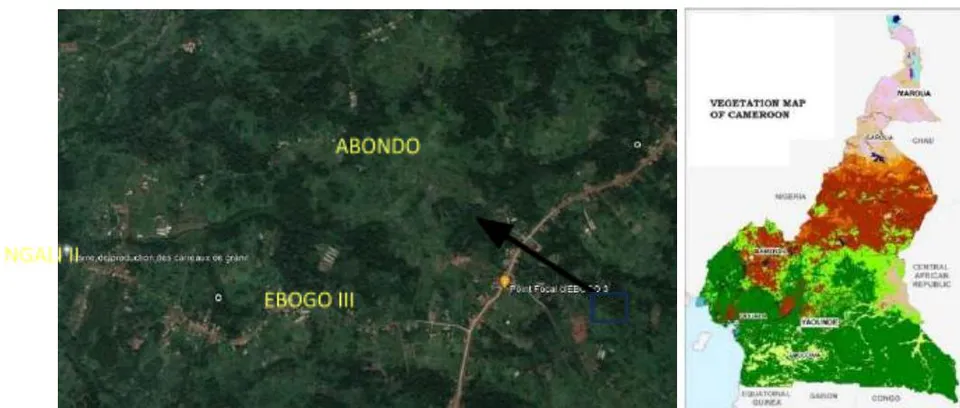
2.2.3 Restoration practice in the "Ndong community" (see Mbile & Elomo, 2024)
Between 2003 and 2004, the World Agroforestry Centre (ICRAF) transferred 28,000 trees of Irvingia wombolu, an indigenous fruit tree, into the NDONG community, Centre region, under the tree domestication programme that began in the 90s [9]. This fragmented forest transition zone just outside Yaoundé (Cameroon's capital City) is a forest degradation hotspot [10] and community livelihoods here have partly depended, and continue to do so, on consumption and sales of products from indigenous tree species including Ricinodendron heudelotii, Monodora myristica, as well as exotic economic trees like Avocado, Citruses and Oil palm. The participants of the programme included men, youth and a women's group – “MERUNGA”. This restoration programme has been monitored for over 20 years and the results published [11].
The ecological lessons learned in this case study involve indigenous tree domestication through the displacement of viable planting materials for ecosystem restoration, and are particularly relevant to;
multifunctionality, social inclusiveness and maintenance-friendly aspects of green ecosystems restoration (or green infrastructure development).
III. DISCUSSION OF THE CASE STUDIES IN THE CONTEXT OF GREEN INFRASTRUCTURE DEVELOPMENT
3.1 Building resilience
To the same extent that the problems of ecosystem degradation are numerous and interconnected, so too should the interventions to resolve them, are of a multifunctional nature.
The northern regions of Cameroon are amongst the most climate vulnerable with longer hours of insolation, high seasonal temperatures and short-lived, but torrential rains. This facilitates soil crusting, and formation of hardpans leading to low water infiltration and potentially higher volumes of surface water. Low soil organic matter, low soil carbon holding capacity and high runoffs exacerbate erosion and soil loss (Figure 5). The low overall forest cover, high exposure enhances vulnerability to strong winds and dust storms causing agricultural land degradation (Figure 6).
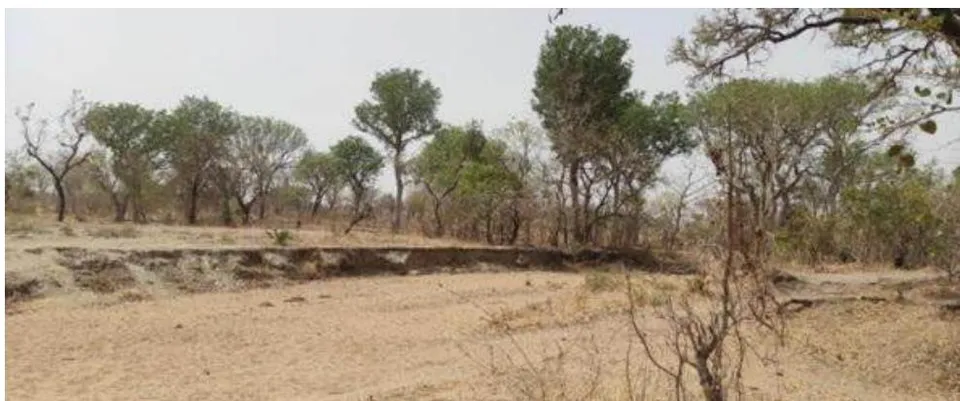
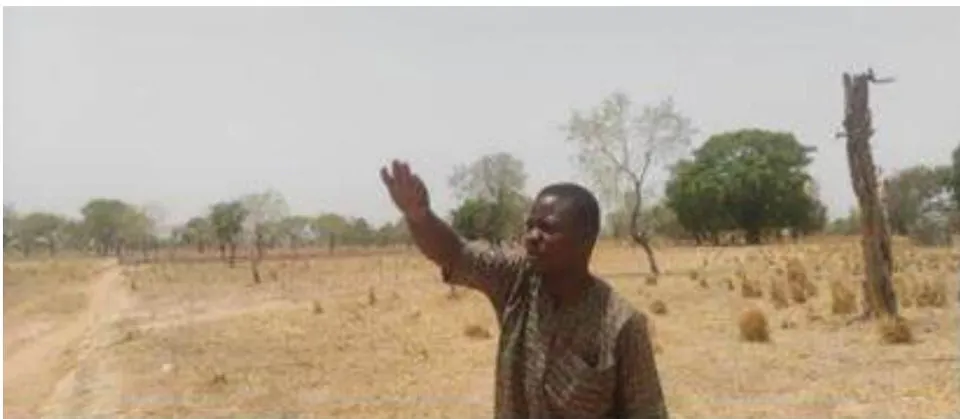
Moving on to the Sanaga-Kadey watershed on the eastern forest transition zones of Cameroon, the population is more dispersed compared to the north region. However, this ecosystem faces similar pressures on riparian forests (Figure 7) that protect rivers and streams.
Whereas in the drier northern savannah, there is strong preference for arable agricultural land (89.59% of assessed opportunities) with fewer trees, rampant wildfires used to prepare agricultural and pastoral lands, including unsustainable extraction of fuelwood drives tree-loss. This form of degradation is also common here in the Sanaga-Kadey watershed (Figure 3 and Figure 7).
In both cases, tree loss on these vulnerable ecosystems generally increases the likelihood of hazards from extreme weather events, like storms, flooding, causing loss of top soil, siltation of waterways, while extreme droughts, exposure and strong winds drive uncontrolled wildfires, decimating what little vegetation is left, thereby reenforcing the degradation cycle.
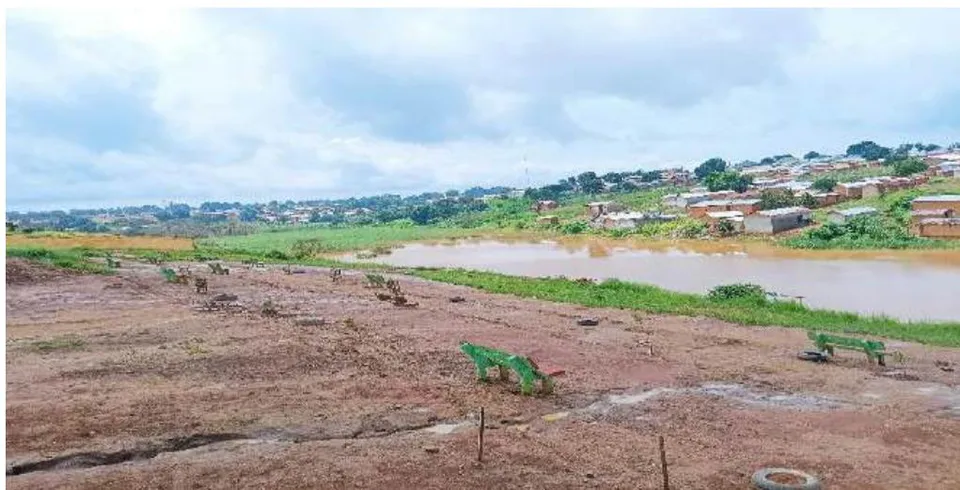
As human populations grow, there is increasing need for more, often low-productivity farmlands and so more forests are converted to farmlands.
The recommended restoration opportunities for both the northern savannah and the Sanaga-Kadey watershed thus emphasize how to enhance the multifunctionality of the ecosystems by sustainably managing and conserving critical resources like water, and tree systems diversity (abundance and evenness) for increased resilience. Such ecosystems restoration opportunities were therefore most strongly recommended for sensitive, high value and easy-to-manage areas of both northern savannah and Sanaga-Kadey watersheds, such as managed farmlands, community home gardens, and relatively smaller areas such as river banks (or gallery forests), community forests and sacred forests (making 11% of total assessed area).
Development of agroforestry systems in both the northern savannah region and the Sanaga-Kadey watershed by planting a range of available, multipurpose trees species (fruit, timber, fuel wood, soil improvers) is one solution. For agricultural land, application of bio regenerating products like Biochar (a carbon-rich material produced by partial oxidation- pyrolysis, at in the absence or limited supply of oxygen, using organic materials such as forestry and agricultural wastes as substrate (32, 33) to improve soil water holding capacity, cation exchange capacity and overall fertility are also recommended.
3.2 Enhancing critical resources use efficiencies
Critical resource use efficiency is an important ecosystem restoration strategy in multifunctional landscapes. Such critical resources include soil nutrients holding capacity and species (e.g. trees)
biodiversity with a direct correlation with system resilience . Due to relatively low growth rates of especially indigenous species, and the harsh soil biophysical factors of low organic matter and hard-pans, the recommended technology to rehabilitate such soils in the north savannah region is the relatively costly Revitech estimated to reach US 1,500 per hectare. This technology, although tested and viable in the targeted context, is costly, and well beyond the financial wherewithal of the relatively poor communities. Its low adoption rates to-date, despite it proven effectiveness is largely due to cost.
The preference for slow-growing indigenous species, for biodiversity and resilience, can actually add to the ecosystem restoration costs per hectare, as it takes longer for indigenous trees to grow, and establish, if at all. As a consequence, and based on lessons from the application of vegetation successions in restoration the application of Revitech on hardpans is still recommended despite costs. The strategy involves the use of fast-growing exotic species (e.g. Acasia) as part of a vegetation succession, creating enabling micro-conditions, which then allows slow growing indigenous species to establish as part of assisted natural regeneration.
Another recommended strategy to restore hard-pans (including abandoned mines where topsoil has been removed), support soil fertility (a critical resource), assist natural regeneration and grow biodiversity, is through the use of biochar through private sector participation. In the northern savannah, biochar production is envisaged through pyrolysis of rice husks, a waste product of the rice-producing company SEMRY (YAGOUA Rice Expansion and Modernization Company).
Similarly, restoration interventions to enhance soil carbon and organic matter in the Sanaga – Kadey watershed are expected to source forestry waste produced from lumbering in communal forests or supplied under contract from private timber companies like PALISCO LLC (a private forestry company in the southeastern forest) operating just south of the watershed. The coordinated role of the private sector is further discussed below under private sector engagement.
Furthermore, the northern savannah degraded areas are in a transhumance zone, prone to farmer-grazer conflicts and frequent bush fires. An interesting (bitter-sweet) relationship exists here between farmers and graziers. The sweet part involves agricultural land fertilization via cow dung. Meanwhile, the bitter parts involve deliberate fires set by pastoralists to stimulate re-sprouting of fresh fodder, crop and saplings raiding by livestock. Managing this bitter-sweet scenario, prevalent in both the northern savannah and Sanaga-Kadey watershed requires (costly) effective and reliable monitoring missions (passive restoration) to manage conflicts and ensure survival of species undergoing natural regeneration.
The restoration assessments for both northern savannah and Sanaga-Kadey watershed, thus recommended species with multiple uses (for soil fertility, medicinal, food values, fodder value, fuel-wood value, etc.), and with strong economic potential (e.g., Cashew nut) to serve as incentive for engaging local communities .
3.3 Carbon capture and climate action
A significant amount of biochar use is envisaged in these recommended ecosystems restoration processes. Biochar is a negative emissions technology, identified by the Intergovernmental Panel on Climate Change (IPCC) as effective in mitigating climate change and achieving net-zero emissions . Biochar increases the soil's capacity to retain, absorb carbon and support natural carbon sinks. It improves soil structure and health (soil organic matter, soil carbon content, microbial and fungal activity, cation exchange and pH), the ability of the soil to retain and absorb carbon and water; and reduces the fluxes of NO2, CH4 and CO2 in the soil.
The quantities to be applied per hectare for either mosaic (e.g., farmer-managed agricultural systems with community tenure) or wide-scale (e.g., abandoned mines, plantations, state-owned forest systems) restoration approaches are yet to be determined for both the north region and Sanaga-Kadey watershed sites. However, there is a 1:3 ratio with respect to biochar use versus carbon removal and storage; i.e., 1 MT of biochar applied to agricultural plots can permanently sequesters and remove up to 3 MT/CO2eq from the atmosphere [21, 22, 23, 24].
In terms of above ground capture and storage, the transition from a degraded cropping system to a tree-based system or agroforest can more than double surface carbon gains . If later converted to a purely tree-based system (e.g. a gallery forest) or through reforestation (e.g., in communal or community forests), this can more than triple above-ground carbon stock gains .
Restoring the significant areas of gallery forests in the Sanaga – Kadey watersheds using mosaic (29364 ha) and wide-scale (82604 ha) approaches through protection, local by-laws, assisted natural regeneration and reforestation, to healthy states, can be comparable to restoring to primary or secondary mixed tropical forests. These will result in over 100,000 ha of gains in both above-ground carbon stocks being permanently stored including the associated biodiversity benefits [29, 30].
Bringing abandoned mines under restoration through a combination of ReviTech®, biochar application, reforestation and assisted natural regeneration is likely to be expensive in the short-term. However, through flexibility in managing costs (such as by using local labor and organic matter) and achieving permanence, through the development of locally useful, mixed tree systems there is good potential for below and above ground, long-term carbon capture and storage (using biochar). Through high integrity voluntary carbon capture and trading (e.g. Gold Standard or VCS) some of the financial investments can be recovered.
Finally, biochar use irrespective of the feedstock requires expensive specialized knowledge, processes and materials for chemical (elemental) analysis of the feedstock to match with the soil properties, and tailor the biochar production to the needs of soils to be brought under restoration. Dealing with assisted natural regeneration also requires selection of most appropriate tree species, determining their nutrient needs and tolerance to relevant environmental factors (local pests, drought conditions, etc.). These are areas that carbon trading can finance and create a circular, self-sustaining, win-win, process of revenue generation, environmental protection, and climate action.
3.4 Connectivity and biodiversity conservation
Across rivers and streams in the Sanaga-Kadey watershed, progressive eutrophication of streams like the Bindiki river (Fig. 6) results in the reduction of the volume of water and the deterioration of its physico-chemical properties to support fish for home use by local populations. The recommendations for ecosystem restoration through development of viable woodlots, agroforests and green belts by communities (including women) will reduce siltation and help recovery of the river and freshwater life.
This setting is an ideal case for the combined application of tailor-made biochar with heavy metal absorption properties and to support both active and passive restoration (e.g., natural regeneration) for increased hydrolytic retention as well as the accumulation of minerals necessary for the growth of biodiversity on the completely eroded land. Women's groups, through robust stakeholder engagement processes, are then an effective mechanism to ensure monitoring and compliance to ensure recovery of green banks.
3.5 Social inclusiveness and private sector engagement
Women are some of the victims of degrading multifunctional landscapes; such as loss of soil fertility, precarity in domestic energy resources and deterioration of water quality. Individual women have also been known to be an important part of the problem of forest landscape degradation as they fend for their families through smallholder agriculture, fuelwood harvesting, etc.
Well organized women's groups can however, play a significant role in accelerating landscape restoration. Securing the consent and participation of women's groups in envisaged ecosystem restoration programs in the Sanaga-Kadey watershed was assessed through the participator process of Free Prior and Informed Consent (FPIC). Getting their views required focused group discussions with the women, and accompanying them on field visits, to their different places of activities (Figure 8). FPIC is an immersion approach which does not only secure the consent of social groups during project implementation, but helps program proponents to develop and appreciate the motivation of social groups; understand their perception and actual states of wellbeing; the challenges they face, and their actual livelihoods strategies pertaining to how they interact with critical resources facing degradation.
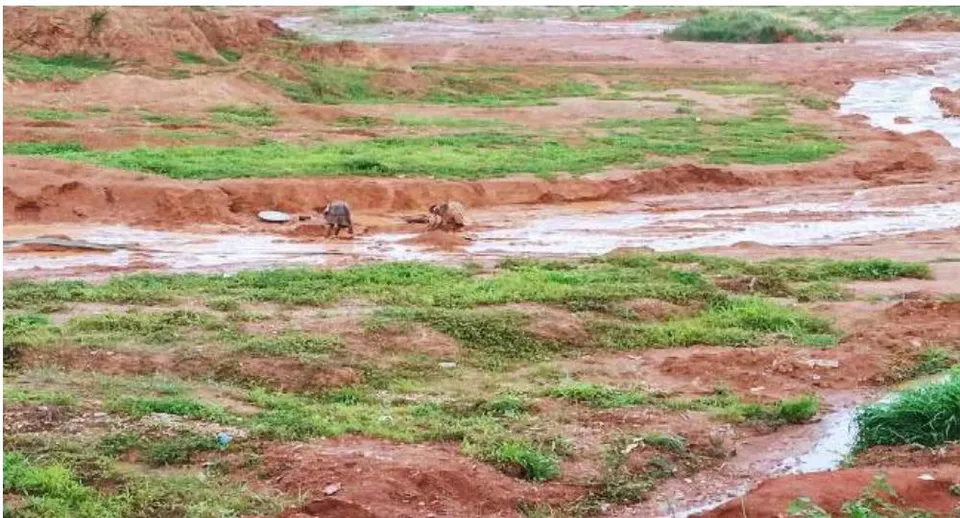
Social inclusiveness in ecosystem restoration often targets the vulnerable. Therefore, one deliberate strategy to strengthen inclusiveness is to link it to engagement with the private sector, given the latter often tends to be powerful and influential. The private sector can thus leverage social legitimacy, while the vulnerable groups can ride on the private sector power, resources and influence.
This restoration assessment thus specifically proposes an innovative human network built on a stakeholder infrastructure composed of three (03) main categories; (i) Investors – such as Biochar developers and carbon markets facilitators/brokers like FACET POWER ; (ii) service providers – nursery managers, trainers, seedlings distributors, researches and knowledge holders (ReviTech), and (iii) active and passive restorers - farmers, women's groups, planters, plantation developers.
FACET POWER seeks to produce biochar by engaging contractually in the north with SEMRI (rice company producing husks as feedstock), and with PALISCO - a timber processing company (producing wood waste as feedstock). Another potential private entity is Terra Formations, a private forestry regeneration and carbon markets facilitator who have expressed interest in the restoration assessment results in the Sanaga – Kadey watershed. Service providers abound and include ReviTech, small nursery managers and NGOS in Garaoua and Bertoua, or others even further afield in established institutions willing to invest resources if a business opportunity emerges, either directly or via local satellites. The third group in this innovative human network of delivery infrastructure are the active and passive restorers. Electronic (virtual) and physical market-place options which need investments and further development, have been proposed to link these three actors in real-time, dynamize their interaction and accelerate rebuilding of Cameroon’s crumbling green infrastructure.
3.6 Developing maintenance-friendly restoration designs
The lesson of ecosystem restoration in multifunctional, farmer- management landscapes come from the restoration practice in the forest-savanna transition zone (Box 3) of central Cameroon. This case study is the subject of a recent publication [9] which makes a strong case for sustainability and a maintenance culture to be built into restoration processes. In the time left in this decade (2020-2030) of landscape restoration, where restoration involving vulnerable groups is expected to play a major role, it is critical to have a long-term view (beyond 2030). Practitioners of ecosystem restoration must be attentive to specificities - the long-term needs of farmers (in particular, vulnerable groups), and of sensitive ecosystems under restoration. Especially, restoration must be sensitive to the physiological transformations that beneficiaries (especially rural women) would have to go through, and how these changes would influence their ability to sustain multiple, often labour intensive, maintenance activities, critical to the sustainability of restoration investments. These include phytosanitary challenges, marketing challenges; renewal of tree-based systems and general support with new knowledge and technologies, to ensure these restored landscapes remain relevant to the livelihoods of their beneficiaries. If such precautions, safeguards are ignored, restoration investments, just like traditional infrastructure, would fall into neglect and be lost, including their benefits.
The spirit of the Rio 1992 declaration on Sustainable Development (Agenda 21), should remind us of a ‘common future’, between project developers, promoters, investors and beneficiaries. The earlier concept, that once the restoration intervention has ended, agencies and project leaders may turn their back on green infrastructure, needs to be revisited in the same way all traditional infrastructure are only as good as their maintenance plans.
IV. CONCLUSIONS
Green infrastructure and traditional hard infrastructure have strong parallels and understanding how the latter can be secured helps us deal better with the former. Just like traditional hard infrastructure, restoring ecosystems requires similar outcomes comprising inter alia; multifunctionality, climate resilience, critical resource use efficiency, carbon neutrality, connectivity, land tenure, stakeholder engagement, social inclusivity and maintenance-friendliness, as central notions.
The linkage to hard infrastructure should make ecosystem restoration less abstract to policy makers and society. It may be approached and valued at least in a similar way as society values and cares for infrastructure, not viewed only as a consumable, but as a necessary part of production and sustainability.
However, a challenge persists that, green infrastructure like biodiversity is utilitarian, is extracted and can be depleted, not a perception of traditional real-estate or hard infrastructure. However green infrastructure also regenerates and renews itself. So, one way to address this perceived deficit in green infrastructure is to use it in ways that enhance renewal, regeneration and to avoid permanent damage.
It is now urgent that restoring green infrastructure is accompanied by a look forward, a maintenance mentality, an “after-sales service”. This should not be an afterthought that comes when ecosystems degrade. It should be built from the outset; in the same way maintenance is at the core of other types of infrastructure development.
ACKNOWLEDGMENTS
The authors recognize the continuing efforts made by the Cameroon government in environmental management. They are grateful to the World-Wide Fund for nature (WWF) Cameroon and to the WWF Forest Landscape Restoration Initiative for Africa, for supporting both the northern savannah and Sanaga-Kadey watershed restoration assessments. Their thanks also go to the World Agroforestry Centre (ICRAF) for supporting work in the forest transition zones. Finally, we recognize all the communities of the northern savannah, Sanaga-Kadey, “ndong” community of Soa and staff of ICRAF and WWF Cameroon without whom there would be less meaning to the work.
Conflict of Interest
The authors declare no conflict of interest.
ABSTRACT
Since the 19th century, complex analysis, including imaginary numbers, has become a major branch of mathematics. However, can a single algebraic operation not only reveal the infallibility of imaginary numbers (complex number theory) but also destroy it? This paper aims to challenge the mathematical basis of imaginary numbers and look at their historical development from a new perspective. In this article, we demonstrate the possibility of the non-existence of imaginary numbers based on examining imaginary numbers by using the exponential function.
Language: English
Imaginary Numbers: An Absurd Starting Point or a Mathematical Necessity?
Ulaanbaatar Tardad
ABSTRACT.
Since the 19th century, complex analysis, including imaginary numbers, has become a major branch of mathematics. However, can a single algebraic operation not only reveal the infallibility of imaginary numbers (complex number theory) but also destroy it? This paper aims to challenge the mathematical basis of imaginary numbers and look at their historical development from a new perspective. In this article, we demonstrate the possibility of the non-existence of imaginary numbers based on examining imaginary numbers by using the exponential function.
I. INTRODUCTION
If a negative number multiplied by itself equals a positive number, then it's hard to understand the square root of a negative number. [1]
I read somewhere but cannot find the source: “When we teach complex numbers, we usually start with an absurd assumption. We define i to be the square root of -1. Then, we construct an elegant theory. But since we start with an absurd assumption, many people have lingering doubts. We don't have to start from an absurd point.” What is this starting point of date for imaginary and complex numbers?
The imaginary numbers may be that existence is hidden in little things we don't understand.
Negative numbers were not commonly accepted among mathematicians until the late 18th century. Think about it! The Egyptians could build the pyramids, the Romans could build and maintain their huge empire. Even Newton (and Kepler and others) could work out the laws of physics and predict planetary motions, WITHOUT the concept of negative numbers. [2].
Understanding the primordial date of the beginning of an imaginary number is also an important aspect of history. Accounting back from Heron of Alexandria [3], it is 1963 years, Bhaskara Acharya [4][5] 1549 years, Girolamo Cardano [6][7] 490 years, and René Descartes [8] 398 years passed. Since that early time, the imaginary number has been studied without interruption.
In mathematics, a complex number is an element of a number system that extends the real numbers with a specific element denoted i, called the imaginary unit, and satisfies the equation ; every complex number can be expressed in the form
Where a and b are real numbers.
Because no real number satisfies the above equation, i was called an imaginary number by René Descartes.
We used the exponential functions for naked 1 to analyze the nature of imaginary numbers.
II. THE IMAGINATION OF THE IMAGINARY NUMBER
The adjective imaginary was first used (as French imaginaire) by René Descartes in 1673, La Geometrie, referring to imaginary numbers in the broad sense, as non-real roots of polynomials. [8] Euler only used the imaginary number but did not explain it. The word imaginary means that the real numbers may be slightly true in content. However, any imaginary number under the root is always different from real numbers and cannot be mixed with any other number or vanish (Identity (2) and Identity (3)).
2.1 The Imagination of The Imaginary Number
Expression does not exist in nature. And there is no imaginary number that has nature's innermost secrets. Human abstractions such as imaginary birds, imaginary flowers, and imaginary melodies can exist only in painting, poetry, and music.
The adjective imaginary was first used (as French imaginary) by René Descartes in 1673, La Geometrie, referring to imaginary numbers in the broad sense, as non-real roots of polynomials. [7][8][9]
Euler only used the imaginary number but did not explain it. The word imaginary means that the real numbers may be true in content. However, any imaginary number under the root is always different from real numbers and cannot be mixed with any other number or vanish (Identity (2) and Identity (3)).
The most magic number in mathematics is the number ONE, which stands at the junction of the highest and lowest numbers on the number line.
Let's check the imaginary number using the following exponent equation (5) and the magic number 1.
[10]
(5)
And, if a = 1; x = 1 the intriguing problem comes in. In this case, we see the next naked identity (6):
And for 1, the next identities (7-8) are correct:
It is only valid when 1 is it. An imaginary number is inherently associated with the number 1.
This sounds like an incorrect solution but it is that at the end. What's true, it's true.
The very existence of imaginary numbers proves that humans create their problems! To err is human. Great mathematician failing to come to a solution. [11].
So, I don't doubt that Identity (9) is correct. under the square root is a work of mathematicians in the dawn of mathematics. This was just such a thought experiment. From this viewpoint, simple imaginary numbers were combined with real numbers and moved into complex analysis.
In this case, Euler's Formula [12-16] is incorrect:
Either way, there is no imaginary number anywhere.
Thus, it is history that the number 1 has been able to give birth to an imaginary and complex number even for a while.
We need to know when and how to use Identities (5-9), or we get counterintuitive results for calculations of the negative number.
III. DISCUSSION
The first technique involves two functions with like bases. Recall that the one-to-one property of exponential functions tells us that, for any real numbers b, S, and T where , , if and only if S = T [16][17].
In other words, when an exponential equation has the same base on each side, the exponents must be equal. This also applies when the exponents are algebraic expressions. Therefore, we can solve many exponential equations by using the rules of exponents to rewrite each side as a power with the same base. Then, we use that exponential functions are one-to-one to set the exponents equal and solve for the unknown .
My questions are
Why is it possible when b\neq1 in the case of exponential functions? Why is it not possible when b = 1?
1 is a real number. Why is it denied for 1?
According to one-to-one property
- Is there a mathematical necessity to hide the imaginary number using 1?
, hence, , then . So, we conclude that there is neither an imaginary nor a complex number.
Conflict of Interest
The authors declare no conflict of interest.
Ethical Approval
Not applicable
Data Availability
The datasets used in this study are openly available at [repository link] and the source code is available on GitHub at [GitHub link].
Funding
This work did not receive any external funding.
References
Cite this article
Related Research

Special Issue
Launch a focused special issue to highlight research, emerging trends, and expert insights in your academic field.