


IntelliPaper
Abstract
Dark Energy from the void makes our Universe rotate. The centrifugal force due to the rotation flings galaxies in the outward direction which leads to the experimentally observed accelerated expansion of our Universe. We provide further experimental proof that out Universe is rotating which keeps it from being isotropic and homogeneous, a necessary and sufficient condition for the Cosmological Principle and the introduction of the scale factor a(t), a distance function only of time, while in fact distances measured must be functions of both time and space. This erroneous assumption invalidates all equations within theCosmological Principle that contain a(t) and its derivatives. We point out some of these erroneous equations of the Cosmological Principle which is based on a non-rotating Universe since a Universe that is not rotating violates the Conservation of Angular Momentum Principle. Subatomic particles, atomic nuclei, planets, stars, galaxies, that are all rotating get their rotation from the Angular Momentum of the Universe.
Explore Digital Article Text
I. MAIN TEXT
1.1 Experimental Proof
1.) The accelerated expansion of the Universe is due to the centrifugal acceleration created by the rotation of the Universe caused by Dark Energy from the void.
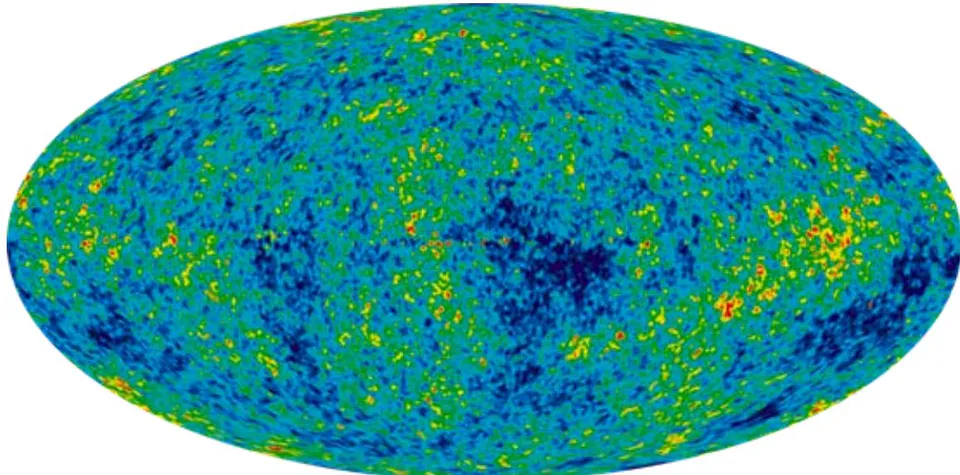
2.) The dipole distortion of the CMB (Cosmic Microwave Background) temperature, which is a Picture of the birth of our 3-D Universe is shown in Figure 1. We see that the blackbody spectrum is shifted to higher brighter temperatures on the right and to lower dimmer temperatures on the left. This implies that our 3-D baby Universe was given a rotational spin in the westerly direction; counterclockwise as viewed from above.
3.) Everything in our universe is spinning which comes from the rotational energy of our Universe. Since our 3-D Universe is rotating in the counterclockwise direction all subatomic particles: the electron, proton, neutron, neutrino, muon, etc. are given a clockwise spin due to their inertia. Since Galaxies, Black Holes, Stars, Planets, and Subatomic particles rotate, this implies that our baby 3-D Universe was born with a rotational spin. Moreover, Stars revolve around their Galactic center while Planets revolve in orbits around their Star, and electrons revolve around the nucleus. Hence all these large and small structures have Angular Momentum due to their rotation and revolution motion. A Universe that is not rotating would have zero Angular Momentum which would go against the Conservation of Angular Momentum Principle since all matter within the Universe has Angular Momentum. The advantage of giving the Universe a spin is to keep it from collapsing on itself due to the inward gravitational force. The outward centrifugal force is greater than the inward gravitational force due to the rotational energy thereby flinging galaxies in the outward direction (Reference 1). This rotational motion is responsible for the experimentally observed outward acceleration of our 3-D Universe.
4.) Since a rotating Universe created from the Dark Energy of the void (Reference 2) has a preferred direction which is the axis of rotation, hence it cannot be isotopic. Being isotropic means that the Universe must be the same in all directions implying that it cannot have a preferred direction because only from the location of the preferred direction can it be isotropic, but it cannot be isotropic from all other locations within the Universe. Because of the rotation that causes the accelerated expansion of the Universe galaxies are being flung in the outward direction, hence our Universe cannot be homogeneous. Being homogeneous means the Universe must look the same from all points within it. The further away one goes from the axis of rotation, the more separated the galaxies become due to the centrifugal force. There is more space between galaxies further out from the axis of rotation, therefore the Universe can never be homogeneous. As secondary to the galaxies being flung in the outward direction due to the accelerated expansion of the Universe for its non-homogeneous nature, we consider the expansion of space within the gaseous region between galaxies being greater than the expansion of space inside a galaxy where matter is more solidified, just as the speed of light in air is greater than the speed of light in a transparent solid. The denser the object, the slower the speed of light and the expansion of space.
1.2 Consequences
Since the Cosmological Principle is based on the Universe being both homogeneous and isotropic at all points within it, parts of which contain the scale factor are erroneous. That is the reason the current theory of Cosmology does not give satisfactory results without Lambda ( ), but even with the inclusion of , it can explain in only a very small region of the energy density parameter with and , several experiments (Reference 3), including the accelerated expansion of the Universe that was determined experimentally from observations of distant type 1a Supernovae, theoretical calculations for which have also been performed (Reference 4).
The Standard Model of Cosmology is built around the Cosmological Principle which leads to the scale factor , a distance function only of time. Starting with the Friedmann Equation for calculating the total Energy U of the Universe, measured distances within the Universe cannot be a function of time only but must also be a function of space since one cannot use the same scale factor at different positions of space, but that makes the mathematical calculations impossible to solve without knowing the exact nature of space at all positions within the Universe because space is not expanding at the same rate and in the same direction everywhere. Mathematical convenience using the same everywhere does not prove physical reality.
The Friedmann Equation based on the Cosmological Principle and the scale factor that it starts with are erroneous and all equations derived using and derivatives of also become erroneous. We use the equations and page numbers from "An Introduction to MODERN COSMOLOGY---Third Edition by Andrew Liddle" (Reference 5) to state all the equations below that are erroneous because they contain or derivatives of . Also, the Friedmann Equation is missing the term for the rotational Kinetic Energy of the Universe, implying all equations derived using the Friedmann Equation would also be missing equivalent terms for rotational motion.
Equation (3.8) Page 23: where represents the comoving coordinate system that is carried along with the expansion of the Universe which is deemed to be uniform (a constant) because of the Cosmological Principle that depends on the Universe being homogeneous and isotropic.
Equation (3.9) Page 24: U = T + V = ma x /2 - 4πGρa x m/3 where U is the total energy of the system and . Note that has been left out of the equation since x has been assumed to have a constant value. The same term has also been left out of the Friedmann Equation below to simplify it.
Equation (3.10) Page 24: where which is the standard form of the Friedmann Equation. The habit of setting means that the Friedmann Equation is written without in the above equation which gives us:
Equation (3.19) Page 28: . The geometry of the Universe is based on 3 values of k as stated on Page 33:
Spherical for k > o implies a Closed Universe.
Hyperbolic for k < o implies an Open Universe.
Most of the equations described below are derived by omitting x, x and x, containing only a, a and a. Unless we know all these three values of x and a, at all locations of the Universe, these equations would become impossible to solve correctly.
Equation (3.15) Page 26: is the fluid equation.
Equation (3.18) Page 27: is the acceleration equation.
Equation (5.4) Page 38: Hubble's Law becomes as is being used throughout the equations below when in fact it should be written as . As soon as we use the incorrect value of , all the equations derived using H become erroneous.
Equation (5.5) Page 38: is the Friedmann Equation as an evolution equation for . is added to the above equation to include the Cosmological Constant as in:
Equation (7.1) Page 55:
Equation (5.10) Page 39: as the definition of redshift z in terms of the scale factor, and , in this case is the ratio of the wavelength of light received at the detector and the wavelength of light emitted by the source, not to be confused with the Cosmological Constant .
Equation (5.12) Page 40: for matter from the fluid equation.
Equation (5.18) Page 41: for radiation from the fluid equation.
Equation (6.9) Page 52: where is the energy density parameter; and according to which for (positive k) we have a Closed Universe, for (zero k) we have a Flat Universe, and for (negative k) we have an Open Universe.
Equation (6.14) Page 53: for the deceleration parameter at the present time .
Equation (7.2) Page 55: for the Cosmological Constant added to the acceleration equation.
Equation (13.6) Page 105: for the Inflationary Expansion of the Universe which also indicates erroneously that our Universe is flat.
Equation (A1.5) Page 122: which is the Robertson-Walker Metric.
II. CONCLUSION
Having provided experimental proof that our Universe is rotating, we have pointed out some of the incorrect equations of the Cosmological Principle based on the scale factor and its derivatives, to which must be added all others that come from the false assumption of the Universe being isotropic and homogeneous. A non-rotating Universe based on the Cosmological Principle violates the Conservation of Angular Momentum Principle. The Cosmological Principle has no experimental basis to prove its validity without Lambda, and in a very small region of the energy density parameter with Lambda, while the Conservation of Angular Momentum Principle has stood the test of time repeatedly everywhere.
Conflict of Interest
The authors declare no conflict of interest.
Ethical Approval
Not applicable
Data Availability
The datasets used in this study are openly available at [repository link] and the source code is available on GitHub at [GitHub link].
Funding
This work did not receive any external funding.
References
Cite this article
Related Research

Special Issue
Launch a focused special issue to highlight research, emerging trends, and expert insights in your academic field.