




IntelliPaper
Abstract
Though they may not be using scientific theories or terminology, common people still practice ‘science’ in their ‘laboratories of life’. They have tremendous capacity to observe, assimilate and learn from the activities of day to day life and the environment around them. One of the many examples to prove this is the interesting case of the Living Root Bridges, which are a remarkable engineering accomplishment of the indigenous tribes of Meghalaya, a state located in the North Eastern part of India. These bridges are built using the living secondary roots of ficus trees (Ficus elastica Roxb. ex Hornem.) planted on either sides of a stream or a gorge and guided across the expanse. The article highlights the efforts of the local tribal communities in pursuing this tradition, and the role of stakeholders in providing an enabling environment for sustenance and propagation of this living tradition.
Explore Digital Article Text
I. INTRODUCTION
Nature has bestowed upon humans a lot of useful resources, which they have been using since time immemorial, primarily for food, clothing and dwelling. As humans settled in agriculture, and aggregated themselves in villages, towns and cities, day-to-day dependence on forests reduced considerably. However, a lot of indigenous communities, which reside in or near forests, depend majorly on them for their sustenance. They have, over a period of centuries, developed an intimate relationship with the forests and the nature around them. This relationship is reflected in many facets of their existence, including home and architecture.
Learning from nature and incorporating natural elements in architecture is increasingly being taken up by architects and researchers. However, Vallas and Courard (2017) have argued that 'living architecture' has been in existence for centuries. Literature related to the use of natural elements to develop pathways across or over obstacles is sparse but available. A number of vine bridges have been reported from the Iya Valley, a remote mountainous valley in Tokushima Prefecture of Japan, of which three, the Iya Kazurabashi and the Oku-Iya Kazurabashi bridges, are known to be maintained to date. The wooden slabs used in these bridges are held together strongly by the climber Wisteria floribunda (Willd.) DC. resulting in these bridges reaching up to the length of 43m (ibid). These vine bridges were built over deep gorges and were used to transport goods and people and could be easily cut in case of any invasion (Luck 2019). Spanning about 25m over the Batang Bayang River, the Jembatan Akar (Root Bridge in the Indonesian language) on the island of Sumatra in Indonesia, is knitted from the roots of two banyan trees and developed over a period of approximately 25 years beginning in around 1890 (Boscamp 2013, Grundhauser n.d.). On the Java island of Indonesia, the Baduy people are reported to have built a root bridge over the Cisimeut River, which connects them with the outside civilization (Anonymous 2019).
The Incas in the Andean region of Peru are also known to have constructed a large number of bridges along with their elaborate road network. Most of these bridges were over gorges and were made of grass and other material (Bauer 2006). Built with perishable material, not many remain today. However, the last remaining Inca rope bridge, the Quesuachka, over the Apurimac River in the Quehue district of Peru could still be seen (ibid). In India as well, the Khasi and Jaintia people of Meghalaya are known to develop root bridges over the last many centuries. A root bridge has also been recently reported from Nagaland state as well (Shachar 2016).
II. THE LIVING ROOT BRIDGES (LRBs) OF MEGHALAYA
Meghalaya, located in North-East India, is home to the Khasi, Garo and Jaintia tribes, who together are the world's largest matrilineal societies. Predominantly a hilly state with stretches of valleys and plateaus, Meghalaya has an agrarian economy. The state receives heavy rainfall during the monsoons with Cherrapunji and Mawsynram, one of the world's two wettest places, being located in the East Khasi district of the state (Guhathakurta et al. 2020).
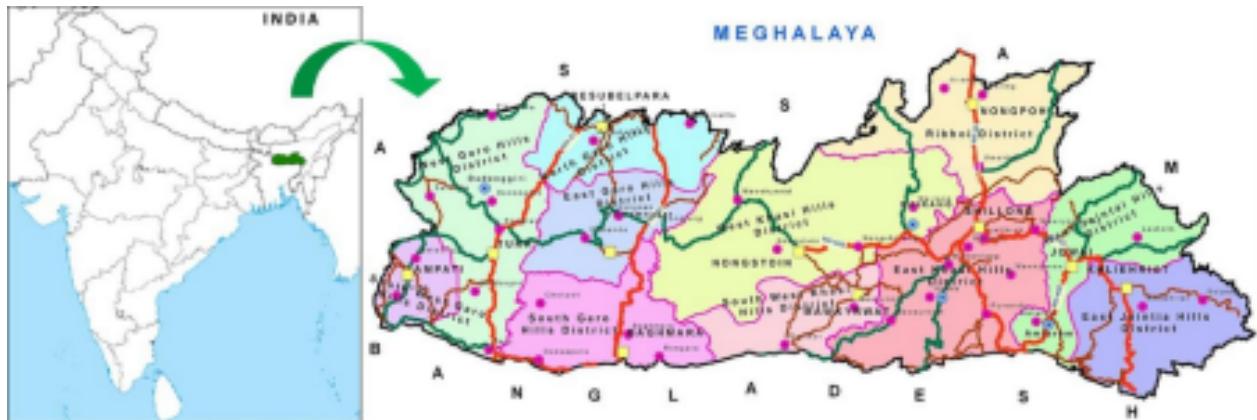 Fig. 1: Location of Meghalaya in India
The villages of Khasi and Jaintia people residing in the southern part of Meghalaya are located in the hills interspersed with waterfalls, rivers and rivulets. Located in a heavy rainfall region, it was difficult for people to cross these hilly streams, especially during the monsoons. Noticing that other solutions like wooden or bamboo bridges could not withstand the strong currents and heavy rains, the people thought of an ingenious idea. They utilised the strength, vigour and tenacity of the aerial roots of the Indian rubber fig (Ficus elastica Roxb. ex Hornem.) tree to build the Living Root Bridges (jing kieng jri in Khasi language) across the hilly terrain for the transportation of goods and people. While the LRBs have been in existence for centuries, scientific studies on them have been meagre until recently when a lot of literature has emerged. Mathew (2005) has described the LRBs while Shankar (2015) has studied and detailed the construction of the LRBs comparing them with steel suspension bridges.
Chaudhuri et. al. (2016) have described LRBs as a low-cost bio-engineering technology, which can be replicated in other similar regions as well. Ludwig et. al. (2019), while studying the LRBs from an interdisciplinary perspective, suggest taking up studies on F. elastica from a structural engineering perspective so as to scientifically understand the development process of LRBs, which may be helpful for future research on living architecture. Middleton et. al. (2019) describe the findings of a photogrammetric survey of the living root bridges. Middleton et. al. (2020) have also evaluated LRBs as an example of regenerative design.
The Khasis and Jaintias make use of the secondary aerial roots of the Ficus elastica trees to build these LRBs across streams or gorges. The aerial roots of the Ficus trees on one side of the stream are guided to the other side so that they can take root firmly in the soil. Sometimes, bamboo or wood scaffolding is provided to support the roots during this period. Over a period of many years, these roots grow, get thicker and stronger, and are able to take the weight of people (about 20 of them at a time and sometimes more) walking on them. Sometimes these bridges are reinforced with secondary support material like wood pieces and stones. Depending upon its span, the development of a sturdy living root bridge can take anything from 10-25 years and one which can last for centuries.
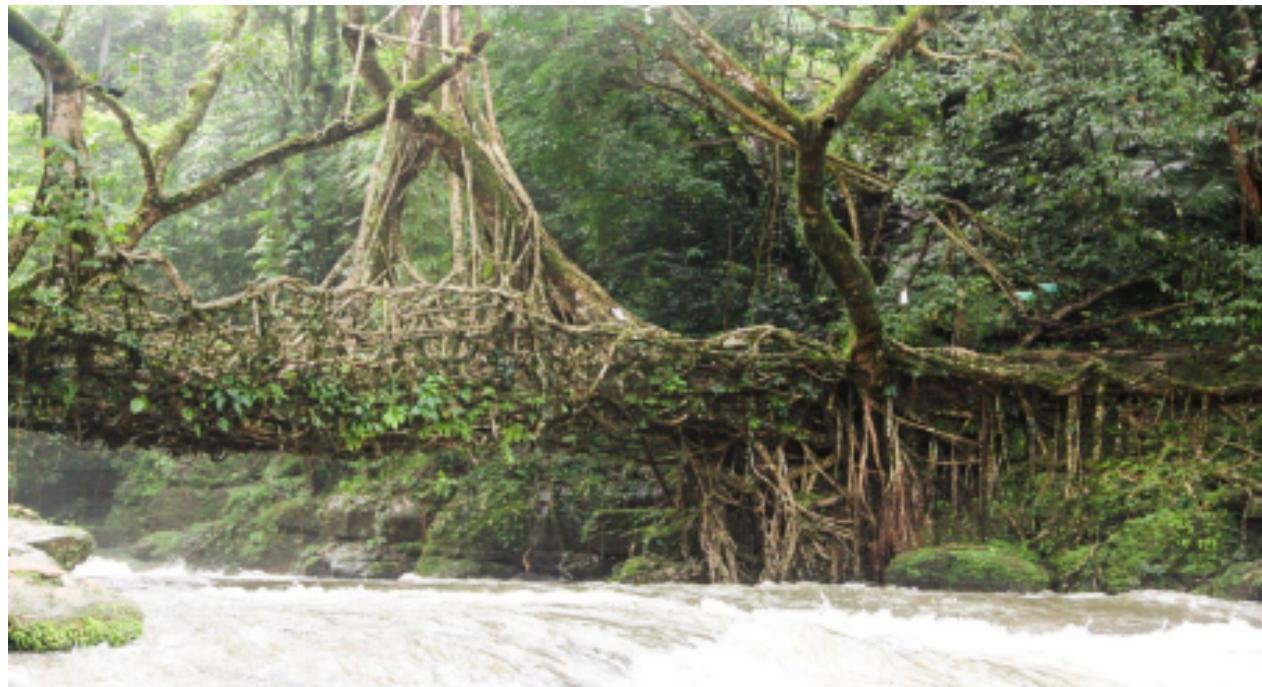 Fig. 2: Jingmaham Living Root Bridge, Mawlynnong, East Khasi Hills, Meghalaya (Photo: Nitin Maurya)
An individual takes the lead in the construction of the LRB and is supported by the community. For safeguarding the LRB, there are community restrictions on extracting latex of Ficus trees used for building the LRBs or using any other parts or that of other trees in the vicinity. Mining sand and stones from the area around the LRBs, especially near the roots of the tree(s), is also prohibited. The community, mobilised through the Darbar (village council) or the village societies/clubs, maintains the LRBs periodically checking the roots, reinforcing the bridge with wood planks or stones, or replacing them or weaving new roots into the bridge. Sometimes during the rains, strong water currents of the stream wash away the soil, sand or stones underneath the bridges. In such cases, the community members lay stones/boulders under the bridge to protect the area from water erosion. While it is difficult to ascertain the life of a LRB, community elders can identify a root getting weak (evident by its dryness). In such a case other available roots can be pulled in and weaved into the bridge to provide it the required strength.
III. THE FICUS ELASTICA, THE KHASIS AND THE JAINTIAS
Humans are connected to and are dependent on nature in multiple ways. Many indigenous cultures demonstrate that a harmonious co-existence with nature is possible by employing social and cultural mechanisms to safeguard and responsibly use available natural resources to meet community needs. That the survival of forests/ nature is important for the existence of humans themselves, is stressed by all indigenous communities the world over. Like other traditional societies, the lives of the Khasis and the Jaintias are also closely intertwined with the forests around them. Forests for them are sacrosanct and not just a natural resource available to exploit. The LRBs, similarly, are also deeply ingrained in the culture of the communities. The process of development of the LRBs has evolved over many centuries and is part of the inherited knowledge system of the communities; knowledge that has been orally transferred over generations. Shankar (2016) deems LRBs as an outstanding example of the Khasis' sacred relation with nature.
The decision to use F. elastica to develop root bridges has to do both with the biological properties of the roots of the plant, and the keen and careful observation of nature and the environment by the Khasis and Jaintias. Heavy rains during the monsoon months make travelling difficult in dense forests interspersed with mountain streams and gorges. Under these conditions, while other material degrades over a period of time, the LRBs grow sturdier. A member of the Moracece family, Ficus elastica is a large tropical tree found in evergreen forests, particularly along river banks (CABI 2020). F. elastica generally grows as an epiphyte (growing on another tree) with its aerial roots growing downwards to reach the ground, becoming thicker and robust. Gradually, the aerial roots encircle the host tree, and its foliage smothers the host resulting in the death of the host tree. Zimmermann et al. (1968) in their study on the aerial roots of F. benjamina L. found out that post anchoring on a substrate they produce tension wood, which facilitates the inoculation (fusing and growing together) process of the aerial roots. Though similar properties of F. elastica have not been studied in detail, however coming from the same genus it may be assumed that the process is similar in this species. Shankar (2015) opines that the aerial roots' capacity to react to mechanical stress with secondary growth, formation of tension wood and development of inoculations, together enables them to perform the structural support function. Another observation that may have prompted the Khasis to use the F. elastica may be its fast-growing habit and tight soil-holding property, which may be evident by lesser landslides in the region of their growth. Shankar (2017) has mentioned the use of indigenous materials, traditional tools and of the expertise developed over many generations, in the development of these living root bridges.
IV. CONSERVING, PRESERVING AND SUSTAINING THE LIVING TRADITION: THE LRBS
Gupta (1999) has argued that conservation and preservation have to be undertaken at both resource and associated knowledge levels. He opines that if only resources are conserved, knowledge will get eroded over time. If only knowledge is conserved, erosion of resources will become an eventuality. For the sustainability of the system, as a whole, incorporating indigenous/ local knowledge in the strategies of regeneration of the resources itself thus becomes important (ibid). Shankar (2017) has opined that the Living Root Bridge is a threatened community-based but sustainable infrastructure practice. He suggests that conservation efforts, research and grassroots entrepreneurship together can possibly provide a viable solution for reinvigorating and contemporising traditional knowledge practices. Gupta (2001) remarks that many communities have respect for nature and its conservation, and concern for future generations. However, incentives for conservation efforts are necessary (Tamale 1996; United Nations Environment Programme 1996, 1998; Emerton 2000).
Appreciating the creativity and unacknowledged scientific acumen of the Khasi and Jaintia tribes, the National Innovation Foundation - India (NIF), an autonomous body of the Indian Government's Science and Technology department, recognised this unique community-developed, community-nurtured grassroots innovation in its Ninth National Biennial Awards (National Innovation Foundation – India 2017). The award money (approx. $6800) was to be used by the community(ies) for any community development-related work only. Many rounds of meetings and discussions were held among the village councils (darbars), community members, Meghalaya Basin Development Authority (MBDA) and State Council of Science, Technology and Environment (SCSTE), both constituents of the Government of Meghalaya in consultation with the NIF. A number of ideas were discussed but a consensus could not be reached. While the discussions were ongoing, to earn interest on the amount, the award money was parked with the SCSTE.
The challenge was to utilise the award money and not simply use it. During the ensuing discussions, first a concept for building a ‘Living Root Bridge Museum’ came up and then from it the concept of a ‘Living Root Bridge Museum and School (LRBMS)’ emerged. The idea is to involve the community toset up a Museum beside a young (few years old) living roots bridge where pictures and videos of the ‘growing’ root bridge could be added periodically along with other related items. Thus, the Museum ‘lives and grows’ along with the living roots bridge. To involve community youth in understanding the process of development of the root bridges, explaining to them the science behind it and undertaking research, a ‘School’ has also been proposed. The site is proposed to be community-built, community-managed and open to tourists not only to enjoythe beauty of the place but also to understand and appreciate the ingenuity of tribal communities who have lived in harmony with nature for centuries. The LRBMS will also be expected to facilitate scientific research on the LRBs by institutions/ researchers desirable for the same. Many associated activities like maintaining sanitation, providing drinking water facilities, maintenance of the earmarked area and buffer zone, sale of local food and crops to visitors, etc. are also expected to come up around the LRBMS, resulting in more livelihood opportunities for the local people.
The setting up of the ‘Living Root Bridge Museum and School’, thus, is expected to address three core issues
a. Conserving - the Living Root Bridges.
b. Preserving - the associated knowledge system and institutionalising its transfer to the next generation.
c. Sustaining - through community-level entrepreneurship in managing the museum, school and ancillary activities.
While appreciating the concept, the Government of Meghalaya topped up the award money with a corpus of approximately $34000 for the purpose. The SCSTE has been undertaking elaborate fieldwork and consultation with the communities to identify a suitable site for developing the Living Root Bridges Museum and School. Narrowing down on the Pynursla Community & Rural Development block of East Khasi Hills district of Meghalaya, the SCSTE has been able to identify and document 71 living root bridges in 13 villages from the block with their span ranging from 2-52 meters and age 35-300 years. This work is being taken up cautiously taking all the stakeholders in confidence, especially the local tribal community. The MBDA has also been making considerable efforts to document and encourage the conservation and preservation of the living roots bridges across the state.
{"image_source":{"path":"images/2324936c4e089c48c08ce554f9ea9e6bbdc197a6f87519c0d7ff8f825ddacc27.jpg"},"content":"","chart_caption":[{"type":"text","content":"Fig. 3: Location of living root bridges in Pynursla C&RD block, East Khasi Hills, Meghalaya (Source: SCSTE, Meghalaya)"}],"chart_footnote":[]}
Once the site for developing the LRBMS is identified in partnership with the local communities, the work to set it up will be initiated. It is hoped that this approach of conservation linked with grassroots-level entrepreneurship will facilitate the continuity of this living tradition over the next many centuries. Though the future will evaluate the success of this initiative, this definitely has the potential to present a case for sustainable conservation and preservation.
ACKNOWLEDGEMENTS
The authors acknowledge the generous support of their respective institutions, team members, Khasi community and in particular the Headmen and community members of the villages under the Pynursla Community & Rural Development Block, East Khasi Hills, Meghalaya.
Conflict of Interest
The authors declare no conflict of interest.
Ethical Approval
Not applicable
Data Availability
The datasets used in this study are openly available at [repository link] and the source code is available on GitHub at [GitHub link].
Funding
This work did not receive any external funding.
References
Cite this article
Related Research


Special Issue
Launch a focused special issue to highlight research, emerging trends, and expert insights in your academic field.
