




IntelliPaper
Abstract
One of India’s internationally accclaimed poets writing in English, Debasish Lahiri is making the universe his home, his concept art inviting more associations with Simon Armitage’s poetry than those echoing from the title of the Poet Laureate’s 2002 book (The Universal Home Doctor). An academic teaching at Kolkata Universiy, Lahiri has a sense of the past which takes him back into the imaginative Middle Ages and further on into Euroasia’s mythologies, where the motley threads of present cultural diversity resolve into subconscious archetypal unity. The passion for the haunting past, shared with his contemporaries (See Katy Shaw’s Hauntology. The Presence of the Past in Twenty-First Century English Literature), serves lessons both of political historicity and spiritual immanence. Lahiri shows an erudite’s sensitivity redeemed by a feast of sensuous imagery and by an uncommon capacity for lexical inventivity.
Explore Digital Article Text
I. INTRODUCTION
At the heart of Debasish Lahiri's poetry, there is a perpetual genesis, not from an absolute beginning, however, but as ontological leap from one level of existence to another: from nature to myth, from myth to artifact, from artifact to dreams which materialize, bringing the beginning to a round end. In his poems, there is no end and no beginning, unless we see them in superposition (what Nicholas Cusanus called "coincidence of opposites"). The origin is indefinitely deferred, the prevailing trope being that of laying in the abyss: the poet looks at Turner looking at Shakespeare imagining Dover or having Edgar falsely representing it to his father (King Lear), or starts wording paint and brush to render his own view of Van Gogh's painting who was himself repainting masters. The poet goes West to dig up its Sanskrit roots, he composes dirges on the deaths of tragic figures of the mid-twentieth century whom he destines to the Isle of the Blessed in ancient Greek mythology. Lahiri is casting the warp of his poems on a very wide scale trying to get at the core of being where everything is connected with everything else so that the disconnected bits of the everyday collect into meaningful wholes, in nostalgic imitation of the totalitarian myths imparting certainty on humanity's infancy. His own ekphrastic poetry appropriates in a way the poetics of ancient tragedies whose merit was the individual representation of commonly known plots. The stress falls entirely on the novelty of interpretation and the art of reinscription.
The ingenuity of his images, the daring metaphors and lexical creativity, the measured sequencing of words in unequal lines but with what feels like the natural rhythm of a heart-beat generate the unmistakable diction of his poetry, but formal refinement pales in comparison to the rhetorical schemes which structure his imaginaries.
II. ONTOLOGICAL CROSSOVERS AND HOLISTIC IMAGINARY
The in-depth structure of meaning bespeaks a poetics of aesthetic detachment from the material world and refuge into an artificial paradise such as the museum space interposed between artist and life in the aestheticizing debut of western modernism. Instead of walking through the door into a perilous world of disappointment, perpetual change and waste, the poet choses to stay in a room visited by the muses, playing instruments and exchanging the morning scene outside with its artificial and multiple substitutes – a troubadour's aubade or a devotee's matins or mythic Krishna's fluting away a departing Radha figure ("Not in Tune"). Lahiri works by analogies creating multiple planes in relation.
The poet speaks in the language of many cultures, East and West, bringing to the surface deep archetypal matrices of what Jung understood by humanity's collective subconscious. His selection of topoi seems to be guided precisely by the possibility of establishing analogies among mythical structures – a famous precedent being T S Eliot's The Wasteland.
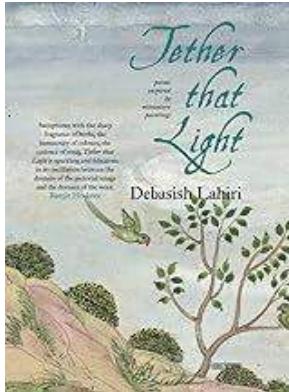
The troping on creation straddles text and image. In his 2022 Tether that Light, for instance, the emblematic images accompanying the text are those of the peacock and of Radha - Lord Krishna's consort. The text is like a fan, opening both to western and Indian mythologies.
The troping is consistent across poems. Light is tethered, that is, forced into shapes – creation out of light, as form giving is any work of art. The poet calls himself a peregrine of lumen (the light emitted by the material sun) and not of lux (eternal light, preceding creation of the world). His creation yields an artifact, which has a double nature, material and ideal.
The hunt for corresponding signifieds of the spirit includes the Sufi tradition, a legend defining the peacock as the form given by God to the spirit. According to it, the peacock saw its image in a mirror and felt overwhelmed. Those drops of sweat falling from its body were the substance out of which the things in the world were created.
Likewise Radha will not play holi in the absence of her lord who had departed to Mathura. The coloured powder is replaced either with the book of rituals (missal) given to her by the dark lord or by dreams induced by his words free from the materiality of writing (the alphabet for them had not been invented).
Radha's sweat, like the peacock's in the Sufi legend, triggers a genesis of sorts. A sun, out of which planets were born, is ensnared (tethered) by a sea of golden sweat and sets the river on fire, flooding it with hues.
The power of Radha's love for the missing Krishna becomes manifest farther away in Mathura, where the river Yamuna runs "red, green and amber," the same as in Vrindavan.
Radha remembers
how every pore of her body
bloomed in sweat like marigolds
till it ran in runnels,
as though from the meadows of Braj,
and clogged a river
with a sea
of golden sweat
that snared a curious sun
and kept him there
all day.
Radha's devotion to Krishna and the creative power attributed to her by the poet makes her a foil of Sophia, worshiper of the sun (divine wisdom) in Rosicrucianism, as well as of the figure of Wisdom which appears in the Bible (The Book of Proverbs) as God's assistant in creating the world.
The scenery of Lahiri's poetry is extremely diverse, feeding on encyclopedic knowledge and numerous cultural encounters. Whereas superficial perception is limited to differences, his poems submerge to the depths where the mind of humanity is revealed to be one.
Holism is not however limited to the order of culture. The poet's metamorphic imagination dismantles the object world replacing it with an aesthetic object. Allegorically, he shuts his door on the world, dissolves his room into sounds and employs the creative power of music to create a garden – the earthly paradise of art.
It is this life-threatening impulse that probably made him touch again and again upon the theme of suicide (as allegorical contempt of the world as it is in the famous Axël by Villiers de l'Isle-Adam).
Tether that Light too starts with an ekphrastic poem – the description of a Mughal miniature painting from the sixteenth century showing a man who had hanged himself. It is the duty of art to redress the frailty and meaningless of life. Contrary to the physical law of gravitation, the artist's arm has arrested the fall of the hanged
Contrary to the physical law of gravitation, the artist's arm has arrested the fall of the hanged man's turban. Whereas life ends in death, art begins with restoration.
In "Gaspar's Dream", the process is reversed. Reality is delusive, all that lives in time turns to dust; the angel supposed to tell Gaspar about the star leading to the birthplace of Jesus is late, the star has not read the map correctly and is serenading a sleeping nymph instead of protecting the Virgin. The magi figures in the caravanserai, of uncertain status, vacillating between kings and beggars, are thus plodding their way without guidance, waiting for a late angel, experiencing fatigue and craving for sleep. The Eucharist is deconstructed as a blood-sucking mosquito. Myth and world are emptied out of meaning. And yet the dust, the debris of life, is cast into an enduring shape. It is not just any shape but that of a stone crafted by Gislebertus of the twelfth century in the Cathedral of Saint-Lazare, Autun, into a monument of the magi – the first mortals to whom Jesus was revealed. The master myth of the West is decentred, deferred, or even lost in doubt and skepticism. An earlier layer is uncovered and given a voice in a self-revealing dramatic monologue spoken by the Indian king, Magus Gaspar.
But stone has a sacred ring to it as well - it is the philosopher's stone (lapis philosophorum), the symbol of the spirit as the terminal point of the alchemical process. Shaping, carving, writing – they are processes mediating between spirit/ consciousness and the formless empirical world. Recurrent images are those of mortar, loam, the mix of blood and dust - the matter of creation as the ultimate reality which comes under the power of an intentional subject – the shape-giving artist.
Writing at a double remote from the empirical world, with night and day distilled into genre (threnody and aubade), with the world of physical distinctions disappearing into myth (alchemical wedding), the poet translates the oneness of the spirit as homogeneity of cultural signifieds. Poetry reverses God's play of creating the world. Light is restored to the word, and the word to the uttering throat – not of God but of the Greek and Latin speaking artist who breathes meaning into the dust hardened into carved stone. As if the poet's subconscious worked through analogies among the main mythical structures, his figures of discourse deploy a coherent conceptual map.
Van Gogh's paintings exerted a similar fascination on the poet due to their violent treatment of landscapes and human figures. "On Van Gogh's Asylum" creates a dynamic picture of the hospital to which the artist had committed himself. Contorted, restless, unnatural, sick, it is not, however, a typical example of pathetic fallacy but rather an aesthetic allegory. The poet demonstrates his capacity of generating a new world out of words with changed functions –abstractions are reified, while objects are dematerialized Blue veins of uncertain nature are running through the pavement, the tree, Van Gogh's suit with a flattening effect, as if physically mapping a three-dimensional landscape onto the bidimensional canvas. The poet is playing with directions. The whole world is uprooted, it starts gliding, rolling, turning. Light descends to Van Gogh's shoes while trees are turned upside down, with their roots in the air, reduced to an empty figure, a metaphor: the roots of pain.
Van Gogh's paintings are actually his own world which is not worldly but the mirror of the painter's mind.
III. CONCLUSION
Debasish Lahiri's poems invite lengthy comments on his profound sense of the pathos of existence, on his engagement with current international issues, such as displacement and cultural memory, or his experimentation with generic forms, such as ekphrasis or the dramatic monologue, but his most relevant contribution to contemporary poetry is probably his channeling of modernist aestheticism into the wake of postmodernist holism, bringing art and world into conjunction.
Books of poetry by Debasih Lahiri:
-
First Will & Testament (Writers Workshop, 2012).
-
Tinder Tender: Poems of Love & Loitering (Authors Press, 2018).
5. Paysages sans Verbes (Éditions Apic, 2021)
-
Tether that Light (Red River, 2022).
-
Legion of Lost Letters. Dramatic Monologues of Romans in Exile (Eyewear Publishing, 2023).
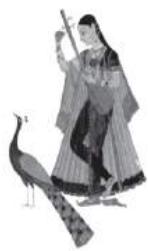
Hindu Goddess Radha with the peacock.
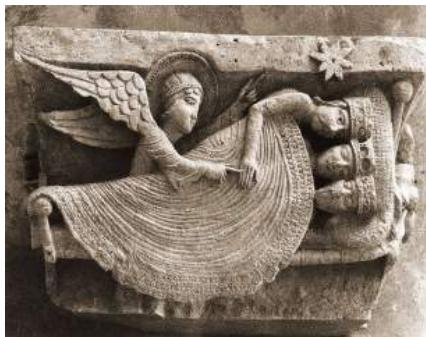
On the "Dream of the Magi" by Gislebertus, C.1120-30 in the Cathedral of Saint-Lazare, Autun
Conflict of Interest
The authors declare no conflict of interest.
Ethical Approval
Not applicable
Data Availability
The datasets used in this study are openly available at [repository link] and the source code is available on GitHub at [GitHub link].
Funding
This work did not receive any external funding.
References
Cite this article
Related Research


Special Issue
Launch a focused special issue to highlight research, emerging trends, and expert insights in your academic field.
