


IntelliPaper
Abstract
This study is the result of long-term field investigations of the complications facing the Libyan education system (LES). This work included several deep research studies intended to measure different aspects of the LES; its categories of education, administrations, and contributors; and their associated problems. These studies, which occurred predominantly between 2019 and 2023, have clearly recognized that the LES's inputs and output sface huge challenges which may quickly lead to a definite collapse, unless all the current conflicting authorities take majoractions to ward a professional reform plan. Further more, these authorities may need to adapt immediate rescue measures, especially in terms of policies, supportive legislations, qualifiedleader ship, and strict employment of the quality and assurance functions. Elab bar first formulated a plan in 2017, which reached its final form in 2022, entitled “Reforming the Libyan Education System: Seven Articulated Years Via a Strategic Planning Pyramid”.Subsequently, Elabbar published two field studies: "Repercussions of the Continuous Instability for the Quality of Education in the State of Libya: An Investigational Study within the Faculty of Education, University of Benghazi (UoB)" (2022) and" Implementing Recommendations at the Faculty of Education, University of Benghazi (UoB): Action Research Methods to Enhance the Desired Reform Strategy" (2023). These studies proposed to continue strengthening the reform proposal with further functional field studies to develop policiesfor different levels of education and launch practical procedures of the transformative models of Continuing Professional Development (CPD),as well as further experimental studies on the values of reform and the substantiality of CPD. This aims to revitalize the foundation of the reform strategy with further insights and practical reflections. Moreover, due to the deep impacts of the ongoingpolitical instabilityon the quality of the Libyaneducation; the obvious absence of any clear education policy among parliament; and conflicts within ministries of education, public universities, and even the schooling system, it seemsalmost impossible for the current authorities to launch gradual national reformprocedures (as suggested) in the near future. Therefore,this study seeks to continue examining the accomplished results andrecommendations and developing the reformstrategy, with particular focuses on the role of policies in education and the roles of faculties in education, as the first years of the reform strategyinvolvefoundational polices, advised legislations, and CPD programs to be applied for all stakeholders and policymakers who are in charge of leading thedesired national reform. This study utilizes the latestresearch’s (Elabbar, 2021, 2022, 2023) positive findings, insights, and experimentation results.All will bereproducedvia fourmodi fied innovative activities--policy, process, procedures, and props (4P’s) --to be examined by the Faculty of Education -UoB, five secondary schoolsinvolved inthe teaching practice program (practicum),and several types of stakeholders from different levels and positions within the LES. The research discovered more complications facing the LES and reached agreater understanding of the suitable transformative CPD modelto be added to the first two years of the reform plan. Additionally, the study developed dynamic policiesto join faculties of education with schooling systems in a preparationaltactic to enhance Elabbar's (2022) planned seven gradual reform years with valuable, up-to-datestrategies.
Explore Digital Article Text
I. INTRODUCTION, AIMS, AND RESEARCH QUESTIONS
The Faculty of Education and some of its administrations and departments have adopted many positive, rapid measures aimed at solving the numerous educational and logistical obstacles and bottlenecks facing the LES. However, the Faculty still faces various challenges daily that are related directly or indirectly to the state instability in the last twelve years. These complications include suspensions of studies, state administration bureaucracy, the near-absence of developed educational policy beyond the basics, a severe lack of educational aids and professional development programs, problems with the culture of education, a self-management attitude, and harmful reflections of political divisions which sadly led to six ministries of education (two ministries of general education, two higher education Ministries, and two ministries of the vocational sector) working at the same time until 2023. Therefore, it is almost impossible for Libya to adopt a gradual national reform program until it establishes a unified government to realize these ideas. Even so, now is a good time to continue to improve, update, and innovate the projected reform plan with additional field studies that directly address reality. This research adapts the 4P's tactic to further explore the positive findings, insights, and endorsements of the previous field research, in order to bridge the obstacles and examine the value of employing transformative education and innovative policies joining schools and the Faculty of Education in short- and long-term reform plans.
1.1 Research Questions
What are the scientific, human, innovation, and logistical foundations and pillars that we need to build on to develop a proposal for an experimental 4Ps' tactic at the Faculty of Education?
Do we need to prepare an integrated, atypical system of transformative education (i.e., unconventional or cloning) that effectively deals with the real requirements and bottlenecks of the educational process in the country and addresses the dynamism of the fundamental difficulties faced by the educational system in the city and the entire state of Libya?
To what extent can this research develop the first years of the projected reform plan in terms of programs, CPD, and policy preparation?
What are the constraints, obstacles, and circumstances behind employing the 4P's and transformative learning among the Faculty of Education members and the other study contributors?
How do we expose Libyan educators to a culture of innovations, leadership, and creativity and encourage them to think in depth about learning and teaching processes?
Can we, from a legal and bureaucratic perspective, adopt atypical foundational principles or suggest an innovative policy or reform plan based on long-term investigation and development?
1.2 Research Strategic Aims
To continue progressing and debating the projected reform plan from various and wider angles, as it is the main solution for LES to overcome its copious realized and anticipated problems.
To encourage joining public school education with higher education in terms of VMGs, management, innovation tactics, short and long-term policies, reform leadership, training, and CP, to promote Elabbar's (2017, 2022) seven-year gradual reform plan for the LES.
To illuminate and explore modern policies of public education utilized around the globe to develop Libyan education policy (based on Libyan culture), interactive teaching paradigms, contemporary teaching abilities, and constant CPD for administrators and all relevant stakeholders.
To engage motivated teachers, TAs, inspectors, and educators who show interest in participating in the suggested 4 P's (policy, process, procedures, and props).
To engage researchers and field studies to continue building a strong foundation for creative students, teachers, faculties of education, and HQs to play a significant role in the suggested ongoing development policy.
II. THEORY
This section aims to provide a brief theoretical overview of the tools used to conduct this qualitative field study. It will define and illustrate the significance of such tools for data collection, analysis, and continuing professional development (CPD) and its transformative model, which is the foundation of the first years of the seven-year gradual reform plan (Elabbar, 2022). It aims also to show the significance of policy within the education system, especially since most studies (including this research) have clearly determined that there is no clear policy for schooling and university systems in the Libyan education system.
2.1. Qualitative Research
Davis (1995) showed that qualitative research is emergent rather than "tightly prefigured" and is essentially interpretive. Holliday (2005) stated that there is an assumption that qualitative research is "going to be 'open-ended', to look deeply into the participants' behavior within the specific social settings" (p.5). Strauss and Corbin (1990) reported that qualitative research is generally defined as "any kind of research that produces findings not arrived at by means of statistical procedures or other means of quantification" (p.17). Best and Kahn (1998) noted that qualitative research involves watching and asking and aims to describe events and persons in detail without the use of any numerical data. Bogdan and Biklen (1998) added:
Qualitative research is conducted in the natural world and uses multiple techniques that are interactive and holistic. It allows for the collection of data that is rich in description of people, the investigation of topics in context, and an understanding of behaviour from the participants' own frame of reference. (p.10)
Shank (2002) described qualitative research as "a form of systematic empirical inquiry into meaning" (p.4), while Lincoln (2000) stated that qualitative research involves an "interpretive and naturalistic approach. This means that qualitative researchers study things in their natural settings, attempting to make sense of, or to interpret, phenomena in terms of the meanings people bring to them" (pp.3-4). Additionally, Berg (2004) reported that qualitative research "provides the framework to explore, define, and assist in understanding the social and psychological phenomena of organizations and the social settings of individuals" (p.11). Pritha Bhandari (2020) explained:
Qualitative data can take the form of texts, photos, videos, and audio. For example, you might be working with interview transcripts, survey responses, fieldnotes, or recordings from natural settings. Furthermost types of qualitative data analysis share the same five steps:
Prepare and organize your data. This can mean transcribing interviews or typing up fieldnotes.
Review and explore your data. Observe the data for outlines or repeated ideas that emerge.
Develop a data coding system. Based on your initial ideas, establish a set of codes that you can apply to categorize your data.
Assign codes to the data. e.g., in qualitative review analysis, this could mean going through each participant's responses and tagging them with codes in a spreadsheet. As you go through your data, you can create new codes to add to your system if necessary.
Identify recurring themes. Link codes together into cohesive, overarching themes. (p.4-6)
Moreover, Maxwell (1996) explained that qualitative research analysis begins in the field, at the time of observation, interviewing, or both, as the researcher identifies problems and concepts that appear likely to help in understanding the situation. Simply reading the notes or transcripts is an important step in the analytic process. Researchers should make frequent notes in the margins to identify important statements and to propose ways of coding the data, e.g., "husband–wife conflict" or "tension-reduction strategy." An interim stage may consist of listing the concepts reflected in the notes and diagramming the relationships among concepts (p. 78-82).
2.2. Transformative CPD
Continuing professional development (CPD) can be seen as systematic way of improving and developing teachers' knowledge, skills, beliefs, and perspectives during their lifelong jobs as teachers. The Institute of Professional Development (2006) defines CPD as combinations of tactics, ideas, concepts, and techniques that help educators to manage their own learning and development (p.20). Rodrigues (2004) stated that "CPD is any process or activity that provides added value to the capability of the professional through the increase in knowledge, skills and personal qualities necessary for the appropriate execution of professional and technical duties, often termed competence" (p.11). Lange (1990) described it as a "process of continual intellectual, experiential and attitudinal growth of teachers," (p.250), which is essential for maintaining and enhancing the quality of teaching and learning experiences.
Hoban (2002) discussed the notion of CPD as a means of supporting educational change. He drew comparisons between the knowledge-focused and contextually void model of a training approach with the context-specific approach of a communities of practice model that "does not necessarily embrace new forms of formal knowledge." He suggested that what is really needed is not a wholesale move towards the teacher-centred, context-specific models of CPD but rather a better balance between these types of models and the transmission-focused models. Hoban's description of the two ends of the spectrum does not, however, include communities of inquiry, which might be based on partnerships between teachers, academics, and other organizations and can involve both "the context and the knowledge required for real and sustainable educational change" (p.235).
Kennedy (2005) described transformative CPD as "supporting teachers in contributing to and shaping education policy and practice would align itself more naturally with action research and transformative models" (p. 248). Kennedy (2005) also stated that transformative CPD is different from the previous two types, as it consists of a combination of processes and conditions of both transmissional and transitional types. She stated that the fundamental aspect of the transformational model of CPD is its combination of practices and conditions that support a transformational agenda. In this sense, it could be argued that the transformational model is not an obviously definable model but instead recognizes the range of different conditions required for transformational practice. Mezirow (2000) defined transformative learning as "learning that produces a major impact, or paradigm shift, which affects the learner's subsequent experiences." Mezirow stated that "the objective of transformative learning is to revise old assumptions and ways of interpreting experience through critical reflection and self-reflection" (p. 339). The presentation of the transformative category of CPD is, according to Kennedy's structure, divided into two significant models: action research and the transformative model. Cranton (2006) described Mezirow's (2000) definitions of transformative learning as follows: "transformative learning is a procedure by which previously uncritically assimilated assumptions, beliefs, values, and perspectives are questioned and thereby become more open, permeable, and better validated" (pp. 2-4).
2.3 Education Policy
Espinoza (2009) said that education policy can be formally recognized as:
The actions taken by governments in relation with educational practices, and how governments address the production and delivery of education in each system. Admittedly, some promote a wider understanding of education policy –i.e., acknowledging the fact that private actors or other institutions such as international and non-governmental organisations can originate educational policies. (p.46)
OECD (2015) showed that education policies cover a wide range of matters such as "those targeting equity, the overall quality of learning outcomes and school and learning environments, or the capacity of the system to prepare students for the future, funding, effective governance or evaluation and assessment mechanisms, among others" (p.20). According to Kee and Lin (2001):
Rhetorical policy refers to broad statements of educational goals often found in national addresses of senior political leaders. Authorized policies are the authoritative statements, decrees, or laws that give explicit standards and direction to the education sector. Implemented policies are the enacted policies, modified or unmodified, as they are being transformed into actions through systemic, programmatic, and project-level changes. (pp.60-63)
They also stated that if the "implemented policies" correspond to "enacted policies, modified or unmodified," then the implementation process can hardly be limited to executing a decision.
III. METHODOLOGICAL PHASES AND EXPERIMENTAL PROCEDURES
In order to address the strategic goals and research questions, gain potential knowledge of the obtained 4P's experiments, as well as to avoid any challenges particularly in terms of the research's scheduled time, field work logistics, ethical approvals, and managemental processes, this field study adopted two separate qualitative methodologies to collect data:
The first qualitative methodology was applied through detailed unstructured interviews, faculty document analysis, intensive focus groups, and arranged CPD transformative model and draft-policy experimental sheets. These sheets were designed for all faculty department heads and members to give feedback on the provided criteria such as unifying the VMG setting on clear education plan goals to overcome difficulties each term and developing the role of faculties of education and their relation with reform and the labor market. These tools were used with 18 staff members (MAs and PhDs), 3 graduate students (English department TAs), 6 undergraduate pre-service EFL teachers, 3 administration office employees, 1 registry office employee, and the faculty's deputy dean for academia.
The second qualitative methodology was designed for 14 EFL school teachers, 9 school inspectors, and 5 school principals from different schools in the city of Benghazi. This part of the study included two former ministers of education and the current Eastern Government minister of education, 2 education policymakers from the parliaments' committee of education, and 8 other key figures from various counties and positions within the LES. These participants were involved in different focus groups, one-on-one meetings, transformative CPD workshops, classroom evaluations (for the EFL teachers), and LES and parliament official document analysis (especially the updated roles, policies, and decrees). These, in addition to ministries (East's and West's 2022 annual reports), reanalyzed Elabbar's collected data, statistics, findings, and field experiments.
All participants from both phases were also involved in short workshops about fundamental aspects of the 4 P's plan and the projected seven years of reform tactics. The overall outcomes were summarized in a reflection platform. These methodological procedures took over 75 working days to be implemented, filtered, and prepared for qualitative analysis.
IV. DATA ANALYSIS AND FINDINGS
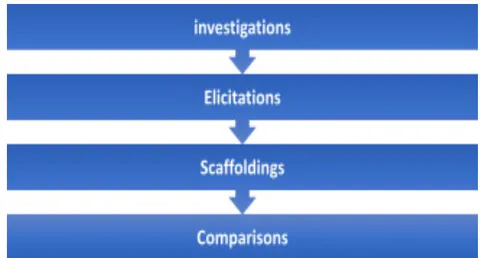
The analysis of the methodological processes involved four qualitative analytical methods: investigations, elicitations, scaffoldings, and comparisons. These approaches aimed to allocate the filtered collected data (based on the research questions and goals) into four subsequent measures and reflections of the collected and tested data. These analytical procedures helped reorganize the researcher's knowledge and actions during experimental work, such as the workshops about transformative CPD, the 4P's, and the significance of innovating and examining the draft policy of education for the LES. Furthermore, these four steps of examination offered additional information and closer evidence about the repercussions of the lack of education aids, the impacts of Libyan culture on education, and the obvious absence of a dynamic policy of education in the LES in general and at the Faculty of Education in particular. They elicited valuable evidence about the lack of CPD programs within schooling and university systems, except for personal initiatives. As during the data analysis, the researcher elicited information by comparing the impacts, cases, and educational outcomes during different times and levels of the ongoing political instability to previously collected data and from to data from Elabbar's (2022, 2023) field studies. The following figure shows the steps that the data went through:
4.1. Summary Findings
This research aimed to expose wider knowledge about the possibilities of presenting the gradual reform idea for Libyan education that Elabbar presented in 2017 and updated in 2022 as an appropriate resolution for the significant problems facing the Libyan education system from different angles. It also aimed to simulate draft policy to join the Faculty of Education and the schooling system (particularly the schools in direct relation with the Faculty of Education practicum) in a unified VMG serving the goals for improved education. The following summary findings address the main challenges found in both schooling and university systems:
The overall situation in the state of Libya and its negative repercussions have produced a tangible reality that cannot be overlooked, in terms of the quality of the educational process for the whole LES. Furthermore, the LES has suffered from the lack of CPD and the absence of a policy of education, in addition to enormous challenges such as bureaucracy and the lack of a shared culture of leadership among administrators of schooling and university systems.
The large number of students in the public schools influenced the experience of students, teachers, and even administrations. The research found that EFL curriculums at schools are not equivalent to the students' existing levels of education. Some teachers reported that "because of their learning styles, culture of education (memorizing), and the time management of providing such content within the current status in the country have produced a discrepancy between content and pedagogical knowledge." This led many schoolteachers to focus only on finishing units and assessing the students' memorization rather than their understanding.
This research confirmed almost all the findings of the previous two studies (Elabbar, 2022, 2023) on Libyan education and possible solutions. For example:
It exposed massive deficiencies in teaching facilities, aids, efficient libraries, internet access, as well as negative cultural effects of education which frustrated faculty and students, who reported coming to campus only to pass exams and obtain certificates rather than to acquire knowledge.
Ongoing bureaucratic management from the separated ministries' protocols had a huge effect that nearly paralyzed most interest in transformation or even suggesting reform proposals be put into practice, as most public universities in Libya remain track centralized with regulations that have not been improved or further developed since their first establishment -- for instance, the 501 higher education roles from 2001.
This research strongly confirmed Elabbar's (2022, 2023) statements:
There is no offered professional development or managed training for professors, TAs, and new educators, and some of them have lost their scholarship opportunities due to the existing instability in the whole country. As a result, most of them (particularly TAs) do not even come to the faculty unless they are called for administrative work or for optional initiatives. (p.28)
Also, the New-generation teachers and employees have a strong desire for change, and many students are willing to accept gradual reform if the authorities facilitate it, but they have not yet done so. (pp. 20-36)
There is a real educational lack in the temporal pool and the knowledge shares acquired and granted to secondary education students in Benghazi who have arrived the Faculty of Education in recent years compared to what they should be. This has weakened their academic and cognitive abilities to deal with the education system, which has led to academic and administrative confusion in the faculty's handling of these challenges.
Due to the ongoing political upheaval and an old-fashioned administration philosophy, most educational authorities "today do not care as much as they should about the substandard quality of education" (Elabbar, 2022, p. 26). They administer only the beginning and end of the study and think that is the education plan, and almost none of the stated quality and assurance instructions are followed exactly.
The teaching practice (practicum) program offered by the Faculty of Education is not relevant to the goals of training pre-service teachers, who have faced real obstacles utilizing new teaching methodologies and employing new communicative approaches.
There is no policy including joined strategies between the Faculty of Education and university faculties or even between the school systems and the divided ministries of education, who have never focus on adopting a fundamental policy of education or CPD approach supports for overcoming problems.
V. RECOMMENDATIONS
After years of research, experimentation, and personal involvement in the Libyan education system, and as result of this study. it became clear for me that the we need to put into practice a reform plan to rebuild the entire education system, which faces real problems that will lead it to a predictable collapse if no one acts. This research was a continuation of other studies investigating almost all levels, documents, impacts, challenges, and positive aspects of the
LES. It ultimately confirmed the need to carry out the projected reform plan and provided additional information to include in the first years of Elabbar's (2022) suggested seven years of reform. The following figure visually addresses how the subsequent actions (after the 4 P's figure) will need to be incorporated into the plan, in terms of the suggested activities and policies and the transformative model of professional development.
In order to build a strong foundation for the suggested 4P's to be added into the reform plan, the key Libyan education officials must contribute to two years (if possible at this difficult time facing the country) of professional development practices. These two-year exhaustive reform preparations need to develop educators' knowledge of education and prepare them for change.
We must keep developing ideas and emphasizing the importance of developing a dynamic written policy of education in order to enable any reform to take place. The Faculty of Education must join its departments' outcomes, and education management must develop one dynamic policy serving the labor market and the desired outcomes of the educational process.
As Elabbar (2018, pp.2-8) suggested, education officials must be invited to take part in the proposed professional and transformative activities. These officials include government and parliament education policy makers (education planners), Ministry of Planning officials in charge of preparing education budgets. ministry office directors, deputy minister directors, ministry education consultants, county administrators and directors, education developers, curriculum creators, teacher trainers, ministry research and training center executives, Ministry of Education legal administrators, Ministry of Education general exam executives, deans and faculties of universities, senior inspectors and their TAs, as well as other key people (decision makers) from the Ministry, government, and parliament who are in charge of education management in Libya.
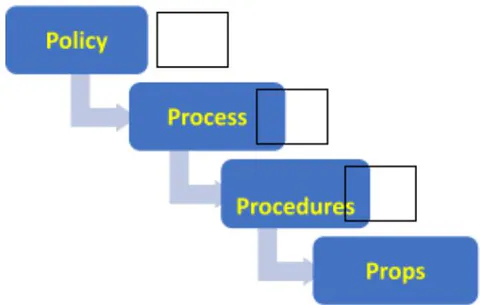
In order to practically implement the 4P's' according to the main proposed reform plan, the targeted administrators should go through different levels and models of transformative professional development; each level may require time limits or evaluation methods to ensure meeting the main goals of the project. For example:
Administrators should attend planned workshops on how to implement transformative learning and action research models as CPD policies. They should also experience intensive lectures, focus groups, monitoring, and education about the role of policymakers and key education figures in transforming the Libyan education system from its current status to the desired status.
Administratoirs should intend sessions and training on integrating technology, interactive learning, and international languages in the education policy, as well as practice writing a pre-policy as an outcome of these activities. This should be followed with transformative workshops on the role of administration in educational regulations and how to develop the current traditional policy into a modern dynamic policy.
The Faculty of Education curriculum and methods of teaching and testing should be gradually changed to meet the requirements and overcome the existing difficulties facing the schooling system, particularly for teachers who have never received any sort of professional development.
The Faculty of Education must run intensive workshops on teaching practice and generate faculty research to overcome difficulties, especially in terms of the lack of Internet, labs, teaching aids, and libraries.
All recommendations need a policy (a clear idea), process (work to get it done), procedures (steps designed to achieve goals) and props (supports to make the plan a reality).
VI. CONCLUSION
At the end of this field work, which explored several levels of educational challenges, desires, effects, simulating ideas, and possibilities of transformative activities for reform, this study advises all Libyan researchers to continue developing the seven-year gradual reform plan. It might be the only way to save the entire Libyan education system from collapse. Reform can happen in Libya, especially because there is a real desire for change among the many educators I met during this long field work. We just need a clear reform policy followed by the 4P's to make it happen.
Conflict of Interest
The authors declare no conflict of interest.
Ethical Approval
Not applicable
Data Availability
The datasets used in this study are openly available at [repository link] and the source code is available on GitHub at [GitHub link].
Funding
This work did not receive any external funding.
References
Cite this article
Related Research

Special Issue
Launch a focused special issue to highlight research, emerging trends, and expert insights in your academic field.