


IntelliPaper
Abstract
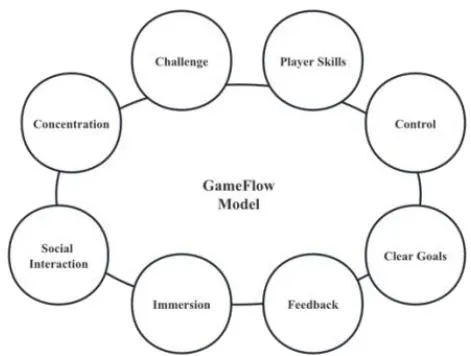
Epistemic video games, interpreted as video games pursuing new knowledge through the mechanism that concatenates practices and cognition, grab numerous attention on account of their extensive implementation since COVID-19. The corresponding academic explorations into the players, especially indicating the students, have largely integrated in game enjoyment and the principals exerted. Understanding the essential factors that promote game enjoyment that aligns with educational purposes is crucially important for clarifying the mechanism of epistemic games. Consequently, the present study adopts the GameFlow model presented by Sweetser and Wyeth (2005), whose accuracy has been verified and yields to evaluate enjoyment of video games by examining specific criteria under eight elements: concentration, challenge, player skills, control, clear goals, feedback, immersion, and social interaction of the model. The highly acclaimed epistemic game “Working with Water” is elected to conduct a case study by implementing the Game Flow model. The result indicates that the overall values for Game Flow cohere with the performance, usability, and potentiality of the epistemic games. The model performs well in the evaluation of epistemic games to a large extent. but simultaneously limited to the intrinsic harshness of the specific genre that differs from others in the degree of enjoyment. As a result, the evaluating model based on GameFlow is worthy of inquiry in an educational context for further investigation.
Explore Digital Article Text
I. INTRODUCTION
Confronted with challenges caused by COVID-19, conventional education in classrooms has been hindered by geographical constraints during the quarantines. In response to the circumstances, increasing recognition of the urgent demand for supportive technologies is advocated to complement and enhance the learning experience. Among all the alternatives, epistemic games stand out owing to their incomparable accessibility and brilliant performance (Parviainen et al. 2021).
Explorations to epistemic games have been a common interest in the academy in recent years, students who identify with players create unprecedented opportunities and challenges, sequestered education has gradually been substituted by virtual schooling (Shaffer et al., 2005). To better understand the mysterious enchantment of video games, numerous studies have focused on the concept of player enjoyment.
The GameFlow model proposed by Sweetser and Wyeth (2005) is adopted in the present study, evaluating an epistemic game "Working with Water", aiming to evaluate the serious genre of games, meanwhile providing an illusion for promoting a comprehensive model, particularly for educational games.
II. LITERATURE REVIEW
2.1 Evaluation of game enjoyment
Player enjoyment has been the central focus of game study since the past decade. In the interactive context, challenge and accomplishment are major cognitive yet sentimental appeals reasoning an individual's choice of gaming, the judgment is proved as the result of the configuration of in-game competence degrees that concentrate on gamers' involvement (Vorderer et al., 2004). Addedly, Vorderer et al. (2004) refer to the disparities in patterns of entertainment, indicating that the procedures of being entertained differ in gamer and game genres. Specifically, in regard to educational games' enjoyment features, Gee (2005) insists on establishing adequate challenge and accomplishment for performing better in enjoyable learning procedures, video games composed of moderate difficulties, decent guidance, and skills acquisition align with the level of challenge and support provided are necessitated for replenishing conventional structure of schooling. Aiming to explain the satisfying experience, flow theory was created and developed by Csikszentmihalyi (1990) for over forty years, it provides a universal system regardless of styles of activities and participants for evaluating the optimal experience. The flow principles comprise eight elements including availability, concentration, clear goal, feedback, control, engagement, immersion, and simulation; moreover, challenge and corresponding achieved skill are indispensable (Csikszentmihalyi, 1990). The notion is extended by Sweetser and Wyeth (2005), who develop an adaptive model GameFlow to evaluate the enjoyment of players by which specific elements such as concentration, challenge, player skills, control, clear goals, feedback, immersion, and social interaction are examined by detailed criteria. The GameFlow theory establishes on the basis that video games strive to prolong the flow experience, hence a balance of challenge and ability is obliged to maintain (Chen, 2007).
The availability of the GameFlow model by Sweetser and Wyeth (2005) has been endorsed by Bernhaupt et al. (2007), who assert GameFlow model is a heuristic theory for measuring gaming experience. In a practical aspect, Inal and Cagiltay (2007) employ this model to resolve essential traits of computer games, Fu et al. (2009) elaborate an EGameFlow scale to assess players' enjoyment derived from the GameFlow model.
2.2 Fulfilling educational principles through epistemic video games
Collins and Ferguson (1993) introduce the concepts of epistemic forms and epistemic games that interpret how novel knowledge is constructed and acquired by the structure of games. In the opinion of Collins and Ferguson (1993), scientific investigations into specific phenomena are guided by the fundamental structure supporting known as epistemic forms, meanwhile, these inquiries are specified under rules and strategies which constitute epistemic games. Building on the epistemic structure theory, Shaffer (2006) extends epistemic frames beyond the technical sense to principles of practice involving inquiry establishing, information accumulation, and evaluation, concluding that the entire mechanism concatenates practices and cognitive modalities through simulation realized via virtual gaming.
Coherent to the core pursuit of deep learning implementation by referring to the construction and acquisition of new knowledge via epistemic games practices, Gee (2004) proposes well-established learning principles with what good epistemic video games incorporate to enhance cognition in the process of learning in classrooms. In discussing his principles, Gee (2004) describes how epistemic games realize educational purposes. Gee (2004) emphasizes that the information conveyed in the context provided by good epistemic video games is supposed to meet the exact educational object of school, moreover, adequate time arrangement for guaranteeing maximum memory and availability of information subsequent to the game playing is crucially important. In addition, Gee (2004) promotes "good games" largely due to the interaction enabling players to resolve gradually more complex levels by which expertise is mastered throughout the game cycle, as a result, deep learning for educational purposes is positively motivated in classrooms. In this respect, Shaffer (2006) explains the benefits of immersive participation from an interest-oriented dimension, which deems that the more interested a child is in a topic, the deeper expertise he/she will develop. This theory, named islands of expertise, reminds us of the usability of epistemic games combining knowledge and educational content. When confronting challenges such as improving the performances of disciplines' grades, the acknowledgment of expertise is simultaneously compiled (Shaffer, 2006).
As a new model encouraging transformation for learning, epistemic games allow students to extend their learning experience beyond the confines of the classroom by organizing their own virtual communities sharing identical values (Shaffer et al., 2005). Their varying contexts yield students the opportunity to explore heterogeneous identities in parasocial experience, in turn, motivations for learning are evoked while experiencing the powerful identities (Shaffer et al., 2005; Gee, 2004).
III. METHODOLOGY
In the present research, the GameFlow model (Sweetser and Wyeth, 2005) is applied to understand to what extent the design practices of Working with Water support improve learning performance with respect to flow experience (see Figure 1).
3.1 Case study
Committed to enhancing awareness among students aged 11 to 16 about the management of water resources of the Central Coast Council, the Chaos Theory team designed the educational game Working with Water. This game has been continually rewarded with the Australian Game Developer Awards for Best Serious Game from 2019 to 2021. This game is highly recognized as a consequence of its parallel usability to the central criteria of GameFlow elements.
IV. RESULTS
4.1 Concentration
Working with Water (WW for abbreviation in the following) stimulates players with the combined aesthetic design in the versions of vision and sound (see Figure 2). The semi-realistic casual style featuring cute cartoonish greatly bonds the adolescent students and the game (Rocket Brush Studio, 2022), which at the same time soothes the seriousness of the serious issue the game conveys. The background music simulating the coast implemented by WW constructs an intricate multimedia case that statistically obviously enhances memory in virtual learning (Fassbender et al., 2012).
Nevertheless, possibly considering the targeted audiences cannot allocate much time to video games, stimuli are limited to overcome a consistent goal of increasing treated water production. Paradoxically, limited stimuli that indicate an identical goal in turn accord with the criteria of concentration, as they shape moderated tasks that perfectly coincide with players' actual cognition system. The stimuli are proved effective, students are focused on exploring the intricate water supply system, aligning with the designers' intention to enhance their level of concentration while learning.
4.2 Challenge
Challenges in WW are comprised of two main aspects: 1. the round-based challenge that dynamically varies depending on the current context, incorporating climatic change such as drought or torrential downpours, maintenance and construction of facilitates, and suddenness occurring along the Central Coast.
- the underlying task revolves around the resolution of the increasing provision of water. Both of these challenges can be effectively tackled by following the tutorial and evoking strategies that conform to the cognitive flexibility strategies of targeted adolescents.
The demand for water increases per round of the game, which produces the corresponding development of the game difficulty. During this period, taking both increments of skill level and refraining from unnecessary frustration into consideration, WW ensures the balance by introducing challenges that are admitted to the students' expertise.
4.3 Player skills
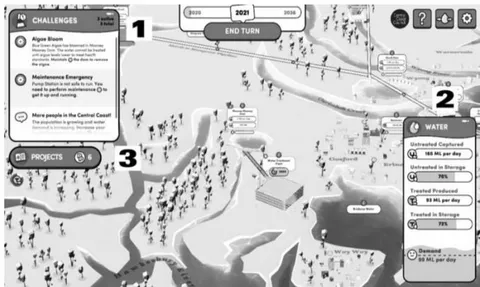
Adaptive to students aged 11 to 16, WW introduces an engaging cartoon character named Whizzy portrayed upon the water droplet, who guides the students in getting familiar with the interface and tacking with round based challenges providing a comprehensible tutorial throughout the game (see Figure 3).
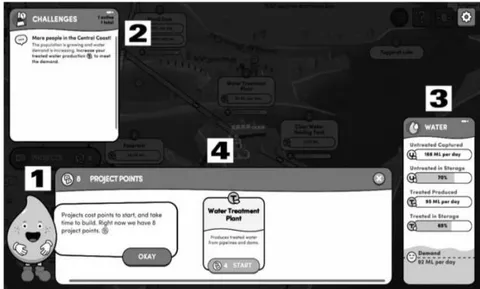
The tutorial by Whizzy facilitates the comprehension of water management issues relating to game challenges and practices for solving increasing water demand that resembles reality. Players are taught to operate with the help of concise hints in the challenge panel, their mission is to build up projects that help to overcome challenges. Students' skills are improved with adequate resources equipped with the projects at a moderate pace, which is realized by the demanding construction period during which students are accommodated with academic information presenting the project. Once completing each turn, level-up functional facilities are rewarded which immediately serve for the next turn, players are instantly satisfied and upgrade their knowledge.
4.4 Control
Players are encouraged to domain the whole management of the water system, through allocating the project points proportioned following their personal organization, players in WW identify themselves with the director of water resource management. The interface system authorizes the player to inspect the general view and also zoom in for meticulous inspection by scrolling and moving the mouse, this interaction likewise legitimizes the sense of control over the movements, engagement, and interface manipulation.
In spite of that, WW can be improved by fixing the saving and loading protocol. At present, the historical progress is discarded once the students exit the game, as known that replicated gaming experience is frustrating, a virtual storage space may bring forward better enjoyment by allowing players to continue their progress across game sessions.
On the other hand, WW is relatively supportive in benefiting from committing errors, even if the actual challenge requirements are not satisfied, gentle admonition is displayed by transforming a smiling face into a crying one in the water panel (Figure 3 (3)). Conversely, in case of succeeding in achieving the goal, a smiling face is ready to be retrieved.
WW stands out as a successful serious game for contributions that meet the educational objectives with regard to comprehending the measures maintaining the sustainable development of drinking water, they are trained for further practices with which the world will be better.
Furthermore, multiple combinations of infrastructures make the player's own strategies implementable, the player determines what propels the progress of his/her own project and assesses the usability of it during gameplay.
4.5 Clear goals
The overriding goal of WW has been advocated in a comprehensive way across the gaming experience (see Figure 2). Notably, the challenge panel (2) keeps alerting that the accelerating population is in great need of water. Besides, what will happen will also be forecasted in the challenge panel.
WW also rightly takes the conformance of the game advance presentation (see Figure 2), by which the clarity of goals is guaranteed by perceiving all the relevant information. Firstly, the challenge panel (1) pended in the upper left of the interface perpetually keeps the players informed of their tasks. Besides, the water panel (2) correlating to the challenge provides additional messages revealing the completion status. Finally, projects panel (3) denotes the resources for sequent movements and interactions that directly determine the result of each round.
4.6 Feedback
In the game, students are allowed to establish their projects by choosing from multiple options of facilities. WW motivates better performance in each round which equals enhanced game skills, afterward, more advanced establishments are unlocked (see Figure 4).
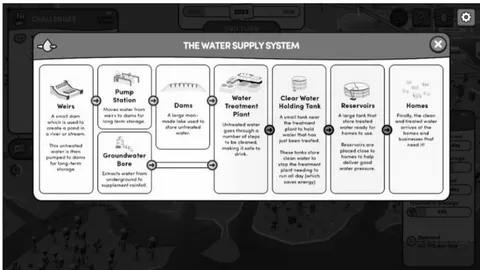
The feedback of WW is immediately redeemed for empowering higher efficiency in the posterior stages of challenges, players are able to check it at any time during the game.
The richness of feedback is combined (see Figure 5), the establishments represent the first modality, and the progress achieved after proceeding turns of games is also visible in the interface, which inspires sustained involvement with games from students' perspectives.
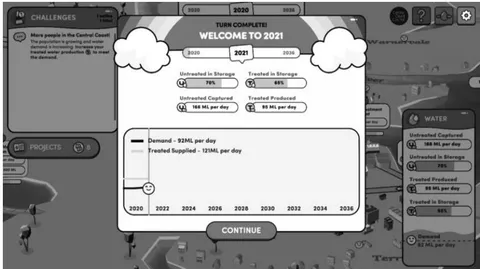
4.7 Immersion
Regarding the game experience that makes players engaged, WW relates students to the virtual world exerting the realistic map encompassing water management facilities and the sketch depicting buildings, rivers, and geographic features. The familiarity with the simulation provided simplifies the immersion sense, the game triggers students to feel responsible for dealing with the water deficit, confident in resolving the problem, and personally connected to the fate of Central Coast.
Visceral involvement tightly attaches to concentration, which implies that the sense of reduced worries and perception of reality heightens fluent involvement in the game. WW strives to reach the goal, but due to the prior explanation of limited genre features, an absolute immersion is pending to be realized technically.
4.8 Social interaction
WW is created for single-person, focusing on improving individual's learning and practicing skills. The absence of competition and cooperation between players encourages students to explore and establish strategies on the basis of their knowledge acquired through school and the game independently.
This feature promotes the construction of personal reflective space, accrediting students from 11 to 16 years old more possibilities to enhance their self-organized ability.
V. CONCLUSION
WW is an online turn-based web strategy game, whose preliminary purpose is to surpass the obstacle the traditional classroom education faced that is brought by COVID-19, whose performance in changing education location from offline to online undoubtedly extends the knowledge transformation mechanism.
The results of the evaluation of WW reveal certain aspects of its linkage to elements including concentration, challenge, player skills, control, clear goals, feedback, immersion, and social interaction, it has been proved that the positive evaluation indicates the usability of WW as been an educational instrument for enhancing learning efficiency.
The study highlights the aesthetic design that contributes to concentration but also to limited stimuli. Challenges that gradually increase in difficulty allow students to develop their skills. The guidance provided by Whizzy and the availability of resources improve players' skills. Control over the water system and the provision of immediate feedback enhance the gaming experience. While immersion is fostered through realistic simulations, social interaction is limited to individual learning.
Nevertheless, a significant flaw is witnessed which relates to the nuance regarding the ranking of enjoyment towards various genres of games. For epistemic games, which weighs more, the knowledge transmission or the flow experience?
The answer is not hard to answer for other genres of games. When modifying the overriding issue, the accuracy of the evaluating model GameFlow is in doubt when applied for educational purposes. This pending curiosity could furnish inquiry for further investigation.
The insights gained from this study intend to give rise to future educational games, further enhancing their effectiveness and impact on student learning outcomes.
Conflict of Interest
The authors declare no conflict of interest.
Ethical Approval
Not applicable
Data Availability
The datasets used in this study are openly available at [repository link] and the source code is available on GitHub at [GitHub link].
Funding
This work did not receive any external funding.
References
Cite this article
Related Research



Special Issue
Launch a focused special issue to highlight research, emerging trends, and expert insights in your academic field.