


IntelliPaper
Abstract
The emphasis of theory-based training on application-basedtraining has its importance in the healthcare sector. Relationship building and a patient-centric approach have taken the core area for organizational commitments to improving their services.When the acquisition of the new set of skills by the participants is used in daily tasks, at low cost, in a dynamic format, the theories are achieved by active participation, and it enables the context to be adapted right habits.As a cluster training program, the participants of the soft skill training programhad an opportunity to link with 4 major clusters such as intrapersonal communication, interpersonal communication, adaptability and developing comfort zone and stress management, and risk reduction in communication. This research study provides insights into the training methodology of soft skill competencies for future healthcare professionals. It helps in assessing the effectiveness of the training program by adapting learning by doing methodology. By adapting Northouse & Northouse’s health communication model, data collected about preparation for the course by the participants, information delivered, and adequacy of inputs provided, Overall rating of the training program conducted as parameters. The research emphasizes the 3 main areas as skill-based learning, tool-based learning, and problem-based learning in the learning-by-doing methodology. This research study provides details on the effectiveness of the training program for communication and soft-skill competencies to be logical, systematic, replicable, focuses on the priority problems, and generative of data that is measurable and action-oriented.
Explore Digital Article Text
I. INTRODUCTION
The "how" of knowledge is more important rather than knowing the whole point of job. In this digital era, there is a rapid call for continuous training and accessibility without any constraints of place and time(Continisio et al., 2021). But, despite the evolution of digitization techniques, training models have remained frozen and there is a continual try to reinvent learning. Putting theory to practice, to overcome the problems of efficiency, learning through practice has been possible by modern training methods.
A classic practice of learning by doing, "To learn before, and then can do them, it has to be learned by doing." As the quote from Aristotle, the famous thinker, and philosopher advocated in modern terms, what would become later, learning by doing. In real life, information received by listening, when put into practice is learning by doing. This simple concept, rather than pure theory, emphasizes laid to apply experiences and actions. As a quote from Maria Montessori "What the hand does, the mind remembers."
Learning by doing is implemented in business strategies, to encourage innovations, creativity, and entrepreneurship. To optimize the resource-intensive processes and aim for performance optimization, management has gained these insights, and learning by doing has been used in recent history.
Objectives
To evaluate training methodology by learning by doing in health care management.
Assess the implementation and effectiveness of the training program/work performance.
Literature review: By literature search, specific 15 communication models were selected, but only one model was considered suitable for an in-depth research review. An appropriate communication model is selected and taken for referring. An intense literature search was performed, and the most suited model was considered.
- Northouse & Northouse's health communication model: Few major factors are responsible for the health care communication process. Among them, three factors contribute to each other. They are as follows:
Relationships
Transactions
Context
From a healthcare communication system perspective, four major types of relationships exist in a healthcare setting:
Professional-professional
Professional-client
Professional-significant others
Client-significant others
As an individual working in the healthcare sector, there will be an involvement/engagement in one or more types of health communication.
Relationships: This model expresses those interpersonal relationships can influence the other types of relationships with health care professionals(Neuhauser & Kreps, 2003). By defining the term health care professional, it is used to identify those individuals who are educated, trained, and experienced to deliver health services to others/clients(Hellen & Mberia, 2011). A wide range of individuals – Physicians, Nurses, Health educators, social workers, Customer care in-charges, Pharmacists, Public health personnel, Health psychologists, Technicians, physiotherapists, Occupational Therapists, Chaplains, and health care Administrators all considered. As everyone is unique, professionals bring distinct characteristics, perceptions, beliefs, and values(Degaleesan & Kulothungan, 2011).
The way each interacts with clients and other health care professionals depends upon the socio-cultural background, past experiences, age, psychological factors, training, and experiences to perform tasks, and these influence quality care(Conversational Interfaces for Task-Oriented Spoken Dialogues: Design Aspects Influencing Interaction Quality, 2011).
Transactions: These are health-related interactions that take place in the communication process between participants. Health transactions can be verbal and non-verbal communication behaviors that complement and are compatible with each other.
Health transactions have two communication dimensions: The content and relationship dimension in messages. The content in health-related communication means clients seek to attain health and maintain well-being over the human life span(Harris, 2008).
Context: The communication setting that takes place in a systematic, professional, and well-structured way in a healthcare organization in context.
At the healthcare organization level, context is referring to specific settings such as hospitals, physician's offices, OPD settings, clinics, or waiting rooms. Health care communication can take place in situations such as one-to-one, in triads (when there is interaction with client & bystander and health care provider), in small groups during Health awareness programs, among large gatherings during health campaigns(B. McCarthy - A New Therapeutic Communication Model "TAGEET" to Help Nurses
Engage Therapeutically with Patients Suspected of or Confirmed with COVID-19, n.d.). The number of persons involved in the interaction also is influenced by context.
Northouse & Northouse's Health Communication Model:
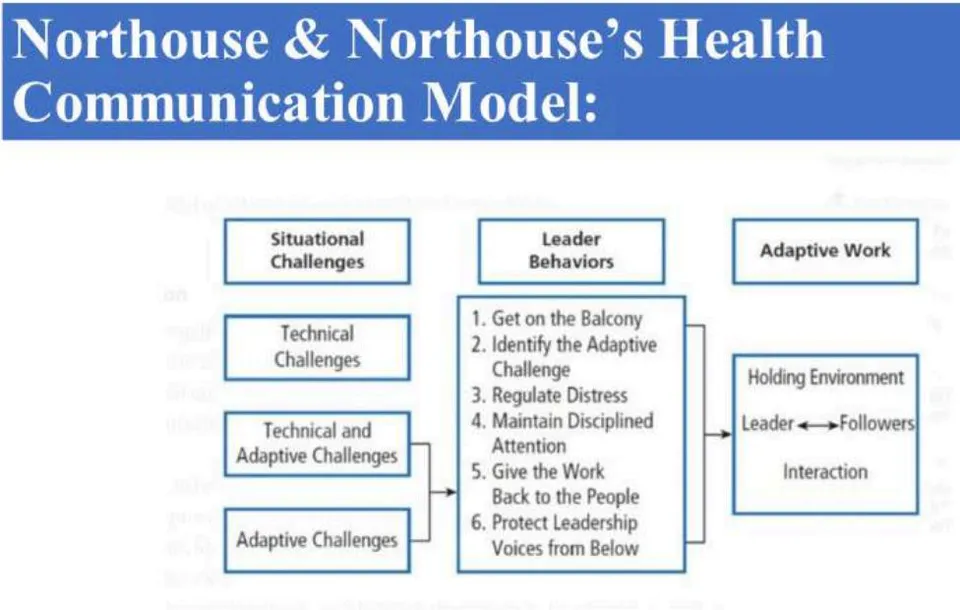
When relationships, transactions, and context, three are considered together as contributory factors from a system perspective, it has a high impact on healthcare communication.
The learnings and inferences drawn from the models:
Communication occurs in multiple forms, not only through oral and written forms. Oral communication is an informal way, mostly used for personal-level conversation and group discussions(Yassin, n.d.). The written form of communication is used for education purposes, business development, and college and schools for education and awareness purposes(Bylund et al., 2012). In healthcare organizations, 'documentation is communication, Communication is documentation' for reliability purposes(Rozilah et al., 2013). Communication can also be through signs, symbols, gestures, and postures that can be used(Prabavathi & Nagasubramani, 2018). An individual can also communicate vital information in the social environment(Communication_and_Social_Environment, n.d.).
Communication is a continuous process that takes place within an organization, throughout life(Agarwal & Garg, n.d.). ("Communication_and_Social_Environment," n.d.). There is a need to review, analyze, interpret, and integrate these communication models and frameworks in healthcare management from the provider-patient perspective(Cheng et al., 2015).
In a nutshell, the learning outcomes that are determined by all these models of communication:
Communication is acquired for understanding purposes (Turkalj & Fosić, n.d.).
Information dissipation regarding the elements of communication (Ye et al., 2020).
Research and Development (R&D) (Hand et al., n.d.) and online mapping purposes (Woo Park, n.d.).
To promote successful communication processes, generating reliable information.
Understand the factors that led to the failure of communication processes.
Implementation of communication in an easily adaptable way along with compassion, empathy, and fundamentals of care and support.
7. Showing and creating information flow.
Introducing and creating features of the communication process innovatively.
Understanding and Estimating the complexities of the communication process.
Execute Measures to improve the communication process.
II. METHODOLOGY
To evaluate the training methodology from the participant's perspective and to understand how and why the training in health care management is the benevolent way.
Source of Data
Literature search and relevant website search.
Documentary search with a specific communication model.
Semi-structured questionnaire for the participant's views and data collection.
Study Setting: The aim is to study and analyze how the participants of health care management underwent training and development to get the desired competencies. The study was undertaken as a newer intervention and as the gap that excised in the literature review. This is a descriptive, interventional, and experimental study.
Study tools
a. Literature search from reputed journals, using keywords, search engines, and articles from reputed publications which were nationally and internationally accepted by health care management domine.
b. Documentary search and training manuals and considering standard operating procedures of health care management training.
c. Semi-structured questionnaire was provided for the participants for knowing their inputs and suggestions to understand the need and requirements of the skill sets and competencies for the desired job/work areas.
Sampling method: The participants were all those who enrolled in the MBA-HHM program in a B-school. The participant's identity was kept anonymous to avoid any bias in the data collection process. No identity was revealed, and data was collected by a questionnaire in the Google form which was submitted by the participants after their consent for data collection. A total number of 120 participants were taken as sample subjects who confirmed their participation in this training process.
- Preparation for the course by the participants:
{"image_source":{"path":"images/5e25e8402438a8b6947aff2312ceafe77ed332a7ca6259cafb12b4694fecf005.jpg"},"content":"","chart_caption":[{"type":"text","content":"Fig. No. 2: Showing preparation for the course by the participants."}],"chart_footnote":[]}
Inference of the data
Have taken part in this course earlier: 2% of the participants had undertaken this course earlier.
Has adequate prior exposure to the prerequisites: 8% of the participants had prior exposure to the prerequisites.
Had to pick up relevant additional topics through concurrent study: 73% of participants had pickup relevant additional topics through concurrent study.
Have no exposure to the background material: 92% of the participants had no exposure to the background material.
Interpretation:
Less than 2% of the participants had been exposed to this training earlier. Only 8% had prior exposure to the prerequisites. These percentages and data, confirm that this course was very new to the rest of the participants, and it was different from their usual learning and teaching sessions.
More than 73% of the participants were able to pick up relevant additional topics. 92% of the participants had no previous exposure to background material. These percentages and data, confirm that a large set of participants were able to gather newer inputs and information from this training program. The training program was very new and performed in an innovative way as they did not have any exposure to the background materials.
{"image_source":{"path":"images/ce19f19bd41770fc161dd59046a93fb75c48849678e4fcf76a090cc68a83f85c.jpg"},"content":"","chart_caption":[{"type":"text","content":"Fig. No. 3: Showing Bar chart of the information delivered/Adequacy of inputs provided to the participants."}],"chart_footnote":[]}
Inference of the data: The Bar chart depicts the information delivery as the adequacy of inputs provided for the participants. On a scale of 0 to 100%, the level of information provided was assessed as per the participant's feedback as follows:
As per the responses provided by the participants, 0% of participants said undergraduate level/none of the participants said that it was at the undergraduate level. This can be interpreted that, the participants all felt that the training program concepts which were delivered were above the undergraduate level of training.
56% of the participants responded that the dept of information provided was for the Graduate level. This result shows that more than half of the participants mentioned that the concepts provided were specific to the graduate level of training.
87% of the participants responded that the dept of information delivered was at the Advance level. This result explains that nearly 87% of participants confirmed that the concepts and depth of information provided were at an advanced level to participants who were performing in a master's degree program.
Interpretation: The information delivered/adequacy of inputs proved was asked to be categorized to the levels on a scale of 0 to 100%.
None of the participants agreed that it was at the Undergraduate level.
The 56% of participants informed that the adequacy of information provided was at the graduate level.
Most of the participants, about 87% responded that adequacy of input proved was an advanced level.
3. Overall rating of the program:
{"image_source":{"path":"images/acbd1c45458981cdab60af69abfdd34d9b7ebbdda9d8685bcf0b921acd94e033.jpg"},"content":"","chart_caption":[],"chart_footnote":[]}
Fig. No.4: Pie chart depicting the Overall rating of the training program.
Inference of the data: The overall rating of the training program is as follows:
1. 91% of participants said Excellent.
- 7% of the participants said Very Good.
3. 2% of participants said Good.
4. 0% of participants said, Poor.
Interpretation
Most of the participants, about 91% said that the overall rating of the training program was Excellent.
About 7% of the participants said that the overall rating of the training program was Very Good.
A few of the participants, 2% said that the overall rating of the training program was Good and none of the participants said it was poor.
IV. DISCUSSION
Relevance of learning by doing training for soft skills and competency in the health care sector and why it works: When listening is intense, the human brain can maintain attention up to the optimal level of 10 minutes at an optimal level. The attention span beyond these plummets, even though the subject is interesting. There are other methods such as reading, writing, and listening which are not at all a match for doing. Doing is practicing, which has two main factors:
Risk-taking: Doing practically means risk-taking. Risk in learning is making mistakes, risk failures, and intellectual limits confrontation. To Err is human. The human brain does not prefer error or failure. By putting in a situation of failure, we remember the error points and try to rectify them as facts.
Emotions: By trying to do things, the experience gained is an emotion that is associated with actions. There are several emotions involved such as joy, stress, embarrassment, and surprises that effectively create memory and are associated with practices. To quantify in terms of numbers, remembering what one does is 75%, by listening, one does 5% only.
Learning By Doing In Action:
Encourage Experimentation and Practice:
{"image_source":{"path":"images/c2cd3e6b9c6d4cc687b5f67171716ec1881eb769a7c6277a03cd32be9b0da5d5.jpg"},"content":"","chart_caption":[],"chart_footnote":[]}
Skill-based learning: Guided by expertise objectives, achieved with practical application.
Tool-based learning: Leveraging case studies, role play, encourages the collective involvement of participants.
Problem-based learning: Focused on redoing exercises, quizzes, other activities repeated several times to facilitate problem-solving. It is by making a mistake that many of us best retain the information.
Fig. No. 5: Learning by doing in action. Source: National Training Laboratory.
- Scope of the training program: There is a wide scope of integration of learning by doing by participants. Learning through the repetition of scenarios, by practical exercises, there is a better approach to the concepts. The reviewing of the situation will be actively understood.
By trying to solve the situational problems or case studies approach from a management perspective, the response will be active, dynamic, and versatile. It is scientifically proven that the brain tries to activate mimicry, the lessons learned, and practicing those skills increases the attention span to an optimal level.
- Operational aspects of the training program: The activity sessions are planned as per the background of theory didactic lectures. The activity sessions are structured to keep the knowledge culminated to put into practice. A wide range of activities aimed to develop the target of social and emotional components are incorporated. The course learning is triggered to make the participants be in the action phase and come out with solution-based approaches. The ideas are made into possibilities, opportunities are created, multiple avenues are customized and activity sessions are adapted. The participants take up an active role and the trainers are on the observer mode. The importance of this segment is to develop a new behavior, and skills that are created and imbibed, these are put into action.
As activities are performed in clusters of 3 group activities, coordination, and team-building spirit is backed. The cascading effect of the activity session has a specific effect on the social-emotional process. As said, each theory session is clubbed with 3 activities as it gives importance to interpersonal and intrapersonal communication among the team members.
The framework of activity sessions: The Knowledge-based activity incorporated into applications. Attitude-based activity is modified for the betterment of mindset. Practice-based activity fosters the participant to perform on the ground and be inclined to get the feel of the skills. For example, the participants are made to be engaged in empathetic conversation, consider other person perspectives, and feel the difference in the role change mode.
Methods adopted for a training program: Methods adopted were many, to mention a few as a case study, role play, dialog conversation, and scenario developed are the methods utilized. The user guide of the manuals for training is utilized. The user manual "The skills to pay the bills, mastering soft skills at workplace success" as an activity reference was taken as a support, and customization was performed as per the organizational and cultural context to fit the training team. "Trainer Manual for Soft Skills Applied in Entry Level Occupations" was used as a background reference and cultural adaptability to suit the organization performed and training was delivered by refining the contents.
As each training program by itself, is a creative learning and is well crafted, it also depended on the trainer's style, participants' adaptability, and outcomes of the activity were a summation of subjective and objective elements.
- Application of learning by doing training using digital technology: As the training was widely used and acclaimed by professionals, it needs to be optimized to the needs of the participants. When the acquisition of the new set of skills by the participants is used in daily tasks, at low cost, in a dynamic format, the theories are achieved by active participation, and it enables the context to be adapted right habits.
As there was a whole range of digital educational devices this allowed for experimentation, activities, and practices. The passive courses as scribbling notes and notes from the screen are modified by open and online digital learning applications. The skill-based learning which was guided by the subject experts had specific objectives in the research and was achieved with applications adapted by practical approach.
Tool-based learning, to encourage collective participation was performed through role play and case study scenarios. Problem-based learning was facilitated by a focused approach of quizzes and redoing exercises. By allowing the participants to make mistakes and have discussions after the activity, retaining was best in terms of information for the participants.
As the training program was well anchored in real and virtual platforms, it was also recorded for viewing later. Learning in the right sequence in the right way to make better choices made the training application effective.
The participants were inclined to concrete problem-solving situations and enjoyed serious games. The time management training program was well taken by the participants. The training focused on leveraging an interactive guided program, it had integrated tools such as digital support were utilized as digital practices.
Limitation of the study:
The training is conducted by considering only the health care professionals who are participants. The other allied health and support staff are not considered participants in these training programs.
The training program is considered only in one B-School which had multi-ethnic and multi-cultural background participants. The diversity of different regional levels was also preferred. The training would be more robust if it is considered and compared in multiple B-school setups. This limitation can be significant as different strata of participants may yield variable inputs and suggestions and data synthesis and data interpretations may be validated optimally.
V. CONCLUSION
As a cluster training program, the participants had an opportunity to the principles linked to 4 major clusters such as intrapersonal communication, interpersonal communication, adaptability and developing comfort zone and stress management, and risk reduction in communication. Learning by doing helped as training mattered most.
As a continuous improvement process, the training program is a pragmatic model that starts with forming/structuring the soft skill competency mapping as a module, collecting data, analyzing results, forming conclusions, and implementing findings into real-life applications as experiential learnings and forming new skill sets for the betterment of the course module.
This research has tried to study the effectiveness of the training program for communication and soft-skill competencies to be logical, systematic, replicable, focuses on the priority problems, and generative of data that is measurable and action-oriented.
Conflict of Interest
The authors declare no conflict of interest.
Ethical Approval
Not applicable
Data Availability
The datasets used in this study are openly available at [repository link] and the source code is available on GitHub at [GitHub link].
Funding
This work did not receive any external funding.
References
Cite this article
Related Research


Special Issue
Launch a focused special issue to highlight research, emerging trends, and expert insights in your academic field.