




IntelliPaper
Abstract
The evaluation of the relationship between morphological predictors and home range size in aquatics mammals has been a tool used to understand the ecological requirements of the species, as well as provide relevant information for the construction of conservation actions and management of populations and aquatics habitats. We evaluated the relationship between the home range size of 34 Amazon River dolphin individuals (Inia spp.), and three explanatory variables reported in the scientific literature (1) body mass, (2) body length, and (3) sex. Home range sizes were calculated as the univariate kernel density estimates at 95% (K95) for the Inia spp. individuals monitored through satellite telemetry across four rivers of the Amazon basin (Bolivia, Brazil, Colombia, and Peru) and five rivers of the Colombian Orinoco basin. Out of three home range predictors evaluated, only the sex predictor showed statistical significance in the Kruskal – Wallis test (p = 0,037).This research also calls attention to the vulnerability of the Inia spp. to human impacts on aquatic landscapes such as the massive construction of dams on a regional scale regulating the flooding pulse and limiting the access of Amazon river dolphins to the different habitat types mainly in the Amazon basin.
Explore Digital Article Text
I. INTRODUCTION
Home ranges are defined as areas in which animals carry out their day-to-day activities and acquire the necessary resources to survive (e.g. Burt 1943; Buskirk 2004; Dahle et al. 2006; Péron 2019). Tucker et al. (2014) analyze the home range of 429 mammalian species including two coastal cetacean species (Orcaella heinsohni; McGowen 2011), and Sotalia guianensis (Caballero et al. 2008). They conclude that home range size is influenced by a range of factors such as body mass, diet, and the environment. Among the various potential consequences of allometry, an animal's home range size provides valuable information on a variety of ecological determinants, including resource use, social behavior and predator avoidance (Knight et al. 2009).
Home range analyses have been historically biased towards terrestrial mammals. Over the last two decades knowledge has grown about the spatial estimates of aquatic species, as represented in the scientific literature (Mosquera-Guerra et al. 2021). It is also unclear if factors driving home range size among mammals are the same in terrestrial and aquatic environments (Tucker et al. 2014). The size of an animal's home range is usually correlated with productivity, the species' biological requirements, and habitat heterogeneity (McNab 1963). Most animals do not use their entire home range with equal intensity but tend to concentrate their time in core areas (Dixon and Chapman 1980; Samuel et al. 1985; Oshima et al. 2010).
Previous studies on the spatial ecology of terrestrial mammals have suggested that home range sizes can be influenced by several factors as follow (1) mating system, (2) spatial distribution of resources (e.g. Boutin 1990; Dahle et al. 2006), (3) body mass (e.g. Harestad and Bunnell 1979; Dahle et al. 2006), (4) age and reproductive status (e.g. Dahle and Swenson 2003a, 2003b; Dahle et al. 2006); (5) population density and interactions with same-species neighbors (e.g. Dahle and Swenson 2003a; Buskirk 2004; Dahle et al. 2006); (6) morphological variation between subspecies (e.g. Kie et al. 2002); (7) intra- or (e.g. Riley and Dood 1984) interspecific competition (e.g. Loft et al. 1993); (8) foraging and predation avoidance (e.g. Krebs and Kacelnik 1991; Tufto et al. 1996; Powell et al. 1997; Relyea et al. 2000); (9) trophic level (e.g. Harestad and Bunnell 1979); (10) season (e.g. Nicholson et al. 1997); and (11) anthropogenic landscape fragmentation (e.g. Kie et al. 2002; Bejder et al. 2006; Pirotta et al. 2013; Bas et al. 2014).
In the case of aquatic mammals, studies of home range variation in the coastal bottlenose dolphin (Tursiops truncates) have been focused on the influence of environmental predictors such as productivity levels and tidal cycles (see, e.g., Wells et al. 1980; Defran et al. 1999; Wells and Scott 1999; Connor et al. 2000; Wells et al. 2017), highlighting the spatial complexity of the three-dimensional nature of aquatic environments (see, e.g., Alexander 2003; Shurin et al. 2006; Rip and McCann 2011; Pawar et al. 2012). Aquatic organisms experience high physiological challenges related to greater individual heath decline (Tucker et al. 2014) as well as difficulties in detecting resources (see, e.g., Jetz et al. 2004; McGill and Mittelbach 2006; Pawar et al. 2012) that can result in variations of their home range.
The quantification of those elements that influence the selection and use of spatial mammalian ecology is technically challenging for aquatic species, and particularly for those inhabiting river systems characterized by greater hydrological dynamics. Home range studies in small cetaceans have been successfully conducted using different techniques and analyses for several coastal and oceanic species, including (1) the harbor porpoise (Phocoena phocoena, Sveegaard et al. 2011), (2) Hector's dolphin (Cephalorhynchus hectori, Rayment et al. 2009; Bräger and Bräger, 2018), (3) common bottlenose dolphin (Tursiops truncates, Mazzoil et al. 2008; Martínez-Serrano et al. 2011; Nekolny et al. 2017; Passadore et al. 2017; Wells et al. 2017; Genoves et al. 2018), (4) Atlantic spotted dolphin (Stenella frontalis, Hill 2014), (5) the franciscana dolphin (Pontoporia blainvillei, Bordino et al. 2008), and (6) Guiana dolphin (Sotalia guianensis, Flores and Bazzalo 2004; Rossi-Santos et al. 2006; Azevedo et al. 2007; Wedekin et al. 2007; Oshima et al. 2010). Currently, home range estimates are available only for the Inia geoffrensis with data derived from different methods (1) satellite tracking of adult individuals in the Amazon (Colombia and Peru), San Martín (Bolivia), Juruena (Brazil), and Orinoco (Colombia and Venezuela) rivers (e.g. Mosquera-Guerra et al. 2021); (2) VHF radio-tagging and capture, recapture, and marking of adult individuals in the Japurá and Solimões rivers (Mamirauá Sustainable Development Reserve, Brazil) e.g. Martin and da Silva, 1998, 2004a,b; Mintzer et al. 2016); (3) photo-identification techniques of previously identified individuals (Pacaya-Samiria Reserve in Peru, e.g. McGuire and Henningsen 2007), and the Cuyabeno and Lagartococha rivers (Cuyabeno Reserve, Ecuador; e.g. Denkinger 2010).
Inia geoffrensis is the largest of the river dolphins (Martin and da Silva 2006) and is also considered one of the top predators of the aquatic trophic webs of the Amazon, Orinoco, and Araguaia-Tocantins basins (McGuire and Winemiller 1998; Gómez-Salazar et al. 2012). The species has the smallest group sizes known among cetaceans (Gómez-Salazar et al. 2011a, 2011b; Mosquera-Guerra et al. 2018a), and its use of space is strongly conditioned by its ecological position as the top predator inhabiting dynamic systems characterized by seasonal variability (Frère et al. 2010) and food availability (Mares et al. 1982).
Inia geoffrensis is subdivided into two subspecies (Committee on Taxonomy 2021); I. g. geoffrensis distributed across the Amazon, and Orinoco basins and I. g. boliviensis, found along the Mamoré, Iténez, and Madeira rivers (Aliaga-Rossel 2002; Aliaga-Rossel et al. 2006; Gravena et al. 2014; da Silva and Martin 2014; da Silva et al. 2018; Aliaga-Rossel and Guizada, 2020). Inia geoffrensis is listed as Endangered (da Silva et al. 2018) by the International Union for Conservation of Nature (IUCN), and is included in Appendix II of the Convention on International Trade in Endangered Species of Wild Fauna and Flora (CITES; da Silva and Martin 2018). The species is considered among the most threatened aquatic mammals globally (Reeves et al. 2003; Trujillo et al. 2010). In recent years, threats affecting aquatic ecosystems such as the construction of hydropower dams, mining, and bycatch of individuals river dolphins have increased in the major river basins of South America (e.g. Trujillo et al. 2010; Mitzer et al. 2014; da Silva et al. 2018; Mosquera-Guerra et al. 2019a; Barbosa et al. 2021; Campbell et al. 2020; Brum et al. 2021).
Understanding the way in which I. geoffrensis home range size is influenced by morphological factors constitutes an important tool for planning management and conservation actions for populations and habitats. This study represents an important collaboration between researchers from multiple organizations from four South American countries. We aimed to evaluate the relationship between a set of morphological predictors and the home range sizes for the I. geoffrensis individuals in the four major rivers in Amazon and five rivers in Orinoco basins.
II. MATERIALS & METHODS
2.1 Study area
This study was conducted from October 2017 to June 2021 in the Amazon and Orinoco river basins. A total of 34 (♀: 11 and ♂: 23) I. geoffrensis individuals were tagged with SPOT-299A and SPOT6-F single-point fin mounted satellite tags (Wildlife Computers, Redmond, WA) in four rivers of the Amazon basin and five rivers of the Colombian Orinoco basin (Fig. 1).
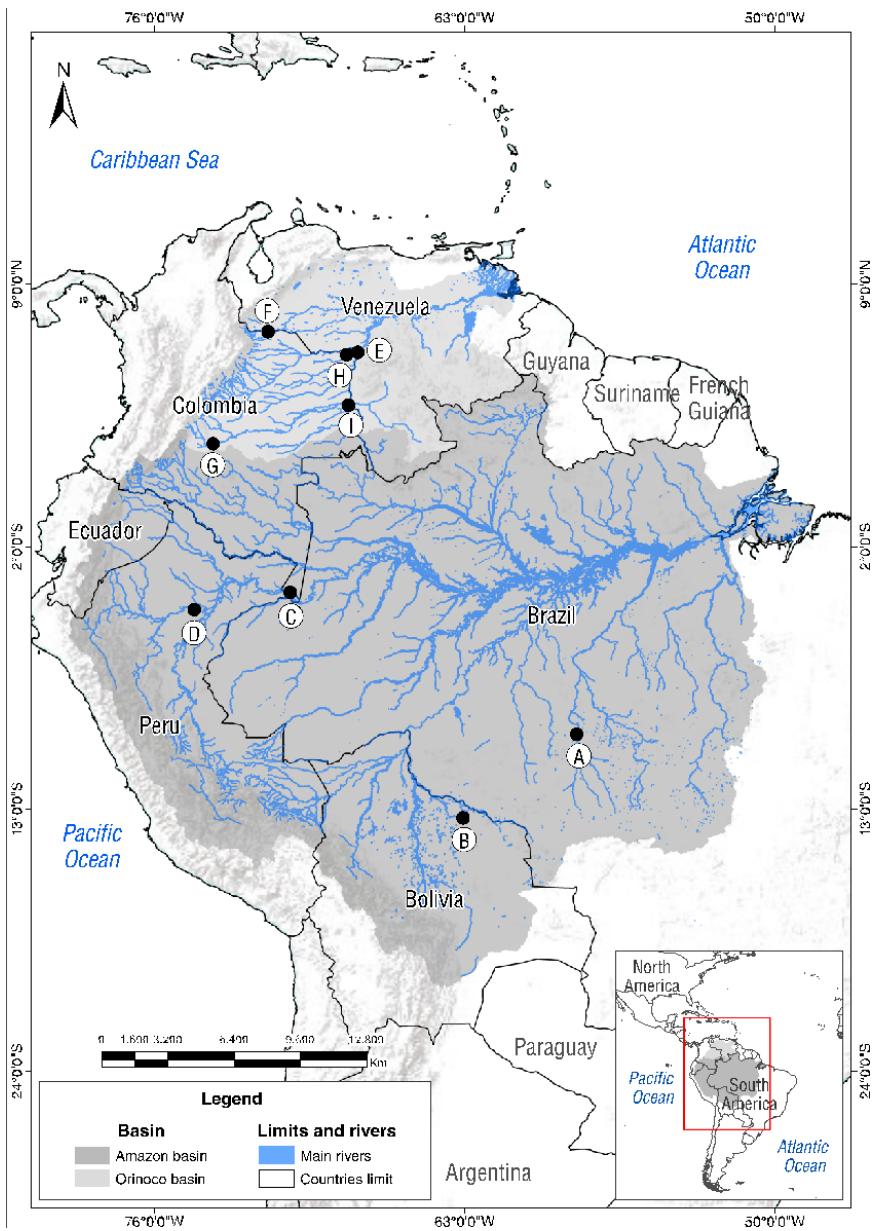 Figure 1: Amazon River dolphins satellite tagging: Amazon basin (A) Juruena River, Brazil, (B) San Martín River, Bolivia, (C) Amazon River, Colombia, and (D) Marañón River, Peru and rivers in the Colombian Orinoco basin (E) Orinoco River, (F) Arauca River, (G) Guayabero River, (H) Bita River, and (I) Guaviare River.
2.2 Dolphin capture protocol and measurement recording
Only adult individuals were selected for tagging, and their ages classes were estimated based on body length, following the methods of da Silva (2009) and Martin and da Silva (2018), and avoiding females with calves. As part of our protocol, a veterinary team was present throughout the capture procedure to monitor the health of the animals according to cardiac and respiratory rates. There was no evidence that individuals experienced excessive stress. No increase in heart and respiratory rates, or sudden movements of head or caudal fins were noted that had been previously documented as signs of stress (Martin et al. 2006). In the event of excessive stress, our safety protocol required that the capture operation would immediately be halted and the dolphin released, but in none of the procedures was it necessary to do this. Our sample size was limited by the number of satellite tracking devices.
2.3 Spatial Analyses
The spatial analyses of the home range sizes of the I. geoffrensis followed the process of Mosquera-Guerra et al. (2021). The locations of the tagged river dolphins were determined using the ARGOS satellite system, maintained by ARGOS Service. Locations were classified by the ARGOS system into one of six location classes (LCs) based on the level of accuracy, measured in kilometers of uncertainty for latitude and longitude. ARGOS classifies location quality relative to an estimated error radius in the following location classes: 3 (accurate to \<250 m), 2 (accurate to 250–500 m), 1 (accurate to 500–1500 m), and A and B (1–2 messages received but no accuracy estimation). In our study, we used only the most accurate data, LCs 3 and 2, after filtering the data with SAS-routine and the ARGOS-Filter (Witt et al. 2010; Wells et al. 2017; Dolton et al. 2020). Data with low accuracy, LC1 (500–1500 m), and data in classes A and B with no accuracy estimations were not used in our analyses (Mosquera-Guerra et al. 2021). Kernel density estimates at a 95% probability utilization distribution (UD) ( ) were used to calculate home ranges (Powell 2000; Oshima et al. 2010; Wells et al. 2017; Mosquera-Guerra et al. 2021).
2.4 Predictors
In our study, the statistical analyses included three morphological explanatory predictors reported in the scientific literature for large terrestrial and aquatic mammals (Table 1). The morphological predictors were obtained from the 34 individuals tagged (10 individuals in this study and 24 Mosquera-Guerra et al. 2021; Supplementary material), and the Table 2 list the range (mean +/- SE) of these predictors. Satellite tagging was conducted under research permits for each country (Bolivia: DGBAP/MEG No. 0515/2017; Brazil: SISBIO 60171-1; Colombia: No. DTA 0898/2018; Peru: RD 515-2018 PRODUCE, RJ 003-2018).
Table 1: Summary of morphological explanatory predictors used in the Kruskal – Wallis test and significance values of the Shapiro-Wilk test Those significant for the explanatory predictors are marked with an asterisk (*).
| Category | Explanatory | Type | p Value | References |
| Morphological | Body mass (kg). | Continuous | 0,001* | Harestad and Bunnell (1979); Dahle et al. (2006); Knight et al. (2009), and Tucker et al. (2014). |
| Body length (cm). | Continuous | 0,05* | Knight et al. (2009), and Tucker et al. (2014). | |
| Sex (♀ and ♂). | Categorical | - | Dahle and Swenson (2003a; b), and Dahle et al. (2006). |
2.5 Statistical analyses
We used a Shapiro-Wilk normality test performed on the explanatory variables (Table 1) and subsequently a Kruskal-Wallis to assess the interactions between and the three predictors (Table 3). Statistical analyses were carried out with the open-source software R.4.0.3 (R Core Team 2020) for the graphical representation using the R software package ggplot2. In all cases, a value of p < 0.05 was considered statistically significant.
III. RESULTS
3.1 Home range ( ) and explanatory predictors
The calculated values of the dependent variable and the morphological predictors considered in the statistical analyses are presented in Table 2 (Supplementary material).
Table 2: Range (mean ± SE) and description of the values calculated for the dependent variable and explanatory predictors for the Kruskal – Wallis test.
| Variable/predictors | Range (mean ± SE) / Description |
| Dependent variable | |
| Amazon River dolphins home range sizes (K95). | 5,59–234 km2 (mean = 53 ± 57,53 km2). |
| Morphological predictors | |
| Body mass (kg). | 49– 200 kg (mean = 102 ± 37). |
| Body length (cm). | 162– 227 cm (mean = 192 ± 20). |
| Sex (♀ and ♂). | Males analyzed (n = 23, 68%) and females (n = 11, 32%). |
The results of the statistical significance values for the interaction between the dependent variable and the three predictors considered are presented in Table 3. These results show the influence of the sexual condition of the individuals on the size of the home range (Figures 2a-c, 3).
Table 3: Statistical significance values of the Kruskal-Wallis test Those significant for the explanatory predictors are marked with an asterisk (*).
| Interactions | $X^2$ | df | p Value |
| $K_{95} \sim Body mass (kg)$ | 2,65 | 3 | 0,44 |
| $K_{95} \sim Body length (cm)$ | 3,11 | 3 | 0,37 |
| $K_{95} \sim Sex (\text{♀ and♂})$ | 4,32 | 1 | 0,037* |
{"image_source":{"path":"images/321a4cb3a422abdd15d3ae4801bd100f1b766eaf5c992f94486e4f74f22497f3.jpg"},"content":"","chart_caption":[],"chart_footnote":[]} {"image_source":{"path":"images/eba7834340b1c10508ed9d015d0f3fe9c116c6a7074d6a3fb35e3ac29e78af9e.jpg"},"content":"","chart_caption":[],"chart_footnote":[]}
{"image_source":{"path":"images/fc1b66f5cbc998a8075a53b81f6a7f166515524fbe4a140371131653fe1ecdcf.jpg"},"content":"","chart_caption":[{"type":"text","content":"Figure 2: Box plot of the variation in home range size ("},{"type":"equationinline","content":"K\{95}"},{"type":"text","content":") by sex for the three predictors assessed: (A) body mass (kg), (B) body length (cm), and (C) sex (♀ and ♂). The red circles correspond to females and the blue circles to males."}],"chart_footnote":[]}
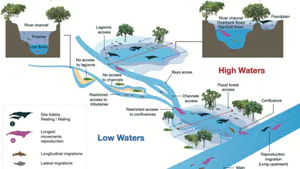
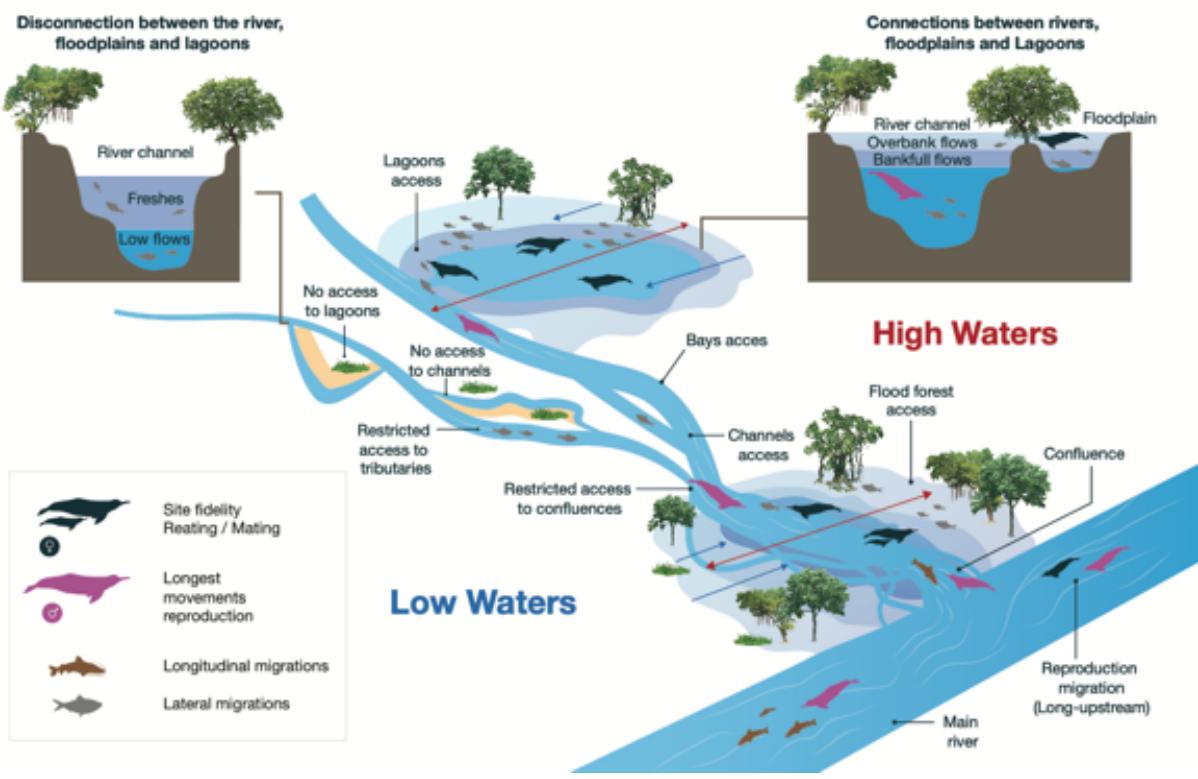 Figure 3: Flood pulse effects on Inia geoffrensis spatial ecology, highlighting variations in density, habitat availability, and fish prey migrations. During the high-water season, the rise in water levels causes the connection between the main river and the floodplains and lagoons. During this period fish and individuals of I. geoffrensis gradually access these new environments. In the season of the flood pulse, fission behaviors of dolphin groups occur, i.e., females with calves settle in the lagoons and confluences and males instead use more habitat types such as the main river and channels behind fish that make upstream breeding migrations. Conversely, during the low water season of flood pulse, the decrease in water levels disconnects the floodplains and lagoons from the main river, in this season dolphin groups merge again and individuals of I. geoffrensis converge in the confluence and channel habitat types to breed; some adult males move hundreds of kilometers to look for groups of females settled in other confluences along the basin.
IV. DISCUSSION
4.1 Body mass and length
The evolution of home range size appears to have been driven mainly by the energetic requirements and costs or benefits associated with a given body mass (see e.g., Nagy 2005). Ecologists have sought to understand the principles underlying how mammals optimize their space requirements (Buskirk 2004). The body-size hypothesis has been used to explain differences in home range size among different species (see, e.g., Harestad and Bunnell 1979; Kelt and Van Vuren 2001; Dahle et al. 2006). Many ecological studies on terrestrial and aquatic mammals employ linear models to establish the relationships between home range size and body mass (see, e.g., Buskirk 2004; Tucker et al. 2014; Kelt and Van Vuren 2001). Early attempts to understand the relation between body mass and home range size suggest that home range increases at the same rate as metabolism (Kleiber, 1961). The strong positive relationship between home range size and body mass reflects the balance between the cost of locomotion and metabolic requirements with increasing body mass (McNab 1963). In the most taxonomically comprehensive analyses of home range size predictors, body mass is the principal predictor in mammals, accounting for 53–85% of the observed variation in home range size among species (Tucker et al. 2014). However, in neotropical mammals, environmental ecosystemic variables such as seasonality, productivity levels, prey supply, sexual condition, gestation status, and presence of young, are perhaps greater influential predictors of home range size. Our statistical analyses failed to establish any relationship between mass and home range size, confirming Fahrig (2013).
In addition, the non-relationship between home range size and allometry of monitored river dolphins could also be explained by morphological variations among subspecies of the genus Inia reported in the scientific literature, even to the point of currently proposing three species (1) I. geoffrensis (Amazonas and Orinoco basins); da Silva and Martin 2014; da Silva et al. 2018), (2) I. boliviensis (Madeira, Iténez, Mamoré, Blanco, and Grande rivers); Banguera-Hinestroza et al. 2002; Ruíz-García et al. 2008), and (3) I. araguaiaensis (Araguaia-Tocantins river basins); Hrbek et al. 2014; Brum et al. 2021). However, the Taxonomy Committee of the Marine Mammal Society only recognizes to date the subspecies considered in this study (Committee on Taxonomy 2021).
Among the main morphological features that differentiate these two subspecies are the total length and the number of teeth. Inia. g. geoffrensis has an overall total length of 219–255 cm (males) and 182–225 cm (females), and the total number of upper jaw teeth range from 23-35 (mean = 26·6) while the lower jaw has from 24-35 (mean = 27·1). In the case, I. g. boliviensis the total length is 230 cm (males) and 208–216 cm (females), and the total number of upper jaw teeth ranges from 31-35 (mean = 33·3) while the lower jaw ranges from 31-34 (mean = 32·3); da Silva and Martin 2014).
4.2 Sex and reproductive status
Sexual dimorphism has been documented in I. geoffrensis with males weighing between 113.5–207 kg, while females weigh between 72–154 kg (da Silva and Martin 2014). Males are likely to be growing marginally faster than females of the same age in the months after birth (Martin and da Silva 2006; 2018). We found a statistical relation between I. geoffrensis sex and home ranges (Table 3, Fig. 2c). Our results are in line with those proposed by Lindstedt et al. (1986) and Folkens et al. (2008) in relation to the differences in home range sizes between males and females for both marine cetaceans (bottlenose dolphin) and terrestrial carnivorous mammals. The documented pattern is concordant with those in fission-fusion societies, such as those seen in many dolphin species, where individuals in the same population may have greatly different ranging patterns (e.g. Defran et al. 1999); and individuals may alternate between local site-fidelity and longer ventures away from the site of their first identification (e.g. Rako-Gospić et al. 2017).
Our mean values for male home range values are also within the I. geoffrensis home ranges reported by Martin and da Silva (1998; 2004a;b) and Mosquera-Guerra et al. (2021), and may represent dominant male individuals in their search for females throughout the basin. Mosquera-Guerra et al. (2021) suggest that sexual status may determine home range sizes and the most extensive movements for individuals of the populations distributed in the Amazon (Colombia), San Martín (Bolivia), and Marañón (Peru) rivers in the Amazon and Orinoco river basins.
Similar results have been reported for male bottlenose dolphins that presumably have larger home ranges than females, a situation that is thought to allow males to increase their reproductive access to females (see, e.g., Eisenberg 1966; Wells et al. 1987; Wells 1991; Sprogis et al. 2016). Previous studies on the behavioral ecology of common bottlenose dolphins (T. truncatus) have revealed great variability in their home range characteristics (see, e.g., Connor et al. 2000; Defran et al. 1999; Wells et al. 1999) that may be due to habitat heterogeneity or to differences in the use of space between the genders (see, e.g., Connor 2000; Wells et al. 1980). Some authors also suggest that the period of parental care of the calf (1.5-5.8 years, Martin and da Silva 2018) for Amazon River dolphins of the genus Inia limits the movement of the female during this period of time when the calf reaches the right physical condition to perform the different movements along the different aquatic landscapes (see, e.g., Mosquera-Guerra et al. 2021). Additionally established correlations are known between age and reproductive status with home range size (see, e.g., Dahle and Swenson 2003a, b; Dahle et al. 2006; Rako-Gospić et al. 2017).
4.3 Conservation implications
In terms of conservation, Mintzer et al. (2016) and Mosquera-Guerra et al. (2022a) report on the relationship between spatial use, sexual status and the level of exposure to hazards for individuals of Inia spp. This sexual segregation differentially exposes males and females to targeted or incidental captures as well as other types of threats (see, Mintzeret et al. 2016). Interactions between Amazon River dolphins and fisheries generally occur in highly productive habitats, such as (1) confluences, (2) channels, and (3) lagoons, where capturing mostly sexually mature individuals and possibly larger numbers of females that have minor movements and are restricted to specific habitats where they care for their calves (see, Mosquera-Guerra et al. 2022a). These factors contribute strongly to the drastic population decline of Inia spp. in its occurrence range of occurrence (see, Williams et al. 2016; Martin and da Silva 2021).
Also, a major human activity that affecting the spatial and movement ecology of I. geoffrensis and the possible adaptation of their populations to climate change is the presence of hydroelectric dams throughout the dolphins' range. In the Amazon basin, 158 hydroelectric dams are either in operation or under construction; and 351 more dams have been proposed (Forsberg et al. 2017; Almeida et al. 2019; Anderson et al. 2019). Many aquatic species are affected by hydroelectric dams (Lees et al. 2016). Among the direct effects caused by hydroelectric dams is the fragmentation of both I. geoffrensis and fish prey populations, resulting in disruptions to gene flow that cause diminishing genetic variability and increased vulnerability (Trujillo et al. 2010; Gravena et al. 2014; Pavanato et al. 2016; Mosquera-Guerra et al. 2018b; Paschoalini et al. 2020; Mosquera-Guerra et al. 2022b). Indirectly, the dams can decrease limiting nutrients for aquatic food webs such as nitrogen and phosphorus downstream of the dam, decreasing levels of productivity and biomass, thus reducing prey availability for the dolphins (Trujillo et al. 2010; Mosquera-Guerra et al. 2018b; Araújo and Wang 2015).
Fragmentation of river networks by hydroelectric dams and other infrastructure constrains potential range shifts of aquatic species for coping with expected temperature rise under climate change (Myers et al. 2017; Mosquera-Guerra et al. 2019b). Range shifts of fish to higher altitudes as a result of climate changes have already been documented, but river fragmentation by hydroelectric dams will block this form of adaptation (Herrera-R et al. 2020). Aquatic species, distributed in the Andean countries such as the I. geoffrensis populations in Peru and Bolivia are thought to be particularly impacted because most hydroelectric dams have been built or planned on Andean tributaries such as the Maderia river basin (Forsberg et al. 2017; Mosquera-Guerra et al. 2018b; Anderson et al. 2019; Tognelli et al. 2019). The ecology and conservation of I. geoffrensis are complex in the Amazonian and Tocantins basins in the current context of transformation, and this urgently requires transforming the energy matrix of the Amazonian countries from hydropower to sustainable production based on solar, wind, and geothermal energies.
Our results do not support the previously established allometric relationship between the body length and mass on the home range sizes of large aquatics mammals, possibly due to the morphological variations of the subspecies of the genus Inia and the influence of the sexual status of monitored individuals on this spatial metric. We suggest the possible influence of non-evaluated predictors such as productivity levels of the aquatic ecosystems assessed (e.g., white, black, clear, and mixed water systems), availability of prey, and the presence of highly productive habitats (e.g., lagoons and confluences).
This research also calls attention on the possible vulnerability of the Amazon River dolphins to human impacts at a regional scale, such as the regulation of the flood pulse and its influence on the lateral and longitudinal movements of these cetaceans in the Amazon mainly. Finally, this paper warns about the negative effects of dam construction as physical barriers that alter prey migration and artificially regulate hydrological processes. These limit species' adaptations to climate change, increasing the risk of extinction of some populations that are located in the areas of influence of these infrastructure projects such as the individuals monitored in this study on the Tapajos River in Brazil.
ACKNOWLEDGEMENTS
This program is part of the strategic plan defined by the South American River Dolphin Initiative (SARDI) supported by the World Wildlife Fund (WWF) in Brazil, Colombia, Peru, Ecuador, and Bolivia. Partial support for two tags from Peru was from the Rufford Foundation through RSG. Special gratitude goes to Marcelo Oliveira da Costa, Daphe Willems, Karina Berg, Lilia Sainz, José Rivas, Jordi Surkin, Roberto Maldonado, Dick Ember, Verónica Téllez, and Monica Wulms from WWF. Federico Mosquera Guerra received a Postdoctoral Fellowship from Pontificia Universidad Javeriana (ID project: 20389 to 2021). EC received a doctoral scholarship from WWF-EFN. Aldo Echeverría, Leslie Cordova, and Adriana Salinas are acknowledged for their support during tagging campaigns in Bolivia and Miriam Marmontel in Brazil. We acknowledge the fishing communities and the local and national authorities for participating in the I. geoffrensis individuals capture process.
Funding: This work was supported by the Whitley Fund for Nature (WFN), World Wildlife Fund (WWF), CORMACARENA, CORPORINOQUIA, CORPOAMAZONIA, Projects Design and Development (PDD), and Pontificia Universidad Javeriana (PUJ).
Author contributions: Federico Mosquera-Guerra, Fernando Trujillo, Jairo Pérez Torres, Hugo Mantilla-Meluk, Nicole Franco, Paul André van Damme, Elizabeth Campbell, Joanna Alfaro-Shigueto, José Luis Mena, Jeffrey C. Manguel, María Jimena-Valderrama, Estefany Acosta-Lugo, and Dolors Armenteras-Pascual conceived the study and designed the methodology. Fernando Trujillo and José Saulo Usma Oviedo acquired the data, Federico Mosquera-Guerra interpreted the results and wrote the first draft of the paper, and all the authors contributed to its writing.
Availability of data and material: The datasets generated during the current study are available from the corresponding author on reasonable request.
Code availability: The R code used during the current study is available from the corresponding author on reasonable request.
Data availability: Data are available upon request.
Declarations
Ethics approval: All procedures involving animals were conducted with the appropriate permits and following ASM guidelines (Sikes 2016).
Open Access: This article is licensed under a Creative Commons Attribution 4.0 International License, which permits use, sharing, adaptation, distribution and reproduction in any medium or format, as long as you give appropriate credit to the original author(s) and the source, provide a link to the Creative Commons licence, and indicate if changes were made. The images or other third party material in this article are included in the article's Creative Commons licence, unless indicated otherwise in a credit line to the material. If material is not included in the article's Creative Commons licence and your intended use is not permitted by statutory regulation or exceeds the permitted use, you will need to obtain permission directly from the copyright holder. To view a copy of this licence, visit http://creativecommons.org/licenses/by/4.0/.
SUPPLEMENTARY MATERIAL
Appendix S1: Summary of the ecological predictors and home range sizes of the Inia geoffensis used in the GAMLSS, including as follow: locations, subspecies, platform transmitter terminal identification number (PPT ID); I. geoffensis home range sizes: : home range 95% utilization distribution (UD) sizes. Morphological predictors: body mass (kg), body length (cm), and sex: ♀: female and male: ♂.
| Locations/Subspecies | PTT ID | $K_{95}$ (km2) | Body Mass (kg) | Body Length (cm) | Sex | References |
| Amazon River (Colombia) | ||||||
| I. g.geoffrensis | 40679 | 30,7 | 78,4 | 199 | ♀ | Mosquera-Guerra et al., 2021 |
| I. g.geoffrensis | 40691-1 | 61,7 | 118 | 176 | ♂ | Mosquera-Guerra et al., 2021 |
| I. g.geoffrensis | 181675 | 48,7 | 109 | 174 | ♂ | This study satellite tracking data |
| I. g.geoffrensis | 181676 | 105,5 | 112 | 178 | ♂ | This study satellite tracking data |
| Juruena River (Brazil) | ||||||
| I. g.geoffrensis | 171926 | 23,6 | 89 | 197 | ♂ | Mosquera-Guerra et al., 2021 |
| I. g.geoffrensis | 40663 | 17,6 | 49 | 162 | ♀ | Mosquera-Guerra et al., 2021 |
| I. g.geoffrensis | 40687 | 27,9 | 60 | 182 | ♂ | Mosquera-Guerra et al., 2021 |
| I. g.geoffrensis | 40681 | 15,5 | 56 | 193 | ♂ | Mosquera-Guerra et al., 2021 |
| I. g.geoffrensis | 40693 | 12,1 | 91 | 205 | ♂ | Mosquera-Guerra et al., 2021 |
| Marañón River (Peru) | ||||||
| I. g.geoffrensis | 55305 | 20,9 | 97 | 197 | ♂ | Mosquera-Guerra et al., 2021 |
| I. g.geoffrensis | 175587 | 32,2 | 63,9 | 177 | ♂ | Mosquera-Guerra et al., 2021 |
| I. g.geoffrensis | 55298 | 11,8 | 72,5 | 182 | ♂ | Mosquera-Guerra et al., 2021 |
| I. g.geoffrensis | 55306 | 6,2 | 101,9 | 173 | ♀ | Mosquera-Guerra et al., 2021 |
| I. g.geoffrensis | 55309 | 20,1 | 92,6 | 170 | ♂ | Mosquera-Guerra et al., 2021 |
| I. g.geoffrensis | 55312 | 64,9 | 111,7 | 182 | ♂ | Mosquera-Guerra et al., 2021 |
| I. g.geoffrensis | 55319 | 186,8 | 99 | 176 | ♂ | Mosquera-Guerra et al., 2021 |
| I. g.geoffrensis | 175588 | 88,3 | 97 | 180 | ♂ | Mosquera-Guerra et al., 2021 |
| I. g.geoffrensis | 40688 | 8,8 | 180 | 214 | ♂ | Mosquera-Guerra et al., 2021 |
| I. g.geoffrensis | 40691 | 18,9 | 68 | 159 | ♀ | Mosquera-Guerra et al., 2021 |
| I. g.geoffrensis | 171927 | 41,2 | 107 | 188 | ♂ | Mosquera-Guerra et al., 2021 |
| I. g.geoffrensis | 40641 | 76,4 | 200 | 227 | ♀ | Mosquera-Guerra et al., 2021 |
| I. g.geoffrensis | 181019 | 15,1 | 83 | 176 | ♀ | This study satellite tracking data |
| I. g.geoffrensis | 181020 | 13,3 | 82 | 175 | ♀ | This study satellite tracking data |
| I. g.geoffrensis | 181015 | 17,59 | 149 | 235 | ♂ | This study satellite tracking data |
| I. g.geoffrensis | 201339 | 20,75 | 129 | 224 | ♂ | This study satellite tracking data |
| Bita River (Colombia) | ||||||
| I. g.geoffrensis | 181017 | 5,59 | 85 | 174 | ♀ | This study satellite tracking data |
| Arauca River (Colombia) | ||||||
| I. g.geoffrensis | 181018 | 25,8 | 88 | 175 | ♀ | This study satellite tracking data |
| Guayabero River (Colombia) | ||||||
| I. g.geoffrensis | 40641 | 49,38 | 180 | 214 | ♂ | This study satellite tracking data |
| I. g.geoffrensis | 181013 | 115,7 | 176 | 223 | ♂ | This study satellite tracking data |
| Guaviare River (Colombia) | ||||||
| I. g.geoffrensis | 181016 | 19,43 | 110 | 210 | ♀ | This study satellite tracking data |
| San Martín River (Bolivia) | ||||||
| I. g.boliviensis | 40640 | 233,9 | 91,2 | 204 | ♂ | Mosquera-Guerra et al., 2021 |
| I. g.boliviensis | 40662 | 89,2 | 83 | 209 | ♂ | Mosquera-Guerra et al., 2021 |
| I. g.boliviensis | 40674 | 204,9 | 85,4 | 208 | ♂ | Mosquera-Guerra et al., 2021 |
| I. g.boliviensis | 171928 | 60,5 | 69,2 | 211 | ♀ | Mosquera-Guerra et al., 2021 |
Conflict of Interest
The authors declare no conflict of interest.
Ethical Approval
Not applicable
Data Availability
The datasets used in this study are openly available at [repository link] and the source code is available on GitHub at [GitHub link].
Funding
This work did not receive any external funding.
References
Cite this article
Related Research


Special Issue
Launch a focused special issue to highlight research, emerging trends, and expert insights in your academic field.
