



Abstract
Feelings play an increasingly important role in psychoanalysis and neuroscience. Following some general reflections, we introduce the concept of predictive coding or anticipatory simulation. Within this framework, feelings are constructed judgements on inner simulative states. Both feelings and language have the task of investing innerstates with meaning and rendering this meaning communicable. Feelings are conscious; they constitute the first form of phenomenal consciousness. This scientific approach can easily be formulated as part of the Lacanian metapsychology. We will show, that the linking of both perspectives enables a gain of knowledge. Thus, for instance, the Markovblanket can be understood as a function of the Real, and the theory of predictive coding sheds light on the characteristics of the Imaginary. Phenomena such as transference, countertransference or projective identification can also be better elaborated against this interdisciplinary backdrop.
Explore Digital Article Text
The ontological background to our reflections is as follows: Spinoza believed that spirit and matter are attributes of a single substance. This observation can also be found in Leibniz's theory of monads. Within the framework of such a "dual-aspect monism", Hegel distinguished between idea (spirit) and matter (nature); however, he understood spirit and nature as two sides of the same coin. Thus, this substantial coin encompasses both the Ideal (i.e., the Immaterial: the soul and the spirit), as well as matter (i.e., the Material: nature and the body (Hegel 2010, § 389). Nature encompasses mechanics and physics as well as our living body including the neuronal networks and excitations which are kick-started by hormones, minerals and neuropeptides. From the perspective of the Ideal, nature and the body are both the Outer and the Other. Nature and the body are ideas "in the form of Otherness" (Hegel 2010, § 247; Orman 2015, p. 523). We highlight this Hegelian trope because nowadays it plays an outsize role in the neurosciences regarding the Theory of Predictive Coding. Although matter is the sensorially Perceptible which is characterised by temporo-spatiality (Hegel 2010, § 261 Z), it can only be thought of in the registers of the Ideal.
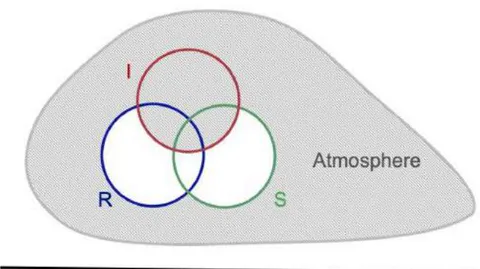
From this idealistic perspective, only the Ideal is real – as if there were no reality but subjective reality. From a Lacanian perspective, this ideal side of materiality is composed of the dimensions of the Real (R), the Symbolic (S) and the Imaginary (I):
The Real is the Non-Represented and Indeterminate; it is unconscious. Although it exists, it is non-existent for us, because it is non-represented. Occasionally, the Real is equated with the Traumatic, but it should not be limited to it. On one occasion, Hegel (2010, § 401 Z) speaks in connection with the soul, which forms the deeper layers of the subjective mind, from simple sensations that he terms unconscious. We therefore describe the Real as the register of unconscious sensations. These sensations are distinguished from conscious or repressed-unconscious thoughts, which belong to the imaginary-symbolic register (cf. Soler 2016, p. 57). In this respect, the Real is everything Ideal that is not a thought. Sensations are translatable to the register of the Imaginary. Later on, they can be determined symbolically, i.e. linguistically.
The Imaginary is the Sensory in the form of images, noises or sounds, smells and tastes, but also in the form of feelings and internally or externally perceived haptics. Feelings are also imaginary thoughts. Additionally, we expand the Imaginary by adding the dimension of the Atmospheric and the Phenomenal. We call feelings that spread in a space (i.e. that go beyond the boundaries of one's body) "atmospheric". The atmosphere is therefore the affective vibe in an architectural or scenic space. The Imaginary, and hence the atmosphere, are initially "phenomenal". "Phenomenality" means preverbal-conscious experience (in the sense of the Greek φαινομεναι – "something appears"). The phenomenon appears as a visual image, acoustic sound, smell, taste, tactile touching, feeling or atmosphere (cf. Demmerling 2021). Imaginary phenomena are characterised by their pure, nonverbal presence. They lose their phenomenality as soon as they are determined or named by the Symbolic, which is discursive-linguistic. The Real is the Pre-Phenomenal, and the Symbolic is the Post-Phenomenal. Thus, the Real exerts an effect on the Phenomenal, i.e. the Phenomenal is posited by this "pheno-real effect". The Pheno-Real is an effect, i.e. it is a fundamental condition of further thinking. It is the experiential core of thought.
The Symbolic is the Linguistic, insofar as words (i.e. signifiers) convey a mental meaning or sense. The sound of the voice is just as imaginary as the graphic design of a letter. Words that contain a meaning or sense, however, belong to the register of the Symbolic. Words and their combinations are learned in childhood. Language then yields more complex, discursive word combinations such as laws. Linguistic signifiers can determine the Phenomenal. In this case, the linguistically determined Imaginary loses its phenomenality. We limit ourselves here to the point of view that the Symbolic is linguistic, and that the symbolic order is only effective within and through language (cf. footnote 15).
Figure 1: Summarises our reflections. It shows matter (M) and the three registers of the Ideal: the Real (R) as the Non-Represented, the Imaginary (I) as the Sensory in the form of images, sounds, smells, tastes, feelings and internally or externally perceived haptics, and the Symbolic (S) as language, words, signifiers; the Imaginary is expanded by the quality of the Phenomenal (Non-Linguistic) and Atmos- pheric (feelings in space and time). The line denotes a substance or structure - in any case, an underlying element from which the Material and Ideal arise (e.g. as thunder and lightning arise from electricity; cf. Solms, 2022, p. 302). Lacan (1998, p. 150 f.) describes matter as a registre biologique, i.e., as a biological order. In this respect, there is a material exterior that is the biological body and a material exterior that is the organic and inorganic world outside of this body. The biological register is the material side of the Ideal, i.e., of the Real, Imaginary and Symbolic:
II. WHAT ARE FEELINGS?
1.1. The question of essences and their physiological correlates
When we examine what feelings are from the perspective of empirical research, we discover the following points of view: feelings are states that occur due to the influence of drives or cognitive processes. They are mainly conceptualised as reactions (Krause 2012, p. 179). Freud (1895, p. 457) described affects as "valve-like discharge channels". Their function was to regulate the drives. Affects are expressed in the facial muscles or the voice (Krause 2012, p. 177). They are both perceived and responded to by others. In this respect, affective systems firstly form a sort of interface between various subsystems of the organism and the environment (Scherer, 2000). Secondly, affective development is divided into the ability to encode and decode affects. Tomkins (1962, 1963) proposes a corresponding taxonomy according to the social functions of the affects. The following types of affects exist: 1) social affects, such as mourning, joy, rage and shame; 2) information-processing affects, such as surprise and interest; and 3) distress affects, such as fear and disgust. Panksepp and colleagues defined seven basic emotions: SEEKING, LUST, CARE, PLAY, FEAR, RAGE/ANGER, SADNESS/PANIC (Panksepp 1998; Panksepp et al. 2016). These affective states trigger chains of action that are characterised by varying degrees of complexity: Flight and attack actions, for example, require very complex motor actions, while vomiting or spitting represent chiefly reflexive responses.
Lisa Feldman Barrett (2020, p. XV) thinks that a major upheaval is currently occurring in our understanding of feeling and spirit. In previous conceptions, it was assumed that every emotion had a specific and innate essence that differed from other essences. On a material level, certain areas of the brain were considered responsible for the origin of emotions. In addition, there was said to be a typical correlate in the body (in the form of a "fingerprint") common to all variants or instances of a specific emotion. This correlate supposedly expressed itself in one particular expressive behaviour (Feldman Barrett 2017; Feldman Barrett 2020, p. 158). By contrast, Feldman Barrett advocates the thesis that a single category of emotion could arise in various areas of the brain. She argues that many variants could emerge in terms of physical correlates. A specific facial expression (e.g., wide-open eyes meant to signal fear) would then instead be said to correspond to a cultural stereotype conveyed by videos, comic books or cartoons (Feldman Barrett 2020, p. 11). Furthermore, she asserts that bodily reactions to emotions are generally very similar to one other, so there are no bodily fingerprints of different emotions (Feldman Barrett, 2020, p. 13). Here, the argument of "many-to-one connectivity" is invoked (Edelman & Gally 2001; Mayr 2004; Marder & Taylor 2011; Clark-Polner et al. 2016; Siegel et al., 2018): this primarily means the ability of different neuronal groups to elicit instances of the same category of emotion. The hypothesis is that an emotion forms a category consisting of highly variable emotional instances. Categories of emotion are therefore merely abstractions that need not necessarily exist in nature (cf. Clark-Polner et al., Wilson-Mendenhall et al., 2015). One can experience fear with or without activation of the amygdala (i.e. the brain region that is commonly considered to be the seat of fear). Rage may or may not be accompanied by elevated blood pressure (Feldman Barrett 2020, XII). Hence, a pattern described as sadness is not a specific brain state in the biological register. It is merely the statistical summary of a highly variable quantity of different variants. In this respect, the brain contains core systems involved in generating numerous mental states: a core system can play a crucial role in thinking, remembering, deciding, seeing, or experiencing different emotions. For this reason, feelings should be understood as holistic constructions, i.e., constructions encompassing the entire brain and the body (Feldman Barrett 2017).
1.2 Assumption and Anticipatory Simulation
This theory of the construction of emotions refers to the idea that brain activity constructs anticipatory simulations, predictions or presuppositions, together with their corrected versions. We are speaking here of clear evidence that what we see, hear, touch, taste or smell are simulations, i.e., predictions or presuppositions about the material Outside. These inner states are by no means simply reactions to stimuli. If someone sees an apple, their brain simulates the image, the taste or the scent of an apple. It uses just a few signals and combines these signals with knowledge about previous apples to construct a hypothesis about the apple on the outside. Simulations are presuppositions about what is happening outside of the brain. The brain applies such predictions to trigger a bodily activity, e.g., taking hold of the apple. If the brain were to react primarily, it would be constantly bombarded with a plethora of chaotic sensory impressions. Its capacity to react would not be able to keep the individual alive (Feldman Barrett 2020, p. 60). Moreover, brain activity that functioned primarily reactively would be far too metabolically complicated, requiring substantially more connections than it could maintain regarding its energy budget.
Friston (2013; 2017, p. 69 ff.) describes the predictive coding (i.e., the coding of sensory signals to produce predictions) within the model of self-organising systems. For this description, he introduces four states:
Outer states ( ): These states encompass the outside of the material world which remains completely hidden from the individual. In our RSI model, the outer state is "matter", which we shall describe in greater detail below.
Inner states (R): These states are presuppositions (simulations) about the outside world, in the sense of presuppositions and retrospective assumptions arising after correction of the prediction error. In the RSI model, these inner states will be described as "imaginary thoughts".
Sensory states (S) mediate between the outer and inner world; in the RSI model, these states are real sensations.
Action states or motor activities (A) arise from presuppositions or retrospective assumptions. The action level should be added to the RSI model (in the broadest sense of Lacan's acte, see Lacan, 2024).
Friston (2013, 2017, p. 69 ff.) locates sensory states (S) and action states (A) within probability statistics operating with probability distributions (p) in the so-called Markov blanket. A Markov blanket separates the inside of the system from the material outside in the form of a mathematical object. Later, we will assign the Markov blanket to the real register, which contains unconscious sensations or sensory signals. These signals construct inner states (presuppositions, simulations) with recourse to conscious and unconscious memory content. The signals are therefore coded in the form of predictions. If the prediction error is large, a surprise effect will occur. This effect leads to an increase in entropy in the form of "free energy" (Friston 2012; Friston 2017, p. 78; Solms & Friston 2018). The presupposition or simulation is then checked by comparing it with further sensory signals (i.e. real sensations), using only those signals needed for the correction of the prediction error. Above all, such a selection saves a great deal of energy. All self-organising systems aim to decrease entropy enough for equilibrium (homeostasis) to be re-established at a deeper entropic level, e.g. as a result of a(n) (motor) action. In this way, through prediction and correction, the brain is constantly creating an ideal model of the world .
1.3 Emotional and Verbal Concepts
Simulative models can be judged emotionally and linguistically, i.e., with feelings and words.
Through emotional judgment, the individual knows in a specific situation whether the situation is pleasurable or unpleasant. A verbal judgement locates and anchors the simulated model in linguistic knowledge and enables the communication of these inner states to others.
The evolutionary function of feelings lies in the evaluation of inner states that simulate the outer world (cf. Panksepp et al. 2016). Similarly, Ulrich Moser (2009, p. 59) argues that an affect or feeling indicates an (inner) situation. Here, we see the main task of feelings: to invest presuppositions and corrected assumptions with an emotional significance. Strictly speaking, feelings are judgements that assign an emotional importance to simulations or inner states. As we shall describe below, feelings are ideal and imaginary thoughts. They are imaginary thoughts that judge other imaginary thoughts. In terms of their regionality, they have no defined neurophysiological correlate, and may also express themselves differently (Feldman Barrett 2020, p. 31). In contrast to Feldman Barrett's theory, we advocate the view that mimetic or vocal signs of affect have indisputably developed over the course of phylogeny, together with the knowledge of their significance. Because of this co-evolution of signs and their understanding, a baby, for example, can draw on an already phylogenetically preformed understanding. We would argue that this phylogenetically preformed affective understanding can be used in the current construction of feelings in the same way that the subject can draw on earlier experiences when constructing or simulating inner states.
As far as verbal concepts are concerned, we should bear in mind that in the child's experience, speech represents nothing but a stream of sounds. Even the infant recognises certain regularities in this stream of speech, however, such as regularly occurring boundaries between specific phonemes. In this way, the child develops concepts that can be used to underpin the stream of sounds with a stable semantic structure: verbal concepts categorise the acoustic input, and the young brain, bathed in the speech of others, is busy building a collection of simple concepts of this type (Feldman Barrett 2020, p. 85). Thus, the child learns that a word heard from its parents pertains to specific inner states (Feldman Barrett 2020, p. 101). In this respect, verbal concepts can also be applied to feelings: emotional concepts are anchored by words which name these concepts. On the other hand, words also categorise various facial and bodily configurations that express the same emotion. Verbal concepts, of course, are also variable, malleable, and context-dependent. A car does not always merely serve the purpose of getting from A to B; it can also be associated with the concept of "status symbol" or "phallus". A concept drawn on to construct a simulation usually contains different information on an object – say, a bee. It includes not only information on the object itself, as "meaning", but also information stemming from other concepts having to do with the object (e.g. "meadow", "flower", "honey", "sting", "pain"), as "sense" (see Frege 1993, pp. 23-43). All this information is integrated into the target concept of "bee" (Feldman Barrett 2020, p. 28). Concepts can therefore also be combined. Combinatorics makes it possible to construct a potentially unlimited number of new concepts from already available ones. In this respect, the brain uses previous experiences organised in the form of concepts to determine simulations by meaning or sense (Feldman Barrett 2020, p. 104).
1.4 The Role of Entropy
The greater the prediction error, the greater the surprise effect due to further sensory data fed into the Markov blanket. This surprise effect causes an increase in entropy in the form of "free energy", i.e. an energy that is not bound by mental work or actions (Friston 2012; Friston 2017, p. 78; Solms & Friston 2018). A surprise effect arises when a newborn, faced with the helplessness of an immature organism, is forced to recognise the erroneousness of its simulations and preassumptions, which relate to a positive situation in the womb. In any case, the excessive energy causes an increase in entropy. Simulations themselves can probably lead to increased entropy, e.g. if the simulation draws on previous traumatic episodes or assumes a punishment before the fact (e.g., in the sense of castration). The aim of any self-organising system, however, is to decrease entropy until as low a homeostatic level as possible is achieved. Our organism has various options available to achieve this aim: The subject can act in such a way that its current sensations once more accord with the predictions (i.e. through an active state (e.g. the baby cries to be fed) or through flight (in a situation perceived as traumatic). Thus, the fulfilment of need, demand or desire serves to decrease entropy (cf. Evans 1996, p. 35 f. and p. 124 f.). Alternatively, the subject can attempt to create more accurate predictions (Solms & Friston 2018).
III. HUMAN FORMS OF BEING
3.1 Multimodal Imaginary Constructions and the Symbolic
As said before, Lacan's (2021) Borromean knot, which is meant to represent mental reality, consists of the three rings of the Real, the Imaginary and the Symbolic. For our reflections, the Imaginary is particularly important. It corresponds primarily to Freud's Sachvorstellungen ("thing-presentations") (cf. Freud 1915). These are thoughts possessing an immediate sensuous and sensory basis: visual images, acoustic sounds, but also tastes, smells, the feeling of being touched, and not least of all the affective feelings. As mentioned, an internalisation process – from "bein touched" to "feelin" – took lace during the Enlightenment, i.e. over the 18 century. Originally, Fühlen and Gefühl (the gerund and noun "feeling", respectively) referred to the sensory perception of the Outer. As part of bourgeois inwardness, "feeling" (the noun) mutated into the perception of inner sensory analysis. Unlike the Real, which is deemed unrepresented, the Imaginary is generally conscious (unless it is secondarily repressed).
However, the Lacanian register of the Imaginary can be far more readily conceptualised with the Theory of Predictive Coding. We assume that presuppositions on the outer world, which is hidden from the individual, are constantly being formed (Friston 2013, 2017; Solms & Friston 2018). Nothing is known about the Outer, but with the help of previous experiences and a handful of sensory signals that are stated on the Markov blanket, imaginary presuppositions as to what the Outer might be like are constructed. We suggest that the Real is a Markov blanket, or that, as a formalised mathematical issue, the Markov blanket represents a part of the register of the Real. Thus, the Imaginary is a presupposition that also refers to the subject's earlier experiences. It is a simulation, or as Lacan (2010) puts it, it is a semblance (perhaps in combination with words). In this respect, the Imaginary predicts how the outer world could be. This prediction consists of images, sounds, smells, taste, or the perception of a touch. Karl Friston showed the aetiology of visual thoughts using an experiment in which the face of Nefertiti was presented to experimental subjects. Subjects were able to construct the face from just a few sensory points – in particular, the eyes, brow, and mouth – by linking these points of sensation with additional information from their memory (Friston 2017, p. 86; Friston, Adams, Perrinet & Breakspear 2012). This simulation requires substantially less effort to be expended than the perception of the entire face would. Figure 3 illustrates the experiment:
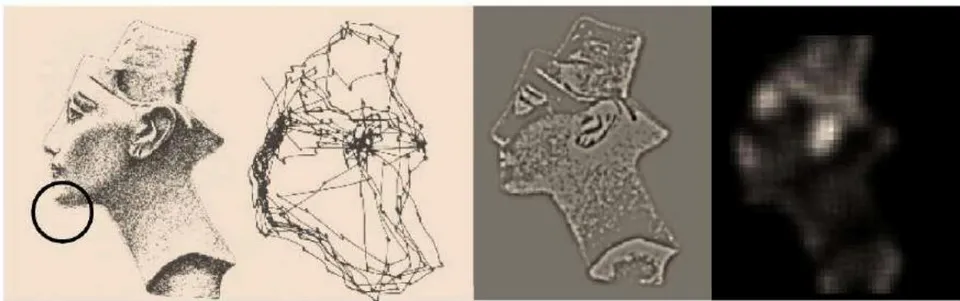
In a further step, this simulated face is squared with the signals of the Markov blanket that point to a prediction error. Here too, not all data are processed. Because of the limited capacity of the brain, only those signals which are necessary for the correction are used. The effect of these selected points of sensation on the – in this example – Visual-phenomenal can be described as the Pheno-real, that is, as the effect of the Real on the Phenomenal. Despite its fictional nature, semblance, i.e. simulation, is "the primary function of truth" (Lacan 2010, p. 37). Truth, one might say, has the structure of semblance. Thus, the truth of the Outer could be based on semblance, i.e. on the imaginary inner state that is possibly determined by words. We can only approach the truth of the Outer through predictions that are already accurate, or through predictions that become more accurate through correction of the prediction error. Hence, there is no truth of the Outer that is not based on semblance, i.e. the inner states.
Here, the salient point is that simulations can be judged both emotionally and verbally: initially, the simulation is judged with feelings of pleasure or unpleasure. This emotional evaluation takes place within a valence of feelings that can be positive or negative. A further evaluative dimension is the degree, i.e. the intensity or excessiveness of feelings (on the material side: the degree of arousal). In the case of trauma, the valence of the feelings is negative, and the arousal is excessive, with the result that the feelings must be secondarily warded off. In this respect, feelings are second-order imaginary thoughts that judge first-order imaginary thoughts. Through this judgement, an imaginary simulation, i.e. an inner state, is invested with an emotional significance. Thus, there are two orders of the Imaginary:
The first order encompasses presuppositions in the form of predictive simulations, as well as retrospective assumptions arising from the correction of prediction errors. These are first-order imaginary thoughts: images, noises, sounds, smells, tastes and the perception of touch and movements. First-order imaginary thoughts arise from pheno-real effects that can be traced back to sensory signals or states on the Markov blanket. These imaginary thoughts are conscious or preconscious, i.e., potentially conscious (e.g. a sound that we pay no attention to, such as the ticking of a clock, or the chirping of birds). Imaginary thoughts (particularly images) can be secondarily repressed.
The feeling judges the simulation, i.e. the presupposition, the surprise effect arising from a prediction error and the corrected simulation, and invests it with an emotional significance. Because of this judging function, feelings are second-order imaginary thoughts. They are conscious. By being conscious, feelings, with their features of valence and arousal, form the foundations of phenomenal consciousness. However, feelings occur primarily when semblance, i.e. the simulation, is plunged into a crisis, e.g. because of prediction errors or trauma-induced inner states. The role of feelings is to point to this crisis.
We now turn our attention to the Symbolic. In the symbolic register, the simulations are determined by linguistic significance (Lacan 2021). It is the Discursive-Linguistic and the structure implied by language. The register of the Symbolic contains the Freudian word-presentations (Freud 1915) that initially appeared in the form of acoustic perceptions, just as the birth of linguistic concepts is described as a categorisation of the stream of speech sounds (Feldman Barrett 2020, p. 85).
Here, the expression "concept" plays an important role: if a linguistically competent individual or a speaking being (cf. Soler, 2009) grasps a thought, then this linguistically composed thought is based on concepts, i.e. the content of such a thought is designated by the content of the corresponding concept (Newen 2003, p. 419). Concepts are abstract objects that are updated in connection with words or propositional statements. Schiffer (2000, p. 9) described concepts as "pleonastic entities" which are not yet linguistic determinations. The concept is knowledge about something (e.g., what a tomato is). Hence, an emotional concept is based on the relatedness of feelings to one or more concepts. A linguistic concept, for its part, is based on the relatedness of words or propositional statements to concepts. Learned knowledge of the meaning of a simulation is thus connected with emotional or linguistic utterances: a concept can be articulated through a feeling or a linguistic proposition. Conceptual knowledge can therefore also be expressed emotionally (via a particular facial configuration) or linguistically. In this respect, the concept of the simulation conveys two forms of meaning: the objective meaning (denotation) and the emotional meaning (connotation) (Eckes 1991).
The Symbolic is thus the fact that there are words (verbal signifiers) whose dimension of meaning is the concept. These words can determine imaginary thoughts (Lacan 2006, p. 228 f.). Freud (1905, p. 120) said that a concept is a kind of Vorstellungskreis ("circle of ideas") which, as knowledge, underlies a feeling or word. Feelings therefore invest a simulation with an emotional meaning, and words add a linguistic meaning. Lacan distinguishes here between the meaning and sense of a word or combination of words by adopting Frege's distinction between meaning and sense. The meaning of the word (or of the sign) relates directly to the object being designated (e.g., the car that we see or imagine): "The reference of a proper name is the object itself which we designate by its means" (Frege 1993, p. 26). By contrast, the sense of the sign relates to the "mode of presentation" of the object. Sense also considers further circumstances (Frege 1993, p. 24). In this respect, meaning is "einseitig" (illuminates a single aspect), while sense is "allseitig" (comprehensive). In ideal terms, the sense is "comprehensive knowledge". However, this comprehensiveness will never be possible; in terms of the sense, something always remains hidden (Frege 1993, p. 24). In contrast to Frege's position, we contend that it is not the object in external reality (since external reality is hidden from us), but rather the simulated, i.e. represented object that is given a meaning or sense through its linkage with language. With the help of verbal signs provided by the parents, the child initially learns the meaning of an idea about external reality. When an adult speaks to an infant, the infant learns that the word has a meaning relating to an idea. As the child matures, it will also learn something about the sense of the idea. Feldman Barrett (2020, p. 91) describes this process using the example of a car: in addition to simply being a car, it can also be a status symbol, a maternal sanctuary, or evidence of male potency. Both the meaning and the sense of a verbal sign can now be evaluated by feelings. Linguistic utterances categorise, stabilise and consolidate the internal imaginary states by investing them with meaning or sense. They make it possible to communicate these states to others. Both feelings and linguistic signifiers may also trigger a simulative reality, however. We hear the word "tomato" or "car" and simulate the corresponding reality: the taste of a tomato or the sound of an engine. This linguistic creativity reminds us in the broader sense of Lacan's idea (2006, p. 223) of "liberated speech", which would mean that signifiers themselves create a simulative reality. The slipping of the signifiers or the switch from one circle of ideas to the next (Freud 1905, p. 120) then evokes inner states, which can be classified either as fantasies or reality. To summarise these aspects, we can say that inner states as well as feelings are invested with a meaning or sense by verbal concepts that are based on one or more conceptual circles of ideas. These verbal concepts are themselves capable of re-evoking inner states which point to something that might exist outside.
3.2 Intersubjective Simulation
Language comes from the Other – this is a fundamental Lacanian idea. Language comes from adults, who are representatives of the "Big Other" that conveys the culture, laws and ideology. According to Freud (1915), word-presentations are used to determine thing-presentations (i.e. imaginary simulations). The basis of all linguistic categories is thus imaginary: it is the tones and sounds that the baby hears. The baby can recognise and make a mental note of their structure (Feldman Barrett 2020, p. 85 ff.). It learns to register the sounds of others as words and to assign these words and word combinations to inner states that simulate the outer hidden world. Through the linkage with language, inner states are given a meaning or sense. Of course, it is not just words but glances, touches or the sound of the voice that are conveyed by the Other. These partial objects are implanted on the Markov blanket (i.e. in the real Unconscious) in the form of sensory states. In this way, the Other's expression of affect, which manifests itself in the voice or facial configuration, becomes the individual's organisational nucleus. It is this expression of the Other's affect that causes an imaginary simulation owing to the pheno-real effects and their translation (cf. Laplanche 2011, pp. 99-114; Laplanche 2017, pp. 108-114). As described, this simulation is judged emotionally by conscious feelings. In this way, the child is confronted with a whole host of parental affect utterances that can be described as "emotional scripts" and that are structured as follows:
The Other possesses an inner state that is judged emotionally. This emotional judgement is expressed in variable configurations of the voice, the facial muscles or tactile contact.
The subject receives affective signals via the Markov blanket and uses a selection of these signals as pheno-real effects. Taking into account further information from the memory, a presupposition or a corrected assumption concerning the message of the Other is simulated.
The subject judges this simulation in both emotional and verbal terms: in a first step, the mother simulates a happy baby face which she judges in an emotionally positive manner (delight, happiness). In a second step, the baby simulates the mother's happy face and judges this simulation in an emotionally positive way. If both the mother and baby smile, the reciprocal simulation is confirmed. Via repetition, an organisational nucleus forms in the child's psyche.
In this way, simulations are shared and states are synchronised. The contribution made by both the Other and the subject itself consists in the fact that the predictive simulation is supplied to a considerable, perhaps even overwhelming extent from their respective memories.
Various transference errors can occur in this complex dialogue structure (cf. Krause 2016 a and b). Firstly, a decoding shortcoming on the part of the Other can be responsible for transference errors. In this case, the Other has an (e.g. alexithymic) perceptual defence against its own and others' affects. Secondly, decoding errors that are more affect-specific can also occur. An example of this would be that only states of rage are disregarded or reinterpreted in the form of another, more positive affect. Prediction errors that are inadequately corrected may also occur. In this case, a simulation is constructed by the subject which has little congruence with the emotional judgement of the Other. As Lacan says in Seminar X, many affects, such as guilt or melancholy, are the attempt to cope with this anxiety concerning what the Other wants. The feeling or affect is therefore both an imaginary and a symbolic construction which attempts to limit the extent to which the subject is overwhelmed by the Real. Feelings can thus form a protective shield. However, they can also unsettle and confuse the subject – for example, when it comes to the evaluation of traumatic states which increase the respective entropy to excessive levels. Lacan (2016, p. 13 f.) speaks of l'embarras ("distress") or l'émoi ("turmoil", "dismay") when faced with the demands and desires of the Other. We might also say, therefore, that feelings are thoughts that attempt to judge, grasp, and process threatening inner states.
3.3. In the Crosshairs of the Axes
How can we imagine the "interconnection" of these different processes intra and inter-individually? Lombardi (2022, p. 64) outlines a horizontal and vertical axis in the experience of the subject: the vertical axis denotes the transformation of an original, as-yet-unrepresented experience (for Bion, the experience O; for Lacan, perhaps the Real) into alpha elements, i.e. into imaginary states that are evaluated with emotional and verbal concepts. By contrast, the horizontal axis extends between the subject and the Other. The Other is located in a hidden outer world. Only the Markov blanket enables a mediating relationship between this outer world and the inner states of the subject. In the crosshairs of these two trajectories lies feeling. Thus, for example, in the case of the distress cry, a state referring to the unbearable absence of the Other is judged with the emotional concept of desperation. This emotional judgement causes an action, i.e., an active state on the Markov blanket expressed as a desperate wailing. Feelings emerging in the crosshairs of these trajectories often serve the purpose of proximity-distance regulation (e.g. the feeling of disgust: see Krause, 2006). Such feelings then appear in the crosshairs of the trajectories. Here, they establish the first forms of consciousness. In the crosshairs of intersubjectivity and transformation, therefore, imaginary thoughts together with their judgements cause the emergence of subjectivity. This early subjectivity will co-determine all further simulations. We therefore contend that the imaginary crosshairs will determine an individual's personality, i.e. their way of being over their entire lifespan, and that the earliest forms of their consciousness are essential imaginary organisational nuclei.
Conflict of Interest: The authors declare no conflicts of interest.
Conflict of Interest
The authors declare no conflict of interest.
Ethical Approval
Not applicable
Data Availability
The datasets used in this study are openly available at [repository link] and the source code is available on GitHub at [GitHub link].
Funding
This work did not receive any external funding.
References
Cite this article
Related Research

Special Issue
Launch a focused special issue to highlight research, emerging trends, and expert insights in your academic field.