


Abstract
Our modern lifestyle exposes us to arƟficial lighƟng in higher frequencies compared to our ancestors and it contradicts the process of the evoluƟon of the human body and our vital systems. In this review paper, the effects of constant exposure to arƟficial lighƟng (especially from light-emiƫng diodes (LEDs)) on human well-being are quesƟoned by taking the circadian rhythm and melatonin levels into account. Also, the rapid increase in light polluƟon and current documentaƟon technology are reviewed to understand the correlaƟon between LED-based luminaire usage and either the expected increase or decrease of documented light polluƟon in the future. Lastly newly developing mulƟlayer LED systems are noted as a means of curbing the short wavelength of the LEDs which are proven to have detrimental effects on the circadian rhythm and, hence human well-being.
Explore Digital Article Text
I. CIRCADIAN SYSTEM, MELATONIN, CHRONODISRUPTION, AND EXTERNAL INPUTS
The human visual system consists of delicate diverse cells that take external information from the surroundings to provide internal responses via a delicate input-response circle manner. It is widely known that rods and cones are the main input cells for the visual system. However, a third set of cells that show higher photosensitivity compared to rods and cones are discovered in the biome which plays a crucial role in providing input to the circadian system. These third sets of cells are widely known as intrinsically photosensitive ganglion cells (ipRGCs). Furthermore, these cells show peak sensitivity to short-wavelength light at 480nm. Due to their lower quantity compared to rods and cones and their significant role in the human circadian system, molecular protection of ipRGCs is crucially important to have a healthy circadian system.
The circadian system or rhythm (CS) is controlled by the suprachiasmatic nuclei (SCN) section of the brain and plays a crucial role in the homeostasis of the body by controlling the secretion of melatonin hormone. Disruption of the circadian system has been linked to a number of physiological consequences, such as sleep-wake disorders, cardiovascular disease, immunological disorders, metabolic disorders, obesity, and cancer progression (Zubidat & Haim, 2017, p. 295-313). Melatonin secretion reaches its peak levels at night and decreases to its lowest point during the day. Hence, one can think of melatonin as the hormone of the darkness.
The input of the light is transferred from the external sources to the SCN via the hypothalamic tract according to the input received by ipRGCs. This connection is important as any ill time input from ipRGCs significantly affects the secretion of melatonin. Recently artificial light at night (ALAN) has been the most prominent input for the disruption of the circadian rhythm therefore for the secretion of the melatonin. Furthermore, in 2013 American Medical Association (AMA) declared light at night as environmental pollution due to its consequences on melatonin secretion (Haim & Zubidat, 2015). This assessment from AMA shows that ALAN can be a dangerous input for human well-being by creating significant misalignment in the circadian system causing ill-timed behavioral and psychological responses and not properly responding the environmental changes. An interesting correlation has been shown between the recent pandemic COVID-19 and the damaged circadian system in both bats and humans. From the bat's perspective, the caged animals are being exposed to constant artificial lighting in animal markets which disrupts healthy circadian rhythm and prevents the full recovery and reduction of the oxidative stress. Eventually, this circle results in genetic mutation of the diseases that animals are carrying. At the other end of the spectrum from a human's perspective, a disrupted circadian rhythm results in a more vulnerable immune system and eventually creates a host for genetically mutated viruses such as COVID-19 (Khan et al., 2020).
Furthermore, it must be noted that the circadian feedback loop is present not only in the pineal gland but also in all cells in peripheral tissues such as the heart, spleen, lung, liver, endocrine glands, and rest of the organs (Zubidat & Haim, 2017, p. 295-313). Any disruption of circadian rhythm can cause bigger health problems if not taken seriously.
Commonly studies related to the ALAN are being performed on rodents, however, it is reported that SCN in humans has between two and a half to four times fold neurons compared to rodents which have between 8000 and 20000 neurons at the SCN legion (Fonken & Nelson, 2014, p. 648-670). This shows that the effects of the ALAN and circadian disruption might be more significant for humans compared to the data sets that are obtained from rodent-based studies. Furthermore, it must be noted that recent studies show that artificial light even dim indoor lighting, especially short-wavelength, can still penetrate the eyelid and disrupt the circadian entrainment by entraining the sensitive ipRGCs in healthy humans and even can show negative effects on totally blind humans (Haim & Zubidat, 2015). This shows significant negative effects of the ALAN even in indoor settings regardless of the higher illuminance levels that have been associated with the disruption of the healthy circadian rhythm. It must be noted that regardless of the timing of the exposure to higher illuminance levels as well as exposure to artificial lighting due to the night shift work or lack of darkness can create cumulative effects of a severely damaged circadian system while causing retinal damage or advancing diseases that are related to high oxidative stress (Contín et al., 2015, p. 255-263). This correlation can be explained by the antioxidant properties of melatonin and its importance in adjusting the redox status of mitochondria. Furthermore, it is reported that melatonin can scavenge up to ten reactive oxygen species (ROS) and reactive nitrogen species (RNS) compared to traditional antioxidant pills which are only able to scavenge a few ROS (Minich et al., 2022). This enhanced role of melatonin in the reduction of cellular oxidative stress and helping to keep the homeostatic level can be crucial for the treatment and/or prevention of diseases such as cancer, Alzheimer's and Parkinson's Diseases. Two decades ago Lissoni et al.'s research on cancer patients showed that 20mg of intramuscular injection of melatonin and 10mg daily oral dose as a follow-up was effective in controlling the tumor growth as well as improving the life quality of the patients (Minich et al., 2022). However, it must be noted that the amount of taken dose for melatonin must be decided by a health professional in order to provide the correct dosage use of the melatonin supplements. Unfortunately, it is widely believed that taking a higher dosage of melatonin supplements that are commercially available would provide more benefits in rapid response, however, it must be noted that this belief can create negative effects on the natural secretion of the melatonin hence damaging the natural circadian rhythm.
Aside from cancer or neurodegenerative diseases, it is also noted that the misaligned or disrupted circadian rhythm causes the development of Type II Diabetes Mellitus (T2DM) in laboratory conditions in fat sand rats (Bilu et al., 2022). Further epidemiological studies show that night shift work significantly increases T2DM compared to non-night shift work conditions by five percent per every five years of night shift work. Furthermore, rotating shifts are further increasing T2DM possibility due to the excessive misalignment of the circadian system (Bilu et al., 2022). Also, recent studies noted that being exposed to light in the spectrum between 415 to 465nm can over-activate the opsin3 protein which regulates melanin production and the persistent pigment darkening and hence hyperpigmentation, which used to be considered UVA exposure dependent (de Gálvez et al., 2022). Also, it is noted that light that has a peak spectrum below 453nm increases oxidative stress equivalent to one-fourth of the oxidative stress that is caused by UVA exposure (Nakashima, Ohta, & Wolf, 2017). Looking at Cardiovascular Diseases, sleep disorders, oxidative stress, and circadian misalignment, the common problem found to be an increase in oxidative stress at the cellular level in the biological system (Wei et al., 2022, p. 297-305). As one of the most important roles of melatonin in reducing oxidative stress and the proven correlation between oxidative stress and detrimental diseases, the healthy secretion regulation of melatonin by the circadian rhythm inputs becomes more important than it's ever thought to be.
II. CURRENT DOCUMENTATION OF ARTIFICIAL LIGHT AT NIGHT VALUES AND CORRELATION OF LED USAGE
Considering those noted crucial effects of melatonin on human well-being and the sensitive nature of the circadian system to light we must consider the level of light pollution that we are experiencing in the modern world. It is noted that one-fifth of the European population and almost every individual in the US is living under excessively night polluted sky and being exposed to ALAN (Falchi et al., 2016). This shows that almost every individual human is experiencing a chronodisruption to a certain degree due to even dim light being able to penetrate eyelids and alter the healthy circadian rhythm.
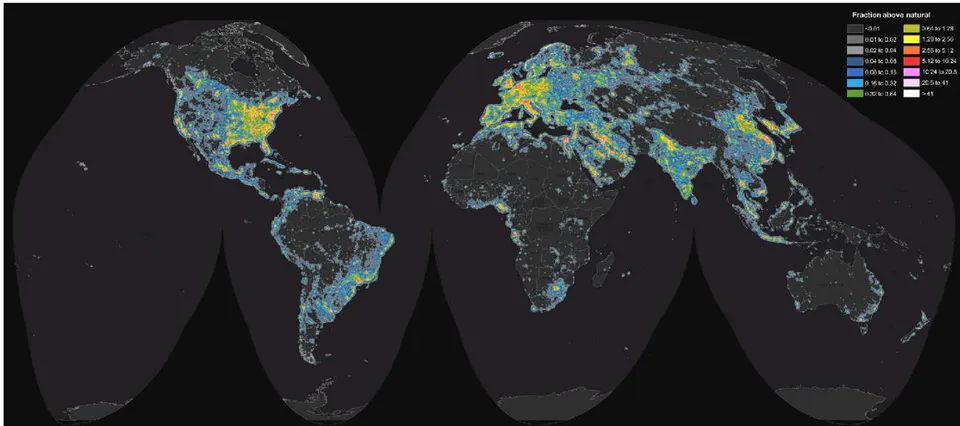
Generally, light pollution maps are being created with the information captured by the Suomi International Polar-orbiting Partnership (NPP) due to its reliability at the band of Visible Infrared Imaging Radiometer Suite (VIIRS). However, one-third of the radiant power of the white LED is not able to be captured by the day/night band of the VIIRS due to the short wavelength of the LED being out of the spectral curve of the day/night band (Cao & Bai, 2014, p. 11915-11935). Even though significant steps are being taken by governing bodies to prevent an increase in light pollution and ALAN, the rapidly increasing use of LED-based luminaires will increase light pollution to higher levels. One can argue that the current luminaires that are in use have been tested to prevent direct illumination to the sky to prevent further increase of light pollution, however, the current system at NPP is not able to capture the correct information as explained earlier.
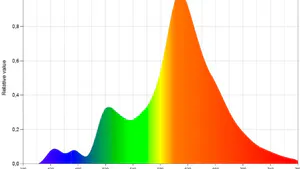
{"image_source":{"path":"images/f232cb86f7657ae28dfd3094a74367d3e7579f55d1f1d7e15ef8d49e3b721788.jpg"},"content":"","chart_caption":[{"type":"text","content":"Figure 2: Spectral response curve of DNB (red), spectral power distribution curve of LED (blue), and spectral power distribution curve of High Pressure Sodium (yellow) (Cao & Bai, 2014, p. 11915-11935)."}],"chart_footnote":[]} On the other hand, in one clinical research condition that included sixteen males and sixteen female juvenile monkeys to assess myopia development under 12-hour light and 12-hour dark conditions using an incandescent lamp (2700K CCT), LED fixtures 3000K, 4000K, and 5000K CCT as light sources which provided 50fc (500lux) illuminance at the center of the cages, researchers concluded that higher CCT light sources affected the elongation of the eye physiology hence creating a higher possibility for myopia development after only one year of exposure. The shortest elongation is noted for the test group which was located in the room that is illuminated by incandescent lamps (Hu et al., 2022, p. 229-233). This further proves that higher irradiance values in short-wavelength have significant effects on human well-being.
III. POSSIBLE FUTURE TECHNOLOGY FOR ARTIFICIAL LIGHTING
Current technology highly depends on LED technology due to its higher energy efficiency and compact size compared to legacy light sources. However high peak of irradiance at a shorter wavelength section can be harmful to human well-being to a degree and detrimental to health hence it is important to improve the spectral power distribution of the LED with combinations of newly developing technology such as quantum dots and organic dyes. According to a study that is conducted by Menéndez-Velázquez et al., by using a multilayer luminescent molecular system approach the team was able to create a white LED that had 2187 CCT and 82.9 CRI (Menéndez-Velázquez et al., 2022).
{"image_source":{"path":"images/55db63aa72938912273f258a6befff2a15322dbc18351d9b6b5c7c26cb6b337c.jpg"},"content":"","chart_caption":[{"type":"text","content":"Human Well-Being in the Age of Artificial Lighting"}],"chart_footnote":[]} {"image_source":{"path":"images/d795688e418dda62523f56b73b5e3ac4047f8b5e8a3866180000c0f60e535cfb.jpg"},"content":"","chart_caption":[{"type":"text","content":"Figure 3 & 4: Spectral Power Distribution and CRI values of the Multilayer Luminescent Molecular System white LED (Menéndez-Velázquez et al., 2022)."}],"chart_footnote":[]}
It must be noted that the R9 value of the created LED is showing a significantly low value and that would affect the visual perception of the objects that are illuminated by this light source, this experiment shows a promising future for the reduction of the short wavelength irradiance values of the LED-based luminaire. Furthermore, the development of this technology might reduce the negative effects of the current LEDs on human well-being.
IV. CONCLUSION
We are currently living in a world where our bodies are under constant input from external resources. Artificial light is the most prominent input to the well-being of humans by affecting the circadian rhythm causing misalignments and increasing the risk of getting exposed to health concerning diseases like cancer and cardiovascular diseases. The current technology and rapid adaptation to LED-based luminaires are increasing these detrimental health effects for humans. Recent studies are showing that short-wavelength sections of the LEDs can be curbed by using additional layers of quantum dots and organic dyes to create less invasive artificial lighting for well-being firstly for humans and secondly for the rest of the fauna and flora. The development of this new style of white LEDs is dependent on further research.
Conflicts of Interest
The author declares no conflict of interest.
Conflict of Interest
The authors declare no conflict of interest.
Ethical Approval
Not applicable
Data Availability
The datasets used in this study are openly available at [repository link] and the source code is available on GitHub at [GitHub link].
Funding
This work did not receive any external funding.
References
Cite this article
Related Research


Special Issue
Launch a focused special issue to highlight research, emerging trends, and expert insights in your academic field.