


IntelliPaper
Abstract
In our paper we discuss the financing situation of SMEs, by analyzing the impact of AI on the credit market for SME. We identify the financial frictions that exist, their causes, and possible solutions. In doing so, we consider the framework within all participants in the SME financial market operate, as well as specific processes on the supply and demand side and the transactional dimension. Of course, this paper must also consider the regulatory specifics that arise in particular from the use of AI in the lending process. The paper concludes with recommendations for SMEs, lenders, and regulators/policy makers.
Explore Digital Article Text
I. INTRODUCTION + RESEARCH QUESTION
Small and Medium Size Enterprises (SMEs) are acknowledged as engines of economic growth, innovation, and employment across both developed and developing economies (Beck & Demirgüc-Kunt, 2006; Ayyagari et al., 2017). SMEs frequently encounter significant barriers in accessing formal finance, often due to perceived higher risks and lack of transparent information (OECD, 2015; Berger & Udell, 2006; OECD,
2024). For SMEs, access to financing is still a challenge. Constraints are caused for instance by information asymmetries, high transaction costs, lack of transparent and audited financial statements, lack of collateral and regulatory barriers. For young SMEs, creditworthiness isn't accurately reflected, because the credit history is not well established (Kazimoto & Baadel, 2025). As a result, loans to SME are either rejected or, depending on the perceived risk, high interest rates are charged.
Credit scoring is a critical determinant for access to loan and the financial health of SMEs. Credit scoring bridges the information gap between SMEs (borrowers) and their lenders, providing an independent assessment of creditworthiness. Credit scoring involves the use of mathematical models by lenders to estimate the probability of default by the borrower in order to assist in decision-making, risk-based pricing of financial services, setting credit limits, and managing customer relationships (Berger et al., 2005, p.201).
But traditional credit scoring models are designed for companies with a long (financial) history. Scoring models often fail when they have to grasp the specific characteristics and dynamics of young SMEs (Altman & Sabato, 2007). In recent years, the rise of financial technology (Fintech) firms has transformed the landscape of SME financing, leveraging innovations in data analytics, artificial intelligence (AI), and digital platforms to improve credit access and reduce frictions. Fintech companies act as lenders, platforms, credit brokers, or information providers.
Adoption of AI-enabled credit scoring models is one of the most profound changes. Traditional scoring models heavily rely on historical financial data and personal relationship. AI driven systems analyze huge sets of structured and unstructured data—including transactional records, social media activity, supply chain interactions, and alternative data sources—to assess creditworthiness (Khandani et al., 2010; Bazarbash, 2019). This shift promises greater accuracy in scoring and inclusion for SMEs that lack formal credit histories. AI re-shapes the financial market. But: Will AI maintain the status quo of inequality in financial inclusion or is it a useful tool for reducing discrimination and adverse selection through more equitable treatment?
The deployment of AI-powered credit scoring is not uniform across countries and regions. Regulatory frameworks—ranging from data protection laws to financial licensing requirements-shape the adoption and effectiveness of these technologies. At the same time, concerns about algorithmic bias, transparency, and accountability introduce new sources of financing frictions.
In terms of financial services, there is a trend toward standardization and liquidity maintenance (linked to short-term operations) due to prudential regulatory issues originating in the Basel Accords (Ascúa, 2022, p. 188).1 Standardization finds a satisfactory mechanism for working with SMEs in credit-scoring models, which, in large numbers of similar financing operations, allows a homogeneous portfolio to be offered to the capital market through derivatives in the form of financial trusts or debt bond issues guaranteed by the standard credit portfolio.
The intersection between financial standardization, credit rating, and derivatives is mainly managed through international banking regulations, specifically the Basel Accords. Standardization in finance, particularly with regard to credit risk, aims to ensure consistent risk measurement and adequate capital reserves for financial institutions (Basel III and the upcoming Basel IV/Basel 3.1) implemented by national authorities (FSB, 2017, p. 14).
Credit derivatives are financial instruments used to manage or trade credit risk by transferring it between parties. The global financial crisis highlighted the need for greater transparency and standardized rules for these instruments. Credit ratings and external ratings are used within regulatory frameworks to determine the risk weighting of the counterparty, which in turn influences the capital that a bank must hold against derivative exposures.
The transfer of standardized financing portfolios to SMEs based on credit scoring through the issuance of securities (derivatives) in the capital market allows financiers to distribute the inherent risk and maintain a balance between liquidity, short-term investments, and long-term financing for SMEs (Berger et al. 2005, p. 203).
This paper analysis the role of Fintech in the intersection of financing frictions, special requirements of SMEs in terms of financing, AI-enabled credit scoring architectures, and regulatory contexts. It examines how these factors interact to shape financing frictions for SMEs and explores policy implications for fostering inclusive and efficient SME credit markets. This leads to our research question: What are the opportunities and limitations of AI in shaping and solving the (formal) financing problems of SMEs?
II. METHODOLOGY
This study employs a multi-case research design to analyze how AI-enabled credit scoring architectures shape SME financing frictions across diverse regulatory contexts. The research incorporates mainly qualitative approaches, uses some empirical data, and secondary literature to derive findings. We follow a multistep research process. After collecting data about SMEs out of published articles in different journals, we can show the economical relevance of SMEs. One limitation will be whether we consider all SMEs, including informal ones, and how to classify SMEs—they are divergent, e.g., size, age and industry. In our next step, we analyze financing frictions SMEs are confronted with: Status (international overview), reasons (and a mapping with different SME segments), and goals and constraints in solving financing frictions. This includes a first look into the framework constraints, Fintech have to work in. Finally, we discuss a wide range of regulatory contexts with conclusion for Fintech enterprises, regulatory, and policies. To discuss approaches of solving the financing problems, we use the concept of business models. Credit scoring architectures, based on financial data as well as on non-financial data helps us to have a closer look on—and to develop deduc tively—the challenges, Fintech enterprises are confronted with.
III. ECONOMIC IMPORTANCE OF SMES
We understand SMEs in the definition of the European Commission: Medium-sized companies show (1) a headcount less than 250 and (2) either a turnover of EUR 50 m (or less) or a Balance sheet total of EUR 43 m or less. Small companies show (1) a headcount less than 50 and (2) either a turnover of EUR 10 m (or less) or a Balance sheet total of EUR 10 m or less.
In several research papers—their selection should be understood as spotlights and do not claim to be exhaustive—we found indications for the importance of SMEs in selected economies. SMEs account for 95-99.9% of total business population, 47.5-70% of private sector employment, 30-60% of the national GDP (Lu, 2018, p. 314 for the UK, Cornelli et al., 2019, p. 1 for the Asian economy, Gopal & Schnabl, 2020, p. 1 and p. 37 for the U.S. and the Euro pean Commission, 2024, for the EU). SMEs constitute over 90% of businesses and contribute to more than 50% of employment worldwide (World Bank, 2025). The World Economic Forum estimates the number of SMEs worldwide with around 400 million that account for approximately 90% of all global firms, generating 70% of employment. 80% of them are located in developing economies. These statements do not include informal SMEs.
The previous description of SMEs neglects the fact of different types of SMEs, each with different financing requirements. We divide industry sector, business age, size of SME, ownership structure, financial health, and legal status (Table 1).
| Industry Sector | Manufacturing | Service | Trade/Retail |
| Business Age | Start-ups | Growth/Expansion | Established |
| Size of SME | Micro | Small | Medium |
| Ownership structure | Sole Proprietorship | Partnership | Corporations |
| Owner | Age | Gender | |
| Financial Health | High Creditworthiness | Low Creditworthiness | |
| Legal Status | Formal | Informal | |
IV. FINANCING FRICTIONS
4.1 Status
As it is known, for various reasons, access to financing is and has been one of the main obstacles to the expansion of SMEs (Binks & Ennew, 1996, p. 17-25; Ascúa, 2009; ICF, 2013, IMF, 2024). The World Bank specifies the extent of the problem by about 50% of formal SMEs with no access to formal credit (World Bank Group, 2022, p. 5).
For Asian Economy, Cornelli et al. (2019, p. 1) found that SMEs are often asked to provide collateral for loans, lacking mutual guarantee institutions. Especially the importance of trade finance must be emphasized for People's Republic of China and India (Cornelli et al., 2019, p. 6). Lots of SMEs substituted their lending from banks through lending via FinTech in the U.S. since 2008 (Gopal & Schnabl, 2020, p. 1 and p.
- Wagner (2019, p. 748 f.) shows roughly a medium level of problems related to access to finance all over Europe. On the other hand, Aristei & Angori (2022, p. 52) report, with of the cases, bank loans as very important sources of finance for SMEs in 11 European countries. Lu (2018, p. 317) shows for the UK that SMEs receive only of total business loans from the banking industry.
"Access to finance remains one of the greatest barriers to SME growth. The latest IFC–World Bank MSME Finance Gap Report (March 2025) estimates that across 119 emerging markets and developing economies (EMDEs), there is a finance gap of about US$ 5.7 trillion, equivalent to 19 percent of GDP and 20 percent of total private sector credit." (World Bank Group, 2025). As they show, the MSME (Micro, Small and Medium Size Enterprises) finance gap grew by +6 % annually, independent of the growth of credit supply by 7%. The finance gap concentrates on developing countries. Observable SME dept financing constraints are credit rejections, quantity restrictions (Aristei & Angori, 2022, p. 48) and interest rate increases, not related to a solid risk observance in SME.
4.2 Reasons of financing frictions
Now we want to have a closer look on the reasons for financing frictions and the requirements of SMEs in terms of financing. In the first step we look at common issues in financing SMEs. Financing frictions refer to obstacles that impede the efficient allocation of loans to firms (World Bank Group, 2022, p. 4 f.). We show supply-side, demand-side and transactional reasons. Table 2 gives an overview.
| Supply-side Constraints | Transactional Constraints | Demand-side Constraints |
| Default risks for lenders (e.g., early-stage borrowers) | Lack of registration (e.g., commercial register), low verifiability | Credit terms and covenants |
| High transaction costs due to limited disclosure relative to credit volume | Lack of transparent accounting systems | Lack of credit records/history |
| Highly concentrated banking sector | Missing track record of creditworthiness | Lack of collateral (tangible assets limited; intellectual property undervalued) |
| Limited microfinance institutions, credit cooperatives, and Fintech platforms | No audited financial statements | Low diversification of financing sources |
| Regulatory barriers and administrative burdens | No long relationship history with financial institutions and limited credit history | Low financial literacy |
| Sectoral challenges (e.g., agriculture, creative industries) | Type I and Type II credit assessment errors | Management and organizational problems |
| Weak legal systems (contract enforcement, bankruptcy procedures) | ||
| Gender and regional financing gaps |
| Industry SectorFinancing amounts | Manufacturing | Service | Trade/Retail | ||
| Large, long-term for less amount for machinery, plants, in- working capital and ventory, and accounts accounts receivables receivables | Short-term need for inventory and accounts receivables | ||||
| Collateral | Tangible assets, accounts receivables | Intellectual property, accounts receivables | Inventory, accounts receivables | ||
| Business AgeFinancing amount | Start-ups | Growth/Expansion | Established | ||
| Small | Large | Medium | |||
| Track record | No | Medium | Long | ||
| Collateral | No | Medium | Large | ||
| Size of SME | Micro | Small | Medium | ||
| Collateral | Personal assets | Some assets | Easy to provide | ||
| Financial literacy | limited | limited | more | ||
| Ownership structure Collateral | Sole Proprietorship | Partnership | Corporations | ||
| Personal assets | Pool of partners | Business-owned | |||
| Financial literacy | limited | more | extended | ||
| Financial Health Collateral | High Creditworthiness | Medium Creditworth. | Low Creditworthiness | ||
| Unsecured loans, less collaterals required | Less strict collaterals required | Strict collaterals required, maybe | |||
| Legal Status | Formal | Informal | |||
Information asymmetry means imperfect information distribution among market participants—SMEs provide less (formal) information to lenders in financial markets. The degree of information asymmetry depends on several factors: age (invers correlation) size (invers correlation) and legal status (Stiglitz & Weiss, 1981; Lehmann & Neuberger, 2001). Type 1 errors (lenders accept bad prospects) and type 2 errors (lenders reject good prospects) arises from this (Altman, 1968; Roy & Shaw, 2021).
After showing common issues, we want to explain in a second step in what cases it's impossible to find easy solutions when assuming one SME equals another. Therefore, we use different SME segments, as introduced in chapter 3. Here we want to go deeper than in chapter 3 and discuss necessities out of different SME segments (Table 3).
Out of our analysis, for the green-colored type of (S)MEs the financing problem could be solved by traditional banks on traditional ways. But lately if the SME counts to the yellow- or red-colored types, Fintech comes in with new solution approaches for the financing problem.
4.3 Goals and constraints in solving financing frictions
Before we start to look on the solution approaches for the above-mentioned problems, we want to define goals and constraints in the solution process. In our model, we show a framework and, in its frame, the supply-side, the demand-side and in between the transactional view (Figure 1). Ensure ethics is part of the framework. Ethics mean there should be no biases, no discrimination, clear accountability, transparency and explainability/predictability of credit scoring results (Lee & Sohn, 2017; Oware & Junior, 2025; Pokholkova et al., 2025, p. 1293 f.). But there also exist methodological solutions for AI-based credit scoring that allow an evaluation of effectiveness, predictability, and justification mechanisms of tool's decision (Pokholkova et al., 2025, p. 1302; Kumar et al., 2021). Some enterprises in the broader field of Fintech have developed their frameworks for ensuring ethical principles with important market participants (Pokholkova et al., 2025, p. 1302; IBM “AI Fairness 360”; EY “Responsible AI”; JP Morgan Chase “Explainable AI Centre of Excellence”).
Figure 1: Framework and market
| Framework | |||
| Privacy concernsGlobal data protection standardsTransparency | Bias tested, fairness auditsFederated learning solutionsTraining with shared data/sandboxes | ||
| Supply-sideSupport in credit portfolio design(Realtime) fraud detection (identification, approval)Transaction cost reductionRisk detectionReplace tangible collateralTime-stable scoring predictionAvoid self-fulfilling prophecies/path dependencies | TransactionalAvoid Type 1/2 error (help-ful for both, supply and de-mand side).Understand rationals behind the lending decision.No biases, no gender gap,no discriminationSpeed up and automate ap-proval process. | Demand-sideFinancial inclusion, accessibility for all applicants Increase management/business/financial skillsRestrained data collection/useData safety and secure storageFair pricing (interest rate) Increase credit volume and number of lenders | |
| Development strategiesEnsure ethicsExplainability (XAI)Regulatory compliance | Combat CybercrimeClear and simple frameworkMore competition (banking sector)Anti-money laundering (AML) | ||
V. REGULATORY CONTEXTS
In the years following the 2008 financial crisis, authorities have begun to regulate Fintech activity, both from a monetary/financial and fiscal perspective (the Financial Stability Board – FSB, 2017, p. 25). Regulators must play a fundamental role in the development of the Fintech industry and fulfill the fundamental mission of preserving the stability of the financial system in the age of AI (Crisanto et al., 2024, p. 6).
Despite the transformative potential of financial technologies, their fast development has introduced significant regulatory challenges for regulators around the world. Traditional regulatory frameworks, designed for conventional financial institutions, struggle to adapt to the complex dynamics of financial technology innovations. In addition, the cross-border nature of many Fintech activities has brought significant jurisdictional challenges, as regulatory authorities must coordinate financial supervision at the international level (Toluwalase et al., 2024, p.29). Most important objectives are financial inclusion, customer protection and financial stability. Many jurisdictions have specific Fintech regulations for digital pay
ment services, online lending, and digital currencies (BIS, 2020, p. 35). Meanwhile, increasing regulation limits the development of new digital players in the financial system if they do not meet the requirements. These requirements are oriented on traditional entities, so regulation strengthens the position of large, traditional financial institutions and large technology platforms with disadvantages for small/young Fintech SMEs.
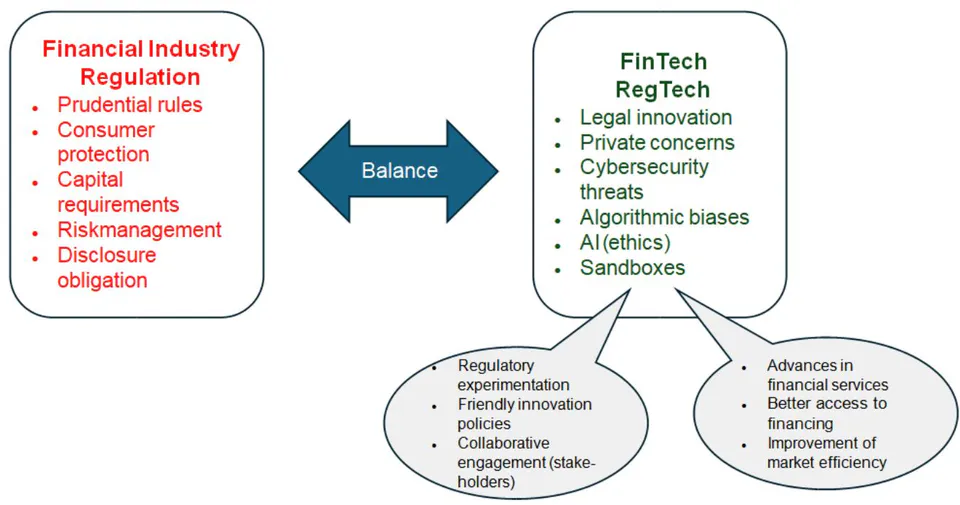
Traditional regulatory approaches prioritize prudential regulation and consumer protection. It more focuses on capital requirements, risk management, and disclosure obligations than on specific risks and characteristics of Fintech such as data privacy, Cybersecurity threats, algorithmic biases.
The United States has a complex regulatory environment for financial technologies, with multiple federal and state agencies responsible for overseeing different aspects of the industry (Deloitte, 2017, p. 3; Deloitte, 2024, p. 20). The Office of the Comptroller of the Currency (OCC) is responsible for regulating national banks and federal savings associations; Consumer Financial Protection Bureau (CFPB); Securities and Exchange Commission (SEC): The SEC regulates the securities industry, including initial coin offerings (ICOs) and digital securities; Federal Reserve System is responsible for regulating and supervising banks and other financial institutions to promote the stability of the financial system. In addition to federal regulation, Fintech companies must also comply with state regulations.
The European Union (EU) has implemented several regulations that apply to Fintech companies operating within its member states, including the General Data Protection Regulation (GDPR), which came into effect in 2018 and regulates the collection, use, and storage of personal data within the EU; the Payment Services Directive 2 (PSD2); the Anti-Money Laundering Directive (AMLD); the Markets in Financial Instruments Directive 2 (MiFID II for trans parency); and the Electronic Money Directive (issuance). The EU has also created a regulatory sandbox environment for Fintech companies to test new products and services in a controlled setting. This environment offers Fintech companies exemptions from certain regulations and access to regulatory guidance.
In Asia, China has a large and rapidly growing Fintech industry, with companies like Alipay and WeChat Pay dominating the mobile payments market. However, the Chinese government has recently cracked down on the industry, implementing new regulations on online lending and requiring Fintech companies to obtain licenses for certain activities (CCAF, 2021, p. 38). Singapore offers a favorable regulatory environment that includes a sandbox. The Monetary Authority of Singapore (MAS) has also introduced a comprehensive framework for digital banking, including strict capitalization and risk management requirements. Japan has a highly regulated financial sector, and Fintech companies must obtain licenses from the Financial Services Agency (FSA) to operate, and it has also established measures to promote Fintech innovation (digital currencies). India has a rapidly growing Fintech industry, with companies such as Paytm and PhonePe dominating the mobile payments market. However, the industry is subject to a complex web of regulations regarding e-KYC (know your customer), data protection, and payment processing. South Korea has recently introduced new regulations to encourage innovation in financial technology, including a sandbox and new rules on digital currencies (Lawrence et al., 2023, p. 13).
In Africa, Fintech is growing rapidly, where it has the potential to increase financial inclusion and stimulate economic growth. South Africa, Egypt, and Nigeria have developed financial sectors, but Fintech companies face significant regulatory hurdles (anti-money laundering regulations, financial services licensing, data protection, and consumer protection).
Kenya is a leader in mobile payments, with companies like M-Pesa, but the regulatory framework for Fintech companies is still developing. These companies must obtain licenses from the Central Bank of Kenya (CBK) to operate and comply with consumer and data protection regulations. In Ghana, Fintech companies must obtain licenses from the Bank of Ghana to operate and comply with various regulations regarding data protection, anti-money laundering, and consumer protection (CCAF, 2021, p. 51).
In Latin America, progress is being made across the region, with certain asymmetries among the largest countries. The main areas of intervention in the Fintech industry are Instant Payment Systems: Countries like Brazil, Argentina, and Mexico are leaders with systems like PIX, MODO, and CoDi, which enable real-time transactions and improve financial inclusion (Carvajal, 2024, p. 15). Cryptocurrency regulation establishes legal frameworks to protect consumers and maintain the integrity of the financial system.
Sandboxes: In Mexico, as part of its Fintech Law, a regulatory environment was established to foster innovation and maintain oversight. This has allowed Fintech companies to test new products and services in a controlled environment, driving the sector's growth (IADB, 2024, p. 101). In Brazil, the Central Bank of Brazil launched a sandbox initiative to support innovative financial solutions, particularly those aimed at increasing financial inclusion and improving payment systems. In Colombia, the Colombian sandbox has been instrumental in promoting collaboration between Fintech companies and regulators, enabling the development of innovative financial products tailored to local needs.
Consumer Protection: New regulations seek to ensure transparency, security, and fairness in financial transactions, strengthening consumer confidence.
For its part, regulation must involve various levels of oversight and monitoring of the application of AI and Machine Learning (ML) in the Fintech industry. Authorities around the world are now focusing on the ethical and legal implications of AI, and Fintech must navigate an ever-expanding network of requirements surrounding transparency, data privacy, non discrimination, and corporate responsibility.
5.1 The Role of Artificial Intelligence (AI)
AI is redefining the financial technology industry, highlighting operational scaling, productivity improvements, early fraud detection, and improved risk assessment. AI regulations vary significantly across jurisdictions, covering critical areas such as data privacy, anti-dis crimination, algorithmic transparency, and accountability for AI-based decisions (BIS CGRM, 2025, p. 85).
The United States takes a decentralized approach to AI regulation, with a combination of federal agency guidelines and state-level laws shaping the enforcement landscape. While there is no overarching federal law on AI, key regulators such as the Federal Trade Commission (FTC) and the Department of Commerce have issued guidelines emphasizing transparency, accountability, and fairness in AI systems. Key areas of regulatory focus include mitigating discriminatory bias, algorithm accountability and clarity, and transparency.
The European Union (EU) is leading the way in establishing comprehensive AI regulations to ensure the ethical, transparent, and responsible use of AI. The AI Act, a groundbreaking proposal, classifies AI systems into risk levels. It prohibits certain high-risk applications, such as social scoring, and imposes strict requirements for others, such as financial services and critical infrastructure. The Artificial Intelligence Act (Regulation (EU) 2024/1689 laying down harmonized rules on artificial intelligence) is the first comprehensive legal framework on AI worldwide. The aim of the rules is to promote trustworthy AI in Europe.
The AI Act ensures that Europeans can trust what AI has to offer. While most AI systems pose little or no risk and can contribute to solving many societal challenges, certain AI systems create risks that we must address to avoid undesirable outcomes. For example, it's often not possible to figure out why an AI system made a decision or prediction and took a particular action, so it can be difficult to assess whether someone has been unfairly disadvantaged, such as in a hiring decision or an application for a public benefits plan.
Once an AI system is commercialized, authorities are responsible for market surveillance, implementers ensure human oversight and control, and providers have a post-market monitoring system. Suppliers and implementers will also report serious incidents and malfunctions. The AI Act entered into force on August 1, 2024, and will be fully applicable two years later, on August 2, 2026, with some exceptions.
The Asia-Pacific region is emerging as a global leader in AI adoption. Countries such as Singapore, Japan, South Korea, and China are implementing regulatory frameworks to foster innovation while also promoting the responsible use of AI. Key regional focus areas include data privacy; bias and fairness (emphasis on ensuring algorithms do not discriminate); and cross-border collaboration. The Asia-Pacific region demonstrates a balanced approach, combining innovation-friendly policies with a growing focus on ethics.
Thus, the Fintech regulations have been evolving and presenting the following features of emerging trends in regulation (BIS CGRM, 2025, p. 115): Digital Identity; Open Banking; Cryptocurrencies; Regulatory sandboxes; International cooperation.
In that direction, the Fintech ecosystem incorporated an additional component, known as RegTech, which combines specific Fintech regulations with technology focused on helping improve compliance with existing regulations (this trend typically involves reducing operational costs for regulatory compliance). In turn, new challenges arose for regulators, most notably the clash between traditional financial institutions and Fintech as new competitors. Furthermore, technology also presented regulators with the challenge of facilitating comprehensive access to technology for all members of the financial system (open-source APIs).
RegTech solutions emerged in the financial services sector as a response to increased regulatory complexity, leveraging advanced tools such as AI, ML, big data analytics, cloud computing, and blockchain. RegTech automates tasks that were traditionally performed manually and were time-consuming, significantly reducing the potential for human error and operational costs. Key applications include regulatory reporting; risk management; identity management; anti-money laundering (AML); compliance management; and regulatory intelligence. Adopting RegTech offers system advantages such as increased efficiency and speed; reduced costs; greater accuracy;
scalability; and improved risk mitigation (Deloitte, 2024, p. 1).
Especially when addressing Fintech companies, if they are SMEs themselves, it's necessary to map the challenges and the regulation, just to check if and where they meet. The question to be answered is, how does regulation influence the development of Fintech-SMEs or how are Fintech-SMEs influenced by regulations? It is necessary to avoid systematic disadvantages for Fintech-SMEs. Therefore, the components of Fintech business models must take into account the following regulatory objectives: No bias or ethical incorrectness (audits of AI, automated compliance process), safety (data protection, fraud prevention, risk management), innovation support (sandboxes, digital/crypto currencies, fair and increased competition, sharing customer data), access (licenses from state institutions) and international (cross border collaboration).
5.2 The Role of Regulatory Sandboxes
Also, as reaction to these challenges, regulators in various jurisdictions have been adopting a more flexible and adaptable approach to financial technology regulation, with significant regulatory experimentation, the introduction of policies that promote innovation, and collaboration with stakeholders in the Fintech ecosystem. Regulatory sandboxes, together with regulatory innovation hubs, provide an environment conducive to Fintech companies testing new products, services, and business models under regulatory supervision (Olawale et al., 2024, p. 119; Uzougbo et al., 2024, p. 9). Innovation tables take the form of forums in which Fintech companies interact with authorities and members of the ecosystem, obtaining development guidance and optimizing the influence of regulatory requirements.
In this regard, some features of regulatory initiatives can be mentioned, such as: Clear legal frameworks (Mexico and Australia for sandbox operations, which reduces regulatory uncertainty for participants); Thematic sandboxes: Some countries focus on specific themes, such as financial inclusion or blockchain technology, to address specific challenges and maximize impact;
Cross-border collaboration: Initiatives such as the Global Financial Innovation Network (GFIN) facilitate collaboration between countries, enabling cross-border testing and harmonizing regulations; Feedback loops: Regulators in countries such as Brazil and India actively engage with sandbox participants to refine policies and address scalability issues.
These areas of experimentation facilitate cooperation, interaction, and knowledge exchange between stakeholders and authorities in order to structure a proactive and innovative regulatory framework. Examples of international experiences include Singapore Fintech Regulatory Sandbox; Australia's Open Banking Policy (ACCC); Financial Conduct Authority Sandbox UK; IoRS (Interoperable Regulatory Sandbox) of the Reserve Bank of India (RBI); Spain's Financial System Digital Transformation Law Sandbox Fintech (Bank of Spain + CNMV + DGSP); Argentina's BCRA Financial Innovation Roundtable; Germany's Fintech Innovation Center supervised by BaFin in collaboration with the Bundesbank and following European Union directives. The case of the US is interesting because, although some states, such as Utah, have set up regulatory testing environments for Fintech, the country does not have a unified national program due to its fragmented regulatory structure.
5.3 Regulatory Framework
Hence, what level of security is necessary and sufficient? The experience of BITCOIN is illustrative of the security of the system and its vulnerability to speculative financial attacks, although it has made a great contribution in terms of Cyber technology. For its part, the tradition of banking regulation tends to avoid risks and strengthen the security of the system.
More recently, prudential supervision has included protecting customers from collateral damage to the system, preventing fraud, and shielding the system from illicit business. The lessons of successive financial crises in 1997, 2002, and 2008 have taught us those financial regulations were partial and unable to prevent these crises. For their part, financial supply agents repeatedly call for less regulation and bureaucracy and greater market freedom as the main incentives for a healthy financial business.
The following diagram (Figure 2) describes the necessary balance that regulators are trying to maintain in the regulation of financial services.
5.3 The Cases of Germany and Argentina in Perspective
Germany regulates Fintech under the same legal framework as traditional financial institutions, based on their specific business models. While there is no single law for Fintech, the regulatory landscape is a combination of national and EU legislation. Key areas of regulation include banking, financial and payment services, investment and securities, and anti-money laundering. The Federal Financial Supervisory Authority (BaFin) and the Deutsche Bundes bank are the primary regulators.
The following is the legislative framework:
- Markets in Crypto-Assets Regulation (MiCA): This EU regulation, now fully applicable in Germany, establishes a harmonized authorization and conduct regime for crypto-asset service providers and issuers of certain tokens. It largely replaces prior national crypto regulations. Fintech providing regulated services, such as crypto custody or payment services, require authorization from BaFin.
Digital Operational Resilience Act (DORA): Fully applicable since January 17, 2025, DORA aims to standardize rules on managing information and communication technology (ICT) risk, incident reporting, and oversight of ICT third-party service providers. Many Fintech startups outsource back-office functions. This is permitted but subject to strict rules, particularly for critical functions, and must comply with DORA requirements.
German Banking Act (KWG) and Payment Services Supervision Act (ZAG): These laws these acts must obtain authorization from BaFin. govern banking and payment services. Fintechs providing regulated services under Securities Institutions Act (WpIG): This is relevant for Fintechs offering investment services, such as robo-advisors or neo-brokers.
Anti-Money Laundering Act (GwG): This law imposes obligations on Fintechs for customer due diligence, transaction monitoring, and reporting suspicious activity. German AML laws require strict identification procedures for customers, with video identification and electronic identity features being approved methods.
Germany's complex and strict regulatory environment, including lengthy and complicated licensing processes, can be challenging and costly for smaller Fintech.
Argentina
Argentina's Fintech regulations are overseen by multiple authorities like CNV, Central Bank, UIF, ARCA (fiscal authority) and have recently seen significant developments aimed at encouraging financial technology while enhancing consumer protection. A new, more liberal administration is working to deregulate the economy, which has impacted the Fintech sector, particularly concerning cryptocurrency and open finance.
The following is the legislative framework:
- Virtual Asset Service Providers (VASPs): Since March 2025, entities that offer services related to virtual assets must register with the National Securities Commission (CNV). This applies to crypto exchanges, crypto asset custodians, and foreign companies targeting Argentine users. Requirements include:
Minimum capital, depending on the business type.
Segregation of customer and company funds.
Strong Cybersecurity and anti-money laundering (AML) controls, with a requirement to report suspicious activity.
The Central Bank (BCRA) has banned traditional banks from offering crypto services directly to customers.
Open finance: A new Open Finance System was created in 2025. The BCRA is developing the regulatory framework, which aims to give users control over their financial data and the ability to share it with Fintechs and banks. The goal is to promote financial inclusion by enabling individuals without formal credit histories to access loans and other financial products.
Payments and wallets: The BCRA actively regulate digital payments and e-wallets, including:
Transferences 3.0 initiative: Promotes interoperability between bank accounts and digital wallets through standard QR codes.
Interoperable QR payments: Merchants are required to accept credit and debit payments from any digital wallet, regardless of the QR code provider.
PSP registration: The BCRA regulates and registers various payment service providers, including initiators and aggregators.
Tokenization: The CNV and the government approved a tokenization regime in 2025, allowing for the creation of digital representations of marketable securities using distributed ledger technology (DLT).
- The Financial Innovation Board of the Central Bank of Argentina (BCRA) is a public private collaboration space designed to promote innovation and competition in financial services through the use of technology. It was promoted to act like a sandbox without its typical formalities. Although it had been operating informally since before, the BCRA Board of Directors officially formalized it in February 2019
Public-Private Collaboration: Brings together experts from the BCRA, fintech companies, banks, entrepreneurs, and public and private institutions.
Promotion of Innovation: It seeks to develop tools and solutions that improve the quality and efficiency of the financial system.
Financial Inclusion: Its purpose is to contribute to greater financial inclusion through the adoption and use of financial technology.
Dialogue and Regulation: Serves as a space for dialogue between regulators and market players to define a scenario that combines security and competition with innovation.
Regulatory approach: There is no single, centralized Fintech law; instead, a blend of general laws and specific regulations apply. The main regulatory bodies include the BCRA, CNV, and the Financial Intelligence Unit (UIF). While there is no official regulatory sandbox, regulators are exploring options in this area.
Deregulation: The Milei administration is focused on deregulation, including measures to simplify financial transactions and increase reporting thresholds for banks. The goal is to reduce barriers for Fintech startups.
VI. APPROACHES TO SOLVE FINANCING PROBLEMS OF SMES
After concentrating in reasons of financial frictions, we try to address possible solutions for these. On the supply side, more competition is necessary. Fintech could help in credit scoring/rating and as lending platforms. Adoptions in legal systems and targeted interventions could address or solve further problems. On the demand side, business and management training, guarantees, targeted interventions and alternative sources of information could be helpful. Approaches to solve transactional problems can be divided into the market level, the organizational level, and the regulatory level. Table 4 shows some details.
| Category | Reasons | Solution Approaches |
| Supply Side | Default risks for lenders | Guarantees, portfolio design, borrower selection, credit scoring |
| High transaction costs compared to credit volume | SME credit rating systems, Credit Risk Database (Japan), credit scoring | |
| Highly concentrated banking sector | Promote Fintech and alternative providers (microfinance institutions, credit cooperatives, digital platforms) | |
| Limited microfinance institutions, credit cooperatives, and Fintech platforms | Targeted policy interventions | |
| Regulatory barriers and administrative burdens | Accept mobile assets as collateral, streamline business registration, licensing and taxation procedures | |
| Weak legal systems (contract enforcement, bankruptcy procedures) | Strengthening and adoption of effective legal frameworks | |
| Sectoral weaknesses (e.g., agriculture, creative industries) | Sector-specific targeted interventions | |
| Gender and regional financing gaps | Targeted inclusive financing policies | |
| Demand Side | Lack of collateralLack of credit history | Credit guarantees, group lending (Rehman et al., 2025)Alternative data sources, credit scoring mechanisms |
| Restrictive credit terms and covenants | Regulatory and policy reforms | |
| Low diversification of financing sources | SME credit ratings, Credit Risk Databas (Japan), credit scoring | |
| Low financial literacy | Training on business processes and accounting practices | |
| Management and organizational weaknesses | Management and capacity-building training | |
| Transaction-Level Issues | Lack of registration and low verifiability | AI-supported creditworthiness assessment new credit scoring approaches |
| Lack of transparent accounting systems | Standardized financial reporting practices | |
| Missing track record of creditworthiness | Development of credit information infrastructure | |
| No audited financial statements | Promotion of audit and disclosure practices | |
| Limited relationship history with financial institutions | Relationship banking and data-based lending models | |
| Type I and Type II credit assessment errors | Improved risk assessment models and data analytics |
\begin{tabular}{I^cl|l|} \hline & Lack of credit history & Alternative data sources, credit scoring mechanisms \ \hline & Restrictive credit terms and covenants & Regulatory and policy reforms \ \hline & Low diversification of financing sources & SME credit ratings, Credit Risk Database (Japan), credit scoring \ \hline & Low financial literacy & Training on business processes and accounting practices \ \hline & Management and organizational weaknesses & Management and capacity-building training \ \hline Transaction-Level Issues & Lack of registration and low verifiability & AI-supported creditworthiness assessment; new credit scoring approaches \ \hline & Lack of transparent accounting systems & Standardized financial reporting practices \ \hline & Missing track record of creditworthiness & Development of credit information infrastructure \ \hline & No audited financial statements & Promotion of audit and disclosure practices \ \hline & Limited relationship history with financial institutions & Relationship banking and data-based lending models \ \hline & Type I and Type II credit assessment errors & Improved risk assessment models and data analytics \ \hline \end{tabular}
| Lack of credit history | Alternative data sources, credit scoring mechanisms | |
|---|---|---|
| Restrictive credit terms and covenants | Regulatory and policy reforms | |
| Low diversification of financing sources | SME credit ratings, Credit Risk Database (Japan), credit scoring | |
| Low financial literacy | Training on business processes and accounting practices | |
| Management and organizational weaknesses | Management and capacity-building training | |
| Transaction-Level Issues | Lack of registration and low verifiability | AI-supported creditworthiness assessment; new credit scoring approaches |
| Lack of transparent accounting systems | Standardized financial reporting practices | |
| Missing track record of creditworthiness | Development of credit information infrastructure | |
| No audited financial statements | Promotion of audit and disclosure practices | |
| Limited relationship history with financial institutions | Relationship banking and data-based lending models | |
| Type I and Type II credit assessment errors | Improved risk assessment models and data analytics |
Empirical analysis shows some successful examples of supporting SMEs in terms of financing. Hossain et al. (2023) report about a very successful Credit Wholesale Program in Bangladesh: interest rate -3 % points below market, repayment rates of loans +95% (Hossain et al., 2023, p. 2). They also report about skill development for SME borrowers, optimizing loan quantity for SMEs and governmental desired loan default ratio.
The positive impact of Fintech on the financial inclusion of SMEs also emerges from both the adoption of financial technologies that could expand access to financial services for SMEs with difficulties in obtaining financing (Daud et al., 2022, p 37 ff.) and the inclusion of marginalized sectors and/or areas (ethnic, religious and racial minorities, rural areas, etc.). However, literature recognizes that there are still barriers that limit the massive participation of SMEs in this new financial paradigm (Jarusen, 2022, p. 927 ff.). Despite advances in Fintech, risk assessment and collateral remain key constraints in SME financing (Thath sarani/Jianguo, 2022).
To solve the problem of lack of information, financiers usually choose to request collateral from the entrepreneurs, i.e., an asset (if possible, sufficiently liquid) to serve as a hedge in case of default. The central bank's own regulations encourage the request for this type of preferred collateral. Collateralization also provides a way for the bank to recoup losses if the firm fails.
From the lender's point of view, taking guarantees provides a self-selection mechanism that ensures that only good projects apply for bank financing. Since business owners are the best judges of the likelihood of success, only those who have confidence in their project will offer guarantees to secure the debt (Keasey & Watson, 1993). In other words, moral hazard will be reduced if the bank loan is secured by the entrepreneur's personal assets (e.g., his own home).
The problem arises when SMEs do not have guarantees satisfactory to the financier. Thus, guarantee systems for SME financing have become widespread, and in many cases involve the direct intervention of the State (Ascúa, 2023).
| Key partners•Credit bureaus | Key activities•Assess collateral•Calculate default probability and expected losses, credit ratios.•Select and weight criteria in IRB[5] | Value proposition•Enduring partnership with SMEs•Selecting low-risk borrowers•Avoid Type 1/2 errors | Customer relationship•Long-lasting business relation to SMEs | Customer segments•Green colored (S)MEs |
| Key resources Disclosed data from SMEs•Credit application history (Rehman et al., 2025, p. 3003).•Financial literacy•Well-trained and experience staff | Channels•Traditional | |||
| Cost structure•High in relation to the lending volume | Framework•No biases•Ensure ethics•Less regulatory boundaries, low administrative burdens•BASEL Accords | |||
Own elaboration, based on the business model approach of Osterwalder et al. (2005); Rehman et al. (2025); Roy & Shaw (2021).
It is no surprise that SMEs are often asked to provide (lacking) collateral for loans, and are also lacking mutual guarantee institutions (Cornelli et al., 2019, p. 1). Eca et al. (2022, p. 3) found in a study related to Portugal that “[...] firms who apply for P2B funding are significantly more likely to already have bank debt in their balance sheet and, at the same time, are firms with less overdue debt”. Aristei & Angori (2022) showed for SMEs in 11 European countries a path dependency in bank loans between constraints in credit access conditions in the past that leads to low credit demand behavior of SME in the future they call it the self-selection effect. With the same result, credit restrictions in the past increased the likelihood of credit restrictions in the following period, at least because of reducing information asymmetries. They also show an increase of difficulties for smaller firms.
For our green-colored case (Table 3), we want to structure the tasks and constraints via a business model for lenders (traditional banks). Business models describe, how a firm creates and captures value. Several ideas of business models are discussed in literature. We follow the idea of Osterwalder et al. (2005), but we transformed their idea and integrated the perspective of framework instead of revenue streams (Table 5).
All above mentioned points (Table 5) are vital when using traditional criteria for credit scoring. But this seems not sufficient for lending to SMEs counting to the yellow- or red-colored case. The AI age offers new approaches in lending and credit scoring, necessary to control and solve financing problems. We assume as main driving forces, among others, the costs of obtaining information and information asymmetries. These could possibly be controlled and solved by new approaches to information procurement and information use. Among others, blockchain, distributed ledger and AI play significant roles as well as alternative sources of information, then the standard ones like external accounting. Further on in our analysis we want to concentrate in AI. The use of AI in credit scoring has the potential to reduce frictions by improving risk assessment and expanding credit access. However, new frictions may arise from algorithmic opacity, regulatory constraints, and ethical concerns (Bazarbash, 2019).
VII. CREDIT SCORING ARCHITECTURE
Credit scoring addresses the default risk of the lender, arising from capacity and motivation of the borrower to fulfill the credit contract. There are two important metrics: probability of default and expected loss in case of default (Bazarbash, 2019, p. 8). Usually, the line of argument goes like this: lenders are awaiting interest payments and the repayment of the loan. But: in a long-lasting business relationship between lender and borrower, there is a huge interest for the lender to continue the business relationship with the borrower so to grant a following loan—the borrower is well-known and this avoids new searching costs for the lender. So, more important than repayment is the ongoing high creditworthiness of the borrower.
7.1 Scoring based on objective/financial data and collateral (green-colored case)
Credit scoring is the process of evaluating the creditworthiness of potential borrowers. Conventional models rely on financial statements, credit history, and collateral (Altman, 1968). Other sources report about 5 Cs: capacity (dept-to-income ratio), capital structure (more or less capital (equity)), coverage (pledged collateral and loan coverage, with an existing formal market for specific assets), character (borrowers track record about missed payments, previous debts default, fraud etc.) and conditions (macroeconomic changes) (Bazarbash, 2019).
Typical financial data in use out of financial statements are revenue history, profit margin, cash flow, leverage ratio and existing dept levels (Shakila et al., 2025).
A commonly accepted credit scoring model for individuals (and also micro-entrepreneurs) is FICO. They use five categories of data: payment history (35 %), amounts owed (30 %), length of credit history (15 %), credit mix (10 %), and new credit (10 %) (Rehman et al., 2025, p. 2999; FICO, 2025). A well-known SME credit scoring architecture is Moody's KMV RiskCalc . For predicting default probability, they use different ratios and measures taken from disclosed information and financial records, compared to a database of 11 million annual financial statements of 2.2 million enterprises (Moody's, 2025).
Credit score calculation based on financial data uses statistical analytical procedures like logistic regression (presupposes linear association between financial behavior and credit worthiness), derivations and decision trees to deep learning (pattern recognition) (Rehman et al., 2025, p. 3003; Accuracy, 2025, p. 10). These methods are often inadequate for some SMEs (yellow-, red-colored case), especially in emerging markets, where formal records are scarce. Here, non-financial data come in the scoring process.
7.2 Scoring based on Non-Financial Data (Yellow-and Red-Colored Case)
Some SMEs, especially small and young ones with an informal legal status and maybe in sole proprietorship don't serve with financial data. And also more established SMEs can serve with non-financial data. These data can be made usable for credit scoring and default risk management for evaluating SMEs' creditworthiness through a multi-stage multi-objective feature-selection technique (Roy & Shaw, 2021, p. 4 ff.; Kou et al., 2021, p. 2). Literature (Table 6) shows several approaches how non-financial data for credit scoring can be structured (Kou et al., 2021; Roy & Shaw, 2021; Rehman et al., 2025; Shakila et al., 2025; Accuracy, 2025; Khandani et al., 2010; Berg et al., 2020; Bjorkegren & Grissen, 2020; Oware & Junior, 2025). The importance of every single non-financial data is not really clear. Kou et al. (2021) show differences in importance depending on test methods.
| Category | Variables/Indicators |
| Firm-based Variables | Business sector, firm age, company patents, corporate governance indicators, management quality, education and experience, integrity and commitment, succession planning, financial flexibility, geographical location, regulatory compliance, shareholder and board structure, legal form |
| Business Risk & Market Variables | Market position and risks, development risks, technological risks, production risks, industry outlook, demand-supply gap |
| Business Performance Variables | Production strength, marketing strength, sales growth, comprehensive business analysis |
| Network-based Variables | Manager network interactions, shareholder network interactions, payment networks (high-frequency transactional data), credit relationship information, credit history, repayment period, compliance records, government approvals, audited accounts, company relationships, relationship length |
| Payment and Transaction Variables | Daily transaction records, wages, tax payments, transaction history, supply chain interactions |
| Behavioral Data | Borrower character and honesty indicators, mobile phone usage for borrowing products, social media activity, text message activity, mobile payment transactions, e-commerce activity, utility bill payments, mobile recharge patterns, professional network stability, social interactions, web browsing patterns |
| Personal and Biometric Data | Biometric data (fingerprint, facial recognition, voice authentication), psychometric tests (personality characteristics) |
Fintech refers to the integration of technology into offerings by financial services companies to improve their use and delivery to consumers (Gomber et al., 2017). In the context of SME financing, Fintech encompasses a range of business models—including peer-to-peer (P2P) lending, crowdfunding, invoice financing, and digital banks—that aim to address long-standing market failures. Here, Fintech is understood as an intermediary actor in credit market. Some of these Fintech are able to use and process non-financial data for credit scoring. From this point of view, the lender's business model (Fintech) for the yellow- and red-colored case is developed (Table 7).
| Key partnersData providersFinanciersAlgorithm developers | Key activitiesFederated learningRealtime fraud detectionRisk detectionScore calculation | Value propositionCredit volume increaseN° of borrowers increase S(ME)sCredit portfolio deci sion for borrowersTime-stable scoring Fair and risk-based pricing (interest rate)Avoid Type 1/2 errors speed-up in decision making | Customer relaTionshipExplaining rationals of lending decisionSkill increases for SMEs | Customer segmentsYellow and red colored SMEsFinancial inclusion |
| Key resourcesAlgorithmsStaff (IT)Data, collection and evaluation | ChannelsEasy to use/ mo bile phone | |||
| Cost structureCut cost volume through less human involvement | FrameworkLess concentration in banking sectorPrivacy concerns, data protection, data safety • No biases, no gender gapsAvoid CybercrimeNo self-fulfilling prophecies in creditworthiness • Less regulatory boundaries, low administrative bur densEnsure ethicsBASEL Accords | |||
VIII. CREDIT SCORING FOR SMES: TRADITIONAL AND AI-BASED
AI-enabled credit scoring uses machine learning algorithms to analyze traditional and non traditional data sources (Bazarbash, 2019; Accuracy, 2025). These systems can identify patterns and predict default risk with higher precision (Rehman et al., 2021, p. 3003), enabling lenders to extend credit to previously excluded SMEs (Berg et al., 2020).
8.1 Scoring based on Financial and Non-Financial Data
This type of evaluation attempts to solve the problem of credit scoring by using multiple criteria decision-making models (MCDM) which are expert-driven and can simultaneously assess financial and non-financial data (Table 7) with limited data available (Abe et al., 2015). Typical concepts in use are decision trees, random forests, BWM/TOPSIS (Accuracy, 2025, p. 10 f.) and fuzzy-logic approaches (Chamochumbi Diaz et al., 2026).
Roy & Shaw (2021, p. 3) successfully tested the best-worst method (BWM) for evaluating the criteria weight and Technique for Order of Preference by Similarity to Ideal Solution (TOPSIS), with the latter credit scores could be derived. They integrated managerial, industrial, ethical and financial factors simultaneously, and derived the weights of these factors. Other possible models are random forest models. They could include multiple decision-trees and capture non-linear relationships between criteria—a huge advantage compared to traditional concepts (Kamirova, 2024, p. 8 f.).
8.2 Possible Weaknesses of Algorithmic Lending
Algorithmic bias in financial technology is a real possibility, e.g., using training data with biases. However, algorithmic decision-making can reduce face-to-face discrimination in markets prone to implicit and explicit biases. But the use of algorithms can also lead to inadvertent discrimination (Barocas & Selbst, 2016). Fintechs discriminate approximately one third less than conventional financiers in terms of costs, as Fintech are not influenced by potential discrimination arising from face-to-face interactions between originators and borrowers (Garcia et al., 2024). However, Fintech uses pricing strategies and data analysis that generate discriminatory pricing strategies. Thus, although algorithm-based digital lending can reduce discrimination compared to analog financiers, it is not sufficient to eliminate discrimination in loan pricing. Further possible challenges using algorithms are from the view of the borrower (Figure 1): Privacy concerns, transparency and explainability of the results, regulatory compliance, and Cybercrime.
IX. CONCLUSIONS AND SUMMARY
The financing gap for SMEs worldwide is not easy to understand, due to different types of SMEs and regional differences. Traditional lenders like banks are not very interested in credit granting to SMEs. The ratio between the credit volume and the cost of credit worthiness checks is unfavorable. In addition, lenders usually ask for easily marketable collateral that retains its value. The ability to provide collateral can vary greatly depending on the sector, the age of the company, its size, its ownership structure, the personality traits of its owners, and the financial health of the SME. But also the highly concentrated banking sector is part of the problem, as well as regulatory barriers. On the side of the SMEs, low financial literacy, low diversification of financing and lack of management skills are observable. Depending on the condition of the respective SME and the capital market, the credit shortage is more or less pronounced.
9.1 Improvements on the part of SMEs
For SMEs, AI-supported credit scoring can replace their (often) lacking tangible and marketable collateral for credits via non-financial data supply or through authorized access to it. They must improve the financial and managerial literacy and skills, especially when it is difficult to provide marketable collateral. SMEs could also form a borrower community to reduce the portfolio risk for the lender and mutually guarantee each other's financial obligations in part. This could increase the credit volume and creates a time-stable scoring prediction.
9.2 Improvements on the part of lenders
The use of AI in creditworthiness assessments can reduce dependence on marketable collateral if new approaches can be shown to produce high-quality, fast, time-stable forecasts of credit default probabilities and the extent of credit default. AI could also help to reduce transaction costs in the risk assessment process and ensure a better risk and fraud detection. The fact that credit checks can be carried out more frequently thanks to more easily accessible relevant data and the use of AI can lead to rapid feedback loops between credit checks and the granting of credit, which, in the sense of a self-fulfilling prophecy, can lead to path dependencies and accelerated negative developments for the SMEs.
9.3 Improvements on the Part of Regulators/Policy
Politicians must ensure, through appropriate regulation, that smaller lenders can also establish themselves on the capital markets. To this end, the regulatory requirements for smaller market participants must be reduced. One strategic advantage of large providers is the abundance of data at their disposal – a resource that is only available to smaller providers to a very limited extent. This problem can be solved if legislators require established providers to make tested and distortion-adjusted test data generally available, supplemented by federated learning solutions. With specific test environments (sandboxes), legislators can support the development of Fintech as lenders, platforms, or service providers. Regulators must agree on a global regulatory standard if they want to avoid international arbitrage by lenders and Fintech companies. At the same time, regulators have to avoid biases and discrimination (via explainability), money laundering, Cybercrime, global data protection and privacy concerns. Moreover, targeted interventions to solve sectoral, gender and regional weaknesses are helpful.
As elaborated, there is not only one type of SME, as usually taken for granted in literature. Using segmentation criteria like industry sector, business age, size of SME, ownership structure, age and gender of the owner, financial health of the SME and its legal status helps to understand financing frictions in a better way. Problems arise out of different financing needs, collateral, track record, financial literacy of the SMEs, and its legal status. We followed a market-oriented perspective when we tried to solve the problems of underfinanced SMEs. Solutions are developed based on goals on the supply-side, transactional and the demand-side, but in an ethical and regulatory framework.
So far, we can answer our research questions: There are great opportunities to solve (formal) financing problems of SMEs via AI involvement in credit scoring, but regulatory and policy must establish a clear and powerful, worldwide framework in a short term—wait and see is no successful approach! AI rapidly reshapes the financial industry—the financial services sector is expected to significantly increase its investment in AI in the coming years. This change must be actively shaped through political and regulatory measures.
Disclosure statement: No potential conflict of interest is seen by the authors.
Footnotes
Conflict of Interest
The authors declare no conflict of interest.
Ethical Approval
Not applicable
Data Availability
The datasets used in this study are openly available at [repository link] and the source code is available on GitHub at [GitHub link].
Funding
This work did not receive any external funding.
References
Cite this article
Related Research


Special Issue
Launch a focused special issue to highlight research, emerging trends, and expert insights in your academic field.