



IntelliPaper
Abstract
Based on previous research, this paper proposesarevolutionary hypothesis about the essence of electrons. The studyfirst draws on the innovative description of the wave-particle dualityof photons in "Hypothesis on the Spatial Motion Mode of Photons", combines the theoretical derivation of the possibility of the existenceof ether space in "Several Conjectures on the Existence of Ether", and the breakthrough idea of the electron structure model, andcreatively puts forward the "Hypothesis on the Ether Space Structureof Electrons". This hypothesis challenges the traditional viewintheories that regards electrons as point particles, and argues that electrons are essentially entities with a wave-particle dualityetherspace structure. This study systematically elaborates on the uniqueether vortex structure and quantum dynamic behavior of electrons,
constructs a brand-new theoretical framework to explainthewave-particle duality of electrons, and provides newunderstandingthe theoretical principles of basic particles such as electrons. Thistheoretical innovation not only helps to deepen the understandingofthe essence of electrons, but may also open up newresearchpathsfor unifying quantum mechanics and classical physics.
Explore Digital Article Text
I. INTRODUCTION
In the development history of modern physics, the wave-particleduality of electrons has always been one of the most challenging core issues de Broglie proposed the hypothesis of matter waves, although quantum mechanics has successfully describedthewave-like and particle-like behaviors of electrons in mathematical form, there remains a fundamental confusion in explainingthephysical essence of this dual nature. The existing quantum theories are more phenomenological descriptions rather than essential explanations, which means that the understanding of the essence of electrons is still shrouded in a veil of mystery.
The author has made some breakthrough progress in previous research. In "Hypothesis on the Spatial Motion of Photons", an innovative three-dimensional helical model of photon motion was proposed, providing an intuitive physical picture for understanding the wave-particle duality of photons. In "Several Conjectures Concerning the Existence of Ether", through rigorous logical reasoning and mathematical derivation, the possible status of the ether concept in modern physics was re-examined, and an electron structure model based on the ether space was initially constructed. These pioneering works have laid a solid theoretical foundation for the current in-depth research.
Based on these previous achievements, this paper aims to propose a more complete and systematic theoretical framework- the"Hypothesis on the Etheric Spatial Structure of Electrons". Electrons are not point particles in the traditional sense, but rather an excited-state with an ether vortex space structure. Within this theoretical framework, the wave-particle duality of electrons can be naturally understood as two different manifestations inside and outside-the-the space structure of electrons: its particle nature corresponds to the self-integrity of the ether vortex space structure, while its wavenature reflects the frequency and wave properties of the circular motion of photon particles within the ether vortexspacestructure.This theoretical innovation has the following important scientific significance: First, it provides a physical explanation of the wave-particle duality of electrons based on the spatial structure; second, it establishes a connection between the quantum behavior of electrons and the microscopic structure of the ether space; third, it may provide new ideas for solving the fundamental problems of quantum mechanics; fourth, it builds a bridge between the quantum theory and the classical physical theory.
In the following chapters, we will elaborate on the theoretical basis, mathematical model of this hypothesis, as well as its ability to explain existing experimental phenomena in detail, and explore the possible theoretical breakthroughs it may bring.
II. ANALYSIS OF THE LIMITATIONS OF MAINSTREAMELECTRON STRUCTURE THEORIES
2.1. The Evolution and Dilemmas of Classical Electron Models
2.1.1 Breakthroughs and Limitations of the Bohr Orbital Model
The Bohr model was the first to introduce quantum concepts into atomic structure, proposing the revolutionary idea that electrons move in specific orbits. This seemingly simple model successfully explained the regularity of the hydrogen atom spectrum, laying the foundation for quantum theory. However, upon closer examination, several fundamental problems with this model emerge. It cannot explain why electrons can remain stable in their orbits without radiating energy, nor can it account for the complex behavior of multi-electron atoms. Moreover, understanding the instantaneous nature of electron transitions remains a challenge. These unresolved mysteries suggest that there are significant gaps in our understanding of the nature of electrons.
2.1.2 Progress and Confusion of the Electron Cloud Model
The development of quantum mechanics led to the emergence of the electron cloud model, which replaced definite orbits with probability densities. This theory has been extremely successful mathematically, enabling precise predictions of the properties of various atoms and molecules. However, when we ask "what exactly is an electron?", the electron cloud only provides a vague probability distribution, unable to tell us the true state of an electron when it is not being observed. Although this probabilistic description is practical, it leaves profound philosophical and physical questions unanswered.
2.1.3 Achievements and Boundaries of the Energy Band Theory
In explaining the properties of solids, the energy band theoryhasdemonstrated its powerful capabilities. It depicts the collective behavior of electrons in crystals, successfully distinguishing between conductors, semiconductors, and insulators. However, this the is based on the assumption of an ideal periodic structure and often struggles with complex situations such as disordered systems and strongly correlated systems. More importantly, it still cannot answer the question of the fundamental properties of individual electrons.
2.2 Mysteries In Modern Electron Theories
2.2.1 Dilemmas of the Relativistic Description
Although the Dirac theory predicted the positron, the interpretation of negative energy states remains controversial. Although electron spin has been incorporated into the theoretical framework, its physical origin remains unclear. These deep-seated problems indicate that even in the most advanced relativistic quantum theories, our understanding of electrons is still incomplete.
2.2.2 Electrons in the Standard Model
In the Standard Model of particle physics, electrons are treated as point particles with no internal structure. Quantum electrodynamics, the quantum theory describing electromagnetic interactions, views electrons as points with no spatial extent and can calculate the interactions between electrons and electromagnetic fields with extremely high precision. These calculation results are highly consistent with high-precision experimental data. So far, in high-energy physics experiments, even at extremely high-energy scales, electrons still behave like point particles without discernible internal components. However, some cutting-edge theories and research suggest that although the view of electrons as point particles is simple, it brings infinite mathematical difficulties and avoids the fundamental origin of electron mass and charge. In some higher-precision electron-electron scattering experiments, when the energy is extremely high, there are small deviations within the error range in the experimental data. Some physicists speculate that this may be due to the internal structure of electrons having an extremely small scale (non-point particles). Although there is currently not enough evidence to overturn the mainstream view that electrons are point particles, these experiments continue to challenge the limits of the concept of electrons as point particles, indirectly reflecting the significance of the hypothesis that "electrons have a radius" in theoretical exploration. The interaction mechanism between electrons and other particles remains a mystery at a deeper level.
2.3 Common Limitations of Existing Theories
All current electron theories face several fundamental challenges. Firstly, there is a lack of a physical picture of wave-particle duality. We lack a model that can intuitively show how electrons simultaneously possess both wave-like and particle-like characteristics. Secondly, there is a disconnect between quantum and classical descriptions. It is unclear how the determinism of the macroscopic world emerges from quantum probability. Thirdly, there is confusion about the nature of the measurement process. There is no consensus on how observation affects the state of an electron. Fourthly, there is a void in the description of spatial structure. Existing theories avoid the question of whether electrons may have an internal structure. These deep-seated problems are not technical but conceptual. They suggest that we need a new perspectivetunderstand the nature of electrons. This understanding may require breaking away from the traditional concept of "point particles" and viewing electrons as entities with more complex spatial structures. This is precisely the starting point for the Etheric Spatial StructureHypothesis that we will explore next.
III. INCOMPLETENESS OF THEORETICAL FORMULAS RELATED TO ELECTRON STRUCTURE
3.1 In-depth Analysis of the Deep Problems of the de Broglie Wave length Formula
The de Broglie wavelength formula , as one of the cornerstones of quantum mechanics, has successfully established a mathematical connection between particle-like and wave-like properties. However, it still has several key deficiencies in terms of physical essence.
3.1.1 Uncertainty of the Kinematic Mechanism
This formula directly associates the wavelength with momentum but fails to clarify the underlying physical mechanism. For an electron with rest mass, its spatial motion velocity is always lower than the speed of light, which is fundamentally different from the motion characteristics of photons. An important question is, as a non-relativistic particle, from which physical process does the wave-like property of an electron originate? The formula itself does not provide a dynamic explanation but merely establishes an empirical mathematical relationship.
3.1.2 Implicit Requirements for Spatial Structure
The application of the formula actually implies that an electron cannot be a mathematical point particle. If an electron indeed exhibits wave-like properties, and a moving electron cannot move in a helical straight line in space like a photon to generate a wavelength and frequency, then it must have some kind of spatial extension structure. What is the relationship between this structure and the wave length? Is it a whole-body vibration or a partial excitation? Existing theories remain silent on these key issues, leaving the physical essence of the de Broglie wavelength still ambiguous.
3.1.3 Lack of Unified Description of Wave-Particle Duality
Although the formula formally connects particle-like and wave-like properties, it fails to provide a unified physical picture. It neither explains how an electron "carries" wave-like properties nor how the wave-like property "collapses" into particle-like property during observation. This disconnect between form and essence reflects the incompleteness of the theory at the fundamental level.
3.1.4 Limitations in Dealing with Relativistic Effects
When the velocity of an electron approaches the speed of light, the change in its mass will significantly affect the wavelength calculation. Although the formula can be improved by introducing the relativistic correction factor , this correction is external and fails to fundamentally solve the limitations of the theoretical framework. In addition, when the electron is at rest (v = 0), the formula predicts that the wavelength is infinite, which is obviously inconsistent with actual observations. This anomaly suggests that it may be necessary to re-examine the concept of "rest" itself or consider the inherent internal motion characteristics of the electron.
All these incompletenesses are not only related to the degree of perfection of a specific formula but also touch on the fundamental conceptual framework of quantum theory. To break throughtheselimitations, it may be necessary to develop a brand-new theoretical paradigm that takes into account the internal structure, spatial properties, and quantum behavior of electrons in a unified manner.
3.2. In-depth Discussion on the Compton Wavelength Formula.
The phenomenon associated with the Compton wavelength originates from the elastic scattering process between photons and stationary electrons. The Compton wavelength formula is: . Where h is Planck's constant, reflecting the quantization characteristics of energy in the microscopic world; is the rest mass of the electron, describing the intrinsic property of the electron in a stationary state; c is the speed of light in a vacuum, playing a central role in relativity and electromagnetism. This formula succinctly reveals the key laws of the interaction between photons and electrons in the microscopic world. It not only has significant descriptive value in the electron system but also shows a certain degree of universality when its theory is extended to other particles (such as protons, neutrons, etc.). The Compton wavelengths of different particles are inversely proportional to their respective masses.
The Compton wavelength formula is based on several key idealized assumptions: first, the electron is abstracted as a point particle with no size; second, the interaction is assumed to be completed instantaneously; third, only electromagnetic interactions are considered. Although the idealized Compton wavelength formula has achieved remarkable success in explaining basic physical phenomena such as the Compton effect, it is far from perfect and has obvious limitations.
First of all, the assumption regarding the electron as a point particle may no longer be applicable in some extreme cases. With the development of high-energy physics experimental techniques, research on the internal structure of microscopic particles has become increasingly in-depth. In fact, modern physics believes that electrons may have some kind of internal structure or a certain degree of spatial extensibility. Under this new understanding, the assumption of a point particle may be overly simplified and unable to accurately describe the real behavior of electrons during the scattering process with photons. For example, the internal structure of an electron may cause changes in the energy and momentum distribution during the scattering process, thereby affecting the measurement results of the Compton wavelength.
Secondly, the assumption that the interaction is completed instantaneously is also too idealistic. In the real world, interactions in the microscopic world are often a complex and time-consuming process, involving the coupling and evolution of multiple quantum fields. The assumption of instantaneous interaction ignores the temporal characteristics of the interaction, which may lead to deviations when describing some complex scattering processes.
Finally, the limitation of only considering electromagnetic interaction is gradually emerging. The interaction of microscopic particles is a complex many-body system. In addition to electromagnetic interaction, there are other fundamental interaction such as weak interaction and gravitational interaction. Although in the photon-electron scattering process, the contribution of electromagnetic interaction usually dominates, in some specific cases, other weak interactions may also have a non-negligible impact on the scattering results.
In conclusion, although the Compton wavelength formula is of great value in describing and explaining some basic physical phenomena, it is only an approximate theory established based on specific idealized assumptions. The Compton wavelength formula may be a special case in a more fundamental and complete theoretical system. It awaits further development and improvement based on new theoretical and experimental research tomorrow comprehensively and accurately revealing the physical essence of the microscopic world.
3.3. In-depth Discussion on the Schwarzschild Radius Formula
The Schwarzschild radius formula describes how small an object with a given mass needs to be compressed in order to become a black hole. The formula is , where Rs is the Schwarzschild radius, G is the gravitational constant, M is the mass of the object, and c is the speed of light in a vacuum. The derivation of the Schwarzschild radius formula is as follows:
Suppose an object of mass m is emitted from the surface of a celestial body with mass M, and the radius of the celestial body is R. At the moment of emission, the object has kinetic energy . At the same time, since the object is in the gravitational field of the celestial body, it has gravitational potential energy (here, the gravitational potential energy at infinity is defined as 0, so the gravitational potential energy on the surface of the celestial body is negative). At this time, the total mechanical energy of the object is . When the object escapes to infinity, it can be considered that the object is no longer affected by the gravitational force of the celestial body, so the gravitational potential energy ; if the object can just escape, then its velocity is exactly 0 when it reaches infinity, that is, the kinetic energy . Therefore, the total mechanical energy of the object at infinity is . Since only gravity does work during the motion of the object, mechanical energy is conserved, that is, . Then . By rearranging and solving for v, we can obtain the escape velocity formula . Therefore, .
Based on this escape velocity formula, Schwarzschild inferred that when R is continuously compressed until the mass produces a black hole effect, even light cannot escape. Therefore, v = c, and the Schwarzschild radius is obtained. The Schwarzschild radius formula is.
However, what I would like to point out here is that the Schwarzschild radius formula is derived based on general relativity and does not take into account the effects of quantum mechanics. When the escaping matter is a photon, it is inappropriate to directly transform the formula into . This is because the velocity of the escaping photon is c. As a relativistic particle with zero rest mass, the kinetic energy of a photon exhibits characteristics that are completely different from those of classical particles. According to Einstein's mass-energy relation, the total energy E of a photon has a simple and direct relationship with its momentum p: E = pc. The energy of a moving photon is , and it is all manifested as kinetic energy, rather than . Therefore, the photon escape formula should be corrected to , and accordingly, the Schwarzschild corrected to mc radius formula should be corrected to .
3.4. In-depth Discussion on the Planck Mass
The Planck mass formula (the specific formula i missing here, but we'll keep the structure for translation) marks the mass scale at which the effects of quantum mechanics and general relativity are both significant. As a fundamental physical constant, the Planck mass has important physical significance. However, the reare significant limitations in its derivation process: this mass scale is purely obtained through the dimensional analysis combination of three basic constants (reduced Planck constant , speed of light c, and gravitational constant G). Although this construction is methodismathematically concise, it lacks a profound physical mechanism explanation. That is, it does not clarify why the combination of these three specific constants has a mass meaning; it fails to explain how quantum effects ( ) and gravity (G) are specifically coupled; the introduction of the speed of light c only ensures the dimensional correctness and does not reflect the internal connection between relativity and quantum mechanics.
Quantum theory indicates that when the Compton wavelengths equal to the Schwarzschild radius, the obtained mass is the Planckmass. The Planckmass is also the minimum possible black hole mass. If the mass of a black hole approaches the Planck mass, its Schwarzschild radius approximately equals the Planck length.
We will attempt to derive it based on this. The Compton wavelength formula is , where h is the Planck constant, is the particle mass, and c is the speed of light in a vacuum. The Schwarzschild radius formula is , where G is the gravitational constant and M is the mass of the celestial body. When the Compton wavelength is equal to the Schwarzschild radius, that is, . Substituting the above two formulas, we get: . Since both and M on both sides of the equation represent mass, we can unify them with m. Then, by rearranging and solving the equation, we get (the specific result is missing here). However, this result has a relatively large deviation from the Planck mass (the specific formula is missing here). Nevertheless, the physics community believes that the Planck mass presented in this way is consistent in terms of order of magnitude and physical meaning. Essentially, it is a characteristic mass defined by combining the basic constants of quantum mechanics and general relativity within the framework of quantum gravity.
Based on a systematic analysis of existing electron theoretical models and their related formulas, we have found that these theories all have problems of insufficient explanatory power and internal contradictions to varying degrees. These theoretical difficulties are mainly reflected in the following aspects:
At the theoretical description level, whether it is Bohr's quantized orbit model, Schrödinger's electron cloud model, or Dirac's relativistic electron theory, none of them can fundamentally clarify the physical essence of the wave-particle duality of electrons. Although these theories have achieved success in mathematical form, they leave many unsolved mysteries in the physical picture.
Secondly, at the formula application level, important relationships such as the de Broglie wavelength formula and the Compton wavelength formula are all based on the idealized assumption of regarding the electron as a point particle. Although this simplified treatment is effective within a certain range, it cannot explain the possible internal structural characteristics of the electron, nor can it fully describe the complex process of the interaction between the electron and the electromagnetic field.
Thirdly, at the experimental observation level, with the continuous improvement of measurement accuracy, the discovery of some fine-effects (such as the anomalous magnetic moment of the electron) poses a severe challenge to the traditional point-particle electrode. These experimental results suggest that the electron may have a more complex spatial structure and dynamic characteristics.
In view of the above theoretical difficulties, we attempt to break free from the constraints of traditional theories and construct a brand-new electron model with a spatial structure.
IV. REVIEW OF RELATED PREVIOUS WORK
4.1. Description of the Wave-Particle Duality of Photons
In Hypothesis on the Spatial Motion Mode of Photons the author comprehensively, deeply, and intuitively describes the wave-particle duality of photons through a specifically constructed physical model and rigorous mathematical analysis methods. The wave-particle duality of photons is one of the most fascinating phenomena in the microscopic world.
The author points out that the wave-particle duality of photons is not simply a superposition of two properties but achieves a high degree of organic unity in its spatial motion process. The actual motion trajectory of a photon exhibits a uniformly constant helical linear motion. This unique motion mode is a perfect combinationofuniform circular motion and uniform linear motion perpendicular to the plane of the circle. From the perspective of spatial motion, the propagation of photons in the ether space is not a simple linear or curvilinear motion but a helical motion that incorporates complex geometric shapes and dynamic characteristics.
This motion mode enables photons to exhibit both the discrete characteristics of particles and the continuous characteristics of waves under different conditions, thus truly achieving the unityofwave-particle duality. Therefore, the particle energy formula of photons is directly equivalent to the wave energy formula of photons E = hv, that is, .
4.2. Description of the Wave-Particle Duality of Electrons
In the research Several Hypotheses about the Existence of Ether, starting from the contradictory phenomena in multiple classical physical experiments and modern physical theories, the author deduces the physical possibility of the existence of ether space through rigorous logical reasoning and theoretical construction. The paper puts forward a novel and bold hypothesis: ether is not only the carrier of negative energy and the stream of consciousness but also a component of space itself. In traditional physical concepts, space is regarded as an absolute, unstructured background. However, in this hypothesis, ether endows space with new connotations and attributes. Ether constructs all things in the universe by capturing photons and transforming them into fundamental particles. This construction process is not accomplished overnight but a complex and orderly one.
Regarding the particle structure model, an innovative view is further proposed. That is, fundamental particles such as electrons, protons, and neutrons are formed by the combination of photons and ether spheres. Specifically, photons move in a uniformly accelerated helical linear motion in the ether space. When a photon encounters a dense ether space, its linear motion changes and transforms into circular motion. This change in motion is not simply a change in direction but is accompanied by a strong interaction between the photon and the ether. During this process, the photon captures part of the ether to form an ether sphere. The point photon then moves in an S-shaped closed loop around the surface of the ether sphere. Through this complex motion mode, fundamental particles such as electrons are ultimately formed.
This brand-new particle structure model provides a deeper and more comprehensive perspective for us to understand the origin and essence of fundamental particles. It not only helps to explain some classical mechanical phenomena that have long puzzled physicists and cannot be explained by classical mechanics, such as electronspin and perturbation problems in quantum electrodynamics, but also provides a new theoretical basis and research direction for us to explore the microscopic structure and evolutionary history of the universe. This model is expected to become a bridge connecting the microscopic and macroscopic, classical and modern physics, promoting the innovation and development of physical theories.
V. THE CONCEIVED ELECTRON ETHER SPACE STRUCTURE MODEL
Based on the existence of the ether space, we have conceived the formation process of electrons. An electron is regarded as being formed by a point photon moving in an S-shaped closed loop around the surface of an ether sphere. The linear velocity of this point photon moving in an S-shaped loop around the surface of the ether-sphere is (c is the speed of light in a vacuum). Meanwhile, the ether sphere itself also undergoes self-rotation and other motions. This series of conceptions lays the foundation for further research on the connection between the wave-particle duality of electrons and the ether space.
5.1 The ether space is the absolute space
In Several Hypotheses about the Existence of Ether, it is proposed that the ether space is a medium with complex structures and dynamics. Electrons exist in the ether space, and their various properties are closely related to the characteristics of the ether space. The self-rotation of the ether sphere and the motion of the point photon on its surface together constitute the basis for the motion of electrons in the ether space.
In our hypothesis, we propose that the ether is the space itself, and there is no void. Therefore, the speed c of light in a vacuum is the speed of light in the ether space. From this, it can be seen that the speed of light is relative to the ether space coordinate system. Since the speed of light c is constant, the ether space coordinate system relative to the constant speed of light must be absolutely stationary. The absolute space should refer to a space whose spacetime coordinate system has absoluteness. An object that is stationary relative to this coordinate system is absolutely stationary; an object that is moving relative to this coordinate system is in absolute motion. However, the absolute space itself can expand and undergo bending deformation. If it is found that after a certain fundamental particle in the ether space is collided by a photon, the photon does not produce a Doppler effect (that is, the frequency and wavelength of the photon do not change after being bounced back by the collision), then it can be said that this fundamental particle is absolutely stationary in the ether space.
For a stationary electron, its photon particles maintain an S-shaped closed-loop rotational motion along the surface of the ethersphere, and the ether sphere also maintains self-rotation at the same time. However, the ether sphere space coordinates of the electron can remain stationary relative to the ether space coordinate system. Therefore, the electron has a rest mass. Photons are always moving in the ether space and cannot be stationary relative to the ether spacecoordinate system. Therefore, photons have no rest mass but only motion mass.
5.2. The Ether Space Structure Model of Electrons
Based on the above hypothesis and combined with electron theory and relevant properties, we conceive a model of an electron that is absolutely stationary in the ether space. This electron has a wave-particle duality ether space structure, specifically as follows: A photon with a motion mass of m is captured by the dense ether and fuses into an ether sphere (with a sphere radius of r) to form an electron. The photon particle moves in an S-shaped closed-loop around the surface of the ether sphere. The essence of the S-shaped circular motion of the photon particle is a combined motion of two circular motions in mutually perpendicular planes. The linear velocity of the photon particle along the directions of the two circular planes is both c, and the linear velocity of the composite motion of the photon particle is . The photon in the electronether sphere has positive energy, while the ether sphere has negative energy. Due to the capture of the helically moving photonandtheinfluence of the circular motion of the photon, the ether sphererotates continuously like the Earth. For a point on the equatorial plane of the ether sphere shell (similar to the position of the Earth's equator), which is perpendicular to the axis of rotation and at a distance of r from the center of the sphere, its linear velocity of motion is also c. For an electron that is absolutely stationaryintheether space, its rest mass is the motion mass of the photon particle moving around the ether sphere. The energy of a stationary electron satisfies both the relativistic and quantum energy formulas: . The positive energy of the photon moving around the surface of the ether space in the electron and the negative energy of the ethersphere always remain equal; when the positive energy of the photon in the electron ether sphere changes, the negative energy of the ether-sphere also changes simultaneously. The larger the motion frequency of the photon particle in the electron ether sphere, the greater the rest mass of the electron, the shorter the wavelength, the smaller the volume of the ether sphere, and the higher the negative energy density of the ether sphere; conversely, the smaller the rest mass of the electron, the longer the wavelength, the larger the volume of the electron ether sphere, and the lower the negative energy density of the sphere (Figure 1).
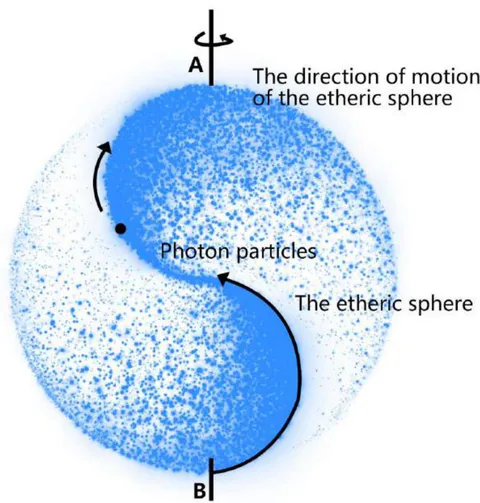
Figure 1: Is a model of a fundamental particle, the electron. B→A is the trajectory of a photon particle moving along the surface of another sphere, which is a closed S-shaped curve. The linear velocity of the photon particle moving on the surface of the ether sphere is . The ether sphere rotates around its axis of rotation. The radius of the electron is r, the wavelength of the electron is , the frequency of the electron is , and the rest mass of the electron is m.
5.3 Characteristics of the Ether Sphere
The author's previous research has pointed out that ether vortices from ether spheres through continuous self-rotation, creating a boundary between fundamental particles and the ether space and giving rise to the self-category of fundamental particles. The ether sphere of an electron coincides with the cosmic ether space. As we know, the cosmic ether space is a continuous whole, in which the dense ether space is formed by the superposition of ether negative energy. Therefore, the ether spheres that make up fundamental particles such as electrons are completely coincident with the cosmicether space in terms of extension. The ether sphere of an electron is formed by the capture of ether from the dense ether space by photons. The ether sphere of an electron coincides completely with the cosmic ether space, and the self-rotation of the ether sphere does not drive the rotation of the corresponding ether space.
5.
- Interaction between the Ether Sphere and the Electron
Within the proposed theoretical framework of the electron ether space, through qualitative analysis of the properties of the ethersphere and its interaction with the electron, we have established a correspondence between the properties of the electron and the characteristics of the medium. The ether sphere is described as a dynamic medium with specific physical properties. In such a medium environment, the physical properties of the electron are deeply associated with the characteristics of the ether sphere:
5.4.1 Basic Properties of the Ether Sphere
It serves as the physical background that carries electromagnetic phenomena and quantum effects; it has elastic restoring force and energy storage capacity; it exhibits isotropic macroscopic characteristics.
5.4.2 Structural Feature Level
There are microscopic-scale density fluctuations within the ether sphere itself; it has a dynamic structure formed through self-organization; it can support wave propagation and energy transfer.
5.4.3 Formation Mechanism of the Electron Structure
The continuous self-rotation of the ether sphere generates stable angular momentum; the periodic motion of the point photon forms standing wave mode; the synergistic action of the two maintains the stability of the electron's orbital motion.
5.4.4 Correspondence of Physical Properties
The self-rotation motion of the ether sphere corresponds to the spin property of the electron; the surface vibration mode explains the charge effect; the overall configuration determines the mass attribute.
This electron theory model provides a more intuitive physical picture and also offers a new perspective for understanding quantum phenomena.
5.5 Physical Explanation of the Wave-Particle Duality of Electrons
The wave-particle duality of electrons precisely stems from this complex motion mode. When observing electrons from the perspective of particles, what we see is a specific discrete state of the motion of point photons around the ether sphere, reflecting the particle nature of electrons. For example, in electron scattering experiments, electrons interact with target materials in the form of discrete particles and leave discrete signals on detectors. This can be understood as capturing the manifestation of electrons as "particles" under specific observation conditions.
5.5.1 Source of Wave Nature
Point photons move in an S-shaped closed loop around the ether sphere. This motion generates a series of fluctuations in the ether space. Just as water waves propagate on the surface of water, the motion of point photons within the ether-sphere of an electron drives local disturbances in the ether space, forming a periodically changing wave. The characteristics of this wave determine the wave nature of electrons. In interference and diffraction experiments, the phenomena of wave superposition and interference exhibited by electrons are precisely due to the interaction between the waves generated by the motion of point photons in the ether space within the electrons. The self-rotationofthe ether sphere further modulates the frequency and wavelength of these waves, making the wave nature of electrons closely related to the state of the ether space.
The particle nature and wave nature of electrons are not independent of each other but are unified in the same motion form in the ether space. When we attempt to measure the particle nature of electrons through experiments, the observation process affects the state of the etherspace, causing the motion of point photons within the electron-stoma tend to exhibit discrete particle characteristics. When we focus on the wave nature of electrons, the state of the ether space underexperimental conditions causes electrons to behave in a wavelike manner. This unified relationship is similar to the collapse of the wave function under different measurement conditions, except that here it is the interaction between the physical process and the etherspace that leads to the manifestation of different attributes of electrons.
VI. MECHANISM OF ELECTRON ELECTRIFICATION
Different combinations of the self-rotation direction of the ether-sphere within fundamental particles such as electrons, protons, and neutrons and the S-shaped closed-loop motion direction of photon particles lead to three situations: fundamental particles carrying positive charge, negative charge, or being electrically neutral. Usually, electrons carry negative charge, protons carry positive charge, and neutrons are electrically neutral. The formationofantiparticles such as positrons is due to the action of forces, which causes the self-rotation direction of the ether sphere within fundamental particles such as electrons and the S-shaped closed-loop motion direction of photon particles to change.
6.1 Electrification of Fundamental Particles
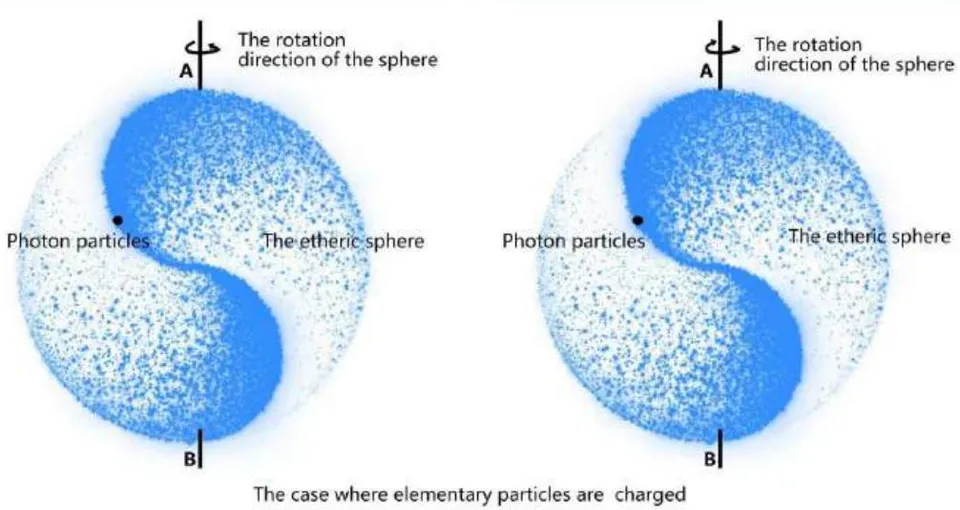
The self-rotation direction of the ether sphere is perpendicular to the S-shaped closed-loop motion direction of the photonparticle(there are two cases: right-hand rule and left-hand rule). The motion of the photon particle cuts through the self-rotation motion of the ether sphere, causing the fundamental particle to acquire a positive or negative charge (Figure 2). One fundamental particle carries one unit of elementary charge, with an electric charge of coulombs.
6.2 Electrically Neutral Fundamental Particles
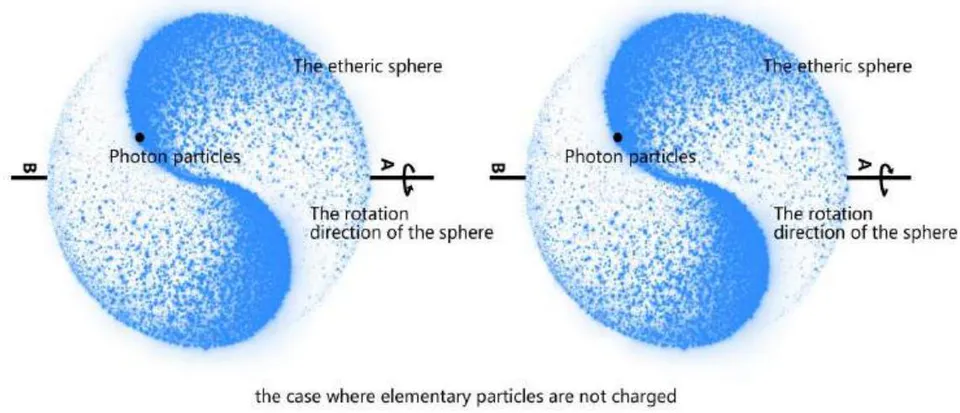
When the self-rotation direction of the ether sphere is parallel to the S-shaped closed-loop motion direction of the photonparticle(there are two cases: the directions are the same or opposite), the motion of the photon particle cannot cut through the self-rotation motion of the ether sphere, thus no charge is generated. Such fundamental particles are electrically neutral (Figure 3).
6.3 Distribution of Ether Density and Electric Charge Inside the Electronic Sphere
The electronic ether vortex sphere demarcates itself from the cosmic ether space through self - rotation. The equatorial velocity of a spherical shell at radius r from the sphere's center is c. Because the linear velocities of self - rotation at corresponding spherical positions from the ether spherical surface to the sphere's center decrease progressively, two cases emerge:
The ether density inside the electronic sphere distributes in gradients, peaking at the center and diminishing towards the spherical surface. The electric charge distribution mirrors the ether density, with the electronic charge concentrating at the ether sphere's center and radiating outward in a spherical pattern to the shell.
The ether spherical surface's rotation at the speed of light makes the electronic ether sphere's surface rigid. Particles with lower energy colliding with it exhibit standard geometric scattering.
Per the electron ether space model, an electron at rest has a radius of , but the minimum radius from the sphere's center is the Planck length . Thus, the internal ether gradient distribution of the electronic sphere can be regarded as arranged in this hierarchy. The position closest to the sphere's center has the highest ether density and the most concentrated charge. In contrast, the position nearest to the ether spherical surface has the lowest ether density and the least concentrated charge.
6.4 The Origin and Confinement Mechanism of Quarks in High Energy Particle Collisions
In 1967 the proton deep inelastic scattering experiment carried out by the collaboration between the Stanford Linear Accelerator Center (SLAC) and the Massachusetts Institute of Technology (MIT) revealed that there might be smaller particles - quarks - inside elementary particles. In this regard, the author of this paper holds the view that quarks may be the "needle-induced vortex effect" generated by high-energy particles incident into the ether spheres of elementary particles such as protons and neutrons. When high-energy particles with extremely short wavelengths are incident into elementary particles such as protons and neutrons, it is like a needle instantly penetrating the ether structural boundary of the target particle. Their energy is instantaneously focused at the subnuclear scale inside the ether sphere of the elementary particle, causing extreme curvature deformation of the ether medium in this region, and the streamline undergoes shear instability and breaks for recombination. Subsequently, the deformed region releases energy to form a high-density ether vortex (HDV), namely the quark. HDV has the characteristic of angular momentum quantization, and its circulation satisfies a specific formula, while the non-integer loop topological defects formed by its rupture are the origin of fractional charges. However, HDV will lose energy due to viscous dissipation and surface tension. When the vortex radius shrinks to the critical scale, it will be converted into hadronization radiation, and quarks seem to "dissipate" in it, which is the essence of quark confinement.
VII. VERIFICATION CALCULATION BASED ON THE ELECTRON ETHER SPACESTRUCTURE MODEL
According to the above electron model (Figure 1), assuming the rest mass of the electron is m and the radius of the electron is r, then the wavelength of the electron is 2πr, the frequency of the electron =hv. In this v is c / (2πr), and the energy of the electron Ee = mc paper, the modified Schwarzschild radius formula is Rs = GM/c .
This paper points out that the Planck mass (the specific formula is missing here). The derivation process is to combine the dimensional analysis of three basic constants (reduced Planck constant , speed of light c, and gravitational constant G) through mathematical methods. It lacks a profound physical mechanism explanation and does not clarify why the combination of these three specific constants has a mass meaning.
Based on the above premises, we attempt to verify relevant electron theoretical formulas based on the ether space structure model of electron wave-particle duality.
- Derivation of the Compton wavelength formula. Given the rest mass of an electron m, the radius of the electron, the particle energy of the electron, which is equal to the wave energy of the electron, that is,. Since the rest mass of the electron is the motion mass of the photon moving in an S-shaped path around the surface of the ether sphere of the electron, and the radius of the photon from the center of the ether sphere is r, then the angular momentum of the moving photon is always mcr, which is equal to the reduced Planck constant. Given that the frequency v of the electron is c /(2 π r), substituting it into the equation, we get; simplifying gives mcr = h/(2 π); adjusting further gives h/(mc) = 2πr. Since the wavelengthof a stationary electron is 2πr, the formula can be rewritten as.
In this formula, m is the rest mass of the electron, c is the speedoflight, h is the Planck constant, and is the wavelength of the stationary electron, which is completely consistent with the Compton wavelength formula. Therefore, it can be inferred that theCompton wavelength is the wavelength of a stationary electron.
- Derive the Planck mass formula. According to the above derivation, it can be known that the wavelength formula of a stationary electron is the Compton wavelength formula. Then, the radius formula of a stationary electron is the Compton wavelength divided by. After rearrangement, the radius formula of a stationary electron, i.e., the Compton radius formula, is. Given that the Compton wavelength formula is applicable to stationary fundamental particles, the Compton radius formula is also applicable to calculating the radii of stationary fundamental particles.
According to quantum theory, when the Compton wavelengths equal to the Schwarzschild radius, the derived mass is the Planckmass. However, based on the ether space model of fundamental particles such as electrons, these particles are not point-like but rather spinning ether spheres with rest mass and radius. Therefore, according to the Schwarzschild theory and formula, the corresponding quantum theory should be revised as follows: when the Compton radius of fundamental particles such as electrons is equal to the Schwarzschild radius , the derived mass is the Planck mass (the Schwarzschild radius formula here is the revised version in this paper). That is: . Since both and M on either side of the equation represent mass, they can be unified and represented by m. After rearranging and solving the equation for m, the result is: which is completely consistent with the Planck mass formula . Thus, the derived Planck mass formula has clear physical significance.
- Derive the formula for the minimum black hole mass of fundamental particles. According to the above derivation, the radius-formula of stationary fundamental particles such as electrons is . When the radius of a fundamental particle equals the Planck length , the corresponding minimum black hole mass is also the Planck mass. By squaring both sides of the equation and rearranging, we obtain: . Which is completely consistent with the Planck mass formula .
It can be seen that, based on the ether space structure model of the electron, not only the Compton wavelength formula can be derived, but also the Planck mass formula with clear physical significance.
- Refine the de Broglie Wavelength Formula. The de Broglie wavelength formula ( ) does not take into account the relativistic effects when particles move at high speeds. Consider an electron with a rest mass that moves at a constant velocity in space after being subjected to a force. The relativistic mass of the electron is m. Starting from the relativistic energy-momentum relation, the total energy E and momentum p of a moving particle in relativity satisfies: . Expanding this formula gives: Rearranging terms, we get: . By isolating terms, we obtain: . Taking the square root of both sides yields: .
The physical meaning of this formula is that the momentum of the moving particle p = mv is equal to the square root of the square of the intrinsic momentum (mc) of the moving mass minus the square of the intrinsic momentum ( ) of the rest mass . Therefore, the de Broglie wavelength formula can be refined to account for relativistic effects as: .
Based on the refined de Broglie wavelength formula, it can be seen that this wavelength corresponds to the momentum generated by the spatial displacement motion of the particle, rather than the wavelength corresponding to the intrinsic momentum of the particle at rest. Therefore, the velocity v of the particle must satisfy: o < v < c.
When v = 0: According to the equation , if v = 0 then and thus . In this case, the particle is at rest, has no motion wave length, and the de Broglie wavelength .
When v = c: Substituting v = c into . We get . In this case, the particle transforms into a photon, with zero rest mass and a moving mass m. Since photons are point particles without internal spatial structure, the wavelength associated with their motion is both the de Broglie wavelength and the photon's own wavelength, given by: . Because m is the moving mass of the photon and , substituting into the photon wavelength formula gives: .
VIII. FORMATION OF ATOMS BY FUNDAMENTAL PARTICLES SUCH AS ELECTRONS
From the formation of fundamental particles such as electrons, it is known that protons, neutrons, and electrons are all self-rotatingether spheres, with their photon particles moving in an S-shaped closed-loop motion along the surface of the ether sphere. Since ether can overlap and stack, it is hypothesized that atoms are structured as follows:
8.1 Structure of a Single-Electron Hydrogen Atom
For example, a hydrogen atom is formed by the mutual overlap of one proton's ether sphere and one electron's ether sphere. Due to the smaller mass of the electron, the volume of the electron's ether sphere is larger than that of the proton's ether sphere, and the density of the electron's ether sphere is lower than that of the proton's ether sphere. The radius of the S-shaped closed-loop motion of the photon particles of the electron is greater than that of the proton, equivalent to the electron undergoing S-shaped closed-circular motion around the proton. The overlap of the proton's and electron's ether spheres generates a strong force, stabilizing the structure of the hydrogen atom. Therefore, there is no need to worry about the electron falling onto the proton (Figure 4). Because density of the electron's ether sphere is lower, the binding force generated between the electron and the proton is weaker than the binding force between the proton and the neutron.
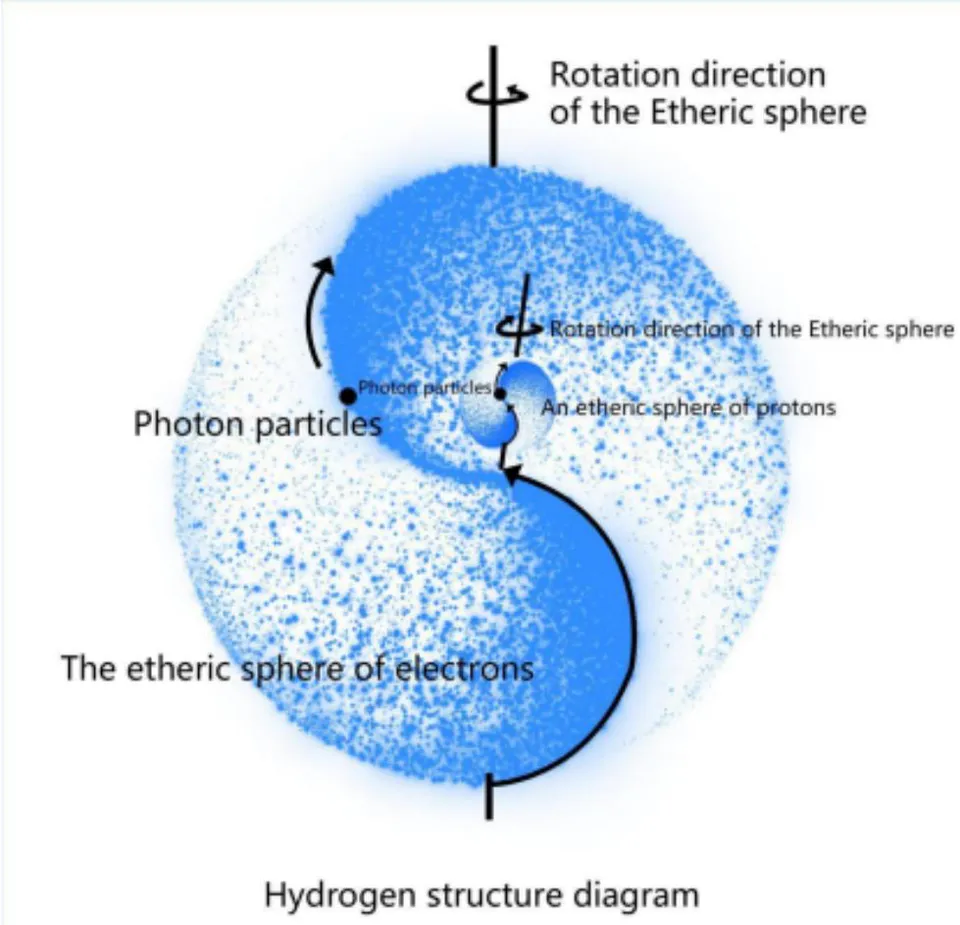
8.
- Atomic Structure with Multiple Electrons
Atoms consisting of multiple protons, neutrons, and electrons are also structured according to this principle (Figure 5). The ether spheres of protons and neutrons overlap with each other to form the atomic nucleus, while the ether spheres of multiple electrons overlap with the atomic nucleus to form the atom. Within the atom: Electron ether spheres with smaller mass (positive energy) have larger volumes, lower negative energy density, and their photon particles move in an S-shaped closed-loop motion on the surface of the ether sphere. Their orbital paths are farther from the atomic nucleus.
The closer the region is to the atomic nucleus, the greater the ether density; the farther the region is from the atomic nucleus, the smaller the ether density. Protons and neutrons, located at the center of the atom, form the atomic nucleus, where their photon particles move in an S-shaped closed-loop motion around the surface of their respective ether spheres. Similarly, the photon particles of multiple electrons also move in an S-shaped closed-loop motion around the surface of their respective ether spheres, forming distinct orbital paths.
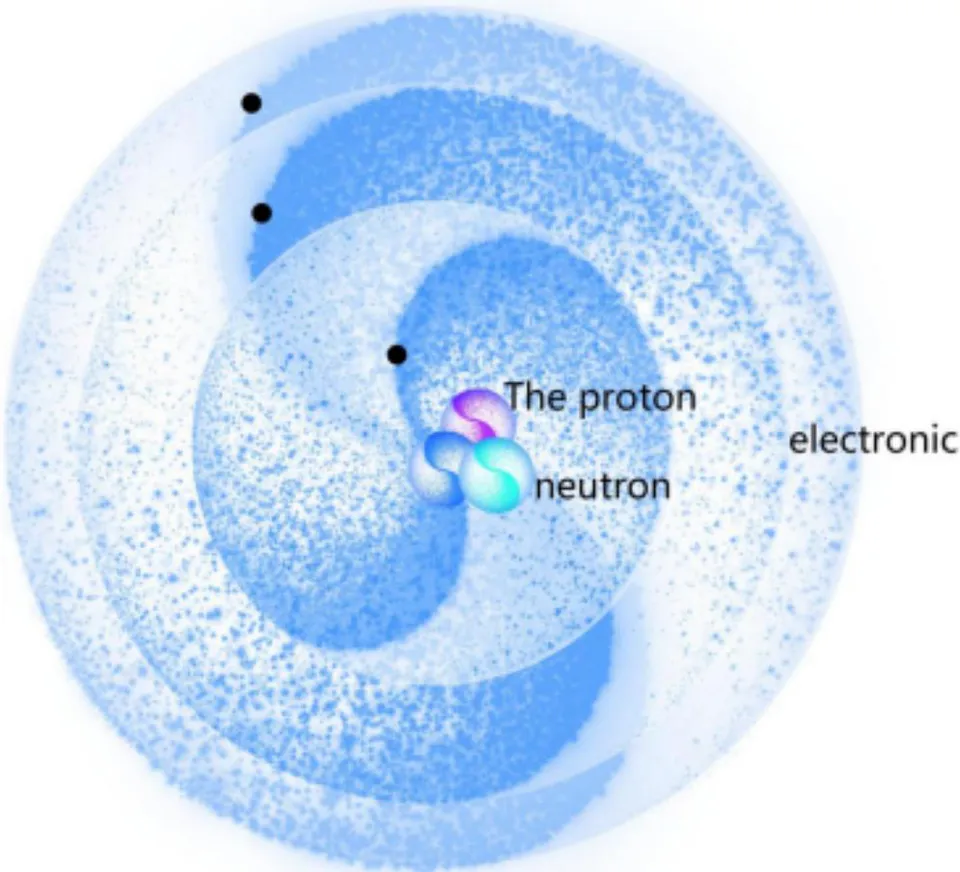
An atom composed of multiple protons, neutrons and electrons
VIII. Summary
The hypothesis of the ether space model for the wave-particle duality of electrons intuitively explains the wave-particle duality of electrons, clearly defines the mass, radius, frequency, wavelength, and other properties of electrons, as well as their interrelationships. Based on this, the Compton wavelength and radius formulas are derived; the Schwarzschild radius formula under photonescape conditions is corrected; the Planck mass formula and the minimum black hole mass formula for particles are derived from a physical perspective; and the de Broglie wavelength formula is re-calculated, revised, and refined.
It should be noted that this hypothesis is based on the author's thought experiments and lacks empirical scientific experiments for verification. It is hoped that this paper can provide a new perspective for relevant scholars and make a modest contribution to their exploration and innovation in the fundamental theories of physics.
Conflict of Interest
The authors declare no conflict of interest.
Ethical Approval
Not applicable
Data Availability
The datasets used in this study are openly available at [repository link] and the source code is available on GitHub at [GitHub link].
Funding
This work did not receive any external funding.
References
Cite this article
Related Research


Special Issue
Launch a focused special issue to highlight research, emerging trends, and expert insights in your academic field.