



IntelliPaper
Abstract
In this research an in vitro multiplication protocol for Cannabis sp. was developed for growing and obtention of new varieties. In stage 1 germination percentage of different landraces was evaluated in vitro and using peat. In stage 2 germinated achenes were subcultured in peat plus 6- benzyl amino purine (6-BAP), macro and micronutrients; and in stage 3 the process for in vitro multiplication of shoots was optimized. Landraces CRNTIO, M.B., and V.P., as well as culture medium GENNBIO were used. Treatments were evaluated using percentages, and quantitative characters were analysed among landraces through analysis of variance (ANOVA). The percentage of in vitro germination for M.B. = 32%, followed by CNRTIO = 16%, and using peat P.V. = 8%, and M.B. = 93.75%. In stage 2 the number of leaves (mean) was statistically different between P.V. = 14 and M.B. = 10.67; the explant length (cm), and the number of shoots were similar between P.V. and M.B. In stage 3 significant differences were obtained for number of shoots or leaves (mean ± S.E.) between P.V. = 1.70 ± 0.51 and M.B. = 0.00 ± 0.51, also for explant length (mm) between P.V. = 2.00 ± 0.57 and M.B. = 0.00 ± 0.57; and in CRNTIO2 was observed callogenesis response in presence of kinetin in the selected medium. The impact of this approach is the development of an efficient protocol for shoot multiplication, and regeneration of hemp plantlets to be genetically transformed, and conserved in germplasm banks for industrial uses in Cotopaxi-Ecuador.
Explore Digital Article Text
I. INTRODUCTION
In the industry of Cannabis spp. There are many hundreds of psychoactive and non-psychoactive varieties whose uses are mainly destined to the medicinal, cultural, and recreational field; the cannabis industry has high potential of growing due to the increase in number of countries focused in its medicinal use. The production of Cannabis in the world has increased since 2011 to 2017 to 406.1 tons (t), and it is expected that licit global market change from 7% in 2018 to 44% in 2025, moving 214 billion of dollars (166 licit and 48 illicit) (Ramírez, Naranjo and Torres 2018).
Among the advantages found to make cultivation of these species viable in countries close to the equator, it is mentioned an adequate legal framework, lower production costs (lighting, labor, inputs), good productive infrastructure, availability, and a favorable productive fabric (pharmacy and floriculture). It is important to promote Cannabis industry due to its potential for creation of job, and export (Ramírez, Naranjo and Torres 2018).
The Cannabis plant has existed for about 10000 years since the discovery of agriculture in the Old World; it is one of the oldest crops of man, it is a source of hemp fiber, oil, achenes (food seeds), narcotic properties used in medicine and pharmacology in the treatment of diseases, and accepted in many world religions (Schultes et al. 2000). Botanically, the Cannabis is part of the Cannabaceae family, which contains two genres, Cannabis and Humulus; and three species for the current crop, C. indica, C. sativa, and C. ruderalis, different by their form of growth, achenes, and mainly by their fiber (Schultes et al. 2000; Thomas 2012). In recent years, the active principle cannabidiol (CBD), an indirect antagonist of tetrahydrocannabinol (THC), has received more importance due to its pharmacological and non-addictive effects.
In Ecuador, given the event of legalization of Cannabis on September 17 in 2019, approved by the national assembly, there is a legal regulation for medicinal or therapeutic and industrial purposes. The content must be less than 1% THC and between 10-15% CBD. In addition, there are seven licenses: 1) Import and commercialization of seeds; 2) Sowing and production of seeds; 3) Cultivation of Cannabis; 4) Cultivation of hemp for industrial use; 5) Processing and production of derivatives; 6) Plant breeding and/or germplasm banks and research; 7) Acquisition of derivatives and/or biomass or Cannabis flower (Ministry of Agriculture and Livestock 2020; Changoluisa and Peñafiel 2021).
In this country there are approximately 7.3 million hectares for agricultural production (ESPAC 2019); approximate extension for permanent and transitory crops and cultivated pastures is 4872049.88 ha, 19% of the national territory (INEC 2016; Morales and Andrade 2023). Therefore, 10000 ha of hemp cultivation would not affect another productive sector, consolidating the power of cutting-edge technologies such as in vitro micropropagation of hemp. In Ecuador about 700 companies are associated with hemp and the use of its derivatives in various products (Salgado 2020); being an industrial crop, an efficient regeneration protocol is necessary for genetic transformation, micropropagation and germplasm conservation (Cheng et al. 2016). Therefore, it is described an in vitro shoot multiplication method using achenes as initial explant.
II. MATERIALS AND METHODS
The achenes of Cannabis sp., landraces CRNTIO, M.B. and P.V., were acquired by the company GENNBIO (Breeding_Genetics_Biotechnology) through REDES DE LIBERTAD. The experimental work covered the following stages: introduction and germination (Stage 1), germinated achenes (Stage 2), and in vitro shoot multiplication (Stage 3). In Stage 1, GENNBIO culture medium (Morales and Andrade 2023; Morales and Chiluisa-Utreras 2022) was used, with 2.5% (p/v) sucrose and 0.05% (p/v) activated charcoal, pH adjusted to 5.8 and previously autoclaved at 121 °C for 20 minutes; in Stage 2 peat was used plus the addition of 6-benzyl amino purine (6-BAP) (Galán-Ávila et al. 2020; Villezcas 2020), macro and micronutrients; and in Stage 3, in vitro shoot multiplication process was optimized by adding kinetin (KIN) to the treatments (Wang et al. 2009). In all stages, cultures remained in growth chamber at temperature of °C, and photoperiod of 16 hours of light and 8 hours of darkness.
2.1 Introduction and germination (Stage 1)
A disinfection treatment was applied prior to in vitro introduction by soaking the achenes in running water for 20 minutes (Chaohua et al. 2016), and superficially sterilizing with alcohol 75% (v/v) for 2 minutes and 30 seconds, followed by immersion in sodium hypochlorite (NaClO) 3% (v/v) with a surfactant agent for 25 minutes (Galán-Ávila et al. 2020), and several washes with sterile distilled water after each disinfectant agent. The disinfection treatment combined investigations with achenes as initial explant. The variables were germination percentage, and contamination.
2.2 Germinated achenes (Stage 2)
Germinated achenes CRNTIO (in vitro), M.B. (in vitro), and P.V. (peat), were subcultured in previously autoclaved peat, containing 2.0 mg·L of 6-BAP (Galán-Ávila et al. 2020; Villezcas 2020), macro and micronutrients in sealed plastic vessels to avoid explant dehydration. The variables were number of leaves, explant length (cm), and number of nodes.
2.3 In vitro shoot multiplication (Stage 3)
Nodal segments of germinated achenes were subcultured in GENNBIO medium with different concentrations of plant growth regulators (Table 2). The data were arranged in 2 x 2 factorial design, two varieties, two hormonal treatments, and n replicates; and through analysis of variance (ANOVA) means were compared using Tukey's test. Additionally, exploratory cultures were carried out with explants from a mother plant. The variables were number of shoots or leaves, and explant length (mm). Statistical packages InfoStat 2016, and Minitab 16 were used.
Table 2: Growth regulators applied to nodal segments of germinated achenes
| Explant | Growth regulators | References |
| Stage 2 explant (M.B. and P.V.) | 0.25 mg·L-1AIA and 1.0 mg·L-1BAP | (Galán-Ávila et al. 2020; Villezcas 2020) |
| Stage 2 explant (M.B. and P.V.) | 2.0 mg·L-1KIN | (Wang et al. 2009) |
| Mother plant (CRNTIO) | 0.25 mg·L-1AIA and 1.0 mg·L-1BAP; 2.0 mg·L-1KIN | (Galán-Ávila et al. 2020; Villezcas 2020; Wang et al. 2009) |
III. RESULTS AND DISCUSSION
The material consisted of achenes product of mass selection process, adapted to the equatorial line. The method was developed for cultivars of Cannabis sativa L.; landraces are heterozygous populations due to cross-pollination; and represent an important gene pool in plant breeding programs.
3.1 Introduction and germination (Stage 1)
In this research, an achene is considered germinated (Figure 1), when the radicle exceeds 1 mm in length outside its cover (Prohens, Soler and Nuez 1999). The use of antibiotics is recommended after disinfection with alcohol or chlorine (Smith 2000), to avoid contamination once the achenes have germinated.
3.1.1 Percentage of germination
The highest percentage of in vitro germination (n = 50) was obtained with M.B. = 32%, followed by CNRTIO = 16%, and in peat with P.V. = 8%. Previous studies with Cannabis mention an in vitro germination percentage (5%) similar to that obtained with P.V., however, the concentration of agar-agar and landraces are key factors to increase these percentages and reduce germination time and emergence of cotyledons (< 7 days), due to the fact that by traditional methods germination and emergence of cotyledons occurs after the fourth day with imported varieties of hemp (Simbaña 2005). Previously, higher germination percentage was obtained in peat (n = 16) with M.B. = 93.75% (Figure 2). By using these methods, in vitro and in peat, controlled nutritive microenvironments are generated (Ioannidis, Tomprou, and Mitsis 2022), space is reduced, and times are optimized.
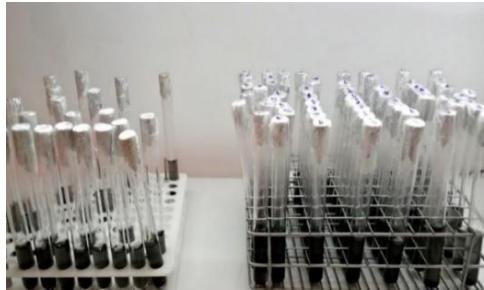
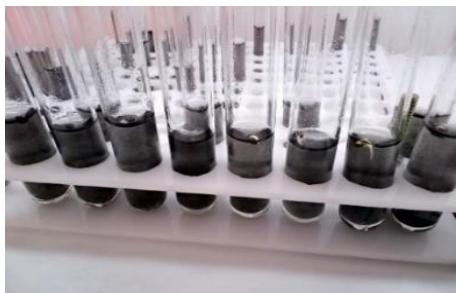 Figure 1: Introduction and in vitro germination of achenes. Source: GENNBIO.
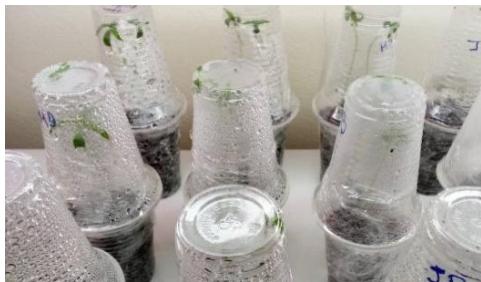 Figure 2: Introduction and germination in peat and in vitro physiology of achenes. Source: GENNBIO.
3.2 Germinated achenes (Stage 2)
As the explants developed, those called off type were discarded.
3.2.1 Number of leaves
The number of leaves (mean) was higher in P.V. = 14 (n = 2) compared to M.B. = 10.67 (n = 3); assuming that the variances are the same, and applying T test for independent samples, these means are significantly different, with p-value = 0.0099.
3.2.2 Length of explant
While, the explant length (mean) did not present significant differences between P.V. = 11.7 cm and M.B. = 9.0 cm, with p-value = 0.3067.
3.2.3 Number of nodes
On the other hand, the number of nodes was statistically similar between P.V. = 6.5 and M.B. = 5.0, with p-value = 0.2048 (Figure 3).
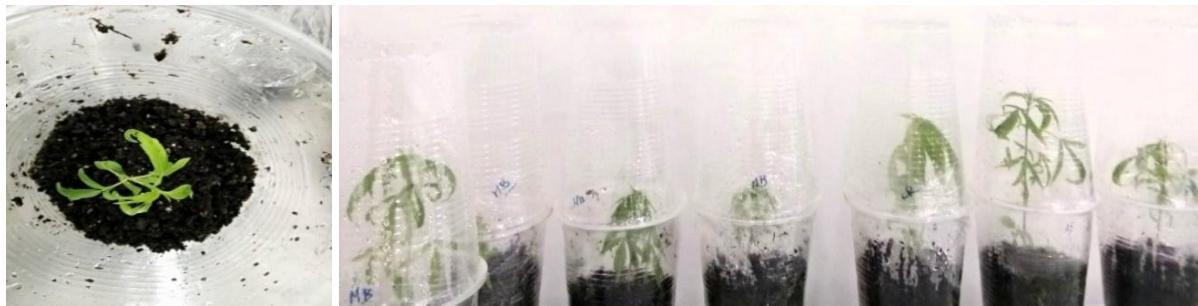 Figure 3: Germinated and subcultured achenes in peat inside growth capsule. Source: GENNBIO.
3.3 In vitro multiplication of shoots (Stage 3)
In vitro shoot multiplication in Cannabis sp. was executed by adding antibiotic solutions to the protocol, mainly fungicides and bactericides in standardized concentrations during the process.
3.3.1 Number of shoots or leaves
In a completely randomized design (DCA), the landraceregulator interaction did not present significant differences, since p-value = 0.2213; therefore, the analysis was continued with the main effects landrace and regulator, sending the landraceregulator effect to the error; thus, the number of shoots or leaves (mean ± S.E.) was statistically different between P.V. = 1.70 ± 0.51 and M.B. = 0.00 ± 0.51, with p-value = 0.0304 (Table 3; Figure 4). In previous studies with Cannabis variety Changtu, it is mentioned the obtention of 1.83, 2.00, and 1.74 auxiliary shoots using KT in proliferation stage, fourteen days after subculture (Wang 2009), similar to the number of shoots or leaves obtained in this research with P.V. using young explants, since they response better to in vitro conditions compared to differentiated tissues, due to the high rate of mitosis (Zwenger 2014).
Table 3: Number of shoots or leaves in landraces of Cannabis at multiplication stage.
| Landrace | Mean ± S.E. | n | Group |
| P.V. | 1.70 ± 0.51 | 10 | B |
| M.B. | 0.00 ± 0.51 | 10 | A |
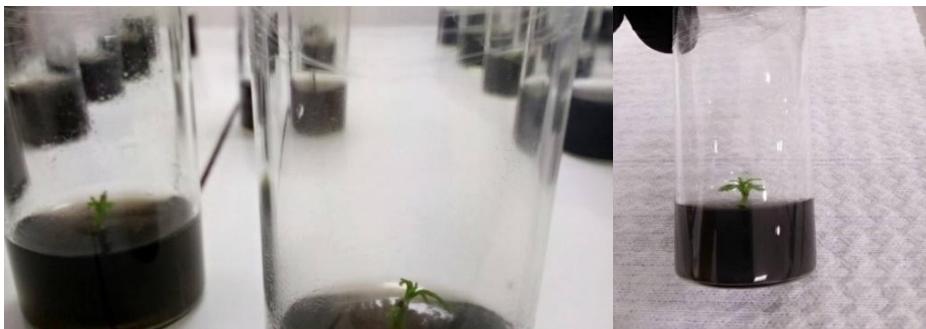 Figure 4: Multiplication of shoots using nodal segments of germinated achenes. Source: GENNBIO.
3.3.2 Explant length
In a completely randomized design (CRD), the landrace*regulator interaction did not present significant differences, since p-value = 0.2213; however, applying Tukey's test, different groups were observed, being the experimental point P.V.: Cit = 3.20 mm ± 0.77 the largest explant (Figure 5), which means that the best result was obtained with application of KIN in P.V.
{"image_source":{"path":"images/ad01754d9552e7f2c646b769b3f60bb2e4098b207a99bc8f60234f3365efc973.jpg"},"content":"","chart_caption":[{"type":"text","content":"Figure 5: Explant length (mm) in Cannabis landraces with different growth regulators. Distinct letters form groups with differences in their means according to Tukey's test."}],"chart_footnote":[]}
The analysis was continued with the main effects landrace and regulator, sending the landrace*regulator effect to the error; thus, explant length (mean ± S.E.) was statistically different between P.V. = 2.00 mm ± 0.57 and M.B. = 0.00 mm ± 0.57, with p-value = 0.0234 (Table 4; Figure 6). Normality of errors was checked using Ryan-Joiner's test (similar to Shapiro-Wilk), with p-value = 0.061.
Table 4: Explant length (mm) in landraces of Cannabis at multiplication stage.
| Landrace | Mean ± S.E. | N | Group |
| P.V. | 2.00 ± 0.57 | 10 | B |
| M.B. | 0.00 ± 0.57 | 10 | A |
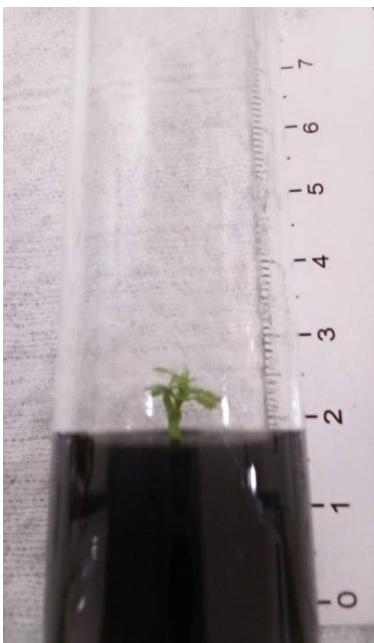 Figure 6: Explant length (mm) in P.V. landrace at multiplication stage in presence of kinetin. Source: GENNBIO.
IV. CONCLUSIONS
In stage 1, the cannabis landrace with the highest in vitro germination and using peat was M.B. = 32% and 93.75%, respectively; followed by in vitro germination in CNRTIO = 16%, and P.V = 8%.
In stage 2, the number of leaves (mean) was statistically different between P.V. = 14 and M.B. = 10.67. The explant length (cm) and the number of nodes were similar between P.V. and M.B.; however, the latter are essential for shoot multiplication process at industrial scale.
In stage 3, it was significantly demonstrated the highest number of shoots or leaves (mean ± S.E.) in P.V. = 1.70 ± 0.51, also the largest explant length in P.V. = 2.00 mm ± 0.57 in presence of cytokinin fourteen days after subculture, respectively. Finally, in CRNTIO2 was observed callogenesis response in presence of kinetin in the selected culture medium.
The impact of this project is the development of an efficient protocol for shoot multiplication, and regeneration of hemp plantlets to be genetically transformed, and conserved in germplasm banks for industrial uses in Cotopaxi-Ecuador.
ACKNOWLEDGMENTS
To London Journals Press (LJP).
Conflicts of interest: the authors declare no conflict of interest.
Conflict of Interest
The authors declare no conflict of interest.
Ethical Approval
Not applicable
Data Availability
The datasets used in this study are openly available at [repository link] and the source code is available on GitHub at [GitHub link].
Funding
This work did not receive any external funding.
References
Cite this article
Related Research


Special Issue
Launch a focused special issue to highlight research, emerging trends, and expert insights in your academic field.
